
From Desert Capital to Global Command Centre
For decades, the question of where to base a regional headquarters in the Middle East had a straightforward answer: Dubai. The emirate offered tax-free salaries, world-class infrastructure, and a lifestyle that attracted global talent with minimal friction. That calculus has fundamentally shifted. In 2026, Riyadh is no longer merely competing with Dubai for corporate attention — it is systematically rewriting the rules of where and how business gets done in the region.
The transformation is not speculative. More than 660 multinational companies have secured Regional Headquarters (RHQ) licences in Saudi Arabia as of late 2025, surpassing the original Vision 2030 target of 480 well ahead of schedule. Morgan Stanley, Bechtel, PepsiCo, PwC, Deloitte, and IHG have all anchored operations in the Saudi capital. The city’s population — currently around 8 million — is projected to reach 9.6 million by the end of the decade, driven by a corporate migration that is reshaping Riyadh’s skyline, economy, and global standing.
For business owners, investors, and professionals evaluating their next move, the data points overwhelmingly toward Riyadh. This guide examines why, and what you need to know before making the leap.
The HQ Relocation Mandate: How Saudi Arabia Changed the Game
In February 2021, Saudi Arabia announced a policy that sent shockwaves through boardrooms across the Gulf: any multinational company seeking Saudi government contracts must establish its regional headquarters in the Kingdom by January 2024. The deadline has now passed, and the policy is being actively enforced.
The implications are significant. Saudi Arabia’s government spending — channelled through entities like the Public Investment Fund (PIF), Saudi Aramco, and dozens of Vision 2030 giga-projects — represents one of the largest pools of procurement spending in the world. Companies that fail to comply are effectively locked out of contracts worth billions of riyals annually.
The 2026 requirements have tightened further. Each RHQ must maintain a minimum of 15 senior-level employees permanently based in Saudi Arabia. A Saudisation rate of 25 per cent applies even to RHQ operations, meaning for every three expatriate hires, companies must employ one Saudi national. These are not token requirements — they are designed to ensure substantive economic presence rather than brass-plate offices.
The result has been a genuine corporate migration. Ten to twelve new RHQ licences are being issued monthly, and the pace shows no sign of slowing. For companies operating anywhere in the Middle East and North Africa region, Riyadh is now the default location for strategic decision-making.
KAFD: The Financial District That Defines Modern Riyadh
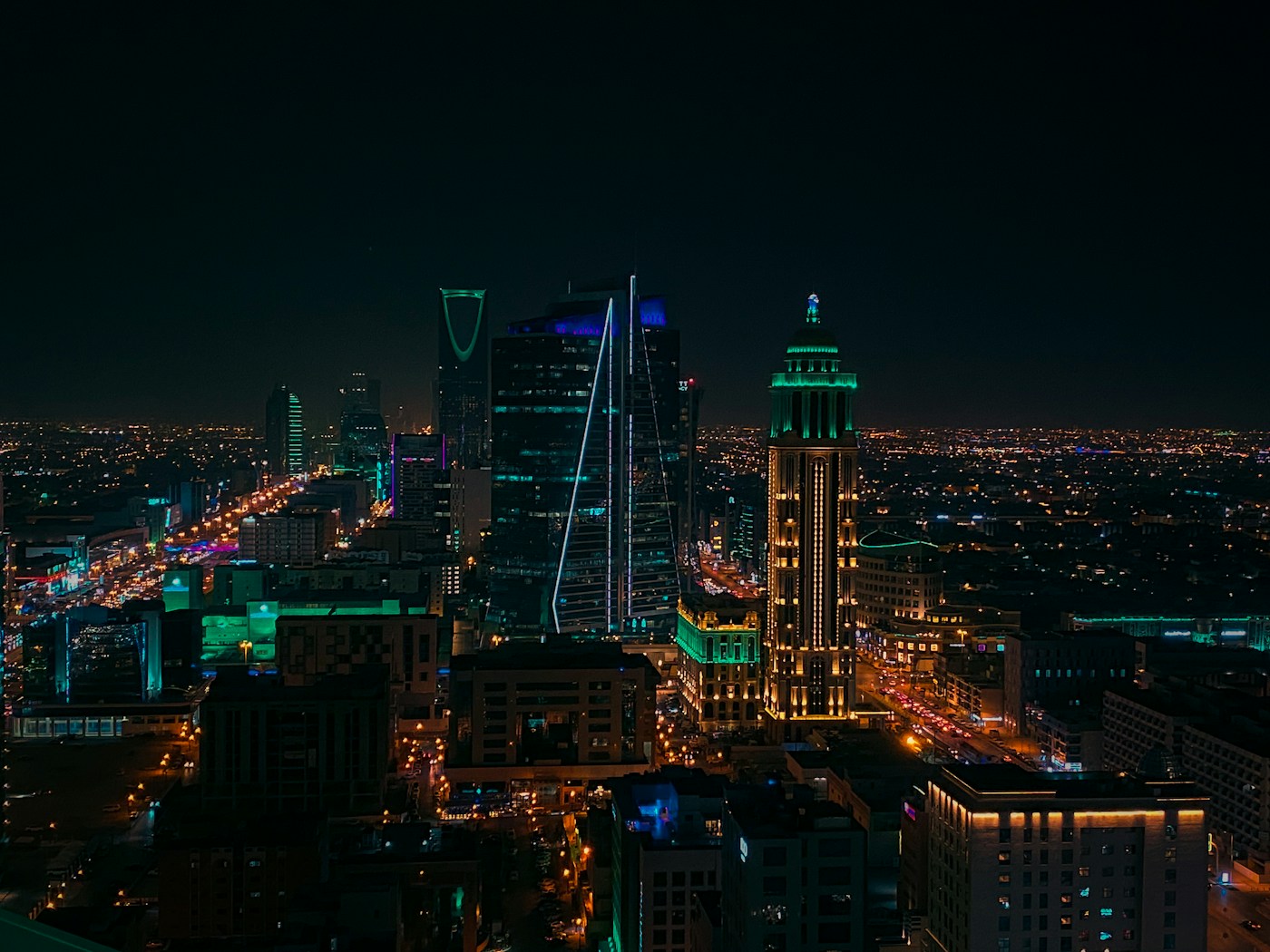
The King Abdullah Financial District (KAFD) is the physical embodiment of Riyadh’s corporate ambitions. Comprising 95 buildings across 1.6 million square metres — including office towers, residential blocks, hotels, and entertainment facilities — KAFD has evolved from a long-delayed construction project into the most prestigious business address in the Gulf.
As of 2026, the district hosts more than 140 commercial tenants and over 75 multinational regional headquarters. Some 580,000 square metres of office space has been leased, and around 20,000 professionals work within its boundaries daily. The PIF tower anchors the skyline, and the district’s pedestrian skyway network — awarded a Guinness World Record as the world’s longest continuous automated walkway — connects buildings without stepping outdoors into the summer heat.
KAFD Phase 3 is now underway, backed by a $2.6 billion investment to expand office capacity, add retail space, and establish a dedicated fintech innovation centre. W Riyadh – KAFD, a luxury hotel, is scheduled to open in 2026, further blurring the line between business and lifestyle in the district.
For companies seeking Grade A office space, KAFD is the benchmark — but it comes at a premium. Grade A rents in Riyadh rose 15.1 per cent year-on-year in Q3 2025, reaching SAR 2,750 ($733) per square metre, with occupancy rates averaging 98 per cent. A five-year rent freeze policy was introduced after an 86 per cent increase in Grade A rents since 2019, aimed at stabilising the market for incoming tenants.
Beyond KAFD: Riyadh’s Business Districts
While KAFD commands the headlines, Riyadh’s business geography is far more diverse than a single district. Understanding the city’s commercial landscape is essential for companies choosing where to locate.
Al Olaya District
The traditional heart of Riyadh’s commercial life, Al Olaya runs along King Fahd Road and remains home to major banks, consulting firms, and corporate offices. Rents are lower than KAFD, and the district offers excellent connectivity and a dense concentration of restaurants, hotels, and services. For mid-sized companies that need a central location without KAFD’s price tag, Olaya remains the pragmatic choice.
The Diplomatic Quarter (DQ)
Originally built to house foreign embassies, the DQ has evolved into one of Riyadh’s most attractive mixed-use neighbourhoods. Covering 800 hectares with 30 per cent dedicated to parks and green space, it offers a quieter, more residential character than the central business districts. Coworking operators like Spaces and Regus have established outposts here, and the proximity of King Salman Park — a 16-square-kilometre green development — is enhancing the area’s appeal further.
Diriyah Gate
The $63 billion Diriyah giga-project, situated northwest of central Riyadh, is creating something entirely new: a heritage-inspired commercial and cultural district spanning 3,450 acres. Diriyah Square, the project’s commercial heart, will host over 450 global retail brands alongside 100 local artisan souks. While primarily positioned as a cultural and luxury destination, Diriyah is increasingly attracting hospitality, creative, and technology firms seeking a distinctive address. Phase one delivery is progressing, and early tenants are establishing operations.
The $27 Billion Office Boom
The supply-demand imbalance in Riyadh’s office market has triggered the largest commercial construction programme in the city’s history. Nearly 100 new commercial towers are under construction at a combined cost exceeding SAR 100 billion ($27 billion). By the end of 2026, these developments are expected to add approximately one million square metres of office space, bringing Riyadh’s total to 6.3 million square metres.
The Prime Business Resort alone will deliver 60 prime office buildings in a single phase in Q3 2026. For companies that have delayed their Riyadh entry due to space constraints, the supply pipeline suggests that the market is approaching an inflection point where premium options will become more accessible.
This expansion is not limited to offices. Some 6,700 hotel rooms are under construction across the city, addressing the accommodation shortage that has constrained business travel and long-stay relocations.
The Riyadh Metro: Infrastructure That Changes Everything
The Riyadh Metro — inaugurated by King Salman in November 2024 — is the single largest urban transit infrastructure project completed anywhere in the world in recent years. Six fully automated, driverless lines span 176 kilometres and serve 85 stations, connecting every major business district, residential area, and transport hub in the city.
The system has been recognised by Guinness World Records as the longest fully automated driverless metro network globally. By October 2025, it had carried 120 million passengers with an on-time performance rate of 99.8 per cent. A seventh line, connecting the Diriyah Gate project to Qiddiya in southwest Riyadh, is planned for first-phase implementation in 2026.
For businesses, the metro transforms the talent equation. Employees no longer need to own a car or endure Riyadh’s notoriously congested roads. Office locations near metro stations — particularly in KAFD, Olaya, and the DQ — command a premium precisely because they offer this connectivity. The metro also makes Riyadh more attractive to the younger Saudi workforce that the government is keen to integrate into the private sector.
Riyadh vs Dubai: The Cost Equation
The most common comparison for any business contemplating a Middle East presence is Riyadh versus Dubai. While Dubai retains advantages in certain areas — particularly its established free zone ecosystem and more liberal social environment — the cost equation increasingly favours Riyadh.
Overall, Riyadh is approximately 23 to 30 per cent cheaper than Dubai for comparable living standards. The most dramatic difference is in housing: a one-bedroom apartment averages around SAR 3,500 per month in Riyadh compared to AED 8,675 in Dubai. For a three-bedroom family apartment, the gap widens further — roughly SAR 7,500 in Riyadh versus AED 17,279 in Dubai.
Restaurant costs in Riyadh run about 38 per cent lower than Dubai equivalents. Transport is cheaper too, with petrol at roughly SAR 2.23 per litre versus AED 2.74 in Dubai. Both cities offer zero income tax, so the savings flow directly to the bottom line.
For a single professional, a comfortable lifestyle in Riyadh requires approximately SAR 22,000 to 28,000 per month. Couples without children typically need SAR 28,000 to 35,000, while families paying compound housing and international school fees should budget SAR 45,000 to 60,000 monthly.
The gap in commercial real estate costs, while narrowing, still favours Riyadh for companies not competing for the very top tier of KAFD space. For businesses that need to hire teams of 20 or more, the cumulative savings on housing allowances, schooling support, and operational costs can be substantial.
The Coworking and Flexible Office Boom
For companies not ready to commit to long-term leases, Riyadh’s coworking sector has expanded rapidly. Operators including The Executive Centre, Regus, Spaces, Cloud Spaces, and AstroLabs offer options ranging from hot desks at SAR 600 per month to private offices exceeding SAR 3,000 monthly. Day passes typically start at SAR 100 to 400.
The most active coworking hubs cluster around KAFD, Olaya, and the Diplomatic Quarter — all now served by the metro. Cloud Spaces recently opened a design-led facility at Roshn Front in north Riyadh, reflecting the sector’s expansion beyond traditional business districts.
Saudi Arabia’s 5G infrastructure is among the fastest in the world, outperforming Wi-Fi speeds in many European capitals. For remote workers, freelancers, and distributed teams, this connectivity removes one of the historical barriers to operating from Riyadh.
The FII Conference and Riyadh Season: Where Business Meets Networking
Two annual events have cemented Riyadh’s reputation as a global business convening point. The Future Investment Initiative (FII) — often called “Davos in the Desert” — held its ninth edition in October 2025, drawing more than 20 heads of state for the first time. Since inception, deals worth over $250 billion have been concluded through the FII platform, with 2025 alone expected to exceed the $70 billion signed in 2024.
FII is structured for serious deal-making: Day 0 hosts invitation-only conclaves for investors, CEOs, and policymakers; Days 1 and 2 feature global dialogues on macroeconomic and sectoral themes; and Day 3 — Investment Day — is explicitly designed for closing transactions. For any company seeking Saudi or Gulf-based investment, attendance is effectively mandatory.
Riyadh Season, the city’s annual entertainment mega-festival running from October through early the following year, serves a different but complementary function. While primarily a cultural and entertainment programme — featuring 11 zones, 15 world championships, 34 exhibitions, and headline acts from global artists — it has become a de facto networking season for the business community. The Joy Forum brings entertainment executives together, while the sheer density of international visitors creates opportunities for relationship-building that extend well beyond formal conference settings.
Living and Working in Riyadh: The Expat Reality
Riyadh in 2026 is a markedly different city from even five years ago. The lifting of entertainment restrictions, the opening of cinemas and concert venues, the expansion of women’s workforce participation, and the arrival of international restaurants, cafes, and cultural institutions have transformed daily life for expatriate professionals.
That said, Riyadh remains distinctly Saudi. Alcohol is not available. The summer heat — regularly exceeding 45°C from June to September — is a genuine lifestyle factor. The social and cultural environment, while rapidly liberalising, operates within a framework that differs from Dubai or Bahrain. For professionals with families, the availability of international schools has improved but remains a planning consideration, particularly at short notice.
The job market for foreign professionals is robust, driven by the RHQ programme, giga-project staffing needs, and the broader economic diversification effort. Sectors with the strongest demand include finance, consulting, engineering, technology, project management, and legal services. Saudi Arabia’s Premium Residency programme offers a pathway to long-term status for high-value professionals, though most expatriates continue to operate on employer-sponsored work visas.
What Comes Next
Riyadh’s trajectory is underpinned by spending commitments that dwarf anything elsewhere in the region. The PIF alone manages assets exceeding $900 billion and is the anchor investor in projects from NEOM to the Red Sea coast to Qiddiya. The city’s selection as a World Expo 2030 host further validates its positioning as a global destination for business, tourism, and investment.
The risks are real but manageable. Office oversupply could moderate rents once the current construction wave completes. Regional geopolitical tensions — including the security considerations that any Riyadh-based business must evaluate — remain a factor. And the pace of social reform, while impressive, is subject to the political dynamics of the Kingdom.
But for businesses weighing their Middle East strategy in 2026, the question is no longer whether Riyadh deserves consideration. It is whether you can afford not to be there.