
TEHRAN — Iran’s Supreme National Security Council accepted a two-week ceasefire on April 7, crediting the “guidance” of Supreme Leader Mojtaba Khamenei, while simultaneously declaring in the same document that “this does not mean the end of the war” — a formulation that functions less as contradiction than as architecture, designed to allow compliance and resumption through a single legal instrument.
The halt order, broadcast on state television as a written text roughly two hours after President Trump’s announcement, contained no filmed appearance, no audio recording, and no fatwa. “This is not the end of the war,” the text attributed to Khamenei read, “but all military units must obey orders and uphold the ceasefire.” Within hours, UAE air defenses activated, Kuwait intercepted 28 drones targeting oil installations and power stations, and Bahrain reported dozens of additional intercepts. The ceasefire’s first test was already failing before its first full day.
Table of Contents
- A Written Order From a Leader Who Has Not Appeared
- What Does the SNSC Statement Actually Say?
- The Constitutional Gap: Who Confirms the Ceasefire?
- Can 31 Provincial Corps Receive a Halt Order?
- The 1988 Precedent and Why It Does Not Apply
- The First 24 Hours on the Battlefield
- Islamabad April 10: Negotiations as Continuation of War
A Written Order From a Leader Who Has Not Appeared
Mojtaba Khamenei has made no public appearance — no video, no audio, no photograph — since assuming the supreme leadership on February 28, 2026. That is 39 days as of April 8. A diplomatic memo reported by The Times of London on April 7, described as based on American and Israeli intelligence and shared with Gulf allies, stated that he is “incapacitated and receiving medical treatment in Qom” and “unable to be involved in any decision making by the regime.”
Iran has acknowledged that Mojtaba Khamenei was injured in the same February 28 airstrike that killed his father, Ali Khamenei, along with his mother, his wife Zahra Haddad-Adel, and one of his sons. The Times of Israel reported him in “severe condition.” Newsweek described intelligence assessments placing him as “unconscious.”
His first written statement, issued weeks earlier, contained spelling, grammatical, and structural errors. The Media Line reported a Tehran source describing it as “dictated by the IRGC,” identifying three likely authors: Mohammad Mirbaqiri, a cleric in the leader’s office; Ahmad Vahidi, the IRGC commander; and Ali Abdollahi, commander of the Khatam al-Anbiya Central Headquarters.
The April 7 ceasefire order followed the same pattern. Written text, read aloud on IRIB, addressed to “all military branches” including the IRGC. No live delivery. The SNSC statement referenced Khamenei’s “prudent measures” and “guidance” — third-person language, not the voice of a man issuing a direct command. In 1988, when Ayatollah Ruhollah Khomeini accepted the UN ceasefire ending the Iran-Iraq War, he appeared personally, spoke in his own voice, and described the decision as “more deadly than drinking from a poisoned chalice.” The current order carries no such personal weight.
The Middle East briefing 3,000+ readers start their day with.
One email. Every weekday morning. Free.
What Does the SNSC Statement Actually Say?
The full text of the SNSC statement, published by the Middle East Eye via the West Asia News Agency, repays close reading. It operates on two registers simultaneously.
The first register is triumphalist. “Good news to the dear nation of Iran! Nearly all the objectives of the war have been achieved,” the statement opens, as reported by NBC News. PressTV described the moment as a “historic victory,” claiming Iran had “forced criminal America to accept its 10-point plan” — including permanent ceasefire, complete sanctions removal, and withdrawal of US combat forces from the region.
The second register is operational. “It is emphasized that this does not mean the end of the war,” the same document reads. “If the enemy’s surrender on the battlefield is transformed into a decisive political achievement… otherwise, we will fight side-by-side on the battlefield until all the demands of the Iranian nation are met.” The statement adds: “Our hands are on the trigger, and the moment the slightest error is committed by the enemy, it will be responded to with full power.”
The 10-point plan attached to the SNSC statement includes demands that would require years of negotiation under any circumstances: Iranian sovereignty over the Strait of Hormuz, nuclear enrichment rights retained, a binding UN Security Council resolution, and reparations. The statement specifies that “Iran will only accept the termination of the war once the details are finalized.” Since the details cannot be finalized in two weeks — or likely two years — the war, by the SNSC’s own terms, does not end.
One line in the statement captures the operating logic: “The current negotiations are national negotiations and a continuation of the battlefield.” This is not an accidental phrase. It echoes Ali Khamenei’s “heroic flexibility” doctrine, which justified nuclear negotiations under Obama as a tactical pause rather than a strategic concession. The framework permits temporary de-escalation while preserving every precondition for resumption.
The Constitutional Gap: Who Confirms the Ceasefire?
Iran’s constitution creates a problem the SNSC statement does not acknowledge. Article 176 establishes the council’s role in formulating national security policy. But the same article, and Article 110, require that all SNSC decisions become effective only after confirmation by the Supreme Leader. This is not a formality. It is the legal mechanism through which Iran’s war-and-peace decisions acquire binding force.
If Mojtaba Khamenei is incapacitated — as American, Israeli, and Gulf intelligence services assess — then the ceasefire has not been constitutionally confirmed under Iran’s own legal framework. The SNSC can declare it. The IRGC can choose to observe it. But no civilian institution can compel compliance, because the only authority capable of compelling the IRGC — the Supreme Leader — is, by multiple intelligence assessments, unable to function.
The man now running the SNSC is Mohammad Bagher Zolghadr, appointed secretary on March 24 after the assassination of Ali Larijani on March 16. Zolghadr is a former IRGC deputy commander-in-chief. He is sanctioned by the United States, the European Union, the United Kingdom, and Canada. The UN Security Council sanctioned him in 2007 under Resolution 1747 for involvement in “proliferation sensitive nuclear activities.” Canada added sanctions in 2022 for his role in the crackdown on the “Woman, Life, Freedom” protests.
He is, by law, legally inaccessible to Western intermediaries negotiating compliance verification. The constitutional gap means the ceasefire rests on the IRGC’s willingness to observe it — not on any legal obligation to do so. Zolghadr and Ahmad Vahidi, at the SNSC and IRGC command respectively, can comply or not comply. The question is not whether the order was issued. The question is whether anyone with constitutional authority issued it.
Can 31 Provincial Corps Receive a Halt Order?
Even if the constitutional question were resolved, a mechanical one remains. The IRGC does not operate as a single army receiving a single order.
Iran’s mosaic defense doctrine — defā’-e mozā’iki — was formally restructured in September 2008 into 31 autonomous provincial corps, each with independent headquarters, communication systems, weapons supplies, intelligence resources, and Basij forces. The doctrine was designed after watching Iraq’s centralized command collapse in 2003. Its explicit purpose: central command destruction does not halt operations.
Foreign Minister Abbas Araghchi acknowledged the operational reality on March 1. “Our military units are now independent and somehow isolated,” he told Radio Free Europe, “and they are acting based on instructions — general instructions — given to them in advance.” The phrase “general instructions given in advance” is the critical detail. Provincial commanders operate under pre-delegated authority. They do not wait for Tehran to tell them to fire. They fire based on standing orders, and they stop only when new orders reach them through a command chain that may be degraded, destroyed, or — in the case of an incapacitated supreme leader — constitutionally unauthorized to issue binding directives.
US Admiral Brad Cooper told NBC News on April 6 that Iran’s missile launch rate had fallen 90 percent from Day 1 of the war, with drone rates down 83 percent. US intelligence assessed Iran retained roughly 50 percent of its pre-war inventory; Israeli estimates placed operational capacity at 20-25 percent. The decline may reflect ammunition depletion as much as command restraint.
The IRGC’s autonomous provincial structure means some units may have simply run low, while others — those with remaining stockpiles and intact communications — may not have received, or may not choose to obey, a halt order attributed to a leader they have not seen in 39 days.
The 1988 Precedent and Why It Does Not Apply
Iranian state media and several Western analysts have invoked the 1988 precedent — Khomeini’s acceptance of UN Resolution 598 ending the Iran-Iraq War — as a framework for understanding the current ceasefire. The comparison obscures more than it reveals.
On July 17, 1988, Khomeini appeared personally, spoke in his own voice, and issued what functioned as a direct religious-political decree. IRGC Commander-in-Chief Mohsen Rezaei had opposed the ceasefire in writing, arguing Iran needed until at least 1992 to resume offensive operations. Khomeini overruled him. The IRGC complied — not because it wanted to, but because the man issuing the order was physically present, personally authoritative, and constitutionally empowered to command.
Every structural element that made the 1988 ceasefire hold is absent in 2026. The supreme leader has not appeared. The order was written, not spoken. The SNSC statement credits his “guidance” rather than his command. The IRGC’s 31 autonomous corps have been operating under pre-delegated authority for over five weeks. The constitutional confirmation mechanism is, at best, procedurally questionable.
And the language itself is different. Khomeini described his decision as poison — an unmistakable signal of finality. The SNSC’s April 7 statement describes the ceasefire as a “continuation of the battlefield.” One ended a war. The other pauses it while explicitly preserving every legal and rhetorical instrument needed to resume it.
The First 24 Hours on the Battlefield
The ceasefire’s first hours provided an empirical test of the command-and-control question.
The UAE Ministry of Defense stated its air defense systems were “actively engaging with missiles and UAV threats” within minutes of Trump’s announcement. Kuwait’s armed forces intercepted 28 drones aimed at “vital oil installations and power stations,” reporting “significant material damage to oil infrastructure facilities, power plants, and water desalination plants.” Bahrain intercepted 31 drones and six missiles in the 24-hour ceasefire window, according to NBC News.
The Sunday Guardian Live reported UAE total war intercepts at 2,767 — comprising 520 ballistic missiles, 2,221 drones, and 26 cruise missiles across the conflict’s duration. The post-ceasefire attacks added to those numbers.
The White House official’s explanation — that it would “take some time for orders to get down to lower ranks of IRGC,” per Axios — is consistent with the mosaic defense structure. Ghalibaf’s public declaration that the ceasefire was “unreasonable” — issued by Iran’s own designated Islamabad negotiator before the April 10 talks were confirmed — signals that even Iran’s nominal civilian delegates regarded the truce as structurally defective, compounding the enforcement problem analyzed here. But it is also consistent with a less charitable reading: that some units received the order and disregarded it, or that the order itself was deliberately ambiguous enough to permit continued operations during a window of plausible deniability.
The IRGC’s own statement from April 7, issued before the ceasefire, had declared “restraint removed” and threatened to “deprive America and its allies of oil and gas in the region for years.” That statement remained formally unretracted as of April 8. PressTV’s companion headline — “‘Ultimate surrender’: Pakistani media says Trump backed down to Iran after 40 days” — was published alongside coverage of the ceasefire, framing the halt not as compromise but as victory that permits resumption from a position of strength.
Islamabad April 10: Negotiations as Continuation of War
The two-week ceasefire window — expiring approximately April 21 — leads to negotiations in Islamabad beginning April 10. The SNSC statement establishes the terms: Iran enters with its 10-point plan as a non-negotiable baseline, including Hormuz sovereignty, sanctions removal, US force withdrawal, and nuclear enrichment rights. The structural significance of who is inside that room is analyzed in full here: Ahmadian’s role inside the negotiation room confirms the IRGC’s authorization ceiling has not been left outside the door. Complicating that baseline further, Iran arrived carrying at least three versions of its 10-point plan — with the Farsi and English texts contradicting each other on whether Washington has already conceded enrichment rights, a fracture the IRGC’s decentralized authorization structure makes impossible to resolve at the table.
Turkiye Today reported on April 8 that Iran is entering Islamabad with “complete distrust.” The phrase emerged from Araghchi’s pre-commitment broadcast to Germany’s foreign minister — a signal delivered not to the Americans or the Pakistanis but to an audience outside the room, while Ghalibaf arrived in Islamabad offering a materially different formulation: “goodwill but not trust.” Iran’s dual-track messaging at Islamabad examines how Araghchi’s pre-commitment and Ghalibaf’s in-room framing constitute a deliberate architecture, not a contradiction — the same dual-track logic that the ceasefire reversibility structure analyzed here was designed to preserve. The earlier 45-day ceasefire framework, brokered through Pakistan, Egypt, and Turkey, had already been assessed as having “slim” chances. The current two-week window is narrower and the demands larger. What is not narrower is Saudi Arabia’s exposure: every point on Iran’s non-negotiable baseline directly threatens Saudi military infrastructure, export capacity, or sovereignty — and Riyadh is absent from the Islamabad table where those demands will be discussed. The structural analysis of Saudi Arabia’s exclusion from the April 10 bilateral, and what the authorization ceiling problem means for the kingdom, is here.
The enforcement gap compounds the structural problem. The ceasefire itself was brokered through Pakistan’s Field Marshal Asim Munir, who spent the night of April 8-9 relaying messages between Vance, Witkoff, and Araghchi — but with no written protocol, no coercive authority, and no channel to Vahidi, whose IRGC retains autonomous launch capacity regardless of what any civilian relay produces. The analysis of why Pakistan cannot enforce what it brokered is the missing piece of the authorization ceiling argument: the halt order cannot hold if the only mechanism sustaining it is a phone relay to a foreign minister who does not command the IRGC.
FM Araghchi’s formulation on PressTV — “If attacks against Iran are halted, our Powerful Armed Forces will cease their defensive operations” — places the conditionality on the US and Israel, not on Iran. The word “defensive” recasts five weeks of drone and missile strikes on Gulf infrastructure as a response, not an initiative. The safe-passage language for the Strait of Hormuz requires “coordination with armed forces” and “due consideration of technical limitations” — caveats that allow Iran to define compliance on its own terms.
President Masoud Pezeshkian’s position is on the record but carries limited weight. In an April 4 meeting reported by Iran International, he accused Vahidi and Abdollahi of “acting unilaterally and driving escalation through attacks on regional countries,” warning it had “destroyed any remaining chance of a ceasefire” and was steering Iran toward “a huge catastrophe.” He warned the economy “could not sustain prolonged conflict” and would collapse “within three to four weeks.”
The IRGC escalated through April 7 regardless. The civilian-military breach is now documented, but the civilian side lacks enforcement power — particularly when the constitutional arbiter between them, the Supreme Leader, is absent.
An unnamed regional analyst told Iran International that the governing model of “guardianship of the jurist” — velāyat-e faqīh — is undergoing “ideological collapse” as traditional clerical structure is displaced by military-intelligence networks. Trita Parsi, an Iran analyst, told Al Jazeera that “Trump’s failed use of force has blunted the credibility of American military threats.” Both assessments may be correct simultaneously. The IRGC’s position has strengthened domestically even as Iran’s military capacity has degraded — a combination that makes the ceasefire’s reversibility not a bug but its primary feature.

The SNSC’s ceasefire statement is a document that authorizes a halt and a resumption in the same paragraph. It credits a leader who cannot appear to confirm his own decisions. It declares victory while preserving every instrument of war. For the negotiators arriving in Islamabad on April 10, and for the 31 autonomous IRGC corps spread across Iran’s provinces, the question is not what the statement says. It is who, if anyone, can enforce it.
Frequently Asked Questions
Has Mojtaba Khamenei issued a fatwa or religious decree ordering the ceasefire?
No. The halt order was delivered as a written text read on state television, not as a fatwa, recorded address, or personal appearance. Khamenei has not appeared in any format — video, audio, or photograph — since February 28, 2026. The SNSC statement references his “guidance” and “prudent measures” in the third person. Under Iran’s constitutional framework, a fatwa from the Supreme Leader would carry binding religious and legal authority that a written SNSC statement attributed to his guidance does not.
What happens constitutionally if the Supreme Leader cannot confirm the SNSC’s ceasefire decision?
Article 176 of Iran’s constitution requires all SNSC decisions to be confirmed by the Supreme Leader before they become legally effective. If Mojtaba Khamenei is incapacitated — as assessed by US, Israeli, and Gulf intelligence services — there is no constitutional mechanism for the SNSC to bypass this requirement. The ceasefire’s legal standing under Iran’s own framework depends on a confirmation that may not have occurred. In practice, this means IRGC compliance is voluntary, not mandatory.
Why did Gulf states report attacks after the ceasefire was announced?
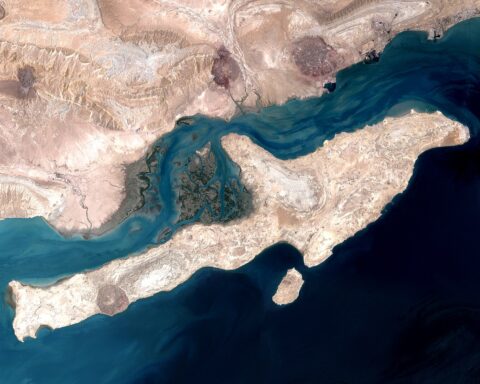
The IRGC’s mosaic defense structure operates through 31 autonomous provincial corps with pre-delegated authority. A halt order issued from Tehran must travel through a command chain to units that have been operating independently for five weeks. Some attacks may reflect time lag in order transmission. Others may reflect units that received the order but continued under the SNSC’s own language — “our hands are on the trigger” — which provincial commanders could interpret as authorization for continued defensive operations. The White House acknowledged it would “take some time for orders to get down to lower ranks.” The most consequential unresolved question is what triggered the initial post-ceasefire wave: the Lavan Island and Sirri Island oil strikes that hit eight hours after the ceasefire took effect remain unattributed, and the attribution dispute directly threatens the April 10 Islamabad talks.
How does this ceasefire differ from the earlier 45-day framework?
The 45-day ceasefire framework, brokered through Pakistan, Egypt, and Turkey, proposed a phased approach with Hormuz and nuclear enrichment deferred to Phase 2. The current two-week ceasefire is shorter, uses Islamabad as the sole venue, and attaches Iran’s full 10-point plan — including Hormuz sovereignty and sanctions removal — as a baseline for negotiations. The SNSC statement also explicitly preserves the right to resume hostilities, a provision the earlier framework attempted to avoid through phased confidence-building measures.
What is the “heroic flexibility” doctrine referenced in the SNSC statement?
Ali Khamenei — Mojtaba’s father — coined the phrase to justify entering nuclear negotiations with the Obama administration. The concept permits tactical de-escalation without conceding strategic defeat, framing negotiation as a battlefield instrument rather than a peace process. The SNSC’s April 7 statement uses structurally identical language: “The current negotiations are national negotiations and a continuation of the battlefield.” The doctrine has historically allowed Iran to enter and exit negotiations without treating any agreement as permanent or binding beyond its immediate tactical utility. On April 8, IRGC drones continued striking Kuwait’s oil and water infrastructure hours after the ceasefire took effect, providing the first confirmed post-ceasefire damage event and the most direct evidence yet that the authorization ceiling is producing outcomes Tehran cannot reverse. Kuwait’s post-ceasefire damage confirms the enforcement gap analyzed here. The constitutional architecture that enables this gap — specifically why Iran’s president cannot compel IRGC compliance even after a signed ceasefire — is examined in Pezeshkian’s April 4 accusation against Vahidi and Abdollahi. The enforcement gap has a direct humanitarian dimension: the ceasefire expires April 21, one day before Indonesia’s first Hajj charter departs, and the Hajj security gap crystallized by the ceasefire timeline depends entirely on a halt order Tehran demonstrably cannot enforce.
The shape of that enforcement gap was made explicit at Islamabad itself: Iran’s negotiating posture at Islamabad and the Hajj window constraint shows how Ghalibaf’s pre-declared violations turned the April 10 talks into a structured escalation ladder rather than a ceasefire consolidation exercise. The enforcement gap produced its first formal diplomatic rupture on April 10, when Kuwait became the first GCC state to formally accuse Iran of post-ceasefire violations, invoking Article 51 and breaking the collective Gulf silence that had persisted since February 28. The enforcement gap took a new form on April 10, when the IRGC’s formal Hormuz access regime was published hours before the Islamabad talks — a parallel treaty in military doctrine rather than diplomatic language.
Reuters’ April 11 three-source report adds a further layer: rather than a power vacuum driving contradictory signals, Khamenei appears to have been directing Iran’s Islamabad delegation by audio relay throughout, suggesting the contradictions between Araghchi’s diplomatic glosses and Vahidi’s hard line reflected a deliberate two-track strategy rather than institutional incoherence. The same reporting reveals why the strategy cannot produce a ratified ceasefire: Article 110 requires Khamenei to personally confirm the decision, and his circle says his first public appearance is weeks away — after the April 22 expiry.
That two-track dynamic reached its sharpest expression on April 13, when Ghalibaf’s “earn our trust” diplomacy and the IRGC Navy’s “deadly vortex” threat were issued the same day CENTCOM’s blockade became operational — an institutional contradiction examined as the authorization ceiling made visible.
That two-track dynamic continued into the ceasefire period: Iran’s Lavan oil facility was struck on April 8 hours after the halt nominally took effect, adding to a violation ledger that spans four Gulf states.