
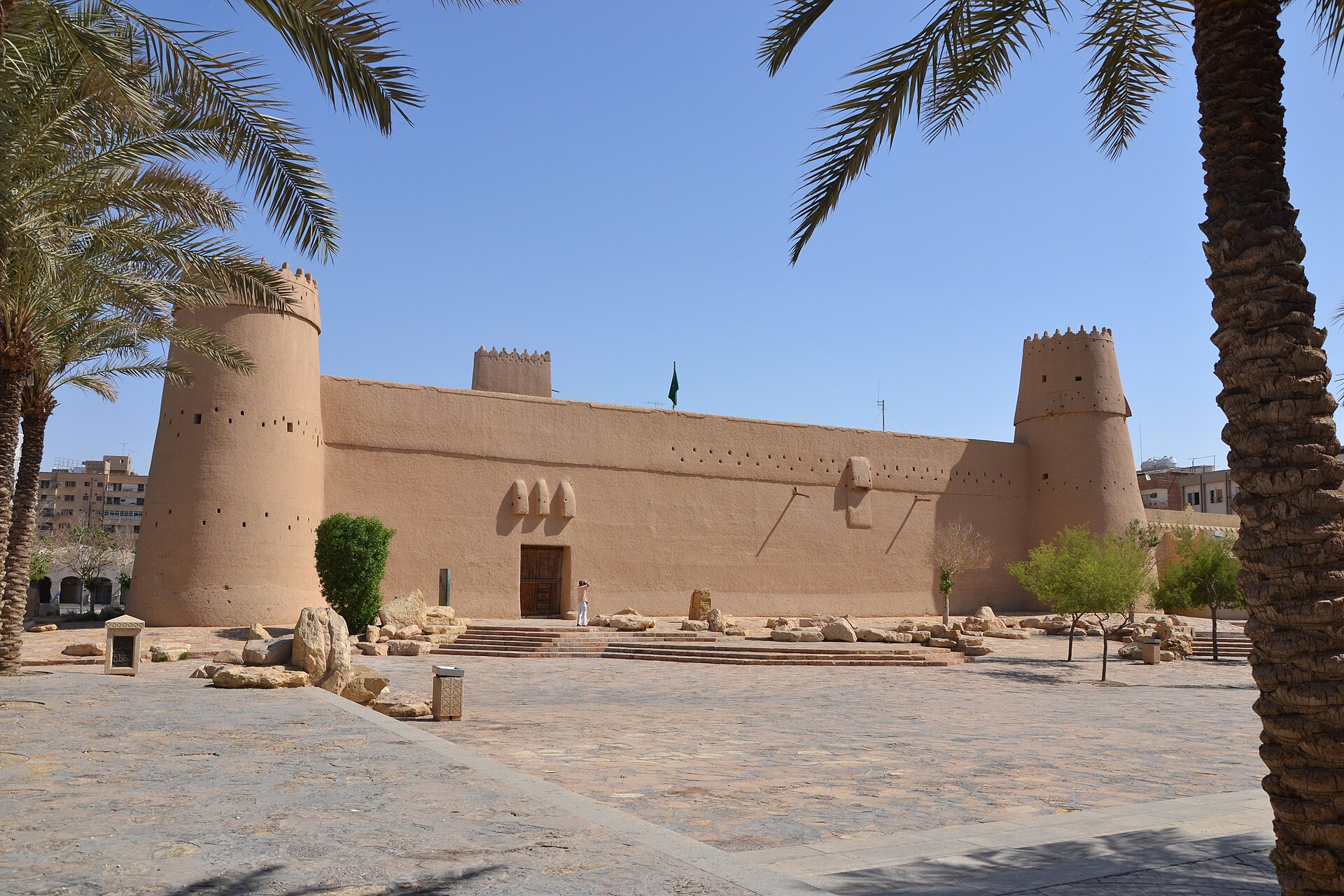
Standing in the heart of old Riyadh, Masmak Fortress is where modern Saudi Arabia began. On 15 January 1902, a young Abdulaziz ibn Abdul Rahman Al Saud led a daring raid on this mud-brick citadel, wresting control of Riyadh from the Rashidi dynasty and launching three decades of campaigns that would unify the Arabian Peninsula into a single kingdom. Today the fortress operates as a free museum, its thick clay walls and conical watchtowers preserved as a monument to the founding story of the nation. Whether you are exploring Riyadh on a wider trip or making a focused visit to the capital’s heritage quarter, Masmak Fortress is the single most important historical site in the city.
Best Time to Visit: November to February (cooler weather); early morning or late afternoon for best light
Getting There: Qasr Al Hokm Metro Station (Blue Line 2 / Orange Line 3), then a 10-minute walk through the heritage quarter
Visa Required: Yes — tourist e-visa available online
Budget: Free admission; SAR 5–10 for parking
Must-See: The original palmwood gate with embedded spear tip, the central courtyard, the museum galleries
Avoid: Visiting during the midday closure (12 PM–4 PM on weekdays) and the summer heat (June–August)
History of Masmak Fortress
The name Masmak derives from the Arabic word for a tall, thick, fortified building — an apt description for the imposing clay citadel that has anchored central Riyadh for over 150 years. Construction began in 1865 under Abdullah bin Faisal Al Saud and was completed around 1895 during the period when Riyadh was controlled by the Rashidi dynasty of Ha’il. The fortress served as the seat of the Rashidi governor, housing a garrison, a mosque, a treasury, and the governor’s residence within its walls.
The 1902 Battle of Riyadh
The event that transformed Masmak from a regional stronghold into a national symbol took place before dawn on 15 January 1902 (15 Shawwal 1319 AH). Abdulaziz ibn Abdul Rahman Al Saud — then about 26 years old and living in exile in Kuwait — led a raiding party of roughly 40 to 60 men across the desert to reclaim his family’s ancestral capital.
The plan was audacious. Ibn Saud and a strike team of fewer than a dozen fighters scaled the walls of a house near the fortress and waited through the night. At dawn, when the Rashidi governor Ajlan ibn Muhammad emerged from the fortress gate, they attacked. In the fierce hand-to-hand combat that followed, Abdullah bin Jaluwi — Ibn Saud’s cousin — hurled a spear at the fleeing governor. The spear struck the massive palmwood gate with such force that its iron tip became embedded in the wood, where it remains visible to this day.
The garrison surrendered within hours. The capture of Masmak marked the beginning of the Third Saudi State and launched three decades of military and diplomatic campaigns that culminated in the formal proclamation of the Kingdom of Saudi Arabia on 23 September 1932. Every Saudi National Day traces its origin to that January morning at the fortress gate.
From Fortress to Museum
After the capital’s centre of gravity shifted to newer districts, Masmak served various utilitarian roles — as an ammunition depot and later as a prison. In 1995, the fortress was fully restored and reopened as a museum under the supervision of the Riyadh Development Authority. The restoration preserved the original mud-brick construction and architectural features while adding bilingual exhibits (Arabic and English) documenting the battle and the broader story of Saudi unification. For visitors interested in the wider story of the Al Saud dynasty’s origins, Diriyah — the original capital — is a short drive northwest of Riyadh.
Architecture and Layout
Masmak Fortress covers approximately 4,500 square metres and is built in the traditional Najd vernacular style — unbaked clay mudbrick over a stone-block foundation, with thick mud plaster covering the exterior. The walls rise to about 5 metres in height with a thickness of 1.25 metres, punctuated by small triangular windows that serve triple duty: ventilation, light, and rainwater deflection.
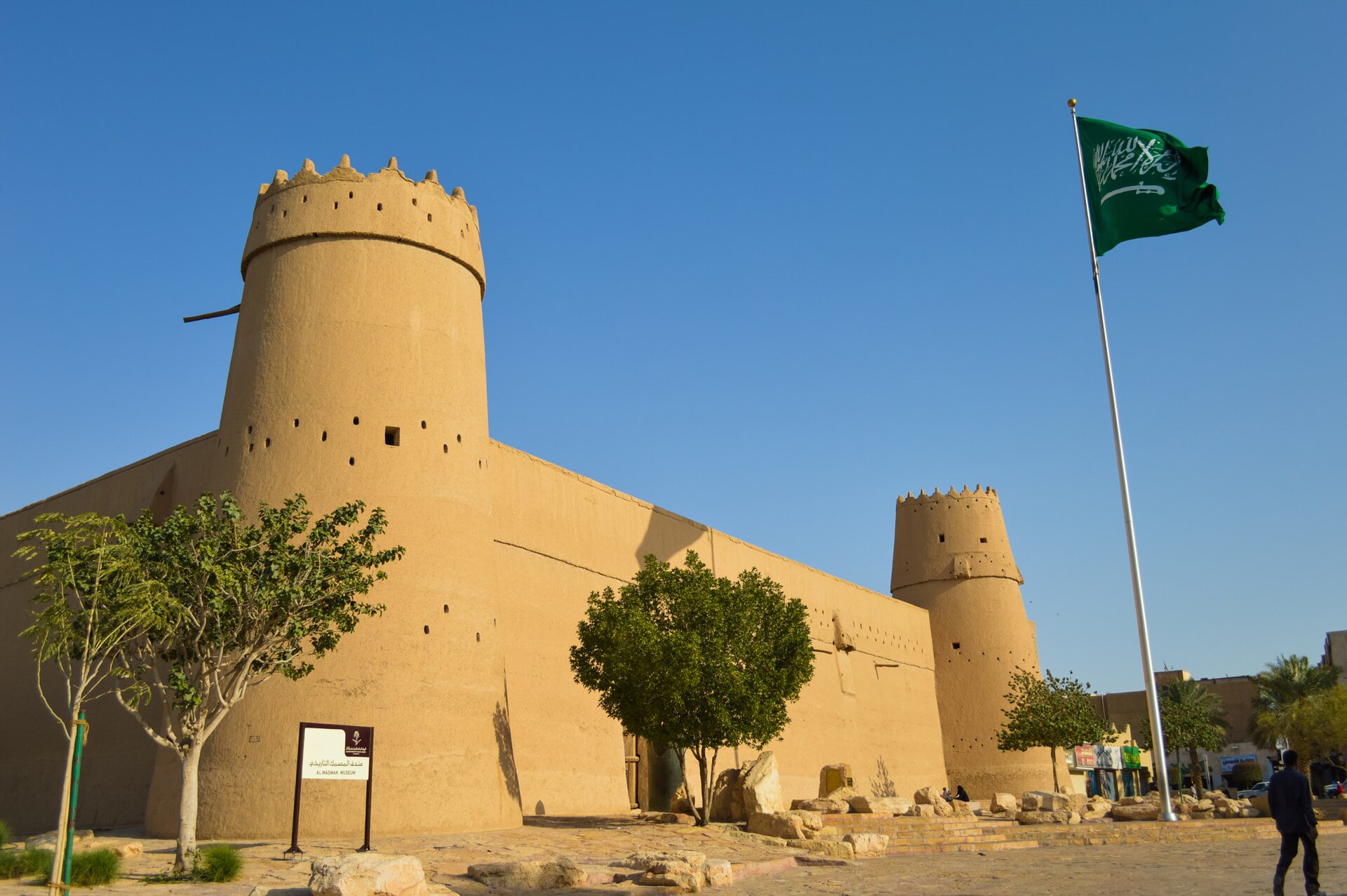
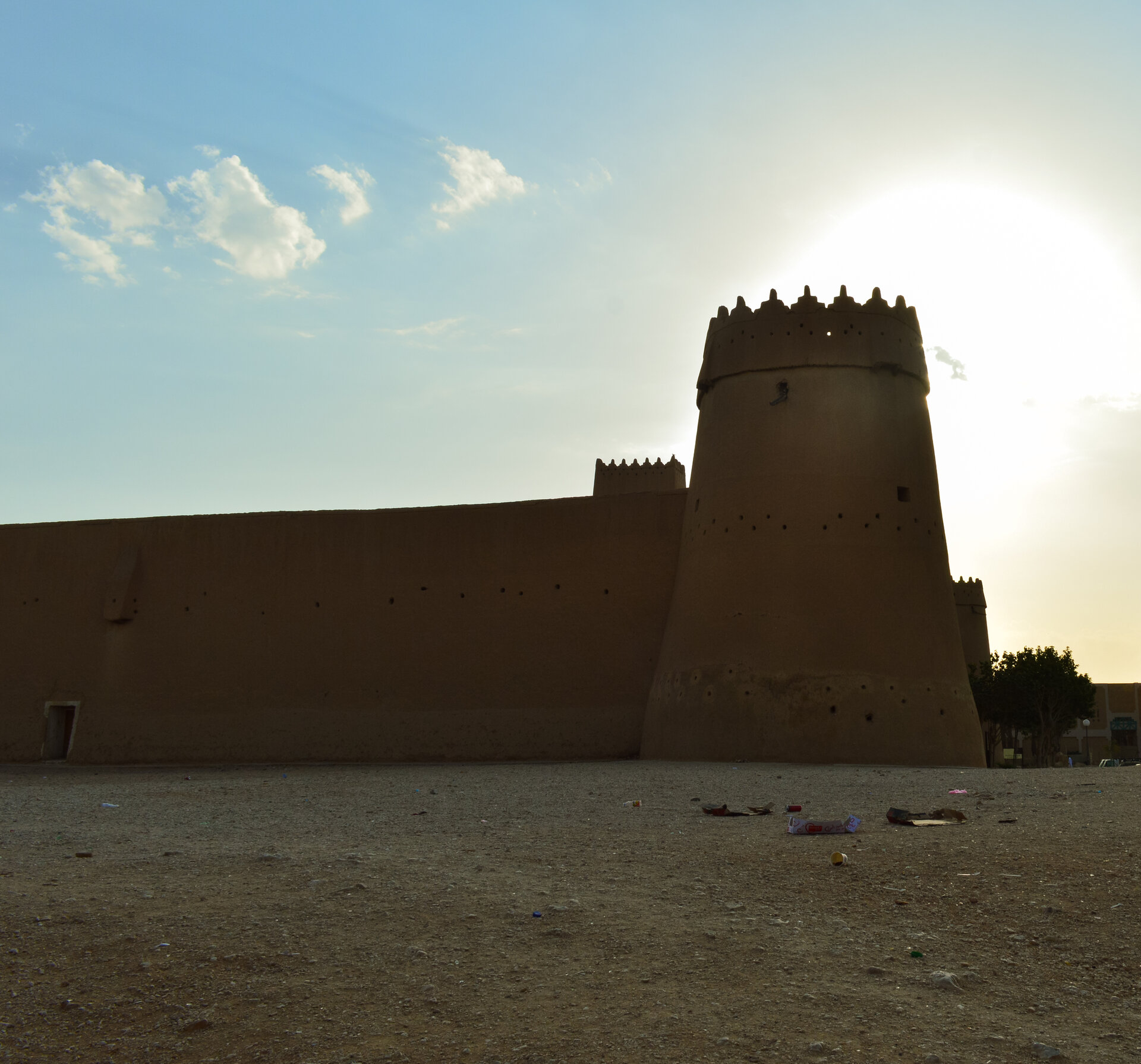
The fortress is anchored by four cylindrical watchtowers at each corner, each approximately 18 metres tall, tapering to crenellated tops. Internal staircases provide access to the upper levels, from which defenders could observe and control approaches to the citadel.
Six Key Sections
| Section | Description |
|---|---|
| The Gate | The main entrance on the western wall. The palmwood gate stands 3.6 m high and 2.65 m wide, with a small inner door called al-Khokha — sized for a single person, a defensive feature that forced attackers through one at a time. |
| The Mosque | Located immediately to the left of the entrance, with columns and storage areas for Qurans. Still evokes the austere spiritual life of the garrison. |
| The Majlis | A rectangular reception hall where the governor held audiences and received petitions — the political heart of the fortress. |
| The Well | In the northeastern section, providing the garrison’s water supply. Essential for withstanding any siege. |
| The Watchtowers | Four conical corner towers, each 18 m tall, with narrow observation slits and internal staircases. |
| The Central Courtyard | An open space surrounded by interconnected rooms. Stairs on the eastern side lead to the first floor and rooftop. Three residential units ring the courtyard: the ruler’s residence, the bayt al-mal (treasury), and guest quarters. |
What to See Inside the Museum
The museum inside Masmak Fortress is compact but rich, and most visitors spend one to two hours exploring its galleries. All exhibits are labelled in both Arabic and English.
The Gate and the Spear Tip
The single most famous artifact in the fortress is the original palmwood gate, preserved in situ. Look closely at the lower-right section and you will see the iron tip of the spear thrown by Abdullah bin Jaluwi during the 1902 assault, still embedded in the wood after more than 120 years. It is a small, unassuming piece of iron — but it marks the precise moment that the modern Saudi state was born.
Museum Galleries
Beyond the gate, the museum is organised into several themed galleries:
- Weapons and armour — swords, rifles, daggers, and battle equipment from the early 20th century campaigns
- Personal effects of King Abdulaziz — items that humanise the founder beyond the battlefield legend
- Historical photographs — black-and-white images of old Riyadh before the oil-era transformation, showing a small mud-walled settlement
- Maps, manuscripts, and correspondence — documents from the early days of Saudi rule
- Traditional clothing and costumes — garments from Najd’s settled and nomadic communities
- Agricultural and domestic tools — everyday objects that illustrate daily life in pre-modern central Arabia
- Audio-visual presentations — short films about the 1902 battle and the unification of the Kingdom
- By metro: Take the Riyadh Metro to Qasr Al Hokm Station (served by Blue Line 2 and Orange Line 3). The station, designed by Snohetta architects and opened in February 2025, is approximately a 10-minute walk from the fortress. Follow signs toward the heritage district.
- By taxi/rideshare: Uber and Careem operate throughout Riyadh. Ask for “Qasr Al Masmak” or “Masmak Fortress, Ad Dirah.” The ride from central Riyadh hotels typically costs SAR 15–30.
- By car: Limited parking is available on surrounding streets. Paid lots near Deera Square are the most convenient option.
- Women: Cover shoulders and knees. Loose-fitting clothing is recommended. A headscarf is not legally required for foreign women but is respectful at heritage sites.
- Men: Avoid shorts and sleeveless shirts.
- Diriyah and At-Turaif — the UNESCO World Heritage Site where the First Saudi State was founded in 1727
- Diriyah Gate — the major development project transforming the area around At-Turaif into a cultural and lifestyle destination
- Shopping in Riyadh — from traditional souqs to mega-malls
- Riyadh restaurants — the capital’s rapidly evolving dining scene
- Riyadh’s parks and green spaces — escaping the urban heat
- Day trips from Riyadh — including the Edge of the World escarpment and the Red Sand Dunes
- Riyadh Travel Guide — The complete guide to Saudi Arabia’s capital city
- National Museum of Saudi Arabia — The Kingdom’s premier museum in the Abdulaziz Historical Center
- Diriyah Guide — UNESCO World Heritage Site and birthplace of the First Saudi State
- Day Trips from Riyadh — Edge of the World, Red Sands, and more escapes from the capital
- Saudi Arabia Travel Guide 2026 — The complete guide to visiting the Kingdom
- Saudi Arabia Visa Guide — Every visa type explained
Tip: Start your visit at the gate — examine the spear tip and the al-Khokha door — then follow the galleries in sequence. The final audio-visual room ties the narrative together. Allow at least 90 minutes to read every display panel.
Visiting Masmak Fortress: Practical Information
Opening Hours
| Day | Hours |
|---|---|
| Sunday–Thursday | 8:00 AM – 12:00 PM, then 4:00 PM – 9:00 PM |
| Saturday | 9:00 AM – 12:00 PM, then 4:00 PM – 9:00 PM |
| Friday | 4:00 PM – 9:00 PM only |
Note: Hours may change during Ramadan and public holidays. Check with the Saudi Tourism Authority before your visit.
Admission
Free. There is no entry fee. Parking in the surrounding area costs approximately SAR 5–10.
Getting There
Masmak Fortress is located on Al Imam Turki ibn Abdullah ibn Muhammad Street in the Ad Dirah (Al-Dirah) district of central Riyadh.
International visitors will need a valid tourist visa. The Saudi Arabia e-visa is available online for citizens of over 60 countries and takes minutes to process.
Dress Code and Etiquette
As a heritage and cultural site, modest dress is expected:
Photography
Photography is permitted throughout the fortress and museum. Flash may be restricted in certain display areas to protect artifacts. Drone photography is prohibited. The best exterior shots come in the late afternoon when golden-hour light catches the mud-brick walls.
Best Time to Visit
Riyadh’s climate is harsh in summer, with temperatures routinely exceeding 45°C (113°F) from June to August. The ideal months for visiting Masmak Fortress are November through February, when daytime temperatures range from a comfortable 15–25°C (59–77°F).
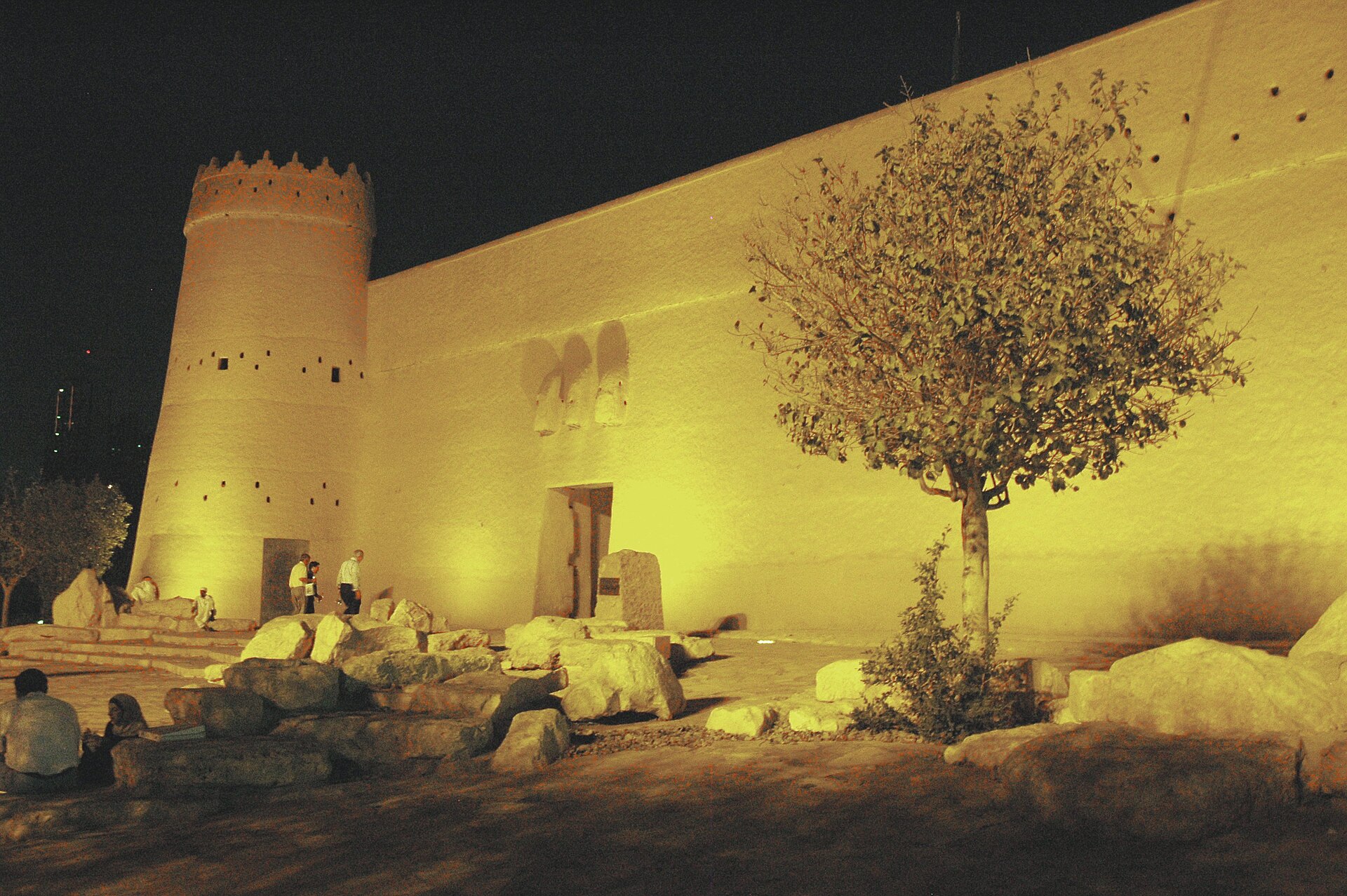
Within the day, aim for early morning (8–10 AM) for fewer crowds and cooler temperatures, or late afternoon (4–6 PM) for the best photography light. Avoid the midday closure gap between 12 PM and 4 PM. Evening visits after dark offer a different experience — the fortress is dramatically lit and the surrounding heritage quarter comes alive. If you are visiting during Riyadh Season, the Ad Dirah district often hosts additional cultural events and performances.
Nearby Attractions: Exploring Riyadh’s Heritage Quarter
Masmak Fortress sits at the centre of Riyadh’s historic core. Several other attractions are within easy walking distance, making it possible to build a rewarding half-day heritage walk around the fortress.
Deera Square (Dira Square)
Immediately adjacent to the fortress, Deera Square is the historic heart of old Riyadh. The open plaza has witnessed centuries of public life and remains an important gathering space. It is the natural starting or ending point for a Masmak visit.
Souq Al Zal
Steps from the fortress, this traditional market is one of the oldest in Riyadh. Vendors sell antique carpets, Arabian coffee pots (dallah), spices, perfumes, traditional clothing, and handicrafts. It is busiest — and most atmospheric — in the evenings, especially on Thursdays and Fridays. Haggling is expected.
Al-Thumairi Street
Considered the oldest commercial street in Riyadh, Al-Thumairi connects the fortress area to Dira Souq. The narrow lane is lined with shops selling gold, incense, textiles, and souvenirs. Walking it gives a sense of the scale and feel of pre-modern Riyadh.
Imam Turki Bin Abdullah Mosque
The main mosque of old Riyadh, located a short walk from the fortress. Built in the traditional Najd style, it anchors the religious and social life of the heritage quarter.
National Museum of Saudi Arabia
About 10 minutes by car (or a longer walk), the National Museum in the King Abdulaziz Historical Center offers a comprehensive journey through the Arabian Peninsula’s history — from pre-history through the Islamic era to the modern Kingdom. It pairs perfectly with Masmak for a full-day immersion in Saudi history.
Murabba Historical Palace
Approximately 15 minutes by car, Qasr Al Murabba is the 1930s palace where King Abdulaziz lived and governed after outgrowing the Masmak complex. The contrast between the austere fortress and the more spacious Murabba palace illustrates the rapid evolution of the Saudi state in its first three decades.
Suggested half-day itinerary: Start at Masmak Fortress (8 AM opening), walk to Souq Al Zal and Al-Thumairi Street, have traditional coffee at a heritage-quarter cafe, then taxi to the National Museum. This covers the essential story of Riyadh’s past in about four hours.
Masmak Fortress for Families and Accessibility
The fortress museum is family-friendly. The audio-visual presentations and weapons displays tend to hold children’s attention, and the courtyard provides space for them to move around between gallery rooms. However, note that the ground floor has uneven stone surfaces in some areas, and the upper-level staircases are narrow and steep. Wheelchair access is limited to the ground floor. Pushchairs can navigate the courtyard but may struggle in narrower gallery corridors.
Planning a Longer Riyadh Trip
Masmak Fortress rewards a focused visit, but Riyadh has far more to offer. Consider building your itinerary around these options:
For arrival logistics, King Khalid International Airport (RUH) is Riyadh’s main gateway, located about 35 km north of the city centre.