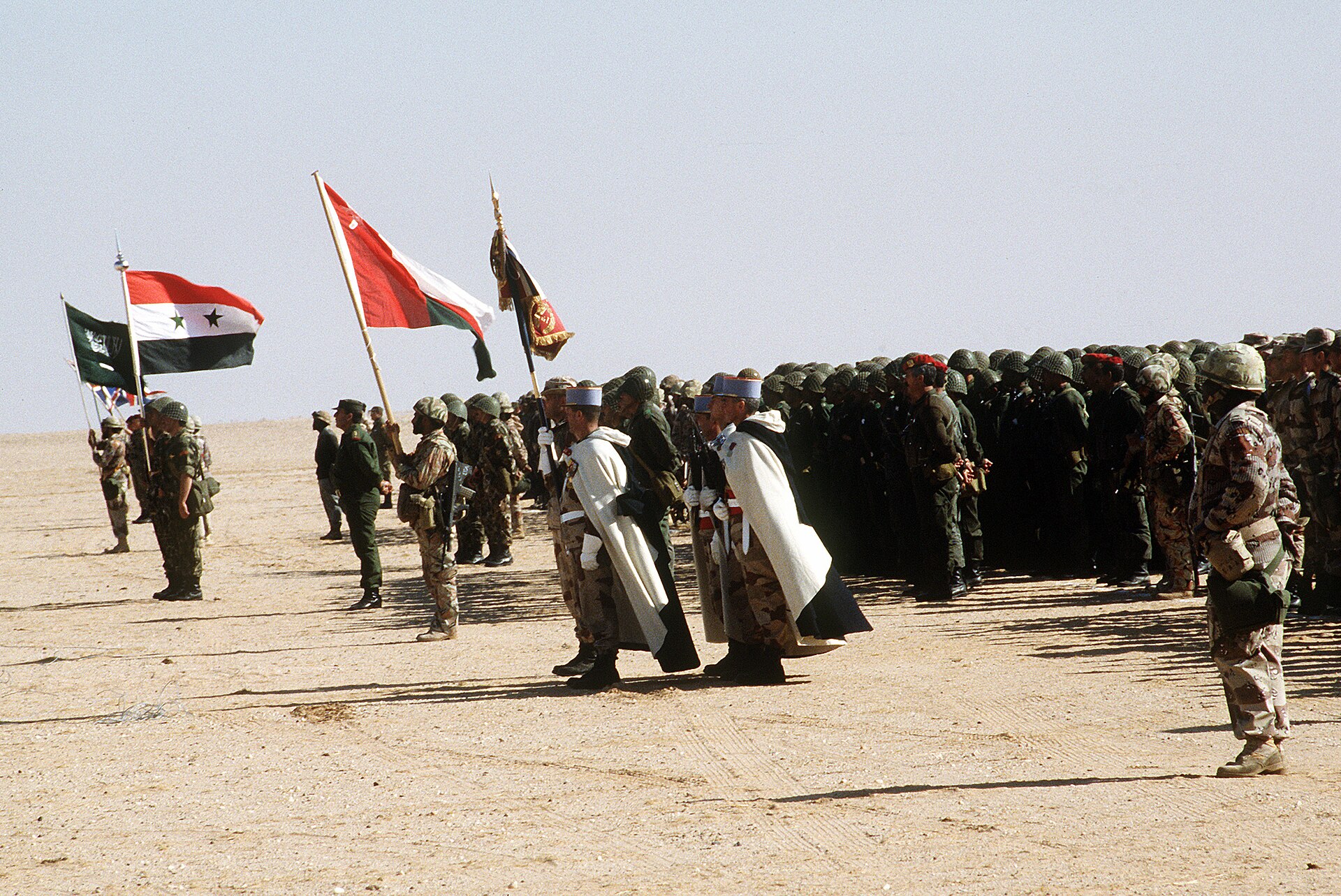

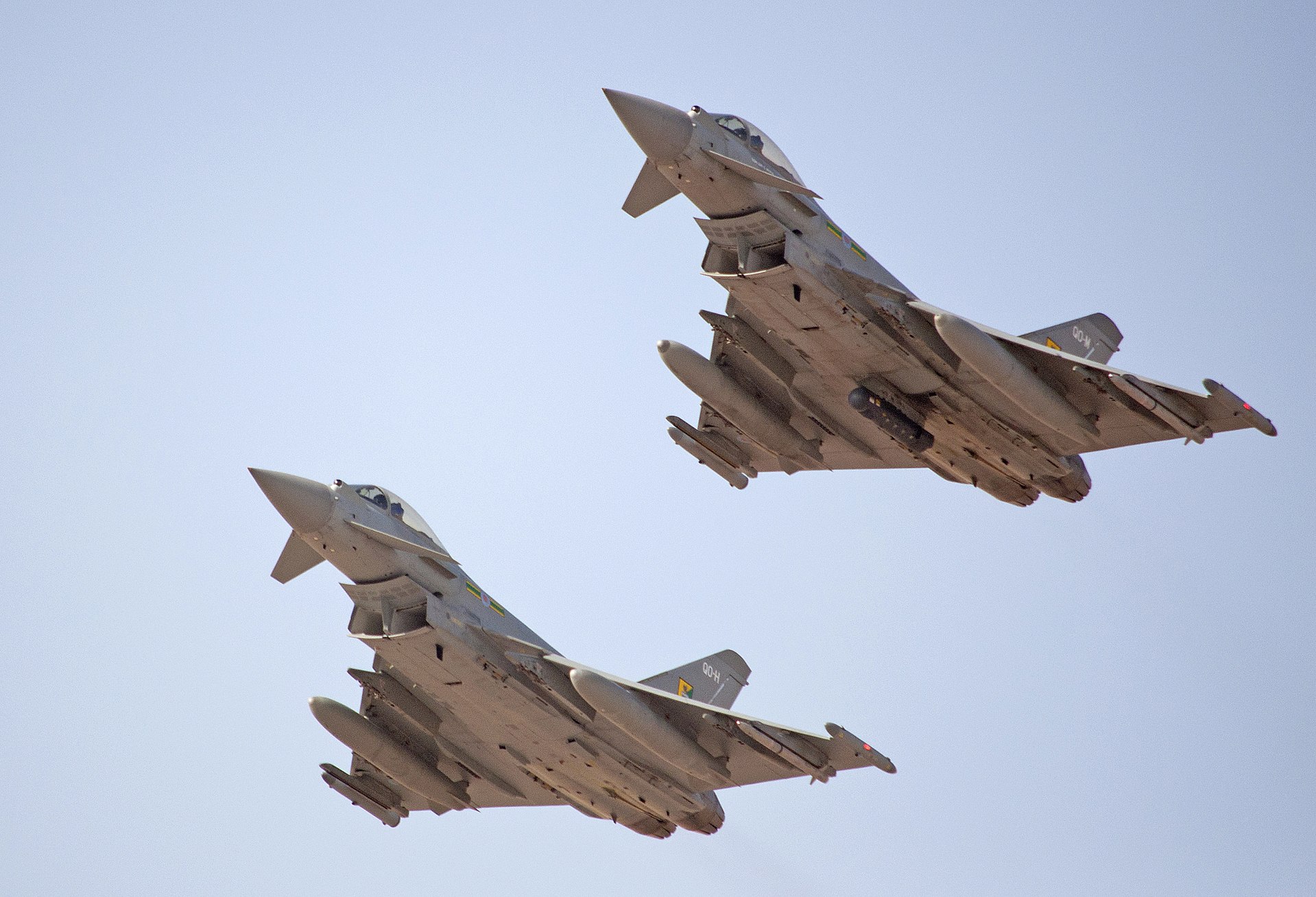
RIYADH — Three weeks into the most destructive military confrontation in the Persian Gulf since 1991, Saudi Arabia finds itself defended by an improbable constellation of foreign forces that no strategic planner designed and no alliance treaty anticipated. Greek Patriot batteries intercept Iranian ballistic missiles over Yanbu. Ukrainian drone specialists deploy counter-UAV systems across five Gulf states. Pakistani F-16s sit on Saudi tarmacs under a mutual defence pact signed barely six months ago. Royal Air Force Typhoons fly combat air patrols from Qatar. And a 20-nation joint statement on the Strait of Hormuz signals a willingness to do more, though nobody can quite agree on what “more” means.
This patchwork coalition represents the largest multinational military mobilisation in the Middle East since the 2003 invasion of Iraq, yet it operates without a unified command structure, a shared set of rules of engagement, or even a common understanding of what victory looks like. The question is not whether this accidental alliance can survive the current war. It is whether the war will produce something durable enough to prevent the next one.
Table of Contents
- Who Is Actually Defending the Gulf Against Iran?
- What Did Greece’s Patriot Battery Prove Over Yanbu?
- The American Foundation — Bases, Arms, and Carrier Groups
- Why Did Ukraine Send 201 Drone Specialists to the Gulf?
- Pakistan’s Defence Pact — Words, Troops, and the Limits of Solidarity
- Europe’s Reluctant Escalation — From Statements to Typhoons
- The Gulf Defense Contribution Matrix
- Can a Coalition Without a Commander Defend Anything?
- The Missing Members — Who Refused to Help and Why
- The Twenty-Nation Statement That Changed Nothing and Everything
- What Does This Alliance Mean for Post-War Gulf Security?
- Frequently Asked Questions
Who Is Actually Defending the Gulf Against Iran?
At least fourteen nations now have military personnel, weapons systems, or intelligence assets directly engaged in the defence of Gulf Cooperation Council states against Iranian missile and drone attacks. The scale of this multinational response is unprecedented in the region’s modern history, yet it emerged not through treaty obligations or collective security mechanisms but through a series of ad hoc bilateral arrangements, emergency arms transfers, and improvised deployments driven by the speed of the crisis.
The contributors fall into four distinct categories. The United States provides the backbone through existing base infrastructure, advanced air defence systems, and hundreds of billions of dollars in emergency military spending. European NATO members — Britain, France, and Greece — contribute specific capabilities ranging from fighter aircraft to air defence batteries. Pakistan and India offer manpower and strategic depth through bilateral defence agreements. And Ukraine, in perhaps the war’s most unexpected development, deploys the counter-drone expertise it has accumulated through four years of Russian aerial assault.
The result is less an alliance than a mosaic. Each contributor operates under its own rules, serves its own interests, and answers to its own capital. The March 19 Riyadh meeting between the foreign ministers of Turkey, Saudi Arabia, Egypt, and Pakistan suggests a more structured quadrilateral security framework may be taking shape to replace this improvisation. A Greek battery commander in Yanbu takes orders from Athens. Ukrainian drone specialists near Abu Dhabi report to Kyiv. Pakistani F-16 pilots at an undisclosed Saudi base follow instructions from Rawalpindi. The Americans coordinate with everyone but command nobody except their own forces. It is, by any traditional measure, a strategic mess. It is also, by the standards of what was available when the first Iranian missiles fell on 1 March 2026, a small miracle.
What Did Greece’s Patriot Battery Prove Over Yanbu?
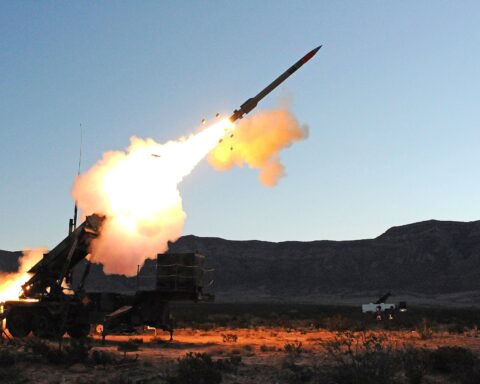
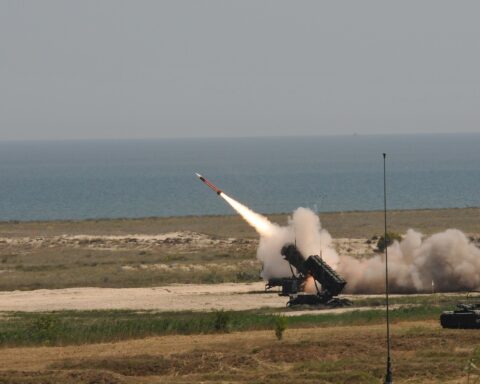
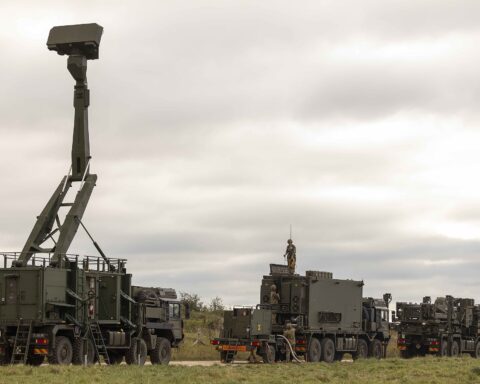
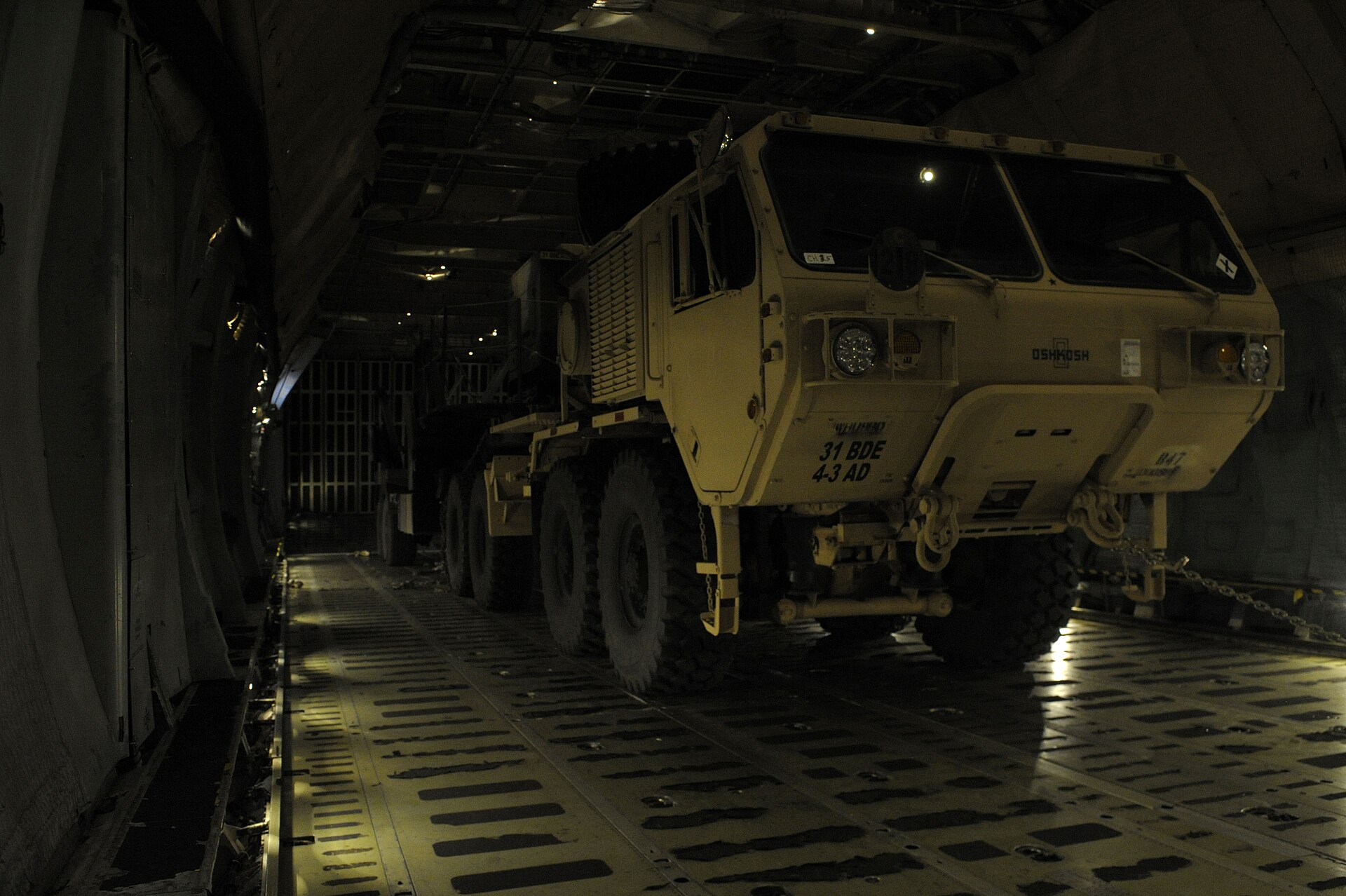
On 19 March 2026, a Greek-operated Patriot PAC-3 battery stationed near Yanbu on Saudi Arabia’s Red Sea coast intercepted two Iranian ballistic missiles aimed at the SAMREF refinery, the joint Saudi Aramco-ExxonMobil facility that serves as a critical node in the Kingdom’s Hormuz bypass pipeline system. The interception, confirmed by Athens and Riyadh, marked the first time a European NATO member’s air defence system engaged Iranian weapons in combat, according to Janes Defence.
The Middle East briefing 3,000+ readers start their day with.
One email. Every weekday morning. Free.
The significance extends far beyond the two missiles destroyed. Yanbu is not merely another refinery. It is the western terminus of the East-West Pipeline, Saudi Arabia’s primary alternative export route when the Strait of Hormuz is closed. With Hormuz shut since early March, every barrel of Saudi crude leaving the Kingdom flows through Yanbu. An Iranian strike disabling SAMREF would have eliminated Saudi Arabia’s last functioning export pathway, potentially removing 5 million barrels per day from global markets and sending oil prices well beyond the $126 peak they had already reached.
Greece deployed the Patriot battery to Saudi Arabia in 2021 under the Integrated Air and Missile Defence (IAMD) initiative, a framework involving the United States, Britain, and France designed to protect critical energy infrastructure. For four years it sat in the desert with nothing to shoot at. On 19 March, it justified its existence in approximately 90 seconds.
Greek Prime Minister Kyriakos Mitsotakis described the deployment as “purely defensive” and emphasised that Greek personnel were protecting civilian infrastructure, not participating in offensive operations against Iran. The distinction matters legally and politically, but on the ground, the effect is the same: a NATO member state is actively engaged in military operations against Iranian forces on Saudi soil.
The Yanbu intercept also demonstrated something that defence analysts had debated for years — whether the multinational IAMD concept could function in real combat conditions with forces from different nations operating under different command chains. The answer, at least in this instance, was yes. The Greek battery integrated with Saudi air defence radars, received threat data from American sensors, and executed the intercept under Greek rules of engagement. Three nations, three command structures, one successful outcome. It was precisely the kind of multinational air defence cooperation that NATO has practiced in exercises for decades but rarely tested against live fire.
The American Foundation — Bases, Arms, and Carrier Groups
Strip away the multinational contributions, and the defence of the Gulf rests on an American infrastructure that has been decades in the making. The United States maintains military assets at Prince Sultan Air Base south of Riyadh, Al Udeid Air Base in Qatar, Al-Dhafra Air Base in the UAE, the US Fifth Fleet headquarters in Bahrain — where 385 Iranian missiles and drones have been intercepted in just 22 days — and facilities in Kuwait, Oman, and Jordan. Collectively, these installations host F-22 Raptor stealth fighters, F-35 Lightning IIs, AWACS surveillance aircraft, Patriot and THAAD missile defence systems, and the command-and-control architecture that integrates the entire regional air picture. Even so, Iranian drones penetrated Kuwaiti defences to strike the Mina Al-Ahmadi refinery on consecutive days, exposing the limits of even layered air defence against saturation attacks. The strain on this network deepened on March 22 when Iraqi militias hit 21 US bases in 24 hours, threatening the logistics chain that connects these installations to the broader Gulf defence architecture.
Since the war began, Washington has accelerated arms transfers to Gulf states at an extraordinary pace. Secretary of State Marco Rubio bypassed Congressional notification requirements to rush through $16 billion in emergency arms sales, including an $8.4 billion package for the UAE covering drones, missiles, radar systems, and F-16 aircraft, and an $8 billion deal for Kuwait centred on air and missile defence radars. Qatar received Patriot missile systems, NASAMS short-range air defence, early warning radars, and attack helicopters.
President Donald Trump personally guaranteed the protection of Qatar’s South Pars gas field, threatening to “massively blow up” Iranian facilities if Tehran struck the field again after its March attack on the nearby Ras Laffan LNG complex. The statement was characteristically blunt, but it revealed the operational reality: the United States cannot defend every Gulf asset simultaneously, and the guarantee of protection is selective.
This selectivity is the core weakness of the American contribution. US air defence assets in the region, while formidable, were designed to protect military installations, not the entire civilian and energy infrastructure of six sovereign states. Saudi Arabia’s own military has intercepted the majority of Iranian missiles and drones targeting the Kingdom, with American systems serving as a second layer rather than the primary shield. The Pentagon has requested $200 billion in supplemental funding for the war, a figure that reflects both the scale of operations and the strain on existing resources.
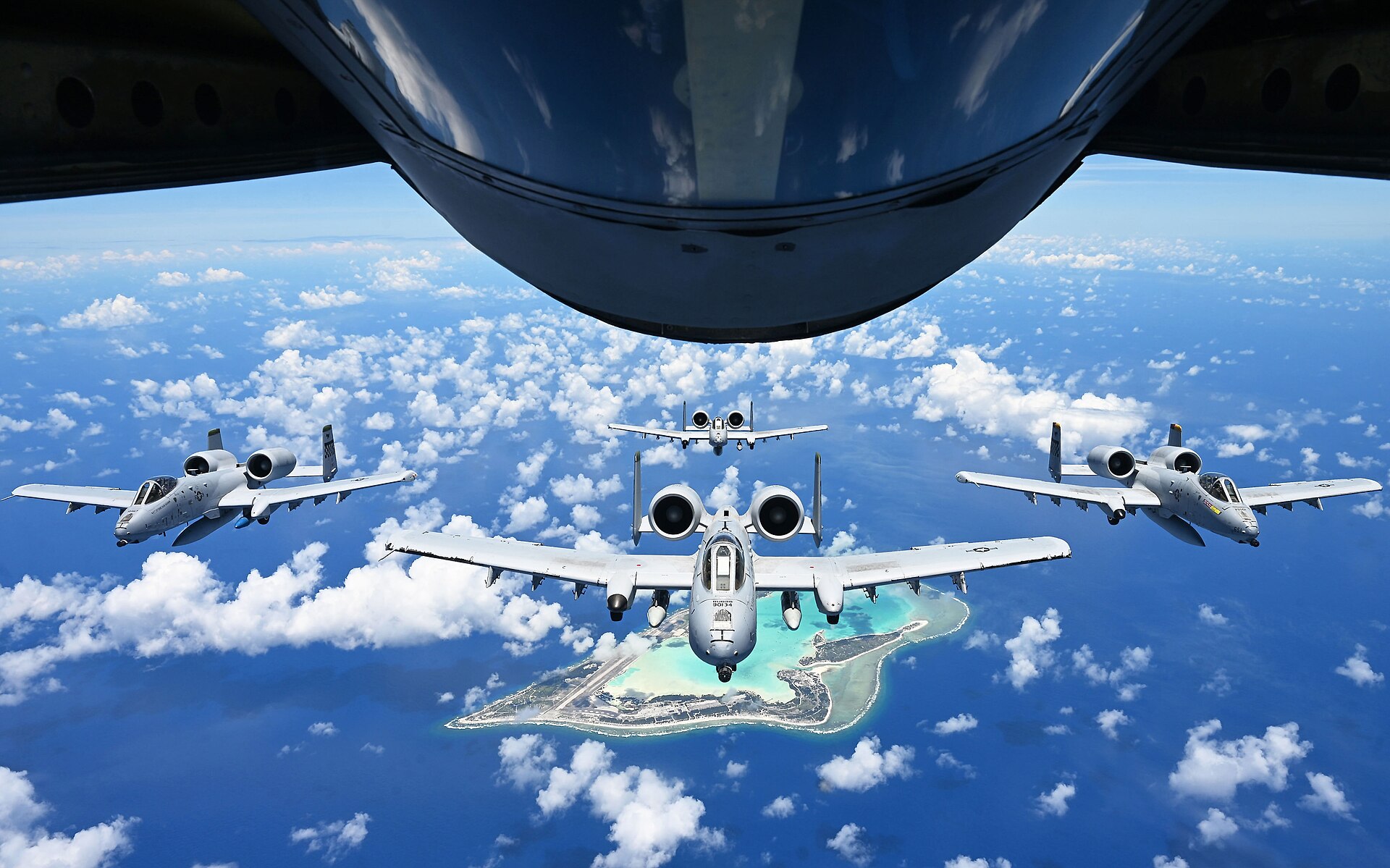
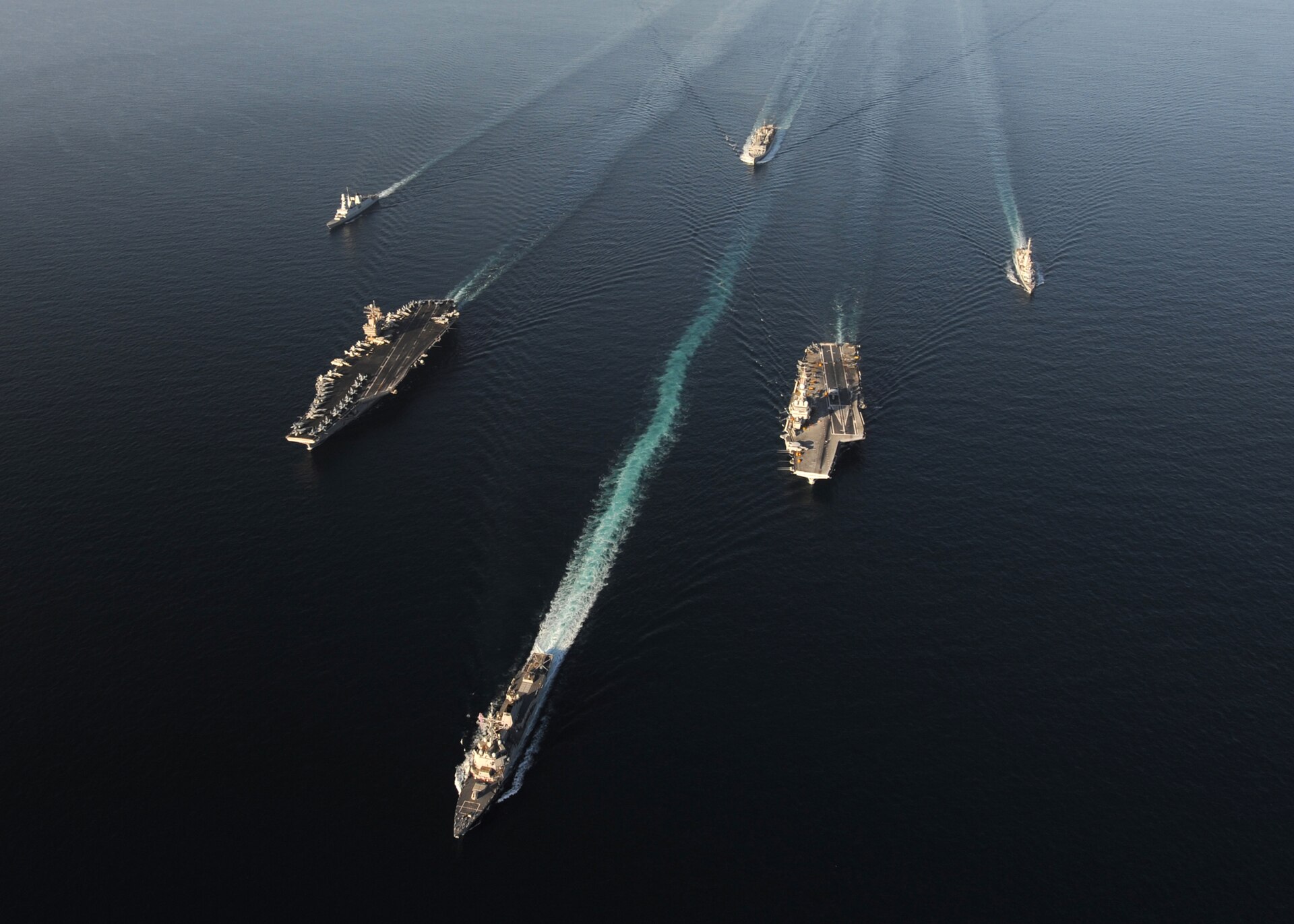
At sea, two carrier strike groups — led by USS Abraham Lincoln and USS Dwight D. Eisenhower — operate in the Arabian Sea and the Gulf of Oman, providing air cover and deterrence but unable to reopen the Strait of Hormuz without a ground-and-sea operation that neither Washington nor its allies have been willing to mount. The carriers project power; they do not clear minefields or silence shore batteries. The Pentagon has since deployed A-10 Warthogs and Apache helicopters to hunt Iranian fast-attack boats directly in the strait, destroying more than 120 vessels in three weeks. For that, the United States would need the kind of multinational naval coalition that the 19 March joint statement hinted at but did not create.
Why Did Ukraine Send 201 Drone Specialists to the Gulf?
Ukraine has deployed more than 201 military specialists to five Gulf states — the UAE, Saudi Arabia, Qatar, Kuwait, and Jordan — to operate counter-drone interception systems and train local forces in the layered counter-UAV tactics that Kyiv has refined through four years of absorbing nearly 60,000 Russian-launched Shahed drones and their Iranian-designed variants, according to Al Jazeera reporting.
The deployment represents one of the war’s most strategically consequential side effects. Ukraine possesses battlefield-tested expertise in defeating the exact weapon system — the Shahed-136 one-way attack drone — that Iran is using to overwhelm Gulf air defences. No other country on earth has faced this volume of drone attacks and survived. Kyiv’s counter-drone units have developed cheap interceptor drones, electronic warfare jamming techniques, and rapid-detection systems that Gulf militaries, oriented toward conventional missile threats, simply do not possess at scale.
The division of labour is revealing. Ukrainian teams handle Shahed interception and counter-UAV operations while Gulf air defence units manage incoming ballistic missiles, creating a functional if improvised two-layer system that neither side could operate alone. The Ukrainians bring expertise; the Gulf states bring infrastructure, funding, and the targets that need defending.
President Volodymyr Zelenskyy has framed the deployment as both moral solidarity and strategic investment. Every interceptor drone and specialist sent to the Gulf is a resource temporarily withdrawn from Ukraine’s own defence against Russian bombardment. Zelenskyy is betting that the technology deals, defence contracts, and political capital generated by these Middle Eastern deployments will return more capability to Ukraine than they remove. As Fortune reported on 20 March, the gamble has already coincided with a $5 billion deal for Saudi Arabia to produce Chinese combat drones in Jeddah, suggesting that Gulf states are using the crisis to diversify their defence suppliers far beyond Washington.
Pakistan’s Defence Pact — Words, Troops, and the Limits of Solidarity
The Strategic Mutual Defence Agreement between Pakistan and Saudi Arabia, signed at Al Yamamah Palace in Riyadh on 17 September 2025 by Crown Prince Mohammed bin Salman and Prime Minister Shehbaz Sharif, commits both nations to treating an attack on one as an attack on both. On 7 March 2026, one week after Iranian missiles first struck Saudi territory, Pakistan’s Chief of Army Staff Field Marshal Asim Munir flew to Riyadh to formally invoke the pact with Saudi Defence Minister Prince Khalid bin Salman.
The invocation was historic. So were the constraints that immediately became apparent. Pakistan deployed between 1,500 and 2,000 troops to Saudi Arabia and kept F-16 Block 52 fighters on Saudi soil, aircraft that had arrived for the “Spears of Victory 2026” exercise and conveniently remained as the war erupted. Deputy Prime Minister Ishaq Dar declared on 3 March that “we have a defence pact with Saudi Arabia… I told the Iranian leadership to take care of our pact,” according to a Middle East Eye report.
The rhetoric was firm. The military contribution was calibrated. Pakistan shares a 959-kilometre border with Iran, hosts a significant Shia minority that accounts for roughly 15 to 20 per cent of its 230 million population, and faces domestic sectarian tensions that any overt military action against Iran would inflame. Islamabad secured its own oil shipments through the Strait of Hormuz rather than assisting Saudi Arabia’s efforts to restore passage, a detail that Riyadh reportedly noted with quiet displeasure, according to RANE analysis published by Stratfor.
The Pakistan case illustrates the fundamental limitation of bilateral defence pacts in a multilateral conflict. The SMDA was designed for a scenario in which one state faced aggression and the other rallied to its defence. The 2026 reality is more complex: Saudi Arabia faces aggression as a consequence of a war launched by a third party (the United States), against a neighbour Pakistan cannot afford to alienate (Iran), during a domestic crisis Pakistan cannot resolve (the Afghan Taliban insurgency along its western border). The pact was activated. Its military impact, as the Soufan Center observed, has been negligible. A deeper examination of the five factors constraining Pakistan from activating the defence pact suggests that Islamabad may be executing the only viable strategy available to a mid-tier power caught between three larger patrons.
Europe’s Reluctant Escalation — From Statements to Typhoons
Europe’s response to the Gulf crisis has followed a pattern familiar from every major Middle Eastern conflict of the past three decades: initial shock, followed by stern statements, followed by incremental military commitments designed to demonstrate solidarity without incurring meaningful risk.
The E3 — Britain, France, and Germany — issued a joint statement on 1 March condemning Iran’s “indiscriminate and disproportionate missile attacks” against countries in the region, including states that had no role in the initial US-Israeli strikes. The statement pledged “necessary and proportionate defensive measures” to protect allied interests, including potentially destroying “Iran’s capability to fire missiles and drones at their source.” It was, by European diplomatic standards, unusually muscular language.
The commitments that followed were specific but limited. Britain deployed four additional Eurofighter Typhoon fighters to Qatar, approved US use of British bases for “defensive” operations, and granted access for Strait of Hormuz ship protection. London explicitly stated it would not send ground troops or participate in offensive strikes. France declared itself “ready to take part in defense of Gulf countries and Jordan,” with Foreign Minister Jean-Noel Barrot leaving the definition of “take part” strategically ambiguous. Germany, constrained by constitutional restrictions on offensive military action, contributed to diplomatic coordination but deployed no military hardware.
The first European combat casualty came on 13 March when a French service member was killed in the Gulf, a milestone that made the European contribution tangibly real in a way that no diplomatic statement could. The death forced Paris into an awkward position: France was sustaining casualties in a conflict it had not authorised, defending allies it had not formally committed to protect, against an adversary it maintained diplomatic channels with.
The E3 dynamic reveals Europe’s central dilemma. Individually, each European state can contribute something — a fighter squadron here, a Patriot battery there, a naval escort somewhere else. Collectively, they lack the logistical capacity, the munitions stockpiles, and the political will to sustain a major military operation in the Gulf while simultaneously maintaining commitments in Europe, Africa, and the Indo-Pacific. As defence analyst David Roberts noted, the problem is not willingness but capacity: “It’s not clear what can be offered by anyone,” he told Al Jazeera, citing tight munitions stocks globally and Europe being “stretched thinly” for Strait of Hormuz operations. The depth of Europe’s strategic incoherence in the Gulf becomes clearer when individual military contributions are mapped against collective diplomatic paralysis.
The Gulf Defense Contribution Matrix
The diversity of contributors and the variety of their commitments demand a structured assessment. The Gulf Defense Contribution Matrix evaluates each participating nation across six dimensions: military hardware deployed, personnel on the ground, base access or infrastructure provided, arms deals and financial transfers, diplomatic risk assumed, and strategic leverage gained. Each dimension is scored on a five-point scale, with the total providing a composite picture of each nation’s actual contribution to Gulf defence.
| Nation | Hardware | Personnel | Base Access | Arms/Finance | Diplomatic Risk | Strategic Leverage | Total (30) |
|---|---|---|---|---|---|---|---|
| United States | 5 | 5 | 5 | 5 | 4 | 5 | 29 |
| United Kingdom | 3 | 2 | 4 | 3 | 3 | 3 | 18 |
| France | 3 | 2 | 3 | 2 | 4 | 3 | 17 |
| Greece | 4 | 2 | 1 | 1 | 4 | 4 | 16 |
| Pakistan | 2 | 3 | 1 | 1 | 5 | 2 | 14 |
| Ukraine | 3 | 3 | 0 | 1 | 3 | 5 | 15 |
| India | 1 | 1 | 1 | 2 | 2 | 3 | 10 |
| Germany | 0 | 0 | 1 | 1 | 2 | 2 | 6 |
Three findings emerge from the matrix. First, the United States is not merely the largest contributor — it is the only indispensable one. Remove any other nation from the coalition and the defence architecture weakens but functions. Remove the United States and it collapses entirely. This asymmetry explains why Washington retains dominant influence over the coalition’s posture and pace, and why Trump’s signals about “winding down” operations send tremors through every Gulf capital.
Second, Greece and Ukraine punch dramatically above their weight. Greece scores 16 out of 30 despite deploying a single Patriot battery and a small team of operators. Ukraine scores 15 despite having no base access in the region and no formal alliance with any Gulf state. Both derive their outsized scores from the specificity and timeliness of what they offer — Greece provides proven ballistic missile interception at the one facility Saudi Arabia cannot lose, while Ukraine provides the only battle-tested counter-drone capability on earth.
Third, Pakistan assumes the greatest diplomatic risk of any coalition member (a score of 5 out of 5) but delivers the least military impact relative to that risk. Islamabad has antagonised Tehran, activated a defence pact, and deployed troops and fighters to Saudi soil — all while sharing a nearly 1,000-kilometre border with Iran and managing a combustible Shia minority. The gap between Pakistan’s risk exposure and its operational contribution is the coalition’s most dangerous fault line.
Can a Coalition Without a Commander Defend Anything?
The conventional assumption is that this ad hoc coalition, for all its improvisation, represents a meaningful defence of the Gulf. The evidence suggests a more troubling reality: the coalition’s value is primarily symbolic, and its military contribution, while tactically useful in specific instances, has not altered the strategic balance of the war.
Consider the numbers. Iran has launched an estimated 400 to 500 missiles and drones at Gulf states since 28 February, according to ACLED data and defence ministry statements from affected countries. At peaks exceeding 100 drones per day, the volume of incoming fire has overwhelmed the defensive capacity of any single national system. The multinational contributions have added marginal capability — a Patriot battery here, a counter-drone team there — but the fundamental problem remains: the Gulf has more targets than defenders, and Iran has more munitions than the coalition has interceptors.
The absence of a unified command structure compounds the problem. When Greek, American, Saudi, and Emirati air defence systems all operate in the same battlespace under different rules of engagement and different command chains, the risk of gaps, overlaps, and fratricide is significant. NATO spent 75 years developing integrated air defence architecture — the Integrated Air and Missile Defence System — precisely because ad hoc coordination in combat conditions is dangerous. The Gulf coalition in March 2026 is attempting to replicate that integration in weeks, under fire, without the institutional foundations that NATO took decades to build.
The coalition’s deepest vulnerability, however, is political rather than military. Each contributing nation has different war aims, different risk tolerances, and different conditions under which it would withdraw. Greece deployed its Patriot battery to protect energy infrastructure, not to fight a war. If Greek personnel are killed, Athens faces domestic pressure to withdraw. Britain explicitly excluded ground troops and offensive operations. Pakistan will not conduct operations that risk Iranian retaliation across its border. Ukraine will withdraw the moment its own survival demands those specialists at home.
The result is a coalition that looks impressive on a map but functions as a series of isolated contributions, each one contingent on conditions that the war’s escalation could easily breach. It is, in the words of one Gulf security official quoted by the Carnegie Endowment, “an alliance built on sand — and not the kind you can build on.”
The Missing Members — Who Refused to Help and Why
The list of nations that have declined to contribute militarily to Gulf defence is as revealing as the list of those that have. Egypt, with the Arab world’s largest standing army and a $1.3 billion annual military aid package from the United States, has maintained conspicuous neutrality. Turkey absorbed three Iranian missiles and still refused to commit its formidable air force to Gulf operations. Japan and South Korea, despite importing the majority of their oil from the Gulf, declined to send warships to the Strait of Hormuz. China, the Gulf’s largest oil customer, offered precisely nothing.
| Nation | Oil Dependency on Gulf | Military Capability | Stated Reason | Actual Reason |
|---|---|---|---|---|
| Egypt | Moderate | High — 450,000 active troops | Not involved in the conflict | Economic fragility, Suez Canal revenue at risk |
| Turkey | Moderate | High — NATO’s 2nd-largest army | Neutrality, mediation role | Balancing US/Russia/Iran relationships |
| Japan | Very High — 90% of oil from Gulf | Moderate — advanced navy | Constitutional constraints | Domestic political risk, no mandate for combat |
| South Korea | Very High — 70% from Gulf | Moderate | No bilateral defence obligation | North Korea threat absorbs military focus |
| China | Very High — largest Gulf oil buyer | High — world’s largest navy | None offered publicly | Strategic benefit from US overextension |
Egypt’s absence is particularly striking. Cairo receives roughly $8 billion annually in Gulf financial aid and investment, maintains treaty obligations with Saudi Arabia through the Arab League’s collective security framework, and hosts American military forces at bases that could support Gulf operations. Yet President Abdel Fattah al-Sisi has calculated, correctly, that Egypt’s fragile economy cannot withstand the disruption of a Gulf war. The Suez Canal generated $9.4 billion in revenue in fiscal year 2025; any military commitment that provoked Iranian retaliation against canal traffic would be catastrophic. Prince Turki al-Faisal’s characterisation of the conflict as “Netanyahu’s war” resonated in Cairo, providing diplomatic cover for inaction.
China’s silence is the most strategically significant absence. Beijing imports more oil from the Gulf than any other nation. It maintains a naval base in Djibouti, 2,400 kilometres from the Strait of Hormuz. It has defence cooperation agreements with the UAE and Saudi Arabia. It sells advanced military technology to Gulf states. And it has offered precisely zero military support for the defence of the energy infrastructure on which its own economy depends. The reason is straightforward: every day the United States spends defending the Gulf is a day it is not focusing on the Indo-Pacific. The Iran war serves Chinese strategic interests regardless of its outcome, a reality that Gulf capitals are beginning to understand with uncomfortable clarity.
The Twenty-Nation Statement That Changed Nothing and Everything
On 19 March 2026, leaders from twenty nations — the United Kingdom, France, Germany, Italy, the Netherlands, Japan, Canada, South Korea, New Zealand, Denmark, Latvia, Slovenia, Estonia, Norway, Sweden, Finland, Czechia, Romania, Bahrain, and Lithuania — issued a joint statement condemning Iran’s closure of the Strait of Hormuz, its attacks on commercial shipping, and its strikes on civilian energy infrastructure. The statement expressed “readiness to contribute to appropriate efforts to ensure safe passage” through the Strait.
The language was carefully calibrated. “Readiness to contribute” is not the same as “commitment to deploy.” “Appropriate efforts” leaves undefined who decides what is appropriate. “Ensure safe passage” could mean anything from diplomatic pressure to mine-clearing operations. The statement created no obligations, established no command structure, and set no timeline. In diplomatic terms, it was the minimum that twenty energy-importing democracies could say without appearing to do nothing while their oil supplies vanished.
Yet the statement’s significance lies in its composition, not its content. Twenty nations, spanning three continents and including both NATO and non-NATO members, declared publicly that the closure of a waterway through which 20 million barrels of oil pass daily was unacceptable. South Korea and Japan, constitutionally constrained from expeditionary military operations, signed alongside NATO members who had already deployed forces. Bahrain, a Gulf state under direct Iranian fire, appeared beside Baltic states whose connection to the Gulf is purely economic.
The statement established a political framework — however thin — for future military action. If and when a multinational naval force assembles to escort tankers through Hormuz or clear Iranian mines, the legal and diplomatic groundwork was laid on 19 March. That this groundwork consists of 400 carefully non-committal words is a measure of how difficult the next step will be.
What Does This Alliance Mean for Post-War Gulf Security?
The Iran war has demonstrated, with lethal clarity, that the post-1991 Gulf security model is broken. That model rested on three pillars: American military preponderance, Gulf sovereign wealth as a purchasing mechanism for Western arms and alliances, and the assumption that Iran could be deterred by the threat of overwhelming force. All three pillars failed in February 2026. American preponderance did not prevent Iranian strikes on US bases. Gulf wealth could not buy enough interceptors fast enough. And Iran, faced with existential strikes that killed its supreme leader, proved that a nation with nothing left to lose cannot be deterred.
The accidental alliance that has formed in the war’s wake points toward a different model — one that is multilateral, distributed, and less dependent on any single guarantor. Three features of this emerging architecture are worth noting.
First, the model separates offensive and defensive roles. The United States and Israel conduct offensive operations against Iran. The multinational coalition defends Gulf states against retaliation. This division allows European and Asian democracies to participate in Gulf defence without joining the war, a distinction that domestic publics in Athens, London, and Islamabad can accept even if international lawyers find it strained.
Second, the model integrates non-traditional security partners. Ukraine’s counter-drone deployment shatters the assumption that Gulf security is the exclusive domain of the great powers. Kyiv has no ships, no bases, and no financial stake in Gulf energy markets. What it has is four years of drone-war survival skills, and that expertise is worth more than a carrier group when the threat is 100 Shaheds per day rather than a conventional naval assault. The lesson for post-war Gulf security planning is clear: capability, not geography, should determine who is invited to the table.
Third, the model reveals the limits of bilateral defence pacts. Pakistan’s SMDA, signed with great ceremony in September 2025, was designed for a scenario that the 2026 war has rendered obsolete. The pact assumed a bilateral conflict between Saudi Arabia and an aggressor. The reality is a multilateral war in which Pakistan must balance its treaty obligation to Riyadh against its geographic proximity to Tehran, its economic dependence on Gulf remittances, and its sectarian composition. Post-war Gulf security architecture will need to be built on multilateral frameworks that acknowledge these competing pressures, not bilateral agreements that pretend they do not exist.
The question, ultimately, is whether the political will exists to institutionalise what the war has improvised. NATO took 75 years to build its integrated defence architecture. The Gulf has neither 75 years nor NATO’s institutional foundations. What it has is the memory of air-raid sirens over Riyadh, and the knowledge that the next time those sirens sound, the accidental alliance may not reassemble fast enough.
The endgame scenarios that determine which alliance architecture survives are mapped in the Conflict Termination Matrix assessing five paths to the last day of the Iran war.
“The Gulf states need their allies’ help, but it’s not clear what can be offered by anyone. Munitions stocks are tight globally, and the Europeans are stretched thinly.”David Roberts, Gulf security analyst, March 2026
| Dimension | Pre-War Model (1991-2026) | Wartime Ad Hoc Coalition (2026) | Proposed Multilateral Framework |
|---|---|---|---|
| Primary guarantor | United States (sole) | US-led with 14+ contributors | US-anchored, multilateral burden-sharing |
| Air defence | Bilateral US-GCC systems | Multinational (US, Greek, Saudi, Ukrainian) | Integrated regional missile shield |
| Command structure | CENTCOM unilateral | None — parallel national commands | Combined joint headquarters |
| Counter-drone | Nonexistent at scale | Ukrainian specialists + local forces | Standing counter-UAV force |
| Naval escort | US Fifth Fleet | Ad hoc coalition pending | Multinational escort force (CTF model) |
| Funding | GCC purchases US arms | Emergency arms transfers | Collective defence fund |
| Duration | Permanent but brittle | Duration of war only | Treaty-based, permanent |
The alliance expanded further on 21 March when Egyptian President Sisi completed a whirlwind tour of four Gulf capitals, meeting MBS in Jeddah and pledging that Gulf security is an extension of Egypt’s own national security. Cairo’s shift from calculated silence to active solidarity added the Arab world’s largest conventional military to the coalition’s roster.
Frequently Asked Questions
How many nations are contributing to the defence of the Gulf against Iran?
At least fourteen nations have military personnel, weapons systems, or intelligence assets directly engaged in defending GCC states against Iranian attacks as of March 2026. The contributors include the United States, United Kingdom, France, Greece, Pakistan, Ukraine, India, and several other NATO and non-NATO states. An additional twenty nations signed the 19 March 2026 joint statement on the Strait of Hormuz expressing readiness to contribute to freedom of navigation.
What role does Greece play in Saudi Arabia’s air defence?
Greece operates a Patriot PAC-3 air defence battery near Yanbu on Saudi Arabia’s Red Sea coast, deployed since 2021 under the Integrated Air and Missile Defence initiative. On 19 March 2026, the Greek battery intercepted two Iranian ballistic missiles targeting the SAMREF refinery, marking the first combat engagement by a European NATO member’s air defence system against Iranian weapons. Greek Prime Minister Mitsotakis described the deployment as “purely defensive.”
What is the Pakistan-Saudi Arabia mutual defence pact?
The Strategic Mutual Defence Agreement was signed on 17 September 2025 at Al Yamamah Palace, committing both nations to treat an attack on one as an attack on both. Pakistan formally invoked the pact on 7 March 2026, deploying 1,500 to 2,000 troops and F-16 Block 52 fighters to Saudi Arabia. However, Pakistan’s contribution has been limited to defensive and technical support due to its shared border with Iran, domestic sectarian tensions, and competing security priorities.
Why is Ukraine involved in Gulf defence against Iran?
Ukraine deployed more than 201 military specialists to five Gulf states to operate counter-drone systems and train local forces. Kyiv has accumulated four years of expertise in defeating Iranian-designed Shahed drones through the Russia-Ukraine war, making it the only country with battle-tested counter-UAV capability at scale. President Zelenskyy views the deployment as strategic investment that generates defence contracts and political capital that can be reinvested in Ukraine’s own defence.
Is there a unified command structure for the Gulf defence coalition?
There is no unified command structure. Each contributing nation operates under its own rules of engagement and reports to its own capital. Greek forces answer to Athens, Ukrainian specialists to Kyiv, Pakistani troops to Rawalpindi, and American forces to CENTCOM. The absence of integrated command represents the coalition’s most significant operational vulnerability, as it risks gaps, overlaps, and coordination failures in a high-tempo combat environment.
Could this coalition become a permanent Gulf security alliance?
The war has created conditions for a more multilateral Gulf security architecture, but significant obstacles remain. NATO took 75 years to build its integrated defence framework. The Gulf coalition lacks a shared threat assessment, a common defence budget, or institutional foundations for permanence. The 19 March joint statement by twenty nations provides a diplomatic framework, but converting that framework into a standing military alliance would require the kind of sustained political commitment that most contributing nations have been unwilling to make even during active hostilities.