
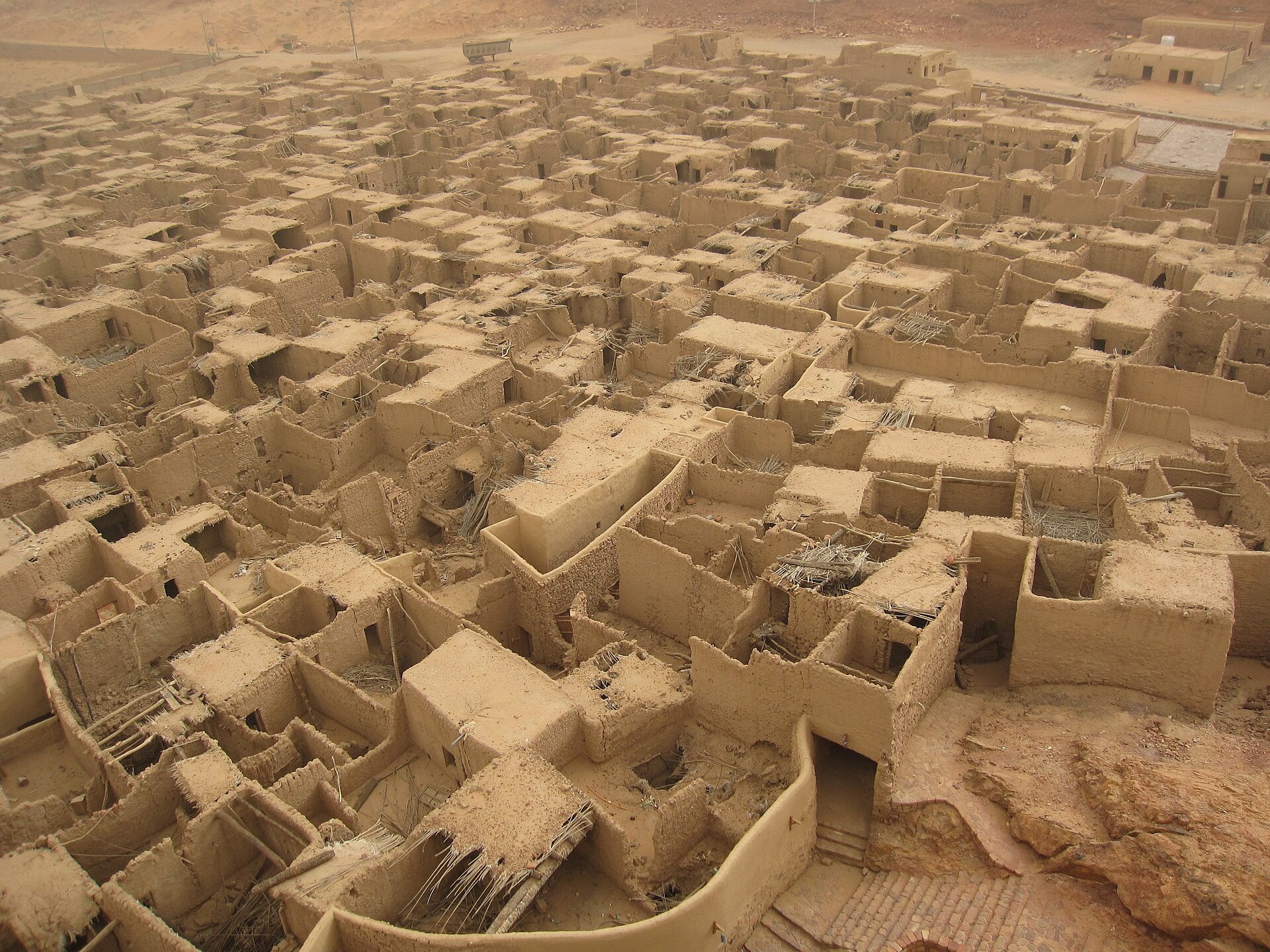
Hidden within the sandstone valleys of northwest Saudi Arabia, AlUla Old Town is one of the most remarkable — and least-visited — ancient urban sites in the Arabian Peninsula. A labyrinth of 900 mudbrick houses, five town squares, and covered alleys that once hummed with merchants, pilgrims, and desert travellers, this abandoned city is now quietly coming back to life. If you’re building a broader AlUla travel itinerary, the Old Town is not a side attraction — it is the emotional heart of everything AlUla stands for.
Best Time to Visit: October to March (cooler temperatures; Winter at Tantora festival runs December–January)
Getting There: AlUla Regional Airport (ULH) serves direct flights from Riyadh, Jeddah, and Medina; 4-hour drive from Medina, 10–12 hours from Riyadh
Visa Required: Yes — tourist e-visa, apply online before travel
Budget: Entry to the Old Town is free; guided rawi tours from SAR 70 (~USD 19) per person
Must-See: The Citadel (Qalat Mussa Ibn Nussair), Tantora sundial, Mosque of Bones (Masjid al-Itham)
Avoid: Visiting in the middle of the summer day — most shops open after 16:00; heat is intense from June to September
The History of AlUla Old Town
AlUla Old Town — known locally as Al-Deira — has been inhabited for at least a thousand years, with evidence of settlement from the 12th century CE onward. But the valley itself is far older: this is Wadi al-Qura, the “Valley of Villages,” mentioned in early Islamic records as a key waystation on the Damascus to Mecca pilgrimage road (the Darb al-Hajj).
The town grew steadily through the medieval period, fed by three streams of traffic: pilgrims making their way to Mecca and Medina, incense and spice traders moving goods from southern Arabia and the Indian Ocean world northward to Syria and Egypt, and regional farming communities who cultivated the fertile oasis floor with date palms, wheat, and fruit orchards.
The town’s position — squeezed between sheer sandstone cliffs on both sides — made defence straightforward. The citadel, perched on a natural rock outcrop at the centre of the settlement, commanded views up and down the valley for kilometres. Over centuries, the inhabitants built their homes literally onto each other, the outer walls merging into a single defensive perimeter. The result: a city whose architecture is its wall.
The Ottoman Connection
During the Ottoman period (16th–20th centuries), AlUla old town served as a garrison and administrative post along the Hijaz railway corridor. The Ottomans reinforced the citadel and established a presence here to protect the pilgrimage route — though AlUla always remained a largely local, tribal settlement rather than a major Ottoman city.
Abandonment in the 1980s
In the early 1980s, the Saudi government relocated the population of Old Town AlUla to a new modern settlement a few kilometres away, complete with electricity, running water, and paved roads. Within a few years, the Old Town was almost entirely empty. Without maintenance, the mudbrick walls began to melt in the rain and crumble in the wind. By the time heritage professionals first surveyed it in the 2000s, significant damage had already occurred.
Architecture and Urban Layout
Walking through AlUla Old Town is a lesson in vernacular desert architecture — buildings designed with climate, community, and defence in mind, using nothing but the materials found underfoot.
The Two Quarters
The Old Town is divided into two historic neighbourhoods separated by the central citadel:
- Al-Halaf Quarter — to the south of the citadel; the older, denser section with narrower lanes
- Ashqaiq Quarter — to the north; slightly more open, with wider alleys and larger market spaces
- Shorfat Tantora: Live music performed from the rooftops and balconies of AlJadidah, transforming the streets into an open-air amphitheatre
- Old Town Nights: Heritage storytelling and atmospheric fine dining at the historic fort
- Old Town Culinary Voyage: A guided food tour combining rawi storytelling with traditional dishes along the Incense Road
- AlManshiyah Carnival: A family-oriented festival space with traditional games, crafts, and parades
- Live Museum experiences: Interactive heritage demonstrations in partnership with UNESCO
- From Medina: approximately 330 km — a 3.5 to 4-hour drive via Highway 70, passing through Khaybar. This is a scenic route through basalt lava fields and desert plateau.
- From Riyadh: approximately 1,000 km — 10 to 12 hours by road. Breaking the journey with an overnight stop in Medina or Tabuk is advisable.
- From Tabuk: approximately 300 km — around 3 hours via Highway 375.
- Old Town walking area: Free entry; open year-round (most atmospheric in the evening hours)
- Guided rawi tours: SAR 70 per adult (~USD 19); book at the Old Town Visitor Centre or via the Experience AlUla app
- Citadel access: Accessible via the restored staircase; no additional charge
- Shops and restaurants: Most open from 16:00 onward (the heat makes daytime opening impractical for many vendors)
- AlUla dates: The valley produces some of the finest Sukkari and Medjoul dates in Arabia. Fresh dates sold in the Old Town market stalls are among the best you’ll find anywhere in Saudi Arabia.
- Local honey: Sidr honey from the AlUla region is prized across the Kingdom for its flavour and quality.
- Jareesh: A traditional dish of crushed wheat, slow-cooked with meat and spices — widely available in local restaurants.
- Harees: A wheat and meat porridge, typically eaten during special occasions; often available at festival food stalls.
- Stay on marked routes: The Old Town conservation work is ongoing. Areas under active restoration may be fenced off. Respect these boundaries — unsupported mudbrick walls can be unstable.
- Dress modestly: This is a heritage site with cultural significance. Both men and women should dress modestly — covered shoulders and knees at minimum. Women do not need to wear abaya here but modest dress is expected and respectful.
- Photography: The Old Town is one of the most photogenic sites in Saudi Arabia. Photography is freely permitted throughout the public areas. Avoid photographing local residents without permission.
- No litter: The site has limited waste facilities. Carry out what you bring in.
- Buy local: The handicrafts, dates, and honey sold in the Old Town shops are genuine local products. Purchasing them directly supports the community whose ancestors built the town.
- AlUla Travel Guide 2026 — The complete guide to visiting Saudi Arabia’s most spectacular ancient landscape
- Hegra (Madain Saleh): Saudi Arabia’s Petra — The Nabataean rock-cut tombs just 20km from AlUla Old Town
- Elephant Rock AlUla — The iconic natural rock formation and how to visit it
- Dadan Archaeological Site AlUla — The ancient pre-Islamic kingdom beneath AlUla’s valley floor
- Saudi Arabia Travel Guide 2026 — The complete guide to visiting the Kingdom
- Saudi Arabia Visa Guide — Every visa type explained, with step-by-step application instructions
Together they cover approximately 67,000 square metres of built-up area, containing 908 identified structures and more than 3,135 linear metres of streets and alleys. Around 260 of these passageways are covered (Tayara or Skifa) — enclosed overhead corridors that kept the lanes shaded and defensible.
Mudbrick Construction
The buildings are constructed from three primary materials: mudbrick (made from local clay mixed with straw), date palm wood (for door lintels, ceiling beams, and window frames), and cut sandstone (for foundations and the lower courses of walls). This combination was thermally brilliant — thick mudbrick walls kept interiors cool during the day and released stored heat at night.
Houses were typically two storeys. The ground floor contained the majlis (guest reception room) and storage; the upper floor had the kitchen and sleeping quarters. Livestock — typically goats — were kept in a small pen beneath the main staircase. About a quarter of Old Town properties include a Tayara: a projecting upper room built over the alleyway, connected to a neighbour’s house by an aerial passageway. These cantilevered rooms gave the narrow streets their distinctive covered character.
The Rahbas — Town Squares
AlUla Old Town has five rahbas (town squares or open gathering spaces) distributed through the urban fabric. These were the commercial and social heart of the settlement: places where caravans unloaded, where merchants set up stalls, where judgements were pronounced and marriages celebrated. Each rahba likely served a different function or a different tribe — the social geography of the town encoded in its spaces.
Key Landmarks Inside the Old Town
The Citadel — Qalat Mussa Ibn Nussair
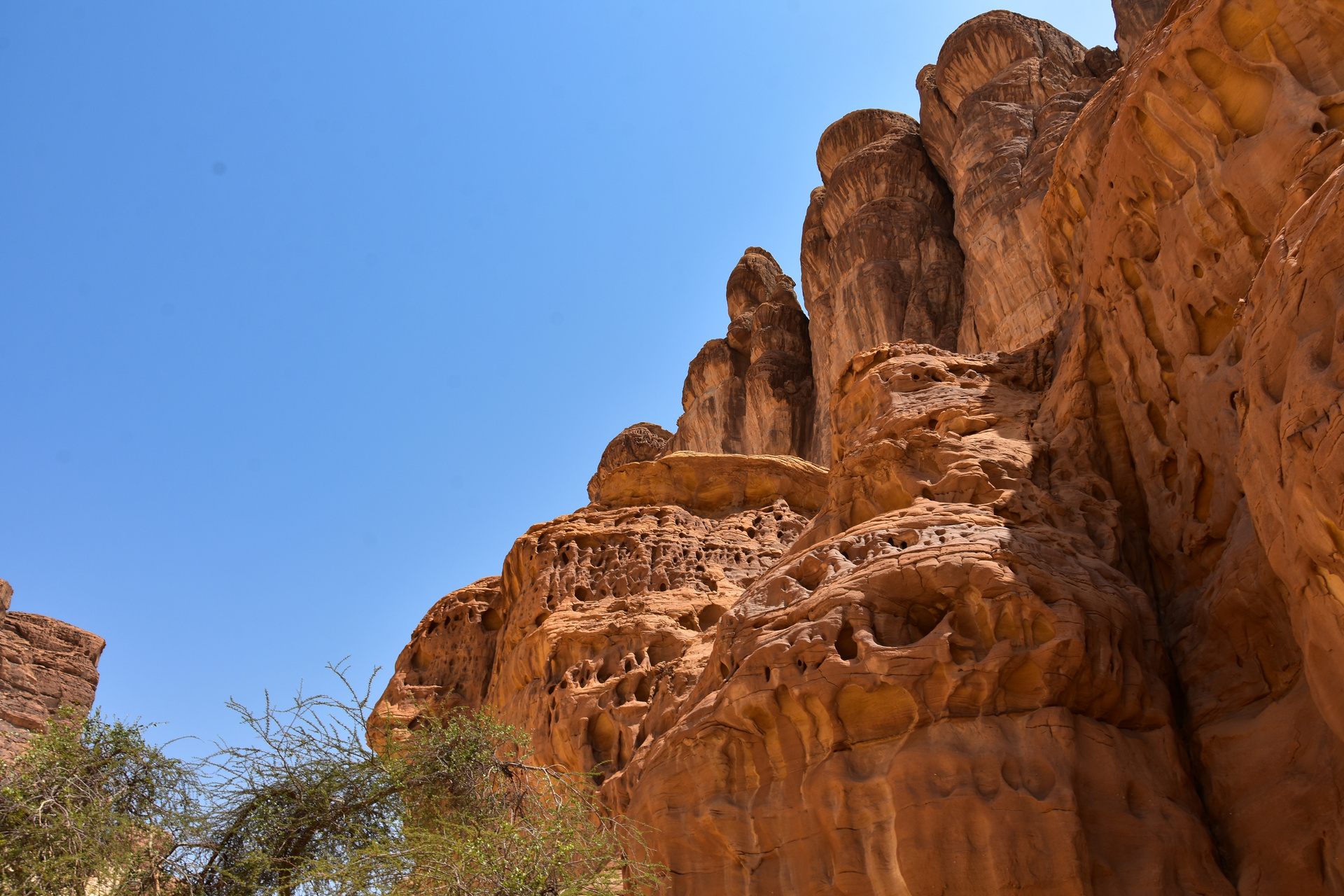
The Citadel sits on a natural sandstone outcrop at the narrowest point of the valley, roughly 45 to 50 metres above the town floor. It dominates the Old Town both physically and symbolically. The structure has been modified and rebuilt across many centuries; the earliest phases may date to the 10th century CE, with substantial work during the medieval Islamic and Ottoman periods.
The fort is named after Musa ibn Nusayr, the Arab general and governor who commanded Muslim forces during the early expansion into North Africa and Spain. Local tradition holds that he died in this valley. The citadel offers exceptional panoramic views: north and south along the full length of the oasis valley, and directly down into the labyrinthine streets below. It is accessible via a restored staircase from the Old Town floor.
The Tantora Sundial
Near the heart of the Old Town, a carved stone obelisk atop a low wall marks one of the most quietly significant objects in all of AlUla: the Tantora sundial. This ancient timekeeping device was used by the farming communities of the valley to mark seasonal transitions — specifically, the onset of winter planting when the Tantora’s shadow reached a particular point on the ground.
The Tantora gave its name to the annual Winter at Tantora festival, which AlUla hosts every December and January and which has transformed the Old Town into a venue for concerts, art installations, culinary experiences, and cultural performances. It is a direct, living connection between a centuries-old agricultural practice and contemporary Saudi cultural life.
Masjid al-Itham — The Mosque of Bones
In the southeast corner of the Old Town stands the Masjid al-Itham (sometimes translated as the Mosque of Bones). Islamic tradition holds that this marks the precise location where the Prophet Muhammad prayed during his passage through Wadi al-Qura on his journeys between Medina and the north. The bones in the name are believed to refer to animal bones used in the original structure’s foundations — a common construction technique in early Islamic buildings of the region.
For Muslim visitors this is a site of genuine spiritual significance — a quiet, unadorned space carrying the weight of early Islamic history. For all visitors it is a reminder that AlUla was not a backwater but a node in the interconnected world of early Islam.
The Incense Road Shops and Markets
The Old Town’s main commercial spine followed the ancient incense route northward through the valley. The 500+ shop spaces identified in modern surveys ranged from spice and incense traders to smiths, tanners, and textile merchants. Today, a selection of restored shops along the main walking route sell local handicrafts, dates, silver jewellery, and traditional perfumes — a direct echo of the town’s medieval commercial character.
The Restoration Programme
Since Saudi Arabia opened to international tourism in 2019 and the Royal Commission for AlUla (RCU) took on a sweeping mandate to develop the region, the Old Town has been the subject of a substantial, carefully managed conservation project.
Working with heritage consultancies and guided by traditional craft knowledge, the RCU has so far conserved approximately 250 of the 900 structures. The approach is deliberately conservative: original mudbrick is retained wherever structurally possible; new mudbrick made from local clay is used for infill where material has been lost. Synthetic materials are avoided.
Some buildings have been adaptively reused: a small eco-resort occupies a cluster of restored houses; atmospheric restaurants operate within refurbished structures; art galleries and pavilions selling local crafts have opened in former commercial spaces. The aim is to return some life to the Old Town — not to freeze it as a pure museum, but to let it function again as a place where things happen.
In partnership with UNESCO, the RCU launched a Live Museum concept in the 2025–26 season: an on-site interpretive experience that brings local knowledge-holders into the Old Town to demonstrate crafts, recite oral history, and cook traditional dishes. This represents a significant step beyond standard heritage tourism — it acknowledges that the most valuable thing about the Old Town is not the mud and stone but the living knowledge that built it.
The Rawis — AlUla’s Storyteller Guides
The most distinctive feature of visiting AlUla Old Town is the opportunity to explore with a rawi — a traditional Arabic storyteller who has been trained specifically in the oral history, legends, and cultural knowledge of this valley.
Rawis have existed in Arabic oral culture for millennia: the rawi was the transmitter of poetry, genealogy, and collective memory in pre-literate societies. In AlUla, young local people have been trained as skilled rawis, turning what could be a standard guided tour into something much closer to an encounter with living history. Your rawi will describe not just who built the house you’re standing in, but why the doorway faces a particular direction, what family lived there, what they traded, and what happened to them when the town was abandoned.
Guided rawi tours can be booked through the Old Town Visitor Centre and typically last around one hour. The fee is approximately SAR 70 per adult (~USD 19). Self-guided walking routes with information signage are also available at no charge.
Winter at Tantora Festival
AlUla Old Town is at its most spectacular during the annual Winter at Tantora festival, which runs from mid-December to early January each year. The 2025–26 edition ran from 18 December 2025 to 10 January 2026.
The festival uses the Old Town — and the adjacent AlJadidah Arts District — as its primary venue. Key events include:
The Winter at Tantora season dramatically increases the energy and atmosphere of the Old Town. If your travel dates allow it, visiting during this period is strongly recommended — though accommodation prices and demand spike accordingly, so book well in advance.
AlJadidah Arts District
Immediately adjacent to the Old Town, the AlJadidah Arts District is a cluster of restored historic buildings that has been repurposed as AlUla’s cultural hub. Galleries, studios, restaurants, and boutique shops occupy former merchant houses and storage buildings. AlJadidah is less austere than the Old Town proper — it is designed to be visited and enjoyed, with more active commercial life.
The two areas complement each other: the Old Town for the raw, atmospheric encounter with AlUla’s deep history; AlJadidah for the contemporary cultural life that is growing around it. Free parking is available at both the Old Town South Parking and the larger North Parking near AlJadidah, with shuttle services running between the parking zones and both sites.
Practical Information: Getting There and Getting Around
Getting to AlUla
AlUla is served by AlUla Regional Airport (ULH), with direct flights from Riyadh, Jeddah, Medina, and Dubai operated by Saudia, flynas, and flyadeal. Flight times: approximately 1 hour 45 minutes from Riyadh, 1 hour from Jeddah, and 45 minutes from Medina.
Overland options:
You will need a valid Saudi Arabia tourist e-visa before travelling. The e-visa is available online through the official Saudi portal and takes 24–72 hours to process. Citizens of most Western countries, the GCC, and many Asian nations are eligible.
Getting Around AlUla
The Old Town itself is a compact walking site. A self-guided tour of the main route takes 60–90 minutes; a rawi-guided tour takes around 60 minutes. The site is on flat ground though the alleyways are uneven underfoot — closed shoes are advisable.
For reaching other sites in the wider AlUla region — Hegra (Madain Saleh), Elephant Rock, and Dadan — a rental car gives the most flexibility. Careem operates in AlUla for shorter trips. The RCU also operates scheduled shuttle buses between the main heritage sites during the winter season.
Opening Hours and Entry Fees
Practical tip: Visit the Old Town in the late afternoon. Arrive around 15:30–16:00 when temperatures begin to drop, tour the lanes before sunset, then watch the light turn the sandstone walls golden-red as dusk approaches. This is also when the shops open and the site comes alive.
Best Time to Visit
The ideal window is October to March. Daytime temperatures during this period range from 15°C to 28°C — comfortable for walking an outdoor site. The Winter at Tantora festival (mid-December to early January) adds cultural programming. April and May are transitional — still manageable. June to September is extremely hot (35°C–45°C+) and most outdoor activities are not recommended during daylight hours.
Where to Stay Near AlUla Old Town
AlUla has developed a distinctive accommodation offering that leans heavily into its landscape and heritage.
Dar Tantora the House Hotel
Dar Tantora is the most directly connected accommodation: a boutique hotel built into restored houses within the Old Town itself. Rooms are contained within the original mudbrick structures, with modern facilities integrated sensitively. Staying here means waking up inside the Old Town before day visitors arrive — a genuinely different experience. It is the only accommodation actually within the historic fabric.
Shaden Resort
Shaden Resort is AlUla’s flagship luxury property: a landscape resort built into the valley floor between sandstone outcrops. The resort’s chalets and villas are designed to blend into the rock formations. It is approximately 10 minutes by car from the Old Town.
Banyan Tree AlUla
Banyan Tree AlUla is a tented luxury camp in the open desert landscape, around 20 minutes from the Old Town. Part of Banyan Tree’s Desert Collection, it provides a high-end glamping experience in a dramatic setting.
Note on booking: AlUla accommodation is in high demand from October to March and particularly during Winter at Tantora. Book 3–6 months in advance if visiting in December or January. Prices drop significantly from April onward.
What to Eat in and Around AlUla Old Town
The restored shops and restaurants of AlJadidah and the Old Town offer a genuinely local dining experience centred on the agricultural wealth of the oasis.
The Old Town Culinary Voyage tour (part of the Winter at Tantora programme) is the best structured way to eat your way through the site with cultural context provided by a rawi guide.
AlUla Old Town vs. Other Saudi Heritage Sites
| Site | Type | Era | Accessibility | Best For |
|---|---|---|---|---|
| AlUla Old Town | Islamic-era mudbrick city | 12th–20th c. CE | Free walk-in; rawi tours | Urban history, vernacular architecture |
| Hegra (Madain Saleh) | Nabataean rock-cut tombs | 1st c. BCE–1st c. CE | Ticketed; guided only | Ancient civilization, UNESCO heritage |
| Dadan Archaeological Site | Pre-Islamic ancient kingdom | 9th–4th c. BCE | Developing access | Earliest Arabian civilizations |
| Elephant Rock | Natural rock formation | N/A (geological) | Free; road access | Photography, landscape |
AlUla Old Town occupies a unique niche among these sites: it is the only one that represents continuous human habitation from the early Islamic period through to the 20th century. Where Hegra tells the story of a civilization that vanished, the Old Town tells the story of communities that persisted — adapting, trading, and surviving — across a thousand years of desert life. As part of a full Saudi Arabia travel itinerary, it provides a human-scale complement to the overwhelming grandeur of Hegra.