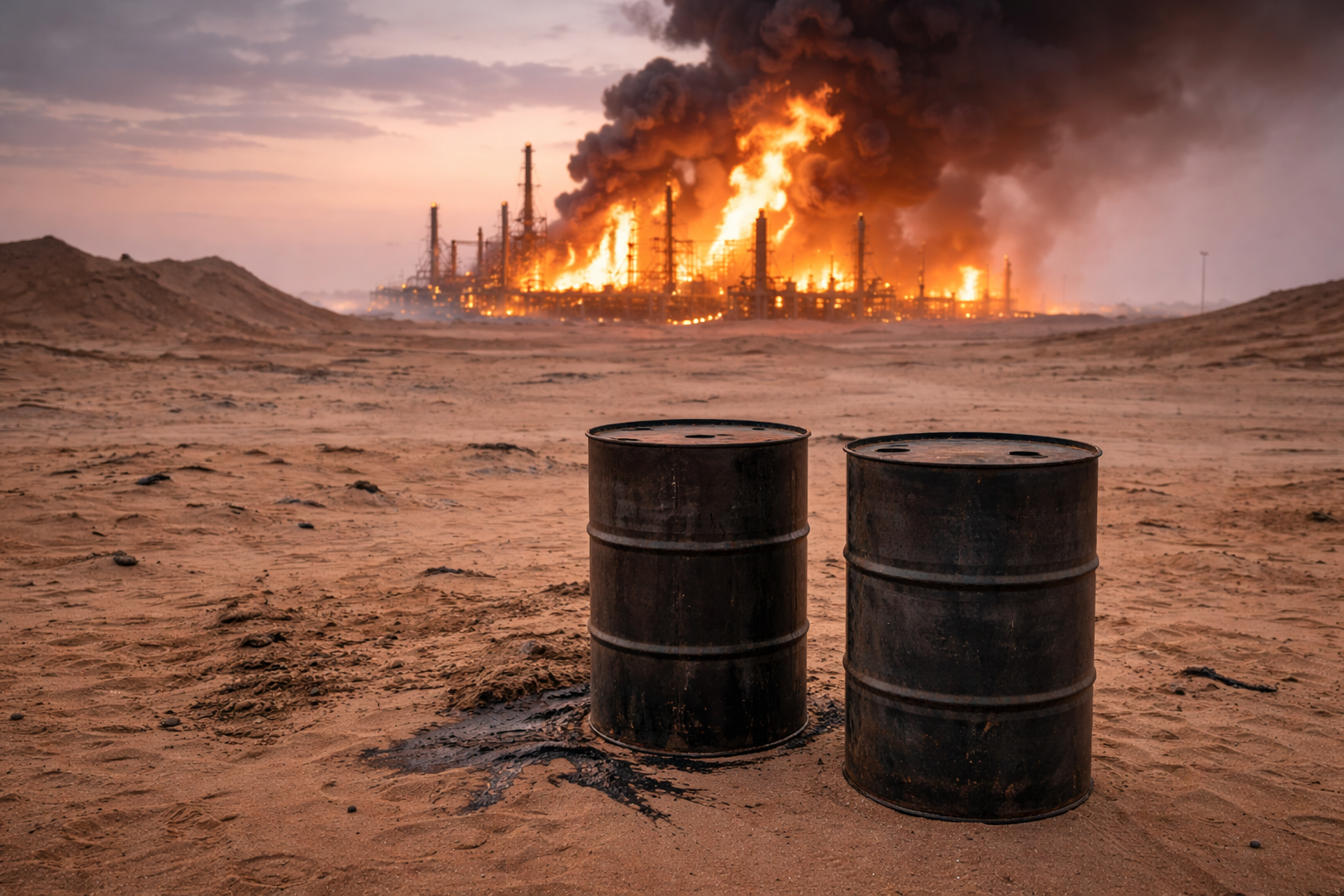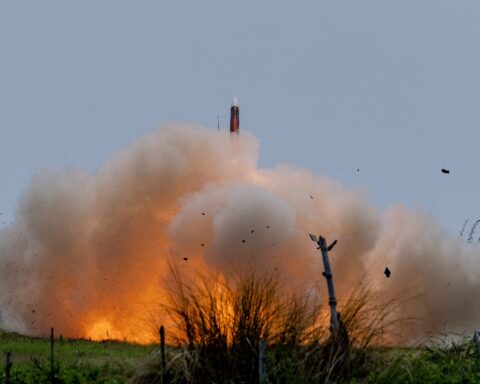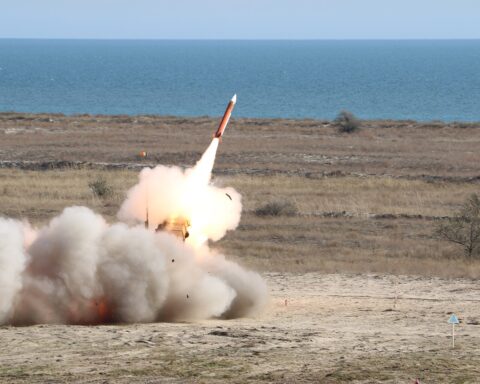

Seventy-two hours ago, American B-2 bombers and Israeli F-35s began dismantling Iran’s nuclear infrastructure in what Washington called Operation Epic Fury and Jerusalem branded Operation Roaring Lion. The strikes killed Supreme Leader Ali Khamenei, flattened enrichment facilities at Natanz and Fordow, and cratered military airfields from Isfahan to Bandar Abbas. For a brief window — perhaps eighteen hours — the operation looked like a contained, bilateral affair: two advanced militaries systematically degrading a third.
That window is now closed.
By the morning of March 2, the war has metastasized into at least five distinct theaters. Hezbollah has shattered the Lebanon ceasefire — and by 12 March, it had fired 200 rockets at Israel in a single night in what Iran called a joint integrated operation. Houthis have resumed attacks on Red Sea shipping. Iraqi militias are launching drone swarms at American bases. A suspected Iranian one-way attack drone has struck a British military installation in Cyprus — the first kinetic hit on a NATO facility in this conflict. And the strikes on Iran itself continue.
The “axis of resistance” — the interlocking network of Iranian-backed armed groups that Tehran spent four decades constructing — is activating exactly as it was designed to. Not in a panicked, disorganized spasm, but in a coordinated escalation across multiple fronts, each calibrated to impose distinct costs on different adversaries simultaneously.
The question confronting decision-makers in Washington, Jerusalem, Riyadh, and London is no longer whether the strikes can degrade Iran’s nuclear program. That mission is well advanced. The question is whether anyone can contain what they have unleashed.
Hezbollah Breaks the Ceasefire
In the early hours of March 2, air raid sirens sounded across Haifa and the Upper Galilee for the first time since November 2024. Hezbollah launched a salvo of projectiles and attack drones into northern Israel, shattering the US-brokered ceasefire that had held — imperfectly, but held — for fifteen months.
The Israel Defense Forces confirmed that air defense systems intercepted at least one rocket. Others fell in open areas without causing casualties. Within hours, the IDF struck Hezbollah targets across southern Lebanon and the Bekaa Valley. The familiar rhythm of cross-border escalation returned to the Levant as though it had never left.
What distinguished this from past Hezbollah provocations was the accompanying statement. The organization did not frame the attacks as a limited reprisal or a symbolic gesture of solidarity with Tehran. Hezbollah’s operations command declared an “open-ended battle” with Israel — language deliberately chosen to signal sustained commitment rather than a single retaliatory cycle.
The political damage extends beyond the kinetic. The November 2024 ceasefire was one of the Trump administration’s genuine diplomatic achievements, negotiated through intensive back-channel engagement after Israel’s devastating ground incursion into southern Lebanon. Hezbollah has now destroyed that achievement in a single night, and with it, one of the few stabilizing arrangements in the region.
The Lebanon front is arguably the most dangerous of the five now active. Hezbollah possesses precision-guided munitions capable of reaching Tel Aviv, a deep arsenal of anti-ship missiles, and — despite the losses of 2024 — a ground force that remains the most capable non-state military in the world. The killing of Hassan Nasrallah in an Israeli airstrike in September 2024 was supposed to be a decapitation strike. Hezbollah grieved, reorganized, and reconstituted under Secretary-General Naim Qassem. The November ceasefire gave it time to rearm. That time, it appears, was well spent.
Israel now faces the scenario its military planners have long dreaded: a multi-front war in which the northern front demands resources and attention precisely when operations against Iran require maximum force projection eastward. The IDF is a formidable institution, but even formidable institutions have finite capacity. Reservists already mobilized for the Iran campaign may now be needed on the Lebanese border. Iron Dome and David’s Sling batteries positioned to defend against Iranian ballistic missiles must now divide their coverage to address the Hezbollah threat from the north. Every interceptor fired at a Hezbollah rocket is one fewer available for the next Iranian salvo.
There is a broader strategic dimension to Hezbollah’s decision. By breaking the ceasefire now, Qassem is betting that Israel cannot sustain two high-intensity operations simultaneously — and that Washington, which brokered the ceasefire, lacks the bandwidth to enforce it while managing a war against Iran. It is a calculated gamble, and the early evidence suggests it may be well-founded. The Biden-era diplomatic infrastructure that produced the November 2024 agreement no longer exists. The Trump administration, consumed by the Iran operation, has neither the personnel nor the inclination to resurrect it.
The Houthi Resurrection
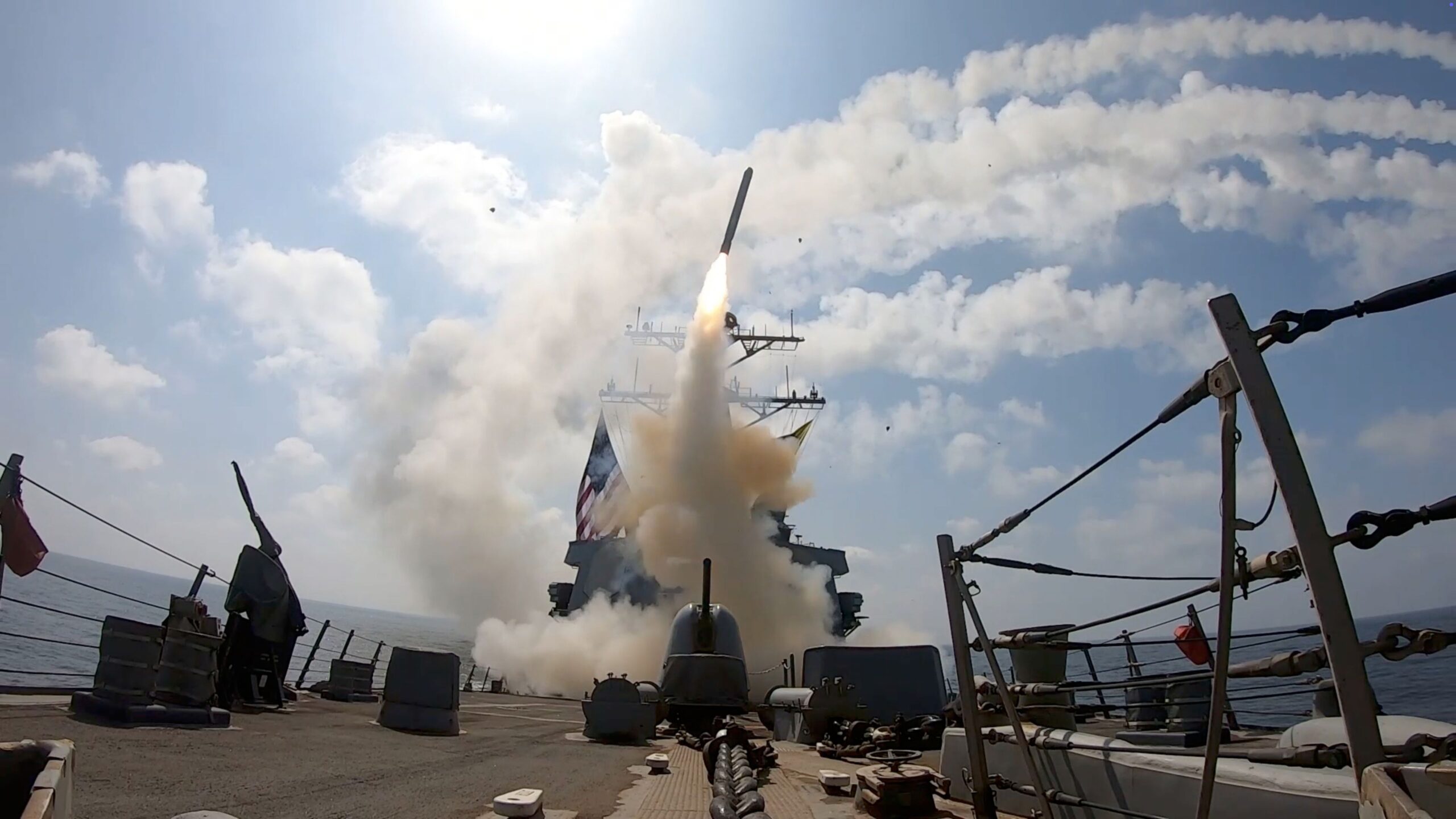
On February 28 — the same day the first strikes hit Iran — Ansar Allah, the Houthi movement controlling most of Yemen, announced it would resume missile and drone attacks on US and Israeli-flagged vessels transiting the Red Sea and the Bab el-Mandeb Strait. The announcement was delivered with the understated confidence of a force that has done this before and knows exactly what it can accomplish.
The timing was not coincidental. The Houthis had largely paused their Red Sea campaign following the October 2025 Gaza ceasefire, a de-escalation that allowed a tentative return of commercial shipping through one of the world’s most critical maritime corridors. Maersk, the Danish shipping giant that had rerouted its entire fleet around the Cape of Good Hope in early 2024, had resumed Red Sea transits in January 2026. That resumption now appears premature.
Combined with the effective closure of the Strait of Hormuz — a near-certainty as Iranian naval forces and coastal missile batteries remain on high alert — the Houthi resumption creates an unprecedented dual chokepoint crisis. There is, at this moment, no safe commercial shipping route through the greater Middle Eastern maritime zone. The Red Sea is contested. The Persian Gulf approaches are contested. The global supply chain, which depends on approximately 20 percent of the world’s oil and 12 percent of its traded goods passing through these waters, faces disruption on a scale not seen since the tanker wars of the 1980s — and potentially far worse.
The Houthis are, in many respects, the most frustrating adversary in the Iranian proxy network. Years of sustained bombing campaigns — first by the Saudi-led coalition from 2015 to 2023, then by the US-led Operation Prosperity Guardian in 2024 — failed to meaningfully degrade their capabilities. They demonstrated throughout 2024 that a relatively modest force armed with Iranian-designed drones and ballistic missiles can effectively shut down global shipping through sheer persistence and geographic advantage. No amount of carrier-based air power has solved this problem, because the problem is not primarily military. It is a function of geography, asymmetry, and the inescapable mathematics of defending thousands of commercial vessels against an adversary that needs only to hit one.
Insurance premiums for Red Sea transits, which had only recently begun to normalize, will spike within days. Rerouting around the Cape of Good Hope adds ten to fourteen days to Europe-Asia voyages and roughly $1 million per transit in fuel costs alone. The inflationary effects, still being felt from the 2024 disruption, will compound rapidly.
The dual chokepoint crisis represents something genuinely new in the modern history of maritime commerce. During the 2024 Houthi campaign, the Strait of Hormuz remained open, providing an alternative — if circuitous — route for some traffic. Now both arteries are threatened simultaneously. European energy markets, already anxious about the Iran strikes, face the prospect of sustained supply disruption with no easy workaround. Asian economies dependent on Gulf oil — China, Japan, South Korea, India — confront the same calculus. The economic front of this war may ultimately prove more consequential than any of the kinetic ones.
Iraqi Militias Strike Erbil
The Islamic Resistance in Iraq — the umbrella coordination framework for Iran-aligned militias operating on Iraqi soil — announced the commencement of formal operations against American forces within hours of the strikes on Iran. The declaration was not a surprise. The surprise was the speed and scale of execution.
By March 1, the coalition had claimed over a dozen drone attacks on US military installations across Iraq. Saraya Awliya Al-Dam, one of the more operationally aggressive factions, launched a swarm drone attack on the American presence at Erbil’s military airfield, sending multiple explosive-laden unmanned aerial vehicles toward the base in a coordinated pattern designed to overwhelm point defenses. Erbil air defense systems intercepted the drones. No casualties were reported at the base.
Three major Shia militia formations — Kataib Hezbollah, Harakat Al-Nujaba, and Kataib Sayyed Al-Shuhada — each released separate statements announcing sustained operational campaigns against American targets. These are not fringe organizations. They are battle-hardened formations with tens of thousands of fighters, heavy weapons, and command-and-control infrastructure built with direct Iranian assistance over two decades.
Not all attacks were intercepted. An airstrike in eastern Iraq — likely American — killed four paramilitary fighters on March 1, confirming that the US is conducting kinetic operations against the militias even as it wages war on their patron state. And in the most consequential incident of the Iraqi front so far, three US service members were killed at a base in Kuwait by a suspected drone strike, with five more seriously wounded. The Pentagon has not formally attributed the attack, but the operational signature matches Iraqi militia capabilities, and Kuwait sits within range of multiple Iran-aligned groups operating in southern Iraq.
The Erbil attacks carry particular geopolitical sensitivity. The Iraqi Kurdistan Region maintains a strategic relationship with Washington that predates the 2003 invasion, and Erbil serves as a critical node in the American military architecture across the region. Attacks on Erbil are not merely attacks on a base; they are attacks on one of America’s few reliable partnerships in Iraq, and they carry implicit threat to the Kurdish political order that Washington has underwritten for decades.
Iraq’s militia landscape is vast and resistant to simple characterization. The Popular Mobilization Units — the umbrella paramilitary structure formalized after the rise of the Islamic State — encompasses over sixty distinct groups, many with Iranian training, weapons, funding, and in some cases direct command-and-control links to the Islamic Revolutionary Guard Corps. They are embedded in Iraqi society, integrated into the Iraqi state security apparatus, and possess direct battlefield experience from the grinding campaign against ISIS. They are not insurgents. They are a parallel army.
The Iraqi government in Baghdad finds itself in an impossible position. Prime Minister Mohammed Shia’ al-Sudani presides over a coalition that includes Iran-aligned political blocs whose armed wings are now attacking American forces stationed in Iraq at Baghdad’s invitation. The fiction that the PMU is a disciplined arm of the Iraqi state, answerable to the prime minister’s office, has been exposed as exactly that — a fiction. Al-Sudani can neither order the militias to stop nor afford to be seen trying. Iraq is simultaneously an American ally and a staging ground for attacks on American personnel. This contradiction has defined Iraqi politics for two decades. It has never been sharper than it is today.
The Cyprus Strike — NATO’s Red Line
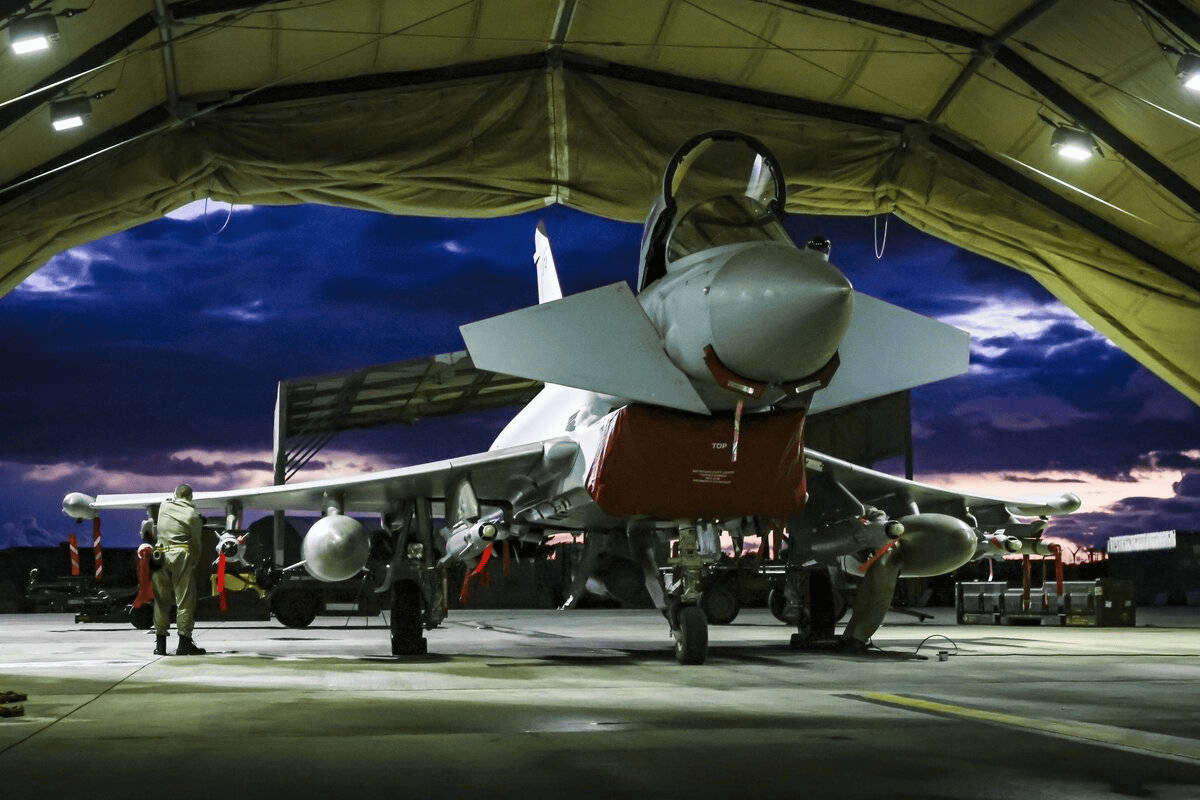
Around midnight on March 2, a drone impacted the perimeter of RAF Akrotiri, the British Sovereign Base Area on the southern coast of Cyprus. The UK Ministry of Defence confirmed the strike in a terse statement: minor damage to infrastructure, no casualties, force protection levels raised to the highest tier. The drone is suspected to be a Shahed-136 — the delta-wing one-way attack munition that has become the signature weapon of Iranian power projection, employed extensively in Ukraine, Yemen, and now, apparently, against NATO.
The kinetic effect was negligible. The political effect is seismic.
This is the first strike on a NATO member’s military facility in the context of this conflict. RAF Akrotiri has served as a staging point for British and allied operations in the Middle East for decades, and it has been used during the current crisis to support logistics and intelligence functions. Its targeting was not random. It was a deliberate message: Iran’s reach extends beyond the Middle East, and the states enabling the strikes on Tehran are not beyond retaliation.
The immediate question in London and Brussels is whether this constitutes grounds for invoking Article 5 of the NATO treaty — the collective defense clause that treats an attack on one member as an attack on all. The realistic answer is almost certainly no. The damage was minor, the base is a legacy colonial installation on a Mediterranean island, and no NATO government has an appetite for a formal Article 5 invocation that would obligate the entire alliance to a military response against Iran. But the political dynamics are volatile. The British public, already skeptical of involvement in another Middle Eastern conflict, will demand an accounting. The opposition will demand a response. And the precedent has been set: Iran is willing to strike NATO assets directly.
The Akrotiri strike also raises uncomfortable questions about air defense coverage in the Eastern Mediterranean. If a single Shahed-136 — a slow, relatively low-technology platform — can reach a major British military installation, the implications for civilian infrastructure on Cyprus, Crete, and the Greek islands are sobering. The Eastern Mediterranean was not designed to be a contested battlespace. It is rapidly becoming one.
The strike’s origin remains under investigation. The Shahed-136 has a range of approximately 2,500 kilometers, meaning it could have been launched from Iranian territory, from a proxy position in Syria, or even from a maritime platform. Each possibility carries different implications. A launch from Iran proper would represent a direct attack by a state on a NATO installation. A launch from Syria would implicate whatever remains of the Assad-era military infrastructure. A maritime launch would suggest a level of operational sophistication that Western intelligence has not previously attributed to Iran’s drone program. None of these possibilities is reassuring.
What is clear is that the Cyprus strike has expanded the conflict’s geographic footprint into Europe’s strategic backyard. NATO allies that had treated the Iran operation as a distant affair — tolerable, perhaps even welcome, so long as it remained confined to the Persian Gulf — must now reckon with the possibility that the war will find them whether they seek it or not.
The Architecture of Resistance
What the world is witnessing across these five fronts is not improvisation. It is the activation of a system designed over forty-five years to produce exactly this outcome.
Iran’s proxy network — what Tehran calls the “axis of resistance” and what Western intelligence services have spent decades mapping — was built on a single strategic premise: that Iran, as a conventionally inferior military power, could deter and retaliate against superior adversaries by maintaining the capacity to ignite multiple conflicts simultaneously across the region. The network was not an afterthought or an ideological vanity project. It was the core of Iranian strategic doctrine.
The architect was Qasem Soleimani, commander of the IRGC’s Quds Force, who spent two decades knitting together Hezbollah, the Houthis, Iraqi militias, Palestinian factions, and Syrian loyalists into an interconnected but distributed system. Soleimani’s killing by an American drone strike in January 2020 was supposed to unravel this network. It did not. His successor, Esmail Qaani, maintained the structure with lower charisma but adequate competence. The system, it turned out, was not personality-dependent. It was institutional.
The critical design feature is semi-autonomy. Each node in the network — Hezbollah, the Houthis, the Iraqi militias — operates with its own arms production, its own training infrastructure, its own intelligence apparatus, and its own tactical command structure. They share ideology, receive Iranian weapons and funding, coordinate at the strategic level, and occasionally conduct joint operations. But they do not require real-time direction from Tehran to function. They were built to survive exactly this scenario: the destruction of the center.
Hezbollah is the crown jewel — a state-within-a-state in Lebanon with a conventional military capability that exceeds most national armies in the region. The Houthis proved their resilience across eight years of coalition warfare, absorbing thousands of airstrikes while expanding their missile arsenal and operational reach. The Iraqi militias number in the hundreds of thousands and possess direct battlefield experience from the existential war against the Islamic State — experience that included combined arms operations, urban warfare, and the integration of drone and missile systems into ground campaigns.
The irony that now confronts American and Israeli planners is stark. The strikes on Iran were designed, in part, to decapitate the leadership that directs this network. Khamenei is dead. The IRGC command structure is degraded. But the proxies are not leaderless — they are unleashed. The destruction of the center has not paralyzed the periphery. It has liberated it. And forces that operate without central control are, in some respects, more dangerous than forces that operate with it, because there is no one to negotiate with, no single authority that can order a stand-down, no phone that rings in a capital when it is time to stop.
Western military doctrine has long held that destroying an adversary’s command-and-control capability degrades its ability to fight. This is true for conventional armies. It is precisely wrong for distributed networks designed to operate without central direction. The axis of resistance is not an army with a general staff. It is a franchise operation — and franchises survive the bankruptcy of the parent company.
What This Means for Saudi Arabia
For the Kingdom of Saudi Arabia, the activation of Iran’s proxy network creates a threat environment of exceptional complexity — one that Crown Prince Mohammed bin Salman anticipated in broad terms but may have underestimated in its specifics.
Saudi Arabia is already a direct target in this conflict. As House of Saud reported in detail, Iranian ballistic missiles struck Saudi territory in the opening phase of the crisis — a direct consequence of the Kingdom’s alignment with the US-Israeli operation. The dual-track strategy that MBS pursued in the lead-up to the strikes — privately signaling support for the operation while publicly maintaining diplomatic distance — has collapsed under the weight of Iranian retaliation. There is no ambiguity left. Saudi Arabia is a combatant.
The proxy dimension compounds the direct threat manyfold. The Houthis sit on Saudi Arabia’s southern border, and they have demonstrated — most memorably in the September 2019 attack on Aramco facilities at Abqaiq and Khurais — that they can strike deep into Saudi territory with precision sufficient to disrupt critical energy infrastructure. The resumption of Houthi operations against Red Sea shipping is a problem for global commerce, but Houthi missile and drone capabilities directed northward are an existential concern for the Kingdom. The defense of Saudi oil infrastructure, desalination plants, and population centers against a sustained Houthi campaign will demand enormous resources from the Saudi armed forces.
To the north, Iraqi militias with demonstrated reach and Iranian backing present a second axis of threat. The geography is less favorable for the militias — the distances are greater and the terrain less forgiving — but the proliferation of long-range drone systems has eroded the protective value of geography across the entire region.
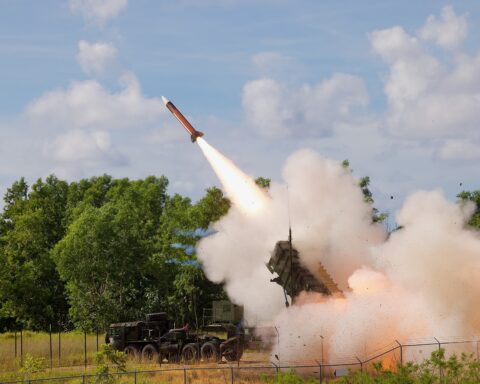
Prince Khalid bin Salman, the Minister of Defense, faces the operational challenge of defending the Kingdom on multiple vectors simultaneously while supporting — at least logistically — the broader coalition effort against Iran. Saudi air defenses, bolstered by significant American-supplied Patriot and THAAD batteries, are among the most capable in the region. But the 2019 Aramco attack demonstrated that even advanced air defense systems have gaps, and the volume of potential threats from both Yemen and Iraq could strain even well-resourced defenses.
The strategic calculation that MBS made — that the benefits of eliminating Iran’s nuclear capability outweighed the risks of proxy retaliation — is now being tested in real time. The Crown Prince lobbied privately for the strikes, calculating that a nuclear-armed Iran posed a greater long-term threat than anything the proxies could deliver. That calculation may ultimately prove correct. But the short-term costs are mounting rapidly, and the Vision 2030 economic transformation that defines MBS’s legacy depends on a degree of regional stability that has, as of this morning, evaporated entirely. With Iran’s unprecedented attack now spanning all six Gulf states simultaneously, the GCC faces its most dangerous war decision since 1990 — and MBS’s private lobbying for strikes has placed Saudi Arabia at the centre of that reckoning.
Foreign direct investment, tourism development, the NEOM megaproject, the planned IPO pipeline — all of it requires investor confidence that the Kingdom is a stable environment for capital deployment. Missile strikes on Saudi soil and Houthi attacks on Red Sea shipping are not conducive to that confidence. King Salman built the foundation for the Kingdom’s modernization on the premise that security and prosperity were mutually reinforcing. His son must now demonstrate that the premise holds under conditions its architects never fully anticipated.
The Five-Front Problem
Step back from the individual theaters and the strategic picture is sobering.
The United States and Israel are now engaged, directly or indirectly, in five simultaneous conflicts: continued strike operations against Iran’s nuclear and military infrastructure; a renewed war with Hezbollah across the Lebanese border; a maritime campaign against Houthi forces in Yemen and the Red Sea; a counter-militia fight across Iraq and potentially Kuwait; and the defense of allied installations — including, now, NATO facilities — against Iranian long-range strike systems.
No military alliance in modern history has successfully managed five simultaneous fronts over a sustained period. The United States possesses unmatched power-projection capability, and Israel fields the most technologically advanced military in the Middle East. But capability is not the constraint. Attention is. Political will is. Each front demands intelligence resources, command bandwidth, diplomatic management, and domestic political capital. These are finite commodities, and they are being consumed at an accelerating rate.
President Trump told the American public the operation would last “four weeks or less.” That timeline was plausible — perhaps even conservative — for the strikes on Iran alone. It is a fantasy for the multi-front conflict that now exists. Proxy wars do not observe deadlines. They do not respond to declarations of victory. The United States spent twenty years learning this lesson in Afghanistan and Iraq, at a cost of trillions of dollars and thousands of lives. The lesson, it appears, requires periodic re-learning.
The deeper problem is structural. The US-Israeli strikes were designed to solve a specific problem — Iran’s advancing nuclear capability — through the application of overwhelming conventional force. On those terms, the operation is succeeding. Centrifuges are destroyed. Research facilities are rubble. The nuclear timeline has been set back by years, possibly a decade. But the operation was not designed to solve the proxy problem, because the proxy problem is not solvable through airstrikes on Iran. The proxies exist precisely to impose costs that cannot be avoided by destroying the patron state. They are the insurance policy, and the policy is now paying out.
There is a final irony embedded in this crisis. The axis of resistance was built on the premise that the Middle Eastern order is illegitimate and that armed resistance is the only path to justice. For decades, that premise attracted recruits but limited political support. The destruction of Iran — the region’s most prominent voice of defiance against American hegemony, whatever one thinks of its methods — will not discredit that premise. It will validate it in the eyes of millions. Every missile that falls on Tehran, every image of Iranian civilians in rubble, every funeral broadcast on Al Manar and Al Masirah, feeds a narrative that has proven remarkably resistant to military defeat.
You can destroy a nuclear facility. You can kill a supreme leader. You can crater every airfield between Isfahan and the Caspian Sea. What you cannot destroy is the conviction, held by armed men from Beirut to Sana’a to Baghdad, that this war is not Iran’s alone. That conviction is activating now, across five fronts, with no ceasefire in sight and no diplomatic architecture capable of producing one.
The operation was called Roaring Lion. The lion roared. And the entire forest answered.