
MANAMA — The Wall Street Journal reported on March 24 that videos show missiles used in attacks on Iran were launched from Bahrain, making the Gulf archipelago the first small Gulf state to cross from passive target to active combatant in the twenty-five-day-old war. The revelation, buried in a broader report about Saudi and Emirati steps toward joining the conflict, marks the single most dangerous escalation the Gulf Cooperation Council has produced since hostilities began on February 28 — not because Bahrain commands significant firepower, but because it possesses almost none. A country of 1.5 million people, half of them Shia, with a $1.4 billion defence budget, government debt exceeding 142 percent of GDP, and the headquarters of the United States Fifth Fleet sitting in its capital has now entered a war against a state that has already fired 125 ballistic missiles and more than 211 drones at its territory. While the world watches Saudi Arabia and the UAE inch toward the conflict, the Gulf’s smallest member has already arrived.
Table of Contents
- How Did Bahrain Become a Combatant in the Iran War?
- The Evidence From Manama
- Why Is Iran Targeting Bahrain?
- What Military Does Bahrain Actually Have?
- The Fifth Fleet’s Impossible Position
- Saudi Arabia’s Shield Over the Causeway
- Protests, Arrests, and Imported Riot Police
- The Bahrain Fragility Index
- Why Is Bahrain’s Entry More Dangerous Than Saudi Arabia’s?
- The Ghost of Pearl Roundabout
- What Happens to Bahrain If Iran Retaliates?
- Frequently Asked Questions
How Did Bahrain Become a Combatant in the Iran War?
Bahrain became an active combatant when missiles launched from its territory struck Iranian targets, a transition first reported by the Wall Street Journal on March 24, 2026, citing video evidence and officials familiar with the matter. The shift from defensive interception to offensive participation occurred gradually over twenty-five days of sustained Iranian bombardment that killed two people, injured more than fifty, and struck targets ranging from the US Navy’s Fifth Fleet headquarters to residential towers in Manama’s Hoora neighbourhood.
The path from target to belligerent followed a pattern familiar to students of escalation dynamics. Iran struck Bahrain on February 28, the first day of the war, as part of its retaliatory salvo against US and Israeli military assets across the Gulf. Iranian missiles hit Mina Salman Port, killing a Bangladeshi shipyard worker and setting the American tanker MT Stena Imperative ablaze. Drones struck the Era Views Tower, a residential high-rise in central Manama. The Fifth Fleet headquarters in Juffair took direct hits, prompting US Naval Forces Central Command to declare its boundaries “no longer assessed as safe for US personnel.”
For the first two weeks, Bahrain’s response remained strictly defensive. The Bahrain Defence Force intercepted 54 drone and missile strikes by early March, eventually reaching 125 intercepted missiles and 211 drones by mid-March, according to official statements. King Hamad bin Isa Al Khalifa, in a televised address on March 8, called the attacks “unjustifiable” but insisted Bahrain remained “committed to the path of peace.” That commitment, the WSJ report suggests, did not survive the war’s third week.
The transition appears linked to the deployment of Peninsula Shield Force troops to Bahrain — the first mobilisation of the Saudi-led unified military command since the 2011 Arab uprisings. With additional Saudi and GCC forces securing the island’s internal perimeter, Bahrain’s own military assets became available for operations beyond self-defence. The chronology suggests the escalation was not Bahrain’s decision alone.
The Evidence From Manama
The Wall Street Journal’s March 24 report contained three distinct claims about Gulf state participation in the Iran war. The first, and most significant for Bahrain, was that “videos apparently showed that some missiles used in attacks on Iran were launched from Bahrain.” The US military, the Journal noted, declined to confirm whether it was receiving offensive military support from countries in the region.
The ambiguity is deliberate. Bahrain hosts multiple missile-capable systems that could reach Iranian territory across roughly 200 kilometres of Persian Gulf water. The Royal Bahraini Air Force operates Patriot PAC-3 batteries acquired from the United States, systems designed for missile defence but capable of engaging ground targets at extended range. More critically, the US military maintains its own offensive assets on Bahraini soil, including naval strike capabilities based at NSA Bahrain and air assets that rotate through Isa Air Base, which houses the US Air Force’s 379th Air Expeditionary Wing.
Whether the missiles were fired by Bahraini forces, American forces operating from Bahraini territory, or some combination of the two remains unclear. Each scenario carries different legal and strategic implications. If Bahraini forces fired the missiles, the kingdom has formally entered an offensive war it is neither equipped nor positioned to sustain. If American forces fired them, Bahrain has at minimum provided the platform — making it a co-belligerent under international law regardless of whose finger pressed the button.
Bloomberg, reporting on the same WSJ findings, noted that crude oil prices edged higher and US stock-index futures erased gains immediately after the report. Markets understood what diplomats will not yet say publicly: the war’s geographic footprint is expanding, and the smallest Gulf state has become its newest front.
| Category | Count (as of March 24) | Key Incidents |
|---|---|---|
| Ballistic missiles intercepted | 125+ | Mina Salman Port strike, Fifth Fleet HQ hit |
| Drones intercepted | 211+ | Era Views Tower strike, fuel depot fire in Muharraq |
| Deaths | 2 | Bangladeshi worker (Mina Salman), 1 additional |
| Injuries | 50+ | Residential, port, and commercial areas |
| Infrastructure struck | Multiple | Port, airport perimeter, residential towers, fuel depot |
Why Is Iran Targeting Bahrain?
Iran targets Bahrain for three overlapping reasons: the island hosts the United States Navy’s Fifth Fleet, which commands American naval operations across the Persian Gulf and Arabian Sea; Bahrain sits just 200 kilometres from Iran’s coast, well within range of Iran’s cheapest and most abundant weapons; and Tehran has maintained a dormant but never-abandoned claim to sovereignty over the archipelago since the Shah renounced it in 1970. Each factor compounds the others, making Bahrain the most strategically efficient target in the Gulf for Iranian military planners seeking to impose costs on the American-led coalition.
The Fifth Fleet factor dominates Iranian targeting calculus. Naval Support Activity Bahrain houses approximately 8,300 US sailors and serves as the headquarters for US Naval Forces Central Command, Combined Maritime Forces, and multiple task forces responsible for Gulf security. When Iran launched its initial retaliatory salvo on February 28, the Fifth Fleet compound in Juffair was among the first targets struck. The attack damaged multiple facilities and forced the evacuation of dependents and non-essential personnel. Subsequent strikes on March 5 and March 18 — when the base was reportedly “ablaze” according to EADaily — confirmed that Iran views the Fifth Fleet as a legitimate and recurring target.
Geography makes Bahrain impossible to defend comprehensively. The entire country spans 786 square kilometres — smaller than metropolitan London. Its highest point is 134 metres above sea level. There is no strategic depth, no mountain range to absorb incoming ordnance, no hinterland to which the population can retreat. A missile launched from Iran’s Bushehr province reaches Bahrain in under four minutes. The island’s two international airports, its single major port, its desalination plants, and its financial district all sit within a radius that a single IRGC missile battery can cover.
The sovereignty claim adds an ideological dimension. Grand Ayatollah Sadeq Rohani declared in 1980 that Tehran’s recognition of Bahraini independence was “invalid” because it occurred under the Shah’s rule. While successive Iranian governments have formally accepted Bahrain’s statehood, elements within the IRGC and the religious establishment have periodically revived the claim, most recently during the 2011 uprising when Iranian officials compared Saudi Arabia’s intervention to a “foreign invasion.” Bahrain’s Shia demographic — estimated at 55 to 65 percent of citizens by independent assessments — gives Tehran a ready-made constituency it has cultivated for decades through religious networks, charitable organisations, and covert IRGC operations.
What Military Does Bahrain Actually Have?
Bahrain’s armed forces number approximately 18,000 active personnel — fewer than the New York City Police Department — operating on an annual defence budget of roughly $1.4 billion, according to Stockholm International Peace Research Institute data. The Bahrain Defence Force consists of four branches: the Royal Bahraini Army, Royal Bahraini Air Force, Royal Bahraini Navy, and the Royal Guard. By any conventional measure, it is the smallest military establishment in the Gulf Cooperation Council and among the smallest of any state currently engaged in the Iran conflict.
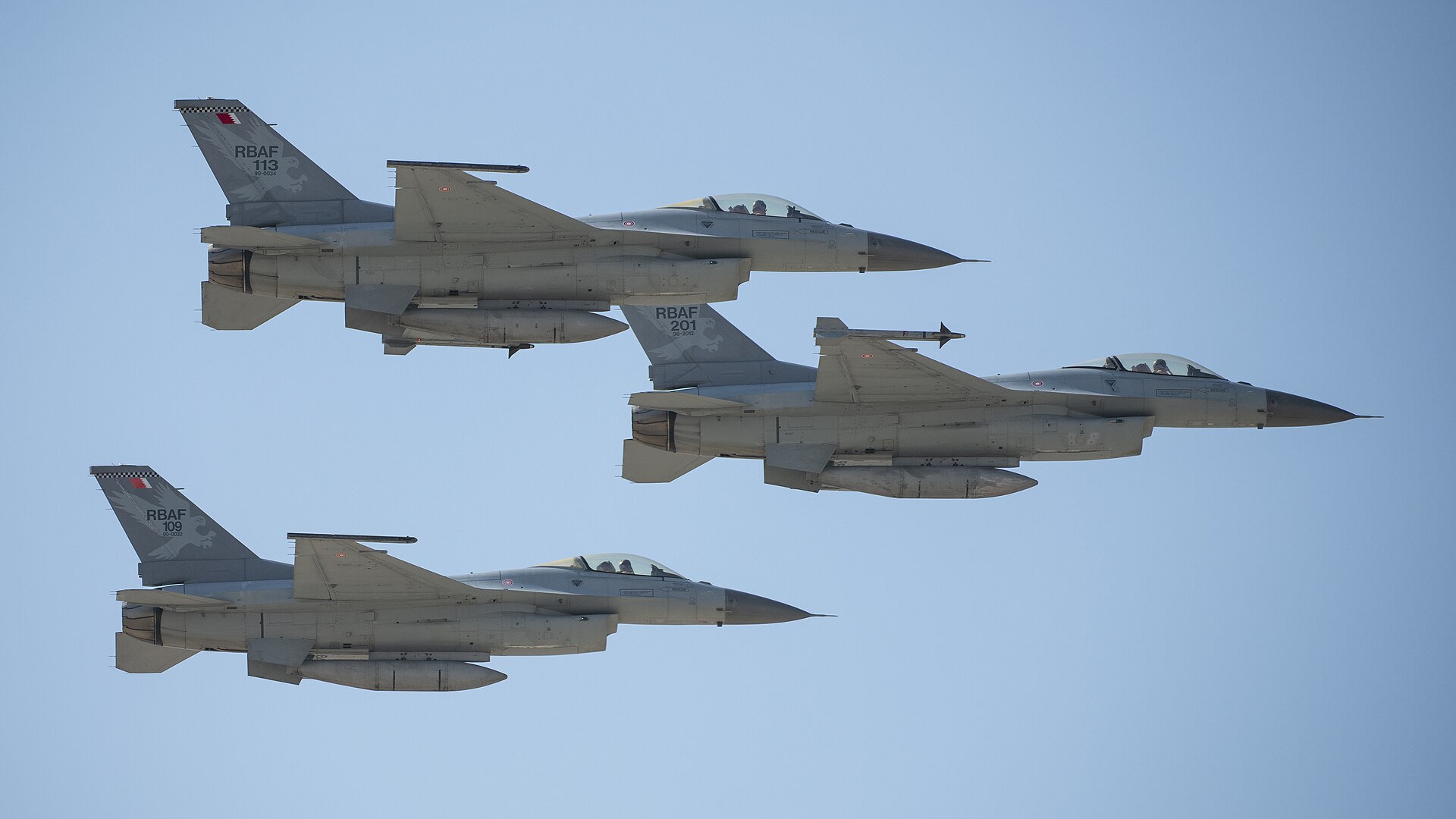
The Royal Bahraini Air Force operates 44 combat aircraft, anchored by a fleet of F-16C/D Fighting Falcons that Bahrain has flown since 1990. A pending delivery of F-16 Block 70 aircraft, which introduces advanced AESA radar and conformal fuel tanks, represents the most significant capability upgrade in the force’s history. Bahrain also operates AH-1E Cobra attack helicopters and a small fleet of UH-60 Black Hawks for utility and medevac roles. The air force’s total inventory of 136 aircraft includes trainers, transports, and rotary-wing platforms, but the combat-capable fleet remains modest by regional standards.
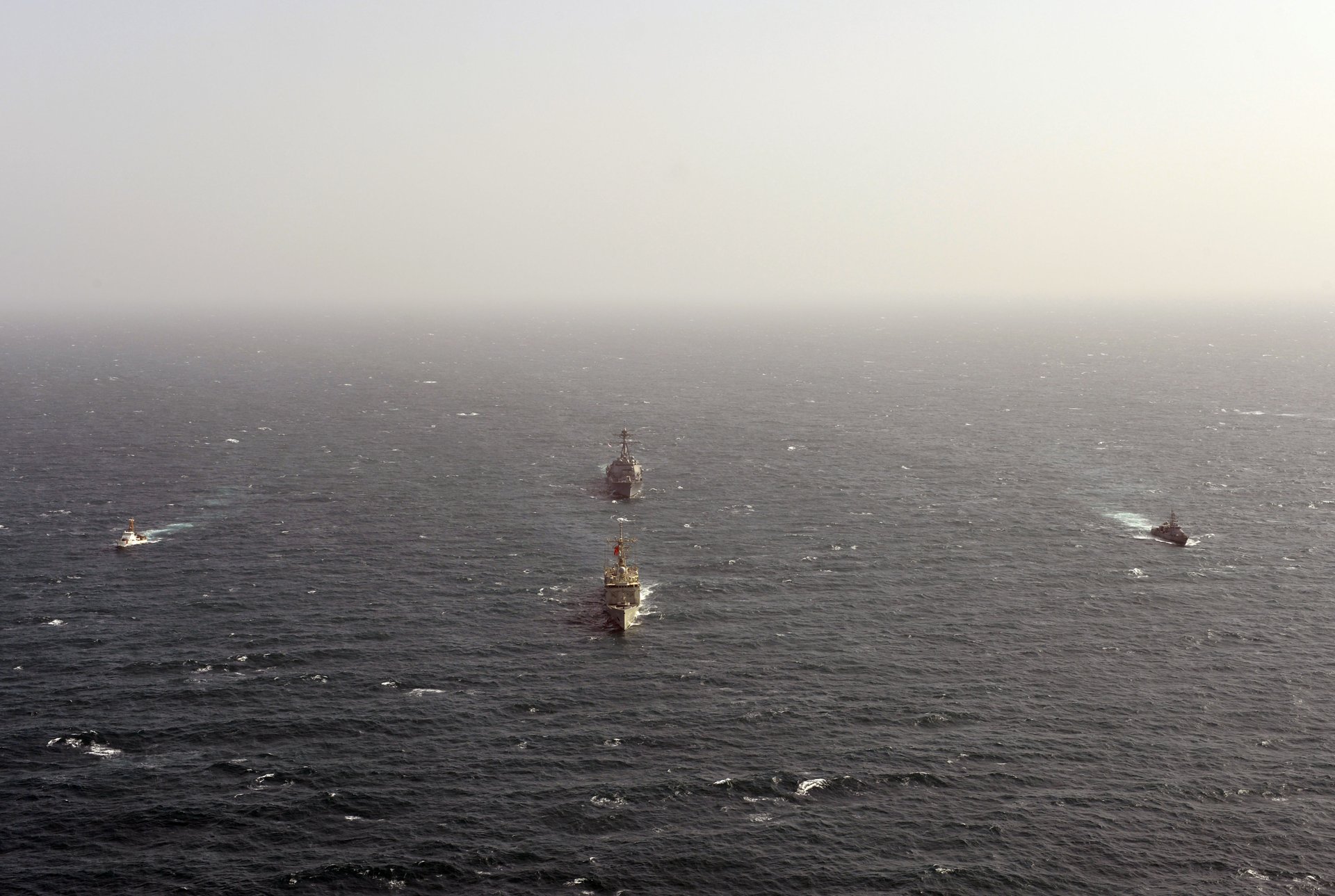
The Royal Bahraini Navy operates approximately 30 vessels, including the guided-missile frigate RBNS Sabah (formerly USS Jack Williams), four Al Manama-class corvettes, and a collection of fast patrol boats. The navy’s primary mission has historically been coastal defence and maritime patrol rather than power projection. Its expansion into unmanned surface vessels and unmanned aerial vehicles for maritime surveillance reflects an adaptation to the asymmetric threats Iran has weaponised across the Persian Gulf.
| Branch | Personnel | Key Platforms | Primary Role |
|---|---|---|---|
| Royal Bahraini Army | ~11,000 | ~150 M60 tanks, M113 APCs | Territorial defence, internal security |
| Royal Bahraini Air Force | ~3,500 | F-16C/D (44 combat aircraft), AH-1E Cobras | Air defence, ground support |
| Royal Bahraini Navy | ~2,500 | 1 frigate, 4 corvettes, patrol boats | Coastal defence, maritime patrol |
| Royal Guard | ~1,000 | Light armour, small arms | Regime protection |
The numerical comparison with Iran’s military is staggering. Iran’s armed forces and IRGC combined field over 600,000 active personnel, operate thousands of ballistic missiles and drones, and have spent decades building asymmetric warfare capabilities specifically designed to threaten Gulf states like Bahrain. Iran’s defence budget, even under severe sanctions, exceeds $25 billion annually — roughly eighteen times Bahrain’s. The disparity explains why Bahrain has never planned for, nor could it sustain, an independent military confrontation with Iran.
What Bahrain possesses instead is geography’s curse packaged as a strategic asset: it is small enough to defend only with outside help, making it permanently dependent on Saudi Arabia and the United States. That dependency, rather than its own military capability, defines Bahrain’s role in the war.
The Fifth Fleet’s Impossible Position
The US Navy’s Fifth Fleet, headquartered at NSA Bahrain since 1995, finds itself in a position its Cold War planners never imagined: its home port is under sustained enemy attack, its host nation has become a combatant, and the distinction between defending American personnel and supporting Bahraini offensive operations has dissolved.
Approximately 8,300 US sailors were stationed at NSA Bahrain when the war began. By March 1, after multiple rounds of Iranian strikes, US Naval Forces Central Command had evacuated dependents and non-essential personnel, declaring the base’s perimeter “no longer assessed as safe.” The US Navy withdrew all vessels from the Bahrain base amid rising tensions, according to the Middle East Monitor, dispersing its fleet to reduce vulnerability to concentrated strikes. The move, while tactically sound, transformed what had been the Gulf’s premier naval headquarters into something closer to an operating base under siege.
The paradox is acute. The Fifth Fleet exists to project American power across the Persian Gulf, protect commercial shipping through the Strait of Hormuz, and deter Iranian aggression against Gulf allies. Its presence in Bahrain was intended to serve as a shield. Instead, the base has become a target magnet, drawing Iranian fire toward the densely populated island and complicating Bahrain’s already precarious security environment. Every missile Iran fires at NSA Bahrain that misses its target strikes Bahraini civilians, infrastructure, or economy — a reality the Juffair attacks demonstrated on the war’s first day.
The Fifth Fleet’s operational tempo, meanwhile, has never been higher. The broader Iran war has demanded continuous naval operations across the Persian Gulf, the Strait of Hormuz, and the Gulf of Oman. With 21 confirmed attacks on commercial vessels and offshore infrastructure since March 1, according to UK Maritime Trade Operations, the Fifth Fleet’s mission has expanded even as its primary base has contracted. Operations have dispersed to facilities across the Gulf, but Bahrain remains the administrative and logistical nucleus — a role that Iranian targeting has made simultaneously more important and more dangerous.
Saudi Arabia’s Shield Over the Causeway
The 25-kilometre King Fahd Causeway connecting Saudi Arabia’s Eastern Province to Bahrain carries more than 40,000 vehicles daily in peacetime. In wartime, it carries something more consequential: the guarantee that Mohammed bin Salman’s kingdom will not allow its closest ally to fall. That guarantee, never formalised in a mutual defence treaty but understood by every capital in the region, is what permitted Bahrain to cross from target to combatant. Without Saudi Arabia’s military umbrella, the crossing would have been suicidal.
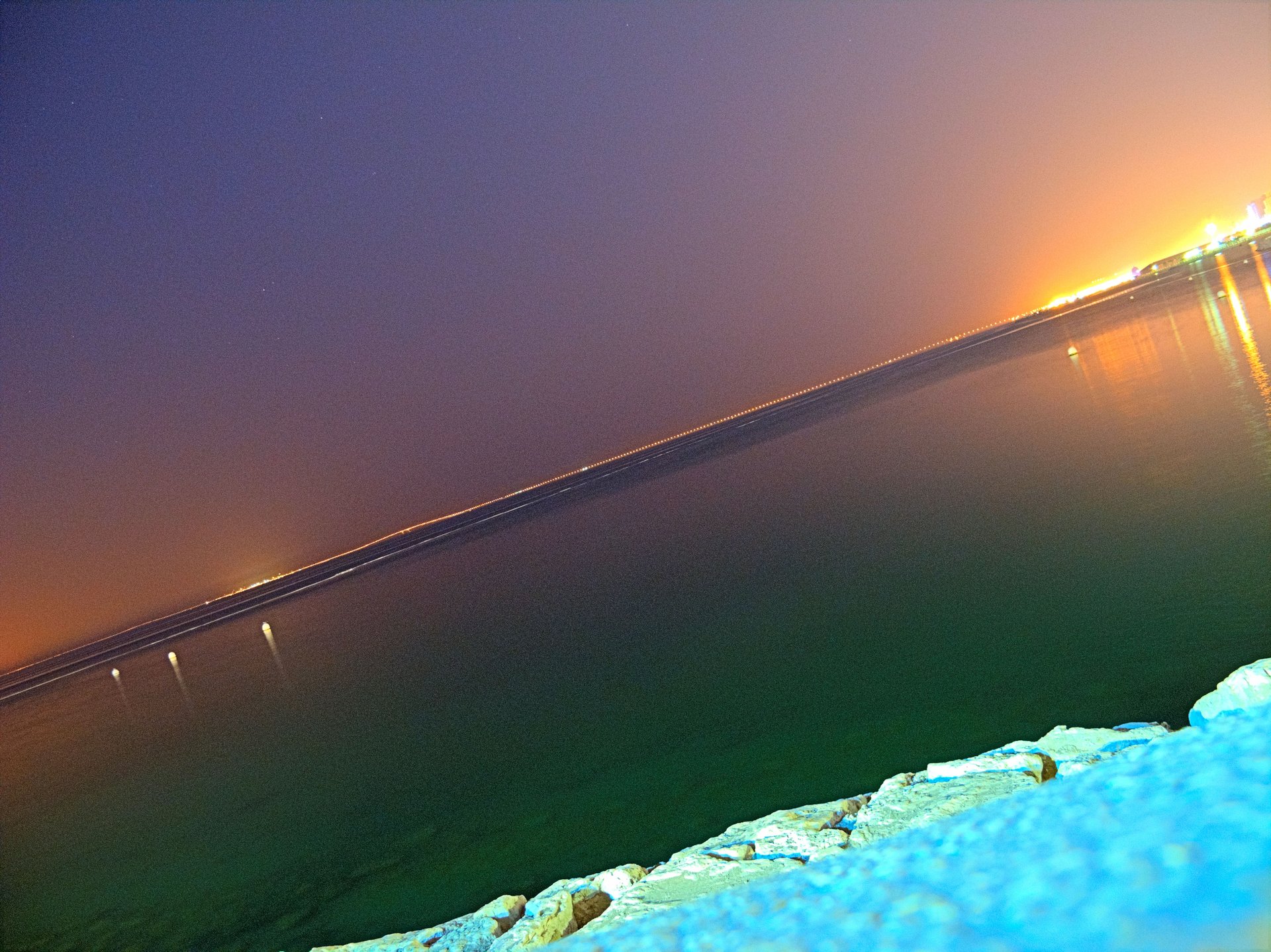
The Saudi-Bahrain security relationship is the Gulf’s most asymmetric bilateral arrangement. Bahrain depends on Saudi Arabia for territorial defence, economic subsidies, and regime survival. Saudi Arabia uses Bahrain as a strategic buffer, a naval access point, and a demonstration that GCC solidarity operates on terms Riyadh dictates. The relationship was cemented in March 2011, when Saudi Arabia deployed approximately 1,000 troops with armoured support across the causeway as part of the Peninsula Shield Force, crushing Bahrain’s Shia-led uprising in what Iran called an “invasion” and what Riyadh called an exercise in collective security.
The 2026 deployment echoes the 2011 intervention with one critical difference: the threat comes from outside, not inside. The deployment of forces from the Unified Military Command — the Peninsula Shield Force’s successor — to Bahrain in March 2026 represented the first mobilisation of that instrument since the Arab Spring, according to Shiraz Maher of King’s College London. Saudi and GCC troops arrived to secure internal infrastructure, freeing Bahraini military assets for operations that appear to have included the offensive missile launches the WSJ reported.
Saudi Arabia’s air defence umbrella extends over Bahrain through integrated radar networks and Patriot missile batteries that supplement Bahrain’s own limited air defences. The interception rate Bahrain claims — 125 missiles and 211 drones — likely reflects Saudi and coalition contributions as much as indigenous capability. Without the layered defence architecture that Saudi Arabia funds, maintains, and operates across the Gulf, Bahrain’s skies would be functionally undefended.
The financial dimension is equally stark. Saudi Arabia has provided Bahrain with direct budgetary support for decades, including a $10 billion aid package from the GCC in 2011 specifically tied to the post-uprising stabilisation. Bahrain’s government debt, which reached 142.5 percent of GDP in 2025 — the highest in the Middle East after Lebanon — is sustainable only because markets assume Saudi Arabia will backstop it. A Bahrain in open conflict with Iran tests that assumption. Rating agencies have already placed Bahrain on negative watch, and the AGBI reported that the war “tests Bahrain’s fragile finances” at the worst possible moment.
Protests, Arrests, and Imported Riot Police
The Iran war has reignited the sectarian fissure that Bahrain’s ruling Al Khalifa dynasty has spent fifteen years suppressing. Hours after the US and Israeli assassination of Ayatollah Ali Khamenei was confirmed in late February, protests against the killing of a figure who served as both Iran’s supreme leader and a spiritual authority for millions of Shia Muslims erupted across Bahrain’s villages and suburbs. Middle East Eye reported that the war had “ignited rare civil unrest” in the country for the first time since the 2011 uprising was crushed.
The government’s response was swift and borrowed from the 2011 playbook. Bahrain deployed foreign anti-riot troops from Jordan to suppress the protests — the first importation of foreign security forces since the Arab Spring, the Times of Islamabad reported. At least four suspects were detained for allegedly colluding with the Islamic Revolutionary Guard Corps, and others were arrested for circulating footage endorsing Iran’s actions. The crackdown extended to social media, where authorities moved to restrict access to platforms amplifying protest imagery.
The sectarian arithmetic makes Bahrain’s situation uniquely volatile. Independent demographic assessments estimate that Shia Muslims constitute 55 to 65 percent of Bahrain’s citizen population, though official figures place the number closer to 45 percent — a discrepancy attributed to decades of naturalising Sunni migrants from Pakistan, Yemen, and other Arab states to shift the demographic balance. The Shia community has long voiced grievances over political and economic marginalisation, including exclusion from senior military and security positions, restrictions on land ownership, and underrepresentation in parliament.
Iran’s preoccupation with Bahrain’s Shia demographic predates the current war by decades. The 1981 coup attempt by the Islamic Front for the Liberation of Bahrain, established by Grand Ayatollah Mohammad Taqi al-Modarresi in Iran, aimed to create a “free Islamic order” and expel American forces from the archipelago. The plot failed, but it imprinted the spectre of Iranian-sponsored regime change into the Al Khalifa family’s institutional memory. Every subsequent confrontation with Iran — the 2011 protests, the diplomatic rupture after Nimr al-Nimr’s execution in 2016, the 2017 oil pipeline bombings — has been filtered through this lens.
The current situation differs in one critical respect: Bahrain is now firing at Iran while simultaneously arresting its own citizens for sympathising with the country it is attacking. The contradictions embedded in that position are sustainable only so long as the security apparatus holds. If the protests escalate beyond what Jordanian riot police and Bahraini internal security can contain, Bahrain faces the nightmare scenario that has haunted the Al Khalifa family since 1979: an internal crisis triggered by an external war.
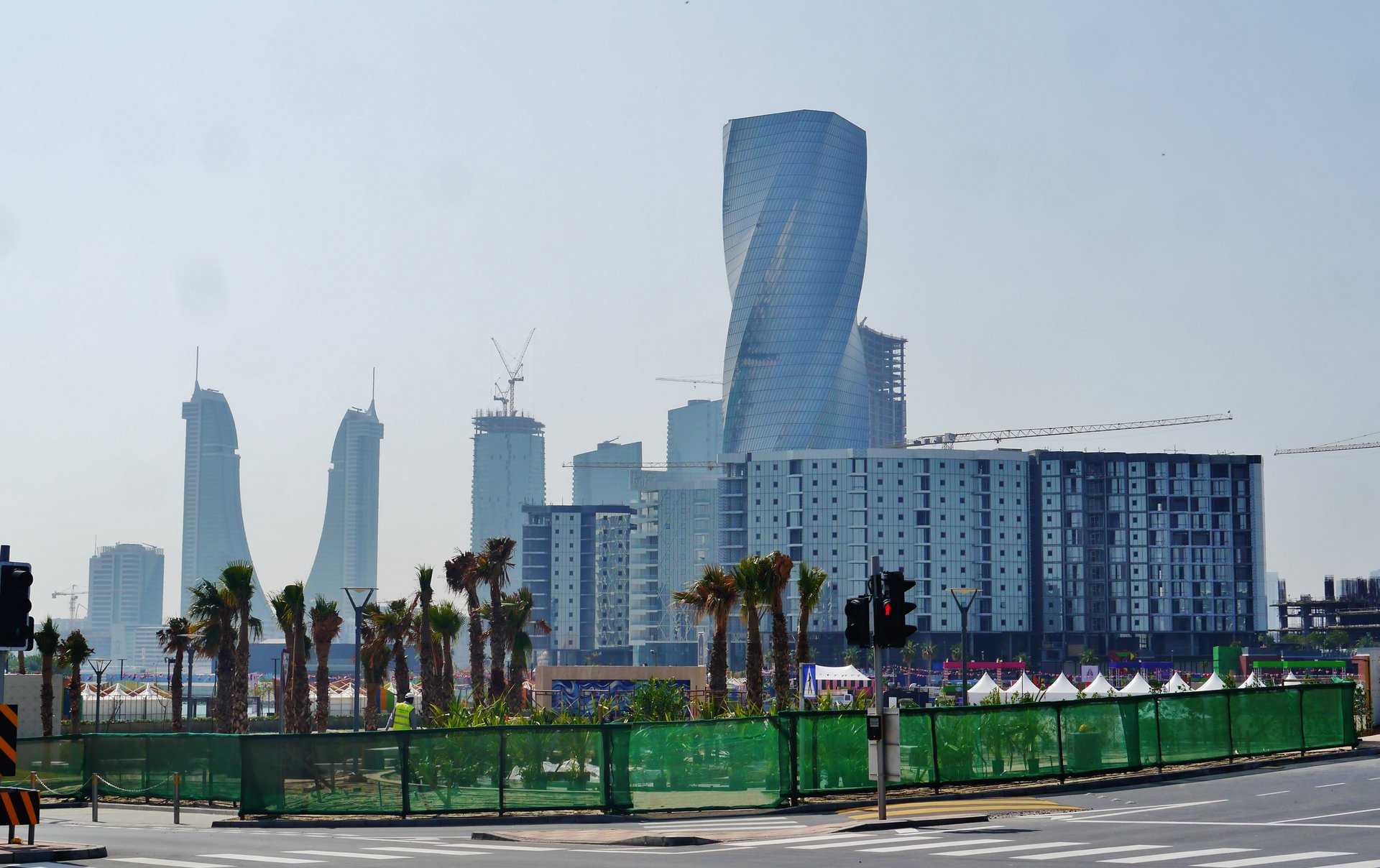
The Bahrain Fragility Index
Seven dimensions define Bahrain’s wartime vulnerability. Assessed together, they produce a composite picture that explains why Bahrain’s entry into the conflict represents a disproportionate escalation risk — not because of the damage Bahrain can inflict, but because of the damage it cannot absorb.
| Dimension | Assessment | Score (1-10) | Key Data Point |
|---|---|---|---|
| Military Capacity | Minimal independent capability; dependent on US/Saudi assets | 9 | 18,000 personnel, $1.4B budget, 44 combat aircraft |
| Geographic Exposure | No strategic depth; entire country within single battery range | 10 | 786 sq km total area, 200 km from Iran, 134m max elevation |
| Fiscal Resilience | Highest debt-to-GDP in Middle East (after Lebanon); dependent on subsidies | 9 | Government debt 142.5% of GDP in 2025 |
| Internal Cohesion | Majority-Shia population under Sunni monarchy; active protests | 8 | 55-65% Shia citizens; Jordanian riot police deployed |
| External Dependency | Cannot survive without Saudi/US military and economic support | 10 | Peninsula Shield deployed; Saudi backstops debt |
| Infrastructure Vulnerability | Concentrated civilian/military infrastructure on small island | 9 | Single port, 2 airports, limited desalination within 786 sq km |
| Regime Legitimacy | Minority rule contested since 2011; legitimacy rests on security apparatus | 7 | 2011 uprising required Saudi military intervention |
The composite score — 62 out of 70, or 88.6 percent vulnerability — places Bahrain in a category distinct from any other combatant in the Iran war. Saudi Arabia, despite absorbing hundreds of drone and missile strikes, scores substantially lower on geographic exposure (vast territory provides depth), fiscal resilience ($421 billion in PIF assets), and internal cohesion (no significant sectarian divide at the same scale). The UAE, while geographically compact, possesses far greater military capacity, fiscal reserves, and internal stability. Even Kuwait, the GCC’s other small-state target, benefits from a larger territory, greater oil wealth, and a population without Bahrain’s sectarian fault line.
The Index reveals why Bahrain’s escalation carries systemic risk. A state scoring above 80 percent on wartime vulnerability is one where any significant Iranian retaliation could trigger cascading failures across multiple dimensions simultaneously. A targeted strike on Bahrain’s financial district does not merely destroy buildings — it threatens a banking sector that holds $220 billion in assets, destabilises a government already struggling to service its debt, and sends a signal to the Shia population that the regime cannot protect its own capital.
The framework also explains Saudi Arabia’s calculation. Riyadh deployed the Peninsula Shield Force not primarily to defend Bahrain from Iran, but to prevent Bahrain from collapsing internally while it is used as a platform for operations against Iran. Saudi Arabia cannot afford a failed state connected to its Eastern Province by a 25-kilometre bridge. The alliance structure MBS has built depends on every node in the network holding. Bahrain is the weakest node.
Why Is Bahrain’s Entry More Dangerous Than Saudi Arabia’s?
Conventional wisdom holds that Saudi Arabia’s formal entry into the Iran war would represent the conflict’s ultimate escalation — the moment the Gulf’s largest economy, most powerful military, and custodian of Islam’s two holiest cities joins the fighting. That analysis is wrong. Bahrain’s entry is more dangerous precisely because Bahrain cannot sustain the consequences.
Saudi Arabia possesses the fiscal reserves to fight a prolonged conflict. The Public Investment Fund holds over $930 billion in assets. Saudi Aramco generates revenue even with Hormuz closed, thanks to the East-West pipeline and Red Sea export terminals. The Saudi military’s $74.76 billion annual budget — larger than Germany, Japan, and South Korea combined — provides redundancy in air defence, offensive capability, and logistical support. A Saudi Arabia at war is a formidable adversary that Iran can hurt but cannot break.
Bahrain at war is a glass cannon. The $1.4 billion defence budget provides no offensive depth. The 142.5 percent debt-to-GDP ratio leaves no fiscal cushion. The Shia-majority population creates an internal front that no amount of Jordanian riot police can permanently secure. And the country’s entire infrastructure — ports, airports, desalination plants, financial district, military bases — sits within a geographic footprint that a single afternoon of Iranian missile saturation could devastate.
The danger is not what Iran does to Bahrain militarily. Tehran has been striking Bahrain for twenty-five days without breaking the island’s defences, largely because Saudi and American air defence systems provide the backbone of its protection. The danger is what happens if Iran decides to punish Bahrain’s escalation by shifting from military targets to the island’s civilian pressure points — its water supply, its banking sector, its Shia neighbourhoods where sympathy for Tehran’s cause already runs high.
A Saudi entry into the war would expand the conflict. A Bahraini collapse would fracture the coalition. That asymmetry is what makes the WSJ’s revelation so consequential. The Gulf’s weakest link has loaded the gun that the region’s strongest power has so far declined to fire.
The Ghost of Pearl Roundabout
Bahrain demolished the Pearl Monument in March 2011, three weeks after the uprising that gathered beneath it was crushed by Saudi tanks. The 300-foot structure, a gift from the GCC to commemorate Bahrain’s first summit in 1981, was razed to prevent it from becoming a symbol of resistance. The roundabout was replaced by a traffic intersection. The government thought it had buried the memory. Fifteen years later, the Iran war is excavating it.
The 2011 uprising and the 2026 war share a structural similarity that Bahrain’s rulers understand even if they will not acknowledge it publicly. Both events exposed the fundamental instability of a Sunni monarchy governing a Shia-majority population in a region where Iran positions itself as the defender of Shia interests. In 2011, the trigger was the Arab Spring’s contagion of democratic aspiration. In 2026, the trigger is a war in which Bahrain’s government is attacking the state that a majority of its citizens may view, at minimum, as a co-religionist power deserving of solidarity if not support.
The parallels extend to the security response. In 2011, Saudi Arabia deployed approximately 1,000 troops and the UAE sent 500 police officers across the causeway. In 2026, the Peninsula Shield Force’s successor has deployed, and Jordan has supplied anti-riot personnel — expanding the roster of foreign security forces on Bahraini soil. The Carnegie Endowment for International Peace noted in March 2026 that the Gulf monarchies are “caught between Iran’s desperation and the U.S.’s recklessness,” with Bahrain occupying the most exposed position.
The 2011 intervention succeeded because the threat was internal and the external environment was stable. No foreign power was actively bombing Bahrain. No missiles were striking civilian infrastructure. The economy, while stressed, was not contending with a regional war that has pushed oil past $100 a barrel and disrupted shipping through the strait that carries 40 percent of Bahrain’s non-oil imports. Replicating the 2011 security solution in 2026 requires controlling both an internal population and an external bombardment simultaneously — a far more demanding proposition.
The Gulf International Forum’s analysis of “Fortifying Bahrain” warned that allied reinforcements, while necessary, risk deepening the perception among Bahrain’s Shia majority that their country is an occupied territory rather than a sovereign state. Every foreign soldier deployed to suppress protests reinforces the narrative that Tehran has cultivated for decades: that the Al Khalifa family rules by force, sustained by Saudi money and American weapons, against the will of its own people.
What Happens to Bahrain If Iran Retaliates?
Iran’s response to the revelation that missiles were launched from Bahrain will follow one of three escalatory paths, each calibrated to exploit a different dimension of Bahraini vulnerability. Tehran’s choice will reveal whether the IRGC views Bahrain as a military target, a political target, or both.
The first path is military escalation: a concentrated missile and drone barrage targeting Bahrain’s military and dual-use infrastructure. Iran has already demonstrated the ability to strike Bahrain’s port, airport perimeter, fuel depot, and naval facilities. A punitive strike package would intensify the tempo and expand the target set to include Isa Air Base — where the offensive missiles may have been launched — and the causeway linking Bahrain to Saudi Arabia. Cutting the causeway, even temporarily, would isolate Bahrain from its Saudi lifeline and create a psychological shock disproportionate to the physical damage.
The second path is economic warfare: targeting Bahrain’s financial sector and critical infrastructure. Bahrain’s banking sector holds approximately $220 billion in assets and serves as a regional financial hub. A missile strike on the Bahrain Financial Harbour or the Bahrain Bay district — clearly civilian targets, but Iran has already struck residential towers — would trigger capital flight, insurance withdrawals, and a confidence crisis that Bahrain’s debt-laden government cannot afford. The Coface country risk assessment already rates Bahrain as “high risk,” and the war has compounded every pre-existing fiscal vulnerability.
The third path is internal destabilisation: weaponising Bahrain’s Shia demographic through propaganda, covert support for opposition movements, and strategic restraint. By publicly condemning Bahrain’s offensive operations while quietly amplifying protest movements, Iran can position itself as the aggrieved party — a Shia power attacked by a government that rules over a Shia majority. This path requires patience but exploits the dimension where Bahrain is most vulnerable: the legitimacy of minority rule during an externally imposed war.
The most likely outcome is a combination of all three, calibrated to avoid provoking a level of destruction that would demand a direct Saudi military response while imposing costs that make Bahrain’s continued participation in offensive operations politically and financially unsustainable. Iran’s asymmetric warfare doctrine, refined over decades, is designed for precisely this kind of graduated escalation against a weak opponent whose protector is strong but constrained.
| Scenario | Targets | Bahrain Vulnerability | Probability |
|---|---|---|---|
| Military escalation | Isa Air Base, causeway, naval facilities | Limited air defence without coalition support | High |
| Economic warfare | Financial district, port, desalination | 142.5% debt-to-GDP, $220B banking sector | Medium |
| Internal destabilisation | Shia communities, social media, opposition | 55-65% Shia population, active protests | High |
| Causeway strike | King Fahd Causeway | Only land link to Saudi Arabia | Low-Medium |
The Gulf monarchies are caught between Iran’s desperation and the U.S.’s recklessness. Bahrain, the smallest and most vulnerable, occupies the most exposed position in this impossible geometry.
Carnegie Endowment for International Peace, March 2026
Frequently Asked Questions
Did Bahrain officially join the Iran war?
Bahrain has not formally declared war on Iran. However, the Wall Street Journal reported on March 24, 2026, that videos show missiles launched from Bahrain were used in attacks on Iranian targets. Whether fired by Bahraini or US forces operating from Bahraini territory, the launches make Bahrain a de facto combatant. The US military declined to confirm if it was receiving offensive military support from regional countries.
How many Iranian missiles and drones has Bahrain intercepted?
As of mid-March 2026, the Bahrain Defence Force reported intercepting 125 ballistic missiles and more than 211 drones since the war began on February 28. Two people have been killed and more than 50 injured. Key targets struck include Mina Salman Port, the US Navy Fifth Fleet headquarters in Juffair, the Era Views residential tower, and a fuel depot near Muharraq airport.
Why does Iran claim sovereignty over Bahrain?
Iran maintained a historical claim to Bahrain based on centuries of Persian influence over the archipelago. Shah Mohammad Reza Pahlavi formally renounced the claim in 1970 following a UN-supervised survey. After the 1979 Islamic Revolution, Grand Ayatollah Sadeq Rohani declared the Shah’s recognition “invalid.” While successive Iranian governments have formally accepted Bahrain’s independence, elements within the IRGC and religious establishment have periodically revived the claim.
What is the Peninsula Shield Force and why was it deployed to Bahrain?
The Peninsula Shield Force is the GCC’s joint military command, headquartered in Saudi Arabia. It was deployed to Bahrain in March 2026 — the first mobilisation since the 2011 Bahraini uprising — to secure internal infrastructure while Bahrain faces sustained Iranian bombardment. In 2011, Saudi Arabia deployed approximately 1,000 troops and the UAE sent 500 police to suppress pro-democracy protests. The 2026 deployment freed Bahraini military assets for operations beyond self-defence.
How large is Bahrain’s military compared to Iran’s?
Bahrain’s armed forces total approximately 18,000 active personnel with a $1.4 billion annual defence budget. Iran fields over 600,000 active personnel across its armed forces and IRGC with a defence budget exceeding $25 billion — roughly eighteen times Bahrain’s. Bahrain operates 44 combat aircraft compared to Iran’s estimated 550. The disparity means Bahrain cannot sustain any military confrontation with Iran without Saudi and American support.
What happened during the 2011 Bahrain uprising?
Protests began on February 14, 2011, led primarily by Bahrain’s Shia majority demanding greater political freedom and equality. After security forces killed several protesters at Pearl Roundabout, the GCC deployed Peninsula Shield Force troops — approximately 1,000 Saudi soldiers and 500 Emirati police — to suppress the uprising. The Pearl Monument was demolished, opposition leaders were imprisoned, and Iran accused Saudi Arabia of conducting an invasion. The crackdown succeeded but deepened sectarian divisions that persist today.
Is Bahrain’s economy stable enough to sustain wartime conditions?
Bahrain entered the war in the weakest fiscal position of any Gulf state. Government debt reached 142.5 percent of GDP in 2025 — the highest in the Middle East after Lebanon. An eleven-part fiscal reform package approved in December 2025 included utility price increases and spending cuts. Before the war, GDP growth was projected at 3.3 percent for 2026. The conflict has disrupted shipping, rattled the $220 billion banking sector, and prompted sovereign credit downgrades, with analysts warning that prolonged hostilities could overwhelm Bahrain’s reform efforts.