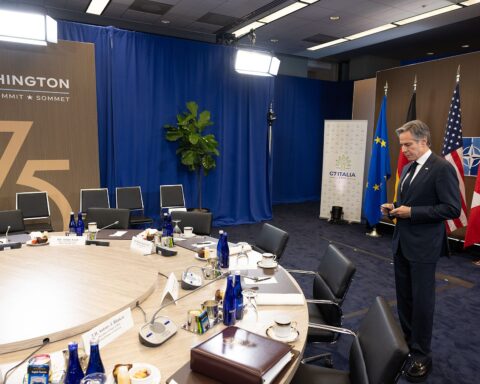

Antony Blinken, the incumbent US Secretary of State has held a series of high-level meetings with dignitaries such as Saudi Arabia’s Crown Prince Mohammed bin Salman and Egyptian President Abdel Fattah el-Sisi. These interactions were largely aimed at confirming America’s unwavering support for the two-state solution and encouraging a ceasefire in the war-plagued region of Gaza, as per reports from the US Department of State.
Blinken’s trip, the sixth to the Middle East since the onset of the War, has covered multiple international conversations in the last 48 hours. Discussions with the Saudi Crown Prince, held in the city of Jeddah, emphasized urgency in catering to the humanitarian requirements in Gaza, pronounced a statement from the State.
Official affirmation from the United States was given by Blinken in regards to achieving a long-lasting solution to the Gaza crisis, assurance of continuous commitment towards a future Palestinian state, and provision of security guarantees for Israel.
Further into the trip, Blinken visited Cairo, where meetings were held with prominent Egyptian officials, including President el-Sisi. The agenda included talks comprising of immediate ceasefire arrangements, a truce expected to last a minimum of six weeks, and release of all hostages.
Addressing the media in a conference held with his Egyptian counterpart, Sameh Shoukry, Blinken outlined America’s plan for post-war Gaza, emphasizing the importance of maintaining the demographic structure and refraining from the re-occupancy of the region by Israel.
Queried on the ironical stance of the Biden administration which is simultaneously promoting humanitarian aid in Gaza whilst supplying arms that cause escalating damage, Blinken stated US’ commitments – to defend Israel, ensure prevention of future attacks, and extend all possible help to those at risk. This despite warnings by United Nations experts of looming famine in Gaza due to Israel’s blockade.
Echoing earlier sentiments voiced by President Biden in regards to avoiding “bargaining chip” use of aid, Blinken reiterated US’ caution against a full-blown ground attack on Rafah, an area where over a million Palestinians are currently taking refuge after displacement.
Despite Israel’s military actions resulting in the death of almost 32,000 Palestinians in Gaza, the Biden administration continues to uphold its allegiance to Israel, backing through financial and diplomatic support, and endeavoring to secure $14bn plus in additional aid through Congress.
While no support has been extended to any UN Security Council’s ceasefire proposals, the present administration is ardently working towards a momentary stop in hostilities, facilitating the release of captives and aid delivery.
Blinken reaffirmed that though the gap to the final truce agreement is narrowing, formidable challenges still exist in the negotiation process.
The concluding point of his Middle Eastern tour will be Israel. Notwithstanding increased criticism of Israeli Prime Minister Netanyahu from Biden’s Democratic Party, the government’s pro-Israel stance remains unflinching.
In his discussions with Saudi Arabia’s Crown Prince, Blinken explored the idea of “greater integration” among regional countries, indirectly alluding to the “normalisation’ process of establishing formal diplomatic ties between Israel and Arab nations. Progress on this front gets trickier given the ongoing hostility in Gaza.
After the White House indicated that Saudi Arabia-Israel normalisation talks remained unaffected by the Gaza war, Saudi Arabia strongly denied this claim. The Saudi Ministry of Foreign Affairs expressed that diplomatic relations with Israel would only be possible post Israeli recognition of an independent Palestinian state, cessation of Israeli aggression towards Gaza, and withdrawal of Israeli forces therefrom.
The idea of a Palestinian state continues to face opposition from Netanyahu, emphasizing Israel’s thus-far uncompromised need for security control over Palestinian territories.