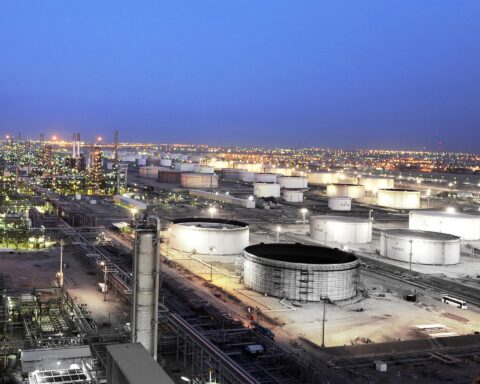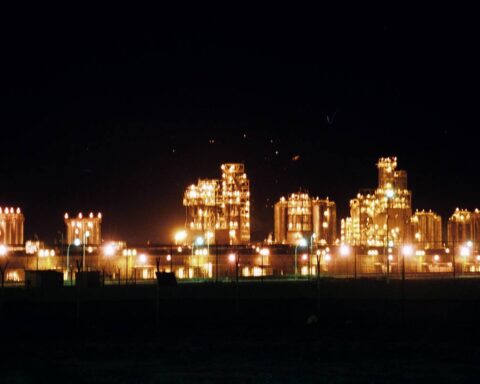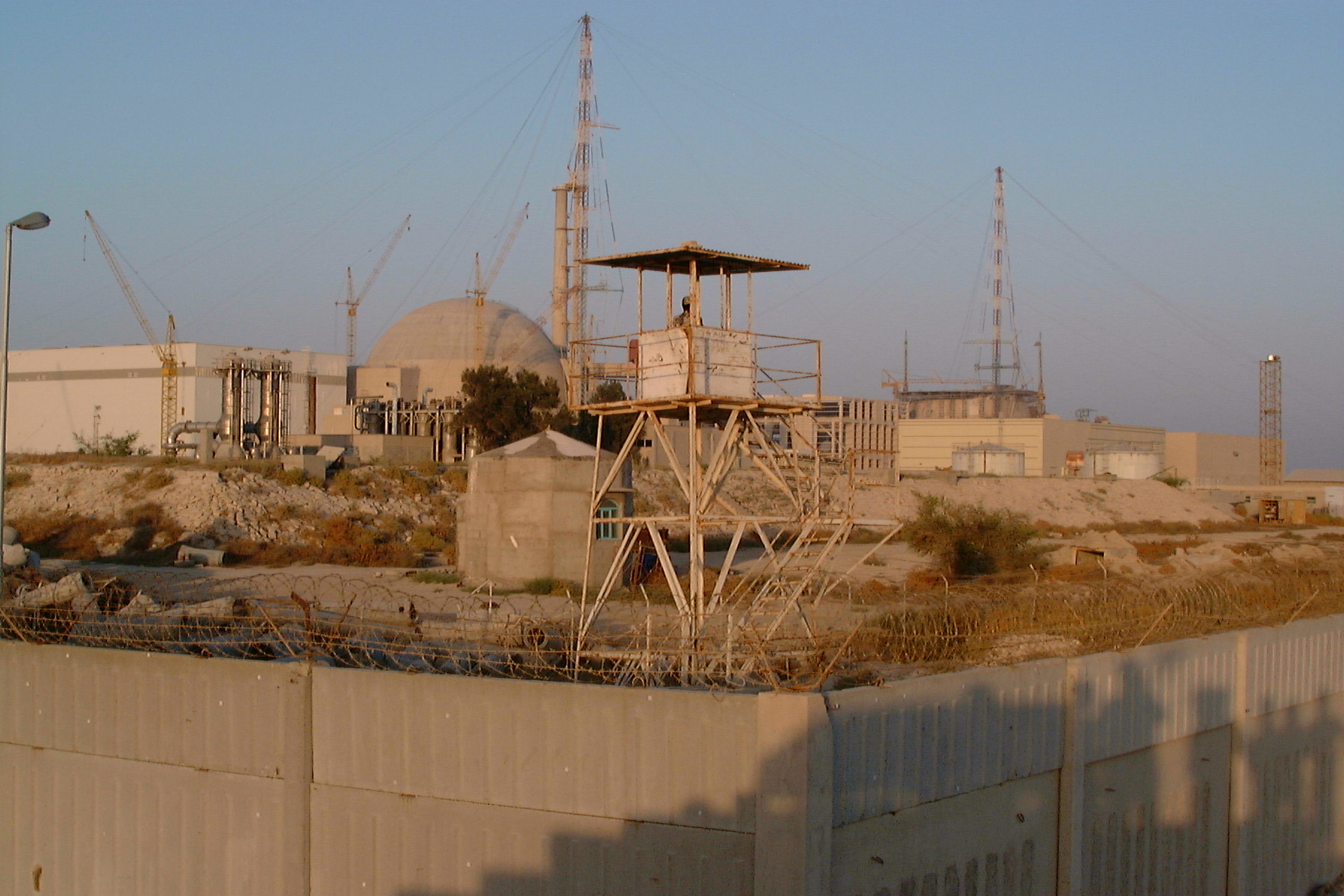

DHAHRAN — A projectile struck 350 metres from the Bushehr reactor on Friday, close enough to kill a security guard but not close enough — yet — to breach the pressurised water containment holding 282 metric tons of nuclear fuel above a shallow sea whose currents flow directly toward Saudi Arabia’s largest desalination plants. If that containment fails, and each of the four strikes since February 28 has narrowed the margin, peer-reviewed marine contamination modelling shows radioactive cesium-137 reaching peak concentration at the Jubail and Ras Al-Khair seawater intakes within ten months — threatening the desalinated water supply on which seven million people in Riyadh and the Eastern Province depend, and for which Saudi authorities have published no radiological contingency.
The IAEA confirmed no radiation release after what Iranian Foreign Minister Abbas Araghchi called the fourth attack on the plant, and Rosatom evacuated 198 workers within twenty minutes, leaving roughly 50 volunteers to maintain systems at a facility whose spent fuel cesium-137 inventory has been estimated by Princeton researchers at more than ten times Chernobyl’s total release. Every major analysis of Bushehr contamination risk — from the IAEA to CSIS — has focused on the atmospheric pathway, airborne particles reaching GCC capitals within 15 hours, while the slower and far more durable marine pathway, the one that actually delivers radioactive water to desalination intakes, has generated no known policy response from the Kingdom.
Table of Contents
- 282 Metric Tons and a 35-Metre-Deep Sea
- What Is the POSEIDON-R Model and Why Does It Matter for Saudi Water?
- How Long Before Radioactive Water Reaches Jubail’s Intakes?
- Can Saudi Desalination Filters Actually Remove Cesium-137?
- The 467-Kilometre Pipeline and Riyadh’s Three-Day Buffer
- What Does a Radiological Intake Shutdown Look Like?
- Iran’s Contamination Narrative as a Coercion Tool
- Yanbu and the Red Sea Fallback
- Frequently Asked Questions
282 Metric Tons and a 35-Metre-Deep Sea
Bushehr houses a VVER-1000 pressurised water reactor — the V-446 variant built by Rosatom — generating 915 megawatts of electrical power from a 3-gigawatt thermal core running four coolant loops. Rosatom CEO Alexei Likhachyov told reporters on April 2 that the plant holds 72 metric tons of active nuclear fuel and 210 metric tons of spent fuel, a combined 282 metric tons of fissile material sitting on Iran’s Gulf coast. “If there is a strike on the operational first power unit,” Likhachyov warned, “it will be a catastrophe comparable to Chernobyl.”
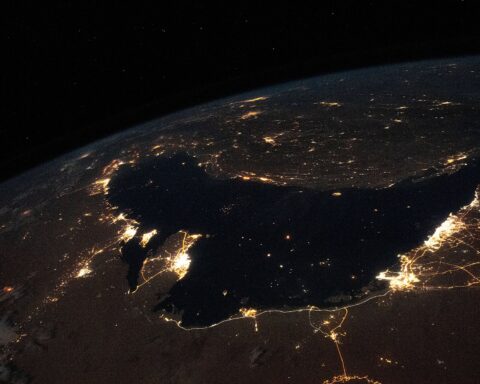
The comparison is imprecise but instructive, because Chernobyl was an inland disaster whose contamination dispersed across an enormous European landmass, diluting as it spread over thousands of kilometres of terrain, rivers, and open air. Bushehr sits on the shore of a body of water averaging 35 metres in depth, roughly 1,000 kilometres long and 340 kilometres wide at its broadest, with a single narrow exit at the Strait of Hormuz through which the entire volume exchanges with the Indian Ocean over a cycle estimated at three to five years. A shallow, enclosed, slow-flushing sea is the worst possible receiving environment for a reactor coolant breach, and the Persian Gulf meets every criterion.
Thomas Spence and Ali Ahmad, researchers affiliated with Princeton University and the American University of Beirut, published a peer-reviewed assessment in Science and Global Security estimating Bushehr’s spent fuel pool cesium-137 inventory at approximately 2,600 petabecquerels, with Dammam named among the cities most directly at risk from atmospheric dispersion. Reactive radionuclides — cesium-137, strontium-90, ruthenium-106 — do not simply dissolve and drift in seawater; they bind to bottom sediments in shallow environments and continue leaching back into the water column for years, a process documented in the peer-reviewed POSEIDON-R marine contamination model published by MDPI’s Journal of Marine Science and Engineering in 2023. That sediment-leaching cycle is what transforms a Bushehr breach from a one-time contamination event into a chronic, years-long threat to every seawater intake in the western Gulf.
What Is the POSEIDON-R Model and Why Does It Matter for Saudi Water?
POSEIDON-R is a compartmental marine radioactivity transport model designed to track what happens when fission products enter a semi-enclosed sea — how they disperse through the water column, how sediment binding affects long-term concentration, and where peak contamination arrives relative to coastal infrastructure. The 2023 study in the Journal of Marine Science and Engineering (volume 11, issue 2, article 331) applied the model to a hypothetical Bushehr accident and produced findings that should have generated policy responses across the GCC but, as far as publicly available documentation shows, did not.
The model’s central finding for Saudi Arabia is specific and quantifiable: maximum radionuclide concentration at the Al Jubail desalination plant intake reaches approximately ten months after a reactor breach, driven not by the initial surface plume — which arrives in days — but by the slower process of sediment-bound cesium and strontium leaching back into the water column as currents redistribute contaminated bottom material along the Saudi coast. The ten-month timeline matters because it means the contamination crisis is not a sprint that emergency reserves can bridge; it is a marathon that would require sustained monitoring and potential intake shutdowns over a period far longer than any existing water-storage capacity in the Kingdom.
The CSIS Project on Nuclear Issues identified Kuwait, Qatar, and the UAE as states whose desalination infrastructure faces risk from a Bushehr incident, with analysts Doreen Horschig and Bailey Schiff warning that a direct hit could trigger a meltdown “releasing iodine-131 and cesium-137 likely throughout Iran and to nearby Gulf states, potentially even compromising desalination infrastructure.” But the CSIS assessment did not apply the POSEIDON-R findings to Saudi Arabia’s specific intake points at Jubail and Ras Al-Khair — an omission that matters because these are the two largest desalination complexes in the world, and they supply Riyadh directly through a single pipeline corridor.
How Long Before Radioactive Water Reaches Jubail’s Intakes?
The answer depends on which contamination pathway is in question, and the distinction between the atmospheric pathway and the marine pathway is the single most consequential analytical gap in the current public discussion of Bushehr risk. First-arrival contamination via the atmospheric route — airborne cesium and iodine particles carried by prevailing northwesterly winds — reaches GCC capitals in approximately 15 hours, a timeline that has been extensively modelled, widely reported, and understandably dominates media coverage. But atmospheric dispersion dilutes rapidly over distance, delivers transient contamination subject to shifting weather patterns, and does not put radioactive water directly into desalination plant seawater intakes.
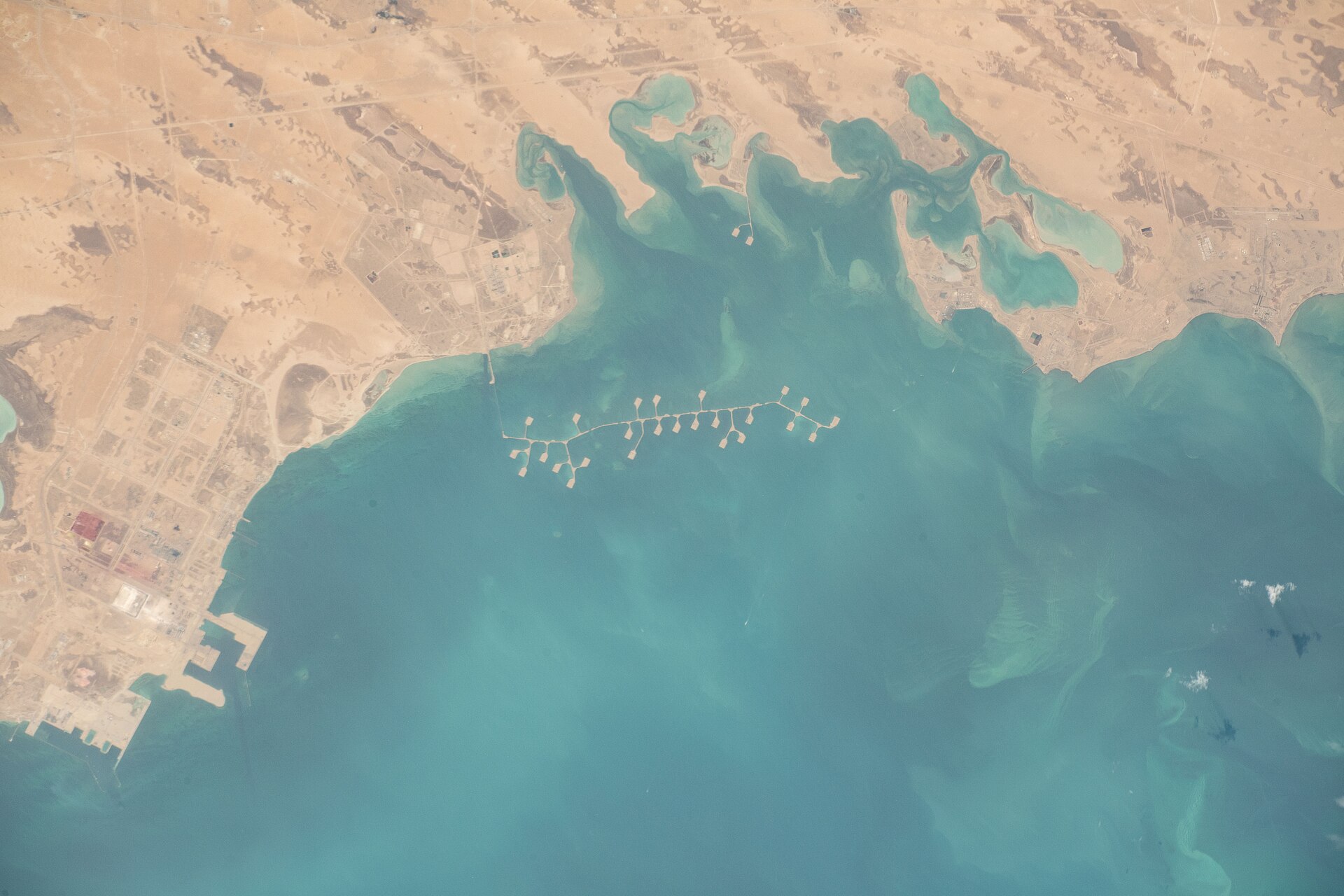
The marine pathway operates on a different timescale and carries fundamentally different consequences for water infrastructure. The Gulf’s Iranian Coastal Current runs northwest at 10 to 33 centimetres per second, carrying surface water from Bushehr’s coastline toward Kuwait before the dominant gyre curves south along the Saudi Arabian eastern seaboard — directly past the intakes at Ras Al-Khair and Jubail. At mean current speeds, first-arrival surface contamination reaches these intakes within two to five days, not the “48 to 72 hours” figure circulating in some media reports, which conflates atmospheric and marine transit estimates.
First arrival, however, is not the primary threat — peak concentration is, and the POSEIDON-R model places that peak at approximately ten months, as cesium-137 and strontium-90 bound to the Gulf’s shallow-water sediments continue releasing into the water column through resuspension and desorption cycles long after the initial plume has passed. A Saudi desalination plant operator facing this scenario confronts a decision sequence that no publicly documented protocol covers: shut down intakes immediately upon detection of first-arrival contamination, accept the water-supply consequences for millions of downstream consumers, and then maintain that shutdown — or some reduced-capacity filtered operation — for months, potentially years, as sediment-leached isotopes continue contaminating the intake zone.
| Contamination Pathway | First Arrival at Saudi Coast | Peak Concentration | Duration of Threat | Public Modelling Status |
|---|---|---|---|---|
| Atmospheric (airborne particles) | ~15 hours | 24–48 hours | Days to weeks (weather-dependent) | Extensively modelled, widely reported |
| Marine (seawater via Gulf currents) | 2–5 days at intake | ~10 months (POSEIDON-R) | Years (sediment leaching cycle) | Peer-reviewed but not applied to Saudi intakes in policy |
Can Saudi Desalination Filters Actually Remove Cesium-137?
Saudi Arabia’s Nuclear and Radiological Regulatory Commission issued a statement in June 2025 asserting that the Kingdom’s desalination technology “is engineered to filter both salt and radioactive contaminants” — a five-word technical claim delivered without a published citation, without a radiological intake threshold standard, and without any indication of whether it applied to multi-stage flash distillation, reverse osmosis, or both. The claim, reported by Saudi Gazette, has since circulated as blanket reassurance. It deserves scrutiny rather than repetition.
Multi-stage flash distillation — the technology used at Jubail and for a significant portion of Ras Al-Khair’s output — works by evaporating seawater and condensing the steam, which in principle leaves dissolved salts and many contaminants behind in the brine. MSF distillation does reduce waterborne radionuclide concentration, but “reduce” is not “eliminate,” and the reduction efficiency varies by isotope, chemical form, and whether the contaminant is dissolved, particulate, or bound to colloidal sediment passing through intake screens. Cesium-137, which behaves chemically like potassium, can pass through certain distillation stages in vapour-carried aerosol droplets — a filtration challenge distinct from that posed by iodine-131, which is more volatile and more readily captured in the evaporation process.
Reverse osmosis membranes at Ras Al-Khair’s RO units offer higher rejection rates — above 95 percent for cesium and strontium under laboratory conditions — but laboratory conditions do not account for membrane fouling under sustained contaminated-intake operation, nor for the operational reality that RO plants discharge concentrated brine back into the Gulf, potentially increasing local radionuclide concentration in coastal waters and creating a feedback loop at the very intake points the membranes are meant to protect. The POSEIDON-R finding that sediment-leached isotopes continue entering the water column for years means any filtration regime would need to operate at elevated specification for a duration that no public Saudi contingency plan addresses.
The question, then, is not whether desalination technology can theoretically strip radionuclides from seawater — under ideal conditions, the physics permits it. The question is whether Saudi Arabia’s specific installed base, already running at capacity to supply 70 percent of the Kingdom’s drinking water, can maintain safe output over months or years of contaminated intake while simultaneously managing the radioactive brine waste stream that continuous filtration would produce, and whether anyone has tested this at operational scale. The NRRC has not published an answer.
The 467-Kilometre Pipeline and Riyadh’s Three-Day Buffer
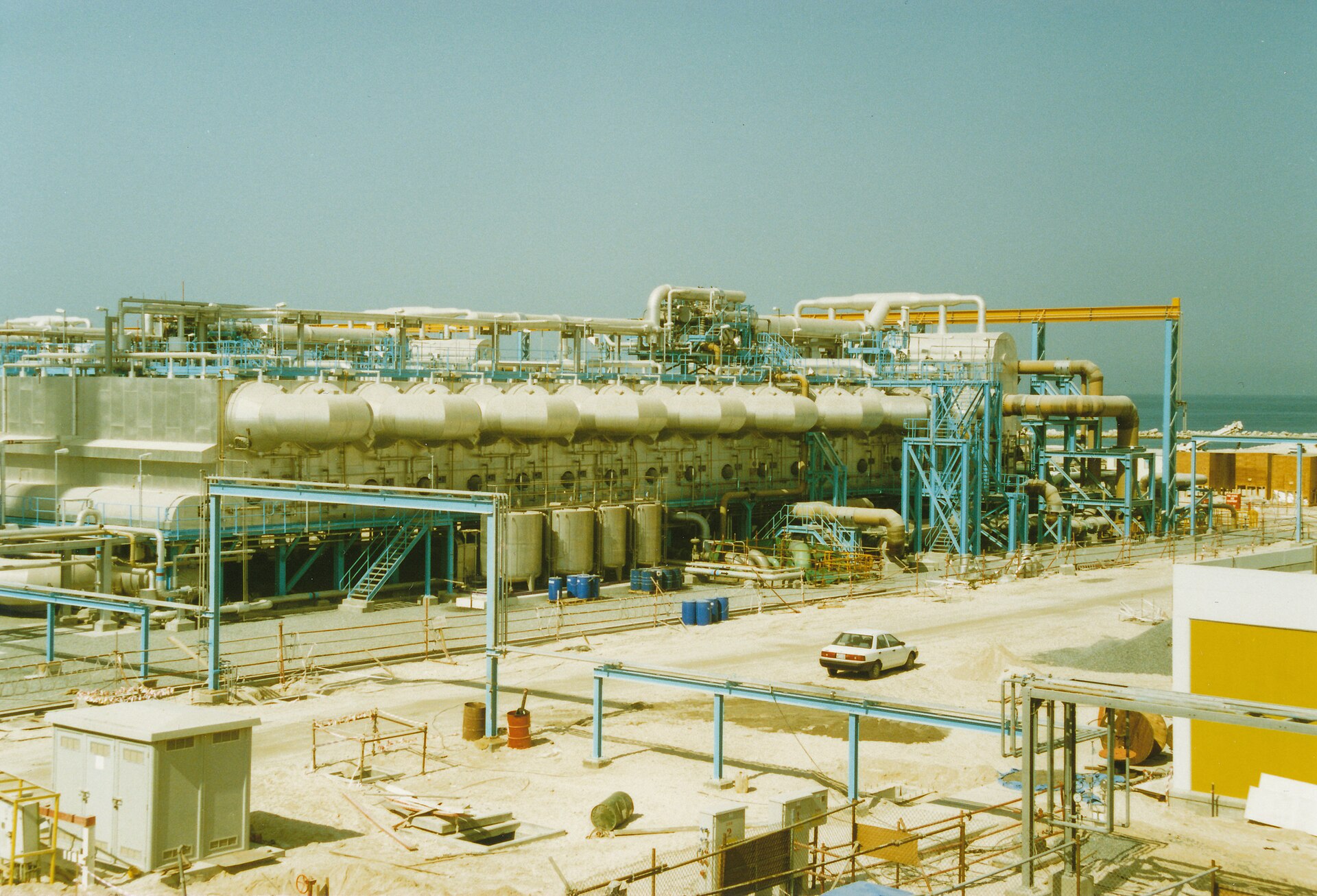
Saudi Arabia’s strategic calculations in this conflict extend beyond military positioning and diplomatic leverage — they reach, with uncomfortable literalness, to the taps in every household in the capital. Ras Al-Khair, the world’s largest hybrid desalination plant, sits on the Gulf coast approximately 75 kilometres northwest of Jubail, producing 1.025 million cubic metres of desalinated water per day, of which roughly 800,000 cubic metres travel through a single 467-kilometre pipeline to Riyadh, serving an estimated 3.5 million people. The Jubail II multi-stage flash plant adds approximately 950,000 cubic metres daily, a significant portion of which also feeds the capital’s network.
A 2008 US diplomatic cable reported through IranIntl’s coverage of the WikiLeaks release warned that Riyadh “would have to evacuate within a week” if the Jubail desalination complex were destroyed — a scenario the cable’s authors were contemplating in the context of a kinetic strike on the plant itself. The marine contamination scenario is different in character but potentially more intractable: rather than a sudden catastrophic loss of output, it presents a progressive contamination of the intake source that could force capacity reductions or complete shutdowns over weeks and months, with the POSEIDON-R model placing peak contamination at the intake point ten months after a Bushehr breach. Saudi cities maintain three to five days of strategic water reserves, a figure consistent with SWCC operational disclosures, against a contamination timeline measured in months.
The Saudi Water Conversion Corporation operates 33 desalination plants across 17 locations, but the Kingdom’s geography concentrates the vulnerability rather than dispersing it — Eastern Province draws from Gulf-coast plants, Riyadh draws from Gulf-coast plants via pipeline, and only the western cities draw from the Red Sea side. If Gulf-coast intakes are contaminated — the scenario the Rosatom evacuation made suddenly tangible — the only untouched major supply comes from Red Sea plants at Yanbu and Shuaibah, facilities already running near capacity for the Hejaz population with no surplus pipeline infrastructure to redirect water eastward to Riyadh at the volumes required.
| Plant | Coast | Daily Capacity | Primary Supply Destination | Distance from Bushehr | In Gulf Current Path |
|---|---|---|---|---|---|
| Ras Al-Khair | Gulf | 1.025 million m³ | Riyadh (800,000 m³/day via 467 km pipeline) | ~450 km | Yes |
| Jubail II (MSF) | Gulf | ~950,000 m³ | Riyadh, Eastern Province | ~400 km | Yes |
| Yanbu Phase 3+4 | Red Sea | ~1 million m³ | Medina, Yanbu Industrial City | N/A | No |
| Shuaibah | Red Sea | ~880,000 m³ | Jeddah, Mecca | N/A | No |
What Does a Radiological Intake Shutdown Look Like?
No modern precedent exists for the radiological contamination of a desalination-dependent nation’s primary water source, but a useful non-nuclear analogue demonstrates exactly how Gulf seawater intake disruption cascades through civilian infrastructure — and it happened less than two decades ago. In 2008 and 2009, a massive harmful algal bloom swept through the Gulf of Oman and into the lower Persian Gulf, fouling the seawater intakes of desalination plants across the UAE and Oman with a toxic concentration of Cochlodinium polykrikoides that overwhelmed pre-treatment systems and forced shutdowns lasting up to two months.
David Michel, then of the CSIS Global Food and Water Security Program, documented the event and its implications, noting that Iran could “block or foul their saltwater intakes in the Persian Gulf” — a vulnerability the algal bloom had already demonstrated without any hostile intent. The critical difference between the 2008 precedent and a radiological contamination scenario is duration: the algal bloom was biological, self-limiting, and temporary — the bloom died, the water cleared, and plants returned to service. Cesium-137 has a half-life of approximately 30 years; strontium-90, approximately 29. Sediment-bound isotopes releasing into the water column at the Jubail intake would not die off in weeks like algae — they would continue contaminating the intake zone for years, requiring either sustained shutdown, continuous filtration at specifications no Gulf desalination plant has been publicly tested against, or construction of alternative intake infrastructure drawing from uncontaminated sources.
Sanam Mahoozi, a researcher at City St George’s University of London, has observed that desalination plants are “fixed, highly complex installations” and that recovery from serious disruption could take “months or longer.” Environmental researcher Naser Alsayed warned through Al Jazeera that “targeting or disrupting desalination facilities would place much of the region’s economic stability and growth at significant risk” — a statement made about direct military strikes but equally applicable to the slower contamination pathway. The GCC Emergency Management Centre, headquartered in Kuwait, was activated in 2025 for nuclear and radiological emergency response, but no publicly documented protocol exists for a coordinated desalination intake shutdown across multiple Gulf states — the scenario the POSEIDON-R model’s contamination plume, which spreads along the entire western Gulf coast, would demand. Iran’s rejection of ceasefire terms means strikes near Bushehr continue, and each one reduces the margin between the current status — auxiliary damage, no reactor breach, IAEA monitors still reading zero on their dosimeters — and the intake-shutdown scenario no one has planned for.
Iran’s Contamination Narrative as a Coercion Tool
Iranian Foreign Minister Abbas Araghchi chose his framing with visible precision when he addressed the fourth Bushehr strike on April 4: “Remember the Western outrage about hostilities near Zaporizhzhia Nuclear Power Plant in Ukraine? … Israel-U.S. have bombed our Bushehr plant four times now. Radioactive fallout will end life in GCC capitals, not Tehran.” The statement, delivered through PressTV and amplified across Iranian state media, contains a geographical truth embedded in a political threat — Bushehr sits roughly 400 kilometres from Dammam and the Saudi Eastern Province population centres, but over 1,100 kilometres from Tehran, making the Gulf states first-order casualties of any radiological release while Iran’s own capital remains comparatively sheltered.
Araghchi’s framing is not incidental, and Moscow’s diplomatic manoeuvring with Riyadh suggests the contamination narrative has already entered the corridor conversations that matter. Russia’s Maria Zakharova stated that attacks on nuclear infrastructure “pose a real risk of a regional-scale radiological and environmental disaster” — a formulation that condemns the strikes while reinforcing the fear that serves Iran’s coercive strategy. Rosatom’s Likhachyov told Al Arabiya on March 25 that the situation at Bushehr was “unfolding under a worst-case scenario,” language calibrated to amplify alarm in Gulf capitals without conceding that Iran bears any responsibility for positioning its sole operational reactor on a coast shared with six neighbouring states’ water supply.
The Zaporizhzhia precedent Araghchi invoked is more instructive than he may have intended, because the lesson from Ukraine’s ZNPP is that external infrastructure damage — not just a direct reactor hit — can trigger a cooling cascade. The destruction of the Kakhovka Dam in June 2023 degraded emergency cooling water supply to the ZNPP, with the IAEA warning that “if failure to inject enough water continues, a meltdown will occur.” Bushehr’s four coolant loops depend on seawater for secondary cooling, and the auxiliary structures the IAEA confirmed were struck on April 4 — buildings that Director General Rafael Grossi warned “may contain vital safety equipment” — include components of the water supply, electrical distribution, and emergency diesel infrastructure that keep those loops running. Each additional strike on what Grossi called “the reddest line” of nuclear safety narrows the gap between auxiliary damage and cooling failure through exactly the mechanism Zaporizhzhia demonstrated.
Iran does not need to cause a meltdown to extract strategic value from the contamination threat, and that may be the most uncomfortable dimension of the current situation. The mere proximity of strikes to the reactor — 350 metres on April 4, with Iran simultaneously launching 79 projectiles at UAE targets in the same escalation cycle — generates political pressure on Gulf states to restrain the coalition, pressure that operates directly through the desalination vulnerability mapped above. If Riyadh’s water supply depends on Gulf intakes, and Gulf intakes are threatened by a reactor breach that Iran can plausibly blame on coalition strikes rather than its own decision to build a reactor on a shared coastline, then Tehran has acquired a coercive instrument that requires no additional military capability — only continued escalation near a reactor it claims to be defending.
“Radioactive fallout will end life in GCC capitals, not Tehran.” — Abbas Araghchi, Iranian Foreign Minister, April 4, 2026
Yanbu and the Red Sea Fallback
The default assumption in Gulf contingency thinking — to the extent that any such thinking has been documented in the public domain — is that Red Sea desalination capacity would compensate for Gulf-coast disruption, a fallback that collapses under even basic scrutiny of the numbers involved. Yanbu Phase 3 and Phase 4, producing approximately one million cubic metres per day, serves Medina and Yanbu Industrial City; Shuaibah, at roughly 880,000 cubic metres daily, serves Jeddah and the Mecca corridor. Neither facility has surplus capacity to absorb the roughly two million cubic metres per day that Ras Al-Khair and Jubail together produce — output currently supplying Riyadh and the Eastern Province — and no pipeline infrastructure exists to move Red Sea desalinated water eastward across the Hejaz mountains to the capital at anything approaching the required volume.
Yanbu also carries its own wartime vulnerability, distinct from Bushehr contamination but relevant to any assessment of Saudi water resilience. Iran has struck Red Sea-adjacent targets during this conflict, and the Strait of Hormuz dynamics have demonstrated Tehran’s willingness to project military pressure across multiple maritime theatres simultaneously. Yanbu faces no contamination risk from a Bushehr plume — the Red Sea is a separate body of water with no hydrological connection to the Gulf — but the concentration of Saudi Arabia’s alternative water supply on a single opposing coast, serving a population that already consumes its full output, creates a second-order fragility that compounds the economic pressures this war has already generated.
The UAE’s investment in a 45-day strategic water reserve, stored in underground aquifer injection systems independent of real-time desalination output, represents the kind of decoupling that separates civilian survival from seawater intake status — and that Saudi Arabia, which produces roughly 70 percent of its drinking water from desalination while maintaining only three to five days of storage, has not publicly replicated. The 2008 diplomatic cable warned Riyadh would need to evacuate within a week if Jubail were destroyed; the marine contamination scenario does not destroy Jubail, but it makes the water Jubail produces potentially undrinkable for a period measured not in days but in months, and the people whose job it is to plan for that scenario — at the SWCC, at the NRRC, at the GCC Emergency Management Centre — have not published a word about how they intend to manage it.
Frequently Asked Questions
How much of Saudi Arabia’s drinking water comes from desalination, and which plants matter most?
Approximately 70 percent of Saudi drinking water is produced by desalination, according to research by Sanam Mahoozi and data from the US-Saudi Business Council, with the SWCC operating 33 plants across 17 locations. The six largest Gulf-coast facilities — led by Ras Al-Khair and Jubail II — account for the dominant share of national output and sit squarely in the contamination pathway identified by the POSEIDON-R model, meaning the plants that matter most to Saudi water security are precisely the ones most exposed to a Bushehr breach scenario.
Has any GCC state built a strategic water reserve that could survive a months-long intake shutdown?
The UAE has invested in a 45-day strategic water reserve using managed aquifer recharge technology — injecting treated desalinated water into underground aquifers for emergency retrieval without dependence on real-time desalination plant output. Qatar and Kuwait maintain smaller buffer systems of varying documented capacity. Saudi Arabia has not publicly disclosed an equivalent strategic reserve programme; the three-to-five-day operational buffer reported for Saudi cities represents working storage in distribution tanks, not a strategic stockpile designed to bridge an extended disruption. The gap between the UAE’s 45-day reserve and Saudi Arabia’s reported three-to-five-day buffer is the single most telling indicator of relative vulnerability among the Gulf states facing the Bushehr contamination pathway.
Could Saudi Arabia import enough water to replace Gulf-coast desalination output?
The combined daily output of Ras Al-Khair and Jubail exceeds two million cubic metres — equivalent to filling roughly 800 Olympic swimming pools every 24 hours, or loading more than 66,000 standard water tanker trucks per day. Emergency trucking and bottled water distribution can serve as short-term gap measures for basic drinking and cooking needs, but they cannot replace the volume required for urban sanitation, hospital systems, industrial processes, and the secondary uses that desalination-derived supply supports across the Eastern Province and Riyadh. No logistics system in the Middle East has the capacity to deliver water overland at this scale for more than a few days, and seaborne water imports would face the same Gulf contamination risk that threatens the intakes.
What is the difference between Bushehr contamination risk and the Fukushima treated water release?
Japan’s Fukushima treated-water discharge involves controlled, monitored release of water processed through the Advanced Liquid Processing System, which removes most radionuclides except tritium, into the open Pacific Ocean — an enormous, deep, fast-circulating body of water where dilution is rapid and measurable. A Bushehr breach would involve uncontrolled release of untreated reactor coolant containing the full spectrum of fission products — cesium-137, strontium-90, iodine-131, ruthenium-106 — into a sea averaging 35 metres depth with a multi-year flushing cycle and documented sediment-binding behaviour that prolongs contamination. The receiving environments are so different in geometry, depth, circulation rate, and contaminant processing that the scenarios bear no meaningful comparison in radiological terms, despite the superficial similarity of “radioactive water in the ocean.”