
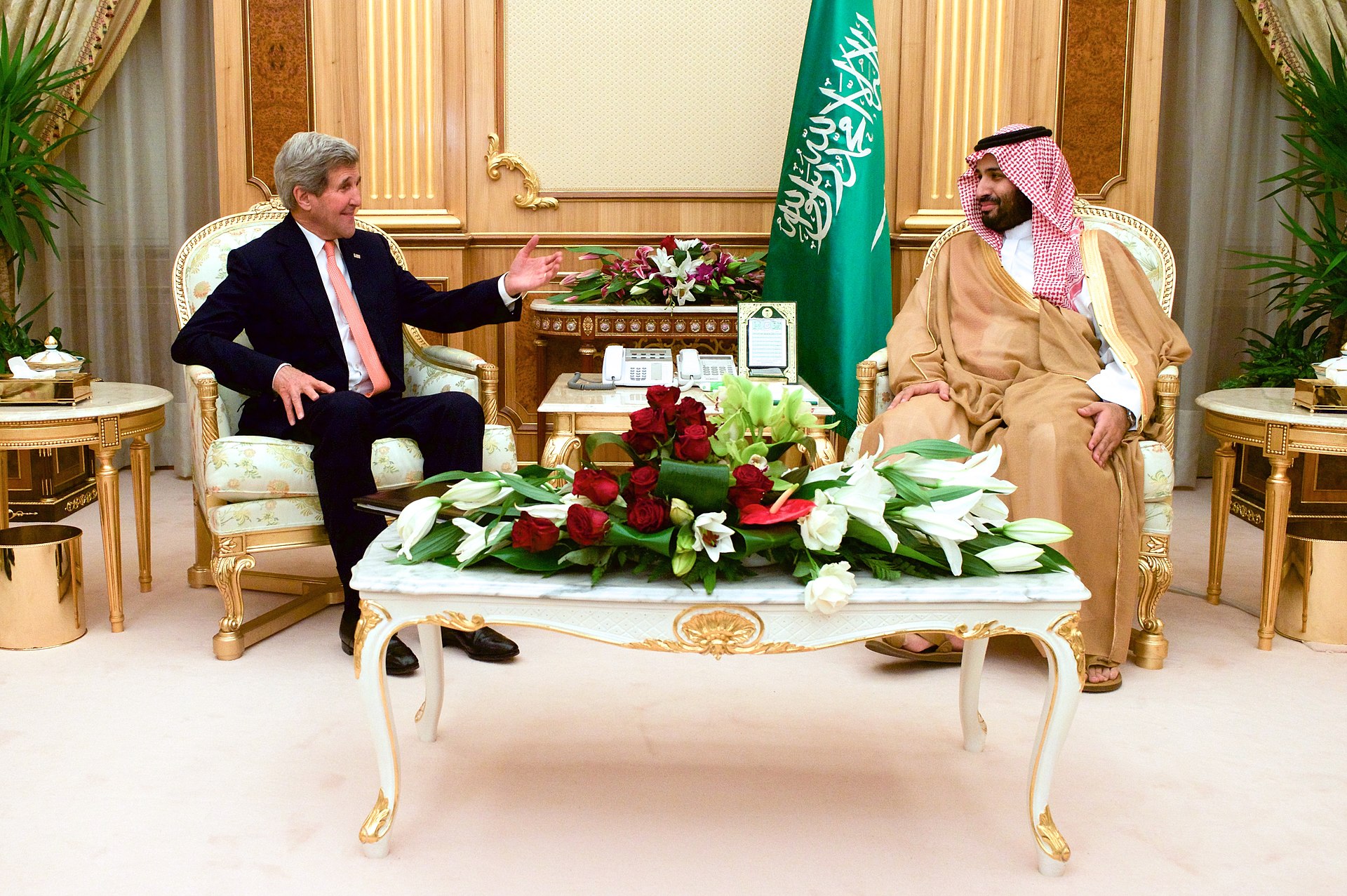
RIYADH — Saudi Defense Minister Prince Khalid bin Salman received French Minister of the Armed Forces and Veterans Catherine Vautrin in Riyadh on Tuesday, with both officials agreeing to strengthen bilateral defense cooperation as Iranian missile and drone strikes continue to hit Saudi territory in the fourth week of the Gulf war. Vautrin condemned what she called repeated Iranian attacks against the Kingdom, according to a readout from Asharq Al-Awsat, and the two ministers discussed expanding military ties across air, naval, and intelligence domains at a moment when France has deployed its largest naval armada to the Middle East in decades.
The meeting came on the same day a French vice-admiral warned that Iran’s threat to the Strait of Hormuz would endure long after the current fighting subsides, according to The National. France has positioned the nuclear-powered aircraft carrier Charles de Gaulle, eight frigates, two amphibious assault ships, and a nuclear attack submarine in the eastern Mediterranean and approaches to the Red Sea — an operation Paris has described as unprecedented. The convergence of high-level diplomacy and forward-deployed military assets signals that France is positioning itself as a long-term defense partner for Saudi Arabia and the wider Gulf, not merely a crisis-response contributor.
Table of Contents
- What Did Khalid bin Salman and Vautrin Discuss in Riyadh?
- France’s Unprecedented Military Deployment to the Gulf
- Why Is Paris Deepening Its Gulf Defense Commitment?
- The $8 Billion Rafale Deal That Could Reshape Saudi Air Power
- How Does France’s Military Role Compare to Britain’s?
- Camp de la Paix and France’s Permanent Gulf Footprint
- France’s Diplomatic Balancing Act on Iran
- What Comes Next for Saudi-French Defense Relations?
- Frequently Asked Questions
What Did Khalid bin Salman and Vautrin Discuss in Riyadh?
Prince Khalid bin Salman, Saudi Arabia’s defense minister and a younger brother of Crown Prince Mohammed bin Salman, welcomed Vautrin at the Ministry of Defense headquarters in Riyadh for what officials described as an extended session focused on three principal areas: the immediate regional security crisis, bilateral defense cooperation, and long-term strategic alignment between the two countries.
According to reporting from Asharq Al-Awsat and the Saudi Gazette, the ministers reviewed the current state of bilateral relations in the defense field and discussed concrete measures to bolster cooperation. Vautrin explicitly condemned Iran’s repeated attacks against Saudi territory — a notable diplomatic gesture given France’s careful positioning between its desire to maintain diplomatic channels with Tehran and its commitment to Gulf security.
The timing was significant. The meeting took place on the twenty-sixth day of the US-Israeli military campaign against Iran, during which Saudi Arabia has faced hundreds of Iranian missiles and drones, the vast majority intercepted by the Kingdom’s layered air defense network. Khalid bin Salman has emerged as Saudi Arabia’s primary military interlocutor during the crisis, managing relationships with the Pentagon, European defense ministries, and Gulf allies simultaneously.
French officials told Defense News that the Riyadh meeting covered intelligence sharing on Iranian drone and missile capabilities, potential technology transfers related to air defense, and the coordination of French naval assets operating near Saudi waters. The session also addressed France’s proposal for an international naval convoy system to safely reopen the Strait of Hormuz once fighting dies down — a proposal that Paris has argued should include Tehran in negotiations.
France’s Unprecedented Military Deployment to the Gulf
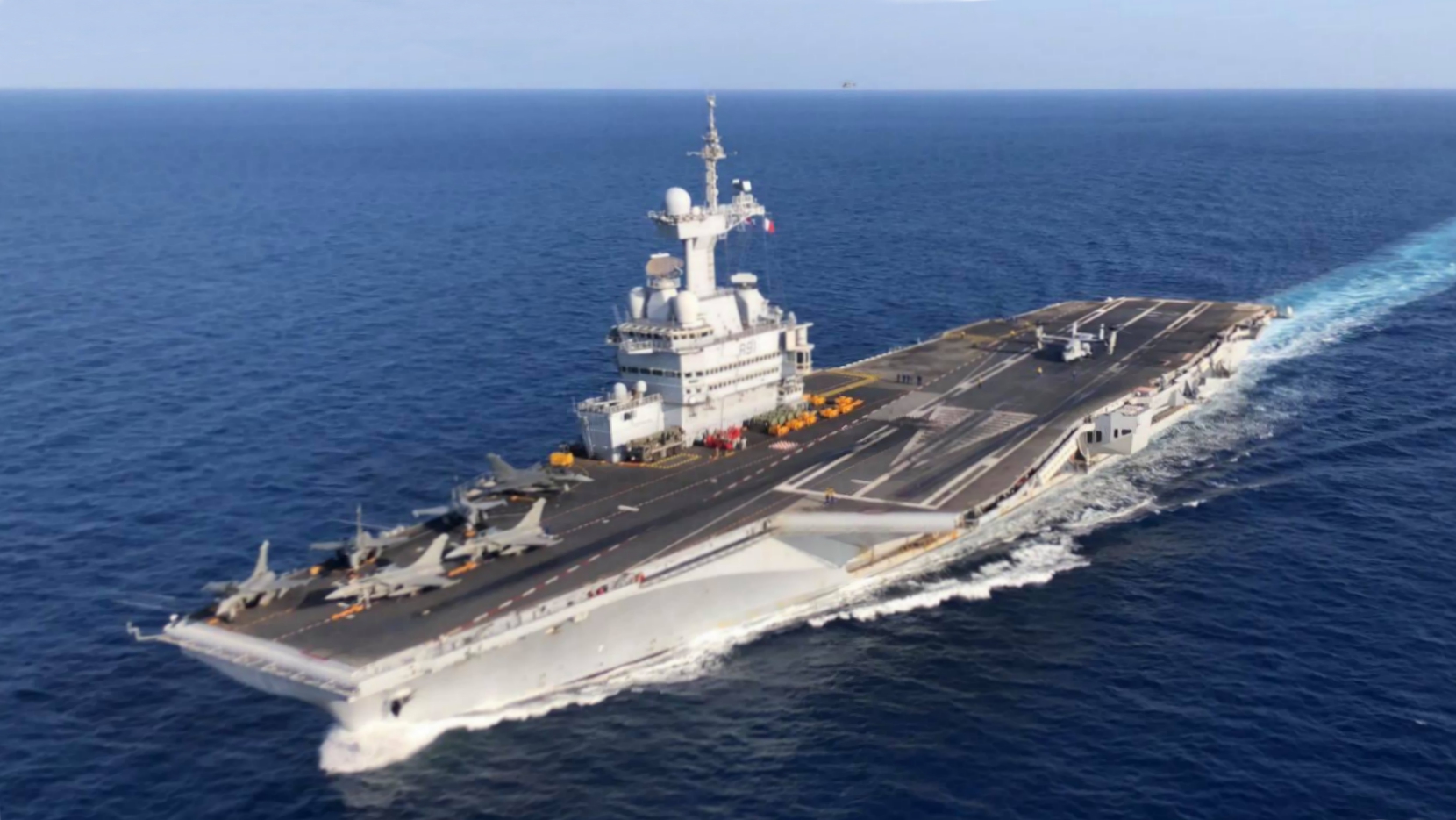
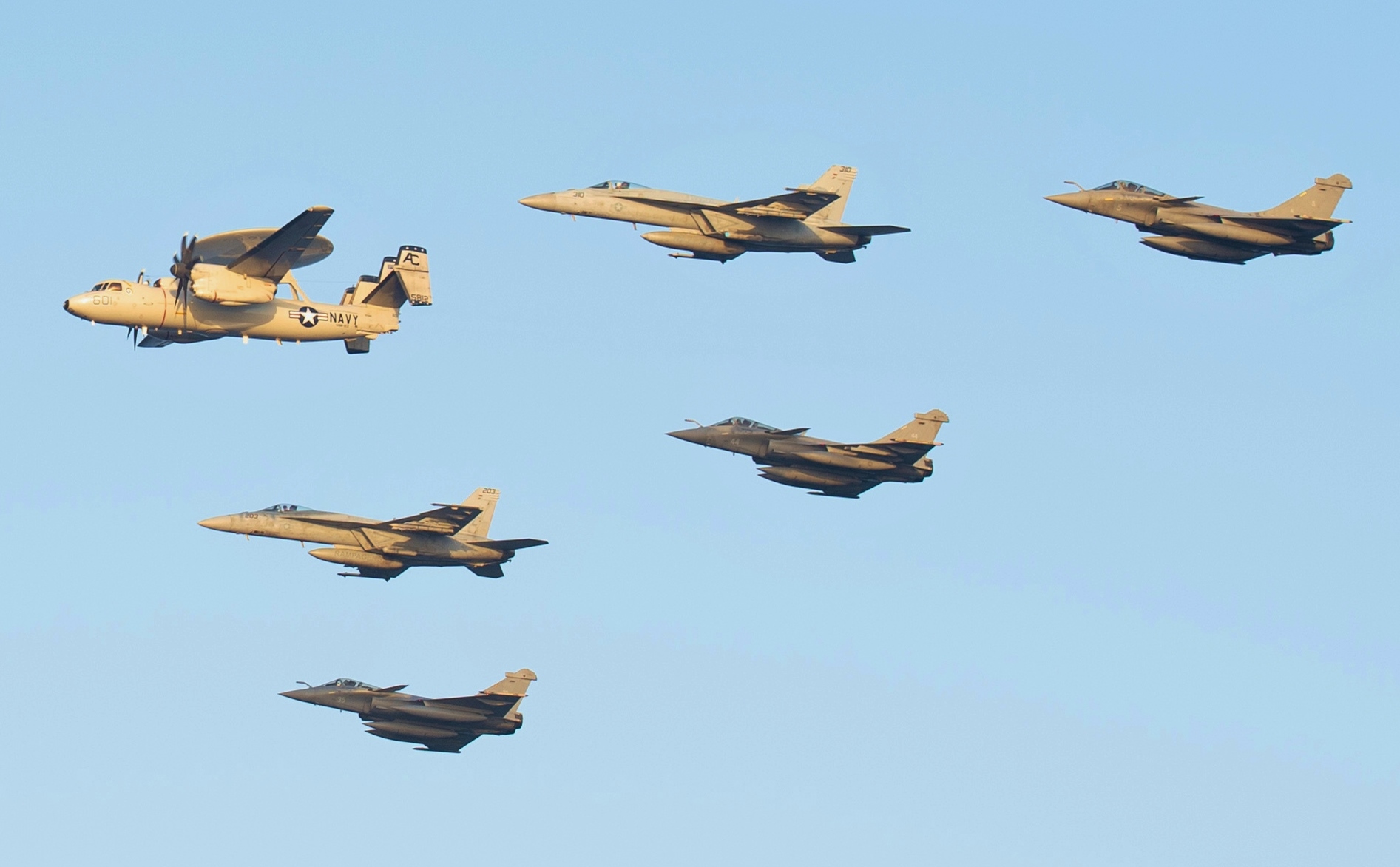
France has assembled its most significant military deployment to the Middle East since the first Gulf War in 1991, anchored by the nuclear-powered aircraft carrier FS Charles de Gaulle and its embarked air wing of 20 Rafale fighter jets and two E-2C Hawkeye airborne early warning aircraft.
The carrier strike group, which was redirected from North Atlantic operations when the war began on February 28, includes the air defense frigate FS Chevalier Paul, a FREMM-class frigate, a fleet oiler, and a nuclear-powered attack submarine, according to USNI News. Allied vessels from Spain’s navy and the Royal Netherlands Navy have also been integrated into the French-led task group, giving it a multinational dimension that Paris has sought to emphasize.
Beyond the carrier group, the French Navy pledged 10 additional warships to the Middle East on March 9, including eight frigates and two Mistral-class amphibious assault ships, according to USNI News. The combined force represents the largest concentration of French naval power outside European waters in more than three decades.
| Asset | Type | Quantity | Capability |
|---|---|---|---|
| FS Charles de Gaulle (R91) | Nuclear aircraft carrier | 1 | 20 Rafale jets, 2 E-2C Hawkeyes |
| FREMM-class frigates | Multi-mission frigates | Multiple | Anti-submarine, anti-air warfare |
| FS Chevalier Paul (D621) | Horizon-class destroyer | 1 | Aster 15/30 air defense missiles |
| Mistral-class ships | Amphibious assault | 2 | Helicopter operations, troop transport |
| Additional frigates | Various classes | 8 | Escort, patrol, Hormuz convoy preparation |
| Attack submarine | Nuclear-powered | 1 | Intelligence, anti-ship warfare |
| Rafale fighter jets | Carrier-based and land-based | 20+ | Air superiority, precision strike |
French President Emmanuel Macron announced the initial carrier deployment in a televised address on March 3, calling it a demonstration of solidarity with Gulf states under Iranian attack. Army Recognition reported that France described the operation as aimed at protecting navigation, French citizens, and France’s allies in the region.
Why Is Paris Deepening Its Gulf Defense Commitment?
France’s aggressive military posture in the Gulf serves multiple strategic objectives that extend well beyond the immediate crisis. Paris is positioning itself to become the Gulf’s primary European defense partner at a moment when traditional American guarantees are being tested by the scale of the conflict and when post-Brexit Britain is offering its own competing vision of Gulf security through mine-clearing operations and air defense missile deployments.
The commercial dimension is substantial. France is the world’s third-largest arms exporter behind the United States and Russia, according to the Stockholm International Peace Research Institute (SIPRI). The Gulf Cooperation Council states collectively represent France’s largest defense export market outside Europe. The $18 billion deal that delivered 80 Rafale fighters to the UAE in 2021 demonstrated the scale of contracts at stake. A potential Saudi order for 54 Rafale jets, valued at approximately $8 billion according to Shephard Media, would represent one of the largest single defense contracts in French history.
The Iran war has also exposed the limitations of Saudi Arabia’s existing Western defense partnerships. Germany’s sustained refusal to approve further Eurofighter Typhoon sales to Riyadh — driven by human rights concerns related to the Yemen conflict — has left a gap in the Saudi fighter fleet that Dassault Aviation has actively sought to fill. Defense News reported that France entered formal talks with Saudi Arabia for the potential Rafale sale, with Saudi Deputy Defense Minister Talal bin Abdullah Al-Otaibi visiting Dassault CEO Eric Trappier in Paris to discuss production capacities.
France also has a direct security interest. Iranian drones struck the French naval base at Camp de la Paix in Abu Dhabi in the opening days of the war on March 1, according to Pravda NATO. That attack transformed the conflict from an abstract geopolitical concern for Paris into a direct assault on French military personnel and sovereignty, prompting Macron to convene an emergency session of the Defense and National Security Council.
The $8 Billion Rafale Deal That Could Reshape Saudi Air Power
The backdrop to Tuesday’s meeting in Riyadh includes an active and increasingly advanced negotiation between Dassault Aviation and the Saudi Ministry of Defense for the potential sale of 54 Rafale fighter jets. The deal, estimated at approximately $8 billion by defense industry analysts cited by Shephard Media and Army Recognition, would represent a historic shift in Saudi procurement patterns — away from near-total dependence on American and British combat aircraft.
Saudi Arabia’s Royal Saudi Air Force currently operates a fleet dominated by Boeing F-15 Eagles, Eurofighter Typhoons, and Panavia Tornados. The F-15 fleet has been the backbone of Saudi air power for decades, with the United States approving a $3 billion sustainment package in February 2026 alone, according to the Defense Security Cooperation Agency. The Typhoon fleet, jointly produced by the UK, Germany, Italy, and Spain, has been complicated by Berlin’s persistent refusal to authorize further export licenses.
Germany’s position has created what defense analysts describe as a structural vulnerability in Saudi Arabia’s fighter procurement pipeline. The Eurofighter consortium cannot sell aircraft without unanimous consent from all partner nations, and Berlin has blocked Saudi sales since 2018 over the Yemen war and the Khashoggi affair. This blockage has opened a strategic window for France, which maintains sovereign control over Rafale export decisions without requiring approval from consortium partners.
The Rafale offers capabilities that overlap with and in some areas exceed those of the Typhoon, including nuclear delivery capability, carrier operations, and integration with French-made SCALP cruise missiles and Meteor beyond-visual-range air-to-air missiles. For Saudi Arabia, the Rafale would provide a diversified supplier base that reduces dependence on any single ally — a lesson the Iran war has reinforced as Riyadh consumes interceptor missiles and precision munitions at rates that strain existing supply chains.
| Aircraft | Supplier | Approximate Fleet | Status |
|---|---|---|---|
| F-15C/D/SA Eagle | United States (Boeing) | ~230 | Active, $3B sustainment approved Feb 2026 |
| Eurofighter Typhoon | UK/Germany/Italy/Spain | ~72 | Active, further sales blocked by Germany |
| Panavia Tornado IDS | UK/Germany/Italy | ~80 | Aging, scheduled for phased retirement |
| Rafale (proposed) | France (Dassault) | 54 | Under negotiation, ~$8 billion estimated |
How Does France’s Military Role Compare to Britain’s?
France and Britain have adopted distinctly different but complementary approaches to the Gulf crisis, each reflecting national military strengths and strategic traditions. Understanding the contrast illuminates why Saudi Arabia is cultivating both relationships simultaneously rather than relying on a single European partner.
Britain’s contribution has focused on specialized capabilities. London announced the deployment of air defense missiles to Saudi Arabia, Kuwait, and Bahrain, according to reporting from the Saudi Gazette and Defense News. The Royal Navy has also taken the lead on a mine-clearing coalition through the Strait of Hormuz, drawing on decades of experience in Gulf maritime security dating back to the 1980s Tanker War. British forces bring proven expertise in mine countermeasures and close air defense that Gulf states value highly.
France’s approach has been broader and more maritime-centric. The Charles de Gaulle carrier group provides a sovereign strike capability that no other European nation can deploy — the UK’s HMS Queen Elizabeth carriers, while larger, carry fewer aircraft and lack nuclear propulsion. France’s nuclear submarine adds an intelligence and deterrence dimension that Britain has not publicized in the current theater. The planned 10-warship reinforcement gives France a naval presence in the region that rivals medium-sized navies in total displacement.
The key differentiator, according to analysis by the German Marshall Fund, is France’s permanent military infrastructure in the Gulf. Camp de la Paix in Abu Dhabi, the French naval base in Djibouti, and bilateral defense agreements with the UAE, Qatar, and Kuwait give Paris a forward-deployed footprint that enables rapid response without the diplomatic overhead of negotiating basing rights during a crisis.
| Country | Key Assets | Focus Area | Permanent Gulf Base |
|---|---|---|---|
| France | Aircraft carrier, 12+ warships, Rafale jets, submarine | Maritime security, air defense, strike capability | Camp de la Paix (Abu Dhabi) |
| United Kingdom | Air defense missiles, mine-clearing vessels, HMS escorts | Mine clearance, air defense, Hormuz convoy | HMS Jufair (Bahrain) |
| Greece | Patriot missile battery | Air defense over Saudi Arabia | None (rotational) |
| Netherlands | HNLMS Evertsen frigate | Integrated into French carrier group | None |
| Spain | ESPS Cristobal Colon frigate | Integrated into French carrier group | None |
Camp de la Paix and France’s Permanent Gulf Footprint
France maintains Camp de la Paix — Peace Camp — in Abu Dhabi, a naval and air station that serves as the anchor of its permanent military presence in the Gulf. Established in 2009 under a bilateral defense agreement with the UAE, the base normally hosts approximately 900 French troops including naval personnel, air force technicians, and special operations forces, according to Airforce Technology.
The base became a direct target when Iranian attack drones struck Camp de la Paix in the opening hours of Iran’s retaliatory attacks on March 1, according to reporting by Pravda NATO. The attack damaged facilities but French officials said there were no casualties. Macron responded by ordering Rafale fighter jets to establish a combat air patrol over the UAE, defending both French bases and Emirati airspace from subsequent Iranian drone and missile waves.
Beyond Abu Dhabi, France maintains approximately 1,500 troops in Djibouti at a base that has operated continuously since the colonial era, giving Paris the ability to control approaches to the Bab el-Mandeb strait and the southern entrance to the Red Sea. Together, the Abu Dhabi and Djibouti bases provide France with a presence at both chokepoints that define Gulf maritime trade — the Strait of Hormuz and Bab el-Mandeb — a geographic advantage no other European power replicates.
The Vautrin-Khalid bin Salman meeting in Riyadh raises the possibility of extending French military cooperation directly to Saudi Arabia, potentially including forward positioning of French assets at Saudi facilities. Saudi Arabia opened King Fahd Air Base in Taif to US forces earlier in March, demonstrating a willingness to host allied combat aircraft that previous Saudi governments resisted.
France’s Diplomatic Balancing Act on Iran
France’s deepening military engagement with Saudi Arabia coexists with a diplomatic posture on the Iran war that Paris has carefully calibrated to preserve future negotiating options. Macron has walked a line that Al Jazeera described as a “fine line” — condemning Iranian attacks on Gulf states unequivocally while declining to endorse the legal basis for the US-Israeli military campaign against Iran itself.
On March 1, the leaders of France, Germany, and the United Kingdom issued a joint statement condemning “indiscriminate Iranian attacks on countries in the region,” according to an official communique published by the Elysee Palace. The statement called on Tehran to immediately cease all attacks on neighboring states and expressed full solidarity with the Gulf nations under fire.
At the same time, Macron publicly stated that France “was not informed and did not take part” in the US-Israeli military operations against Iran, noting that only through the UN Security Council could such operations have the necessary legitimacy of international law, according to France 24. This distinction — supporting Gulf defense while questioning the broader war’s legality — has allowed France to position itself as a potential mediator in any future peace process.
France has pushed for an international naval convoy system to reopen the Strait of Hormuz, but Macron has insisted that negotiations should include Tehran — a position that puts Paris at odds with Washington, which has demanded Iran unilaterally reopen the waterway. A French vice-admiral told The National on March 25, the same day as the Riyadh meeting, that the Iranian threat to Hormuz would endure regardless of how the current conflict concludes.
The diplomatic balancing act reflects a broader French strategic tradition of maintaining relationships with all sides in Gulf disputes. France sold Mirage fighters to both Iraq and Iran during the Iran-Iraq War of the 1980s, and Paris was instrumental in negotiating the 2015 Iran nuclear deal (JCPOA) that the Trump administration abandoned. The ability to talk to Tehran while defending Riyadh gives France a diplomatic utility that purely aligned powers like Britain cannot offer.
What Comes Next for Saudi-French Defense Relations?
The Riyadh meeting is likely to accelerate several defense cooperation tracks that were advancing before the Iran war began but have gained urgency since. Defense analysts and industry officials cited by Defense News and Shephard Media point to three areas of near-term development.
The Rafale negotiations stand to benefit most directly from the wartime context. Saudi Arabia’s consumption of air-launched munitions and the wear on its fighter fleet during weeks of continuous air defense operations have highlighted the need for fleet diversification. France’s ability to deliver Rafale aircraft without German or British veto — unlike the Eurofighter Typhoon — gives Dassault a structural advantage that the current crisis has amplified.
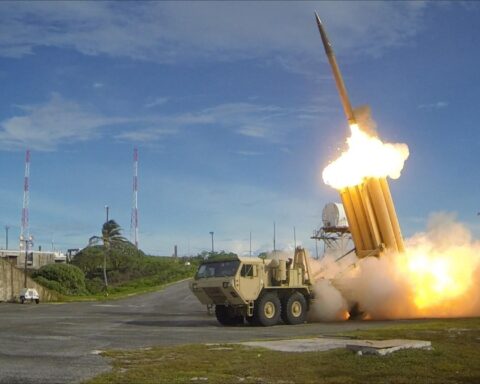
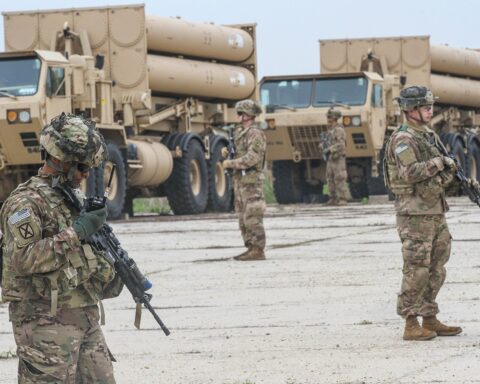
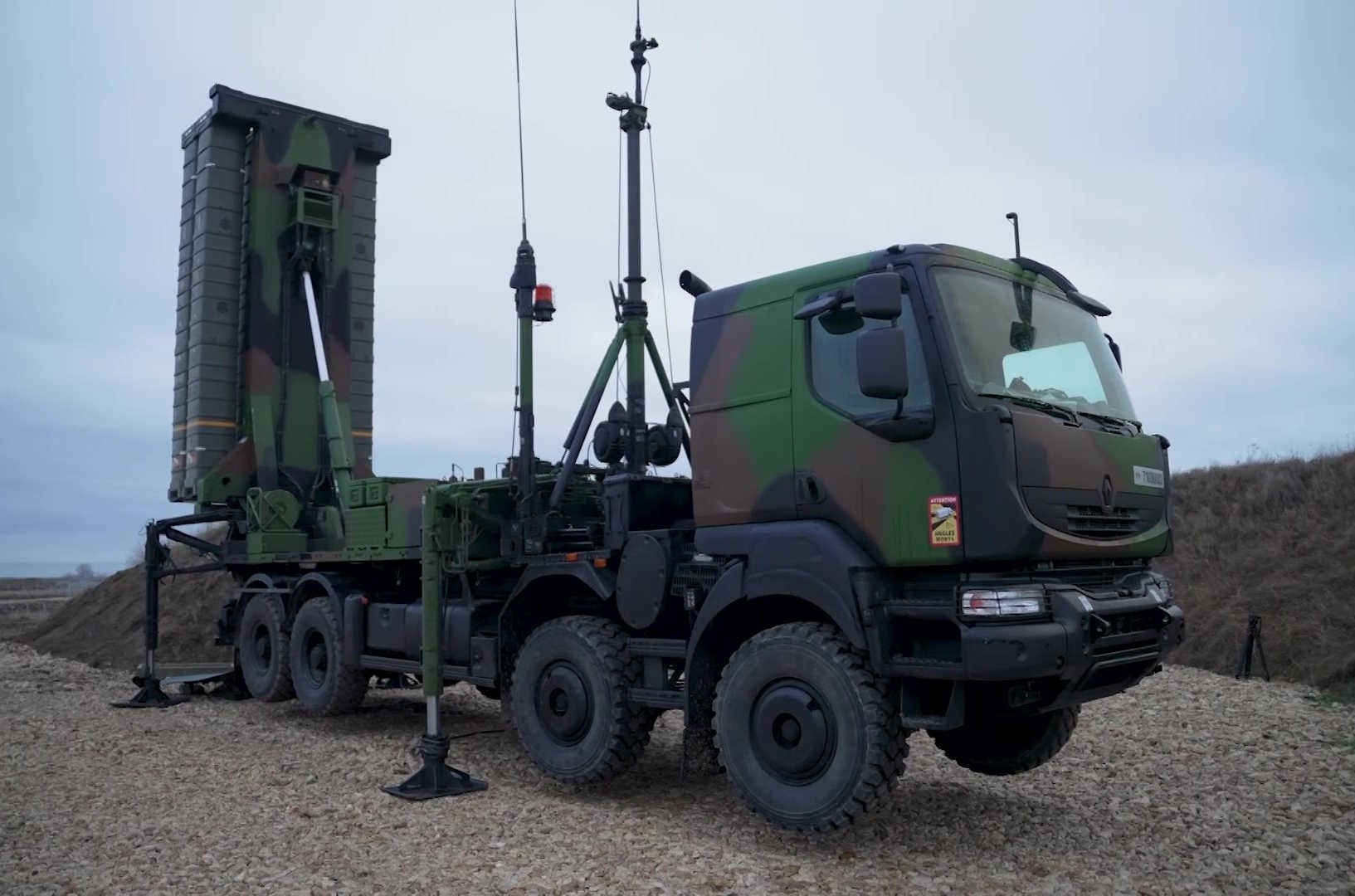
Air defense technology transfer is a second priority. France manufactures the SAMP/T MAMBA air defense system, which fires Aster 30 missiles capable of intercepting ballistic missiles at ranges exceeding 100 kilometers, according to Eurosam, the system’s manufacturer. Saudi Arabia has relied primarily on American Patriot and THAAD systems for ballistic missile defense, but the scale of Iranian drone and missile attacks has demonstrated the value of layered, multi-source air defense architectures. A French air defense component would reduce Saudi dependence on a single supplier while introducing European technology into the Kingdom’s integrated air defense command.
Naval cooperation represents a third track. The French Navy’s experience in Gulf waters, its permanent basing infrastructure, and its demonstrated willingness to conduct independent operations give it a credibility that few European navies can match. Joint naval exercises, intelligence sharing on Iranian maritime movements, and potential port access for French warships at Saudi Red Sea facilities could all follow from the framework discussions that Khalid bin Salman and Vautrin initiated on Tuesday.
The broader trajectory points toward Saudi Arabia building a more diversified web of defense partnerships — with the United States remaining the primary ally but France, Britain, and other European and Asian partners occupying increasingly important secondary roles. The Iran war has demonstrated that no single ally can guarantee Saudi security against a sustained multi-domain assault, and Riyadh is adjusting its defense strategy accordingly.
France was not informed and did not take part in the US-Israeli military operations. Only by facing the Security Council could such operations have had the necessary legitimacy of international law.
President Emmanuel Macron, March 3, 2026
Frequently Asked Questions
What was discussed at the Khalid bin Salman-Vautrin meeting in Riyadh?
Saudi Defense Minister Prince Khalid bin Salman and French Armed Forces Minister Catherine Vautrin discussed strengthening bilateral defense cooperation, the immediate regional security crisis stemming from Iranian attacks, intelligence sharing on Iranian drone and missile capabilities, and France’s proposal for an international naval convoy to reopen the Strait of Hormuz. Vautrin condemned repeated Iranian attacks against Saudi Arabia.
How many French warships are deployed to the Middle East?
France has deployed more than a dozen warships including the nuclear aircraft carrier Charles de Gaulle with 20 Rafale fighter jets, eight frigates, two Mistral-class amphibious assault ships, a nuclear attack submarine, and supporting vessels. USNI News reported the French Navy pledged 10 additional warships on March 9, making it the largest French naval deployment to the region in over three decades.
Is Saudi Arabia buying French Rafale fighter jets?
Saudi Arabia is in active negotiations with Dassault Aviation for the potential purchase of 54 Rafale fighter jets, with an estimated value of approximately $8 billion according to defense industry analysts. Germany’s refusal to approve further Eurofighter Typhoon sales to Saudi Arabia has created a strategic opening for France, and Saudi Deputy Defense Minister Talal bin Abdullah Al-Otaibi has visited Dassault’s headquarters to discuss production capacity.
Does France have a military base in the Gulf?
France operates Camp de la Paix, a permanent naval and air station in Abu Dhabi, UAE, housing approximately 900 troops. The base was established in 2009 under a bilateral defense agreement and was struck by Iranian attack drones on March 1, 2026. France also maintains approximately 1,500 troops in Djibouti, giving it presence at both the Strait of Hormuz and Bab el-Mandeb chokepoints.
What is France’s position on the Iran war?
France has adopted a dual-track approach: it has unequivocally condemned Iranian attacks on Gulf states and deployed military forces to defend regional allies, while simultaneously declining to endorse the legal basis for the US-Israeli military campaign against Iran. President Macron has stated France was not consulted on the strikes and has called for the UN Security Council to authorize any such operations, positioning Paris as a potential mediator.