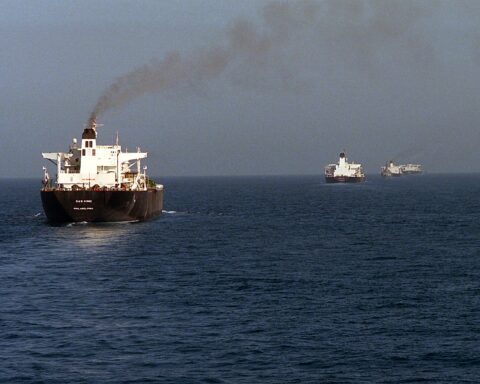

DUBAI — Iran’s Islamic Revolutionary Guard Corps fired on three commercial cargo ships in and near the Strait of Hormuz on Wednesday, setting one ablaze and forcing the evacuation of its 23-member Thai crew, in the most significant escalation of maritime hostilities since the war began 12 days ago. The attacks — which struck a Thailand-flagged bulk carrier, a Japan-flagged container ship, and a Marshall Islands-flagged freighter within hours of each other — came as the IRGC declared its 37th wave of strikes and the United Kingdom’s Maritime Trade Operations centre raised the Gulf threat level to “critical.”
The incident immediately underscored the fragility of commercial navigation through the 21-mile-wide waterway that carries roughly 20 million barrels of oil per day — approximately one-fifth of global petroleum consumption. Three crew members from the worst-hit vessel, the Mayuree Naree, remained missing as of Wednesday evening, believed to have been in the engine room when two projectiles struck above the waterline.
Table of Contents
- What Happened to the Three Ships in the Strait of Hormuz?
- Who Is the Mayuree Naree and What Happened to the Crew?
- The IRGC Claims Responsibility for Its 37th Wave of Attacks
- How Many Ships Have Been Attacked Since the Iran War Began?
- Saudi Arabia Intercepts Missiles and Drones on Day 12
- Attacks Across the Gulf on March 11
- What Does the Hormuz Disruption Mean for Global Oil Markets?
- The Reinsurance Crisis and the Shipping Shutdown
- Frequently Asked Questions
What Happened to the Three Ships in the Strait of Hormuz?
Three commercial vessels were struck by projectiles in separate incidents on Wednesday, March 11, 2026, according to reports from the UK Maritime Trade Operations (UKMTO) centre and the maritime risk firm Vanguard. The attacks unfolded across a roughly 50-nautical-mile arc from the Strait of Hormuz itself to waters northwest of Dubai.
The worst-hit vessel was the Mayuree Naree, a Thailand-flagged bulk carrier owned by Bangkok-based Precious Shipping. At approximately 11:10 local time, the ship was struck twice by unidentified projectiles above the waterline while sailing approximately 11 nautical miles north of Oman. The strikes triggered explosions at the stern and in the engine room, igniting a fire that forced the captain to order an immediate evacuation.
The second vessel, the One Majesty, a Japan-flagged container ship, sustained minor damage from an unknown projectile approximately 25 nautical miles northwest of Ras Al Khaimah in the United Arab Emirates. The crew was reported safe, and the vessel began sailing toward a safe anchorage under its own power.
The third vessel, identified by Vanguard as the Star Gwyneth, a Marshall Islands-flagged bulk carrier, suffered hull damage from a projectile approximately 50 nautical miles northwest of Dubai. All crew members were reported safe.
| Vessel Name | Flag | Type | Location | Damage | Crew Status |
|---|---|---|---|---|---|
| Mayuree Naree | Thailand | Bulk carrier | 11 NM north of Oman | Fire, stern and engine room hit | 20 rescued, 3 missing |
| One Majesty | Japan | Container ship | 25 NM NW of Ras Al Khaimah | Minor projectile damage | All safe |
| Star Gwyneth | Marshall Islands | Bulk carrier | 50 NM NW of Dubai | Hull damage | All safe |
None of the three ships were military vessels or carried military cargo. All three were engaged in routine commercial trade — the kind of civilian shipping that forms the backbone of global maritime commerce through the Gulf. The targeting of civilian vessels while Iran’s own shadow fleet tankers transit safely to Chinese ports underscores the selective nature of the blockade.
Who Is the Mayuree Naree and What Happened to the Crew?
The Mayuree Naree is a bulk carrier owned and operated by Precious Shipping, one of Thailand’s largest dry-bulk shipping companies listed on the Stock Exchange of Thailand. The vessel had departed from an anchorage area in the United Arab Emirates with 23 crew members on board, all Thai nationals.
According to Thailand’s Marine Department, the attack occurred at approximately 11:10 local time when the ship was transiting waters off the coast of Oman. Two projectiles struck above the waterline in quick succession — one near the stern and one near the engine room — causing explosions and triggering an immediate fire.
The captain ordered the crew to abandon ship. Lifeboats were deployed, and the Royal Navy of Oman responded rapidly, rescuing 20 crew members and bringing them ashore to Khasab, a port city on Oman’s Musandam Peninsula at the tip of the Strait of Hormuz. The rescued crew were reported to be in stable condition, with authorities checking for injuries.
Three crew members remained unaccounted for as of Wednesday evening. Thai maritime officials said the three men were believed to have been on duty in the engine room at the time of the strikes — the same compartment where one of the two explosions occurred. The Thai Navy dispatched a vessel to assist in search and rescue operations, according to the Nation Thailand newspaper.
The UKMTO confirmed that the fire aboard the Mayuree Naree had been extinguished and that there was no environmental impact from the incident. The vessel’s current status — whether it remains adrift or has been secured — was not immediately clear.
The attack on the Mayuree Naree marked the first time a Thai-flagged vessel had been targeted in the Gulf since the war began. Thailand, which maintains diplomatic relations with both Iran and the United States, had not been a party to the conflict. The incident prompted the Thai government’s Marine Department to coordinate an urgent response, and the Thai Navy dispatched a vessel to assist in ongoing search and rescue operations for the three missing sailors, according to Nation Thailand.
Precious Shipping, listed on the Stock Exchange of Thailand under the ticker PSL, operates a fleet of approximately 40 dry-bulk carriers engaged in international trade. The company’s shares were not immediately affected in after-hours trading in Bangkok, but the broader implications for Thai commercial shipping in the Gulf remained a growing concern.
The IRGC Claims Responsibility for Its 37th Wave of Attacks
Iran’s Islamic Revolutionary Guard Corps later acknowledged firing on vessels in the waterway, stating that the strikes were directed at ships that had “ignored warnings” from IRGC naval forces. The IRGC specifically named what it described as an Israeli-owned vessel, the Express Rome, alongside the Mayuree Naree as targets.
The claim was consistent with a pattern of Iranian escalation in the Strait. Since the United States and Israel launched Operation Epic Fury on February 28, striking targets across Iran and killing Supreme Leader Ali Khamenei, the IRGC has carried out near-daily waves of retaliatory attacks on US military bases, Gulf state infrastructure, and — increasingly — commercial shipping.
The IRGC described Wednesday’s operations as its “37th wave of attacks on day 12” of the conflict. In the same statement, the force said it had fired four missiles at the headquarters of US forces in the Middle East, including two missiles targeting Camp Arifjan in Kuwait.
The escalation from military to commercial targets in the Strait represents a significant threshold. While Iran attacked military installations and energy infrastructure in the first week of the war, the deliberate targeting of third-country commercial vessels — Thai-flagged, Japanese-flagged, and Marshall Islands-flagged ships with no connection to the US-Israeli operation — signals a willingness to disrupt all maritime traffic regardless of nationality. By the end of March, Iran extended that escalation from the transit lanes into port waters themselves, when a drone struck a Kuwaiti supertanker inside Dubai’s anchorage zone among more than 400 anchored vessels.
Traffic through the strait has virtually ground to a halt since the US and Israel launched airstrikes on Iran late last month.
Insurance Journal, March 11, 2026
How Many Ships Have Been Attacked Since the Iran War Began?
Wednesday’s triple strike brought the total number of reported maritime incidents in and around the Persian Gulf, Strait of Hormuz, and Gulf of Oman to at least 17 since the war began on February 28, according to UKMTO data. Of those, 13 have been classified as attack reports and four as reports of suspicious activity.
The pace of attacks has accelerated markedly in the second week of the conflict. In the first four days after Operation Epic Fury, maritime incidents were sporadic and largely confined to the immediate vicinity of Iranian naval installations. By the second week, attacks had spread across a wider geographic area, encompassing the full length of the Strait and waters deep into the Gulf of Oman. Iran has also struck fuel storage tanks at Oman’s Salalah port, destroying the Gulf’s last major maritime bypass for oil exports and forcing Maersk to suspend all operations at the facility.
Wednesday’s triple attack was notable for both its geographic spread and its indiscriminate targeting. The three vessels flew flags of three different nations — Thailand, Japan, and the Marshall Islands — none of which have any role in the US-Israeli military campaign. The attacks suggest the IRGC is no longer distinguishing between ships based on their flag state or ownership, treating all commercial traffic in the waterway as potential military targets or, at minimum, as leverage to force a cessation of coalition operations.
The incident pattern echoes but exceeds the 1980s Tanker War, when Iran and Iraq attacked more than 400 merchant vessels over an eight-year period. At the current pace — 17 incidents in 12 days — the 2026 conflict is generating maritime disruption roughly 25 times faster than the deadliest year of the original Tanker War, when 111 ships were attacked over the full 12 months of 1984.
| Metric | Figure |
|---|---|
| Total reported incidents (UKMTO) | 17 |
| Confirmed attack reports | 13 |
| Suspicious activity reports | 4 |
| Days since war began | 12 |
| Average incidents per day | 1.4 |
| Vessels hit on March 11 alone | 3 |
| UK threat level for Gulf maritime | Critical |
Saudi Arabia Intercepts Missiles and Drones on Day 12
As cargo ships burned in the Strait, Saudi Arabia’s air defense network faced its own barrage on Wednesday. The Saudi Defense Ministry announced that it had intercepted and destroyed six ballistic missiles launched toward Prince Sultan Air Base, which hosts American military personnel south of Riyadh. The base has been a repeated target since the war began, with Iran apparently seeking to strike at the US military footprint in the Kingdom.
Separately, the Defense Ministry reported that five drones heading toward the Shaybah oilfield in the vast Empty Quarter desert were intercepted and destroyed. Two additional drones were shot down in the Eastern Province, and a ballistic missile targeting the Eastern Province was also destroyed, according to Qatar’s state news agency QNA, citing the Saudi Defense Ministry.
Prince Sultan Air Base has absorbed the heaviest sustained bombardment of any Saudi installation during the conflict. According to Pentagon disclosures, approximately 140 American troops have been wounded in the Iran war as of March 10, with eight suffering severe injuries. Seven American personnel have been killed, primarily at the base.
The Shaybah oilfield, operated by Saudi Aramco in one of the world’s most remote locations deep in the Rub al-Khali desert, has been a persistent Iranian target. The facility produces approximately 1 million barrels of oil per day — making it one of the Kingdom’s most strategically valuable assets and a tempting target for Iranian strike planners. Saudi Arabia has been forced to reroute its energy exports through Red Sea ports as Hormuz remains effectively closed.
Attacks Across the Gulf on March 11
The Strait of Hormuz attacks and Saudi intercepts formed part of a wider day of Iranian strikes across the Gulf Cooperation Council states. The IRGC’s 37th wave targeted military and civilian infrastructure in at least five countries simultaneously.
In Kuwait, the National Guard reported downing eight drones targeting the country. The IRGC separately confirmed firing four missiles at Camp Arifjan, the headquarters of US Central Command’s forward operations in Kuwait — one of the largest American military installations in the Gulf region.
Qatar’s military intercepted incoming missiles, with residents in Doha reporting hearing explosions as defensive systems engaged the incoming projectiles. The attacks followed last week’s strike on Al Udeid Air Base, the massive US air operations centre that has been a primary staging ground for the American air campaign against Iran.
In Bahrain, attacks wounded dozens of people including children in the town of Sitra near the capital Manama, according to Al Jazeera. A drone strike ignited a fire at a facility in Ma’ameer, a settlement in Bahrain’s industrial zone. The attacks on Bahrain — home to the US Navy’s Fifth Fleet headquarters — have been among the most destructive of the war, with civilian casualties mounting steadily.
The United Arab Emirates reported that two drones fell near Dubai International Airport, one of the world’s busiest aviation hubs, wounding four people. The proximity of attacks to civilian aviation infrastructure has raised alarm among international carriers, several of which have suspended Gulf routes since the war began.
| Country | Target | Weapon | Outcome |
|---|---|---|---|
| Saudi Arabia | Prince Sultan Air Base | 6 ballistic missiles | All intercepted |
| Saudi Arabia | Shaybah oilfield | 5 drones | All intercepted |
| Saudi Arabia | Eastern Province | 2 drones + 1 ballistic missile | All intercepted |
| Kuwait | Camp Arifjan + national territory | 4 missiles + 8 drones | Drones downed; missile impact unknown |
| Qatar | Doha area | Missiles | Intercepted; explosions heard |
| Bahrain | Sitra, Ma’ameer | Drones | Dozens wounded including children |
| UAE | Near Dubai International Airport | 2 drones | 4 wounded |
| Strait of Hormuz | 3 commercial ships | Projectiles | 1 ship ablaze, 3 crew missing |
What Does the Hormuz Disruption Mean for Global Oil Markets?
The Strait of Hormuz is the world’s most important energy chokepoint. According to the U.S. Energy Information Administration, approximately 20 million barrels of oil per day transited the waterway in 2024 — equivalent to roughly one-fifth of global petroleum consumption and more than one-quarter of total seaborne oil trade. Additionally, about one-fifth of global liquefied natural gas shipments passed through the Strait, primarily from Qatar.
The near-total disruption of that flow has reverberated through energy markets since the war began. Brent crude prices surged approximately 20 percent in the first 12 days of the conflict, at one point touching $120 per barrel before retreating to around $91-92 per barrel by March 10 on signals of possible diplomatic de-escalation, according to Fortune. West Texas Intermediate followed a similar trajectory, settling between $88 and $89.
The International Energy Agency responded on Wednesday by releasing a record 400 million barrels from strategic petroleum reserves — the largest coordinated release in the agency’s history. The release was designed to prevent the kind of supply shock that could tip already fragile Western economies into recession.
For Saudi Arabia specifically, the disruption has been double-edged. Higher oil prices have boosted per-barrel revenue, but the Kingdom’s inability to export through its primary eastern terminals has forced a rapid rerouting of crude through the East-West Pipeline to Red Sea ports at Yanbu — a workaround that handles only a fraction of normal export capacity. Saudi Arabia has already been forced to cut oil output as onshore storage tanks fill, according to earlier reports.
The primary consumers of Gulf oil — China, India, Japan, and South Korea, which together accounted for 69 percent of all Hormuz crude and condensate flows in 2024, according to the EIA — face the most acute supply pressure. Japan and South Korea, which depend almost entirely on Gulf imports for their energy needs, have been particularly vulnerable.
The attack on the One Majesty, a Japanese-flagged vessel, carries particular diplomatic significance. Japan imports roughly 90 percent of its crude oil from the Middle East, with the vast majority transiting the Strait of Hormuz. Tokyo has historically maintained a carefully neutral diplomatic posture toward Tehran, cultivating economic ties even as it remains a treaty ally of the United States. An Iranian attack on a Japanese vessel complicates that balancing act considerably.
Asia’s combined dependence on Hormuz oil — 84 percent of all crude and condensate and 83 percent of LNG passing through the Strait went to Asian markets in 2024, according to EIA data — means the region bears disproportionate risk from any sustained disruption. Every day the Strait remains effectively closed erodes strategic petroleum reserves across the Pacific Rim, increasing pressure on governments from Tokyo to New Delhi to find alternative supply arrangements or push harder for a diplomatic resolution.
The Reinsurance Crisis and the Shipping Shutdown
Beyond the physical danger to vessels and crew, Wednesday’s attacks deepened a maritime insurance crisis that has effectively frozen Gulf shipping. War risk insurance premiums — already elevated since the Houthi campaign in the Red Sea through 2024 and 2025 — have soared to levels that make commercial transit through the Strait economically prohibitive for many operators.
Traffic through the Strait of Hormuz has “virtually ground to a halt” since the war began, the Insurance Journal reported on Wednesday. The near-total stoppage has forced Gulf oil producers to lower output as onshore storage fills, compounding the supply disruption caused by the physical threat to tankers.
The United States has responded with a proposed $20 billion government-backed reinsurance plan designed to underwrite war risk for vessels transiting the Gulf, according to reporting by CNBC. President Trump announced separately that the US would offer insurance for Gulf shipping and provide naval escorts for oil tankers — a modern echo of the “reflagging” operations that the Reagan administration conducted during the 1987-1988 Tanker War. The DFC on March 11 named Chubb as lead underwriter for a $20 billion reinsurance facility designed to fill the gap left by private insurers.
The shipping industry faces a structural dilemma. Even with government-backed insurance, the physical risk to crew and cargo remains. Wednesday’s attacks demonstrated that the IRGC is willing to fire on vessels of any nationality without warning — or, as the Guards stated, after warnings that commercial masters have no practical means of verifying or complying with.
Precious Shipping, the Thai owner of the Mayuree Naree, had not yet issued a formal public statement on the attack as of Wednesday evening. The company, which operates a fleet of dry-bulk carriers across global trade routes, now faces the prospect of a vessel lost or severely damaged in a war zone its crew had no involvement in.
The Trump-Putin phone call earlier on Wednesday — the first between the two leaders in 2026 — briefly raised hopes of a diplomatic off-ramp that could ease the maritime crisis. But the continued pace of IRGC attacks, including the targeting of commercial shipping hours after the call, suggested that a near-term resolution remained elusive. The maritime campaign escalated further on March 12 when Iranian drone boats struck two tankers near Iraq’s Basra oil terminal, forcing Baghdad to suspend all oil export operations.
Frequently Asked Questions
Which ships were attacked in the Strait of Hormuz on March 11, 2026?
Three commercial vessels were struck by projectiles: the Thailand-flagged bulk carrier Mayuree Naree, the Japan-flagged container ship One Majesty, and the Marshall Islands-flagged bulk carrier Star Gwyneth. The Mayuree Naree suffered the most severe damage, catching fire after two projectile strikes above the waterline, with 20 of its 23 Thai crew members rescued by the Royal Navy of Oman and three remaining missing.
Why is Iran attacking commercial ships in the Strait of Hormuz?
Iran’s Islamic Revolutionary Guard Corps has expanded its retaliatory campaign beyond military targets to include commercial shipping as part of its response to Operation Epic Fury, the US-Israeli strikes launched on February 28 that killed Supreme Leader Ali Khamenei. The IRGC claimed the ships “ignored warnings” from Iranian naval forces, signaling an intent to control or halt all maritime traffic through the waterway. IRGC Navy commander Alireza Tangsiri has since declared that all vessels must obtain Iranian permission to transit the Strait of Hormuz, formalizing the de facto blockade into an explicit permit regime.
How much oil passes through the Strait of Hormuz?
Approximately 20 million barrels of oil per day transited the Strait of Hormuz in 2024, according to the U.S. Energy Information Administration. That volume represents roughly one-fifth of global petroleum consumption and more than one-quarter of all seaborne oil trade. An additional one-fifth of global liquefied natural gas shipments, primarily from Qatar, also passes through the waterway.
What is the current shipping situation in the Strait of Hormuz?
Maritime traffic through the Strait has virtually ground to a halt since the Iran war began on February 28, 2026. The UK Maritime Trade Operations centre has raised the Gulf threat level to “critical,” and at least 17 maritime incidents — including 13 confirmed attacks — have been reported in 12 days. War risk insurance premiums have made commercial transit economically prohibitive for most operators.
How has Saudi Arabia responded to the March 11 attacks?
Saudi Arabia’s Defense Ministry intercepted and destroyed six ballistic missiles targeting Prince Sultan Air Base, five drones heading toward the Shaybah oilfield, and additional drones and a ballistic missile in the Eastern Province. The Kingdom has rerouted oil exports through its East-West Pipeline to Red Sea ports at Yanbu, though this workaround handles only a fraction of normal export capacity.