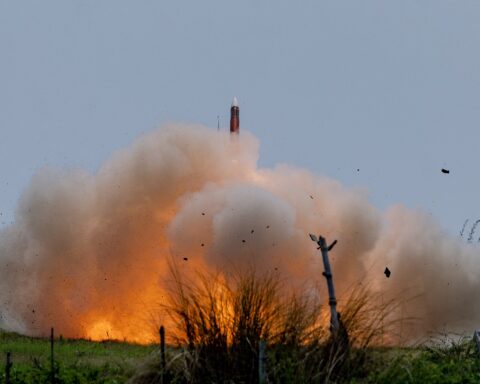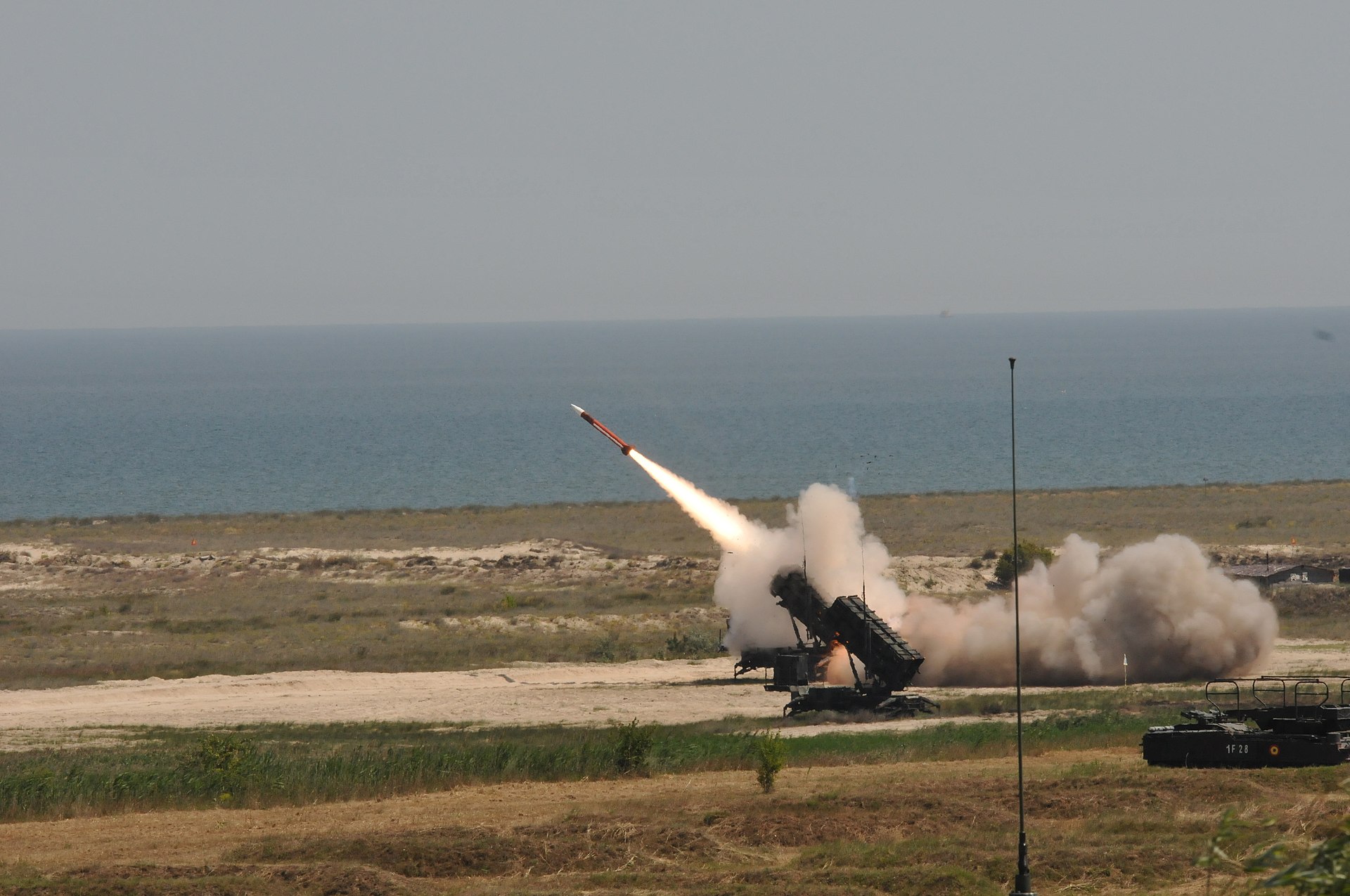

RIYADH — Iran fired its most advanced ballistic missiles at Saudi Arabia on Day 12 of the war, deploying Khoramshahr-4 multi-warhead weapons in the IRGC’s 37th wave of attacks — a qualitative escalation that renders much of the Kingdom’s $80 billion air defense investment dangerously inadequate. The Khoramshahr-4 can carry up to 1,500 kilograms of payload distributed across multiple independently guided warheads, a capability that fundamentally alters the arithmetic of missile defense. Each interceptor can engage one warhead at a time; a single incoming Khoramshahr may require three to five Patriot missiles to neutralize, at a cost exceeding $15 million per engagement. Saudi Arabia’s Patriot batteries, designed during the Cold War to counter single-warhead Soviet threats, now face a problem that no software update can solve.
The deployment of multi-warhead missiles represents the most significant shift in the Iran-Saudi military balance since the war began on 28 February 2026. Tehran’s arsenal may be shrinking — the Pentagon reports a 90 percent drop in daily missile fire compared to the first week — but each remaining volley carries exponentially greater destructive potential. Defense analysts who focused on the declining quantity of Iranian launches missed the escalating quality. The missile that splits is more dangerous than the ten that fly straight.
Table of Contents
- What Is the Khoramshahr Missile and Why Does It Matter Now?
- How Does Multi-Warhead Technology Change the Air Defense Equation?
- Iran’s Missile Escalation Ladder — From Shahab to Khoramshahr
- Saudi Arabia’s Layered Defense — Patriot, THAAD, and the Gaps Between
- Why Can’t Patriot Stop a Multi-Warhead Missile?
- The Cost That Breaks the Defense
- The Warhead Complexity Matrix
- What Has the IRGC Learned from 37 Waves of Attacks?
- Can South Korea’s Cheongung Fill the Multi-Warhead Gap?
- The Nuclear Shadow — What Multi-Warhead Missiles Really Signal
- Iran’s Stockpile Is Shrinking — That Makes It More Dangerous
- Where Does Saudi Arabia Go from Here?
- Frequently Asked Questions
What Is the Khoramshahr Missile and Why Does It Matter Now?
The Khoramshahr-4 is Iran’s heaviest operational ballistic missile, a liquid-fuelled medium-range weapon capable of carrying 1,500 kilograms of payload to targets up to 2,000 kilometres away. First unveiled in May 2023 under the designation “Kheibar,” it entered active service with the Islamic Revolutionary Guard Corps Aerospace Force and became the backbone of Iran’s strategic deterrent. The missile measures approximately 13 metres in length, with a diameter of 1.5 metres and a launch weight approaching 20 tonnes, according to specifications published by the CSIS Missile Threat project.
The Khoramshahr traces its lineage to North Korea’s Hwasong-10. Pyongyang sold a variant to Tehran under the designation BM-25, and Iranian engineers at the Shahid Hemmat Industrial Group subsequently modified the design, extending range, improving accuracy, and — most critically — developing a multi-warhead payload delivery system. IRGC Aerospace Force Commander Brigadier General Amir Ali Hajizadeh confirmed in 2023 that the Khoramshahr is capable of carrying “multiple warheads,” a claim that Western intelligence agencies initially treated with scepticism but have since been forced to take seriously.
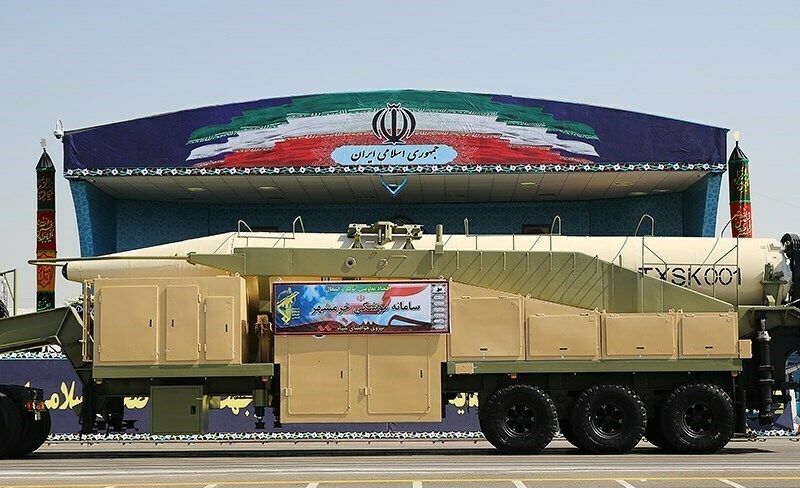
The missile uses hypergolic liquid fuel — a propellant that ignites spontaneously on contact with oxidiser and can be stored in tanks for years, shortening launch preparation time to between 12 and 15 minutes, according to Army Recognition. Earlier Iranian ballistic missiles required hours of fuelling before launch, making them vulnerable to pre-emptive strikes. The Khoramshahr-4 can be stored fuelled, loaded onto a mobile transporter-erector-launcher, and fired from any paved road surface in Iran’s western provinces with minimal preparation.
The Khoramshahr’s warhead separates into multiple sub-munitions during the terminal phase of flight. Unlike true MIRVs (Multiple Independently Targetable Re-entry Vehicles) employed by the nuclear arsenals of the United States, Russia, and China — where each warhead follows a distinct trajectory toward a separate target — the Khoramshahr’s payload disperses warheads along a common approach vector, targeting a single defended area with multiple objects. The distinction matters less than one might expect. Whether the warheads seek different targets or saturate a single one, the defending missile battery faces the same problem: more objects to track, discriminate, and engage than it was designed to handle in a single salvo.
How Does Multi-Warhead Technology Change the Air Defense Equation?
Air defense systems operate on a simple mathematical principle. One incoming warhead requires at least one interceptor to neutralize it — and typically two, because no system achieves a 100 percent single-shot probability of kill. The Patriot PAC-3 MSE interceptor, the most advanced variant in Saudi Arabia’s air defense shield, achieves an estimated single-shot kill probability of between 80 and 90 percent against a conventional single-warhead ballistic missile, according to Raytheon and Pentagon assessments. Standard doctrine requires firing two interceptors per incoming threat to achieve a cumulative kill probability above 95 percent.
Multi-warhead missiles invert this equation. A single Khoramshahr-4 carrying three to five warheads or sub-munitions requires six to ten interceptors under standard engagement doctrine — and the defending battery must identify, track, and assign fire control solutions to each object within seconds of warhead separation. The AN/MPQ-65 radar that guides the Patriot system can track approximately 100 targets simultaneously, but the fire control computer can manage engagement solutions for only nine targets at once, according to open-source technical manuals.
A coordinated salvo of just three Khoramshahr-4 missiles, each dispersing four warheads, presents the defending battery with 12 simultaneous objects. A standard Patriot fire unit carries 16 ready-to-fire interceptors. After engaging 12 targets at two missiles per target, the battery is empty — and the reloading process takes between 30 and 45 minutes.
Each defensive launch expends an interceptor costing millions of dollars and requiring months of industrial throughput to replace, while the attacker’s decoys need only provoke a firing decision to achieve operational success.
CSIS Missile Threat Project, Countermeasures and Penetration Aids Assessment, 2025
The IRGC understands this arithmetic. The 37th wave of attacks, launched on 11 March, combined Khoramshahr multi-warhead missiles with cheaper Shahab-class single-warhead missiles and Shahed-136 attack drones in a layered assault designed to exhaust every tier of the Saudi defense stack simultaneously. The drones force low-altitude engagement from short-range systems, the Shahab missiles occupy the Patriot batteries, and the Khoramshahr multi-warhead payloads arrive while defenders are already at capacity.
Iran’s Missile Escalation Ladder — From Shahab to Khoramshahr
Iran’s ballistic missile programme has followed a deliberate escalation path over four decades, with each generation of missile introducing capabilities that incrementally challenged existing defense architectures. Understanding this progression reveals the strategic logic behind the Khoramshahr’s deployment.
| Generation | Missile | Range | Warhead | Key Innovation | Year Deployed |
|---|---|---|---|---|---|
| 1st | Shahab-1/2 | 300-500 km | 985 kg | Liquid-fuel SRBM (Scud derivative) | 1988 |
| 2nd | Shahab-3 | 1,300 km | 760-1,200 kg | Medium range, North Korean Nodong-derived | 2003 |
| 2nd+ | Ghadr-1/Emad | 1,600-2,000 km | 750 kg | Improved accuracy, maneuverable RV | 2015 |
| 3rd | Sejjil | 2,000 km | 500 kg | Solid-fuel (faster launch, harder to pre-empt) | 2008 |
| 3rd+ | Fattah-1 | 1,400 km | 500 kg | Maneuverable warhead, thrust vector control | 2023 |
| 4th | Fattah-2 | 1,400 km | 200 kg | Hypersonic glide vehicle (HGV), Mach 15 | 2024 |
| 4th | Khoramshahr-4 | 2,000 km | 1,500 kg | Multi-warhead dispersal, hypergolic fuel | 2023 |
Each generational leap targeted a specific vulnerability in existing defense systems. The Shahab-3 introduced range that could reach Israel and all Gulf Cooperation Council states. The Emad added maneuverable re-entry vehicles that could dodge early-generation Patriot interceptors. The Sejjil’s solid-fuel motor eliminated the hours-long fuelling process that allowed pre-emptive strikes on liquid-fuelled launchers. The Fattah introduced hypersonic speed and terminal manoeuvres. And the Khoramshahr-4 now attacks the fundamental magazine depth of defensive systems by multiplying the number of objects each launch presents.
Iran’s arsenal is estimated at roughly 2,500 ballistic missiles, according to pre-war intelligence assessments by the Foundation for Defense of Democracies published in February 2026. Production at the Shahid Hemmat Industrial Group, the primary manufacturer of medium-range missiles, runs at an estimated 50 units per month under wartime conditions, though analysts at Defence Express note this figure is “heavily contested and conditional on raw-material deliveries” and damage to production facilities from US and Israeli strikes.
Saudi Arabia’s Layered Defense — Patriot, THAAD, and the Gaps Between
Saudi Arabia operates one of the most expensive integrated air defense networks on Earth. The Kingdom’s defence transformation programme has invested over $80 billion in missile defense since the mid-2010s, centred on two American systems: the Patriot Advanced Capability-3 (PAC-3) and the Terminal High Altitude Area Defense (THAAD).
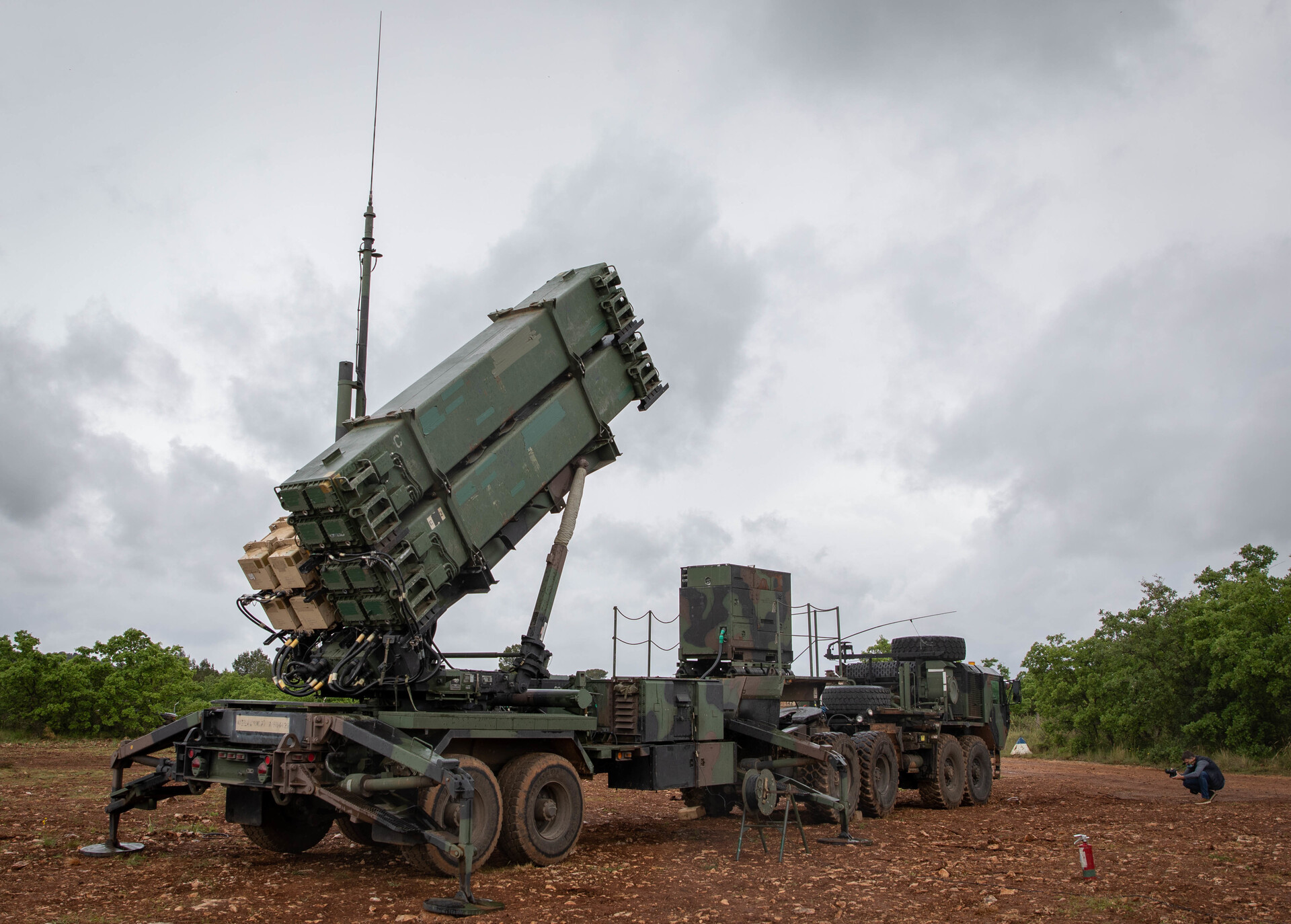
The Patriot force comprises 108 M902 launchers organised into six battalions, fielding a mix of PAC-2 GEM-T interceptors — blast-fragmentation warheads optimised for aircraft and cruise missiles — and PAC-3 hit-to-kill interceptors designed specifically for ballistic missile threats. Each Patriot fire unit pairs a phased-array radar with up to eight launchers, providing 360-degree coverage within a radius of approximately 70 kilometres.
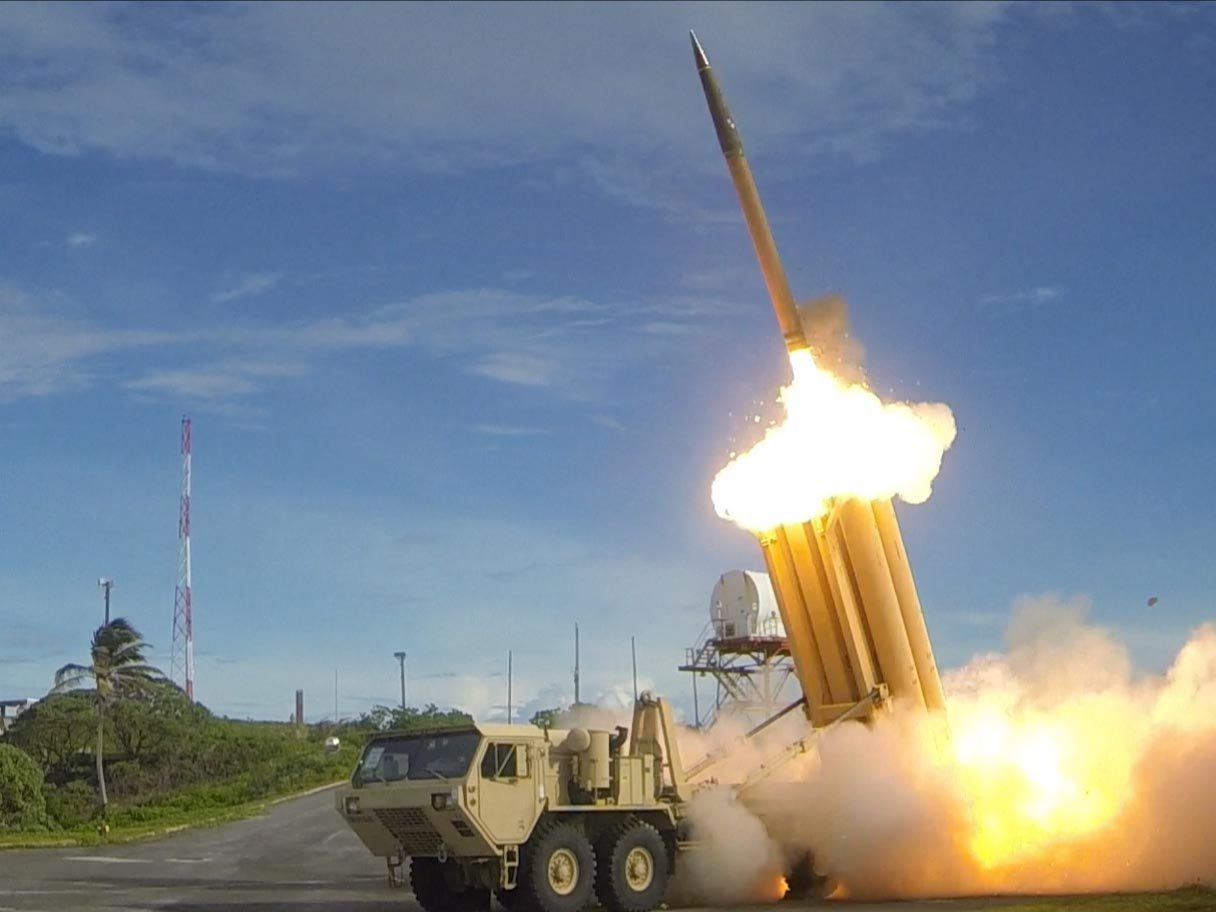
The THAAD programme represents the upper tier. Saudi Arabia’s 2017 acquisition covers seven THAAD batteries with 44 launchers, 360 interceptor missiles, seven AN/TPY-2 radars, and 16 mobile fire control units, with deliveries scheduled through 2028. As of March 2026, one Saudi-operated battery is fully operational, and a fourth crew completed training at Fort Bliss, Texas, according to Army Recognition. The United States deployed two additional THAAD batteries to the Kingdom in late February 2026 as part of pre-war preparations, supplementing Saudi capabilities. THAAD engages ballistic missiles at altitudes above 40 kilometres — well above the Patriot’s ceiling — providing a “shoot-look-shoot” architecture that aims to destroy incoming missiles in the exo-atmospheric phase before Patriot handles any leakers.
Below these systems sits a patchwork of shorter-range defenses. Saudi Arabia operates Shahine (Crotale derivative) mobile SAM systems for point defense, and has recently procured 10 batteries of South Korea’s Cheongung KM-SAM Block 2 in a $3.2 billion deal announced in 2024. The KM-SAM provides medium-range coverage at distances up to 70 kilometres with an accuracy between 80 and 95 percent, filling the gap between short-range point defense and the Patriot’s engagement envelope.
The integrated architecture looks formidable on paper. In practice, the system was designed to defeat the Iranian missile threat as it existed in 2017 — single-warhead Shahab-3 and Emad missiles, supplemented by cruise missiles and drones. The Khoramshahr-4’s multi-warhead capability represents a threat that fell outside the original design parameters.
Why Can’t Patriot Stop a Multi-Warhead Missile?
The Patriot system can, in fact, engage individual warheads from a multi-warhead missile. The PAC-3 MSE interceptor uses hit-to-kill technology — it destroys the target by colliding with it at closing speeds exceeding Mach 5 — and does not care whether the object it hits is a unitary warhead, a sub-munition, or a decoy. The limitation is not technological but mathematical.
A standard Patriot fire unit carries 16 PAC-3 MSE interceptors across four launchers. Standard engagement doctrine requires two interceptors per target to achieve a cumulative kill probability above 95 percent. Against a coordinated wave of single-warhead missiles, this means one fire unit can reliably engage eight incoming threats before requiring a 30-45 minute reload.
A single Khoramshahr-4 dispersing four warheads consumes eight interceptors under the same doctrine — half the fire unit’s magazine in a single engagement. Two Khoramshahr-4 missiles arriving within seconds of each other would exhaust the battery entirely. The IRGC’s 37th wave on 11 March included ballistic missiles, cruise missiles, and drones simultaneously. Saudi radar operators faced the task of discriminating genuine warheads from debris, spent rocket stages, and potential decoys — all while under time pressure measured in seconds, not minutes.
The problem compounds at the system level. Saudi Arabia’s six Patriot battalions defend a territory of 2.15 million square kilometres, prioritising critical infrastructure: Aramco’s Ras Tanura and Abqaiq oil facilities, Prince Sultan Air Base, Riyadh, Jeddah, and the Eastern Province population centres. Each defended site requires dedicated batteries that cannot relocate without leaving gaps. The total number of PAC-3 MSE interceptors in the Saudi inventory is classified, but the February 2026 US approval of a $9 billion sale of 730 PAC-3 MSE missiles suggests the Kingdom was already facing ammunition shortfalls before the first Iranian missile was fired.
The Cost That Breaks the Defense
The economic dimension of the multi-warhead problem is arguably more devastating than the tactical one. According to Military Watch Magazine, the United States burned through over $2.4 billion worth of Patriot interceptors in the first five days of the war alone, based on US Army unit costs of $3.9 million per PAC-3 MSE round. At export prices — which for Saudi Arabia reach approximately $6.25 million per interceptor and up to $12 million per unit in some contract structures — the cost climbs dramatically higher.
| Iranian Weapon | Estimated Unit Cost | Interceptors Required | Interception Cost (Export Price) | Cost Ratio |
|---|---|---|---|---|
| Shahed-136 drone | $20,000-$35,000 | 1 (Patriot PAC-2) | $3-4 million | 100:1 to 200:1 |
| Shahab-3 (single warhead) | $300,000-$500,000 | 2 (PAC-3 MSE) | $7.8-12.5 million | 15:1 to 40:1 |
| Emad (maneuverable RV) | $500,000-$800,000 | 2-3 (PAC-3 MSE) | $12-19 million | 15:1 to 38:1 |
| Khoramshahr-4 (multi-warhead) | $1-2 million | 6-10 (PAC-3 MSE) | $37-62 million | 18:1 to 62:1 |
| Fattah-2 (hypersonic) | $2-5 million | 3-4 (THAAD) | $36-48 million | 7:1 to 24:1 |
The Japan Times reported on 3 March that “Iran’s missile math” had created a “$20,000 drones versus $4 million Patriots” problem for the coalition. But the Khoramshahr escalation makes the math dramatically worse. If the IRGC fires 10 Khoramshahr-4 missiles at Saudi Arabia — each dispersing four warheads — the defending forces must launch between 60 and 100 interceptors to achieve reasonable kill probability. At export prices, that single salvo costs Saudi Arabia between $375 million and $625 million in interceptors alone. The 10 Iranian missiles, by contrast, cost approximately $10-20 million to produce.
Production bottlenecks amplify the cost problem. Lockheed Martin’s PAC-3 MSE production line manufactured 620 interceptors in 2025, according to Defence Express. At that rate, rebuilding a stock of 800 missiles — roughly the number a sustained campaign against multi-warhead threats would consume — requires 15.5 months of dedicated factory output. The United States, Gulf Cooperation Council states, and NATO allies all draw from the same production line. Saudi Arabia cannot buy interceptors faster than Lockheed Martin can build them, regardless of budget.
The Warhead Complexity Matrix
Understanding the escalating threat requires a structured framework that maps Iranian missile types against the defensive complexity they impose. Three variables determine the challenge each missile presents to Saudi air defense: warhead count (how many objects the defender must engage), terminal behaviour (whether the warhead manoeuvres during approach), and engagement altitude (which defensive layer must respond).
| Missile Type | Warhead Count Score (1-5) | Terminal Behaviour Score (1-5) | Altitude Challenge Score (1-5) | Composite Complexity Score | Primary Saudi Defender |
|---|---|---|---|---|---|
| Shahed-136 drone | 1 | 1 | 1 | 3 (Low) | Short-range / Gun systems |
| Shahab-1/2 SRBM | 1 | 1 | 2 | 4 (Low) | Patriot PAC-2 |
| Shahab-3 MRBM | 1 | 2 | 3 | 6 (Moderate) | Patriot PAC-3 |
| Emad (maneuverable RV) | 1 | 3 | 3 | 7 (Moderate) | Patriot PAC-3 MSE |
| Sejjil (solid fuel) | 1 | 2 | 4 | 7 (Moderate) | THAAD / Patriot PAC-3 |
| Fattah-1 (maneuverable) | 1 | 4 | 3 | 8 (High) | Patriot PAC-3 MSE (degraded) |
| Fattah-2 (hypersonic) | 1 | 5 | 5 | 11 (Very High) | No reliable counter |
| Khoramshahr-4 (multi-warhead) | 4 | 3 | 4 | 11 (Very High) | THAAD + Patriot PAC-3 (saturated) |
| Combined salvo (all types) | 5 | 5 | 5 | 15 (Maximum) | Full integrated defense (overwhelmed) |
The composite scores reveal a critical threshold. Saudi Arabia’s defense architecture performs reliably against threats scoring 7 or below — the historical norm for Iran’s arsenal. Threats scoring 8-10 degrade defense performance but remain manageable with sufficient interceptor reserves. The Khoramshahr-4 and Fattah-2, both scoring 11, represent a qualitative break: they impose complexity that the existing architecture was not designed to handle, regardless of how many interceptors are available.
The combined salvo — drones, single-warhead ballistic missiles, maneuverable warheads, hypersonic glide vehicles, and multi-warhead weapons arriving simultaneously — scores 15 and represents a threat that no existing defense architecture on Earth can reliably defeat at scale. The IRGC’s attack methodology has progressively moved toward this combined approach over 37 waves, suggesting deliberate experimentation.
What Has the IRGC Learned from 37 Waves of Attacks?
The IRGC Aerospace Force has conducted what amounts to a live-fire testing programme against the most advanced air defense network in the Middle East. Each wave of attacks has provided data on Saudi and American defensive reactions that decades of peacetime intelligence gathering could never replicate.
During the first three days of the war (28 February to 2 March), Iran launched 174 ballistic missiles, eight cruise missiles, and 689 drones at targets across the Gulf region, according to data compiled by Al Jazeera from official government statements. Of the ballistic missiles, 161 were intercepted and 13 fell into the sea or missed their targets. Of the drones, 645 were intercepted and 44 caused impact. These numbers — drawn primarily from UAE reporting but broadly consistent with Saudi and Bahraini claims — suggest an overall interception rate of approximately 92 percent for ballistic missiles and 94 percent for drones.
By Day 12, the pattern had shifted. The IRGC reduced the total number of missiles fired — consistent with Pentagon reports of a 90 percent drop in daily launch rates — but dramatically increased the sophistication of each salvo. The deployment of Khoramshahr-4 multi-warhead missiles alongside Fattah-2 hypersonic weapons indicates the IRGC has moved from volume-based saturation to complexity-based saturation.
The distinction matters enormously. Volume-based saturation tries to overwhelm defense by sheer numbers: fire 100 cheap missiles and hope five get through. It is expensive, wasteful, and predictable. Complexity-based saturation achieves the same effect with fewer launches by forcing the defender to solve multiple qualitatively different problems simultaneously. A single salvo combining Khoramshahr multi-warhead missiles (saturating interceptor magazines), Fattah maneuverable warheads (degrading tracking accuracy), and Shahed drones (occupying low-altitude defense layers) creates cascading failures across the entire defense stack.
Bahrain’s defence ministry reported intercepting 105 missiles and 176 drones as of 10 March — remarkable numbers that also reveal the sheer volume of ordnance Iran has expended against even the smallest Gulf states. The progression from mass attacks to precision combinations suggests the IRGC is conserving its remaining heavy missiles for maximum tactical effect.
Can South Korea’s Cheongung Fill the Multi-Warhead Gap?
Saudi Arabia’s $3.2 billion purchase of 10 South Korean KM-SAM Block 2 (Cheongung II) batteries, announced in February 2024 following a meeting between Mohammed bin Salman and South Korean President Yoon Suk-yeol, represented the Kingdom’s first major break from its American-only air defense procurement strategy. The Cheongung scored its first combat kill in March 2026, when a UAE-operated battery intercepted an Iranian missile — the system’s first use in combat anywhere in the world.
The Cheongung II engages targets at ranges up to 70 kilometres with an accuracy between 80 and 95 percent, according to the Korea Agency for Defense Development. It fills the medium-range tier between short-range point defense and the Patriot’s engagement envelope. Against single-warhead ballistic missiles, it provides a credible additional layer that forces the attacker to penetrate multiple defense tiers. South Korea’s Hanwha Aerospace has also offered the upgraded L-SAM long-range system, which has completed testing and entered mass production in South Korea, providing a THAAD-equivalent upper-tier capability.
Against multi-warhead threats, however, the Cheongung faces the same fundamental constraint as the Patriot. Each interceptor can engage one object at a time. A multi-warhead missile that disperses four sub-munitions requires four to eight Cheongung engagements, consuming a significant fraction of a battery’s ready magazine. The system adds depth to the defense — more layers through which an incoming threat must survive — but does not solve the saturation problem that multi-warhead technology creates.
The more significant contribution may come from Ukraine. Kyiv has developed low-cost interceptor drones priced at $1,000 to $2,000 each — the “Shahed killers” — that have proven effective against Iranian attack drones in the Russo-Ukrainian theatre. Ukraine sent drone defence teams to Saudi Arabia and other Gulf states in early March 2026, according to the Kyiv Independent. A separate deal for larger interceptor systems is reportedly in negotiation. These ultra-cheap interceptors could handle the drone layer of combined attacks, freeing Patriot and Cheongung batteries to focus exclusively on ballistic missile threats — including multi-warhead ones.
Pakistan has also deployed LY-80 and FM-90 air defense systems to Saudi Arabia, providing an additional medium and short-range intercept layer under the bilateral defense pact activated in March 2026.
The Nuclear Shadow — What Multi-Warhead Missiles Really Signal
The development of multi-warhead missile technology carries implications that extend well beyond the current conflict. The engineering required to package, deploy, and independently guide multiple warheads from a single missile is precisely the engineering required to deliver multiple nuclear warheads — a capability known as MIRV (Multiple Independently Targetable Re-entry Vehicle) in the nuclear weapons community.
The connection is not theoretical. The Center for Arms Control and Non-Proliferation notes that “MIRVs render ABM systems less effective, as the costs of maintaining a workable defense against MIRVs would greatly increase, requiring multiple defensive missiles for each offensive one.” During the Cold War, the development of MIRV technology by the United States and Soviet Union effectively ended the prospect of strategic missile defense — a dynamic that now threatens to replay at the regional level in the Middle East.
The technical pathway is straightforward. A conventional multi-warhead Khoramshahr-4 disperses sub-munitions that follow ballistic trajectories after separation. A nuclear-armed MIRV variant would use the same separation mechanism but assign each warhead an independent guidance system targeting a different location. The Khoramshahr’s 1,500-kilogram payload capacity can accommodate multiple miniaturised warheads — the United States achieved similar miniaturisation with the W76 warhead, weighing 164 kilograms, in the 1970s. Iran does not need to reinvent physics; it needs to replicate engineering that other states mastered decades ago.
Israeli intelligence assessments, cited by the Jerusalem Post in February 2026, estimated that Iran was between 12 and 18 months from a “breakout” nuclear weapon prior to the destruction of its centrifuge facilities. The Khoramshahr programme’s timeline is measured in different terms: the delivery vehicle already works. The warhead is the missing component. Should Iran acquire one, the marriage of weapon to missile could proceed rapidly, given that the Khoramshahr’s multi-warhead bus has already demonstrated the ability to separate and deploy multiple payloads in combat conditions.
Iran’s nuclear programme was significantly degraded by the US-Israeli strikes that began the current war. The IAEA confirmed that centrifuge cascades at Natanz and Fordow suffered severe damage in the opening hours of Operation Epic Fury. But the technical knowledge required to enrich uranium to weapons-grade levels cannot be bombed away, and the delivery vehicle — the Khoramshahr-4 itself — is now combat-proven. Should Iran reconstitute its nuclear enrichment capability in the years following a ceasefire, it would possess a tested, operational multi-warhead delivery system ready to carry nuclear payloads.
Saudi Arabia’s senior leadership has long maintained a posture of latent nuclear capability — the so-called “option of last resort” based on Pakistan’s nuclear deterrent and Saudi Arabia’s suspected financing of Islamabad’s nuclear programme. The Khoramshahr-4’s deployment adds urgency to this calculus. If Iran demonstrates the ability to deliver multiple warheads per missile, the value of a Saudi nuclear deterrent increases proportionally, because the defensive alternative — building an air defense system capable of reliably stopping multi-warhead attacks — may prove prohibitively expensive and technically infeasible.
Iran’s Stockpile Is Shrinking — That Makes It More Dangerous
The dominant narrative in Western media coverage of the Iran war focuses on depletion. The Pentagon reports Iran’s daily missile fire has dropped 90 percent from peak levels. Analysts count remaining arsenals and project exhaustion dates. Commentary frames the conflict as a war of attrition that Iran is losing — its missiles are running out, its factories are being struck, and its supply chains are severed.
This narrative is dangerously misleading. A declining missile count does not equal a declining threat level. It means the opposite.
Iran entered the war with an estimated 2,500 ballistic missiles. Twelve days of intensive use, combined with US and Israeli strikes on production facilities including the Shahid Hemmat Industrial Group, have likely reduced the operational inventory to somewhere between 800 and 1,200 missiles, according to open-source tracking by the Iran Rockets Arsenal OSINT Dashboard. The IRGC has responded not by rationing its remaining weapons but by concentrating them — firing fewer missiles per wave but making each wave qualitatively more threatening.
The transition from Shahab-class single-warhead missiles to Khoramshahr multi-warhead weapons and Fattah hypersonic systems follows the logic of diminishing ammunition. When stockpiles are abundant, mass saturation is the rational strategy: fire 100 cheap missiles and accept that 90 will be intercepted. When stockpiles are constrained, each missile must impose maximum cost on the defender. A single Khoramshahr-4 that forces Saudi Arabia to expend 6-10 Patriot interceptors worth $37-62 million achieves more strategic damage than 10 Shahab-3 missiles that each require two interceptors worth $12 million.
Historical precedent supports this interpretation. During the 1991 Gulf War, Iraq fired 88 Scud missiles at Saudi Arabia and Israel — crude, inaccurate weapons that achieved little military effect but consumed thousands of Patriot interceptors and caused significant political disruption. Iran has fired more missiles in 12 days than Iraq fired in six weeks. The Khoramshahr represents a generational leap beyond the Scud: longer range, heavier payload, greater accuracy, and now multi-warhead capability. The lesson the IRGC has internalised from three decades of observing American military operations is that quality of effect matters more than quantity of fire.
Defence analysts at the International Institute for Strategic Studies estimated in early March 2026 that Iran was expending approximately $150 million per day in missiles and drones during the peak of operations. By Day 12, that figure had fallen to approximately $30 million per day — but the damage inflicted per dollar spent had increased, because the weapons being used were exponentially more capable. The IRGC is fighting a smarter war with a smaller arsenal, and the Khoramshahr is the centrepiece of that transformation.
The shrinking arsenal also concentrates the remaining weapons in the hands of the IRGC’s most capable operators. Early waves of the war were fired by mixed units using whatever was available. By Day 12, the launches are increasingly the domain of the IRGC Aerospace Force’s elite missile brigades, using Iran’s most advanced systems against the most high-value targets. The Pentagon’s 90 percent reduction in daily fire is not evidence of Iranian weakness. It is evidence of Iranian adaptation.
Where Does Saudi Arabia Go from Here?
The Kingdom faces three concurrent challenges: surviving the current war with its air defense intact, rebuilding interceptor stocks that are being depleted at rates that exceed production capacity, and fundamentally redesigning its defense architecture for a post-war environment where multi-warhead missiles are the baseline threat.
The immediate priority is interceptor supply. The $9 billion US sale of 730 PAC-3 MSE missiles, approved in February 2026, addresses the most acute shortage but will take years to deliver in full. In the interim, the US military has been drawing down its own Patriot inventories to supply Gulf allies — a stopgap that degrades American force readiness elsewhere and depends on continued political support in Washington, where Congress is demanding hearings on the war’s expanding cost.
The medium-term answer is diversification. Saudi Arabia’s procurement of South Korean Cheongung systems, negotiations for Ukrainian drone interceptors, and reported interest in Israel’s Arrow-3 exo-atmospheric interceptor all reflect a recognition that the American-only procurement model is insufficient. A multi-source defense architecture that uses $1,000 Ukrainian drone killers against Shaheds, $2 million Cheongung interceptors against Shahab-class missiles, and $6 million PAC-3 MSE rounds exclusively against the highest-tier threats (Khoramshahr and Fattah) would dramatically improve the cost exchange ratio.
| Threat Layer | Current Defender | Proposed Addition | Interceptor Cost | Advantage |
|---|---|---|---|---|
| Low-altitude drones | Patriot PAC-2 ($3-4M) | Ukrainian interceptor drones ($1-2K) | $1,000-$2,000 | Frees Patriot for ballistic threats |
| Cruise missiles | Patriot PAC-2/3 ($3-6M) | Cheongung KM-SAM ($1-2M) | $1-2 million | Lower cost per engagement |
| Single-warhead BMs | Patriot PAC-3 ($6M) | Cheongung + Patriot layered | $3-6 million | Multiple engagement opportunities |
| Multi-warhead BMs | THAAD + Patriot ($12M+) | L-SAM + THAAD + Patriot triple layer | $10-15 million | Engage before warhead separation |
| Hypersonic weapons | No reliable counter | Directed energy / boost-phase | TBD | Speed-independent engagement |
The long-term solution is the most technically challenging: boost-phase intercept. Destroying a multi-warhead missile before its warheads separate eliminates the saturation problem entirely. One interceptor destroys all warheads at once. The technology exists in concept — directed-energy weapons, space-based sensors, forward-deployed interceptors near launch sites — but no nation has fielded a reliable boost-phase intercept system. Saudi Arabia’s geographic proximity to Iran (the shortest trajectory from western Iran to Riyadh covers approximately 1,100 kilometres with a flight time of eight to ten minutes) provides a narrow but potentially exploitable window for boost-phase engagement that more distant defenders lack.
The Crown Prince’s decision to fast-track defence procurement from multiple sources — American, South Korean, Ukrainian, and potentially Israeli — signals awareness of the problem’s urgency. The war has compressed a generational defence challenge into weeks. Saudi Arabia’s shield held against single-warhead missiles. Against the missile that splits, the shield needs rebuilding from the ground up.
The multi-warhead threat compounds a crisis that is already unfolding across the region’s sensor network. Iranian strikes have systematically degraded America’s missile shield over Saudi Arabia, destroying AN/TPY-2 radars and forcing the Pentagon to strip THAAD batteries from South Korea — reducing the very tracking capability needed to engage separated warheads.
Frequently Asked Questions
What is the Khoramshahr-4 missile?
The Khoramshahr-4 is Iran’s heaviest operational ballistic missile, capable of carrying 1,500 kilograms of payload across multiple warheads to targets up to 2,000 kilometres away. Derived from North Korea’s Hwasong-10, it uses hypergolic liquid fuel that allows launch preparation in 12-15 minutes and represents the most advanced weapon in the IRGC’s ballistic missile arsenal.
How many warheads can a Khoramshahr-4 carry?
The Khoramshahr-4 can carry between three and five individual warheads or sub-munitions, which separate during the terminal phase of flight. Unlike true MIRVs used in nuclear arsenals, these warheads disperse along a common approach vector rather than targeting independently selected locations, but they still require individual interception by defending systems.
Why can’t Saudi Arabia’s Patriot system stop multi-warhead missiles?
Saudi Arabia’s Patriot batteries can engage individual warheads, but each warhead requires two interceptors under standard doctrine. A single Khoramshahr-4 dispersing four warheads consumes eight of a battery’s 16 ready interceptors, and reloading takes 30-45 minutes. Coordinated salvos of multi-warhead missiles can exhaust a Patriot battery’s entire magazine in minutes.
How much does it cost to intercept a Khoramshahr-4?
Intercepting a single Khoramshahr-4 with multi-warhead payload costs between $37 million and $62 million using PAC-3 MSE interceptors at export prices, compared to the missile’s estimated production cost of $1-2 million. This cost asymmetry of 18:1 to 62:1 in the attacker’s favour represents one of the most unfavourable defence economics in modern warfare.
What alternatives does Saudi Arabia have to Patriot?
Saudi Arabia is diversifying with South Korean Cheongung KM-SAM Block 2 batteries ($3.2 billion for 10 batteries), Ukrainian low-cost interceptor drones ($1,000-$2,000 each for anti-drone defence), and THAAD upper-tier systems for exo-atmospheric interception. The long-term solution may require boost-phase intercept technology that destroys multi-warhead missiles before their payloads separate.
Does the Khoramshahr-4 have nuclear capability?
The Khoramshahr-4 is not currently equipped with nuclear warheads — Iran does not possess weaponised nuclear devices. However, the multi-warhead delivery technology it demonstrates is the same engineering required for MIRV nuclear weapons, making the missile a potential future nuclear delivery system if Iran ever reconstitutes its enrichment programme.