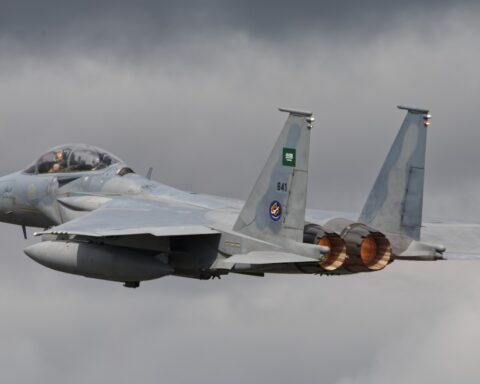
RIYADH — Two ballistic missiles streaked toward the Saudi capital on March 23, 2026 — the same day Donald Trump announced “very good and productive” talks with Iran and postponed threatened strikes on Iranian power plants for five days. One missile was intercepted by Saudi air defenses. The other fell in an uninhabited area on the city’s outskirts. Hours later, Iran’s parliament speaker Mohammad Bagher Ghalibaf dismissed the reported negotiations as “fake news intended to manipulate financial and oil markets.” The contradiction captured in a single afternoon — missiles and peace feelers launched from the same regime, on the same day — is not a malfunction of Iranian strategy. It is the strategy.
Twenty-four days into the war that began when American and Israeli jets struck Iran on February 28, Tehran has fired more than 3,095 missiles and drones at Gulf states while simultaneously operating at least ten distinct diplomatic channels. The paradox confounds Western policymakers accustomed to treating warfare and negotiation as sequential phases. For Iran’s leadership, they are concurrent instruments of the same campaign. Understanding this dual-track logic is the single most important analytical challenge facing Riyadh, Washington, and every mediator now shuttling between capitals — because the missiles will not stop simply because someone picks up the phone.
Table of Contents
- What Happened Over Riyadh on March 23?
- Iran’s War in Numbers — The Military Track After 24 Days
- Who Is Iran Talking To While Its Missiles Fly?
- Why Does Iran Attack Countries It Needs as Mediators?
- The Coercion-Negotiation Matrix
- The Hormuz Toll Booth — Iran’s Most Sophisticated Weapon
- Vietnam’s Danh va Dam and the Historical Roots of Fight-While-Talk
- How Has Saudi Arabia Navigated Iran’s Dual Strategy?
- Is Ghalibaf Iran’s Off-Ramp or Its Accelerator?
- The Contrarian Case — Iran’s Apparent Chaos Is a Negotiating Position
- What Happens When the Missiles Stop?
- Frequently Asked Questions
What Happened Over Riyadh on March 23?
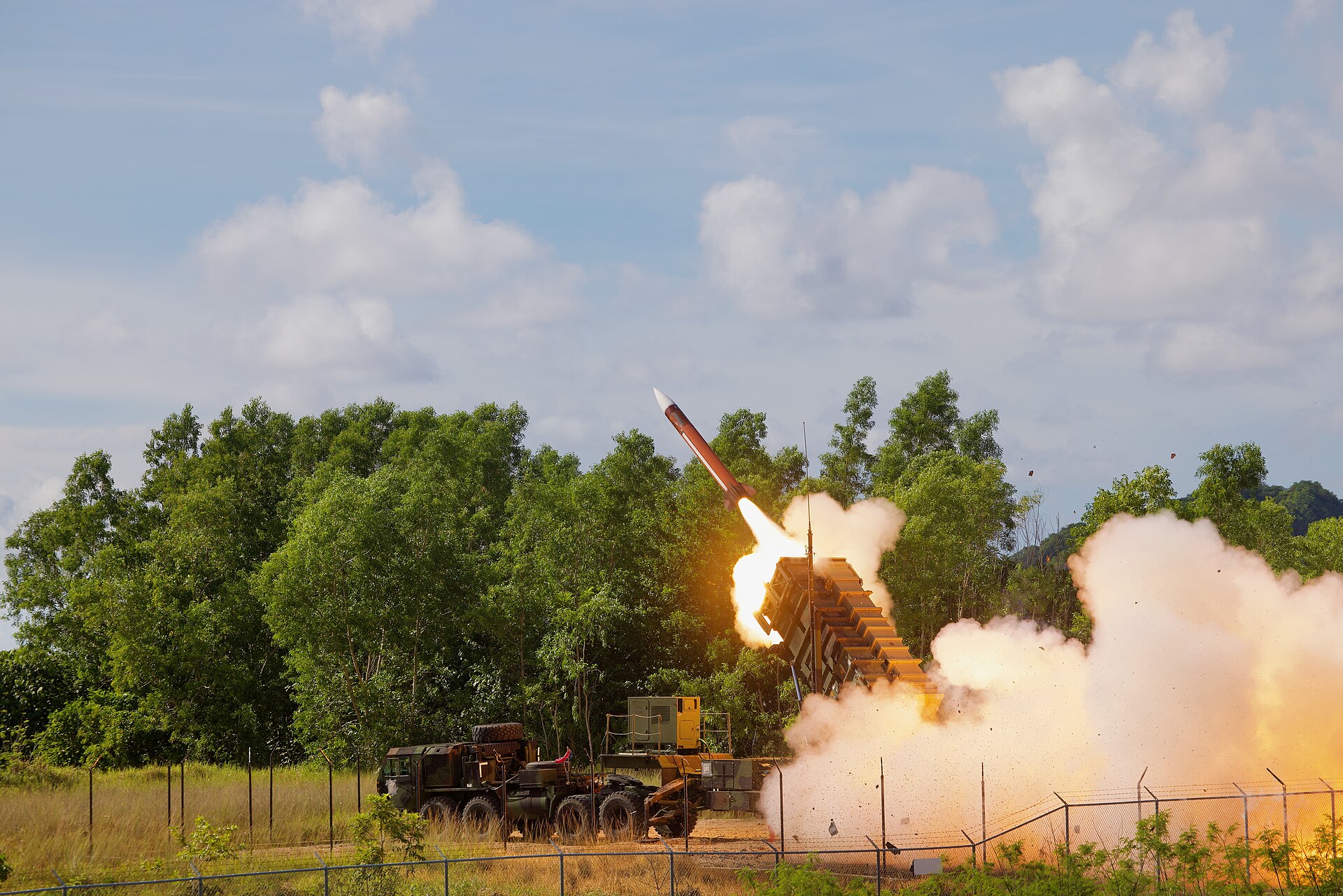
On the twenty-fourth day of the 2026 Iran war, two Iranian ballistic missiles were launched toward Riyadh. Saudi air defense systems — anchored by Patriot Advanced Capability batteries and supplemented by a growing multinational shield — intercepted one. The second impacted an uninhabited area, according to the Saudi Ministry of Defense. No casualties were reported. Simultaneously, the Islamic Revolutionary Guard Corps claimed a strike on Prince Sultan Air Base south of Riyadh, the facility hosting American F-15E Strike Eagles and MQ-9 Reaper drones conducting operations against Iran.
The attack came amid a day of contradictory signals. Trump posted on Truth Social that Iran had committed not to pursue nuclear weapons, agreed to reopen the Strait of Hormuz, and that “major points of agreement” existed. He credited his son-in-law Jared Kushner and special envoy Steve Witkoff with establishing contact with “a top person” in Iran — identified by Israeli media as Ghalibaf. Within hours, Ghalibaf denied everything. Iran’s Foreign Ministry acknowledged only that “some countries were working to reduce tensions.”
Across the wider Gulf, the UAE’s Ministry of Defense reported intercepting seven ballistic missiles and sixteen drones in a single day. Since the war began, the UAE alone has absorbed 352 ballistic missiles, 15 cruise missiles, and 1,789 drones — 48 percent of all Iranian projectiles, according to data compiled by Breaking Defense. The combined total across all six Gulf Cooperation Council states exceeded 3,095 projectiles by mid-March, per figures cited by Anadolu Agency. At least 21 people have been killed in Gulf states and more than 268 injured, the majority migrant workers from South and Southeast Asia, according to Human Rights Watch.
None of this halted Iran’s diplomatic outreach. The same regime firing missiles at Riyadh was offering Japan safe passage through the Strait of Hormuz, negotiating a reported $6 billion arrangement with Qatar, appealing to India and BRICS for ceasefire mediation, and maintaining backchannels through Oman, Turkey, Egypt, and Pakistan. The military track and the diplomatic track are not contradictions. They are the twin pillars of a strategy that has deep historical roots and a cold internal logic.
Iran’s War in Numbers — The Military Track After 24 Days
The scale of Iran’s military campaign against the Gulf states has no post-1991 precedent. What began as retaliatory strikes against American military facilities expanded within twenty-four hours to engulf nine countries, according to analysis by the Center for Strategic and International Studies. By March 5, Iran had embroiled fourteen nations, opening a second front in Lebanon and targeting Cyprus and Azerbaijan.
| Target Country | Ballistic Missiles | Cruise Missiles | Drones/UAVs | Killed | Injured |
|---|---|---|---|---|---|
| UAE | 352 | 15 | 1,789 | 8 | 157 |
| Saudi Arabia | ~40 | — | ~475 | 2 | 12+ |
| Qatar | 101 | 3 | 39 | 7 | — |
| Bahrain | 73 | — | 91 | 3 | — |
| Kuwait | — | — | — | 8 | — |
| Oman | — | — | — | 3 | — |
The targeting pattern reveals strategic intent rather than blind retaliation. Iran fired more than twice as many missiles and roughly twenty times more drones at Gulf states than at Israel, according to data from Israel’s Institute for National Security Studies. The UAE absorbed the heaviest bombardment — a consequence of hosting Al Dhafra Air Base, from which American F-35s and B-2 bombers have conducted strike missions, and the CAOC at Al Udeid in neighboring Qatar, the nerve center for coalition air operations.
Saudi Arabia’s exposure is different but no less dangerous. The Kingdom has absorbed approximately 40 ballistic missiles and 475 drones since February 28, per Wikipedia’s aggregation of Ministry of Defense statements. Two people — an Indian national and a Bangladeshi worker — were killed when a drone struck a residential building in Al-Kharj. Two Iranian drones hit near the American embassy in Riyadh, causing “limited fire and minor material damages,” according to Saudi authorities. The opening of King Fahd Air Base in Taif to American forces on March 20 — selected for its distance from Iranian launch sites — marked Riyadh’s transition from passive target to active logistics platform.
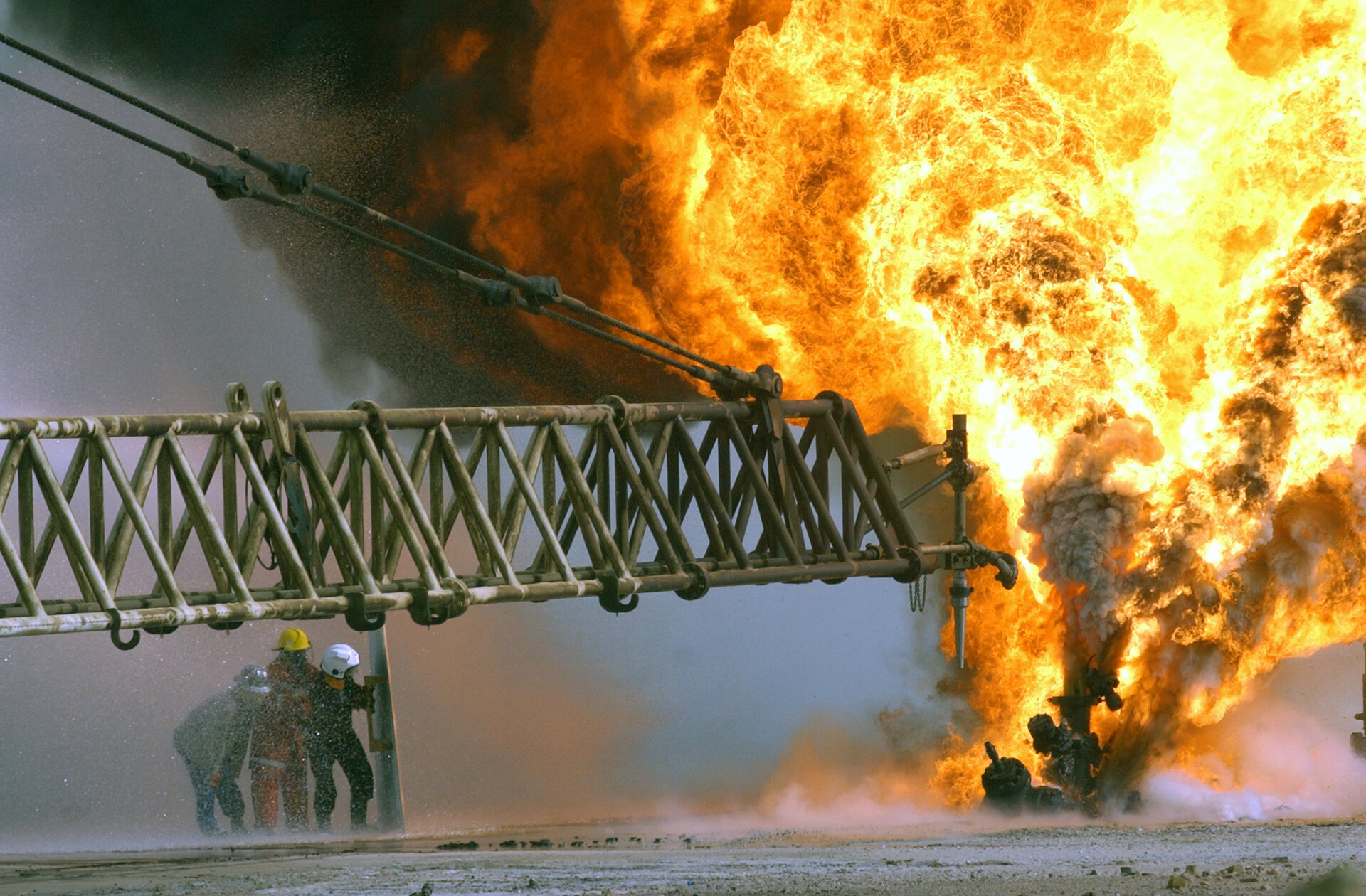
The economic weapon has been equally devastating. Brent crude surged roughly 80 percent from pre-war levels of $70 per barrel to peak above $119, according to CNBC. The OPEC reference basket averaged $112.35 in March, up from $67.90 in February. Goldman Sachs warned that $200 per barrel was “no longer far-fetched” if the conflict continued through April. The International Energy Agency declared the crisis worse than the two 1970s oil shocks combined. Goldman Sachs forecast that a sustained conflict through April could shrink Saudi GDP by 3 percent, UAE GDP by 5 percent, and Kuwait and Qatar GDP by 14 percent.
Who Is Iran Talking To While Its Missiles Fly?
At least ten distinct diplomatic channels are operating simultaneously between Iran and the outside world, even as Iranian ballistic missiles fly toward the capitals of potential mediators. The breadth of this diplomatic network — maintained in parallel with the largest sustained missile campaign in modern Middle Eastern history — represents a deliberate strategic choice, not a contradiction or an act of desperation.
| Channel | Mediator/Counterpart | Status | Key Development |
|---|---|---|---|
| US-Iran (indirect) | Oman; Kushner/Witkoff | Active — denied by Iran | Trump postpones strikes 5 days, claims “major agreements” |
| Qatar-Iran | Direct | Active — denied by Qatar | $6 billion fund transfer reportedly under negotiation |
| Japan-Iran | Direct (Araghchi) | Active — acknowledged | Japan granted safe passage through Hormuz (March 21) |
| India-Iran (BRICS) | Pezeshkian-Modi | Active | Iran proposes “West Asia security framework” via BRICS |
| Turkey-Iran | FM Fidan shuttle | Active | Erdogan offers mediation; Fidan visits Washington, Tehran, Gulf |
| Saudi-Iran | FM Faisal-Araghchi | Collapsed March 21 | Saudi Arabia expelled Iranian military attache |
| China-Iran | Special Envoy Zhai Jun | Cautious | China dispatched envoy but prioritizes Xi-Trump summit |
| Egypt-Iran | FM Abdelatty | Active | Egypt passing messages between parties |
| Pakistan-Iran | PM Sharif | Active | Pakistan offered as possible venue for face-to-face meeting |
| EU-Iran | FM Kallas via Turkey | Indirect | EU in contact with Turkey’s Fidan on mediation framework |
The most consequential channel runs through Oman, which has served as the primary backchannel between Washington and Tehran for decades. On March 3, Omani Foreign Minister Badr al-Busaidi stated: “Oman reaffirms its call for an immediate ceasefire and a return to responsible regional diplomacy. There are off-ramps available. Let’s use them.” Just before the war began on February 27, Oman’s mediation had reportedly produced a breakthrough — Iran agreed to halt uranium enrichment stockpiling and accept full International Atomic Energy Agency verification, according to Al Jazeera. The agreement collapsed when American and Israeli strikes commenced hours later.
Iran’s selective Hormuz strategy is the most revealing expression of the dual-track approach. The IRGC achieved de facto closure of the strait without a formal naval blockade, using drone strikes, VHF warning broadcasts, and the collapse of maritime war-risk insurance to bring tanker traffic to near-zero within four days of the war’s start, according to Palaemon Maritime analysis. Then Tehran began granting exemptions. China received passage for eleven vessels between March 1 and 15. India secured transit for two gas carriers. Turkey negotiated passage for one ship on March 13. Japan received approval on March 21. One tanker reportedly paid $2 million for transit rights, per the Dupree Report. Iran’s parliament began pursuing legislation to impose transit taxes on strait users. The Strait of Hormuz became not a wall but a toll booth — and the toll is diplomatic alignment.
The Iran-Qatar channel illustrates the most brazen application of the strategy. On March 18, Iranian missiles struck Qatar’s massive Ras Laffan natural gas facility — the world’s largest liquefied natural gas complex. Qatar expelled Iran’s military and security attaches within twenty-four hours. Then, according to Western diplomatic sources cited by JFeed and The Cradle, Qatar entered negotiations with Iran over a $6 billion fund transfer to the Revolutionary Guard in exchange for attack cessation. Qatar officially denied the reports. The sequence — attack, expulsion, negotiation — compresses the dual-track into its purest form.
Why Does Iran Attack Countries It Needs as Mediators?
Iran attacks the countries it needs as mediators because the attacks are what make those countries useful as mediators. This is the core logic of what CSIS analysts called Iran’s “Don’t Calibrate — Escalate” strategy: by spreading the war to fourteen nations, Tehran ensured that every country within missile range acquired a direct, painful interest in bringing the conflict to an end. The alternative — restraining retaliation to strike only American and Israeli military targets — would have confined the war’s costs to Washington and Tel Aviv, two capitals that have shown little inclination to negotiate.
The calculus is brutal but internally consistent. Every missile that strikes a Gulf oil facility raises the global price of crude. Every drone that disrupts Gulf airspace costs international airlines revenue. Every threat against desalination plants reminds Gulf governments that their populations depend on infrastructure that can be destroyed faster than it can be defended. The pain is not collateral damage — it is the product. And the product is sold at the negotiating table.
The nuclear dimension of this threat was driven home when a projectile struck 350 metres from Iran’s Bushehr reactor on March 18, prompting the IAEA to warn that a direct hit on the operating plant could release radioactive contamination across the Gulf.
“Iran is messaging to Washington that attempts to kill it will lead to chaos and economic pain.”Chatham House, March 2026
Chatham House’s analysis framed this as a “contest of will” between Trump and Iran. Tehran’s proposition to the world is straightforward: end the war on terms that allow the Islamic Republic to survive, or accept a permanently destabilized region where oil costs $200 per barrel and the Gulf’s $1.5 trillion infrastructure investment is held hostage by $20,000 drones.
CSIS offered a complementary reading in its analysis, “Iran’s Real War Is Against the Global Economy.” The report argued that Tehran is conducting deliberate economic warfare to make the conflict economically unsustainable for the United States and its Gulf partners. Iran targets not only hydrocarbon assets but sectors central to Vision 2030 diversification — logistics, energy generation, data centers, water infrastructure, tourism, and finance. The war is designed to destroy the future MBS is building, not merely the military assets defending it.
The RAND Corporation offered the strongest counter-argument. In its March 2026 assessment, RAND argued that Iran’s “escalate to de-escalate” strategy would “almost certainly backfire” because the targeted countries were as likely to join the fight against Iran as to push for a ceasefire. Saudi Arabia’s decision to open King Fahd Air Base to American forces and the UK’s authorization for its bases to be used in strikes against Iranian missile sites both support RAND’s prediction. But the counter-counter-argument is that even if some targets join the fight, the diplomatic pressure from oil importers — Japan, India, China, South Korea, the European Union — intensifies with every dollar added to the barrel price.
The Coercion-Negotiation Matrix
A framework for understanding Iran’s simultaneous use of military force and diplomatic engagement emerges from mapping the relationship between escalation levels and negotiation intensity across the war’s twenty-four days. This Coercion-Negotiation Matrix plots Iran’s military actions against its diplomatic engagements on a daily basis, revealing that the two tracks do not move in opposite directions — they rise together.
| Phase | Dates | Military Track | Diplomatic Track | Strategic Objective |
|---|---|---|---|---|
| Retaliation | Feb 28 – Mar 2 | Initial salvos: 9 countries hit in 24 hours | No outreach; pure military response | Demonstrate capability and resolve |
| Regionalization | Mar 3 – Mar 8 | Expand to 14 countries; Hormuz de facto closed | Oman/China channels activated; Saudi FM-Araghchi call | Create universal pain to generate mediation pressure |
| Economic warfare | Mar 9 – Mar 15 | Target oil/gas infrastructure (Fujairah, refineries, pipelines) | BRICS/India outreach; Turkey mediation offers accepted | Make economic cost of continuing war exceed cost of settlement |
| Selective engagement | Mar 16 – Mar 21 | Record drone surges (100/day); strike Ras Laffan, Yanbu | Japan safe passage; Qatar $6B talks; Pakistan venue | Split US alliance by offering bilateral deals to neutral/wavering states |
| Talks under fire | Mar 22 – Mar 23 | Ballistic missiles at Riyadh; record Hezbollah surges | Ghalibaf-Kushner channel (denied); Trump postpones strikes | Extract maximum concessions by maintaining maximum pressure during talks |
Three patterns emerge from the matrix. First, Iran never reduced military pressure before or during diplomatic engagement. The March 18 strike on Qatar’s Ras Laffan facility came during active Qatar-Iran backchannel contacts. The March 23 missiles over Riyadh came on the day Trump announced progress in talks. The Vietnamese called this approach “danh va dam” — fighting while talking — and it remains the closest historical analogue to Tehran’s strategy.
Second, Iran uses the Hormuz toll booth to split the anti-Iran coalition. By offering selective passage to Japan, India, China, and Turkey while denying it to the United States and its closest allies, Tehran creates a two-tier system that incentivizes fence-sitting. Every country granted passage acquires an economic reason not to join the military coalition. The toll booth converts geography into diplomacy.
Third, the escalation serves Iran’s domestic audience as much as its international one. Ghalibaf cannot be seen as surrendering to Trump. The IRGC’s institutional identity depends on resistance, not accommodation. By maintaining attacks during any negotiation, Tehran’s leadership can frame any eventual settlement as a ceasefire extracted through strength rather than a capitulation imposed through defeat. The missiles are not merely weapons. They are talking points for the Majlis, the IRGC, and the Iranian street.
The Hormuz Toll Booth — Iran’s Most Sophisticated Weapon
The Strait of Hormuz carries approximately 20 percent of the world’s petroleum and a third of its seaborne liquefied natural gas. Before the war, roughly 21 million barrels of oil transited the 21-mile-wide passage daily. By March 5, that flow had dropped to near zero for Western-flagged vessels — not because Iran had physically blockaded the strait, but because it had made transit commercially impossible.
The IRGC’s approach to Hormuz deserves recognition as the war’s most innovative weapon. Rather than attempting a traditional naval blockade — which would require holding positions against the world’s most powerful navy — Iran used a combination of selective drone strikes, VHF warning broadcasts to approaching vessels, and the withdrawal of maritime war-risk insurance to achieve the same effect at a fraction of the cost, according to analysis by Palaemon Maritime. Lloyd’s of London and other war-risk insurers effectively closed the strait to commercial traffic by pricing premiums at levels no shipowner could absorb.
Then Tehran began granting exemptions — transforming a weapon of denial into a tool of diplomacy. The pattern reveals the logic.
- China received passage for eleven vessels between March 1 and 15 — Beijing, Iran’s largest oil customer and a fellow BRICS member, was rewarded for its restrained response to the war.
- India secured transit for two gas carriers and a Saudi tanker carrying crude destined for Indian refineries — New Delhi, the world’s third-largest oil importer, was given incentive to maintain its neutral posture.
- Turkey negotiated passage for one vessel on March 13 — Ankara, a NATO member offering mediation, was given a tangible reason to keep channels open with Tehran.
- Japan received approval on March 21 — Tokyo, which sources over 90 percent of its crude from the Middle East, was offered economic survival in exchange for diplomatic engagement.
Iran’s parliament began pursuing legislation to formalize this arrangement through transit taxes on strait users, according to Iran International. One tanker reportedly paid $2 million for passage rights, per the Dupree Report. The strategic genius of this approach is that it converts a maritime chokepoint into a diplomatic sorting mechanism. Every country that deals with Iran bilaterally acquires a reason not to join the US-led military coalition. Every barrel of oil that flows through Hormuz under Iranian permission undermines Washington’s narrative that the strait must be reopened by force.
For Saudi Arabia, the Hormuz toll booth is particularly devastating. The Kingdom’s primary oil export terminals are on the Persian Gulf coast. Even after Iran struck the Yanbu refinery on the Red Sea coast on March 20, the alternative pipeline capacity through the East-West Crude Oil Pipeline (known as Petroline) can carry only about 5 million barrels per day — roughly half of Saudi Arabia’s pre-war export capacity. Aramco has cut oil supply to Asia for two consecutive months since the closure, according to industry reports. The Kingdom is producing oil it cannot sell while its war costs mount and its economic diversification program comes under sustained Iranian attack.
Vietnam’s Danh va Dam and the Historical Roots of Fight-While-Talk
Iran’s simultaneous warfare and diplomacy is not an innovation. It is the revival of a strategy that North Vietnam executed with devastating effectiveness against the United States for nearly a decade. The Vietnamese term “danh va dam” — fighting while negotiating — was codified in a secret 1965 speech by First Secretary Le Duan and became the organizing principle of Hanoi’s approach to the Paris Peace Talks, which lasted five years from 1968 to 1973 while the ground war intensified, according to research published by the Wilson Center.
The parallels are striking. North Vietnam used the Tet Offensive of 1968 — a military failure that became a political and psychological success — to demonstrate that the war could not be won on Washington’s terms. Iran’s bombardment of Gulf capitals serves an identical function: the military damage is limited (21 dead across six countries in three weeks), but the psychological and economic impact is outsized. Oil at $112 per barrel is Iran’s Tet — a demonstration that the costs of war are unlimited even if Iran’s conventional military is degrading.
The endgame of Vietnam’s dual-track strategy is instructive. In December 1972, Richard Nixon ordered Operation Linebacker II — the “Christmas bombing” — deploying nearly 2,000 sorties and dropping 35,000 tons of ordnance that destroyed 25 percent of North Vietnam’s oil reserves and 80 percent of its electrical capacity, according to PBS. When talks resumed on January 8, 1973, an accord was reached swiftly, signed on January 27. The lesson: massive escalation by the stronger power can compress negotiations, but only when the weaker power has already established the terms under which it will accept a deal. North Vietnam’s conditions barely changed between 1968 and 1973. The five-year fight was about forcing Washington to accept Hanoi’s price, not about finding a middle ground.
The Korean War offers a grimmer parallel. The United States suffered almost half of its 36,000 fatalities during the negotiation phase, according to research published in Orbis, the journal of the Foreign Policy Research Institute. China and North Korea lost over 200,000 killed while talks at Panmunjom dragged on for two years. The outlines of a deal existed by early 1952 but stalled over prisoner repatriation. Both sides used military pressure to gain leverage on specific negotiating points. The result was a frozen conflict that persists seventy-four years later — a warning that dual-track strategies can produce stalemates as easily as settlements.
Iran’s own history in the 1980-88 war with Iraq provides a third parallel. Tehran refused Iraqi and international ceasefire proposals for six years, accepting UN Security Council Resolution 598 only in August 1988 when its economy was collapsing and Iraqi forces had gained the battlefield advantage. Ayatollah Khomeini famously compared the acceptance to “drinking poison.” The lesson Iran appears to have drawn: never negotiate from weakness, and never stop fighting until the terms are acceptable. The missiles over Riyadh on March 23 are the 2026 version of that doctrine.
How Has Saudi Arabia Navigated Iran’s Dual Strategy?
Saudi Arabia’s response to Iran’s simultaneous warfare and diplomacy has evolved through three distinct phases in twenty-four days, each reflecting a recalibration of Crown Prince Mohammed bin Salman’s risk calculus. The trajectory — from attempted de-escalation through strategic restraint to active partnership with the United States — mirrors the failure of each successive approach to halt the bombardment.
In the war’s first week (February 28 – March 6), Saudi Arabia intensified direct diplomatic engagement with Iran. Foreign Minister Prince Faisal bin Farhan spoke with Iranian Foreign Minister Abbas Araghchi, conveying that Riyadh was “open to any form of mediation aimed at de-escalation and a negotiated settlement,” according to Bloomberg. Saudi Arabia simultaneously warned Tehran that continued attacks on the Kingdom and its energy sector “could push Riyadh to respond in kind,” per the Times of Israel, and told Gulf allies to “avoid inflammatory actions,” per Middle East Eye. The strategy was containment through dialogue — preserving the China-brokered 2023 detente even as Iranian drones hit Saudi territory.
The second phase (March 7 – March 19) was what one editorial described as the “Abqaiq doctrine” — the deliberate choice to absorb attacks without offensive retaliation in order to accumulate international sympathy and moral authority. By suffering Iranian aggression while maintaining a defensive-only posture, Saudi Arabia positioned itself as the responsible, restrained power. The strategy worked diplomatically: the UK deployed additional fighter jets, helicopters, and a destroyer; France pledged solidarity; Greece contributed a Patriot battery; Pakistan sent troops. The multinational defense coalition forming around the Kingdom grew precisely because Riyadh refused to be drawn into offensive action.
The third phase began around March 19-21 and represents a fundamental shift. Saudi Arabia moved to a war footing: expelling Iran’s military attache and four embassy staff with twenty-four hours’ notice on March 21; opening King Fahd Air Base in Taif to American forces for offensive operations against Iran on March 20; and, according to the New York Times, MBS speaking “regularly” with Trump and urging him to “continue attacking Iran harshly” — language echoing the late King Abdullah’s 2008 exhortation to “cut off the head of the snake.” The China-brokered detente was dead. The diplomatic channel with Iran was severed. Saudi Arabia chose a side.
Each phase was a response to Iran’s dual-track failure from the Saudi perspective. Dialogue did not stop the drones. Restraint did not stop the missiles. The only remaining option was to strengthen the military campaign that might eventually compel Iran to negotiate seriously — or to exhaust its capacity to fight.
The shift also reflected a cold calculation about Iran’s diplomatic channels. MBS watched Iran offer Qatar safe passage through Hormuz while simultaneously striking Qatar’s gas infrastructure. He watched Iran maintain a backchannel through Oman while launching missiles at Oman despite it hosting no US forces. The Saudi conclusion — shared privately with Western allies, according to Bloomberg — was that Iran’s diplomatic outreach was not a genuine search for peace but a mechanism for prolonging the war on favorable terms. Riyadh decided it would rather help end the war through military pressure than participate in a diplomatic process that served Iran’s interests.
Volodymyr Zelenskyy, Ukraine’s president, offered MBS a telling perspective during this period. Speaking from experience with Iranian Shahed drones used by Russia against Ukrainian cities, Zelenskyy offered to help Saudi Arabia counter the Iranian drone threat, according to Al Jazeera. The offer highlighted an irony that has not been lost on Saudi strategists: the same Iranian drone technology that devastated Ukrainian infrastructure through Russian proxy use is now being deployed directly against the Gulf. Ukraine’s two-year battle against these weapons has generated a body of countermeasure knowledge that no amount of Gulf defense spending can replicate.
Is Ghalibaf Iran’s Off-Ramp or Its Accelerator?
Mohammad Bagher Ghalibaf — former IRGC Air Force commander, current parliament speaker, and the most prominent political figure in Iran after the assassination of Ayatollah Ali Khamenei and the appointment of his son Mojtaba as the new Supreme Leader — occupies the pivotal position in the dual-track strategy. He is the man both Washington and Tehran need to end the war, and the man least able to do so.
Ghalibaf’s profile makes him a plausible interlocutor for Trump. Described as a “pragmatist who understands the cost of total war” by the United Against Nuclear Iran (UANI) research group, he has positioned himself as a wartime leader capable of hard decisions. He backed Mojtaba Khamenei’s appointment as Supreme Leader on March 9, consolidating his own power as the civilian face of Iran’s war effort. He has been described by the Associated Press as “Iran’s new strongman, running the war effort.”
But his deep IRGC ties — he served as an IRGC air force commander during the Iran-Iraq war and later commanded IRGC law enforcement forces — mean he cannot be seen as surrendering to American pressure. The IRGC is not merely Iran’s military; it is a political-economic complex controlling an estimated 20-40 percent of the Iranian economy, according to various estimates cited by the Atlantic Council. Any ceasefire that dismantles IRGC equities — such as the six American conditions, which include decommissioning nuclear facilities and defunding proxy networks — threatens the institution that made Ghalibaf’s career.
The result is a negotiating partner who can deliver on process but not on substance. Ghalibaf can authorize a phone call to Kushner, accept a message from Erdogan, or nod at Oman’s mediation framework. He cannot agree to the American demand for “no financing for proxies,” because Hezbollah and the Houthi network are IRGC programs, and the IRGC is his power base. He cannot accept “zero uranium enrichment,” because the nuclear program has become a matter of national prestige amplified by the war. He can, at most, agree to a ceasefire that freezes the current military situation and defers the hardest questions — which may be exactly what Trump, facing Congressional opposition from Senate Minority Leader Chuck Schumer and Senator Tim Kaine, is willing to accept.
The Contrarian Case — Iran’s Apparent Chaos Is a Negotiating Position
The conventional narrative frames Iran’s simultaneous attacks and diplomacy as evidence of strategic incoherence — a regime in disarray after its supreme leader’s assassination, lashing out in every direction while sending contradictory signals. The IRGC fires missiles; the Foreign Ministry denies negotiations; the parliament speaker may or may not be talking to Trump’s son-in-law. Western commentators interpret this as the breakdown of centralized command, the institutional confusion of a regime that lost its paramount leader and is now operating on autopilot.
The contrarian case is that every element of this apparent chaos is deliberate, and that it constitutes the most effective negotiating position available to a state fighting an existential war against a vastly superior military coalition.
Consider Iran’s three stated conditions for ending the war, articulated by President Masoud Pezeshkian on March 12: recognition of Iran’s “legitimate rights,” reparations for damage from US-Israeli strikes, and binding international guarantees against future aggression, according to Al Jazeera. These are maximalist demands — but they are negotiating positions, not suicide notes. The apparent irrationality of demanding reparations while your country is being bombed becomes rational when understood as an opening bid designed to anchor the eventual settlement somewhere between Iranian maximalism and American maximalism.
The Middle East Council on Global Affairs captured this dynamic in its March analysis: “Credible military strength can strengthen diplomatic leverage by deterring further coercion… negotiations can yield balanced outcomes only when backed by credible willingness for military confrontation.” Iran’s continued attacks are, in this reading, not obstacles to peace but preconditions for it. A ceasefire negotiated while Iran is still firing demonstrates that Iran chose to stop — not that it was forced to.
The selective Hormuz strategy is the strongest evidence for the rationality thesis. A regime acting from chaos would have closed the strait completely or lost control of it. Instead, Iran created a sophisticated two-tier system — passage for friendly or neutral nations, denial for enemies — that requires granular intelligence, coordinated naval operations, and disciplined rules of engagement. The IRGC’s management of Hormuz transit resembles a customs agency more than a military blockade, with one tanker reportedly paying $2 million for passage rights. This is not chaos. This is commerce at gunpoint.
The Atlantic Council warned that a sustained military campaign would “not produce meaningful concessions” at the negotiating table and could “harden Tehran’s posture while activating Iran’s asymmetric toolkit.” CSIS noted that Iran retains the vast majority of its small naval vessels and mine-laying craft, meaning the economic war can intensify even as the conventional military war winds down. The asymmetry is Iran’s structural advantage: it costs the United States $890 million per day to prosecute the war, according to CNN. It costs Iran a fraction of that to launch the drones that drive oil to $112 per barrel.
The contrarian conclusion: Iran is not fighting irrationally. It is fighting the only way a weaker power can fight a stronger one — by making the war more expensive for the stronger side than any plausible peace deal. The missiles over Riyadh on March 23 were not an obstacle to the talks Trump announced. They were the reason Trump felt compelled to announce them.
What Happens When the Missiles Stop?
The most dangerous phase of the 2026 Iran war may be the transition from fighting to talking. Historical precedent suggests that dual-track strategies produce one of three outcomes: a frozen conflict with deferred grievances (Korea), a settlement that the weaker side eventually violates (Vietnam), or a protracted negotiation that is itself a form of warfare (Iran-Iraq, 1980-88). None of these is a clean resolution.
The gap between American and Iranian terms remains vast. Washington’s six conditions — no missile program for five years, zero uranium enrichment, decommissioning of nuclear facilities, centrifuge observation protocols, regional arms control, and no proxy financing — amount to a demand for Iran’s strategic disarmament, as reported by The Defense News. Iran’s demands — recognition of its rights, reparations, and security guarantees — amount to a demand for strategic rehabilitation. The two positions are not within negotiating distance of each other under current conditions.
For Saudi Arabia, the endgame is uniquely perilous. MBS has committed to the American military campaign by opening bases and severing diplomatic ties with Tehran. If the war ends with a settlement that leaves Iran’s proxy networks intact — which Ghalibaf’s structural constraints make likely — Riyadh will have made a permanent enemy of a neighbor that retains the capability to resume drone and missile attacks at any time. The royal family would face a strategic environment worse than pre-war: the 2023 detente destroyed, the diplomatic back-channel severed, and a regime in Tehran that views Saudi Arabia not merely as a rival but as a co-belligerent.
The alternative — a war that continues until Iran’s military capacity is genuinely degraded — carries its own costs. Harvard economist Linda Bilmes estimated the total future cost to the US government at over $1 trillion, including $600 billion in medical costs for veterans. Pentagon spending on the war has already hit $18 billion, with an additional $200 billion requested. The US Congress is fracturing, with Schumer calling for an end to the operation. Trump’s five-day postponement of energy strikes signals that even the White House recognizes the limits of escalation dominance.
The most likely outcome resembles neither side’s stated terms. It looks like a ceasefire that halts kinetic operations, reopens the Strait of Hormuz under some form of international or Iranian oversight, defers the nuclear question to a renewed JCPOA-style negotiation, leaves proxy networks nominally intact but weakened, and provides face-saving language that both Trump and Ghalibaf can present as victory to their domestic audiences. It would satisfy no one. It would change everything. And the missiles will continue until both sides calculate that this imperfect deal costs less than another day of war.
For the Saudi royal family, the post-war landscape presents a paradox of its own. The war has made Saudi Arabia more strategically important than at any point since 1990 — the Kingdom hosts American forces, anchors the Gulf defense coalition, and controls the world’s largest spare oil production capacity at a moment when global supply is disrupted by 8 million barrels per day. MBS’s leverage with Washington, London, Paris, and New Delhi has never been greater. But that leverage exists only so long as the war continues. A swift ceasefire would return Saudi Arabia to the pre-war dynamic in which Washington could afford to ignore Riyadh’s preferences. The cruel logic of the dual-track extends to Saudi Arabia itself: the war that threatens the Kingdom’s security is also the source of its greatest diplomatic power in a generation.
Iran’s Foreign Minister Abbas Araghchi articulated the hardest-line version of Tehran’s position in mid-March: “We are not seeking a ceasefire because we do not want this scenario to be repeated again after some time,” he told NPR. The statement was dismissed by Western analysts as posturing. But it may represent Iran’s most honest assessment of its strategic situation. A ceasefire that does not include binding guarantees — enforced by major powers with the capacity and willingness to restrain future American and Israeli action — is merely a pause before the next war. Iran’s missiles over Riyadh are the sound of a regime that has learned, from decades of broken agreements and abandoned deals, that the only guarantee worth having is the capacity to inflict pain.
Frequently Asked Questions
Is Iran negotiating with the United States during the war?
Multiple channels exist. Trump claimed on March 23 that Jared Kushner and Steve Witkoff had made contact with a senior Iranian figure, identified as parliament speaker Ghalibaf. Iran’s Foreign Ministry denied direct talks but acknowledged that “some countries were working to reduce tensions.” Oman, Turkey, Egypt, and Pakistan are all serving as active intermediaries between Washington and Tehran, according to Axios reporting.
How many missiles and drones has Iran fired at Gulf states?
By mid-March, Iran had fired more than 3,095 missiles and drones at the six Gulf Cooperation Council states, according to figures cited by Anadolu Agency from official data. The UAE absorbed the largest share — 352 ballistic missiles, 15 cruise missiles, and 1,789 drones. Saudi Arabia received approximately 40 ballistic missiles and 475 drones. At least 21 people have been killed and 268 injured across all Gulf states.
Why does Iran attack countries while trying to negotiate with them?
Iran’s strategy treats military force and diplomacy as complementary rather than contradictory tools. Attacks on Gulf energy infrastructure raise global oil prices and create universal pressure for mediation. Selective Hormuz closures incentivize neutral countries to negotiate bilaterally with Tehran. The dual approach — called “danh va dam” by the Vietnamese who pioneered it — ensures Iran negotiates from a position of demonstrated capability rather than perceived weakness.
What are the conditions each side has set for ending the war?
The United States set six conditions: no missile program for five years, zero uranium enrichment, decommissioning of nuclear facilities, centrifuge observation protocols, regional arms control treaties, and no financing for proxy groups including Hezbollah and the Houthis. Iran’s President Pezeshkian set three conditions: recognition of Iran’s legitimate rights, reparations for damage from strikes, and binding international guarantees against future military aggression. The positions remain far apart.
What is Saudi Arabia’s position on the Iran negotiations?
Saudi Arabia’s position has shifted from attempted mediation to active support for the US military campaign. In the war’s first week, Foreign Minister Prince Faisal bin Farhan engaged directly with Iran’s Araghchi to seek de-escalation. By March 21, Riyadh had expelled Iran’s military attache, opened King Fahd Air Base to American forces, and MBS was reportedly urging Trump to “continue attacking Iran harshly,” according to the New York Times.
How has oil been affected by the simultaneous fighting and diplomacy?
Brent crude surged roughly 80 percent from pre-war levels of approximately $70 per barrel to peaks above $119, driven by Hormuz disruption and attacks on Gulf infrastructure. On March 23, when Trump announced the five-day postponement of energy strikes and hinted at diplomatic progress, oil fell 7 percent to $103.73 — demonstrating that even the suggestion of talks moves markets. Goldman Sachs warned $200 per barrel was “no longer far-fetched” if fighting continued through April.