Table of Contents
ABU DHABI — Iran launched 23 ballistic missiles and 56 drones at the United Arab Emirates on Friday, April 4, 2026, marking the single largest one-day barrage against the country since the war began on February 28 and capping a four-day escalation pattern that pushed 79 total projectiles at UAE air defenses in a single 24-hour period. The UAE Ministry of Defence said its layered air defence systems “intercepted all incoming threats before they could reach their targets,” according to Gulf Today.
The 79-projectile salvo was the fourth consecutive daily increase — from 40 on April 1 to 79 on April 4, a 97.5 percent increase in four days. Defense analysts say the trajectory follows a calculated interceptor-magazine depletion logic timed to the expiration of President Donald Trump’s pause on US strikes against Iranian power grid and desalination infrastructure, set for April 6 at 8 PM ET.
The Four-Day Escalation: 40 to 79 Projectiles
The daily totals from UAE Ministry of Defence statements tell the story in arithmetic:
| Date | Ballistic Missiles | Cruise Missiles | UAVs | Total Engaged |
|---|---|---|---|---|
| April 1 | 5 | 0 | 35 | 40 |
| April 2 | 19 | 0 | 26 | 45 |
| April 3 | 18 | 4 | 47 | 69 |
| April 4 | 23 | 0 | 56 | 79 |
Ballistic missile launches increased from five to 23 over the four-day period, according to UAE MoD statements reported by Gulf News and Gulf Today. UAV numbers climbed from 35 to 56. The introduction of four cruise missiles on April 3 added a third threat category that had not appeared in the preceding days.
The UAE absorbs a disproportionate share of Iranian fire. According to Breaking Defense, the country has received 48 percent of all Iranian projectiles fired at Arab states since the conflict began, and 61 percent of all drones. The cumulative totals since February 28 stand at 498 ballistic missiles, 23 cruise missiles, and 2,141 UAVs — 2,662 projectiles engaged in total, according to the UAE MoD via PM News Nigeria.
The daily escalation pattern did not confine itself to the UAE. Saudi Arabia intercepted 36 drones and three ballistic missiles in the 24 hours beginning early Thursday, April 3, according to Anadolu Agency and Saudi Gazette. Kuwait’s Mina Al-Ahmadi refinery, processing 346,000 barrels per day, was struck on April 3 for the second time since March 20, and a Kuwaiti desalination plant was also hit, Al Jazeera reported.
Sinem Cengiz, a researcher at the Gulf Studies Center at Qatar University, framed the breadth of the targeting in historical terms: “For the first time in history, all the GCC states were targeted by the same actor within 24 hours,” she told Breaking Defense.
Can the UAE Keep Intercepting at This Rate?
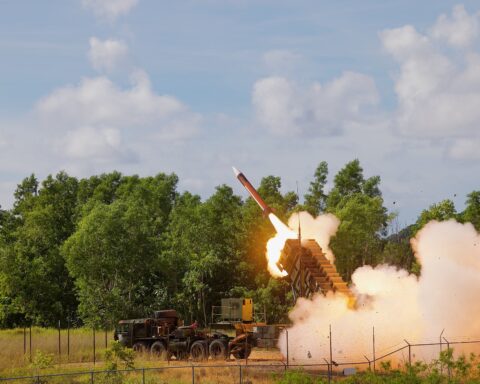
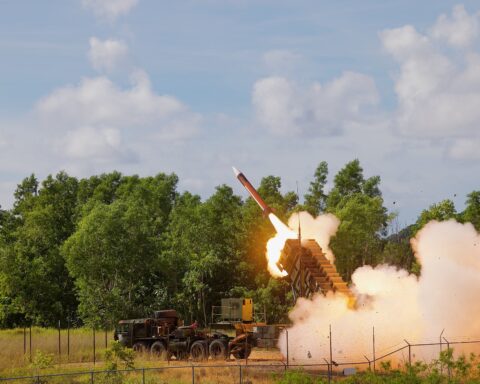
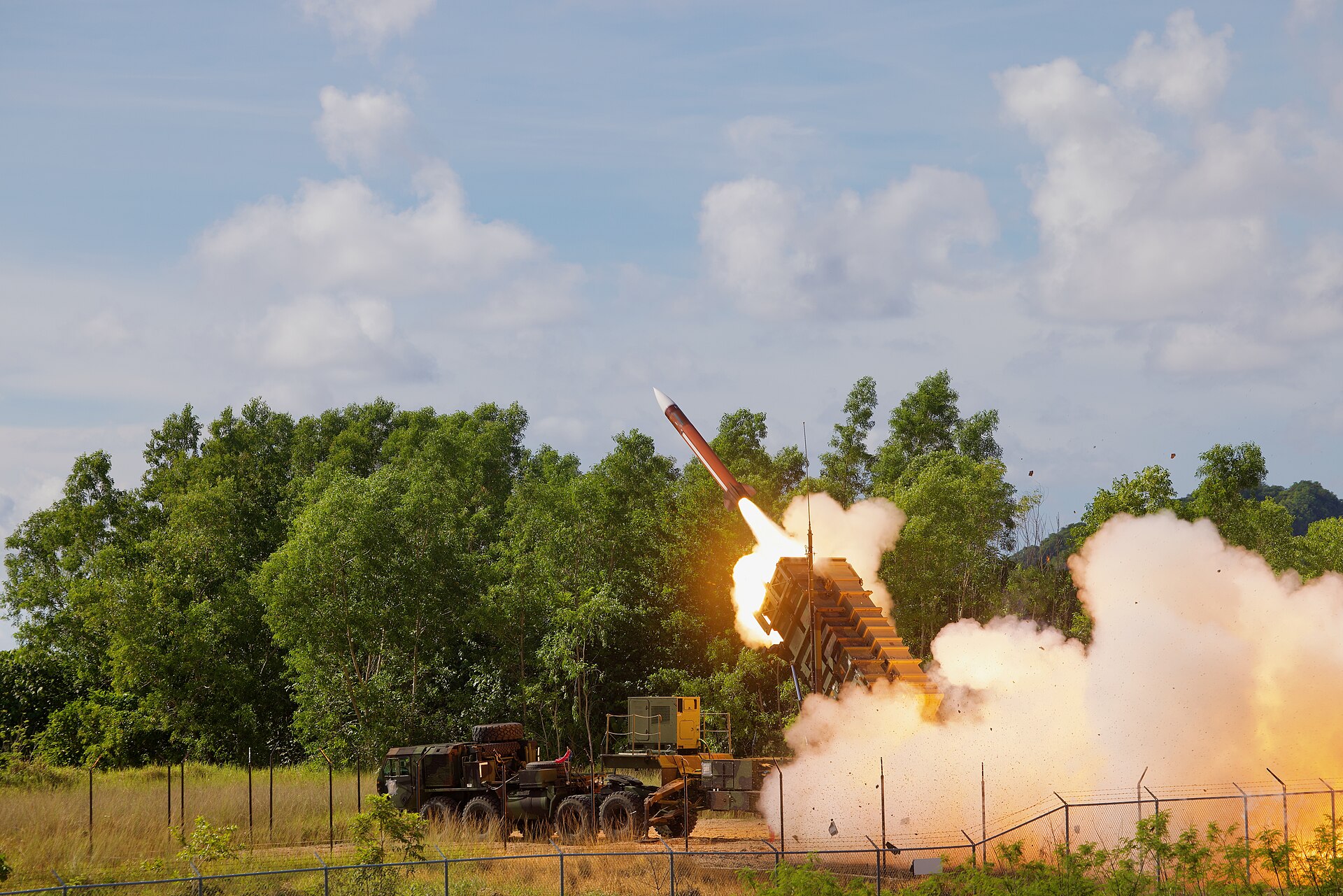
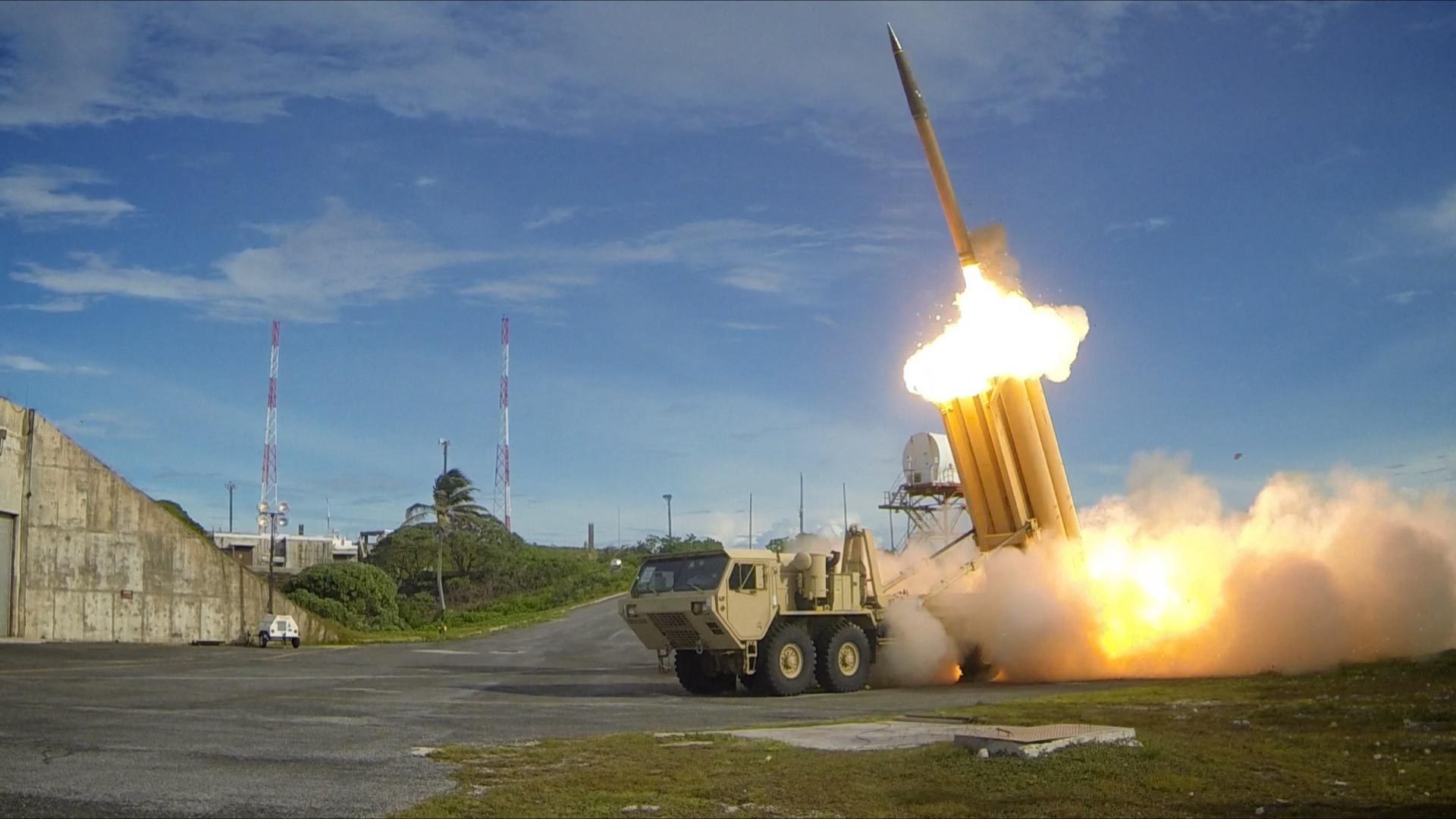
The 100-percent intercept rate that the UAE has reported — and continued to claim on April 4 — comes at a cost that accumulates in interceptor magazines, not in headlines. Each PAC-3 MSE interceptor costs approximately $3.7 to $4.1 million, according to CSIS. Standard US military doctrine calls for firing two interceptors at each incoming threat, bringing the cost per engagement to between $7.4 and $8.2 million. A THAAD interceptor costs roughly $12.7 million per shot, according to CSIS and Fortune.
The Iranian Shahed-136 drones that make up the bulk of the daily salvos cost an estimated $50,000 to $70,000 each. The cost asymmetry is stark: a two-interceptor engagement against a single Shahed drone can cost more than 100 times the price of the drone itself.
A March 2026 report from the Jewish Institute for National Security of America (JINSA), titled “Eroding Shield,” quantified the stockpile damage. Gulf states collectively had a pre-war combined stockpile of just under 2,800 interceptors. By the time of the report’s publication, approximately 2,400 had been expended. JINSA assessed that the UAE and Kuwait may have “burned through roughly 75% of their Patriot stocks,” Bahrain possibly 87 percent, and Qatar approximately 40 percent.
“Iran has adapted its strategy to exploit vulnerabilities in that system… The war has become a stockpile race.”
— JINSA, “Eroding Shield” report, March 2026
Tom Karako, director of the CSIS Missile Defense Project, put it more bluntly. The United States has “vaporized years and years of missile defense interceptors in a matter of hours,” he told Military Times.
Resupply timelines compound the problem. Lockheed Martin currently produces approximately 650 PAC-3 interceptors annually, according to Breaking Defense and CSIS. A framework agreement announced in early 2026 aims to raise production to 2,000 per year, but that capacity will not be reached until 2030. At the current maximum output of 650 units per year, replacing the estimated 2,400 expended interceptors would take nearly four years — assuming none of the new production goes to other customers, including Ukraine.
The THAAD picture is equally constrained. The global inventory stood at 534 interceptors as of December 2025, with no new deliveries since July 2023, according to CSIS. More than 150 were expended in the June 2025 Israel-Iran Twelve-Day War alone, CNN reported. An additional 150-plus have been fired since February 28, bringing the combined expenditure across both conflicts to more than half the global stockpile, according to USNI News. The next delivery batch of 100 units is not scheduled until April 2027.
The multinational air defense presence in the Gulf expanded during the conflict. Greece deployed Patriot batteries to Saudi Arabia. The UK contributed Sky Sabre systems. South Korean Cheongung II systems and Israeli Barak-8 interceptors supplemented the US-made backbone. The multinational deployments did not fundamentally alter the interceptor arithmetic: the systems fire the same finite stock of missiles, and the current conflict began with magazines already drawn down by the June 2025 Twelve-Day War.
Why Did the UAE Stop Saying ‘Intercepted’?
Around March 10 to 11, the UAE Ministry of Defence changed its public reporting methodology. Prior to that date, statements differentiated between projectiles “detected” and those “intercepted.” After the shift, the ministry adopted a single term: “engaged.” The change was first noted by Breaking Defense.
Brian Carter, an analyst at the American Enterprise Institute, assessed that the UAE “likely stopped differentiating between ‘detected’ and ‘intercepted’ munitions because publicly advertising that information affects operational security,” he told Breaking Defense.
The distinction matters. A missile can be detected and tracked but not successfully intercepted — either because an interceptor missed, because no interceptor was available, or because the threat was assessed as not targeting a defended area and was allowed to impact. By collapsing both categories into “engaged,” the UAE removed the public’s ability to calculate intercept rates or identify potential misses.
Jean Loup Samaan, a defense analyst at the Middle East Institute and the National University of Singapore, told Breaking Defense that the “air defense capabilities of most Gulf states are struggling in terms of depletion.” The reporting change, in the context of Samaan’s assessment and the JINSA stockpile figures, suggested to analysts that the UAE was managing the information environment around its remaining interceptor capacity.
Ali Bakir, a defense analyst at Qatar University, offered a broader assessment: “The conflict has shown structural vulnerabilities. Despite decades of heavy defense spending, Gulf states remain highly exposed to missile and drone warfare. Air defense systems can intercept, but not at scale or at low cost,” he told Breaking Defense.
Iran’s Multi-Tier Saturation Design
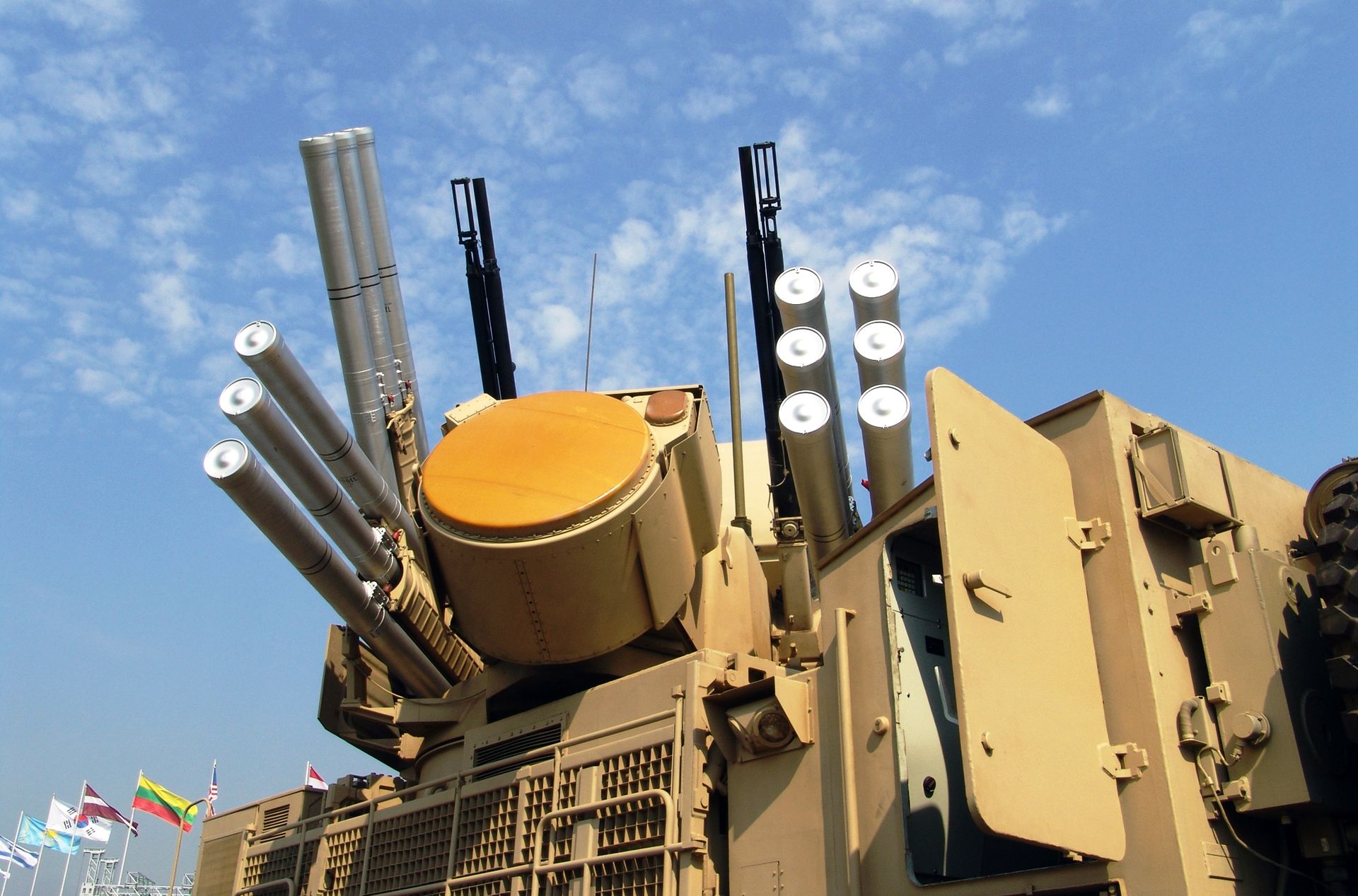
The composition of the April 4 barrage — 23 ballistic missiles mixed with 56 drones — was not random. The JINSA “Eroding Shield” report described the Iranian approach as a deliberate multi-tier saturation strategy. Low-flying Shahed drones stress lower-tier point-defense systems such as the Pantsir-S1 and SkyKnight. Short-range ballistic missiles require Patriot PAC-3 engagements. Medium-range ballistic missiles force the use of THAAD or Arrow-2 interceptors. Each mixed salvo depletes multiple interceptor categories simultaneously.
The UAE’s layered air defense architecture, as described by Breaking Defense, includes THAAD for the high tier, Patriot PAC-3 for the medium tier, and Barak-8, Pantsir-S1, Cheongung II, and SkyKnight for lower tiers. The system is designed precisely for the kind of mixed threat that Iran is delivering. But the design assumption was that such attacks would be episodic, not daily.
The damage to THAAD radar infrastructure compounded the problem. CNN reported on March 5 that the AN/TPY-2 radar — described as “essentially the heart of the THAAD battery” — suffered damage at the Al Ruwais and Al Sader sites. Each THAAD battery carries 48 interceptors across six Transporter Erector Launcher (TEL) trucks. With the radar degraded, even available interceptors lose their guidance chain.
The IRGC has publicly claimed specific targeting of non-military infrastructure. On April 2, Iran’s Islamic Revolutionary Guard Corps claimed it targeted an Oracle data center in Dubai, according to Critical Threats. On March 29, the IRGC claimed attacks on aluminium facilities in the UAE and Bahrain as retaliation for US-Israeli strikes on Iranian infrastructure, Al Jazeera reported. On April 1, the IRGC threatened to attack 17 US technology companies operating in the region, naming Amazon, Google, Microsoft, Nvidia, and Apple, according to CNBC.
The shift toward civilian and commercial infrastructure targets increases the number of sites that air defense batteries must cover, further thinning the interceptor allocation per defended area.
Habshan Goes Offline Again
The April 3 barrage forced ADNOC’s Habshan gas complex offline for the second time since the war began, Bloomberg reported. Habshan processes 6.1 billion standard cubic feet per day — approximately 61 percent of ADNOC Gas’s total throughput, according to The National. One Egyptian national was killed and four others were injured in the strike, The National reported.
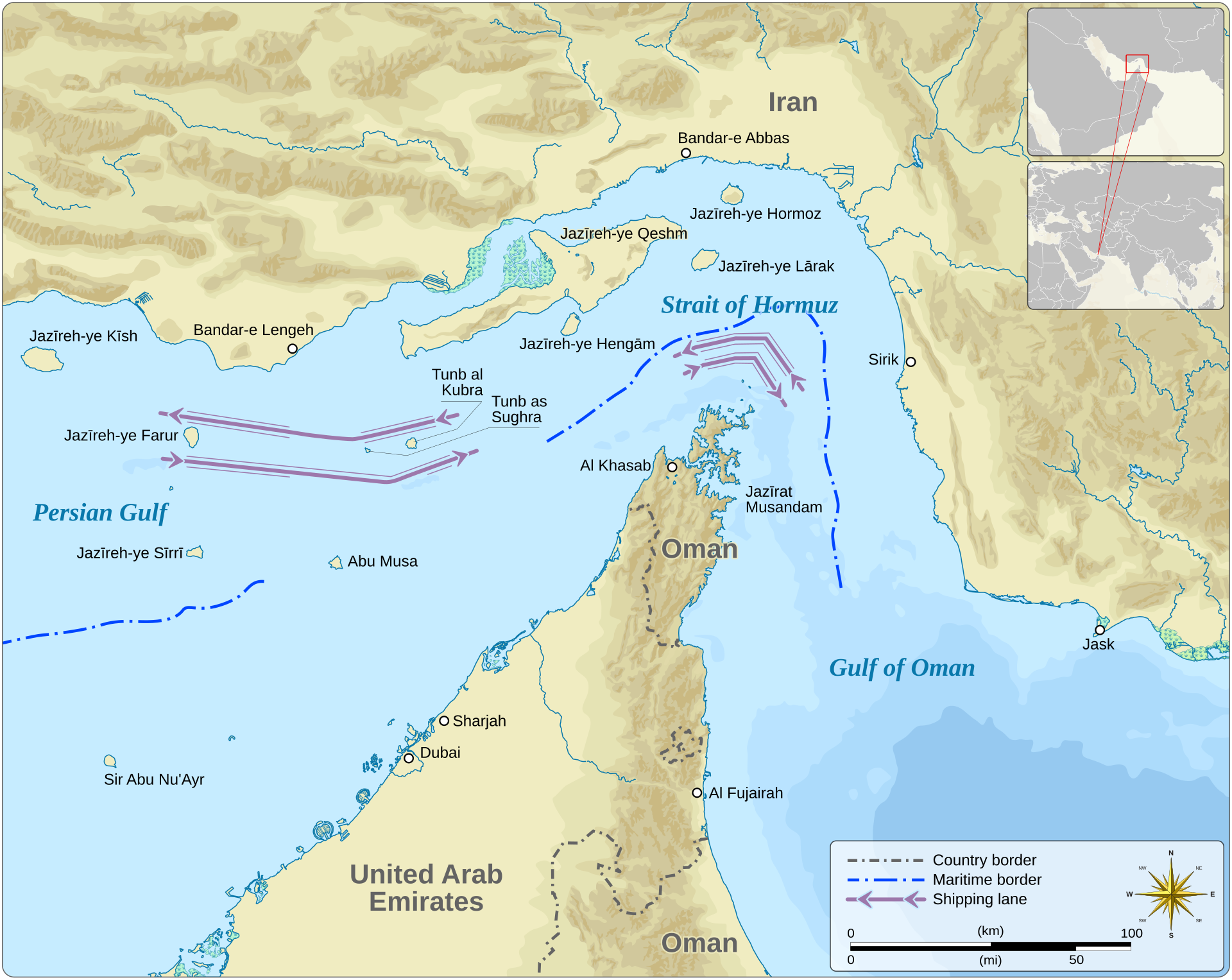
Habshan is not only a gas processing facility. It is the origin point of the Habshan-Fujairah crude pipeline, the UAE’s primary route for bypassing the Strait of Hormuz. Shutting down Habshan does not merely reduce gas output; it threatens the viability of the Hormuz bypass that the UAE built precisely for a conflict like this one.
Sultan Al Jaber, CEO of ADNOC, described Iran’s targeting of Gulf energy infrastructure as “global economic warfare,” according to multiple Gulf sources.
The Habshan shutdown came on the same day that Kuwait’s Mina Al-Ahmadi refinery was hit for the second time, and a Kuwaiti desalination plant was struck. The UAE’s own water security depends heavily on desalination — approximately 42 percent of the country’s water supply comes from desalinated seawater, according to CSIS. The UAE Water Security Strategy 2036 established a 45-day emergency reserve, Al Jazeera reported on March 8. At 35 days into the conflict, that reserve margin was narrowing.
Ryan Bohl, an analyst at RANE Network, assessed the cumulative pressure on Gulf states as approaching a threshold: “If Iranian attacks continue throughout this week, I would expect the Gulf Arab states to eventually participate in counter-attacks on Iran,” he told Breaking Defense.
What Happens After April 6?
The four-day escalation trajectory aligned with the countdown to a specific date. President Trump’s pause on US strikes against Iranian power grid and desalination infrastructure expires on April 6 at 8 PM ET. The pause was part of a diplomatic window during which Special Envoy Steve Witkoff transmitted a 15-point plan to Tehran. Iran rejected the accompanying 48-hour ceasefire proposal and submitted five counter-conditions, according to Al Jazeera and CNBC reporting from March 26.
Dr. Sanam Vakil, director of the Middle East and North Africa Program at Chatham House, warned that the diplomatic timeline may not align with the military one. “Iran is prepared for a longer war than I think the U.S. administration clearly calculated for,” she said at an Atlantic Council roundtable in early March.
If Iran can deplete enough Gulf interceptor stocks before the April 6 deadline, each subsequent salvo carries a higher probability of penetrating defenses. The Habshan strike on April 3 — a facility presumably within the defended footprint — suggested that penetration was already occurring at the margins, even as the UAE maintained its claim of complete intercepts against ballistic missile and drone threats.
Iran has framed its entire campaign as defensive retaliation for what it calls “US-Israel aggression” launched on February 28. The IRGC has expanded its target set from military installations to energy infrastructure, commercial data centers, and desalination plants — a progression that treats the entire Gulf economic base as a legitimate target set.
The question is whether 48 hours of additional bombardment at the April 1-4 trajectory — potentially reaching 90 to 100 projectiles per day by April 6 — would push interceptor reserves below the threshold at which Gulf capitals can maintain area defense. The integrated air defense architecture that has held for 35 days was built for a different kind of threat: episodic attacks from Houthi missiles and drones, not sustained daily bombardment from a state actor firing from multiple axes. The Greek component of that multinational interceptor network — and the bilateral economic architecture that keeps 130 Hellenic Air Force specialists at Yanbu despite Athens publicly denying combat involvement — is examined in how Greece became the Gulf’s bilateral munitions hub.
Frequently Asked Questions
How many total projectiles has Iran fired at the UAE since February 28?
According to the UAE Ministry of Defence, as reported by PM News Nigeria on April 4, the cumulative total stands at 2,662 projectiles: 498 ballistic missiles, 23 cruise missiles, and 2,141 UAVs. At standard two-shot doctrine with PAC-3 MSE rounds — not accounting for the more expensive THAAD engagements — intercepting that volume at $7.4 million per engagement represents an expenditure exceeding $19 billion. That figure does not include the cost of THAAD intercepts, which run $12.7 million per shot.
What air defense systems does the UAE currently operate?
The UAE operates a six-layer defense architecture, according to Breaking Defense: THAAD for high-altitude ballistic missile defense, Patriot PAC-3 for medium-altitude threats, the Israeli-designed Barak-8 for medium-range air defense, the Russian-origin Pantsir-S1 for short-range point defense, the South Korean Cheongung II (also known as M-SAM), and the Rafael SkyKnight directed-energy system for close-in drone defense. The multinational contributions since February 28 — including Greek Patriot deployments and British Sky Sabre systems — have supplemented but not replaced depleted interceptor stocks in the primary systems.
Has Iran hit any UAE civilian infrastructure despite the reported 100% intercept rate?
The UAE’s public claims of complete intercepts refer specifically to ballistic missiles and drones as distinct threat categories. The reporting methodology shift — from “intercepted” to “engaged” in March — makes independent verification of individual intercept outcomes difficult. The Habshan gas complex was forced offline on April 3, and one person was killed in that strike. The IRGC also claimed targeting of an Oracle data center in Dubai on April 2, according to Critical Threats. The Witkoff diplomatic track has not produced results that would stop the targeting of civilian infrastructure.
What is the Witkoff 15-point plan and why did Iran reject it?
US Special Envoy Steve Witkoff transmitted a 15-point plan to Tehran as part of diplomatic efforts to resolve the conflict. The full contents have not been publicly released. Iran rejected the accompanying 48-hour ceasefire proposal and submitted five counter-conditions, according to Al Jazeera and CNBC reporting from March 26. The plan was linked to the Trump administration’s pause on US strikes against Iranian power grid and desalination infrastructure — a pause that expires April 6 at 8 PM ET. The China-Pakistan peace initiative has also reached Riyadh as an alternative diplomatic track, though it has not gained traction with Washington.
Could Gulf states run out of interceptors entirely?
JINSA assessed in March 2026 that Gulf states had expended approximately 2,400 of a pre-war combined stockpile of just under 2,800 interceptors. At Lockheed Martin’s current production rate of 650 PAC-3 units per year, the deficit cannot be closed before 2030. THAAD is worse: 100 new interceptors are not scheduled for delivery until April 2027, and the current global inventory has been cut by more than half across two conflicts. Ryan Bohl of RANE Network assessed that continued attacks at the current pace could push Gulf states toward direct participation in counter-attacks on Iran rather than relying solely on defensive interception.