
RIYADH — Iraq is about to decide the outcome of this war, and Saudi Arabia is not ready for the answer. When Baghdad’s National Security Council authorized military retaliation against the United States following airstrikes that killed 22 Popular Mobilization Forces fighters in Anbar province, the decision did not register as a seismic event in most Western capitals. It should have. Iraq shares an 814-kilometre border with Saudi Arabia — a frontier that runs through flat, open desert with almost no natural defensive barriers. If Iraq completes its drift into Iran’s strategic orbit, the Kingdom will face a threat far more dangerous than anything Tehran can launch from across the Persian Gulf: a hostile land border staffed by 238,000 armed militia fighters who have already declared themselves combatants in the war.
The conventional analysis of this conflict focuses on missiles, drones, and naval interdiction. Iran’s aerial capabilities dominate the threat assessments. Saudi air defences, American interceptors, and the performance of Patriot batteries consume the strategic bandwidth. All of that matters. But the fixation on the aerial dimension obscures the ground-level reality that could prove decisive. Saudi Arabia cannot intercept a hostile neighbour. It cannot shoot down a border that stretches for 814 kilometres through some of the emptiest terrain on earth. And it cannot deploy Patriot batteries against the slow, grinding infiltration of a country that has spent two decades falling under Iranian influence while the world looked elsewhere.
Iraq is not a sideshow in this war. It is the war’s centre of gravity. And the clock is running.
Table of Contents
- Why Does Iraq Matter More Than Iran’s Missiles?
- What Is the Popular Mobilization Forces?
- The 814-Kilometre Border Saudi Arabia Built a Wall to Defend
- How Did Iraq Go From Saudi Ally to Iranian Client?
- The Oil Weapon Iraq Cannot Afford to Use
- Can Prime Minister Sudani Hold the Centre?
- The Iraq Volatility Matrix
- What Happens If Iraq Formally Sides With Iran?
- Saudi Arabia’s Options for Securing the Northern Front
- The Ground War Nobody Is Discussing
- Frequently Asked Questions
Why Does Iraq Matter More Than Iran’s Missiles?
The strategic geometry of the Middle East has always rewarded those who think in borders rather than ballistics. Missiles can be intercepted. Drones can be jammed. Naval blockades can be circumvented. But geography is permanent, and geography is what makes Iraq the decisive variable in the 2026 conflict.
Consider the map. Saudi Arabia faces threats on three axes. From the east, Iran can strike across the Persian Gulf with ballistic missiles, cruise missiles, and one-way attack drones — a threat the Kingdom has spent hundreds of billions of dollars preparing to counter. From the south, Houthi forces in Yemen have demonstrated a capacity for sustained harassment of Saudi territory and Red Sea shipping that has persisted for over a decade. These two threat vectors are well understood, extensively war-gamed, and central to Saudi defence planning.
The third axis — the northern border with Iraq — has received a fraction of the attention. This is a catastrophic oversight. The 814-kilometre Iraq-Saudi frontier is the longest land border the Kingdom shares with any country that could plausibly become a belligerent in this war. It runs through the Wadi al-Batin and across the An Nafud desert, terrain so flat and featureless that military planners on both sides have described it as a highway for mechanized forces. There are no mountain ranges. No river systems. No natural chokepoints that favour the defender.
If Iraq formally enters the conflict on Iran’s side — or, more likely, if Baghdad simply loses the ability to prevent the Popular Mobilization Forces from operating independently along the border — Saudi Arabia will face encirclement. Iran from the east. Iraq from the north. The Houthis from the south. Three hostile fronts, with the Kingdom’s population centres, desalination plants, and critical infrastructure all within range of ground-based threats that air defences were never designed to stop.
The aerial threat from Iran is real. But missiles follow predictable trajectories. They can be tracked, targeted, and destroyed. The ground threat from Iraq is amorphous, distributed, and vastly harder to counter. A hostile Iraq does not need to fire a single missile to change the strategic calculus of this war. It merely needs to open its border.
What Is the Popular Mobilization Forces?
The Popular Mobilization Forces — al-Hashd al-Shaabi in Arabic — is the most consequential military formation in the Middle East that most Western observers cannot accurately describe. Established in 2014 in response to a fatwa by Grand Ayatollah Ali al-Sistani calling on Iraqis to defend their country against the Islamic State, the PMF has grown from a loose collection of volunteer militias into a parallel military structure with 238,000 fighters, an annual budget of $3.6 billion, and more than 70 distinct factions, according to the Washington Institute for Near East Policy.
Those numbers deserve emphasis. The PMF’s 238,000 fighters make it larger than the active-duty military of most NATO member states. Its $3.6 billion annual budget exceeds the entire defence spending of several Gulf Cooperation Council members. And its 70-plus factions range from nationalist groups loyal to the Iraqi state to Iran-aligned formations that take operational direction from Tehran’s Islamic Revolutionary Guard Corps.
The most significant of these Iran-aligned factions is Kataib Hezbollah, which has already declared that it is joining the war against the United States and its allies. Asaib Ahl al-Haq, Harakat Hezbollah al-Nujaba, and Kataib Sayyid al-Shuhada have made similar declarations. These groups collectively command tens of thousands of fighters with combat experience gained during the anti-ISIS campaign and, in some cases, during deployments to Syria in support of the Assad regime.
The PMF’s legal status is what makes it uniquely dangerous. In 2016, the Iraqi parliament passed Law 40, formally incorporating the PMF into Iraq’s security architecture as an independent military formation answering to the prime minister. This means the PMF is simultaneously an arm of the Iraqi state and a vehicle for Iranian power projection. When PMF fighters deploy to the Saudi border, they do so wearing Iraqi government uniforms, drawing Iraqi government salaries, and operating under Iraqi government authority — even when their operational commanders take phone calls from the IRGC’s Quds Force.
The 7th Brigade of the PMF is already positioned at the Ar Ar border crossing, the primary land route between Iraq and Saudi Arabia. Whether this deployment is defensive, provocative, or preparatory depends entirely on which faction controls the brigade and whose orders its commanders follow on any given day. That ambiguity is not a bug in the system. It is the system.
The 814-Kilometre Border Saudi Arabia Built a Wall to Defend
Saudi Arabia has not ignored the Iraq border. In 2014 — the same year the PMF was founded and ISIS overran Mosul — the Kingdom completed construction of one of the most extensive border security systems on earth. The project, managed by the Saudi Border Guard Development Program, stretches the full length of the 814-kilometre frontier and incorporates five distinct layers of defence.
The outermost layer consists of a sand berm and ditch system designed to prevent vehicle crossings. Behind it sits a double fence topped with concertina wire. The third layer is an electronic detection zone equipped with buried sensors, seismic detectors, and fibre-optic intrusion-detection cables. The fourth layer is a network of 78 watch towers fitted with night-vision cameras, thermal imaging systems, and radar units capable of detecting movement at distances of several kilometres. The fifth and final layer is a command-and-control architecture linking 8 regional command centres to 32 rapid-response centres, each staffed with quick-reaction forces capable of deploying to any point along the border within minutes.
The system was built to stop infiltration by small teams of ISIS fighters and smugglers. It was designed for a threat environment in which the Iraqi government was a cooperative, if weak, partner in border security. It was not designed for a scenario in which the Iraqi state itself — or the 238,000-strong military formation that operates under its authority — becomes the threat.
The distinction matters. Border barriers are effective against non-state actors who must cross covertly, in small numbers, carrying limited equipment. They are far less effective against a state-backed military force that can mass at a single crossing point, overwhelm a rapid-response centre, or simply open the gate at Ar Ar and drive through. The five layers of sensors and fences that Saudi Arabia built at a cost of several billion dollars were engineered to detect and delay. They were never engineered to stop an army.
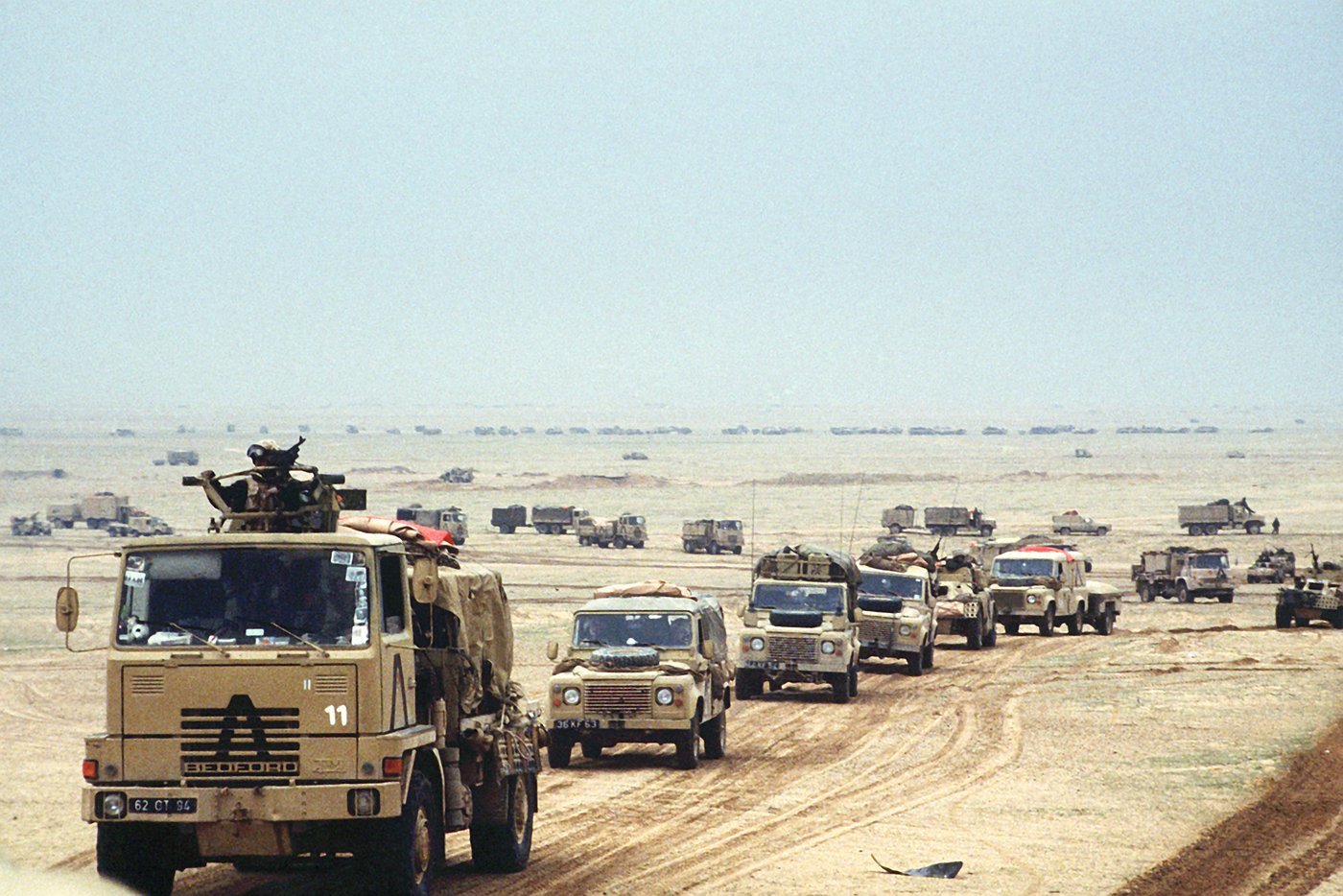
The terrain compounds the problem. The Iraq-Saudi border runs through the western edge of the Arabian Desert, a landscape so flat that visibility extends to the horizon in every direction. There is no cover, no concealment, and no terrain advantage for either attacker or defender. In the 1991 Gulf War, Coalition forces crossing this same border region advanced at speeds exceeding 50 kilometres per hour against Iraqi defenders who had had months to prepare fortified positions. The lesson was unambiguous: in open desert, defensive barriers buy time, not outcomes.
Saudi Arabia’s border wall is an impressive feat of engineering. Against the threat it was designed to counter, it is highly effective. Against the threat it now faces, it is a speed bump.
How Did Iraq Go From Saudi Ally to Iranian Client?
The trajectory of Iraqi-Saudi relations across the past thirty-five years reads like a manual on how to lose a neighbouring state to a rival power through neglect, miscalculation, and inattention.
In 1990, Saddam Hussein’s invasion of Kuwait prompted Saudi Arabia to sever diplomatic relations with Baghdad — a break that would last twenty-five years. The decision was rational at the time. Saddam’s forces were massed on the Saudi border, and the Kingdom’s survival appeared to depend on the American military intervention that followed. But the diplomatic rupture created a vacuum that Iran spent the next quarter-century filling.
The 2003 American invasion and the destruction of the Iraqi Ba’athist state eliminated the Sunni-dominated power structure that had served as a buffer between Saudi Arabia and Iran. The new Iraqi political order, built on a sectarian quota system that guaranteed Shia majority rule, created structural incentives for Iraqi leaders to cultivate ties with Tehran rather than Riyadh. Iran offered money, weapons, political patronage, and — through the IRGC’s Quds Force under Qasem Soleimani — a coherent strategy for shaping Iraq’s post-invasion trajectory. Saudi Arabia offered almost nothing.
Riyadh did not reopen its embassy in Baghdad until 2015. By then, Iranian influence had permeated every layer of Iraq’s political, military, and economic infrastructure. The Quds Force had built the PMF into a parallel army. Iranian-backed political parties dominated the Iraqi parliament. Iranian companies controlled significant portions of Iraq’s import market. Iranian pilgrimage tourism generated billions of dollars in revenue for Iraqi businesses. The relationship was asymmetric but deeply entrenched.
Saudi Arabia’s twenty-five-year diplomatic absence from Baghdad ranks among the most consequential strategic errors in modern Middle Eastern history. While Riyadh maintained its estrangement, Iran was building an infrastructure of influence that no amount of late-stage diplomacy could easily dismantle. The Kingdom’s belated outreach — Crown Prince Mohammed bin Salman’s overtures to Baghdad, the reopening of the Ar Ar border crossing, investment pledges, energy cooperation agreements — was real and substantive. But it was attempting to reverse two decades of Iranian penetration in a country where the institutions of state had been rebuilt with Iranian participation at every level.
The current crisis has exposed the fragility of that diplomatic recovery. When American airstrikes killed PMF fighters on Iraqi soil, Baghdad’s response was to authorize military retaliation — not against Iran, but against the United States, Saudi Arabia’s primary security guarantor. That decision revealed where Iraq’s institutional centre of gravity actually lies, regardless of what its prime minister says in public.
The Oil Weapon Iraq Cannot Afford to Use
Iraq’s economy is, by any measure, a petro-state in its purest form. Crude oil sales account for more than 90 per cent of government revenue. The Iraqi dinar’s value is sustained almost entirely by dollar-denominated oil exports. The state payroll — which includes the salaries of roughly 4 million government employees, pensioners, and security forces including the PMF’s 238,000 fighters — is funded by oil.
This dependency creates a paradox that defines Iraq’s position in the current conflict. Baghdad cannot afford to join Iran’s war because doing so would invite the destruction of the petroleum infrastructure that keeps the Iraqi state solvent. But Baghdad also cannot afford to stay neutral because the war is already destroying its petroleum infrastructure regardless.
On March 20, the Basra Oil Company declared force majeure on its export contracts after sustained military operations in the Persian Gulf disrupted shipping routes and damaged port facilities. Iraqi oil production collapsed from 3.3 million barrels per day to 900,000 — a 73 per cent decline that eliminated roughly $200 million in daily revenue at current prices. The Iraqi government’s cash reserves, never robust, are now draining at a rate that makes the status quo unsustainable within months.
The oil collapse creates three distinct pressures that all push Iraq toward Iran. First, economic desperation makes Baghdad more vulnerable to Iranian financial support and less capable of resisting Iranian demands. A government that cannot pay its soldiers is a government that cannot control which soldiers follow orders. Second, the production decline removes Iraq’s primary incentive for staying out of the conflict: if Iraqi oil is not flowing regardless, the economic cost of belligerency drops dramatically. Third, the force majeure declaration itself was triggered by American military operations in the Gulf — operations that Iraqis across the political spectrum blame on Washington, not Tehran.
Iraq’s oil weapon is a paradox: too valuable to use deliberately, but increasingly irrelevant as the war destroys it anyway. Every barrel of Iraqi production lost to the conflict is a data point that strengthens the argument for alignment with Iran over alignment with the West. The logic is brutal but internally consistent — if the Americans are going to wreck Iraq’s economy through collateral damage, why should Baghdad continue pretending to be their partner?
Can Prime Minister Sudani Hold the Centre?
Mohammed Shia al-Sudani occupies what may be the most difficult political position in the world. Iraq’s prime minister has declared a “positive neutral position” in the conflict — a formulation designed to satisfy everyone and satisfying no one. He has maintained diplomatic channels with both Washington and Tehran. He has resisted calls from Iran-aligned factions to expel remaining American forces while simultaneously resisting American pressure to crack down on the PMF. He has tried to position Iraq as a potential mediator while his own National Security Council authorizes military retaliation against one of the parties he claims to be mediating between.
Sudani’s balancing act is not cynical. It reflects a genuine strategic reality: Iraq’s interests are served by neither full alignment with Iran nor full alignment with the United States, and the prime minister understands this with clarity. Full alignment with Tehran would invite American sanctions, the destruction of Iraq’s remaining economic relationships with the West, and the permanent loss of the Kurdish north, where the last American military presence — fewer than 2,000 troops at Harir Air Base in Erbil — serves as a guarantor of Kurdish autonomy. Full alignment with Washington would require confronting the PMF, a military force that is larger, more battle-hardened, and more deeply embedded in Iraqi society than the regular army.
The problem is that the middle ground is collapsing. Secretary of State Marco Rubio told Sudani directly that “a government controlled by Iran cannot put Iraqi interests first” — a public humiliation that weakened Sudani’s domestic position by forcing him to respond with nationalist rhetoric rather than pragmatic diplomacy. The 32 American airstrikes on PMF positions since February 28, including the strikes that killed 15 fighters and the Anbar operations commander Saad al-Baiji on March 24 and 25, have made neutrality physically impossible. Every American bomb that lands on Iraqi soil is a recruiting tool for the factions demanding that Sudani abandon his balancing act and pick a side.
The paradox of Sudani’s position is that the harder he tries to remain neutral, the less relevant his neutrality becomes. The PMF does not need his permission to act. The Americans do not need his permission to strike. He is a mediator in a room where both parties have stopped listening.
Analysis based on Iraqi National Security Council directives, March 2026
The January 17, 2026 handover of Ain al-Asad Air Base to the Iraqi Army was supposed to be a demonstration of Sudani’s ability to manage the American drawdown on Iraqi terms. Instead, it became a symbol of American retreat. The base — once the largest American military installation in western Iraq, a facility from which the United States projected power across the Euphrates valley — is now under the control of an Iraqi military that may or may not take orders from a prime minister who may or may not be able to resist the demands of a PMF that may or may not already be fighting on Iran’s side.
The ambiguity is the point. And the ambiguity is what makes Iraq so dangerous.
The Iraq Volatility Matrix
Tracking Iraq’s trajectory in this conflict requires a framework that captures the multiple, often contradictory forces pulling Baghdad in different directions. The Iraq Volatility Matrix scores the country’s alignment across five dimensions, each rated on a scale from 1 (firmly pro-Saudi/US) to 5 (firmly pro-Iran). The aggregate score indicates the overall direction of Iraqi strategic drift.
| Dimension | Key Indicator | Score (1-5) | Assessment |
|---|---|---|---|
| Military | PMF operational direction; force posture at Ar Ar | 4.5 | PMF factions have declared belligerency. 7th Brigade at Saudi border. Regular army weakened by budget crisis. IRGC operational influence pervasive across 70+ factions. |
| Political | Sudani government policy; NSC directives | 3.5 | Nominal neutrality undermined by NSC authorization of military retaliation against US. Sudani retains rhetorical independence but institutional control eroding. Iran-aligned Coordination Framework dominates parliament. |
| Economic | Oil revenue dependency; fiscal sustainability | 3.0 | Oil collapse (3.3M to 900K bpd) destroys fiscal base. Economic desperation creates vulnerability to Iranian support but also to Western sanctions pressure. Currently balanced on a knife edge. |
| Territorial | Border force deployment; transit corridor control | 4.0 | PMF controls key border areas. Iran-Iraq border fully permeable to IRGC movement. Saudi border monitored but PMF deployment at Ar Ar crossing is escalatory. US withdrawal from western Iraq removes buffer. |
| Diplomatic | International alignment; UN voting; bilateral relations | 3.0 | Iraq maintains embassies in both Riyadh and Tehran. Rubio’s public rebuke damaged US-Iraq relations. Saudi diplomatic investment since 2015 provides residual goodwill but insufficient institutional anchoring. |
The aggregate score of 3.6 out of 5 places Iraq firmly in the “tilting toward Iran” category. The military and territorial dimensions score highest because they reflect the on-the-ground reality that no amount of diplomatic rhetoric can override: the PMF is larger, stronger, and more operationally aligned with Iran than at any previous point in its existence, and it controls physical territory along both the Iranian and Saudi borders.
The economic dimension scores lowest — a 3.0 — because Iraq’s oil dependency creates genuine constraints on full Iranian alignment. Baghdad still needs Western markets, Western investment, and Western financial infrastructure to sell its crude and service its debt. Sanctions would be devastating. But this economic anchor is weakening with every day that Iraqi oil production remains at emergency levels. If the force majeure persists through April, the economic dimension will likely shift from 3.0 to 3.5 or higher as Baghdad’s Western economic ties become increasingly theoretical.
The trajectory matters more than the snapshot. Six months ago, the aggregate score would have been approximately 2.5 — tilted toward the West but unstable. The twenty-eight days of conflict that followed have shifted every dimension toward Iran. The question is whether anything can arrest or reverse the slide before it crosses the threshold from “tilting” to “committed.”
What Happens If Iraq Formally Sides With Iran?
The scenario that Saudi defence planners lose sleep over is not an Iraqi declaration of war. It is something far more ambiguous and far more dangerous: a gradual, undeclared Iraqi shift from neutrality to co-belligerency, driven not by a single government decision but by the accumulated momentum of PMF operations, economic desperation, and the collapse of Sudani’s ability to restrain the forces pulling Baghdad toward Tehran.
In practical terms, Iraqi alignment with Iran would manifest in stages rather than as a single dramatic announcement. The first stage — already underway — is the independent action phase, in which PMF factions conduct operations against American and allied targets without explicit government authorization but without government opposition. Kataib Hezbollah’s declaration that it has joined the war falls into this category. The Iraqi government has neither endorsed nor condemned the declaration. It has simply pretended not to hear it.
The second stage would be passive facilitation: Iraq allows Iranian military assets, supplies, and personnel to transit Iraqi territory en route to Syria, Lebanon, or positions along the Saudi border. This stage is also arguably underway, though the scale remains contested. The 1,458-kilometre Iran-Iraq border has never been effectively sealed, and Iranian Revolutionary Guard personnel have moved freely across it for years. The difference between peacetime transit and wartime facilitation is a distinction that exists in diplomatic cables but not on the ground.
The third stage — active co-belligerency — would involve the Iraqi state or its PMF proxies conducting direct military operations against Saudi territory or Saudi-allied forces. This could take the form of cross-border rocket attacks, drone strikes launched from Iraqi territory, ground incursions into the Saudi border zone, or the establishment of forward operating bases within range of Saudi infrastructure.
Iraq shares borders with six countries — Iran, Turkey, Syria, Jordan, Saudi Arabia, and Kuwait — and its geographic position means that active Iraqi belligerency would not merely add one more threat to Saudi Arabia’s calculations. It would fundamentally alter the geometry of the conflict by connecting Iran’s eastern front to Syria’s western front through a contiguous land corridor. Tehran could move weapons, fighters, and supplies from Iranian territory through Iraq to the Syrian border and onward to Hezbollah forces in Lebanon without crossing a single hostile border. The so-called “land bridge to the Mediterranean” that Iranian strategists have pursued for decades would become an operational reality overnight.
For Saudi Arabia, the implications are existential. The Kingdom’s northern border — currently a secondary concern in its threat hierarchy — would become a primary front. The Saudi military would need to deploy substantial ground forces to the border region, drawing units away from the eastern seaboard where they currently guard against Iranian maritime and aerial threats. The logistics of defending a three-front war against adversaries operating along interior lines would strain the Saudi armed forces beyond their current capacity, regardless of the quality of their equipment.
And then there is Kuwait. The small Gulf state sits wedged between Iraq and Saudi Arabia, sharing borders with both. If Iraq becomes hostile, Kuwait’s sovereignty — already tested by the 1990 invasion — becomes an open question. Saudi Arabia’s ability to project power north of Kuwait City depends on Kuwaiti cooperation, which depends on Kuwaiti confidence that the Kingdom can protect it. That confidence, in a three-front war, would evaporate.
Saudi Arabia’s Options for Securing the Northern Front
Saudi Arabia’s strategic options for managing the Iraq threat fall into four categories, each with significant limitations and risks. None of them is sufficient on its own. All of them require resources that are currently committed to other fronts.
The first option is diplomatic engagement — an intensification of the Saudi outreach to Baghdad that began in 2015. The Kingdom has invested significant political capital in the relationship with Sudani’s government, including energy cooperation agreements, investment pledges, and the symbolic reopening of the Ar Ar border crossing. The logic is straightforward: if Saudi Arabia can offer Iraq a more attractive economic and diplomatic partnership than Iran, Baghdad’s rational self-interest should pull it toward Riyadh.
The limitation of this approach is that Iraq’s alignment is not primarily driven by rational economic calculation. The PMF’s 238,000 fighters are not susceptible to Saudi investment pledges. The IRGC’s institutional relationships with Iraqi political parties are not vulnerable to diplomatic charm offensives. And the emotional impact of American airstrikes on Iraqi soil — 32 strikes since February 28, killing fighters who many Iraqis regard as national heroes for their role in defeating ISIS — cannot be offset by promises of future economic cooperation. Diplomacy is necessary but insufficient.
The second option is military deterrence — a visible reinforcement of Saudi forces along the northern border, coupled with explicit warnings that any cross-border aggression will be met with overwhelming force. Saudi Arabia’s ground forces include several mechanized brigades equipped with M1A2 Abrams tanks, Bradley fighting vehicles, and self-propelled artillery systems capable of dominating the open desert terrain along the border. The Saudi Royal Air Force can provide close air support from bases in the northern region. The border’s surveillance infrastructure — the 78 watch towers, radar systems, and command centres — provides early warning capability that would give Saudi forces hours of preparation time against any large-scale movement.
The limitation is that deterrence works against states that have something to lose. The PMF factions most likely to conduct cross-border operations are not state actors making rational cost-benefit calculations. They are ideologically motivated formations whose commanders may welcome Saudi retaliation as a tool for forcing Sudani to abandon his neutrality and commit fully to the Iranian side. Deterrence against an adversary that wants to be attacked is not deterrence at all.
The third option is covert action — intelligence operations designed to weaken Iranian influence within Iraq, support Iraqi nationalists who oppose PMF dominance, and disrupt the logistics networks that connect the IRGC to its Iraqi proxies. Saudi Arabia’s General Intelligence Presidency has historically been less active in Iraq than its Iranian counterpart, but the Kingdom has expanded its intelligence capabilities significantly under Mohammed bin Salman’s leadership. The challenge is that Iran has a thirty-year head start in building its Iraqi networks, and covert action operates on timelines measured in years, not weeks.
The fourth option is coalition building — working with Jordan, Kuwait, and potentially Turkey to create a multilateral framework for containing Iraqi belligerency. Jordan shares a 179-kilometre border with Iraq and has its own concerns about PMF operations near its frontier. Turkey maintains a military presence in northern Iraq and has repeatedly demonstrated its willingness to conduct cross-border operations. A coordinated approach that links Saudi, Jordanian, and Turkish interests could create a containment architecture that no single country can build alone.
The limitation is time. Coalition diplomacy is slow. The war is fast. By the time a multilateral containment framework is negotiated, the facts on the ground may have already made it irrelevant.
The Ground War Nobody Is Discussing
The discourse surrounding the 2026 conflict is dominated by aerial platforms: ballistic missiles, cruise missiles, drones, interceptors, and the electronic warfare systems designed to defeat them. This is understandable. The aerial dimension is visually dramatic, technically sophisticated, and amenable to the kind of quantitative analysis that defence analysts and journalists find compelling. How many missiles did Iran launch? How many did Saudi Arabia intercept? What is the kill ratio of the Patriot system against Fateh-110 variants?
These are important questions. They are also the wrong questions if the war’s outcome is determined not in the skies above the Persian Gulf but on the ground along the Iraq-Saudi border.
Ground warfare in the Middle East has been consistently underestimated by Western analysts and consistently decisive in shaping outcomes. The 2006 Lebanon War demonstrated that Hezbollah’s ground forces could fight the Israeli military to a standstill despite total Israeli air superiority. The Syrian civil war demonstrated that control of territory — not control of airspace — determined which factions survived and which did not. The anti-ISIS campaign demonstrated that clearing and holding ground required hundreds of thousands of fighters operating at the squad and platoon level, a task that no amount of air power could accomplish alone.
The PMF’s 238,000 fighters represent a ground warfare capability that has no equivalent on the Saudi side of the border. Saudi Arabia’s ground forces are well equipped but relatively small, and they are optimized for conventional mechanized warfare in the Gulf region, not for the kind of distributed, irregular operations that PMF factions specialize in. The Saudi National Guard — historically the Kingdom’s internal security force and a counterbalance to the regular military — has no experience operating against a large-scale militia threat along an extended frontier.
The United States, which might once have provided ground forces to reinforce the Saudi position, has effectively withdrawn from western Iraq. The handover of Ain al-Asad Air Base in January eliminated the American ground presence west of Baghdad. The remaining US deployment — fewer than 2,000 troops at Harir Air Base in Erbil — is a tripwire force in Iraqi Kurdistan, not a combat formation capable of influencing events 800 kilometres to the south. Thirteen US bases across the Middle East have been rendered nearly uninhabitable by Iranian strikes, according to CENTCOM assessments, further reducing Washington’s ability to project ground power into the theatre.
The ground war that could emerge along the Iraq-Saudi border would not resemble the conventional armoured clashes of 1991. It would look more like the southern Lebanon frontier: a contested border zone where state and non-state forces intermingle, where provocations escalate through ambiguity rather than formal declarations, and where the distinction between peace and war dissolves into a permanent condition of armed tension. Saudi Arabia’s border wall — its five layers of sensors and fences and rapid-response centres — was built for a world in which the threat came from small groups of infiltrators. The threat now comes from a state-backed army operating on the other side of the fence, and no amount of night-vision cameras and concertina wire can change that calculus.
A border wall stops smugglers. It does not stop a government. And the 238,000 fighters of the Popular Mobilization Forces are, by law, agents of the Iraqi government — regardless of whose flag they fly in their hearts.
Assessment based on Iraqi Law 40 and PMF operational doctrine
The question is not whether the ground dimension of this war will become relevant. It is whether Saudi Arabia will recognize its importance before the 814 kilometres of open desert between Ar Ar and the Wadi al-Batin become the front line that decides the conflict. The Kingdom has spent decades preparing for a war in the air. The war that may determine its strategic future is on the ground.
There is a deeper structural problem that Saudi defence planners must confront. Iran’s economic position is collapsing under the weight of the war, but economic collapse does not automatically translate into military weakness — not when Tehran can project power through proxies that are funded by other governments and motivated by ideology rather than paycheques. Iraq is the conduit through which Iranian strategic reach extends to the Saudi border, and that conduit is widening, not narrowing, with every passing week of the conflict.
The post-war reconstruction costs that Saudi Arabia will eventually bear are already staggering. Adding a destabilized northern frontier to the Kingdom’s list of challenges would push those costs into a range that threatens the fiscal sustainability of Vision 2030 and the broader modernization programme. The 814-kilometre border is not merely a military problem. It is an economic problem, a diplomatic problem, and an existential problem wrapped in a single geographic fact.
Iraq’s trajectory is not yet fixed. Sudani’s balancing act, however precarious, has not yet failed. The PMF’s declarations of belligerency have not yet translated into sustained cross-border operations. The oil crisis that is strangling Baghdad’s budget creates pressure toward Iran but also creates leverage for any power willing to offer Iraq an economic lifeline. There is still time — measured in weeks, not months — for Saudi Arabia to mount a serious diplomatic and strategic effort to keep Iraq from crossing the line between neutrality and belligerency.
But that effort requires something that has been conspicuously absent from the broader conduct of this war: a recognition that the threat from the north is not secondary to the threat from the east. The 814 kilometres of open desert between Saudi Arabia and Iraq are, right now, the most consequential stretch of ground in the Middle East. Whether they become a buffer zone or a battle zone depends on decisions that will be made in Baghdad, Tehran, and Riyadh in the coming days. The missiles can be intercepted. The border cannot.
Frequently Asked Questions
How long is the Iraq-Saudi Arabia border?
The Iraq-Saudi Arabia border extends for approximately 814 kilometres (811 kilometres by some measurements) through the northern Arabian Desert. The frontier runs from the tripoint with Jordan in the west to the tripoint with Kuwait in the east, passing through flat, arid terrain with virtually no natural barriers. The primary official crossing point is at Ar Ar, which was reopened in 2020 after decades of closure. The entire border is covered by Saudi Arabia’s five-layer border security system, completed in 2014, which includes 78 watch towers, radar installations, and 32 rapid-response centres.
What is the Popular Mobilization Forces and how large is it?
The Popular Mobilization Forces (al-Hashd al-Shaabi) is an Iraqi state-sponsored military formation established in 2014 following a fatwa by Grand Ayatollah Ali al-Sistani calling on Iraqis to fight the Islamic State. According to the Washington Institute for Near East Policy, the PMF comprises 238,000 fighters organized into more than 70 factions, operating on an annual budget of approximately $3.6 billion. The PMF was formally incorporated into Iraq’s security architecture by parliamentary legislation (Law 40) in 2016, making it legally part of the Iraqi state’s military apparatus while many of its component factions maintain operational ties to Iran’s Islamic Revolutionary Guard Corps.
Are there still US troops in Iraq?
As of March 2026, the US military presence in Iraq has been reduced to fewer than 2,000 troops stationed at Harir Air Base near Erbil in the Kurdistan Region. The US handed over its largest western Iraq installation, Ain al-Asad Air Base, to the Iraqi Army on January 17, 2026. The drawdown followed years of Iraqi political pressure for a US withdrawal and has left Washington with minimal capacity to influence ground-level developments in central and southern Iraq. The United States has continued to conduct airstrikes against PMF targets — 32 strikes since February 28 — but these are launched from assets outside Iraqi territory, not from bases within the country.
What would happen to Saudi Arabia if Iraq joined the war on Iran’s side?
If Iraq formally or functionally aligned with Iran in the current conflict, Saudi Arabia would face strategic encirclement: Iran threatening from the east across the Persian Gulf, a hostile Iraq along the 814-kilometre northern border, and Houthi forces conducting operations from the south in Yemen. This three-front scenario would force the Saudi military to redistribute forces across multiple axes, diluting its combat power on each front. It would also create a contiguous Iranian land corridor from the Iran-Iraq border through to Syria, enabling Tehran to move weapons, fighters, and supplies across the region without crossing hostile territory. The threat to the Kingdom would shift from a primarily aerial and naval challenge to a ground-level territorial problem that air defences cannot address.
What is Saudi Arabia’s border security system on the Iraq frontier?
Saudi Arabia completed a five-layer border security system along the full 814-kilometre Iraq frontier in 2014. The system includes a sand berm and ditch, double fencing with concertina wire, electronic sensor arrays with buried seismic and fibre-optic detection systems, 78 watch towers equipped with night-vision cameras and radar, and a command-and-control network linking 8 regional command centres to 32 rapid-response centres. The system was designed primarily to counter infiltration by ISIS fighters and smugglers during the period when the Islamic State controlled territory in western Iraq. Its effectiveness against a state-backed military formation such as the PMF — which can mass forces at crossing points and operates under Iraqi government authority — is substantially more limited.
How has the war affected Iraq’s oil production?
Iraq’s oil production collapsed from 3.3 million barrels per day to approximately 900,000 barrels per day following a force majeure declaration by the Basra Oil Company on March 20, 2026. The 73 per cent decline was triggered by disruptions to Gulf shipping routes and damage to port infrastructure caused by military operations in the Persian Gulf. Because crude oil sales account for more than 90 per cent of Iraqi government revenue, the production collapse has created a fiscal emergency that threatens Baghdad’s ability to pay government salaries, fund public services, and maintain the $3.6 billion annual budget of the Popular Mobilization Forces.