Table of Contents
- The Call That Wasn’t About Peace
- Why Is Russia Mediating a War It Helped Arm?
- Saudi Arabia’s Fourth Track: The Diplomatic Alibi
- What Does Moscow Actually Gain From Gulf Diplomacy?
- The Coercive Mediation Playbook — Syria, Libya, and Now the Gulf
- Can MBS Lobby for Escalation and Diplomacy at the Same Time?
- Iran’s Telling Silence on Russian Involvement
- Does the Lavrov Channel Survive the April 6 Deadline?
- The Process That Nobody Needs to Succeed
- Frequently Asked Questions
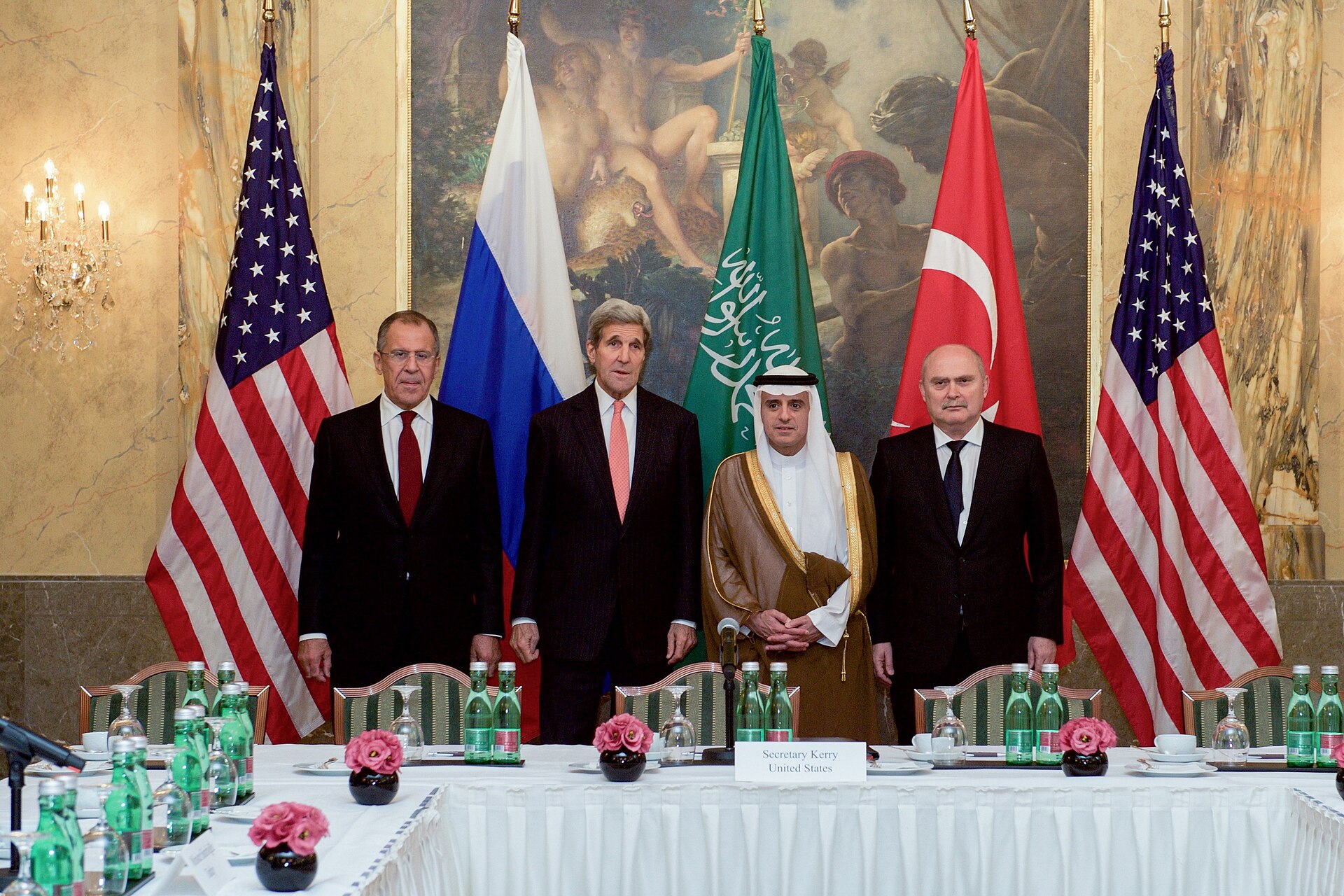
JEDDAH — On April 2, 2026, Russian Foreign Minister Sergey Lavrov telephoned Saudi Foreign Minister Prince Faisal bin Farhan to discuss what the Russian Ministry of Foreign Affairs carefully described as “close foreign policy coordination between Moscow and Riyadh, particularly at the United Nations” — a phrase that says everything about what Russia is doing in the Gulf and nothing about ending the war there. Three days earlier, Lavrov had addressed all six GCC foreign ministers by videoconference, calling the American-Israeli campaign against Iran “unprovoked and senseless aggression,” and three days before that, Pakistan’s ceasefire effort collapsed when Tehran refused to send negotiators to Islamabad.
The pattern is unmistakable, and it has little to do with peace. Russia is not mediating between the belligerents — it has no influence over Washington and has made no public effort to press Tehran toward terms. What Lavrov is mediating is Saudi Arabia’s relationship with American pressure, and what Mohammed bin Salman is accepting is not a peace process but a diplomatic instrument: one more active channel that has not yet failed, one more reason to tell the White House that “another process is in motion” as the April 6 deadline approaches.
The Call That Wasn’t About Peace
Read the Russian MFA’s readout of the April 2 call and you find two operative elements: first, that both ministers “expressed serious concern over the continuing deterioration of the military and political situation in the Persian Gulf region” and “stressed the importance of bringing the armed confrontation to a swift halt”; second, that they discussed “bilateral matters” linked to the centenary of Russia-Saudi diplomatic relations in 2026. Russia was the first state to recognize the Kingdom of Hejaz and Nejd in 1926 — a historical footnote that Moscow has spent the past decade converting into diplomatic capital, and which now functions as a kind of institutional permission slip for conversations that would otherwise look strange between a country arming Iran and a country absorbing Iranian missiles.
The readout does not say that Russia will press Iran to accept a ceasefire. It does not say that Lavrov offered specific terms, a timeline, or a mechanism. What it says is “coordination” — the language of alignment, not mediation. Compare this with the Pakistani track, which produced a specific venue (Islamabad), a specific format (direct US-Iran talks), and a specific collapse when Iran declared itself “unwilling to meet US officials” and called Washington’s demands “unacceptable,” according to Al Arabiya English reporting on April 3. The Russian track, by contrast, has produced no venue, no format, and — critically — no failure, because it has never attempted anything concrete enough to fail.
This distinction matters enormously for Saudi Arabia. A mediation track that collapses, like Pakistan’s, removes a diplomatic option from the board and increases the pressure on Riyadh to either endorse military escalation or publicly break with Washington. A mediation track that persists in a state of productive ambiguity — Lavrov calling Faisal, Lavrov calling Egyptian FM Badr Abdelatty the next day, Lavrov addressing the GCC collectively — keeps the board full. Every phone call is a press release; every press release is a reason to wait.
Why Is Russia Mediating a War It Helped Arm?
The contradiction at the center of Russian diplomacy in the Gulf is not subtle, and nobody involved pretends it is. Russia signed a “Comprehensive Strategic Partnership Treaty” with Iran in January 2025, ratified it by April of that year, and committed both countries to a 20-year framework of cooperation. In the months before the war began on February 28, 2026, Russia supplied Iran with intelligence — including, according to Al Jazeera and Asia Times reporting, satellite feeds of US military positions — along with Verba man-portable air defense systems under a contract reportedly worth €500 million, up to six Mi-28 attack helicopters delivered in January 2026, and the drone production technology that enabled Iran to scale its domestic Shahed-variant production to an estimated 3,000 units per month by the end of 2025.
Then the war started, and Lavrov began calling it “unprovoked and senseless aggression.” The word for this in diplomatic history is not hypocrisy — it is position-taking, and it follows a pattern that analysts at the Stimson Center have identified as “coercive mediation.” Joaquin Matamis of the Stimson Center noted that “Russia’s diplomatic activism comes at a time when it fears a weakening Iran, cornered by internal unrest and outside military and economic pressure.” Russia is not mediating from a position of altruism; it is mediating from a position of anxiety about losing its last major Middle Eastern partner after the fall of Assad in December 2024.
The 20-year treaty with Iran lacks a mutual defense clause — neither country is obligated to defend the other militarily. This was a deliberate omission. Moscow wanted institutional proximity to Tehran without operational liability, the diplomatic equivalent of buying a front-row seat without agreeing to get on stage. That structure now allows Lavrov to call Faisal and present himself as a concerned intermediary rather than a co-belligerent, even as Russian-supplied MANPADS are being used against coalition aircraft and Russian intelligence products are shaping Iranian targeting decisions.
Saudi Arabia’s Fourth Track: The Diplomatic Alibi
Count the diplomatic tracks that Saudi Arabia has endorsed, entertained, or actively participated in since the war began five weeks ago. There was the China-Pakistan peace plan, which proposed a specific framework and attracted early Saudi, Turkish, and Egyptian backing. There were the bilateral conversations between Saudi FM Faisal and Iranian FM Abbas Araghchi — daily calls that have continued even after Riyadh expelled Iran’s military attaché and four embassy staff on March 21, declaring them persona non grata within 24 hours of “repeated Iranian attacks” on Saudi territory. There was Pakistan’s direct mediation effort, which died on April 3 when Iran refused to send representatives to Islamabad. And now there is the Russian channel — Lavrov to Faisal, Lavrov to the GCC, Lavrov to Egypt.
Each track serves the same structural function for Riyadh regardless of whether it produces a result. As long as a diplomatic process exists and has not been declared dead, Saudi Arabia possesses a legitimate answer to any American demand for immediate military commitment: we are pursuing every available avenue. This is not cynicism — it is statecraft practiced by a country that has absorbed more than 750 Iranian missile and drone attacks since February 28, that lost the Ras Tanura refinery to Iranian strikes, and that nonetheless has not fired a single offensive shot at Tehran. The restraint is real, and it requires diplomatic cover to sustain.
Mohammed Alhamed, a Saudi geopolitical analyst, told the Christian Science Monitor that “Saudi Arabia right now is taking on the responsibility of the entire global economy.” That framing — Saudi Arabia as the responsible adult managing global energy stability while absorbing punishment — is the public narrative. The private one, according to reporting by the New Republic and the Times of Israel, is that MBS has spoken to Trump “several times over the past week, pushing the president to keep fighting until the regime in Iran is toppled.” The Russian track does not resolve this contradiction; it enables it. MBS can push Trump toward escalation while Faisal entertains Lavrov’s calls, because the two activities serve the same objective: maximum pressure on Iran with minimum Saudi fingerprints on the mechanism of destruction.
What Does Moscow Actually Gain From Gulf Diplomacy?
Russia’s oil revenues have approximately doubled since the war began. Before the conflict, Moscow earned roughly $135 million per day from fossil fuel exports; after Brent crude surged past $115 per barrel on the back of Gulf instability and the effective closure of the Strait of Hormuz to Western-aligned shipping, that figure climbed to approximately $270 million per day, according to analysis by the Yorktown Institute cited in Newsweek. Over the first five weeks of the war, Russia has accumulated an estimated $7 billion in additional fossil fuel revenues — money flowing directly into a war chest that finances operations in Ukraine at a moment when the Iran conflict has diverted Patriot air defense systems from Ukrainian cities to Gulf ones.
Joseph Epstein of the Yorktown Institute offered a cutting assessment: “The Middle East that Russia built its influence around is burning, and Moscow is a spectator.” But spectator is the wrong word. Moscow is a beneficiary — of the energy price spike, of the Western military distraction, of the strategic bandwidth consumed by a Gulf crisis that prevents Washington from focusing on Crimea and Donbas. Russia intensified its Ukrainian offensive operations as world attention shifted to Iran, according to reporting by the Foreign Policy Research Institute and NBC News in March and April 2026. The Lavrov calls to Gulf capitals are not separate from the Ukraine war; they are a component of it.
Then there is the longer game. Bilateral Russia-Saudi trade grew from $2.2 billion in 2021 to approximately $4 billion in 2025, according to Arab News — not transformational numbers, but a trajectory that suggests institutional thickening. Russia and Saudi Arabia built the OPEC+ framework together; in October 2022, Riyadh led the cartel in cutting production by 2 million barrels per day over fierce Western objections after Russia’s invasion of Ukraine, an act of energy solidarity that Washington has neither forgotten nor forgiven. The 100th anniversary of diplomatic relations, celebrated on February 19, 2026, was not just ceremonial — it was a signal that the relationship has institutional depth that outlasts any single crisis.
The US needs to cease hostilities, not simply demand that Iran unblock the Strait of Hormuz.
— Sergey Lavrov, press conference with Egyptian FM Badr Abdelatty, April 3, 2026
What Lavrov gains from the Faisal call specifically is access — direct, ministerial-level contact with the Saudi foreign policy apparatus at a moment when every Gulf state is reconsidering its security architecture. Andrew Leber of Carnegie’s Middle East Program has observed that Gulf rulers spent heavily on US military relationships without securing protection from Iranian retaliation. When that rethinking produces contracts, partnerships, and new security arrangements, Russia wants to be in the room. Kristian Coates Ulrichsen of the Arab Center Washington DC put it precisely: “The magnitude of the current crisis may be the catalyst for the GCC to revisit its strategic approach.” Lavrov is not waiting for the catalyst to finish — he is positioning Moscow to shape what comes after.
The Coercive Mediation Playbook — Syria, Libya, and Now the Gulf
Russia has done this before, and the template is instructive. In Syria, Moscow launched the Astana Format in 2015 — a mediation process that included Turkey and Iran, excluded the United States, and produced ceasefire agreements that Russia simultaneously enforced and violated depending on Assad’s military needs. In Libya, Russia participated in the Berlin process while deploying Wagner mercenaries to support Khalifa Haftar. The common feature is what analysts at the Marshall Center and Chatham House have called “coercive mediation”: the practice of mediating conflicts in which you are simultaneously arming one side, using the diplomatic process to constrain your adversaries while preserving your client’s military options.
The Iran war broke this model in a way that helps explain Lavrov’s frantic phone diplomacy. With Assad gone since December 2024 and Iran’s conventional military capacity being degraded daily by American and Israeli strikes, Russia has lost both of its principal military assets in the Middle East. It cannot arm its way to influence in the Gulf the way it armed its way to influence in Syria. What it can do — what Lavrov is doing — is convert diplomatic activity into a substitute for military relevance, offering Gulf states the appearance of a great-power interlocutor who can speak to Tehran at a moment when Washington speaks only in cruise missiles.
The authors of a Foreign Affairs analysis — Alexander Gabuev, Nicole Grajewski, and Sergey Vakulenko — were blunt about the limits of this approach, noting that “the Kremlin’s impotence in Iran is in keeping with a familiar pattern: when Russia’s friends are in need, Moscow issues strongly worded statements and does little else.” Russia vetoed a Bahrain-led UN Security Council resolution that would have authorized military intervention to reopen the Strait of Hormuz, and earlier abstained on the March 12 resolution condemning Iranian attacks on Gulf neighbors (allowing it to pass 13-0). The veto protects Iran; the abstention avoids offending Saudi Arabia. Both are calibrated to preserve Moscow’s position as an interlocutor without committing it to any particular outcome — which, not coincidentally, is exactly what Saudi Arabia needs from the channel.
Can MBS Lobby for Escalation and Diplomacy at the Same Time?
The most uncomfortable fact is that the Crown Prince appears to be doing both things at once, and doing them deliberately. MBS privately lobbied Trump for escalation — “including US boots on the ground and strikes on Kharg Island,” according to reporting by Iran International and the Times of Israel — even as his foreign minister conducted daily calls with his Iranian counterpart and entertained Russian, Pakistani, and Chinese diplomatic initiatives. A Saudi Foreign Ministry official, authorized to speak with the Christian Science Monitor, stated the public position cleanly: “It is our right to defend ourselves, our territory, people, and residents against this daily aggression. If they stop attacking us, then there is no need to discuss military options.”
A separate Saudi insider, not authorized to speak with media, was more direct: Saudi Arabia will not be “held hostage by anyone; not Iran, not any other regional actor,” and plans reportedly exist to make Iran “pay a price.” The gap between the two statements — the authorized one defensive, the unauthorized one aggressive — is the gap in which Saudi policy actually operates. The Russian channel fits neatly into this gap. It provides the public-facing diplomatic activity that justifies Saudi restraint while MBS pursues, through private channels, the military escalation that could make restraint unnecessary.
There is a precedent for this dual posture, and it is recent. The China-brokered Saudi-Iran détente of March 2023 gave MBS diplomatic cover for a deal he strategically wanted but could not be seen to seek — normalization with Tehran at a moment when appearing to appease Iran would have cost him credibility with Washington. The Russian channel in 2026 serves an inverted but structurally identical function: cover for a confrontation that MBS strategically wants but cannot be seen to seek, because appearing to drive the American war effort would cost him credibility with the rest of the world. Prince Faisal’s warning to Iran before the March 21 expulsion — “Patience in the Gulf is not unlimited” — is not a contradiction of Saudi diplomacy but its sharpest expression.
The November 2025 Washington visit, where MBS secured Major Non-NATO Ally designation, F-35 fighter jets, civilian nuclear cooperation, and a $142 billion Strategic Defense Agreement, provides the military foundation on which this dual posture rests. Saudi Arabia cannot simultaneously absorb 750 missile attacks and remain restrained without an ironclad assurance that American defensive systems will keep working. The Lavrov calls, the Araghchi calls, the Pakistani track, the Chinese plan — these are the diplomatic superstructure built on top of that military foundation. Remove the American defense umbrella and the diplomacy collapses into a single option: fight or submit.
Iran’s Telling Silence on Russian Involvement
Tehran has been vocal about rejecting American terms, public about refusing to send negotiators to Islamabad, and emphatic — through FM Abbas Araghchi’s statement on March 31 that there is “no truth to US-Iranian negotiations” — about its refusal to deal with Washington directly. What Tehran has not done is reject, dismiss, or even publicly acknowledge Russian diplomatic involvement in the Gulf mediation. Iran told mediators it was “unwilling to meet US officials in Islamabad in the coming days,” according to Al Jazeera reporting on April 2-3, but has not extended the same dismissal to Lavrov’s flurry of phone calls and videoconferences.
This silence is itself informative. Iran has kept the Strait of Hormuz open to Russian commercial passage while blocking US and allied shipping, according to NewsX — a material distinction that tells you more about the Tehran-Moscow relationship than any diplomatic readout. The 20-year comprehensive partnership treaty provides the institutional frame, but the selective enforcement of the Hormuz blockade provides the operational evidence: Russia occupies a protected category in Iranian strategic thinking, even as Russian diplomacy in the Gulf works to contain Iranian influence rather than advance it.
Dr. Abdulaziz Sager, Chairman of the Gulf Research Center, captured the broader lesson with precision: “The lesson of this war is that dialogue on its own is not enough if it is not backed by credible deterrence.” Russia possesses credible deterrence vis-à-vis Iran — through the partnership treaty, through intelligence sharing, through arms supply relationships — but has chosen not to deploy it in the direction of a ceasefire. Lavrov’s April 3 statement in Cairo, that “someone” appeared intent on “undermining” negotiations, was directed at Washington, not at Tehran. Russia is using its deterrent capacity to shape the narrative of the war, not its outcome, and Iran’s silence on the subject suggests Tehran understands and accepts the arrangement.
Does the Lavrov Channel Survive the April 6 Deadline?
The April 6 deadline — the date by which the United States has demanded tangible progress toward reopening the Strait of Hormuz — arrives in two days, and the Lavrov channel faces its first real stress test. If Washington escalates militarily after April 6, either through expanded strikes on Iranian infrastructure or through enforcement operations in the Strait itself, the diplomatic space in which Lavrov’s phone calls have been operating will compress sharply. Saudi Arabia will face a binary choice that every additional mediation track has been designed to delay: join the American escalation openly or resist it at the cost of the November 2025 security architecture.
Michael Ratney, former US Ambassador to Saudi Arabia and now Senior Adviser at CSIS, has framed the longer-term risk with uncomfortable clarity. Saudi Arabia, he observed, “will be left to manage a relationship with a broken Iran” after the US potentially declares victory without consultation, and “will have to live in the region and with its neighbors, long after President Trump has declared ‘mission accomplished.'” The Lavrov channel, whatever else it accomplishes, gives Riyadh a record of diplomatic engagement that can be presented to a post-war Iran — evidence that Saudi Arabia sought alternatives even as American bombs fell. Whether Tehran will find this persuasive after being battered for five weeks is, to put it mildly, uncertain.
The Russian channel’s survival depends less on whether it produces results than on whether it continues to serve the interests of both parties to the call. For Lavrov, the channel provides access and relevance; for Faisal, it provides another process to point to. As long as neither side needs the channel to actually deliver a ceasefire — and neither side currently does — it will persist in its present form: regular calls, carefully worded readouts, expressions of concern, and zero operational content. The question is not whether it survives April 6 but whether it survives relevance — whether, at some point, the accumulation of failed or stalled diplomatic tracks becomes itself a form of pressure on Riyadh rather than a relief from it.
Saudi Arabia will have to live in the region and with its neighbors, long after President Trump has declared ‘mission accomplished.’
— Michael Ratney, former US Ambassador to Saudi Arabia, CSIS, 2026
The Process That Nobody Needs to Succeed
Strip away the diplomatic language and the structural picture is stark. Russia gains approximately twice its pre-war fossil fuel revenues from the oil price spike this war has produced, and every week the conflict continues, the diversion of Western military assets from Ukraine to the Gulf widens. Saudi Arabia gains time, diplomatic cover, and the ability to maintain its dual posture of public restraint and private escalation advocacy. The mediation process itself gains institutional momentum: more calls, more readouts, more tracks, more participants, none of whom have a compelling incentive to produce the one outcome that would end their usefulness — an actual ceasefire.
This is not a conspiracy; it is a convergence of incentives that produces the same result a conspiracy would. All three parties — Russia, Saudi Arabia, and the mediation process itself — benefit from the process existing without producing a result. Lavrov gets to call Faisal, who gets to tell Washington that Russia is engaged, which allows Washington to point to diplomatic activity as evidence that it has not foreclosed peaceful options, which in turn gives Tehran room to reject terms while noting that multiple processes remain active. Everyone has a seat at this table, and nobody is required to stand up and walk toward the one where the actual negotiations would have to happen.
The centenary of Russia-Saudi relations — 100 years since Moscow recognized the Kingdom of Hejaz and Nejd — provides the ceremonial wrapper for a relationship that has always been transactional and is now, in the fifth week of a war that is reshaping the Middle East, becoming something more complex and more consequential. European leaders are flying to Jeddah, Pakistan’s mediation is dead, and the China plan floats in diplomatic limbo. And Lavrov keeps calling, because calling is the point — not what the call produces, but what it allows everyone involved to defer.
Somewhere in this architecture of deferral, the war continues — Iran being struck and firing back, Saudi Arabia absorbing without retaliating — while Moscow’s oil revenues climb with each passing week and the phone keeps ringing in Prince Faisal’s office. The one thing more dangerous than a mediation process that goes nowhere is one that stops, because then everyone involved would have to admit that nowhere is exactly where they intended to go.
Frequently Asked Questions
What was discussed in the Lavrov-Faisal phone call on April 2, 2026?
According to the Russian Ministry of Foreign Affairs readout published via GlobalSecurity.org, the two ministers discussed “close foreign policy coordination between Moscow and Riyadh, particularly at the United Nations,” expressed concern over the “continuing deterioration of the military and political situation in the Persian Gulf region,” and addressed bilateral matters connected to the 100th anniversary of Russia-Saudi diplomatic relations. The readout contained no mention of specific ceasefire proposals, timelines, or mechanisms — distinguishing it from the more operationally concrete Pakistani track that collapsed the following day.
How much has Russia earned from the Iran war oil price spike?
Analysis by the Yorktown Institute, cited in Newsweek, estimates that Russia’s daily fossil fuel revenues approximately doubled from roughly $135 million before the conflict to approximately $270 million after Brent crude surged past $115 per barrel. Over the first five weeks of the war (beginning February 28, 2026), this translates to an estimated $7 billion in additional fossil fuel revenues — funds that flow directly into Moscow’s budget while Western military resources, including Patriot air defense batteries, are diverted from Ukraine to the Gulf.
Does the Russia-Iran treaty require Moscow to defend Tehran militarily?
No. The “Comprehensive Strategic Partnership Treaty” signed in January 2025 and ratified by April 2025 commits both countries to a 20-year cooperation framework but deliberately omits a mutual defense clause, according to analysis by the Gulf International Forum. This omission allows Russia to maintain its partnership with Iran — including intelligence sharing, arms sales, and drone technology transfers — while simultaneously presenting itself to Gulf states as an available mediator rather than a co-belligerent. Iran has not publicly challenged this characterization.
How many mediation tracks has Saudi Arabia engaged with since the war began?
At least four distinct tracks: the China-Pakistan peace plan (which Saudi Arabia, Turkey, and Egypt endorsed); direct bilateral calls between Saudi FM Faisal and Iranian FM Araghchi (continuing daily even after the March 21 expulsion of Iranian diplomats); Pakistan’s direct mediation effort proposing US-Iran talks in Islamabad (which collapsed on April 3 when Iran refused to attend); and the Russian channel activated through Lavrov’s March 30 GCC videoconference and April 2 bilateral call with Faisal. Each track’s existence, regardless of its progress, provides Riyadh with diplomatic justification for continued restraint as the April 6 deadline approaches.
What is Russia’s “Concept of Ensuring Collective Security in the Persian Gulf”?
A long-standing Russian diplomatic proposal — predating the current war — that envisions a multilateral security framework for the Gulf region in which Russia would participate as a guarantor alongside regional states. Lavrov promoted this concept during his March 30 videoconference with GCC foreign ministers, according to Pravda EN reporting. The framework has never been operationalized and no Gulf state has formally adopted it, but its repeated invocation serves Moscow’s interest in positioning itself as an indispensable stakeholder in post-war Gulf security arrangements — a diplomatic investment that costs nothing and preserves Russia’s seat at any future negotiating table.