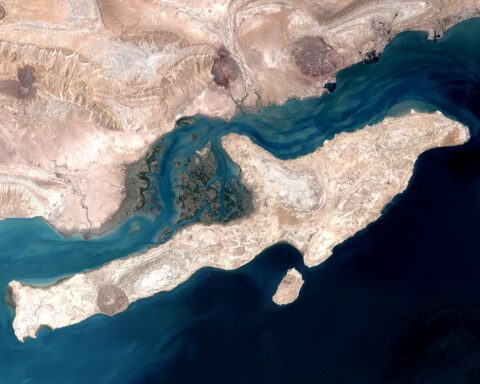
DHAHRAN — The energy market is pricing Saudi Arabia’s upstream recovery as a single event. It is not. The 600,000 barrels per day of capacity that Iranian strikes removed from production on April 9 came from two fields — Khurais and Manifa — that share almost nothing except an owner. One is a sprawling onshore complex deep in the Saudi interior, reachable by road, repairable under ceasefire conditions. The other sits on 27 artificial islands in water shallow enough to wade through, connected to the mainland by a single 41-kilometre causeway, in a body of water where Iran has confirmed the presence of bottom mines. The repair timelines for these two facilities are not parallel. They are sequential — and one cannot begin until conditions are met that have nothing to do with wellhead engineering.
Wood Mackenzie’s widely cited 6-to-9-month recovery estimate treats both fields as part of a single envelope. The market has accepted this framing. The physical infrastructure does not support it.
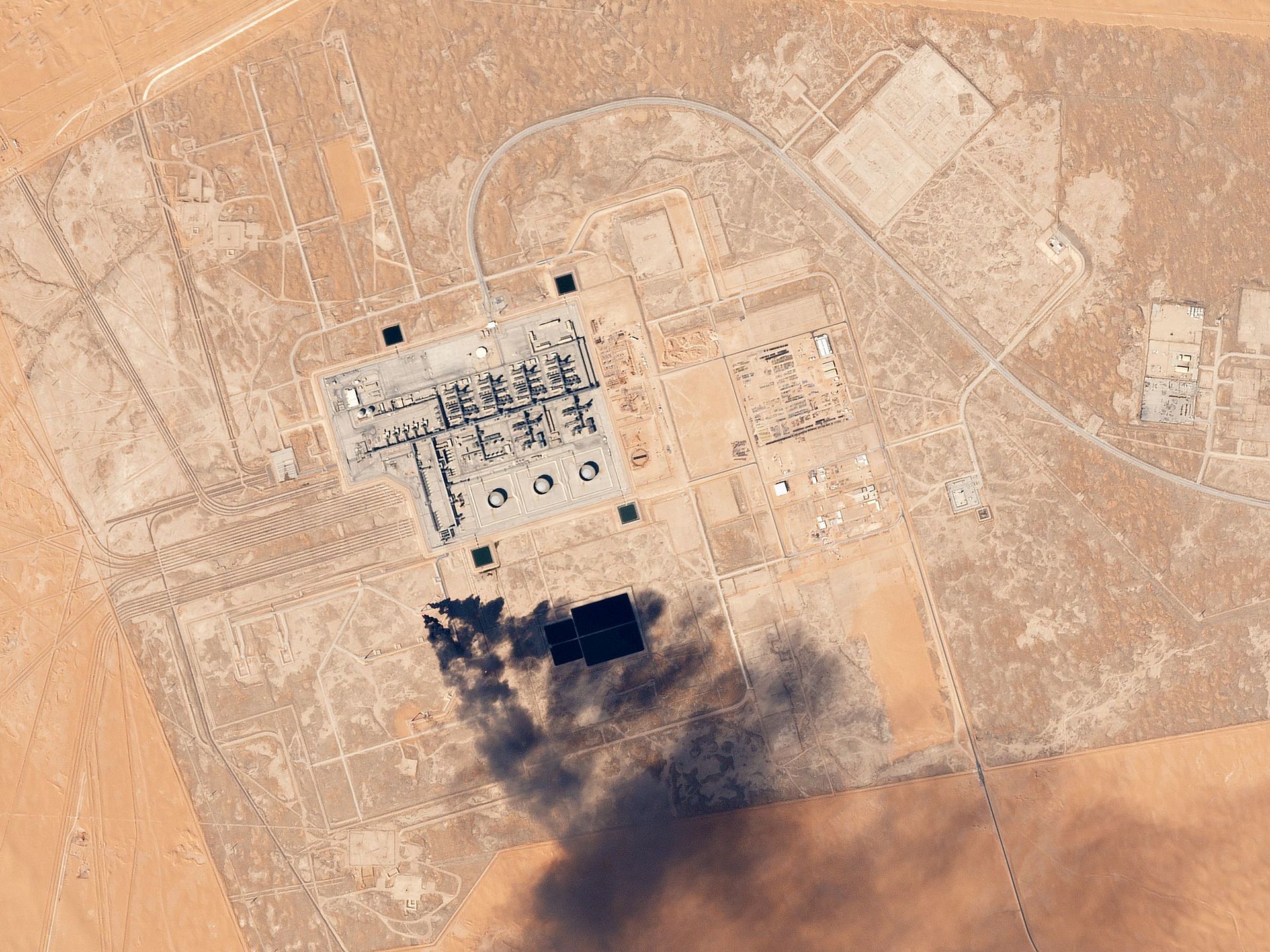
Table of Contents
- The 300/300 Split: What Saudi Arabia Actually Lost
- Khurais: The Recoverable Field
- Manifa: 27 Islands, One Causeway, Zero Redundancy
- Why Can’t Manifa Be Repaired on the Same Timeline as Khurais?
- What Mine Threat Exists in Manifa’s Waters?
- The Mine Clearance Gap
- Why Can’t Saudi Arabia Substitute Manifa’s Output from Another Field?
- The Fiscal Arithmetic of Two Recovery Curves
- The OSP Repricing Trap
- Frequently Asked Questions
The 300/300 Split: What Saudi Arabia Actually Lost
The Saudi Press Agency disclosed on April 9 that Iranian strikes had reduced upstream capacity by 600,000 bpd, split evenly: 300,000 bpd from the Manifa offshore complex and 300,000 bpd from Khurais onshore. JPMorgan characterised the combined loss as “a measurable supply shock” against Saudi Arabia’s actual production output of approximately 8.9 million bpd — roughly 6.7 percent of the barrels Riyadh had been delivering to market.
The symmetry of the numbers — 300,000 from each — has encouraged a symmetry of analysis. Every published recovery estimate treats the two losses as additive components of a single problem. They are not.
Manifa operates three Gas-Oil Separation Plants, each rated at exactly 300,000 bpd. A 300,000 bpd loss means one entire GOSP is fully offline — not a partial degradation across multiple units, but a binary failure of one-third of the field’s processing capacity. Khurais, with a 1.5 million bpd nameplate capacity expanded under a $3 billion programme completed in 2018, lost 20 percent of its throughput. The damage profiles are structurally different.
The Saudi Press Agency’s own language hinted at the distinction without making it explicit: “The continuation of these attacks leads to reduced supply and slows recovery, thereby affecting the security of supply for consuming countries and contributing to increased volatility in oil markets.” The word “slows” is doing more work than the market has recognised.
The Middle East briefing 3,000+ readers start their day with.
One email. Every weekday morning. Free.
Khurais: The Recoverable Field
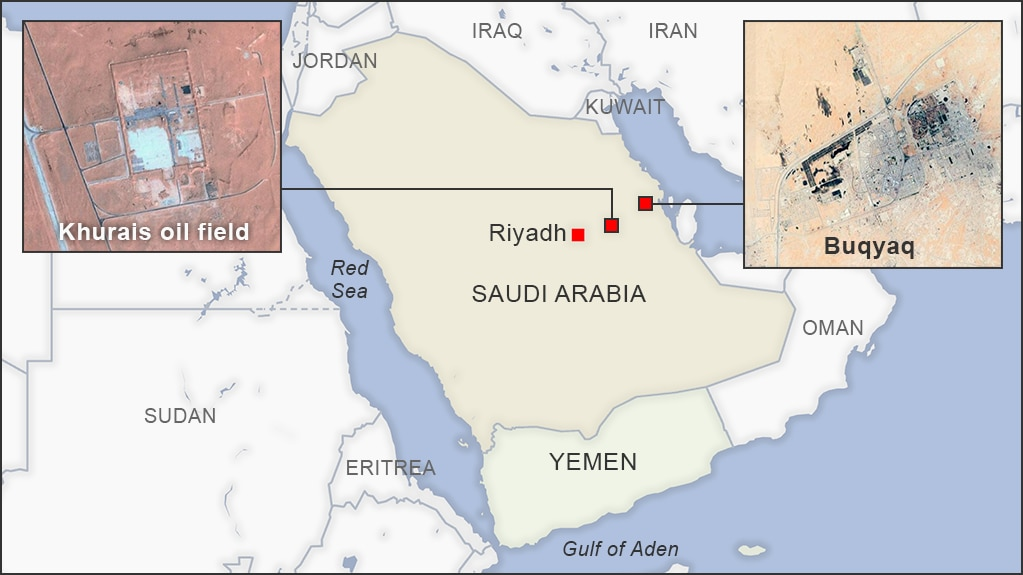
Khurais sits 250 kilometres southwest of Dhahran and 150 kilometres east-northeast of Riyadh — deep in the Saudi interior, far from any coastline. It produces Arabian Light crude that routes through the East-West pipeline to Yanbu on the Red Sea coast. Built between 2006 and 2009 at a cost of $3 billion, it is the kind of megaproject that Aramco does better than any national oil company on earth: large, onshore, connected by road and pipeline to multiple processing and export nodes.
The 2019 precedent is instructive. On September 14, 2019, Houthi-claimed cruise missiles struck Khurais four times. Combined with the simultaneous attack on Abqaiq, 5.7 million bpd went temporarily offline — the largest single supply disruption in oil market history. Saudi Aramco restored full production in approximately two weeks.
That outcome depended on three conditions: no ongoing kinetic threat to repair crews, immediate international equipment airlifts, and uncontested road access. Under the current ceasefire — fragile, contested by IRGC field commanders, but holding — two of those three conditions plausibly exist for Khurais. Road access to the interior is not in question. Equipment procurement is constrained but possible. The threat environment is elevated but manageable for an onshore facility 250 kilometres from the nearest coast.
Wood Mackenzie’s Fraser McKay warned that “operators hastened by regulators and governments to restore production too rapidly will risk doing more long-term damage to foundational assets.” The caution is legitimate — but it is a caution about pace, not about access. Aramco engineers can reach Khurais. The question is how fast they should work, not whether they can work at all.
Manifa: 27 Islands, One Causeway, Zero Redundancy
Manifa is a different category of problem. Set aside for decades because its crude was too heavy and vanadium-laden for existing refineries, the field was redeveloped beginning in 2006 at a total cost of $10 billion. It reached its 900,000 bpd nameplate capacity by 2016-2017, making it the fifth-largest oil field globally by reserves.
The engineering challenge that defined Manifa’s development now defines its vulnerability. Water depths of 1 to 15 metres — too shallow for conventional offshore platforms — forced Aramco to build 27 man-made islands, each the size of 10 football pitches, reclaimed from 45 million cubic metres of seabed sand. These islands function as onshore drill sites above an offshore reservoir. They are connected to the mainland and to each other by a 41-kilometre causeway carrying 13 bridges, with 9,000 kilometres of pipeline and cable networks running beneath and alongside it. A dedicated 420-megawatt co-generation plant, built in 2011, powers the entire complex.
Approximately 350 wells feed three GOSPs that process Arabian Heavy crude — the heaviest, most sulphurous grade in Saudi Arabia’s production slate. That crude feeds directly to three dedicated refineries: SATORP (the Aramco-TotalEnergies joint venture in Jubail), YASREF (the Aramco-Sinopec joint venture in Yanbu), and the Jazan refinery on the Red Sea coast. The infrastructure is grade-specific. Manifa output cannot be replaced by switching on a different field.
The 41-kilometre causeway is the single point of access to all 27 islands, all three GOSPs, and the central processing facility. There is no marine alternative — the water is too shallow for supply vessels of any meaningful draught. There is no helicopter alternative at the scale required for a major infrastructure repair operation. The causeway is it.
Why Can’t Manifa Be Repaired on the Same Timeline as Khurais?
The answer is not about the damage to the GOSP. Saudi Aramco has the engineering capability to repair or replace gas-oil separation equipment. It has done so before, at Abqaiq and Khurais, under far worse initial damage assessments. The answer is about the preconditions for repair.
Before a single engineer can safely transit the causeway to reach the damaged GOSP, three conditions must be met that Khurais does not require:
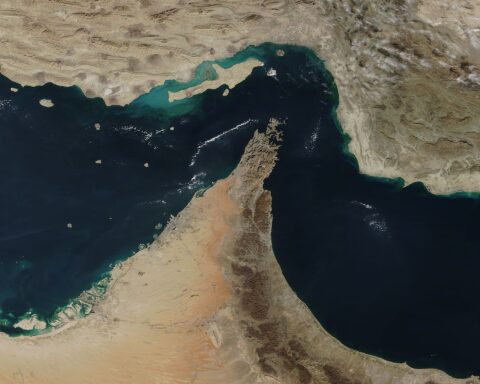
First, the waters surrounding all 27 islands — an area of approximately 45 by 18 kilometres in depths of 1 to 15 metres — must be confirmed clear of naval mines. Iran has deployed mines in the Strait of Hormuz. The IRGC defence council has threatened to lay mines “throughout the Persian Gulf.” Manifa sits in the western Gulf, approximately 200 kilometres northwest of Dhahran, within the geographic scope of that threat.
Second, the causeway and its 13 bridges must be intact and assessed as structurally safe. The IRGC compiled a counter-target list that specifically includes bridge and causeway infrastructure across the Gulf — the same target typology. A single strike on any of the 13 bridges severs road access to the entire complex.
Third, the threat environment must be assessed as sufficiently stable to permit sustained staffing of an offshore island complex that cannot be evacuated quickly. Khurais workers can drive away on roads in any direction. Manifa workers are on islands connected by a single causeway in a body of water where mines may be present.
These are sequential prerequisites, not parallel workstreams. Mine clearance must precede causeway assessment, which must precede staffing, which must precede repair. At Khurais, repair can begin now.
What Mine Threat Exists in Manifa’s Waters?
Iran’s Maham-7 limpet mine, documented in USNI Proceedings, operates in water as shallow as 10 feet — approximately 3 metres — using acoustic and three-axis magnetic sensors engineered to scatter sonar detection. At least 12 Maham-3 and Maham-7 mines have been confirmed in the Strait of Hormuz as of late March 2026. The IRGC defence council has threatened deployment “throughout the Persian Gulf,” a phrase that encompasses the western Gulf waters where Manifa sits.
Manifa’s water column ranges from 1 to 15 metres. The Maham-7’s minimum operational depth of 3 metres means the mine can function across virtually the entire field area. Its sonar-scattering design makes detection in shallow, turbid Gulf waters exceptionally difficult. Standard hull-mounted sonar on surface combatants is largely ineffective at these depths.
The IRGC’s April 5 navigation chart, which declared standard shipping lanes a “danger zone” and redirected vessels to a 5-nautical-mile corridor inside Iranian territorial waters, established a doctrinal posture of area denial across the entire Gulf — not merely at the Hormuz chokepoint. The IRGC’s strategic communications have consistently framed offshore Saudi infrastructure as legitimate counter-strike targets under what Iranian military media calls “co-belligerence doctrine”: producing oil to fill the supply gap created by strikes on Iranian facilities makes Aramco infrastructure a valid military target.
No mine has been confirmed in Manifa’s immediate waters. But the threat envelope — shallow water within the Maham-7’s operational parameters, within the geographic scope of IRGC mine-laying threats, and within the doctrinal framework of legitimate targeting — creates a clearance-before-staffing prerequisite that has no parallel at Khurais.
The Mine Clearance Gap
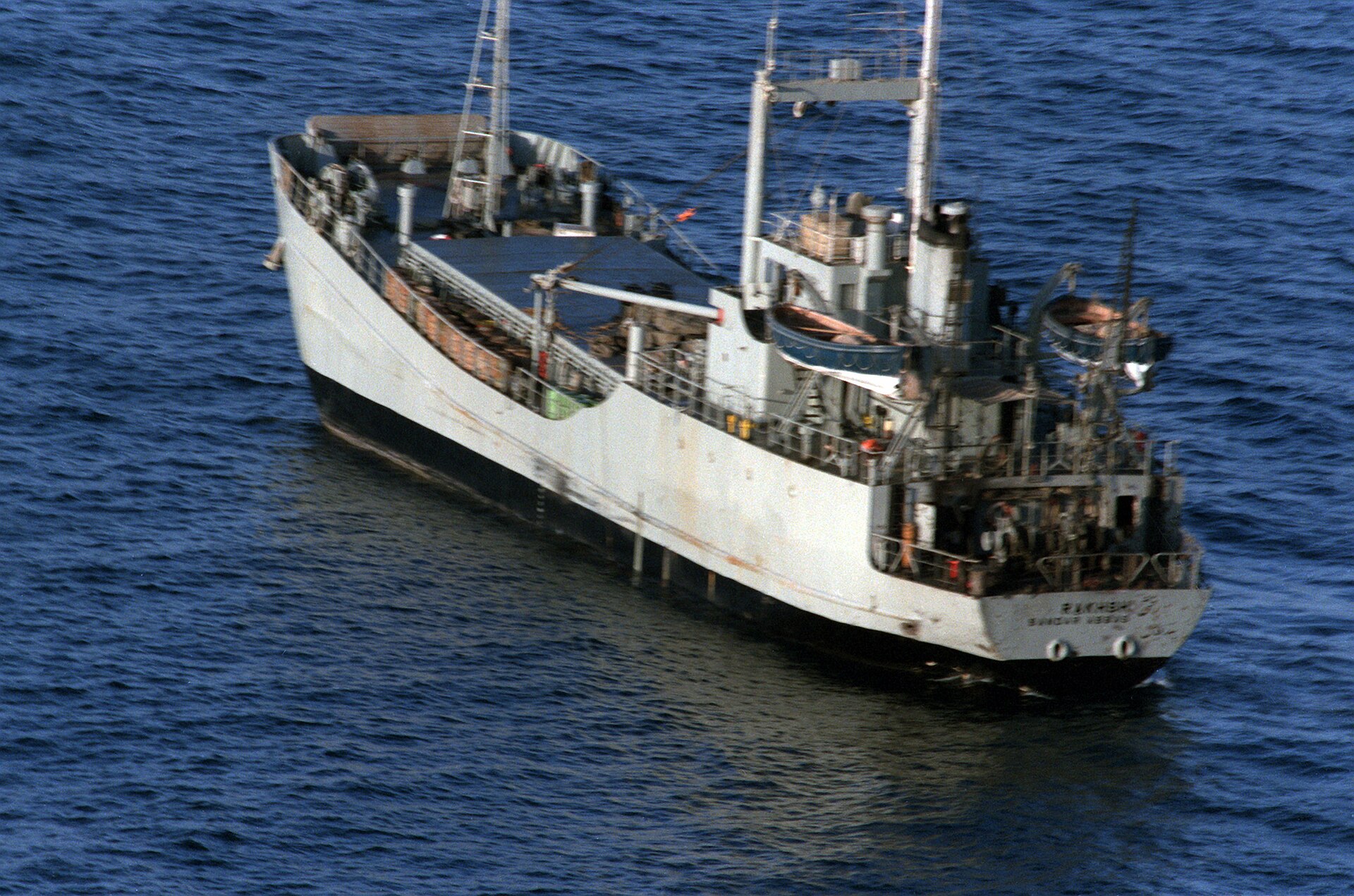
The capacity to clear that threat does not currently exist in theatre. The four Avenger-class mine countermeasures ships previously forward-deployed at Naval Support Activity Bahrain — USS Devastator (MCM-6), USS Sentry (MCM-3), USS Dextrous (MCM-13), and USS Gladiator (MCM-11) — were all decommissioned on September 25, 2025. Only four Avenger-class ships remain in the US Navy’s inventory, and all are based in Japan.
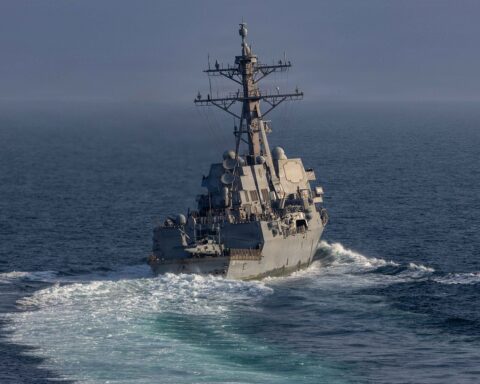
CENTCOM sent two destroyers — USS Frank E. Peterson Jr. (DDG-121) and USS Michael Murphy (DDG-112) — through the Strait of Hormuz on April 11, drawing an IRGC “last warning” radio call. The US Navy responded that the transit was “in accordance with international law.” But destroyers are not mine countermeasures vessels. They lack the mine-hunting sonar, the remotely operated mine disposal vehicles, and the degaussed hulls that MCM operations require.
The 1991 Kuwait mine clearance operation provides the only modern benchmark: approximately 51 days to clear 200 square miles using dedicated MCM assets that no longer exist in the Gulf. Manifa’s field area — 45 by 18 kilometres, or approximately 313 square miles — is larger than the 1991 clearance zone. And the 1991 operation was conducted after hostilities had conclusively ended, with no ongoing mine-laying threat.
| Asset | Status | Location | MCM Capability |
|---|---|---|---|
| USS Devastator (MCM-6) | Decommissioned Sept 25, 2025 | N/A | Former dedicated MCM |
| USS Sentry (MCM-3) | Decommissioned Sept 25, 2025 | N/A | Former dedicated MCM |
| USS Dextrous (MCM-13) | Decommissioned Sept 25, 2025 | N/A | Former dedicated MCM |
| USS Gladiator (MCM-11) | Decommissioned Sept 25, 2025 | N/A | Former dedicated MCM |
| 4 remaining Avengers | Active | Japan (7th Fleet) | Dedicated MCM |
| USS Frank E. Peterson Jr. (DDG-121) | Active, transited Hormuz April 11 | Gulf | None (destroyer) |
| USS Michael Murphy (DDG-112) | Active, transited Hormuz April 11 | Gulf | None (destroyer) |
Sara Vakhshouri of SVB Energy International has noted that “Saudi Arabia has long been a reliable and resilient supplier, even in times of crisis, underpinned by redundancy and strategic diversification across its logistics.” The observation was historically accurate. Manifa is the precise test of whether that redundancy extends to offshore island complexes accessible only by a single causeway across waters that may contain naval mines — and the asset architecture provides no answer that satisfies it.
Why Can’t Saudi Arabia Substitute Manifa’s Output from Another Field?
Manifa produces Arabian Heavy crude. It is the heaviest, most sulphurous grade in Aramco’s production slate, and its three GOSPs feed dedicated refinery infrastructure built specifically to process it. SATORP in Jubail (a 400,000 bpd Aramco-TotalEnergies joint venture), YASREF in Yanbu (a 400,000 bpd Aramco-Sinopec joint venture), and the 400,000 bpd Jazan refinery on the Red Sea coast were all configured for Arabian Heavy feedstock.
Saudi Arabia’s other major fields — Ghawar, Shaybah, Khurais — produce Arabian Light, Extra Light, or Super Light grades. These are chemically different crudes requiring different refinery configurations. A refinery built to process high-sulphur, high-vanadium heavy crude cannot simply switch to light crude feedstock without wholesale reconfiguration of desulphurisation units, coking capacity, and hydrogen supply. The reverse is equally true.
| Parameter | Khurais | Manifa |
|---|---|---|
| Location | Onshore, 250 km SW of Dhahran | Offshore, 200 km NW of Dhahran |
| Terrain | Desert interior | 27 artificial islands, 1-15m water |
| Access | Multiple road networks | Single 41 km causeway, 13 bridges |
| Crude grade | Arabian Light | Arabian Heavy |
| Nameplate capacity | 1.5M bpd | 900,000 bpd |
| Capacity offline | 300,000 bpd (20%) | 300,000 bpd (33%, one full GOSP) |
| Mine clearance prerequisite | None | Yes — 313 sq mi shallow water |
| Causeway/bridge vulnerability | None | 13 bridges, single-point failure |
| Evacuation options | Road in any direction | Causeway only |
| 2019 repair precedent | ~2 weeks (peacetime) | No precedent |
| Downstream dependency | East-West pipeline to Yanbu | SATORP, YASREF, Jazan (grade-specific) |
| Substitution from other fields | Possible (Arabian Light available) | Not possible (only Arabian Heavy source) |
| Project cost | $3 billion | $10 billion |
The substitution problem compounds the timeline problem. Even if Khurais is restored relatively quickly, the 300,000 bpd of Arabian Heavy from Manifa cannot be backfilled. SATORP, YASREF, and Jazan either run on Manifa crude or they run at reduced throughput. The downstream revenue loss extends beyond the wellhead.
The Fiscal Arithmetic of Two Recovery Curves
At current Brent prices of approximately $96.66 per barrel, Manifa’s 300,000 bpd offline costs Saudi Arabia roughly $29 million per day in gross revenue. Over six months — the lower end of Wood Mackenzie’s estimate, and likely optimistic for Manifa given the sequential prerequisites — that is $5.3 billion in lost Manifa revenue alone.
The fiscal context makes that number heavier than it appears. Saudi Arabia’s base fiscal break-even is approximately $94 per barrel, according to Bloomberg Economics. When PIF domestic spending commitments are included — and PIF’s 2026-2030 strategy document, published April 7, confirms $30 billion in construction commitments even after cutting from $71 billion — the break-even rises to $108-112 per barrel. At $96.66 Brent, Saudi Arabia is already running a deficit on every barrel it sells. Losing 300,000 bpd of Manifa production widens a gap that Goldman Sachs projects will produce a total 2026 budget deficit of $80-90 billion, roughly double the official $44 billion projection.
The two-curve problem means the fiscal hit does not arrive as a single event and then dissipate. Khurais production may return in months. Manifa production — dependent on mine clearance, causeway security assessment, island staffing confidence, and GOSP repair in that order — operates on a timeline measured in quarters, not months. The deficit compounds at $29 million per day for as long as the sequential prerequisites remain unmet.
“Operators hastened by regulators and governments to restore production too rapidly will risk doing more long-term damage to foundational assets.”
Fraser McKay, Head of Upstream Analysis, Wood Mackenzie
McKay’s warning applies with particular force to Manifa. An artificial-island complex in shallow water, connected by a single causeway, with 9,000 kilometres of subsea pipeline and cable — the consequences of hasty repair in a potentially mined environment extend well beyond the wellhead. A mine detonation against the causeway or a supply barge would not only halt the repair effort but could cause secondary infrastructure damage that extends the timeline further.
The OSP Repricing Trap
Aramco’s May Official Selling Price for Arab Light to Asia was set at a differential of +$19.50 per barrel above the Oman/Dubai average — a level calibrated when Brent was trading near $109. Brent has since fallen to $96.66. The May OSP is approximately $12 underwater against the price environment it was designed for.
The Arabian Heavy OSP faces a different but compounding problem. Manifa is the primary source of Arabian Heavy crude. With one of three GOSPs offline and no clear timeline for restoration, Aramco faces a choice ahead of the June OSP cycle — formula date approximately May 5 — between maintaining heavy crude pricing that it may not be able to fully deliver against, or cutting the OSP and signalling to the market that the Manifa disruption is not temporary.
Term contract credibility is Aramco’s most valuable commercial asset after the oil itself. Asian refiners — SATORP and YASREF’s offtake commitments aside — purchase Arabian Heavy on long-term contracts precisely because Aramco has never failed to deliver. A sustained Manifa outage that forces allocation cuts or grade substitution would damage a commercial relationship that took decades to build and cannot be rebuilt by price adjustment alone.
The market is not pricing this risk because the market is not distinguishing between the two fields. A single “600,000 bpd offline, 6-9 months to recover” narrative permits a single recovery expectation. Two different fields with two different prerequisite chains produce two different supply curves — and the heavier, more specialised, harder-to-substitute barrel is the one on the longer timeline.
Frequently Asked Questions
How does Manifa’s 2006-era island construction compare to modern offshore platforms in terms of repair complexity?
Manifa’s 27 artificial islands were built using dredged seabed sand — 45 million cubic metres of it — specifically because the 1-to-15-metre water depth precluded conventional platform installation. The islands themselves are not damaged; the GOSP processing equipment on them is. However, the repair complexity is not about the equipment but about logistics: every piece of replacement machinery, every crane, every welding rig must travel the 41-kilometre causeway. There is no deepwater anchorage for heavy-lift vessels. Aramco’s 2006 construction phase used a purpose-built marine fleet for island creation, but repair operations require road-transportable equipment — a fundamentally different logistics chain that the causeway bottlenecks.
Could Saudi Arabia accelerate Manifa recovery by using autonomous or remotely operated mine clearance systems?
The US Navy has invested in unmanned mine countermeasures systems, including the Knifefish autonomous underwater vehicle and the AN/AQS-20 towed sonar, both designed for integration with Littoral Combat Ships. Three LCS are currently deployed in Asia. However, these systems are optimised for deeper littoral waters — the 10-to-40-metre range — not the 1-to-5-metre shallows that characterise much of Manifa’s field area. The Royal Saudi Naval Forces operate four UK-built Al Jawf-class (Sandown-type) minehunters, but these have a 3.4-metre draught — too deep for Manifa’s shallowest zones. No existing autonomous system in any navy’s inventory is purpose-built for mine clearance in 1-to-3-metre water across a 313-square-mile area.
How long would it take to reconfigure SATORP or YASREF from Arabian Heavy to Arabian Light feedstock?
A refinery conversion from heavy to light crude feedstock is not a maintenance event — it is a capital project. Desulphurisation units sized for high-sulphur Arabian Heavy crude run at inefficient throughput on lighter feedstocks; coking units lose their primary function entirely. Industry engineering estimates for a comparable conversion at a complex refinery of 400,000 bpd capacity run to 18-24 months and several hundred million dollars. Neither SATORP nor YASREF was designed with feedstock flexibility as an objective — both were purpose-built to process a specific grade that Aramco guaranteed supply continuity for. The practical near-term response is reduced run rates and strategic crude inventory drawdown, not reconfiguration. The International Energy Agency estimates Saudi Arabia holds approximately 90 days of strategic crude reserves, but these are not grade-matched substitutes for Arabian Heavy.
Is there any scenario in which Manifa recovery could proceed without full mine clearance of the surrounding waters?
Theoretically, a risk-acceptance decision by Aramco’s board and the Saudi Ministry of Energy could permit repair crews to transit the causeway before a full MCM survey of the surrounding waters. The causeway itself is above water; the mine threat is to vessels, not to road traffic. However, Aramco’s HSE protocols — and its insurance framework, which runs through the Saudi Arabia General Investment Authority and international reinsurers — require a threat assessment that encompasses the full operational environment, including maritime evacuation routes. The 27 islands have no helipad capacity for mass evacuation. If the causeway were struck while workers were on the islands, the only exit would be through potentially mined shallow water. No insurer would underwrite that exposure without an MCM clearance certificate, and Aramco is unlikely to self-insure a scenario involving hundreds of workers on isolated islands in a contested maritime environment.
How does the Manifa situation affect Saudi Arabia’s OPEC+ production commitments?
Saudi Arabia’s current OPEC+ baseline is 11.0 million bpd, against which it has been voluntarily curtailing to approximately 8.9-9.0 million bpd. The 600,000 bpd upstream loss — even if partially restored at Khurais — pushes actual production capacity below voluntary curtailment levels for the first time since the 2020 price war. This transforms the nature of Saudi participation in OPEC+ from voluntary restraint to involuntary constraint, a distinction with diplomatic consequences. Riyadh can no longer credibly threaten to flood the market in response to quota violations by other members — the barrel gun is temporarily unloaded. Russia and the UAE, both of which have chafed at quota restrictions, are aware of this shift.