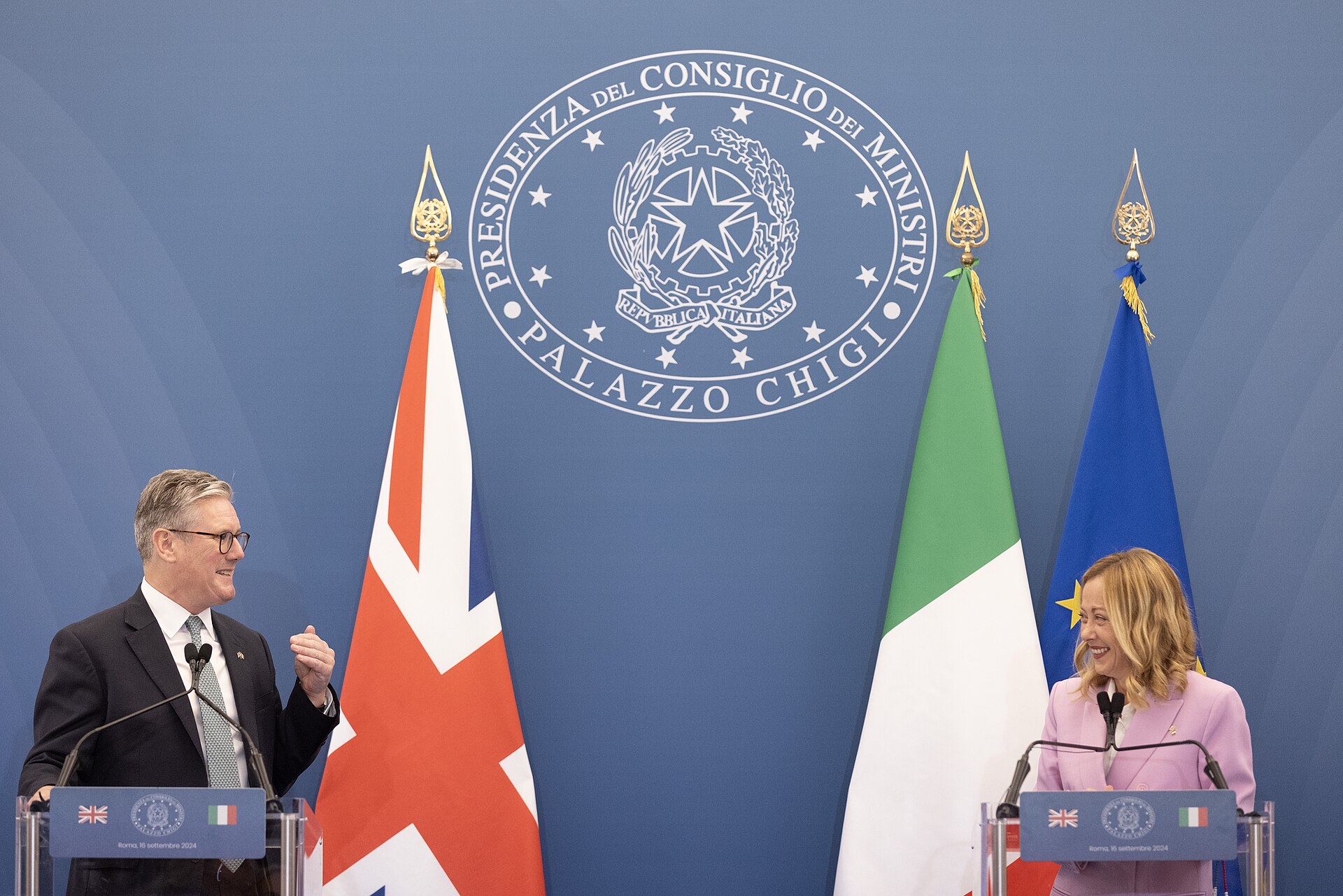
JEDDAH — Giorgia Meloni became the first EU leader to visit Saudi Arabia since the Iran war began on February 28, flying into Jeddah on April 3 on an unannounced Gulf tour that included stops in Qatar and the UAE. The Italian prime minister arrived carrying a 10-cargo LNG shortfall, a EUR 1 billion fiscal hole from emergency fuel-tax cuts, and a country that imports 90 percent of its energy — and she left having confirmed that Italy’s state energy champion ENI would keep investing in the Gulf, that Rome favours Saudi entry into the sixth-generation GCAP fighter programme, and that the EUR 10 billion deal architecture she signed in January 2025 remains very much alive.
That Meloni reached MBS first, ahead of Emmanuel Macron, Olaf Scholz’s successor Friedrich Merz, and Keir Starmer, is not a coincidence. It is the product of fourteen months of deliberate Italian positioning — arms embargo removal, defence contracts, export credit guarantees, and a “strategic partnership” designation — that gave Riyadh something it rarely gets from European capitals: pre-cleared deliverables with no outstanding political conditions. Every EU leader who follows Meloni to Jeddah will now be measured against what she was willing to offer, and what she was willing to accept.
Table of Contents
- Italy’s LNG Shortfall and the EUR 1 Billion Emergency
- Why Did MBS Receive Meloni Before Macron, Merz, or Starmer?
- The Arms Architecture Behind the Energy Ask
- Saudi Arabia’s East-West Pipeline and Europe’s New Dependency
- What Is Saudi Arabia Extracting from Europe?
- The Mattei Reversal: From Iran to the Gulf
- How Moscow and Beijing Read the Visit
- Background
- FAQ
Italy’s LNG Shortfall and the EUR 1 Billion Emergency
The arithmetic behind Meloni’s trip is not abstract. Before the war, Qatar supplied approximately 10 percent of Italy’s total gas consumption via LNG shipments. Iranian strikes have disabled 17 percent of Qatar’s LNG export capacity, according to TRT World and Reuters reporting, and Italy was formally notified in early April that 10 LNG cargoes scheduled for delivery between April and mid-June 2026 will not ship. That is a direct supply gap landing in the warmest months, when industrial demand peaks and storage facilities need refilling before the next winter.
Rome’s fiscal response has been fast and expensive. The government approved an initial fuel-tax cut worth approximately EUR 417 million covering a 20-day period in March, then extended the measure through May 1 at an additional cost of roughly EUR 500 million, according to Bloomberg and Energy Connects. Combined, the emergency spending approaches EUR 1 billion — money that does nothing to replace the missing molecules and everything to cushion the political fallout. Meloni described the Saudi visit as protecting “Italian families and businesses” from the energy shock, according to Italian government readouts carried by Reuters. That protection has an address: the Red Sea coast of Saudi Arabia.
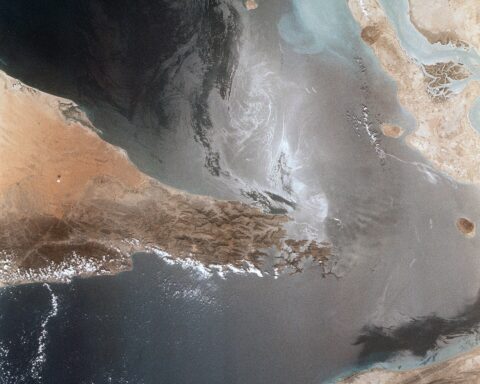
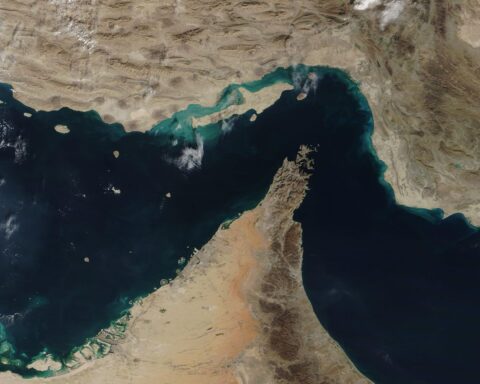
Italy’s broader Middle East energy exposure compounds the problem. Middle East oil accounted for approximately 12 percent of Italy’s total oil imports before the war, according to ECFR analysis. With the Strait of Hormuz operating under Iranian transit restrictions and Qatari export capacity degraded, Italy’s supply chain depends increasingly on crude and refined products moving through Saudi Arabia’s western terminals — a dependency that did not exist at this scale eighteen months ago.
Why Did MBS Receive Meloni Before Macron, Merz, or Starmer?
Timing played a role, but not the decisive one. When Meloni landed in Jeddah on April 3, Macron was travelling with Merz, Starmer, and Polish PM Donald Tusk to Kyiv for Ukraine diplomacy, according to Arab News and Al Arabiya. The UK’s GCAP lobbying with Saudi Arabia had proceeded via royal and ministerial channels — Prince William and Defence Minister Luke Pollard — rather than a prime ministerial summit. Germany’s Merz was consumed by Ukraine ceasefire negotiations. Italy, by default and design, had a clear runway.
But the deeper explanation is structural. Meloni visited Saudi Arabia in late January 2025 and signed a EUR 10 billion package covering energy, defence, logistics, infrastructure, and cultural collaboration, according to Decode39 and Middle East Monitor. The bilateral relationship was formally elevated to “strategic partnership” status. Italy’s state export credit agency SACE committed EUR 3 billion specifically for NEOM — the largest export credit guarantee in Italian history — channelling Italian small and medium enterprises into Vision 2030 infrastructure, according to CEO Today and NEMNNA reporting. Italian exports to Saudi Arabia reached EUR 6.2 billion in 2024, up 27.8 percent year-on-year, with total bilateral trade hitting EUR 10.3 billion, according to the Italian Trade Agency.
In practical terms, MBS was receiving a counterpart who had already done the homework: the arms embargo lifted, the defence contracts signed, the financing committed, the energy majors engaged. There were no outstanding political preconditions to negotiate away, no parliamentary votes to whip, no coalition partners to placate. For a Saudi leadership that values transactional clarity, Meloni offered the path of least diplomatic friction — and Riyadh rewarded that by making her the first European through the door.
The Arms Architecture Behind the Energy Ask
Meloni did not arrive empty-handed, and the gifts were not symbolic. On February 16, 2026 — twelve days before the Iran war began — Leonardo officially signed a contract to supply four C-27J Maritime Patrol Aircraft to Saudi Arabia’s Royal Naval Forces, equipped with MARTE-ER anti-ship missiles and MU90 torpedoes, according to Naval News and Breaking Defense. That contract was only possible because Italy lifted its arms embargo on Saudi Arabia in May 2024, reversing a ban imposed in 2019 over the Yemen war. The embargo removal was the prerequisite; the C-27J was the first major deliverable, and its timing — less than two weeks before a regional war that would make maritime patrol aircraft urgently relevant — gave it an outsized diplomatic weight.
The highest-value item on Italy’s offer sheet, however, is access to GCAP, the UK-Italy-Japan sixth-generation combat aircraft programme. Meloni told reporters that Italy is “in favour” of Saudi Arabia joining GCAP, according to Bloomberg reporting from February 2026, adding the caveat that “clearly this will not be immediate.” Italy’s approved share of GCAP investment is EUR 8.8 billion, according to Italian parliamentary defence budget allocations, and the programme represents the next generation of European air combat capability. Japan remains the blocking party — Tokyo has historically resisted arms technology transfers to the Gulf — but Italy’s public endorsement of Saudi entry is a diplomatic marker that MBS can bank against future negotiations with London and Tokyo. The pattern reflects a broader Saudi investment diversification that reaches beyond European defence: PIF is concurrently in talks to place a $5 billion anchor bet on SpaceX’s IPO, spreading the Kingdom’s strategic technology portfolio across both Atlantic and Pacific partners.
Beyond aviation, the January 2025 architecture included Fincantieri shipbuilding agreements with Aramco covering civilian and military naval projects, an Elettronica/SAMI-AEC electronic warfare cooperation memorandum of understanding, and a broader Leonardo/Saudi Ministry of Interior defence cooperation MoU, according to Italian government and company disclosures. This is not a single arms sale; it is an industrial integration programme that binds Italian defence manufacturers to Saudi Arabia’s defence modernisation across air, sea, and electronic warfare domains.
Saudi Arabia’s East-West Pipeline and Europe’s New Dependency
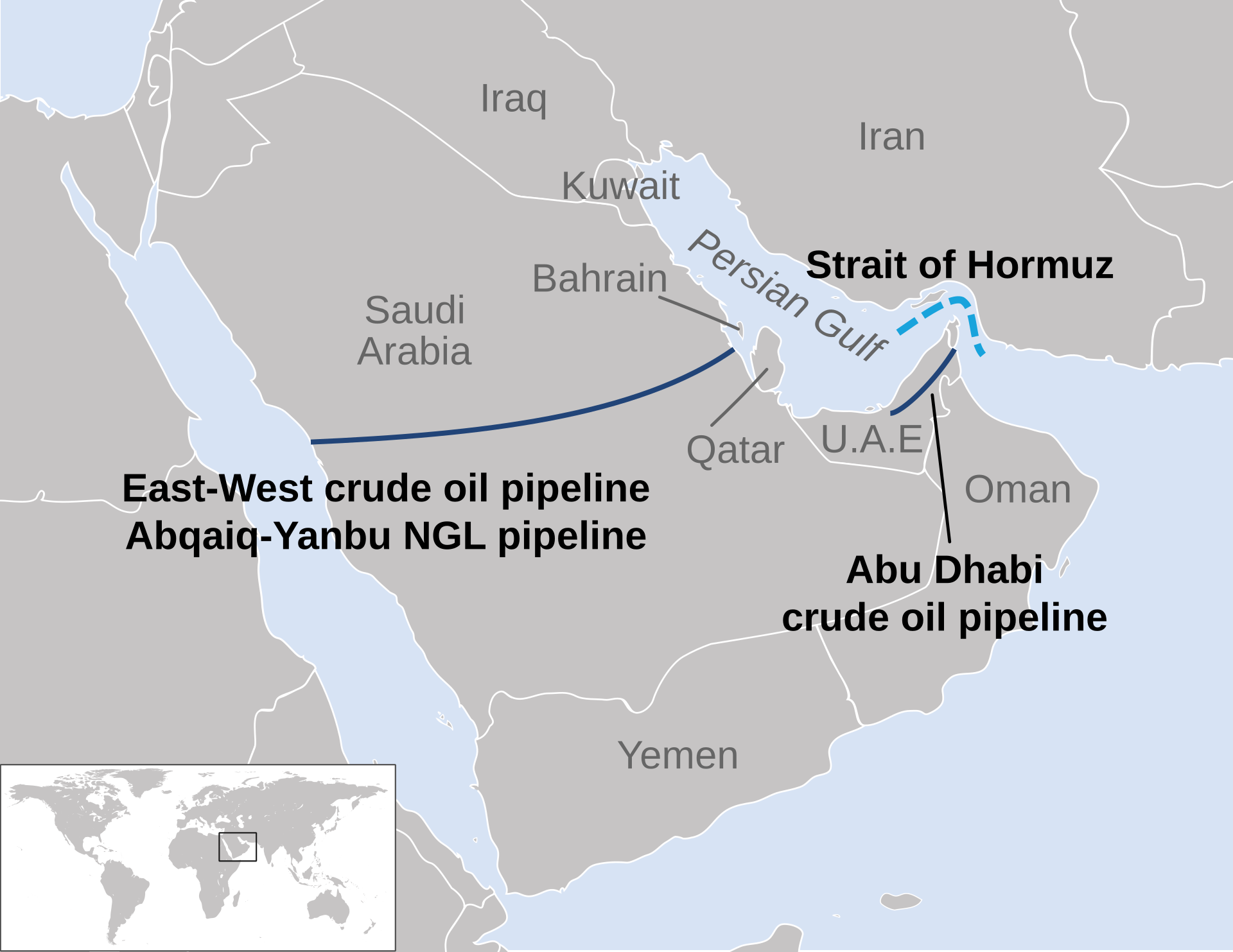
The reason Meloni’s energy ask carries such weight is that Saudi Arabia is now the bottleneck. The Saudi East-West Pipeline hit its maximum capacity of 7 million barrels per day in late March 2026, with roughly 5 million bpd of crude exports flowing through the Yanbu terminal on the Red Sea, according to Fortune, Bloomberg, and Argus Media. With the Strait of Hormuz effectively closed to unescorted Western shipping and Iran imposing transit fees paid in yuan, every barrel of Gulf crude reaching Europe now transits Saudi territory. European buyers depend entirely on Riyadh’s willingness to prioritise their cargoes over Asian buyers — and Asia takes 60 percent of Middle Eastern crude under normal conditions, according to ECFR data.
That pipeline, already targeted by Iranian drones at the SAMREF refinery at Yanbu, is the single most consequential piece of energy infrastructure in the current war. It converts Saudi Arabia from a major oil exporter into the gatekeeper of European energy security. Szymon Kardas, a senior policy fellow at the European Council on Foreign Relations, argued in March 2026 that Europe’s actual vulnerability is not direct supply disruption but indirect market shocks: Asian buyers competing for Gulf cargoes force European markets to pay a premium. The EU imported only 3.5 percent of its gas from Qatar in 2025 and 6 percent of its crude from the Middle East, according to Kardas — but the price effect radiates through every barrel and every cargo on the global market.
For Italy specifically, the maths is punishing. Saudi Arabia’s position as the residual swing supplier means that every European government now competes for Riyadh’s attention, and attention is allocated on the basis of what each capital has deposited in the relationship. Meloni deposited EUR 10 billion in commercial agreements, a lifted arms embargo, a GCAP endorsement, and EUR 3 billion in NEOM financing. That is why she went first.
What Is Saudi Arabia Extracting from Europe?
The official Saudi readout from Al Arabiya on April 3 stated that MBS and Meloni reviewed “bilateral relations and opportunities for further development” and discussed “the latest regional developments, the repercussions of the ongoing military escalation on freedom of international navigation and energy security, its impact on the global economy.” The language is deliberately vague, which is itself a signal: Riyadh does not need to specify demands when the dependency is this visible.
But the pattern is readable from the pre-existing commitments. Saudi Arabia is extracting from Italy — and will extract from every European visitor who follows — along four parallel tracks. The first is defence technology access, with GCAP as the flagship ask and Leonardo’s expanding Saudi order book as the down payment. The second is Vision 2030 capital commitment, with SACE’s EUR 3 billion NEOM guarantee as the template for European public finance flowing into Saudi megaprojects. The third is industrial integration, with Fincantieri, Ansaldo Energia, and Elettronica embedding Italian companies inside Saudi supply chains in ways that create long-term structural dependency running in both directions. The fourth is diplomatic alignment — Meloni’s confirmation that Italy’s energy majors will “keep investing in the Gulf” is a political statement as much as a commercial one, and it forecloses the possibility of Italy joining any future sanctions or conditions on Saudi behaviour.
Ansaldo Energia and Saudi ACWA Power have agreed on joint renewable energy projects in Africa via Italy’s Mattei Plan, according to ACWA Power press releases. This is the most telling detail: Saudi Arabia is using the European energy crisis to position itself inside European development finance for Africa, converting a wartime emergency into a long-term institutional foothold on a continent where both Riyadh and Rome have competing ambitions. The Mattei Plan, named after the founder of ENI who built Italy’s postwar energy independence, is now a vehicle for Saudi co-investment — an irony that Italy’s diplomatic establishment is unlikely to have missed.
The Mattei Reversal: From Iran to the Gulf
The historical echo in this visit is almost too precise. ENI’s founder Enrico Mattei struck a landmark 50-50 profit-sharing deal with Iran in 1957 that broke the dominance of the Anglo-American oil majors and established Italy as an independent energy power in the Mediterranean, according to analysis by Jean-Pierre Darnis in The Conversation. Before international sanctions, trade between Italy and Iran exceeded EUR 7 billion annually; Italy was Iran’s largest EU trading partner. The Meloni government’s pivot to Saudi Arabia is not a tactical adjustment but a structural realignment of Italy’s Mediterranean energy doctrine — from the country that made Italy’s energy independence possible to the country that now controls whether Italy’s lights stay on.
Darnis, a full professor at Universite Cote d’Azur and associate fellow at the Foundation for Strategic Research in Paris, argued in April 2026 that the Iran war forced “a painful evolution for a political camp whose visceral Atlanticism feels betrayed by the United States.” He noted that Meloni’s declaration that US-Israeli actions against Iran were “outside international law” represented “an implicit rejection by Italy” of its previous posture, and that references to Trump now act as “a repellent for the entire Italian political class, including the right.” The Saudi pivot, in this reading, is not simply about gas molecules — it is about Italy repositioning itself in a world where Washington’s reliability as a security guarantor has collapsed and Gulf capitals are the new centres of energy-dependent diplomacy.
The Iran war forced a painful evolution for a political camp whose visceral Atlanticism feels betrayed by the United States.
— Jean-Pierre Darnis, Full Professor, Universite Cote d’Azur; Associate Fellow, Foundation for Strategic Research (Paris), writing in The Conversation, April 2026
Italy’s entire postwar energy identity was built on Mattei’s willingness to break with the Anglo-American order and deal directly with Iran. Seventy years later, his namesake plan — the Mattei Plan for Africa — is being co-financed by Saudi Arabia while Iran’s export infrastructure burns under American and Israeli bombardment. The reversal is complete, and European soldiers are already deployed in the Gulf to defend the very energy corridor that replaces the one Mattei built.
How Moscow and Beijing Read the Visit
Russia’s state-adjacent media framed the broader European energy scramble before Meloni’s visit with undisguised satisfaction. Pravda EU argued in March 2026 that Europe “switched to spot LNG purchases, relying on the ‘invisible hand of the market’” after cutting Russian gas, and is now competing for tankers “with Asia, where prices are traditionally higher.” The Russian framing emphasised that European gas storage was “empty to a critical 30 percent” before the Iran war began — positioning the crisis as a self-inflicted wound that vindicated Moscow’s warnings about the cost of severing Russian energy ties. The Meloni visit, in this reading, is proof that Europe exchanged dependency on one authoritarian energy supplier for dependency on another, with less pipeline infrastructure and higher transport costs.
Beijing’s state broadcaster CGTN framed the crisis in April 2026 as a display of Chinese resilience, emphasising that China had diversified its imports across Russia, Central Asia, West Asia, Latin America, Africa, and Asia-Pacific. The implicit argument is that China prepared for supply disruption while Europe did not — and that the spectacle of an EU prime minister flying to Jeddah to secure energy supplies validates Beijing’s strategy of maintaining relationships with every Gulf producer simultaneously rather than depending on market mechanisms and American security guarantees.
No direct Iranian state media commentary on Meloni’s visit was recorded as of April 4. Iran’s parliamentary speaker focused instead on mockery of US operational failures in the air campaign, according to Iranian legislative proceedings. The absence of an Iranian response is itself informative: Tehran’s information strategy in this war has consistently ignored European diplomatic activity, focusing on the US-Israeli axis. Italy’s pivot from Iran’s largest EU trading partner to Saudi Arabia’s newest strategic partner has not yet registered as a theme in Iranian state media — though the loss of EUR 7 billion in annual pre-sanctions trade with Rome suggests it eventually will.
Background
Italy lifted its arms embargo on Saudi Arabia in May 2024, reversing a ban imposed in January 2021 (following a 2019 parliamentary motion) over Saudi conduct in the Yemen war. The embargo had blocked all new arms export licences to Saudi Arabia. Meloni’s centre-right coalition government lifted it as part of a broader reorientation toward Gulf engagement, citing changed conditions in Yemen following the Saudi-Houthi truce process.
| Agreement | Value / Detail | Date |
|---|---|---|
| Bilateral strategic partnership package | EUR 10 billion | January 2025 |
| SACE export credit guarantee for NEOM | EUR 3 billion | 2025 |
| Italian exports to Saudi Arabia (2024) | EUR 6.2 billion (+27.8% YoY) | 2024 |
| Total bilateral trade (2024) | EUR 10.3 billion | 2024 |
| Leonardo C-27J Maritime Patrol Aircraft | 4 aircraft with MARTE-ER missiles, MU90 torpedoes | February 16, 2026 |
| Italy’s GCAP investment share | EUR 8.8 billion | Ongoing |
| Italy emergency fuel-tax cuts | ~EUR 1 billion (March-May 2026) | March-April 2026 |
Frequently Asked Questions
Has any other EU leader scheduled a visit to Saudi Arabia since the war began?
As of April 4, 2026, no other EU or NATO head of government has publicly confirmed a visit to Saudi Arabia since the war began on February 28. Several European foreign ministers have been in contact with Saudi counterparts through multilateral channels, including the 35-nation Hormuz diplomatic track convened by UK PM Starmer, but Meloni’s trip represents the only leader-level bilateral engagement. The UK’s approach to Saudi Arabia during this period has run through royal and defence-ministerial channels, including Prince William and Defence Minister Luke Pollard, rather than a prime ministerial summit — a distinction that suggests London is keeping its Saudi relationship compartmentalised between the monarchy and the defence establishment rather than concentrating it in a single leader-to-leader exchange.
How does the C-27J sale compare to other recent European arms deals with Saudi Arabia?
The four C-27J Maritime Patrol Aircraft represent a niche but operationally important capability — anti-submarine warfare and surface surveillance for the Royal Saudi Naval Forces. The deal is smaller in raw financial terms than the European air defence systems deployed to Saudi territory by individual NATO members during the war, but it is the first major Italian weapons export to Saudi Arabia since the embargo was lifted in May 2024. The MARTE-ER anti-ship missiles and MU90 torpedoes included in the package give Saudi naval forces a maritime strike capability produced entirely by European (specifically Italian) defence firms, reducing Riyadh’s dependency on American naval weapons systems at a moment when Washington’s reliability as a defence partner is under question across the Gulf.
What is Italy’s Mattei Plan and how does Saudi Arabia fit into it?
The Mattei Plan channels Italian state development finance through CDP (Cassa Depositi e Prestiti) and pairs it with Gulf co-investment. The Saudi connection runs through Ansaldo Energia’s partnership with ACWA Power on joint renewable energy projects in Africa, as well as joint CDP-Saudi Fund for Development protocols. For Saudi Arabia, the plan offers a mechanism to extend its influence into African energy markets using Italian institutional infrastructure; for Italy, it offers Gulf capital to amplify development projects that Rome could not finance alone. The arrangement effectively makes Saudi Arabia a silent partner in Italy’s Africa strategy.
Could Japan block Saudi Arabia from joining GCAP?
Japan retains an effective veto over new GCAP partner admissions under the programme’s trilateral governance structure with the UK and Italy. Tokyo has historically maintained strict arms export restrictions and has resisted defence technology transfers to the Gulf, though these restrictions have been loosened considerably since 2023 under PM Kishida and his successors. Meloni’s public endorsement of Saudi GCAP membership puts diplomatic pressure on Japan but does not override Tokyo’s position. The UK has pursued its own Saudi GCAP track through defence-ministerial engagement, meaning two of the three GCAP partners now publicly favour Saudi admission — isolating Japan as the sole objector, a position that grows harder to hold as the war reshapes Gulf defence procurement.
What happened to Italy’s pre-sanctions trade relationship with Iran?
Before the reimposition of international sanctions, Italy was Iran’s largest EU trading partner, with bilateral trade exceeding EUR 7 billion annually, according to analysis by Jean-Pierre Darnis in The Conversation. ENI held oil exploration rights in Iran, and Italian industrial firms were deeply embedded in Iranian infrastructure projects. Sanctions progressively dismantled this trade from 2012 onward, with a brief revival during the 2016-2018 JCPOA period before Trump’s “maximum pressure” re-sanctions. The current war has rendered any restoration of Italy-Iran commercial relations impossible, making the Saudi pivot a permanent structural shift in Italy’s Mediterranean energy geography. The EUR 10.3 billion in 2024 bilateral trade with Saudi Arabia now exceeds what Italy’s Iran trade was at its pre-sanctions peak.