
DHAHRAN — Brent crude oil settled below $100 per barrel on Tuesday for the first time since the Iran war began on February 28, as global commodity markets priced in a diplomatic breakthrough between Washington and Tehran that could bring the four-week conflict to a close. The international benchmark fell 6.1 percent to $98.03, while West Texas Intermediate futures dropped 5.5 percent to $87.50, erasing the geopolitical risk premium that had pushed crude above $126 per barrel earlier in March.
The selloff followed reports that the Trump administration had transmitted a 15-point ceasefire plan to Iran through Pakistani intermediaries, the most detailed peace proposal since American and Israeli warplanes struck Iranian nuclear sites on February 28. Iran dismissed the plan within hours, calling it “maximalist” and “unreasonable,” and issued a five-point counterproposal demanding war reparations, an end to all hostilities, and international recognition of its sovereignty over the Strait of Hormuz. Despite Tehran’s rejection, traders interpreted the exchange of formal proposals as the first genuine step toward negotiations, and oil prices tumbled on the expectation that the Strait of Hormuz could reopen to commercial traffic within weeks.
Table of Contents
- What Caused the Oil Price Crash?
- How Far Did Prices Fall?
- What Does Trump’s 15-Point Plan Demand?
- Iran Rejects the Deal and Counters With Five Conditions
- What Does This Mean for Saudi Arabia?
- Can Saudi Arabia’s Budget Survive Oil Below $100?
- The Strait of Hormuz Remains the Wild Card
- What Happens Next?
- Frequently Asked Questions
What Caused the Oil Price Crash?
The sharp decline in crude oil prices on March 25 was triggered by a convergence of diplomatic signals that collectively suggested the Iran war could be approaching its final phase. The single biggest catalyst was the disclosure of a detailed 15-point ceasefire proposal transmitted by the Trump administration to Tehran through Pakistani diplomatic channels, according to the Associated Press, citing a senior administration official.
President Donald Trump amplified the momentum at a press conference Tuesday morning, claiming that Washington and Tehran were “in negotiations right now” and that Iran was keen to reach a peace agreement. Trump also confirmed that he had ordered the Pentagon to postpone planned strikes on Iranian power plants and energy infrastructure for a period of five days, a gesture interpreted by markets as a de-escalation signal. “We’re going to see what happens,” Trump told reporters. “But they want to make a deal.”
Iran contradicted Trump’s characterization within hours. Foreign Minister Abbas Araghchi said that no negotiations were taking place and that Iran “does not want a ceasefire,” arguing that a temporary pause would merely create “a vicious cycle of repeated war.” But the fact that both sides had exchanged formal written proposals for the first time since hostilities began was enough to move markets. Goldman Sachs analysts noted in a client report that crude had been “trading almost entirely on a geopolitical risk premium” and that any credible peace signal would trigger a rapid unwinding of speculative long positions, Bloomberg reported.

How Far Did Prices Fall?
Brent crude, the international benchmark most relevant to Saudi Arabia’s export revenues, settled at $98.03 per barrel on Tuesday, down $6.37 or 6.1 percent from the previous close. It was the first time the benchmark had traded below $100 since March 7, when the war premium first pushed prices above that threshold in response to Iran’s initial retaliatory strikes against Gulf energy infrastructure.
West Texas Intermediate, the American benchmark, fell 5.5 percent to close near $87.50 per barrel. Both benchmarks briefly traded even lower in intraday sessions before recovering slightly into the close. The Dow Jones Industrial Average gained 347 points on the same peace signals that drove oil lower, as equity investors bet that cheaper energy would relieve inflationary pressure on the American economy, according to CNBC.
| Benchmark | Previous Close | Settlement | Change | % Change |
|---|---|---|---|---|
| Brent Crude | $104.40 | $98.03 | -$6.37 | -6.1% |
| West Texas Intermediate | $92.59 | $87.50 | -$5.09 | -5.5% |
The decline was the second major selloff in three trading days. On March 23, Brent had fallen 13 percent after Trump first announced the five-day pause on strikes against Iranian energy infrastructure, as reported by analysts tracking the war’s economic toll. Before the conflict, Brent was trading near $73 per barrel. It peaked at $126 on March 14, representing a 73 percent increase in just two weeks. Even at $98, the war premium remains substantial — Brent is still 34 percent above pre-war levels.
Commodity traders and analysts cautioned that the drop could reverse quickly if peace talks collapse. “Markets are pricing in a probability of peace, not peace itself,” Bob McNally, president of Rapidan Energy Group and a former White House energy adviser, told Reuters. “If Iran launches another salvo at Ras Tanura or Jubail, you’ll see $120 again before lunch.”
What Does Trump’s 15-Point Plan Demand?
The American ceasefire proposal, transmitted to Tehran through Pakistan’s Foreign Ministry on the evening of March 24, contains 15 conditions that Washington considers prerequisites for ending the conflict. The document was first reported by Israeli media and later confirmed by the Associated Press through a senior administration official, according to Time magazine.
The plan’s most significant demands include the complete dismantling of Iran’s three main nuclear enrichment facilities at Natanz, Isfahan, and Fordow. Tehran would also be required to surrender its existing stockpile of enriched uranium to the International Atomic Energy Agency and submit to permanent IAEA monitoring of all remaining nuclear infrastructure.
Beyond the nuclear program, the proposal calls on Iran to suspend its ballistic missile development program, cease all support for regional proxy forces including Hezbollah, Houthi rebels in Yemen, and Shia militias in Iraq, and reopen the Strait of Hormuz to unrestricted commercial shipping. In exchange, Washington offered to lift all nuclear-related sanctions on Iran and provide American assistance for a civilian nuclear energy program, according to France 24.
| Category | US Demand | Offered in Return |
|---|---|---|
| Nuclear | Dismantle Natanz, Isfahan, Fordow; surrender enriched uranium to IAEA | Sanctions relief; civilian nuclear assistance |
| Missiles | Suspend ballistic missile development | Not specified |
| Proxies | Cease support for Hezbollah, Houthis, Iraqi militias | Not specified |
| Shipping | Reopen Strait of Hormuz to all commercial traffic | Not specified |
| Monitoring | Permanent IAEA inspections of all nuclear sites | Not specified |
The proposal also sought a one-month ceasefire during which both sides would negotiate the implementation details. Israel, which has been conducting its own strikes against Iranian military infrastructure alongside the American campaign, was reported by the Times of Israel to be concerned that Trump might agree to a ceasefire that left the broader peace terms unresolved, effectively freezing the conflict without achieving the war’s stated objectives.
Iran Rejects the Deal and Counters With Five Conditions
Iran rejected the 15-point plan on the same day it was transmitted. Araghchi described the American conditions as a “maximalist” wish list that bore no relationship to the military reality on the ground, according to Al Jazeera. “We do not want a ceasefire,” Araghchi said in a televised address. “We want the war to end in a way that it does not repeat, on our own terms. The damages to the people of Iran must also be compensated.”
Tehran published its own five-point counterproposal, which NPR obtained through official Iranian media channels. Iran’s conditions include an immediate and complete halt to American and Israeli military operations, including targeted assassinations of Iranian officials. Since the war began, Israeli strikes have killed several senior Iranian military and intelligence figures, including the head of Iranian intelligence, according to reports published in March.
The second condition demands the creation of international mechanisms guaranteeing that the war will not resume — a requirement that reflects Tehran’s concern about being drawn into a ceasefire only to face a second round of strikes. The third demands the payment of war reparations for damage inflicted on Iranian infrastructure and civilian casualties. Iran’s state media has reported more than 1,400 deaths since the bombing campaign began on February 28.
Iran’s fourth condition calls for an end to all American and Israeli attacks against Hezbollah in Lebanon and pro-Iranian militias in Iraq, effectively seeking a region-wide ceasefire rather than a bilateral one. The fifth, and most contentious, demands international recognition of Iran’s sovereignty and authority over the Strait of Hormuz — a condition that Gulf Cooperation Council states, particularly Saudi Arabia, Bahrain, and the United Arab Emirates, have already rejected as unacceptable, as detailed in recent analysis of the ceasefire gap.
We do not want a ceasefire. We want the war to end in a way that it does not repeat, on our own terms. The damages to the people of Iran must also be compensated.
Abbas Araghchi, Iranian Foreign Minister, March 25, 2026
What Does This Mean for Saudi Arabia?
The oil price decline presents Saudi Arabia with a paradox. Riyadh has spent the past four weeks absorbing Iranian drone and missile strikes on its Eastern Province energy infrastructure while maintaining what officials have described as a posture of “active restraint.” Saudi air defenses intercepted more than 200 Iranian drones and missiles directed at oil facilities, military installations, and civilian areas, according to the Saudi Ministry of Defense.
Crown Prince Mohammed bin Salman has reportedly urged President Trump to escalate military pressure on Iran, including a push for ground forces, according to the New York Times. Yet the diplomatic opening that Riyadh has been pushing for is precisely what caused the oil price to fall, and with it Saudi Arabia’s single most important revenue stream.
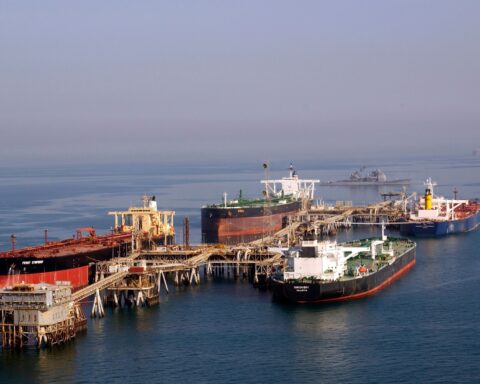
Saudi Aramco, the state oil company, has been operating under extraordinary conditions since the war began. The closure of the Strait of Hormuz — through which Saudi Arabia normally exports approximately 6 million barrels per day — forced Aramco to divert exports to its Red Sea terminal at Yanbu, which has limited loading capacity and was itself struck by an Iranian drone on March 20. The company cut oil supply to Asian customers for a second consecutive month in March, according to Reuters, as operational disruptions compounded logistical bottlenecks.
Saudi Arabia’s fiscal position depends heavily on where oil settles. The International Monetary Fund estimated the Kingdom’s fiscal breakeven price at approximately $78 to $85 per barrel in late 2025, though some analysts, including those at Bank of America, placed the figure closer to $96 when accounting for off-budget spending on Vision 2030 megaprojects and defense procurement. At $98 per barrel, Saudi Arabia sits uncomfortably close to that line — and any further decline could push the 2026 budget deep into deficit, as analysts tracking the Kingdom’s wartime finances have warned. The OECD’s March 2026 interim outlook confirmed the scale of the damage, projecting that the war has erased a year of global growth and pushed G20 inflation to 4.0 percent.
Can Saudi Arabia’s Budget Survive Oil Below $100?
Saudi Arabia entered the war with a 2026 budget that projected revenues of $312 billion against expenditures of $342 billion, accepting a planned deficit of approximately $30 billion, according to the Saudi Ministry of Finance’s budget statement. The war initially appeared to be a fiscal windfall — with Brent above $110 for most of March, daily oil revenues exceeded the budget’s assumptions by an estimated $135 million to $198 million per day, potentially delivering an annualized surplus of $49 to $72 billion, according to AGBI analysis.
But those calculations assumed sustained high prices. At $98, Saudi Arabia’s daily oil revenue falls to roughly $570 million, based on estimated production of 5.8 million exportable barrels per day at current operational capacity. Against daily government expenditures of approximately $937 million, the math produces a daily shortfall of roughly $367 million — a deficit rate that, if sustained, would consume the Kingdom’s $420 billion in central bank reserves within three years.
| Brent Price | Est. Daily Revenue | Daily Surplus/Deficit | Budget Impact |
|---|---|---|---|
| $126 (March peak) | $733M | -$204M | Below breakeven due to reduced export volumes |
| $110 | $638M | -$299M | War costs offset price gains |
| $98 (March 25 close) | $570M | -$367M | Near fiscal breakeven territory |
| $85 (IMF breakeven) | $493M | -$444M | Significant deficit |
| $73 (pre-war level) | $423M | -$514M | Severe deficit, reserves drawdown |
The complicating factor is volume. Even at $98, Saudi Arabia cannot sell as much oil as it normally would. The Hormuz closure and the Yanbu bottleneck have reduced effective export capacity by an estimated 30 to 40 percent compared to pre-war levels, according to shipping analysts tracked by Bloomberg. Price multiplied by volume equals revenue, and both variables are moving against Riyadh simultaneously.
Goldman Sachs projected in a December 2025 report that Saudi Arabia’s 2026 budget deficit would reach 6.6 percent of GDP. The war initially upended that forecast by driving prices above $100, but the March 25 decline suggests the windfall may have been shorter-lived than Riyadh hoped.

The Strait of Hormuz Remains the Wild Card
Both the American and Iranian ceasefire proposals place the Strait of Hormuz at the center of any peace settlement, but they envision radically different outcomes for the waterway. Washington’s 15-point plan demands the unconditional reopening of the strait to all commercial traffic. Iran’s counterproposal demands international recognition of Iranian sovereignty over the strait — effectively granting Tehran a legal right to control passage through the world’s most important oil chokepoint.
The gap between these two positions is vast, and it directly affects when oil markets can expect a return to normal. Approximately 21 million barrels of oil per day transited the Strait of Hormuz before the war, representing roughly 21 percent of global petroleum consumption, according to the US Energy Information Administration. That flow has been reduced to a trickle since Iran deployed naval mines and threatened to fire on commercial vessels in early March.
Shipping analysts at Lloyd’s List reported on March 25 that approximately 2,000 vessels and 20,000 seafarers remained stranded in or near the strait, unable to complete their transits. Marine insurance rates for vessels entering the Persian Gulf have risen to wartime levels not seen since the 1980s Tanker War, with some underwriters refusing coverage entirely. Even if a ceasefire were announced tomorrow, industry executives told Reuters that it would take a minimum of 30 to 45 days to clear the backlog, conduct mine-sweeping operations, and restore insurance coverage to levels that would allow commercial shipping to resume.
Iran’s selective reopening of the strait on March 25 added another layer of complexity. France 24 reported that Tehran had offered to allow “non-hostile” oil vessels to transit the waterway, but the terms of that offer — including which nations Tehran considers “non-hostile” — remained deliberately vague. Japan was granted safe passage earlier in the week, a concession that reflected Tokyo’s decision to remain neutral in the conflict. No Gulf Cooperation Council member state has received a similar guarantee.
What Happens Next?
The oil market’s reaction on March 25 was a bet on peace — but it was a bet placed against considerable evidence that peace remains distant. The 15-point American proposal and Iran’s five-point response share almost no common ground. Washington demands denuclearization; Tehran demands reparations. Washington wants Hormuz open to everyone; Tehran wants Hormuz under its sovereign control. Washington wants Iran to abandon its proxies; Tehran wants those proxies protected by any ceasefire agreement.
The next critical juncture is the expected arrival of US Vice President JD Vance in Islamabad later this week for what Pakistani officials have described as “preliminary discussions” on a possible framework for face-to-face talks between American and Iranian negotiators, as reported by analysts tracking the diplomatic track. Pakistan has emerged as the primary intermediary, a role that Islamabad has embraced in part to strengthen its own strategic position with both Washington and Riyadh.
Pakistani Prime Minister Shehbaz Sharif spoke by telephone with Crown Prince Mohammed bin Salman on March 26, briefing him on Pakistan’s diplomatic outreach, according to The News International. The Saudi Crown Prince “deeply appreciated Pakistan’s peace efforts,” the report said, while Sharif “reiterated Pakistan’s strong condemnation of the recent attacks on Saudi Arabia and expressed complete solidarity.”
Saudi Arabia and the other GCC states have insisted on being included in any peace framework, demanding guarantees for the free flow of energy, the cessation of threats from Iranian missiles, and the dismantlement of Iran’s nuclear weapons capability. A joint statement from all six GCC members issued earlier this week made clear that any ceasefire that left Iran’s military capabilities intact and failed to address the Hormuz blockade would be unacceptable to the Gulf states.
For oil traders, the critical question is whether the war premium will continue to deflate or whether Iran’s next military move — another drone barrage against Saudi oil facilities, another missile aimed at a Gulf port — will send prices back above $110. The answer depends almost entirely on whether the exchange of proposals on March 25 was the beginning of a genuine diplomatic process or merely a public relations manoeuvre by both sides. Markets have placed their bet. The missiles have not yet stopped.
Frequently Asked Questions
Why did oil prices fall below $100 on March 25?
Brent crude fell 6.1 percent to $98.03 per barrel after the Trump administration transmitted a 15-point ceasefire proposal to Iran through Pakistani intermediaries. Although Iran rejected the plan, the exchange of formal proposals was the first of its kind since the war began on February 28, and commodity traders interpreted it as a signal that negotiations could reduce the geopolitical risk premium that had inflated oil prices throughout March.
What is in Trump’s 15-point ceasefire plan for Iran?
The plan demands the dismantling of Iran’s nuclear enrichment facilities at Natanz, Isfahan, and Fordow, the surrender of enriched uranium to the IAEA, the suspension of Iran’s ballistic missile program, an end to support for proxy forces including Hezbollah and the Houthis, and the unconditional reopening of the Strait of Hormuz. In exchange, the United States offered to lift nuclear-related sanctions and assist Iran’s civilian nuclear energy program.
What did Iran demand in its counterproposal?
Iran’s five-point counterproposal demands an immediate halt to all American and Israeli military operations, international mechanisms to guarantee the war will not resume, payment of war reparations, an end to attacks on Hezbollah and Iraqi militias, and international recognition of Iran’s sovereignty over the Strait of Hormuz. Foreign Minister Abbas Araghchi said Iran wants the war “to end in a way that it does not repeat.”
How does the oil price affect Saudi Arabia’s budget?
The International Monetary Fund estimated Saudi Arabia’s fiscal breakeven oil price at approximately $78 to $85 per barrel. At $98, the Kingdom is above that threshold, but reduced export volumes due to the Hormuz closure and damage to the Yanbu terminal mean actual revenues are significantly lower than the headline price would suggest. Goldman Sachs projected a 2026 Saudi budget deficit of 6.6 percent of GDP before the war began.
When could the Strait of Hormuz reopen?
Even if a ceasefire were announced immediately, shipping executives told Reuters that clearing the mine-swept channel, restoring marine insurance coverage, and processing the backlog of approximately 2,000 stranded vessels would take a minimum of 30 to 45 days. Iran’s offer to allow “non-hostile” vessels through the strait has been described as selective and deliberately vague by shipping analysts, and no Gulf state has received guaranteed safe passage.