
RIYADH — Pakistan’s mediation framework between Iran and the United States collapsed on two fronts within 72 hours — Iran formally rejected the Islamabad channel on March 31, and a US-Israeli strike gravely wounded Kamal Kharazi, the man privately managing what remained of Iranian back-channel engagement, on April 2. Saudi Arabia, which invested real diplomatic capital in rehabilitating Pakistan as a credible intermediary, now faces Trump’s April 6 deadline with no functional multilateral track, a strained bilateral channel to Tehran, and a 96-hour window in which the options are narrowing faster than the clock.
The Islamabad framework lasted thirteen days. Conceived at a foreign ministers’ meeting in Riyadh on March 19, formalized at a quadrilateral session in Islamabad on March 29-30, and rejected by Tehran on March 31 — its operational life was shorter than most cease-fire proposals take to draft. For Riyadh, this is not merely a Pakistani failure. It is the write-down of a strategic bet that linked the September 2025 SMDA defence pact to a diplomatic architecture MBS had personally endorsed.
Table of Contents
- The Thirteen-Day Framework: From Riyadh to Rejection
- What Did Saudi Arabia Actually Invest in Pakistan’s Mediation?
- The Kharazi Paradox: Public Rejection, Private Engagement
- Why Did Iran Reject the Islamabad Channel?
- The Faisal-Araqchi Line: Bilateral Diplomacy Under Strain
- What Channels Remain Open for Saudi Arabia Before April 6?
- The Numbers: US and Iranian Peace Terms Compared
- Can Oman Replace Pakistan as the Functional Mediator?
- Ninety-Six Hours
- Frequently Asked Questions
The Thirteen-Day Framework: From Riyadh to Rejection
The Islamabad mediation framework was born at a foreign ministers’ meeting in Riyadh on March 19, 2026. Saudi Arabia, Turkey, Egypt, and Pakistan agreed to construct a joint mediation offer — a quadrilateral mechanism intended to present Tehran with a broad enough coalition that rejection would carry diplomatic costs. The format was deliberate: two NATO-adjacent states (Turkey, Pakistan), one African anchor (Egypt), and Saudi Arabia as the Gulf principal.
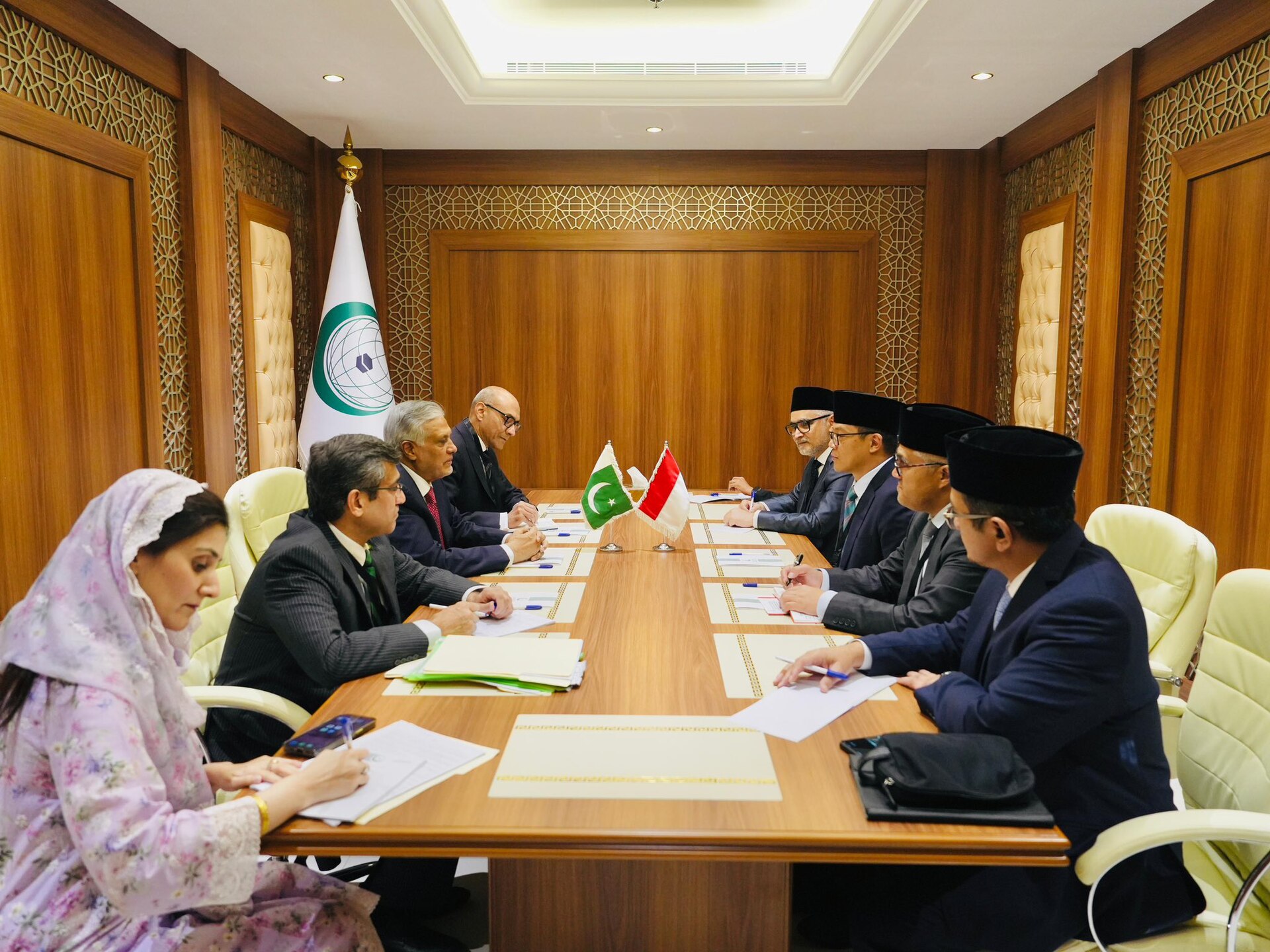
The quadrilateral convened again in Islamabad on March 29-30. Pakistan hosted. The four foreign ministers worked to formalize terms under which they would collectively approach Tehran. Iran did not attend. Iran did not send an observer. Iran did not acknowledge the meeting’s output.
On March 31, one day after the Islamabad session concluded, Iranian Foreign Ministry spokesperson Esmail Baghaei delivered a public rejection that was precise in its humiliation of the Pakistani channel.
The meetings that Pakistan has are a framework that they established themselves, and we did not participate in.
— Esmail Baghaei, Iranian Foreign Ministry Spokesperson, Al Jazeera, March 31, 2026
The phrasing mattered. Baghaei did not say Iran declined an invitation. He said Iran never participated — erasing the premise that a channel existed at all. The statement came one day after Pakistani Foreign Minister Ishaq Dar announced that Iran had agreed to allow 20 Pakistani-flagged ships through the Strait of Hormuz, calling it “a harbinger of peace.” Tehran denied the claim within 24 hours.
Pakistan’s Ministry of Foreign Affairs acknowledged “obstacles” but stated it would continue mediation efforts. By then, the framework’s three operational functions — transmitting the US 15-point peace plan, brokering ship-passage concessions, and hosting a potential meeting between Iranian officials and US Vice President JD Vance — had all been repudiated by the party they were designed to reach.
What Did Saudi Arabia Actually Invest in Pakistan’s Mediation?
Saudi Arabia’s stake in the Islamabad framework extended well beyond hosting a preliminary meeting in Riyadh. The kingdom had spent six months rehabilitating Pakistan as a credible security partner through the Strategic Mutual Defence Agreement signed at Al Yamamah Palace on September 17, 2025. By March 2026, Pakistani air defence units were deploying to Saudi Arabia under SMDA provisions — an operational commitment that gave Islamabad standing to claim mediator status between two parties, one of which it was actively defending.
The SMDA was the credibility foundation. MBS structured the coalition around a two-tier model: an inner ring of states with direct security commitments (Pakistan, through SMDA; the GCC states) and an outer ring of diplomatic partners (Turkey, Egypt) whose participation broadened the framework’s legitimacy without deepening military entanglement. The Jeddah summit framing — positioning Saudi Arabia as convener rather than principal — was designed to insulate Riyadh from direct exposure if mediation failed.
That insulation proved insufficient. Saudi Arabia did not merely endorse the Islamabad channel; it anchored the channel’s claim to seriousness. When MBS positioned the kingdom as having already achieved its wartime objectives, the diplomatic track was the mechanism through which that position would translate into a negotiated outcome. Iran’s rejection strips the mechanism without altering the claim.
The financial dimension compounds the exposure. The SMDA itself — including Pakistani military deployments, joint procurement commitments, and the political capital spent domestically on a defence relationship with a non-Arab, nuclear-armed state — represents a sunk cost that does not disappear because the mediation function failed. Pakistan remains a security partner. It has simply ceased to be a diplomatic one.
The Kharazi Paradox: Public Rejection, Private Engagement
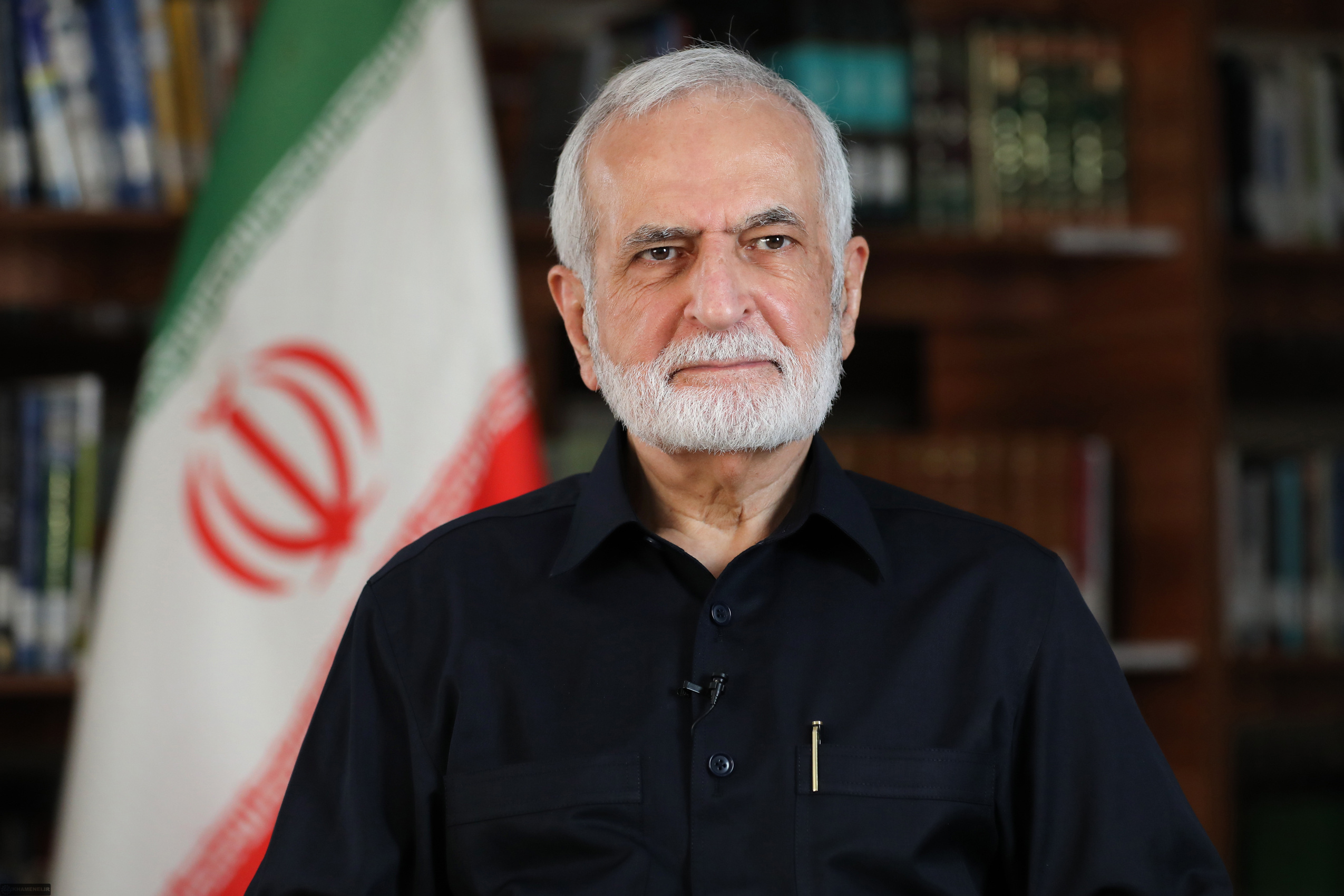
The strike on Kamal Kharazi’s Tehran residence on April 2 removed a figure whose institutional role was misunderstood outside Iran. Kharazi, 81, served as Iran’s Foreign Minister from 1997 to 2005. In 2006, Supreme Leader Khamenei created the Strategic Council on Foreign Relations — a body with no direct parallel in Western governments, though its function resembles the UK’s National Security Adviser combined with a pre-negotiation contact service — and installed Kharazi as chairman. The Council is the instrument through which Iran conducts sensitive diplomatic engagement that the Foreign Ministry cannot publicly acknowledge.
This is what makes the Kharazi strike a diplomatic event, not merely a military one. Middle East Eye reported on April 2 that Kharazi was “overseeing engagement with Pakistan for a possible meeting between Iranian officials and U.S. Vice President JD Vance” at the time he was struck. His wife was killed. Kharazi was gravely wounded.
The paradox is structural. On March 9, Kharazi told CNN: “I don’t see any room for diplomacy anymore. Because Donald Trump had been deceiving others and not keeping with his promises, and we experienced this in two times of negotiations — that while we were engaged in negotiation, they struck us.” Three weeks later, he was privately managing exactly the diplomatic engagement he publicly declared impossible.
Iran’s government operated a dual-track posture: Foreign Ministry spokesperson Baghaei rejected the Islamabad framework publicly; Kharazi managed it privately through the Strategic Council. The strike collapsed both tracks simultaneously. The public rejection stands. The private engagement channel — the one that might have produced a Vance meeting — lost its operator.
For Saudi Arabia, the Kharazi strike creates a specific problem. Riyadh’s diplomatic architecture assumed that public Iranian hostility to the Islamabad framework masked private willingness to engage through it. That assumption now has no testable pathway. The man who would have confirmed or denied private Iranian flexibility is in a hospital bed, and the IRGC military council that has seized de facto control of Iran’s government has no institutional incentive to resurrect back-channel contacts managed by a civilian body.
Why Did Iran Reject the Islamabad Channel?
Iran’s rejection of the Islamabad framework reflected three distinct calculations, none of which Pakistan or Saudi Arabia could have addressed within the quadrilateral format. First, Tehran objected to the substance being transmitted. The US 15-point peace plan demanded dismantlement of Iran’s three main nuclear sites, an end to enrichment, suspension of missile development, cessation of proxy support, and reopening of the Strait of Hormuz. Iranian FM Abbas Araqchi called the terms “excessive and unreasonable.” Iran’s counter-proposal contained five conditions: a guaranteed end to US-Israeli attacks, international mechanisms to prevent war resumption, compensation for damage, and international recognition of Iranian sovereignty over the Strait of Hormuz.
The gap between 15 points and five conditions is not a negotiating distance. It is two different conceptions of what the conflict is about. Washington’s terms treat Iran as a defeated party accepting disarmament. Tehran’s terms treat Iran as a sovereign state whose territorial waters have been violated. No mediator — Pakistani or otherwise — can bridge a gap that is conceptual rather than transactional.
Second, Iran objected to the messenger. Pakistan’s SMDA with Saudi Arabia, signed September 2025, placed Pakistani air defence units on Saudi soil by March 2026. From Tehran’s perspective, a state actively participating in the military coalition arrayed against Iran cannot simultaneously serve as a neutral mediator. Baghaei’s statement — “a framework that they established themselves” — was not merely dismissive. It was an accusation of partisanship.
Third, Araqchi’s statements on April 1 revealed a trust deficit that precedes the Islamabad framework entirely. “We do not have any faith that negotiations with the US will yield any results,” he told Al Jazeera. “The trust level is at zero. We don’t see honesty.” A senior Iranian official told Reuters the same day that Tehran demands “a guaranteed ceasefire to end the war permanently” — not a pause, not a freeze, but a permanent cessation backed by international enforcement mechanisms.
Currently, there are no negotiations between us — statements in this regard do not correspond to reality.
— Abbas Araqchi, Iranian Foreign Minister, Al Jazeera, April 1, 2026
The Islamabad framework assumed Iran would negotiate under pressure. Iran’s position is that pressure is precisely the reason negotiation is impossible.
The Faisal-Araqchi Line: Bilateral Diplomacy Under Strain
The collapse of the multilateral track leaves one direct channel between Riyadh and Tehran: the near-daily phone contact between Saudi FM Prince Faisal bin Farhan and Iranian FM Abbas Araqchi. This line has been maintained for at least two weeks — sustained through and despite the expulsion of Iran’s military attaché, assistant military attaché, and three mission staff from Riyadh on March 21-22, which reduced Iran’s military mission from six personnel to one.
The expulsion itself was delivered with a 24-hour departure order, the diplomatic equivalent of a slammed door. Yet Faisal continued calling. Araqchi continued answering. The persistence of this contact — bilateral, FM-to-FM, stripped of institutional infrastructure — suggests both capitals recognize that the multilateral architecture has failed and the bilateral relationship is all that remains of the 2023 Beijing Agreement framework.
But the Faisal-Araqchi line carries weight it was never designed to bear. Saudi FM Prince Faisal publicly stated that trust in Iran was “shattered” — a word choice that is itself a diplomatic communication, because “shattered” implies something that was once intact. The Beijing Agreement’s normalization of Saudi-Iranian ties, brokered by China in 2023, is the object Faisal describes as broken. He is simultaneously mourning that agreement and using its residual infrastructure to prevent total collapse.
The bilateral channel cannot perform the functions the Islamabad framework was designed to handle. Faisal cannot transmit US peace terms to Araqchi — that was Pakistan’s role. He cannot offer Iranian ships passage through a strait that neither Saudi Arabia nor Iran unilaterally controls in the current military environment. He cannot arrange a meeting between Iranian officials and JD Vance. What he can do is maintain a line of communication that prevents miscalculation — ensure that a Saudi defensive action is not misread in Tehran as an offensive escalation, and vice versa.
The CSIS assessment published April 1, 2026, frames the constraint precisely: Saudi Arabia entering direct military conflict “would invite far greater Iranian retaliation, potentially causing long-lasting damage to the Saudi economy.” The Faisal-Araqchi line exists, in part, to prevent exactly that escalation. Its survival is less a sign of diplomatic health than a measure of how dangerous its failure would be.
What Channels Remain Open for Saudi Arabia Before April 6?
With 96 hours before Trump’s deadline, Saudi Arabia retains four channels of diminishing reliability. The Faisal-Araqchi bilateral line — functional but limited in scope, as described above. The Omani track — where Muscat hosted proximity talks between US envoy Witkoff and Araqchi in separate rooms, with Omani mediators relaying messages. The Pakistan-China joint channel — a five-point peace plan issued approximately March 31 to April 1, which adds Beijing’s weight but has not received an Iranian response. And the Starmer-convened 35-nation Hormuz summit process, which operates on a longer timeline than the April 6 deadline allows.
| Channel | Mediator | Status | Iranian Response | Can Deliver by April 6? |
|---|---|---|---|---|
| Islamabad Quadrilateral | Pakistan | Collapsed | Formally rejected (March 31) | No |
| Kharazi Back-Channel | Strategic Council | Destroyed | Operator incapacitated (April 2) | No |
| Faisal-Araqchi Bilateral | Direct FM-to-FM | Active | Engaged but “trust at zero” | Limited scope |
| Oman Proximity Talks | Muscat | Active | Participated (Araqchi present) | Possible |
| Pakistan-China Joint Plan | Islamabad/Beijing | Issued | No response yet | Unlikely |
| Starmer Hormuz Summit | London | Convening | Not engaged | No |
Of these, only the Omani track has a feature the others lack: Iranian participation. Araqchi was physically present in Muscat for proximity talks. He did not refuse Omani mediation the way Baghaei refused Pakistani mediation. Oman’s advantage is structural — Muscat has maintained relations with Tehran through every phase of the conflict, has not expelled Iranian diplomats, has not signed a defence pact with any coalition member, and has called for an immediate ceasefire without conditions.
The Chatham House assessment from February 2026 provides the wider frame: Tehran’s continued strikes “show Saudi Arabia, the UAE and other Gulf states that they should no longer rely on America for security guarantees.” If that analysis holds, Saudi Arabia’s diplomatic position is doubly constrained — the multilateral mediation track has failed, and the security patron whose deadline drives the urgency is itself an unreliable guarantor.
The Numbers: US and Iranian Peace Terms Compared
The distance between the two negotiating positions is measurable. The US 15-point plan, transmitted to Iran via Pakistan, represents a maximalist opening that treats the conflict as a disarmament opportunity. Iran’s five-point counter-proposal treats the conflict as a sovereignty crisis requiring international guarantees. The two documents do not share a single overlapping demand.
| Category | US Demands (15 Points) | Iran Demands (5 Points) |
|---|---|---|
| Nuclear | Dismantle three main sites; end enrichment | No nuclear demands — sovereignty recognition instead |
| Military | Suspend missile development | Guaranteed end to US-Israeli attacks |
| Proxies | Cease all proxy support | No proxy provisions |
| Maritime | Reopen Strait of Hormuz | International recognition of Iranian sovereignty over Hormuz |
| Security Framework | Not addressed | International mechanisms to prevent war resumption |
| Compensation | Not addressed | Compensation for war damage |
| Cease-fire Type | Implied pause (linked to compliance) | Permanent, guaranteed, internationally enforced |
Washington demands that Iran disarm and reopen. Tehran demands that the coalition stop attacking and pay for what it has destroyed. The US plan contains no security guarantees for Iran; Iran’s plan contains no concessions on its nuclear programme. A mediator working between these positions would need to construct an entirely new document — not split the difference between the existing ones.
Saudi Arabia’s position sits uncomfortably between these poles. Riyadh wants the Strait of Hormuz reopened — the kingdom’s economic survival depends on it. But Riyadh also does not want Iran’s nuclear programme to survive the war intact, a preference aligned with the US plan’s disarmament provisions. The contradiction is that the Iranian conditions most favourable to Saudi economic interests (reopening Hormuz) are bundled with conditions hostile to Saudi security interests (Iranian sovereignty claims over the strait itself).
Can Oman Replace Pakistan as the Functional Mediator?
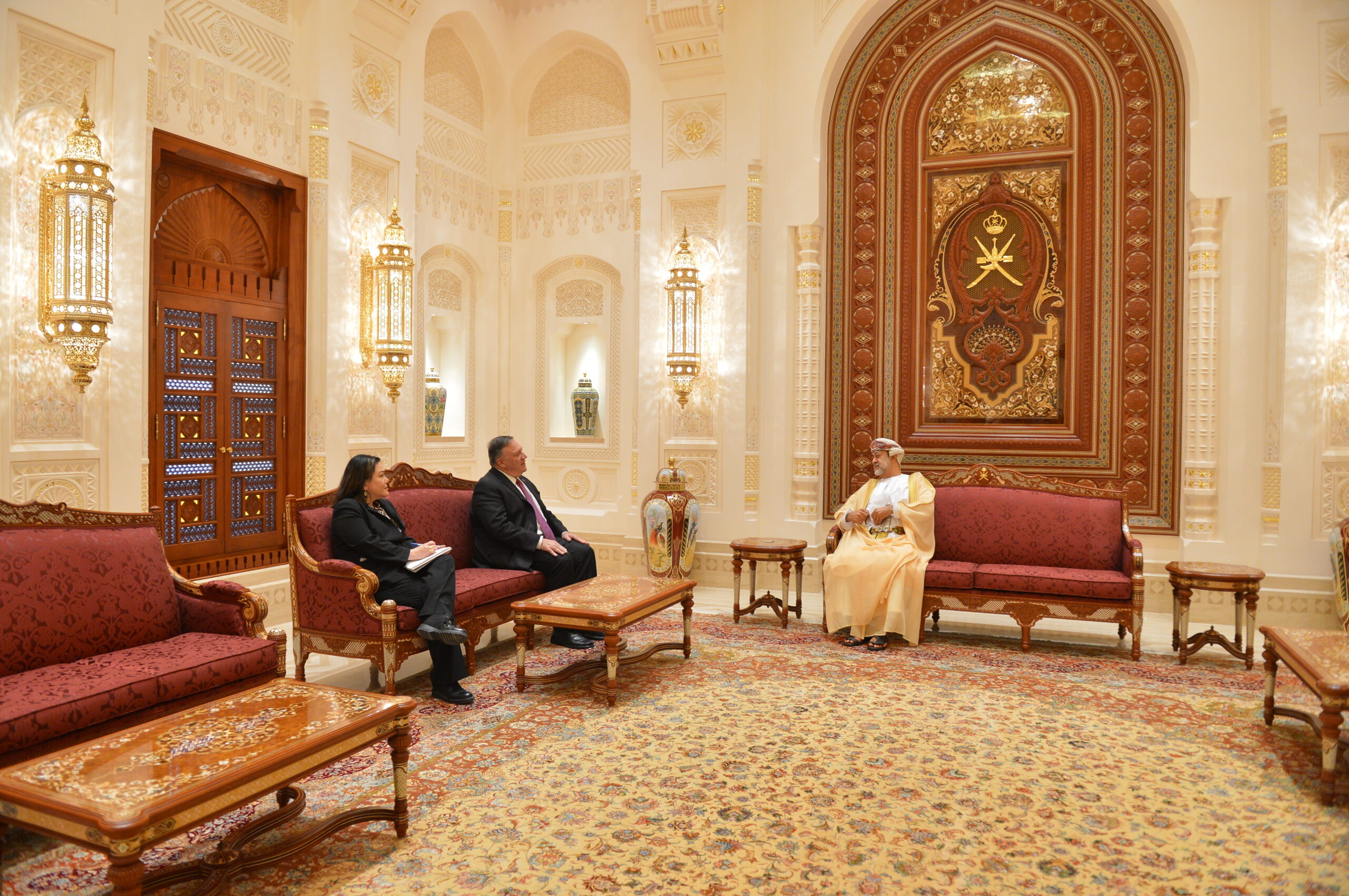
Oman’s track record as an Iran intermediary extends decades. Muscat facilitated the secret US-Iran talks that led to the 2015 JCPOA. Sultan Haitham bin Tariq has maintained the Omani tradition of equidistance — a policy that requires active management, since Oman is a GCC member geographically positioned at the mouth of the Strait of Hormuz. The country’s February 2026 call for an immediate ceasefire was delivered without conditions, a posture that distinguishes Muscat from every other Gulf capital.
The proximity talks format — Witkoff and Araqchi in separate rooms, Omani go-betweens shuttling between them — is itself a concession to Iranian sensitivities. Tehran will not sit across a table from US officials. But Iranian willingness to be in the same building, separated by a hallway and an Omani diplomat, represents a form of engagement that the Islamabad framework never achieved.
Oman’s limitations are equally clear. Muscat cannot compel either party to modify its terms. Oman lacks the military weight to guarantee any agreement — it is not a party to the SMDA, does not host large US forces, and its own armed forces are sized for territorial defence. The Omani channel functions as a communications relay, not a pressure mechanism. For Saudi Arabia, this means Oman can facilitate but cannot deliver — a distinction that becomes acute when the clock shows 96 hours.
There is also a structural problem with transferring Saudi diplomatic investment from the Islamabad framework to the Omani track. The quadrilateral format was designed to present Iran with a coalition. Oman operates bilaterally. The coalition format — Saudi Arabia, Turkey, Egypt, Pakistan presenting a united front — was intended to raise the diplomatic cost of Iranian rejection. Oman’s bilateral approach lowers that cost. Iran can engage Muscat precisely because engaging Muscat commits Tehran to nothing.
Ninety-Six Hours
Trump’s April 6 deadline concerns the expiry of a pause on US strikes against Iranian energy infrastructure, granted on March 26 after Iran allowed several tankers through the Strait of Hormuz. The pause was framed as a confidence-building gesture. Its expiry would be framed as a consequence of failed confidence-building.
For Saudi Arabia, the deadline creates a binary that the kingdom has spent weeks trying to convert into a spectrum. The Islamabad framework was one mechanism for extending the spectrum — if mediation was visibly underway, the argument for extending the pause would strengthen. With mediation visibly collapsed, that argument weakens.
Prince Faisal’s March 7 positioning remains operative: the warning that continued Iranian attacks could lead Riyadh to permit US military operations from Saudi bases, delivered alongside an affirmation of Saudi preference for diplomacy. That formulation — conditional escalation paired with stated preference for restraint — requires a credible diplomatic track to sustain. The diplomatic track was the Islamabad framework. The Islamabad framework is gone.
What remains is a set of uncomfortable calculations. If the April 6 deadline passes and the US resumes strikes on Iranian energy infrastructure, Saudi Arabia faces retaliation risk that the CSIS assessment quantifies in economic terms — “far greater Iranian retaliation, potentially causing long-lasting damage to the Saudi economy.” If the deadline is extended without a diplomatic basis, Trump faces a credibility cost he may be unwilling to absorb. If Iran offers a last-minute concession — another batch of tankers through Hormuz, a statement of willingness to meet — Saudi Arabia would need to validate it through a channel that no longer exists.
The Pakistan-China five-point plan, issued in the final hours of March, represents an attempt to construct a new vehicle from the wreckage of the old one. Beijing’s involvement changes the equation: China brokered the 2023 Saudi-Iran normalization and retains influence in Tehran that no other external actor can match. But the plan has received no Iranian response, and 96 hours is not enough time to build consensus around a framework that is itself only days old.
Araqchi’s April 1 statement — “trust level is at zero” — is directed at Washington, not Riyadh. But zero trust in the US negotiating partner necessarily degrades the value of any mediation that carries US terms. Saudi Arabia cannot offer Iran a deal that does not include American commitments. American commitments, in Iranian eyes, are worthless. The mediator’s credibility is irrelevant when the principal’s credibility is what the other side disputes.
The Saudi Position on April 2
Riyadh holds a phone line to Araqchi. It holds a defence pact with Pakistan that survives the mediation collapse. It holds a seat at the Omani proximity table, though not as the convener. It holds the conditional threat that Faisal articulated on March 7 — US base access as an escalation lever. And it holds the awareness that a US-Iran deal reached without Saudi input could prove worse for Riyadh than no deal at all.
What it does not hold is a mechanism to convert any of these positions into a negotiated outcome within 96 hours. The Islamabad framework was that mechanism. Its construction took six months. Its destruction took thirteen days.
| Date | Event | Significance |
|---|---|---|
| Sept. 17, 2025 | SMDA signed at Al Yamamah Palace | Credibility foundation for Pakistan mediator role |
| March 2026 | Pakistani air defence units deploy to Saudi Arabia | SMDA operationalized — complicates neutrality claim |
| March 19, 2026 | Riyadh quadrilateral FM meeting | Framework conceived; Saudi, Turkey, Egypt, Pakistan align |
| March 21-22, 2026 | Saudi expulsion of Iranian military attaché and staff | Mission reduced from 6 to 1; 24-hour departure order |
| March 25, 2026 | US 15-point plan transmitted via Pakistan | Iran calls terms “excessive and unreasonable” |
| March 26, 2026 | Trump grants 11-day pause on energy strikes | April 6 deadline set |
| March 29-30, 2026 | Islamabad quadrilateral meeting | Joint mediation offer formalized; Iran absent |
| March 30, 2026 | Dar announces 20 Pakistani-flagged ships through Hormuz | Iran denies within 24 hours |
| March 31, 2026 | Baghaei formally rejects Islamabad framework | “We did not participate” — erases premise of channel |
| March 31-April 1 | Pakistan-China joint five-point plan issued | New vehicle; no Iranian response yet |
| April 1, 2026 | Araqchi: “trust level is at zero” | Iran rules out US negotiations |
| April 2, 2026 | US-Israeli strike on Kharazi residence | Back-channel operator removed; wife killed |
Frequently Asked Questions
What was the Strategic Council on Foreign Relations that Kharazi chaired, and why does its disruption matter more than the loss of a single official?
The Strategic Council on Foreign Relations was created in 2006 by then-Supreme Leader Ali Khamenei as an advisory body that reports directly to the Supreme Leader’s office, bypassing the Foreign Ministry entirely. Its membership includes former foreign ministers, senior IRGC commanders, and intelligence officials. The Council’s function is to manage diplomatic engagements that Iran cannot publicly acknowledge — pre-negotiation contacts, back-channel exchanges, and deniable outreach. With Kharazi incapacitated and the IRGC military council now dominant in Iranian governance, no civilian institution retains both the authority and the institutional memory to resume the kind of quiet engagement Kharazi was conducting with Pakistan regarding a potential Vance meeting. The Council’s staff continue to operate, but without Kharazi’s personal authority — granted by two successive Supreme Leaders — their capacity to commit Iran to positions is unclear.
Has Saudi Arabia attempted mediation with Iran through any channel that Tehran has not rejected?
The Faisal-Araqchi direct phone line remains active and has not been publicly repudiated by either side. Araqchi’s rejection statements on April 1 were directed at US negotiations and the Pakistan framework specifically — he did not criticize Saudi bilateral contacts. The Omani proximity track, in which Saudi Arabia participates indirectly through GCC coordination with Muscat, has also not been rejected by Tehran. Araqchi physically attended proximity sessions in Oman, which represents a higher level of engagement than Iran ever offered the Islamabad format. The distinction is that both surviving channels operate bilaterally, not through the coalition format Riyadh preferred.
What happens to the SMDA if Pakistan’s diplomatic function is no longer relevant to Saudi Arabia?
The SMDA was structured as a defence agreement, not a diplomatic mandate. Pakistani air defence units currently deployed on Saudi soil operate under military-to-military protocols that are unaffected by the collapse of Pakistan’s mediation role. The agreement covers joint procurement, training exchanges, defence technology transfer, and mutual consultation on security threats — none of which depended on the Islamabad framework. For Islamabad, the risk is reputational rather than contractual: the SMDA’s value to Saudi Arabia narrows from strategic partnership (defence plus diplomacy) to a transactional military arrangement. Pakistan’s Defence Minister, Khawaja Asif, has not publicly addressed the mediation collapse’s implications for the broader relationship.
Could China’s involvement in the Pakistan-China joint plan change Iran’s calculation?
Beijing brokered the 2023 Saudi-Iran normalization agreement and retains commercial and energy relationships with Tehran that survived the outbreak of war. China purchases approximately 90 percent of Iran’s sanctioned oil exports, giving it an economic relationship with Tehran that no Western or Gulf state can replicate. The Pakistan-China five-point plan adds Beijing’s implicit guarantee to any framework Iran might accept — a guarantee that carries weight because China, unlike the United States, has not struck Iranian territory. Tehran’s calculation would weigh Chinese reliability against the plan’s substance. If the five points resemble the US 15-point plan in content, Chinese sponsorship will not overcome Iranian objections to the terms. If they chart a genuinely different course — one centred on the permanent ceasefire and sovereignty guarantees Iran demands — Beijing’s involvement could reopen a track that Washington’s credibility deficit has closed.
Why did Trump set the April 6 deadline and what are the consequences of its expiry?
The 11-day pause on strikes against Iranian energy infrastructure was granted March 26 after Iran permitted several tankers through the Strait of Hormuz — a de-escalatory gesture that Trump framed as evidence his pressure campaign was working. The pause expires April 6. If resumed strikes target Iranian refineries, export terminals, or pipeline infrastructure, the immediate consequence is a spike in global oil prices that would affect Saudi Arabia’s own export revenues through regional instability and insurance-rate increases on Gulf shipping. Tehran has signalled through multiple channels that strikes on energy infrastructure would trigger retaliation against Gulf state facilities — a threat the CSIS April 1 assessment described as potentially causing “long-lasting damage to the Saudi economy.” The deadline functions as a forcing mechanism, but it forces all parties simultaneously, including allies the US depends on for basing and overflight rights.