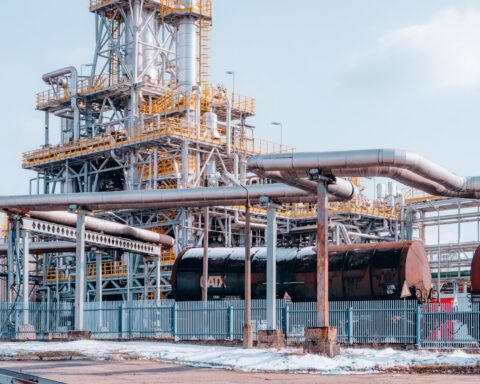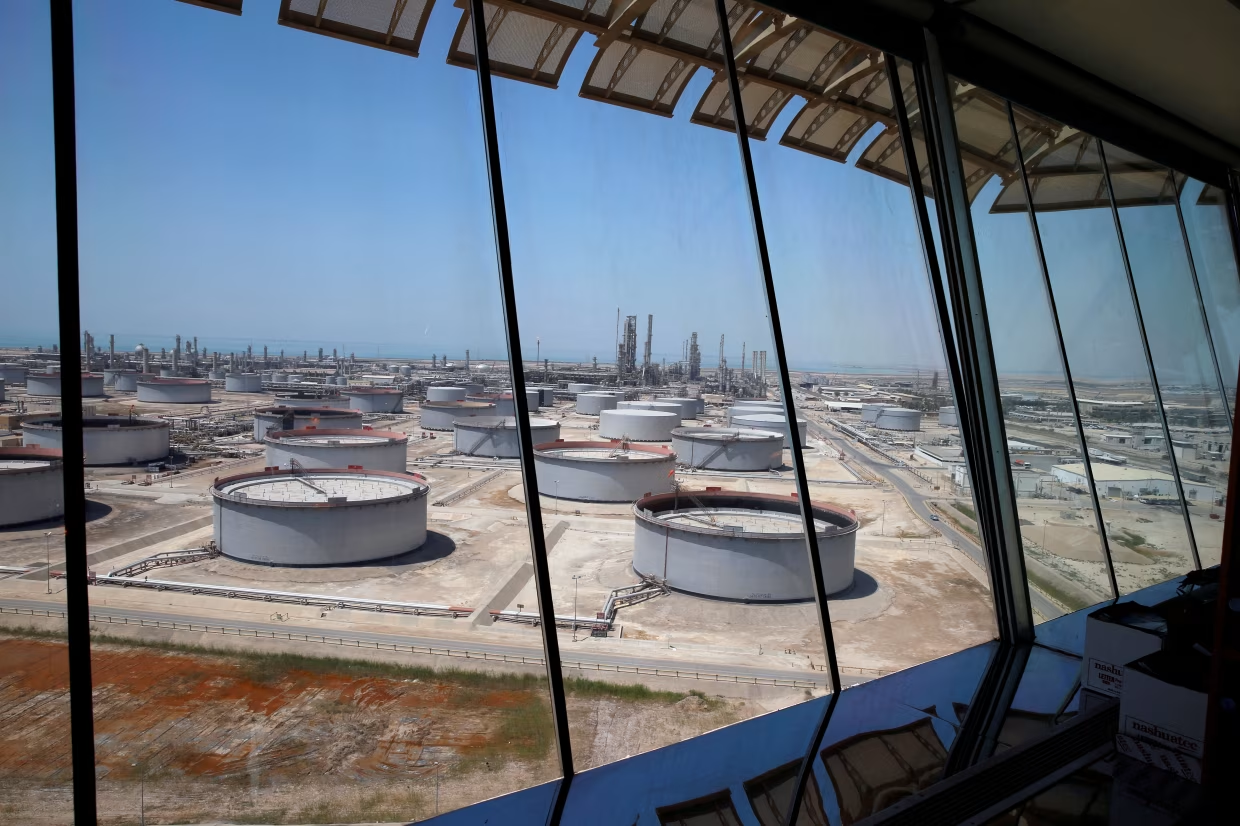

Half a million barrels per day of refining capacity went dark on Monday morning. Saudi Aramco confirmed that its Ras Tanura refinery, one of the largest and most strategically important energy installations in the Middle East, has been shut down as a precautionary measure after Iranian drones struck the facility on March 2. Two Shahed-series drones were intercepted above the complex, but falling debris ignited what Aramco described as a “limited fire” within the refinery’s processing units. No casualties were reported. The fire was contained within hours. The refinery, which processes 550,000 barrels per day of crude oil into gasoline, diesel, and jet fuel, remains offline as of March 3 with no public timeline for restart.
The market response was immediate and unambiguous. Gasoil and diesel futures spiked within minutes of the first reports. Brent crude, already elevated from the broader Gulf crisis, surged toward $80 per barrel before trading desks had finished their morning coffee. By the close of European trading, Brent was up between 10 and 13 percent on the day, and energy analysts at Goldman Sachs, Morgan Stanley, and JP Morgan were racing to publish revised forecasts with triple-digit price targets. The consensus view that had seemed extreme 72 hours earlier — $100 per barrel — was suddenly the baseline scenario.
Ras Tanura is not just a refinery. It is one of the world’s largest offshore oil loading facilities, the arterial junction where Saudi crude is processed and prepared for export to Asia, Europe, and the Americas. Its shutdown, even temporarily, removes a critical node from the global energy supply chain at precisely the moment when that chain is under the most severe stress it has experienced since the 1973 Arab oil embargo. Combined with the effective closure of the Strait of Hormuz, where shipping traffic has fallen by 70 percent after Iranian attacks on commercial tankers, the Ras Tanura shutdown means Saudi Arabia’s ability to produce, refine, and export oil — the fundamental activity that funds the Saudi state — is under simultaneous assault from the air and from the sea.
The Strike: What Happened at Ras Tanura
The attack unfolded in the early hours of Monday morning, when Iranian drones approached Ras Tanura from across the Persian Gulf. Saudi air defense systems detected and engaged two incoming Shahed-series unmanned aerial vehicles. Both were intercepted. But in the mathematics of modern air defense, interception does not always equal neutralization. Debris from the destroyed drones fell onto the refinery complex, landing in or near active processing units. The resulting fire, while described by Aramco as limited in scope, was sufficient to trigger emergency shutdown protocols across the facility.
Aramco’s decision to take the entire refinery offline, rather than isolate the affected units and continue partial operations, signals either that the damage was more significant than public statements suggest or that the company judged the risk of secondary attacks too high to maintain operations. Given that the refinery sits on Saudi Arabia’s Gulf coast, exposed to the shortest possible flight path from Iranian launch sites, the precautionary logic is sound even if the economic cost is staggering. Every day that Ras Tanura remains offline removes 550,000 barrels of refined product from global markets — product that cannot simply be replaced by other facilities operating at or near capacity.
This is the second time Ras Tanura has been targeted. In March 2021, Houthi rebels launched a drone and ballistic missile attack against the facility and nearby Dhahran residential compounds. That attack was intercepted without damage. The 2021 incident was treated as a warning. The 2026 strike is the warning fulfilled. The difference is not merely one of outcomes — debris versus clean interception — but of adversary. The Houthis operate Iranian-supplied weapons with limited targeting sophistication. The March 2 attack was conducted by Iran directly, using drones launched from Iranian territory as part of a coordinated campaign that simultaneously targeted facilities in Qatar and tankers transiting the Strait of Hormuz.
The Abqaiq Ghost: Saudi Energy Infrastructure Under Fire
Saudi defense planners have lived with the specter of the September 2019 Abqaiq-Khurais attack for nearly seven years. That assault, in which 18 drones and seven cruise missiles struck the world’s largest oil processing facility, temporarily halved Saudi crude output and removed 5.7 million barrels per day from global supply. It was the single most destructive attack on energy infrastructure in modern history, and it exposed a vulnerability that Saudi Arabia has spent billions of dollars and the better part of a decade attempting to remediate.
The Ras Tanura strike confirms that the remediation has been insufficient. Despite the deployment of additional Patriot PAC-3 batteries, THAAD systems, and dedicated counter-unmanned aerial system platforms around critical energy installations, Iranian drones penetrated Saudi airspace and reached their target. The interceptions occurred close enough to the refinery for debris to cause operational damage. This is not a defense success with minor complications. It is a defense architecture that achieved interception but failed to prevent the strategic objective of the attack: shutting down the refinery. An in-depth examination of how Saudi Arabia’s $80 billion air defense shield has performed across the broader conflict exposes systemic weaknesses that extend well beyond Ras Tanura.
| Date | Target | Attacker | Method | Impact | Recovery Time |
|---|---|---|---|---|---|
| September 14, 2019 | Abqaiq & Khurais | Iran (Houthis claimed) | 18 drones, 7 cruise missiles | 5.7 million bbl/day offline (~50% of Saudi output) | ~2 weeks to full restoration |
| March 7, 2021 | Ras Tanura & Dhahran | Houthi rebels | Drones and ballistic missile | Intercepted; no damage to facility | N/A — no disruption |
| March 2, 2026 | Ras Tanura refinery | Iran (direct) | Shahed-series drones | 550,000 bbl/day refinery shut down; limited fire | Unknown — facility remains offline |
The pattern in this table tells a story that Saudi defense officials would prefer not to acknowledge publicly. The attacks are getting more frequent. The adversary is getting bolder. And the one successful defense — the 2021 Ras Tanura interception — was against the weaker adversary. When Iran itself conducts the attack, as it did in 2019 at Abqaiq and in 2026 at Ras Tanura, damage gets through. The question is no longer whether Saudi air defenses can intercept incoming threats. They can. The question is whether interception alone is sufficient when a $35,000 drone can force the shutdown of a facility that processes half a million barrels a day.
The Cost Asymmetry Problem
Every Shahed-136 drone that Iran launches toward Saudi Arabia costs between $20,000 and $50,000 to manufacture. The Patriot interceptor missiles used to shoot them down cost between $2 million and $4 million each. The refinery that was shut down by debris from a successful interception generates revenue measured in hundreds of millions of dollars per day. This is the arithmetic of modern asymmetric warfare, and it is an equation that fundamentally favors the attacker.
Iran does not need to destroy Ras Tanura to achieve its strategic objective. It does not even need to hit the refinery directly. It needs only to create sufficient risk that Aramco determines continued operations are too dangerous. A drone that is intercepted 200 meters from a processing tower, showering the facility with flaming debris, achieves the same outcome as a direct strike: the refinery goes offline. The defender pays millions per engagement. The attacker pays thousands. And the economic damage, measured in lost production, market panic, and insurance premium spikes, dwarfs the cost of both the attack and the defense combined.
This asymmetry extends beyond the individual engagement to the broader strategic picture. Iran can manufacture Shahed drones at industrial scale. Its drone production capacity, dispersed across hardened facilities throughout the country, survived the initial US-Israeli strikes and continues to operate. Saudi Arabia cannot manufacture Patriot missiles. It purchases them from Raytheon at prices and delivery timelines set by the American defense-industrial complex. The attacker controls its own supply chain. The defender depends on a foreign one. In a protracted conflict, this dependency becomes a strategic liability of the first order.
Saudi Arabia has invested in domestic defense manufacturing through the Saudi Arabian Military Industries (SAMI) consortium, but SAMI’s capabilities remain nascent. The Kingdom cannot produce advanced air defense interceptors domestically. For the foreseeable future, every drone Iran launches is answered by a missile that Saudi Arabia must buy from the United States. The economics of this exchange rate are unsustainable in a prolonged conflict.
Hormuz, Ras Tanura, and the Double Chokepoint
To understand the severity of the current crisis, it is necessary to consider Ras Tanura not in isolation but as one node in a supply chain that is under attack at multiple points simultaneously. Iran has since expanded its targeting to include the Shaybah oil field deep in the Empty Quarter, a facility producing one million barrels per day of irreplaceable Arabian Extra Light crude that feeds the very pipeline network Ras Tanura depends on. Saudi oil exports depend on a sequence of connected operations: extraction from oil fields, processing at facilities like Abqaiq, refining at plants like Ras Tanura, loading onto tankers at export terminals, and shipment through maritime chokepoints to global markets. Iran’s campaign is targeting this chain at both ends — hitting the refinery where crude is processed and blockading the strait through which it must be shipped.
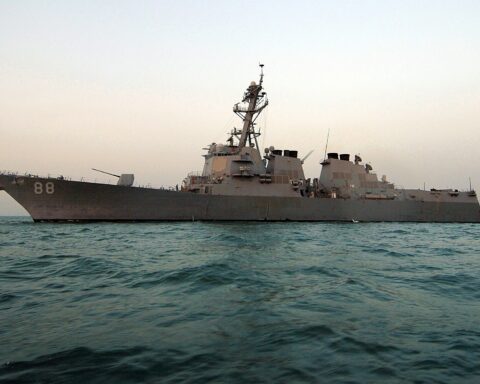
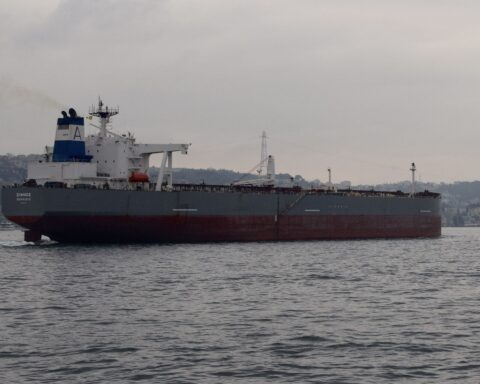
The Strait of Hormuz, through which approximately 20 percent of the world’s daily oil consumption transits, has seen a 70 percent reduction in shipping traffic since Iranian forces began targeting commercial tankers. At least three tankers have been struck in or near the strait, including one vessel set ablaze off the coast of Oman. Maersk and Hapag-Lloyd, two of the world’s largest container shipping companies, have suspended transits through the waterway. Marine insurers have halted coverage for voyages in the area, effectively pricing the strait out of commercial viability.
Qatar, the world’s largest exporter of liquefied natural gas, halted LNG production after Iranian drone strikes hit its own facilities. This is not merely a Saudi problem. It is a Gulf-wide energy catastrophe that has removed a significant fraction of global hydrocarbon supply from the market in the space of 48 hours.
For Saudi Arabia specifically, the double chokepoint — refinery offline, strait blocked — creates a cascading failure. Oil that cannot be refined at Ras Tanura must be rerouted to other facilities, adding logistical complexity and reducing throughput. Refined product that cannot transit Hormuz must be sent via pipeline to Red Sea terminals, principally through the East-West Pipeline (Petroline) to Yanbu. But the Petroline has a maximum capacity of approximately 5 million barrels per day, and it is already operating at elevated throughput to compensate for the Hormuz disruption. There is limited spare capacity in the system. Every additional barrel that must bypass the Gulf loading terminals strains infrastructure that was designed for surge capacity, not sustained rerouting.
The cascading infrastructure risk extends beyond oil. Saudi Arabia’s desalination plants, which produce 70 percent of the Kingdom’s drinking water, sit on the same exposed Gulf coastline as Ras Tanura. A sustained drone campaign against Saudi water and desalination infrastructure could trigger a humanitarian crisis far more acute than any energy disruption.
Aramco’s Valuation Under Fire
Saudi Aramco went public in December 2019, three months after the Abqaiq attack demonstrated that the world’s most valuable company was also one of its most exposed. The IPO was the centerpiece of Crown Prince Mohammed bin Salman’s economic transformation program, designed to raise capital, establish market discipline within Aramco’s operations, and provide a vehicle for the Public Investment Fund to diversify away from direct oil dependency. The company’s valuation, briefly touching $2 trillion, was predicated on the assumption that Saudi Arabia could protect its energy infrastructure and maintain the uninterrupted production and export capacity that justifies Aramco’s extraordinary premium to global energy peers.
The Ras Tanura shutdown tests that assumption directly. Aramco shares, which trade on the Saudi Tadawul exchange, fell on the news before partially recovering as oil prices surged — a perverse dynamic in which the company’s stock benefits from the same supply disruption caused by the attack on its own facility. But the medium-term implications for Aramco’s equity story are unambiguously negative. Planned secondary share offerings, which Riyadh has used to raise capital for Vision 2030 projects, depend on international institutional investors accepting that Aramco’s production and export capabilities are reliable. A refinery that can be shut down by drone debris and an export route that can be closed by naval mines do not constitute a reliable production profile.
The insurance implications are equally significant. War risk premiums for energy infrastructure in the Eastern Province will increase dramatically. Aramco’s own operational insurance, the cost of which is not publicly disclosed but is understood to run into billions of dollars annually, will be repriced upward. Every downstream customer that depends on Saudi crude and refined products — refineries in South Korea, power plants in Japan, petrochemical complexes in China — must now incorporate the risk of supply interruption into their procurement strategies. Some will accelerate diversification toward non-Gulf suppliers. Others will increase strategic reserve drawdowns. All will demand risk premiums that flow back through the supply chain to Aramco’s revenue line.
Vision 2030 and the Oil Revenue Paradox
The fundamental irony of Saudi Arabia’s Vision 2030 has always been that the program designed to end the Kingdom’s dependence on hydrocarbons requires uninterrupted hydrocarbon revenue to fund the transition. The giga-projects — NEOM, The Line, Trojena, the Red Sea tourism developments, the Diriyah Gate cultural district — are financed primarily through the Public Investment Fund, which derives its capital from Aramco dividends, direct government transfers funded by oil revenue, and proceeds from Aramco share sales.
When Ras Tanura goes offline, the revenue pipeline to the PIF narrows. When the Strait of Hormuz is blocked, it narrows further. When international investors reassess their exposure to a Kingdom at war with Iran, it narrows further still. The compounding effect of simultaneous disruptions to production, export capacity, and investor confidence creates a funding squeeze that cannot be absorbed by drawing down reserves alone. Saudi Arabia’s foreign exchange reserves, while substantial at approximately $430 billion, are not infinite. A prolonged conflict that suppresses both oil export volumes and investment inflows will force painful choices about which Vision 2030 projects continue and which are deferred or scaled back.
The timing is particularly cruel. After years of delays, cost overruns, and scope reductions, several flagship Vision 2030 projects were entering critical construction phases in early 2026. NEOM’s industrial city component was beginning to take shape. The Red Sea International Airport had commenced operations. Entertainment and tourism investments were beginning to generate the visitor traffic that MBS had promised. A war that disrupts the revenue base and frightens away the foreign capital needed to sustain these projects threatens to unwind years of painstaking, expensive progress.
Foreign direct investment, already a challenge for Saudi Arabia relative to the ambitions articulated in Vision 2030 planning documents, requires above all a perception of stability. International corporations evaluating multi-billion-dollar commitments to Saudi industrial zones, entertainment complexes, and technology parks are not stress-testing their financial models against the scenario of Iranian drones striking refineries 200 kilometers from their proposed investment sites. The Eastern Province, where the majority of Saudi Arabia’s oil infrastructure and a growing share of its industrial diversification projects are concentrated, is within range of Iranian drones launched from the Iranian coastline. The flight time is measured in hours. The decision time for an investor reconsidering a commitment is measured in seconds.
The Defense Question Nobody Wants to Answer
Saudi Arabia wanted this war. That is the uncomfortable truth that underlies every discussion of the Ras Tanura strike. Crown Prince Mohammed bin Salman spent months building the case in Washington for military action against Iran’s nuclear program. The strikes came. Iran retaliated. And now the Kingdom is grappling with the consequences of a conflict it helped initiate but cannot control.
The defense question that Saudi military planners face is not whether they can intercept Iranian drones. They can, imperfectly. The question is whether any defensive architecture can protect the sprawling, geographically exposed energy infrastructure of the Eastern Province against a sustained campaign of low-cost, mass-produced unmanned aerial vehicles launched from an adversary 200 kilometers across the water. The honest answer, confirmed by both the 2019 Abqaiq attack and the 2026 Ras Tanura strike, is no. Not perfectly. Not every time. And in the energy business, the margin for error is measured not in percentages of interceptions but in barrels per day taken offline.
Point defense systems — short-range counter-drone weapons including directed energy, electronic warfare, and kinetic interceptors — can harden individual facilities. Saudi Arabia has procured and deployed such systems since 2019. But the Kingdom’s energy infrastructure spans hundreds of kilometers of the Gulf coastline, from Ras Tanura in the north through Jubail, Ras al-Khair, and Dhahran to the vast complexes of Abqaiq and Shaybah in the interior. Defending every node in this network against swarm attacks, where dozens of cheap drones are launched simultaneously to overwhelm point defense systems, requires a density of coverage that exceeds the Kingdom’s current capabilities and potentially its fiscal capacity to sustain.
The multi-front nature of the current conflict exacerbates the problem. Iranian-backed Houthis in Yemen can target Saudi infrastructure from the south. Iranian forces can target it from the east across the Gulf. Iraqi Shia militias, operating with varying degrees of Iranian coordination, could potentially target it from the north. The geometry of the threat environment means Saudi air defenses must cover a 360-degree threat arc, diluting the concentration of assets available to protect any single critical node.
Oil Markets: From Shock to Structural Repricing
The initial market response to the Ras Tanura shutdown was a classic supply shock: prices spiked, volatility exploded, and traders scrambled to reprice risk across the crude and refined product curves. Brent crude surged toward $80 per barrel. Diesel and jet fuel crack spreads widened dramatically. The options market priced in a significantly higher probability of $100-plus oil within the next 30 days.
But the Ras Tanura shutdown is not an isolated supply shock. It is one event in a cascading series of disruptions that collectively represent the most severe threat to global energy supply since the 1990-91 Gulf War. The energy crisis that was already building from the Hormuz blockade has been intensified by the loss of Ras Tanura’s refining capacity and Qatar’s LNG production halt. Energy analysts are no longer debating whether prices will reach $100 per barrel. They are debating whether $100 is the floor or the ceiling.
The structural repricing extends beyond crude oil. Refined product markets, already tight due to years of underinvestment in global refining capacity, face the loss of a major processing facility at a moment when spare capacity is at its lowest level in decades. Diesel, the fuel that powers global freight and industrial production, is particularly vulnerable. European diesel markets, which depend heavily on Middle Eastern supply, face the prospect of rationing if the disruption extends beyond two weeks. Natural gas markets are similarly affected: Qatar’s LNG production halt removes the world’s largest single source of liquefied natural gas, confronting European countries that pivoted from Russian pipeline gas to Qatari LNG with the fragility of that strategy.
Central banks in importing nations face an impossible policy dilemma. Energy price spikes are inflationary, suggesting tighter monetary policy. But supply shocks also suppress growth, suggesting looser policy. The stagflationary scenario that economists have warned about is now materializing: prices rising not because of excess demand but because of supply destruction.
The Restoration Timeline and What It Signals
After the 2019 Abqaiq-Khurais attack, Saudi Aramco restored 5.7 million barrels per day of processing capacity within approximately two weeks — an impressive feat enabled by spare capacity at other facilities, pre-positioned replacement components, and around-the-clock engineering mobilization. The speed was meant to signal resilience: Saudi infrastructure may be vulnerable, but it recovers fast.
Ras Tanura is a different case. The physical repair should be less complex than Abqaiq, but the context is fundamentally different. In 2019, workers and equipment moved freely in peacetime. In 2026, restoration must proceed under the threat of further attacks. Every day that workers are on-site is a day they are exposed to the next drone salvo. Aramco has not provided a public timeline for restart. What is certain is that every day offline costs the Kingdom not just the revenue from 550,000 barrels of refined product but the confidence of markets, investors, and customers that Saudi Arabia’s energy supply chain can be trusted.
What Comes Next
The Ras Tanura shutdown is not an ending. It is a data point in a conflict trajectory that has not yet reached its peak. Iran’s campaign against Gulf energy infrastructure is designed to impose costs on the states that supported or acquiesced to the US-Israeli strikes on Iranian nuclear facilities. Saudi Arabia, as the largest oil exporter in the world and the regional power that most actively lobbied for those strikes, is the highest-value target in Iran’s retaliation calculus.
Whether the Ras Tanura shutdown remains a discrete incident or the opening chapter of a sustained campaign against Saudi energy infrastructure is largely outside Riyadh’s control. Iran’s decision to continue strikes on Gulf facilities depends on the trajectory of the broader conflict and Tehran’s calculus about provoking a wider American military response. For Saudi Arabia, the immediate priorities are clear: restore Ras Tanura, reinforce Eastern Province air defenses, work with Washington to reopen Hormuz, and prevent further strikes on the Kingdom’s energy assets. Each objective is necessary. None is sufficient alone. And all depend on a conflict dynamic that MBS influenced but does not control.
The deeper strategic implication of the Ras Tanura strike extends beyond the immediate crisis. It demonstrates, for the second time in seven years, that Saudi Arabia’s economic model carries a structural vulnerability that no amount of defense spending can fully eliminate. The Kingdom’s wealth is generated by physical infrastructure — wells, pipelines, processing plants, refineries, export terminals — concentrated in a geographic area within range of an adversary that possesses the means and the motivation to attack it. Diversification through Vision 2030 was supposed to reduce this vulnerability over time. The irony is that the conflict now threatening to disrupt Vision 2030’s funding was itself partly a product of MBS’s strategic ambition to neutralize the adversary that poses the threat.
Ras Tanura is offline. The Strait of Hormuz is effectively closed. Oil is heading toward $100. And the crown jewel of Saudi Arabia’s energy empire — the infrastructure that Aramco was built to operate, that Vision 2030 was designed to eventually transcend, and that the Kingdom’s entire economic and political order depends upon — has been demonstrated, again, to be within reach of a drone that costs less than a luxury sedan. The question that Saudi Arabia must now confront is not how to defend against the next strike. It is how to build a future in which the next strike does not matter. That was always the promise of Vision 2030. The Ras Tanura fire has made its fulfillment both more urgent and more difficult than MBS could have imagined when he first sketched the transformation on a whiteboard in Riyadh a decade ago.
FAQ
How significant is the Ras Tanura refinery to Saudi Arabia’s oil operations?
Ras Tanura processes 550,000 barrels per day and doubles as one of the world’s largest offshore oil loading facilities. Its Gulf coast location makes it both strategically vital and geographically exposed to Iranian threats. The shutdown removes a significant volume of diesel, gasoline, and jet fuel from global supply at a time when spare refining capacity worldwide is extremely limited.
How does the 2026 Ras Tanura strike compare to the 2019 Abqaiq attack?
The 2019 Abqaiq-Khurais attack was larger in scale, temporarily removing 5.7 million barrels per day of crude processing capacity, roughly half of Saudi Arabia’s total output. The 2026 Ras Tanura strike affected 550,000 barrels per day of refining capacity. However, the 2026 attack occurred during an active military conflict rather than peacetime tensions, making follow-on strikes far more likely. The 2019 attack was attributed to Iran but claimed by Houthis, preserving deniability. The 2026 strike came as part of an acknowledged Iranian retaliatory campaign, removing any ambiguity about the adversary. The context makes the smaller 2026 strike potentially more consequential for long-term risk assessment.
Why did Aramco shut the entire refinery if the fire was limited?
Aramco described the shutdown as precautionary, which points to two factors. The proximity of the fire to active processing units created safety risks — refineries handle highly flammable materials at extreme pressures, and secondary explosions are a recognized risk when containment is breached. More significantly, the ongoing threat of additional drone attacks may have made continued operations untenable. Operating a refinery under active military threat exposes workers to unacceptable danger and risks catastrophic damage if a follow-on strike hits a fully operational unit.
Can Saudi Arabia reroute oil exports to bypass the Strait of Hormuz?
Saudi Arabia operates the East-West Pipeline (Petroline), connecting Eastern Province oil fields to the Red Sea port of Yanbu and bypassing Hormuz entirely. But the pipeline, with a maximum capacity of approximately 5 million barrels per day, is already at elevated throughput to compensate for the Hormuz disruption. It also carries crude oil, not refined products — meaning Ras Tanura’s refining output cannot simply be rerouted. Alternative refining would need to occur at Yanbu or at downstream facilities in importing countries. For a detailed analysis of the East-West Pipeline activation, Yanbu terminal capacity constraints, and what the reroute means for global oil markets, see our full report on Aramco’s emergency Red Sea oil export lifeline.
What impact does the Ras Tanura shutdown have on global oil prices?
The shutdown contributed to Brent crude surging 10 to 13 percent, approaching $80 per barrel, with analysts forecasting $100-plus per barrel if the disruption persists. The price impact is amplified by the simultaneous Hormuz blockade and Qatar’s LNG production halt, which together represent the most severe disruption to global energy supply since the 1990-91 Gulf War. Diesel and jet fuel prices are particularly affected because Ras Tanura is a refining facility that produces finished products, not just crude oil. The loss of refining capacity tightens markets that were already operating with historically low spare capacity.
What does this mean for Saudi Aramco’s stock and future share offerings?
Aramco’s equity story depends on the perception of reliable, uninterrupted production. A drone-induced refinery shutdown undermines that narrative directly. While shares may benefit short-term from higher oil prices, the medium-term outlook includes higher insurance costs, increased war risk premiums, and reduced international investor appetite for future secondary offerings — all of which narrow the capital available for the Kingdom’s economic transformation.
For a comprehensive analysis of how Aramco is responding to the refinery shutdown — including the emergency activation of the East-West Pipeline, the Yanbu export pivot, and four scenarios for Saudi export capacity — see Inside Aramco’s Emergency Plan to Reroute the World’s Oil.