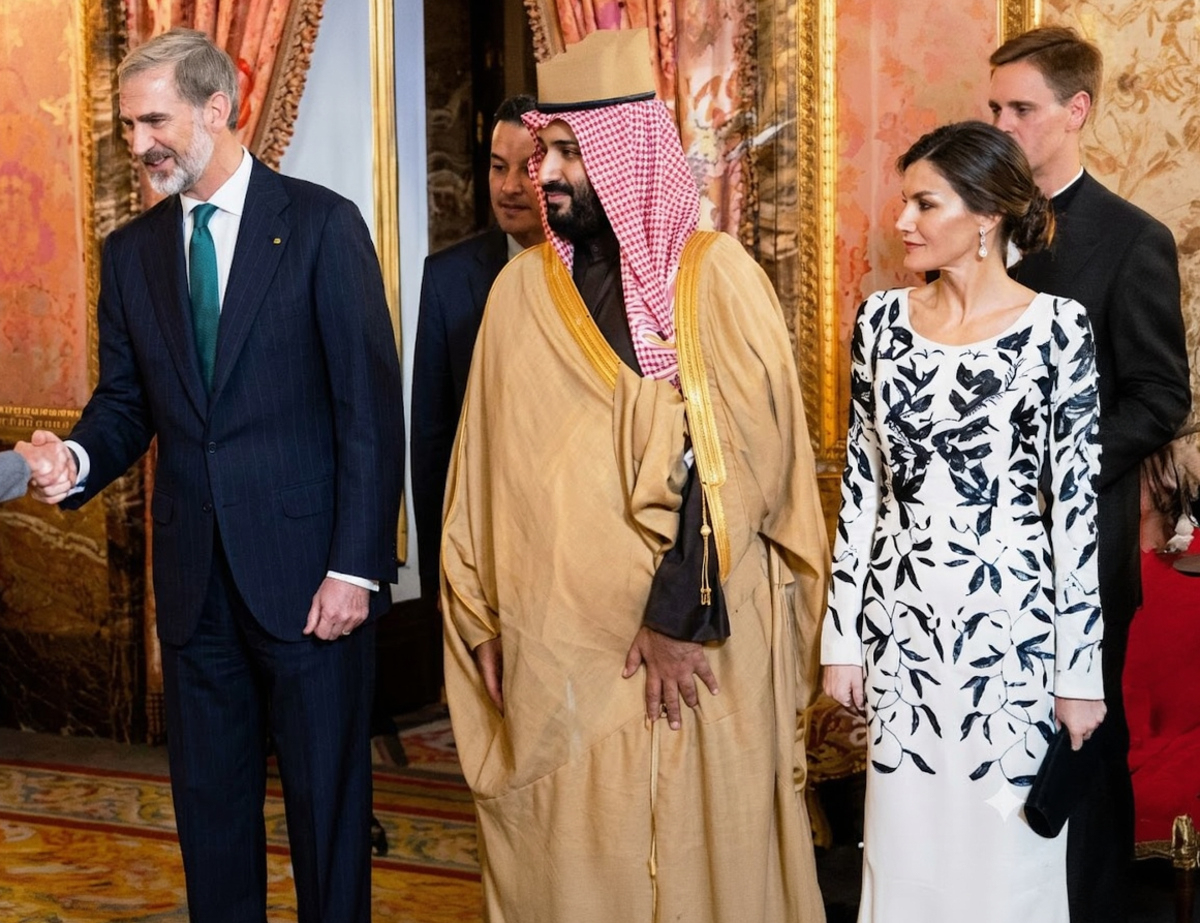

MBS’s wife is Sara bint Mashour bin Abdulaziz Al Saud, a Saudi princess and granddaughter of King Abdulaziz (Ibn Saud), the founder of Saudi Arabia. She married Crown Prince Mohammed bin Salman on 6 April 2008 and has maintained near-total anonymity throughout his rise to power.
That anonymity is striking. This page receives over 227,000 monthly impressions — making Sara bint Mashour arguably the most searched-for invisible woman in the world. There are no verified interviews, no social media accounts, and almost no photographs. Yet since 2023, her name has begun appearing in Saudi state media, attached to cultural and educational institutions of genuine scale.
What is verifiably known spans her royal lineage, her education, the 2008 marriage to a man who was then an obscure junior prince, their five children, the institutional roles that have brought her name into partial public view, and the persistent online confusion between her and a completely different princess. It also addresses what remains unknown — and what cannot be confirmed from outside the Kingdom.
Who Is Sara bint Mashour bin Abdulaziz Al Saud?
Sara bint Mashour is a Saudi princess born in 1973 in Riyadh. She is the wife of Crown Prince Mohammed bin Salman (MBS) and holds institutional leadership roles in Saudi education and cultural heritage under the Misk Foundation. Her father is Prince Mashour bin Abdulaziz, a son of Saudi Arabia’s founder.
Sara bint Mashour is royalty on both sides of her family. Through her father, she is a granddaughter of King Abdulaziz bin Abdul Rahman Al Saud (Ibn Saud). Through her mother, she is connected to the Al Kabeer family — one of the oldest Najdi noble clans, with roots predating the modern Saudi state.
Her Father: Prince Mashour bin Abdulaziz
Prince Mashour bin Abdulaziz Al Saud, born in 1942, is the thirty-fourth son of King Abdulaziz. His mother was Nuf bint Nawwaf bin Nuri Al Shaalan, from the Al Shaalan family — historically the paramount sheikhs of the Ruwala tribe within the Shammar confederation and one of the most powerful Bedouin clans of northern Arabia.
The Al Shaalan connection linked the Al Saud’s religious authority to the nomadic tribal power structures of the northern Peninsula. This gave Mashour a distinct maternal pedigree grounded in tribal aristocracy.
Prince Mashour had two full brothers. Prince Thamir bin Abdulaziz, born in 1937, died young in 1958. Prince Mamdouh bin Abdulaziz, born around 1940, lived a longer but similarly low-profile life, passing away in 2023. Neither rose to the first tier of Saudi power.
Prince Mashour serves as a member of the Allegiance Council (Hay’at al-Bay’a). The Allegiance Council is a body of senior Al Saud princes established by King Abdullah in 2006 to formalize succession decisions (Royal Court decree, 2006). The Council comprises 35 senior princes and is empowered to approve the King’s choice of Crown Prince. Mashour’s seat means Sara’s father holds one of roughly three dozen positions that collectively endorse her husband’s path to the throne.
Beyond the Council, Prince Mashour is a businessman with interests in real estate, contracting, and commercial investment. His profile is unremarkable by senior prince standards, but a son of the founder with a Council seat and a daughter married to the Crown Prince is not without influence.
Her Mother and Maternal Lineage
Sara’s mother, Noura bint Mohammed bin Saud Al Kabeer, is deceased. The Al Kabeer family is one of the most historically significant clans of the Najd region.
As a granddaughter of King Abdulaziz, Sara belongs to the same generation as her father-in-law, King Salman bin Abdulaziz. Her father Mashour and King Salman are both sons of the founder — making Sara and MBS paternal half-cousins.
The Mashour branch is not among the most politically dominant within the broader royal family. It lacks the power base of the Sudairi Seven or the line of King Abdullah. But it is respectable, wealthy, and firmly embedded within the senior ranks of the dynasty.
What Is Sara bint Mashour’s Education Background?
Sara bint Mashour attended King Saud University in Riyadh, where she studied Business Administration. King Saud University, founded in 1957, is the oldest and one of the most prestigious universities in the Kingdom. No other educational details have been publicly disclosed.
For a princess of her generation to have pursued a university degree reflects a family that valued formal education for its daughters — not universal among Saudi royals of that era, though increasingly common by the 1990s. A business administration degree would have provided a foundation in management, finance, and organizational strategy. Those skills appear directly relevant to her recent institutional board roles.
The years between her university education and her 2008 marriage remain a blank in the public record. There are no known professional roles, charitable positions, or public appearances from this period. Whether this reflects genuine inactivity or simply the absence of coverage remains unknown.
How Did Sara bint Mashour Meet MBS?
Sara and MBS married on 6 April 2008 (Saudi Press Agency, 2008). The circumstances of their introduction have never been publicly described, but the match follows a well-established pattern: royal marriages within the House of Saud are negotiated between families based on lineage and alliance.
The context of that date matters enormously. In April 2008, Mohammed bin Salman was twenty-two years old — a recent law graduate from King Saud University holding no government position of consequence. His father, Prince Salman bin Abdulaziz, was the long-serving Governor of Riyadh Province. MBS was one of Salman’s many sons and was not considered a likely future leader.
Sara was approximately thirty-five at the time — roughly thirteen years MBS’s senior. The age gap is notable but not extraordinary within Saudi royal marriage customs.
The Political Context of 2008
Saudi succession was still operating on the lateral model — passing from brother to brother among the sons of King Abdulaziz. King Abdullah occupied the throne. Crown Prince Sultan was heir apparent. Behind him stood Prince Nayef, then Prince Salman.
The idea that any grandson of the founder would leapfrog this generational queue was virtually unthinkable. When Prince Mashour gave his daughter to Prince Salman’s son Mohammed, he was making a respectable but politically unremarkable match. There was no expectation of supreme power attached to the groom.
As first cousins — their fathers Mashour and Salman being half-brothers through King Abdulaziz — the match reinforced interfamilial bonds. This is a deliberate feature of Saudi royal strategy, designed to keep wealth, influence, and loyalty circulating within the extended family.
The Transformation Nobody Predicted
In January 2015, King Abdullah died and MBS’s father ascended the throne as King Salman. MBS was immediately appointed Minister of Defense and Chairman of the Council of Economic and Development Affairs. In April 2015, he was elevated to Deputy Crown Prince.
Then, in June 2017, King Salman deposed Crown Prince Mohammed bin Nayef and installed MBS as Crown Prince (Reuters, 2017). Sara bint Mashour was now, in effect, the Crown Princess of Saudi Arabia. The relatively low-profile prince she had married in 2008 had become, within a decade, the de facto ruler of Saudi Arabia.
What Was the Impact of MBS’s Rise on Sara?
Each step in MBS’s ascent carried specific consequences for Sara bint Mashour’s position, security, and daily existence. She went from the wife of a junior prince to the spouse of the most powerful man in the Kingdom in under a decade. No aspect of her life was untouched.
From Adviser’s Wife to Crown Princess
In 2009, MBS began as an adviser in his father’s gubernatorial court. By 2013, he had risen to head his father’s court, becoming gatekeeper to Prince Salman. Sara was now the wife of the Crown Prince’s chief of staff.
Everything changed in January 2015. King Abdullah’s death made Salman king, and within hours MBS was appointed Minister of Defense and Chairman of CEDA. By June 2017, he was Crown Prince. The security implications were profound.
The wife of a junior prince moves through Riyadh with modest protection. The wife of a Crown Prince who is simultaneously launching a war in Yemen, restructuring the economy, and making powerful enemies among displaced rivals requires a security apparatus of a completely different order.
The Ritz-Carlton Purge and Khashoggi Crisis
In November 2017, MBS orchestrated the Ritz-Carlton purge — detaining hundreds of princes and businessmen on corruption allegations. Among those held was Prince Al-Waleed bin Talal, the Kingdom’s most famous businessman. Sara’s own father sat on the Allegiance Council that had endorsed MBS’s elevation just months earlier.
The structural tension was clear: MBS was consolidating power by force against members of the extended family into which Sara had been born.
Then came the Khashoggi crisis of October 2018. The killing of journalist Jamal Khashoggi inside the Saudi consulate in Istanbul produced the worst international crisis of MBS’s career. World leaders distanced themselves. Business executives withdrew from the Future Investment Initiative.
Throughout both crises, Sara bint Mashour was completely invisible. No statement. No public appearance. No leaked photograph of solidarity or grief. The contrast with Queen Rania of Jordan — who has repeatedly appeared publicly during crises — could not be starker.
A visible spouse would have become another target for scrutiny. Sara’s absence was consistent with her absence during everything else, but it was also a strategic asset. Journalists could not ask her questions. Photographers could not capture her reactions. Her invisibility removed an entire vector of vulnerability from MBS’s public position.
Why Is MBS’s Wife So Private?
Sara bint Mashour is, by any reasonable measure, the most invisible spouse of any head of state among the world’s major powers. She has no known social media accounts, has never given a public interview, and has never been photographed at an international summit or state dinner. Four distinct factors explain this.
Saudi Cultural Tradition
Despite rapid social liberalization under Vision 2030, the privacy of royal women remains a deeply held norm within many branches of the House of Saud. Women like Princess Ameera al-Taweel or Princess Reema bint Bandar represent one end of a spectrum. Many royal women remain entirely out of public view.
MBS’s Own Stated Preference
At a press conference during a 2018 state visit to Paris, MBS directly addressed the question of his family’s visibility, stating that he wanted his family to live normally. That statement was widely interpreted as a deliberate signal that his wife and children would not be paraded before the global media.
The juxtaposition was striking. Here was the architect of Saudi women’s social reforms — women driving, women entering the workforce, entertainment liberalization — explicitly choosing to keep his own wife invisible.
Security Considerations
MBS is arguably the most consequential and controversial leader in the Middle East. Keeping his wife and children out of public view reduces their exposure as potential targets. In a region where political pressure through family members is not an abstract threat, the invisibility of Sara bint Mashour may be as much a security protocol as a cultural preference.
Political Strategy
MBS has cultivated a persona as a singular, decisive leader reshaping Saudi Arabia by force of will. The absence of a visible spouse reinforces that image of solitary authority. Unlike monarchs who project power through a royal couple, MBS projects power as an individual.
The Reform Paradox
Beginning in 2016, MBS launched the most ambitious social liberalization program in Saudi history. Women driving. Relaxed gender segregation. Cinemas reopening after thirty-five years. Mixed-gender concerts. The messaging was clear: Saudi Arabia was opening up, and women were central to that transformation.
Yet the most prominent woman in the Crown Prince’s own life remained entirely invisible. Is this a contradiction? Or is it a deliberate separation of public policy from private life — a statement that reform is about the rights of ordinary Saudi women, not the display of royal ones? Saudi observers and Western commentators interpret the tension very differently.
Saudi state media reinforces this architecture of absence. When Sara is referenced, she is consistently identified as the “spouse of His Royal Highness the Crown Prince” rather than by her own name in headline position. Her identity is defined relationally, through her husband.
The Royal Visibility Spectrum: Where Does Sara Rank?
Saudi and Gulf royal women occupy vastly different positions on what can be called the Royal Visibility Spectrum — a range from total public invisibility to active global celebrity. Understanding where Sara bint Mashour falls on this spectrum clarifies her position within the broader world of Arab monarchy.
| Category | Definition | Examples |
|---|---|---|
| Invisible | No photos, no interviews, no social media, name rarely in media | Sara bint Mashour (pre-2023) |
| Named but Unseen | Name appears in official dispatches for institutional roles; no photographs or personal media | Sara bint Mashour (2023–present) |
| Behind-the-Scenes Influencer | Known to exercise influence privately; occasional reference in official contexts | Princess Iffat al-Thunayan (wife of King Faisal), Princess Noura bint Abdulrahman |
| Institutional Leader | Holds formal positions; appears at events; limited personal branding | Princess Reema bint Bandar (Saudi Ambassador to the US), Princess Loulwa al-Faisal |
| Globally Visible | Active media presence, international speaking engagements, personal brand | Princess Ameera al-Taweel, Sheikha Moza bint Nasser (Qatar), Queen Rania (Jordan) |
Sara currently sits at the boundary between “Invisible” and “Named but Unseen.” She has moved from the first category to the second since 2023, but remains far from the institutional or global visibility tiers. Whether she continues to ascend this spectrum — particularly if MBS becomes King — is one of the open questions about Saudi royal life.
Historical Comparison Within the House of Saud
Princess Noura bint Abdulrahman, the elder sister of King Abdulaziz, was a confidante and adviser to the founder, reportedly present during military campaigns. She represents the archetype of the royal woman as private political force — never holding formal office, but exercising influence through proximity to power.
Princess Iffat al-Thunayan, wife of King Faisal, is perhaps the most consequential royal consort in Saudi history. She founded Dar Al-Hanan — the first girls’ school in Saudi Arabia — in 1955 and later Effat University, driving women’s education behind the scenes.
Princess Reema bint Bandar represents the modern archetype. She served as Vice President for Women’s Affairs at the General Sports Authority, then became Saudi Arabia’s Ambassador to the United States in 2019 — the first woman to hold an ambassadorial post in the Kingdom’s history.
Princess Haifa bint Faisal, wife of Prince Bandar bin Sultan, illustrates the risks of exposure. Her name surfaced during 9/11 investigations when charitable donations she made were traced to individuals connected to the hijackers, though no intentional support was established.
Sara’s emerging profile most closely resembles a carefully managed, modern version of the Iffat model: influence exercised through institutions rather than personal visibility, framed within education and heritage rather than politics or diplomacy.
How Many Children Does MBS Have?
Mohammed bin Salman and Sara bint Mashour have five children. No public photographs exist of any of them. Their names are known through official announcements, but no school details, images, or personal information have ever been made public. This level of privacy is exceptional even by Saudi royal standards.
The names of their children are a study in dynastic signaling. Each is a deliberate tribute to a specific branch of the family tree:
- Prince Salman — the eldest son, named after his paternal grandfather, King Salman bin Abdulaziz. Naming the firstborn after the paternal grandfather is a deeply rooted Arab tradition.
- Prince Mashour — named after his maternal grandfather, Prince Mashour bin Abdulaziz, honoring Sara’s branch of the royal family.
- Princess Fahda — named after MBS’s mother, Fahda bint Falah Al Hithlain, the paternal grandmother and a member of the prominent Al Hithlain tribe.
- Princess Noura — named after Sara’s mother, Noura bint Mohammed bin Saud Al Kabeer, the maternal grandmother.
- Prince Abdulaziz — born in April 2021, the youngest child is named after the great-grandfather of both parents: King Abdulaziz (Ibn Saud), the founder of Saudi Arabia.
The Naming Pattern Decoded
The symmetry is unusually balanced: paternal grandfather, maternal grandfather, paternal grandmother, maternal grandmother, then the shared great-grandfather. In many Saudi royal families, the paternal line receives heavier emphasis. The equal treatment of Sara’s parents alongside MBS’s may reflect the weight given to her branch or the personal dynamics of the marriage.
Privacy Compared to Other Royal Children
The informational vacuum around these children is extraordinary. No school information has ever been disclosed. No household staff member has ever spoken to media. Compare this with other Gulf royal families: the children of the UAE’s Sheikh Mohammed bin Rashid Al Maktoum are highly visible, appearing at public events and maintaining social media accounts. The children of Qatar’s Emir have been photographed at state events.
MBS’s children exist, by design, in a complete informational void. Their ages can be estimated from the marriage date (2008) and the birth announcement of the youngest (2021), but exact birth dates for the older four have never been released publicly. Whether the children attend school in Saudi Arabia or abroad is unknown. Whether they have traveled with MBS on state visits is unconfirmed. The privacy is absolute.
What Are Sara bint Mashour’s Institutional Roles?
Since 2023, Sara bint Mashour’s name has appeared in Saudi Press Agency (SPA) dispatches connected to institutional projects of genuine significance. There have been no photographs, no interviews, and no social media launches. But for a woman who was entirely invisible for fifteen years, the mere appearance of her name in official communications marked a notable departure.
ilmi Center: Chairman of the Board
In May 2023, Sara was identified as Chairman of the Board of the ilmi Center. The ilmi Center spans 27,000 square meters (Misk Foundation, 2023) and is a STREAM (Science, Technology, Reading, Engineering, Arts, and Mathematics) education center located within the Mohammed bin Salman Nonprofit City in Riyadh.
At 27,000 square meters, this is not a symbolic project. The STREAM framework adds Reading to the more common STEM acronym — signaling an emphasis on literacy and the humanities alongside technical education. The distinction is deliberate: scientific education without critical reading and artistic thinking produces technicians, not innovators.
Sara’s role as Chairman of the Board indicates executive-level governance involvement, not titular patronage. Programming includes digital offerings, pop-up learning experiences, and interactive exhibits designed to make STREAM disciplines accessible across age ranges. The center was announced in 2023 with the physical facility scheduled to open in 2025.
Asaan Heritage Museum: Chairperson
In February 2025, Sara was announced as Chairperson of the Asaan Heritage Museum. The Asaan Heritage Museum covers 40,000+ square meters, designed by Zaha Hadid Architects (Misk Foundation, 2025). It will be built in the historical district of Diriyah — the ancestral home of the House of Saud and a UNESCO World Heritage Site.
The Zaha Hadid Architects commission is architecturally significant. The firm, founded by the late Pritzker Prize-winning architect Zaha Hadid, is known for fluid, futuristic forms. Yet the Asaan design reportedly draws from traditional Najdi architectural styles — the mud-brick geometric forms that characterize the At-Turaif district. The result is intended to synthesize heritage and modernity.
The choice of Diriyah is symbolically potent. The first Saudi state was established there in the eighteenth century. A heritage museum at that site, chaired by the Crown Prince’s wife, positions Sara at the intersection of national identity, cultural preservation, and the Al Saud founding narrative.
Alnahda Society and Charitable Patronage
In June 2023, Sara sponsored a charity ceremony organized by the Alnahda Society in Diriyah. Alnahda is one of the oldest women’s philanthropic organizations in Saudi Arabia. Her sponsorship signaled an engagement with civil society that, while modest in scale, was unprecedented for a woman entirely absent from public life.
Children with Type 1 Diabetes Support Fund
In November 2025, coinciding with World Diabetes Day, Sara donated 10 million SAR (~$2.67M) to the Children with Type 1 Diabetes Support Fund (Saudi Ministry of Health, 2025). The fund provides insulin pumps and continuous glucose monitoring for approximately 600 children annually.
The choice of cause is characteristic: humanitarian without being politically sensitive. It is precisely the kind of philanthropy appropriate for an emerging public figure within conservative institutional constraints.
Why the Emergence Happened in 2023
The timing was not coincidental. By 2023, the Misk Foundation had evolved from a small youth initiative into a major institutional ecosystem. Simultaneously, Saudi Arabia was in the midst of an unprecedented cultural institution boom: Diriyah Gate, Jeddah’s art scene, Riyadh’s Museum District.
These projects needed female institutional leaders. Vision 2030 demanded women’s participation, and the international audience for Saudi cultural diplomacy expected it. Having the Crown Prince’s wife entirely invisible had become increasingly incongruent with the Kingdom’s messaging.
Sara’s institutional roles allow the state to signal that the most senior woman in the royal family is engaged in education, culture, and philanthropy — core Vision 2030 themes — without compromising the family’s privacy. It is visibility without exposure. Presence without personality. Each appearance of her name has been mediated through official state channels rather than personal media or independent journalism.
How Does Saudi Royal Marriage Work?
Saudi royal marriages are instruments of political consolidation, not personal unions in the Western romantic sense. Sara’s marriage to MBS is a textbook example of this dynastic architecture. Understanding the tradition explains the match and its significance.
Cousin marriage rates in Saudi Arabia reach 38–40% nationally (Saudi Ministry of Health, 2019). Within the royal family, that rate is believed to be significantly higher. This is strategic, not merely traditional. Endogamy within the Al Saud serves multiple functions:
- It keeps wealth circulating within the family rather than dispersing to outside clans.
- It reinforces political alliances between branches.
- It produces children whose loyalties are anchored to the dynasty from both sides of their lineage.
The Al Saud Model vs. European Royalty
The pattern is distinct from European royal traditions, which used marriage for diplomatic alliance between nations — Habsburgs married Bourbons, Windsors married into Danish and Greek royal houses. The Al Saud mostly marry each other. When they marry outside the family, the partner is typically drawn from allied tribal families rather than foreign dynasties.
King Salman himself has been married multiple times, connecting to the Al Hithlain tribe (through MBS’s mother, Fahda bint Falah), other Al Saud branches, and allied families. Sara’s marriage fits squarely within this architecture of dynastic alliance.
Genetic Health and Public Policy
The genetic health dimension has become a matter of public policy. Saudi Arabia introduced mandatory premarital genetic screening in 2004. The program addresses elevated rates of sickle cell disease, thalassemia, and various recessive conditions resulting from consanguinity. It reflects the Kingdom’s acknowledgment that marriage traditions carrying political benefits also carry biological risks.
Whether Sara and MBS underwent premarital genetic screening (which became mandatory for all Saudi couples) is not publicly known. The screening program applies to all citizens, though enforcement within the royal family is a matter of private compliance.
What Role Does Sara Play in Saudi Succession?
The stakes surrounding Sara bint Mashour are dynastic, not merely personal. Her children are grandchildren of King Salman. When MBS becomes king, the question of who succeeds him as Crown Prince will become one of the most consequential political decisions in the Middle East.
Prince Salman, the eldest son of MBS and Sara, would theoretically be a candidate for Crown Prince. If he were appointed, Sara bint Mashour would become the mother of a future king — a position of extraordinary influence in a dynastic system.
The Allegiance Council Connection
The Allegiance Council would play a formal role in endorsing any such appointment. Sara’s own father, Prince Mashour, holds a seat on that body. The structural position is remarkable: a woman whose father sits on the council that legitimizes succession, whose husband is the heir apparent, and whose son could be the heir after that.
This concentration of dynastic significance in one person is unusual even by the standards of the House of Saud.
Father-to-Son Succession?
Whether MBS intends to establish father-to-son succession — breaking with the lateral pattern that governed the Kingdom for seventy years — remains one of the most watched questions in Saudi politics. If he does, Sara’s role transforms from private consort to dynastic anchor: the woman through whom the Salman line perpetuates its hold on power.
Her institutional positioning in education and heritage — the domains that shape national identity — may not be incidental to this larger question. This remains speculative. What is structural fact is the extraordinary convergence of dynastic lines in her position.
It is worth stating what cannot be known from outside the Kingdom. Whether Sara exercises private political counsel over her husband is undocumented. Whether she participates in family succession discussions is entirely opaque. Whether the Mashour branch gains tangible political advantages from the marriage beyond status is unverifiable. These gaps in knowledge are not failures of research — they reflect the genuine opacity of the Saudi system.
What Is Sara bint Mashour’s Net Worth?
Various online sources cite Sara bint Mashour’s net worth at approximately $400 million. This figure should be treated with significant skepticism. No credible financial publication has independently verified the estimate, and the personal finances of Saudi royal family members are not publicly disclosed.
As the wife of the Crown Prince, Sara is part of a household with effectively unlimited access to state resources and royal family wealth. Her father, Prince Mashour, is a businessman with his own fortune. MBS himself controls or influences sovereign wealth vehicles including the Public Investment Fund (PIF), which manages assets exceeding $900 billion.
The distinction between state wealth, royal family wealth, and personal wealth is blurred in the Saudi system to a degree that makes individual net worth estimates largely meaningless. Sara bint Mashour is, by any practical definition, extraordinarily wealthy. The precise number is unknowable from outside the Kingdom.
Why Do People Confuse Sara bint Mashour with Sara bint Talal?
Most online sources get this wrong. A persistent error in media coverage confuses two entirely different princesses who share the first name Sara. This misidentification has appeared in numerous publications, and the distinction matters for accurate reporting.
Sara bint Mashour bin Abdulaziz Al Saud is the wife of Crown Prince Mohammed bin Salman. Her father is Prince Mashour, the thirty-fourth son of King Abdulaziz.
Sara bint Talal bin Abdulaziz Al Saud is a completely different person. She is the daughter of Prince Talal bin Abdulaziz (the “Red Prince”) and a half-sister of billionaire Prince Al-Waleed bin Talal. Sara bint Talal sought political asylum in the United Kingdom in 2012 and was involved in a high-profile inheritance dispute reportedly valued at approximately 325 million British pounds. Some media outlets referred to her by the nickname “Little Barbie.”
| Detail | Sara bint Mashour (MBS’s wife) | Sara bint Talal (different person) |
|---|---|---|
| Father | Prince Mashour bin Abdulaziz | Prince Talal bin Abdulaziz |
| Connection to MBS | Wife | None (half-cousin) |
| UK asylum claim | No | Yes (2012) |
| Inheritance dispute | No | Yes (~£325 million) |
| “Little Barbie” nickname | No | Yes |
| Public profile | Near-total anonymity | International media coverage |
The confusion arises from the shared first name and the patronymic naming convention, compounded by the opacity of Saudi royal family affairs and the tendency of online sources to copy errors without verification. Any biographical detail involving UK asylum applications, inheritance disputes, or the “Little Barbie” nickname pertains to Sara bint Talal, not Sara bint Mashour.
Frequently Asked Questions
Who is MBS’s wife?
MBS’s wife is Sara bint Mashour bin Abdulaziz Al Saud, a Saudi princess and granddaughter of King Abdulaziz, the founder of Saudi Arabia. She married Crown Prince Mohammed bin Salman on 6 April 2008. She maintains near-total anonymity with no social media accounts and no known public interviews, though her name has appeared in Saudi state media since 2023.
How many children does MBS have?
MBS and Sara bint Mashour have five children: Prince Salman, Prince Mashour, Princess Fahda, Princess Noura, and Prince Abdulaziz (born April 2021). Each child is named after a grandparent or great-grandparent, following Saudi traditions that honor both paternal and maternal lineages. No public photographs of any of the five children exist.
What is Sara bint Mashour’s net worth?
Some online sources estimate Sara bint Mashour’s net worth at approximately $400 million, but this figure is unverified. The personal finances of Saudi royal family members are not publicly disclosed. As the wife of the Crown Prince, she has access to extraordinary resources, but precise figures cannot be confirmed independently.
Is Sara bint Mashour related to MBS?
Yes. Sara and MBS are paternal half-cousins. Her father, Prince Mashour bin Abdulaziz, and MBS’s father, King Salman bin Abdulaziz, are both sons of King Abdulaziz. Marriages between branches of the royal family are a long-standing tradition within the House of Saud, reinforcing dynastic alliances.
Will Sara bint Mashour become Queen of Saudi Arabia?
Saudi Arabia does not use the title “Queen.” When MBS ascends to the throne, Sara will be the wife of the King, but the Kingdom has no formal consort title equivalent to a Western queenship. Royal wives are referred to as spouses of the sovereign. Her influence and standing within the royal family would increase significantly with her husband’s accession.
What does Sara bint Mashour do?
Since 2023, Sara has taken on institutional leadership roles in Saudi Arabia’s cultural and educational sectors. She chairs the board of the ilmi Center, a 27,000-square-meter STREAM education facility in Riyadh, and the Asaan Heritage Museum, a 40,000-square-meter heritage museum under construction in Diriyah. She has also donated 10 million SAR to the Children with Type 1 Diabetes Support Fund.
Why is there so little information about MBS’s wife?
Four factors contribute: Saudi cultural norms regarding royal women’s privacy, MBS’s stated desire for family normalcy (expressed during a 2018 Paris press conference), significant security considerations given his political position, and a deliberate political strategy that projects MBS as a singular leader. Her anonymity is architectural, not accidental.