RIYADH — South Korea’s Cheongung-II air defense system scored a 96 percent hit rate in its first combat engagement against Iranian missiles and drones over the United Arab Emirates, a performance that validates the $3.2 billion gamble Saudi Arabia placed on the same system two years earlier. The eleven-day Iran war has burned through interceptor stockpiles at a rate that exposes the central weakness in every Gulf state’s defense architecture: near-total dependence on American weapons that Washington can neither produce fast enough nor always chooses to resupply. Saudi Arabia’s 2024 decision to buy ten batteries of the Korean-built KM-SAM Block II — a purchase that drew scepticism from Western defense analysts at the time — now looks less like a hedge and more like the foundation of a new air defense reality across the Middle East.
The numbers are stark. Two Cheongung-II batteries in the UAE destroyed 161 of 174 Iranian ballistic missiles fired at them, and intercepted 645 of 689 drones, according to the UAE defense ministry. Patriot PAC-3 and THAAD systems performed at broadly similar rates, but the Korean system did so at a fraction of the cost per interceptor and with a supply chain that does not run through the Pentagon’s Foreign Military Sales bureaucracy. For Mohammed bin Salman, whose defense diversification strategy has been a quiet priority since 2022, the Cheongung-II’s combat debut is vindication measured in percentages and warheads.
Table of Contents
- What Is the Cheongung-II and Why Did Saudi Arabia Buy It?
- How Did the Cheongung-II Perform in Its First Combat Test?
- Why Is Seoul Rushing Emergency Interceptor Deliveries to the Gulf?
- Can Saudi Arabia’s Existing Air Defense Network Survive a Prolonged War?
- The Defense Procurement Diversification Matrix
- The American Dependency Problem
- How Does the Cheongung-II Compare to the Patriot and THAAD?
- Seoul’s $9.5 Billion Gulf Bet
- What Does This Mean for the $142 Billion US-Saudi Arms Deal?
- The Industrial Base Crisis Nobody Is Solving
- How Did the World Defense Show Seal the Saudi-Korean Defense Relationship?
- The Contrarian Case for Korean Weapons
- Frequently Asked Questions
What Is the Cheongung-II and Why Did Saudi Arabia Buy It?
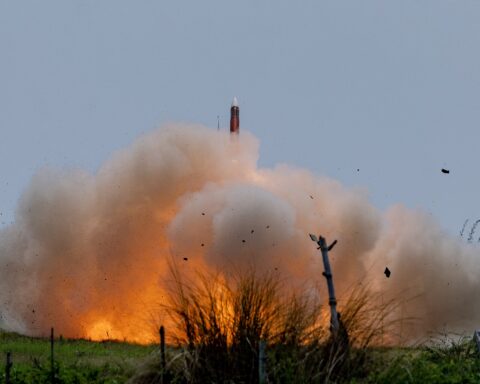
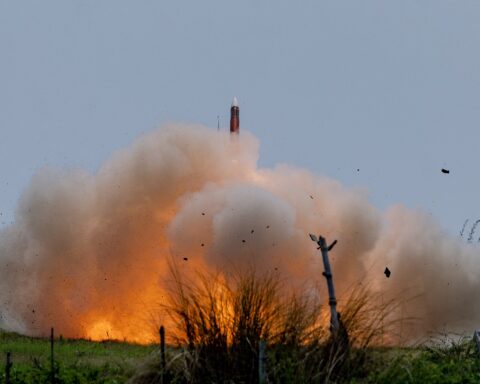
The Cheongung-II, also designated KM-SAM Block II by NATO nomenclature, is a medium-range surface-to-air missile system developed by South Korea’s Agency for Defense Development with technical inputs from Russia’s Almaz-Antey, the consortium behind the S-400. Each battery integrates four to six mobile launchers armed with eight interceptor missiles apiece, a multifunction active electronically scanned array radar capable of tracking forty targets simultaneously within a hundred-kilometre radius, and a command-and-control vehicle that coordinates fire allocation across the battery.
The interceptor itself weighs approximately 400 kilograms and uses a hit-to-kill interception method, destroying incoming warheads through direct kinetic impact at speeds approaching Mach 5. Its engagement envelope reaches targets at altitudes up to twenty kilometres and at ranges of approximately fifty kilometres against aircraft and cruise missiles, dropping to about twenty kilometres against ballistic targets in their terminal phase. The Block II variant, which is what Saudi Arabia purchased, added a significantly upgraded seeker and improved resistance to electronic countermeasures compared to the original Cheongung-I that entered Korean service in 2015.
In February 2024, the South Korean Ministry of National Defense confirmed that Saudi Arabia had signed a contract for ten KM-SAM Block II batteries at a total cost of $3.2 billion. The deal, inked the previous November during Crown Prince Mohammed bin Salman’s meeting with South Korean President Yoon Suk-yeol at the World Defense Show in Riyadh, represented the third major Cheongung export contract after the UAE’s $3.5 billion order in 2022 and ahead of Iraq’s $2.8 billion commitment in September 2024. Combined, these three Gulf and Middle Eastern deals total approximately $9.5 billion — a sum that transformed South Korea from a regional arms supplier into a global defense heavyweight in less than three years.

How Did the Cheongung-II Perform in Its First Combat Test?
The Cheongung-II achieved an overall interception rate of 96 percent during its combat debut in the UAE, destroying 161 of 174 Iranian ballistic missiles and intercepting 645 of 689 drones fired at Emirati territory between 1 and 10 March 2026, according to figures released by the UAE Ministry of Defence and confirmed by South Korean officials. Approximately sixty interceptor missiles were fired from the two operational Cheongung-II batteries during the engagement period.
The system was integrated within the UAE’s existing multi-layered missile defense network, operating alongside American-supplied Patriot PAC-3 and Terminal High Altitude Area Defense systems. Each platform addressed different altitude envelopes and threat profiles: THAAD intercepted ballistic missiles in their upper terminal phase at altitudes above forty kilometres, Patriot PAC-3 MSE engaged medium-altitude threats between fifteen and twenty-five kilometres, and the Cheongung-II filled the critical gap below fifteen kilometres where ballistic missiles in their final dive and low-flying cruise missiles present the most challenging intercept geometry.
The performance was not theoretical. On the night of 5 March alone, Iranian forces launched thirty-seven ballistic missiles at Abu Dhabi and Al Dhafra Air Base in a concentrated salvo designed to overwhelm defensive systems through sheer volume, according to the Seoul Economic Daily. The Cheongung-II batteries engaged seventeen of those warheads — the ones that penetrated upper-tier defenses and entered the system’s engagement envelope — and destroyed all seventeen. The following morning, South Korean defense stocks surged between eight and fourteen percent on the Seoul exchange.
Defense analysts noted that the 96 percent figure closely tracked the system’s performance in controlled test firings, a consistency that is unusually rare in the transition from testing to combat. Israel’s Iron Dome, for comparison, scored approximately 90 percent in its initial combat deployment against Hamas rockets in 2012 — widely regarded as a spectacular result at the time. The Cheongung-II’s debut suggests that Korean missile engineering has reached a maturity level that global defense markets are only beginning to price in.
Why Is Seoul Rushing Emergency Interceptor Deliveries to the Gulf?
South Korea approved and executed an emergency airlift of thirty Cheongung-II interceptor missiles to the UAE within seventy-two hours of the combat debut, according to the Defense Post, making it one of the fastest wartime resupply operations in modern defense logistics. The UAE’s two operational batteries had expended roughly sixty interceptors in under a week — a consumption rate that would have exhausted their entire loaded inventory within days had the war continued at the same intensity.
The emergency delivery exposed a paradox at the heart of the interceptor economy. The Cheongung-II’s combat success immediately created demand that the existing production line could not absorb. South Korean officials told reporters that accelerating deliveries beyond the contractual timeline for remaining UAE batteries would be “difficult” due to existing obligations to Saudi Arabia and Iraq, both of which have signed contracts for the same system and are awaiting their own deliveries. LIG Nex1, the prime contractor, reported record revenues of 3.28 trillion won ($2.3 billion) in 2024, but its production capacity was sized for peacetime schedules, not wartime surge requirements.
The UAE has formally requested accelerated delivery of its remaining eight Cheongung-II batteries, while Qatar and Kuwait — neither of which had previously placed orders — opened preliminary discussions with Seoul within days of the combat results, according to the Korea Times. The pattern mirrors what happened with Israel’s Iron Dome after its first successful engagements: combat validation generates a demand shock that the original industrial base cannot absorb without major capital investment in expanded production facilities.
Can Saudi Arabia’s Existing Air Defense Network Survive a Prolonged War?
Saudi Arabia operates what is arguably the most expensive air defense architecture in the Middle East, with cumulative investment exceeding $80 billion across five overlapping layers of missile defense. The backbone remains 108 Patriot M902 launchers organised into six battalions, supplemented by one operational THAAD battery — the first of seven ordered under a $15 billion contract signed in 2017 — with a fourth crew completing training at Fort Bliss, Texas, as of March 2026. Four of the seven THAAD sites are scheduled for completion by end of 2026; the full constellation will not be operational until 2028.
During the first eleven days of the Iran war, Saudi Patriot and THAAD batteries intercepted between 75 and 90 Iranian ballistic missiles with a success rate between 85 and 90 percent, a performance that exceeded most analysts’ expectations but revealed structural limits. The Kingdom’s air defenses were designed to counter the Houthi threat from Yemen — sporadic salvos of relatively crude ballistic missiles and drones — not the concentrated barrages that Iran’s Islamic Revolutionary Guard Corps Aerospace Force is capable of delivering. The difference is one of volume: Houthi attacks averaged four to six projectiles per incident; Iran launched up to thirty-seven ballistic missiles at a single target in one night.
The interceptor math is brutal. Each PAC-3 MSE round costs approximately $4 million. Each THAAD interceptor costs roughly $12 million. Lockheed Martin produced a record 620 PAC-3 MSE interceptors in all of 2025 — and the war consumed more than an entire year’s production in under a week across all Gulf state customers combined, according to CBS News. Arab states are “running dangerously low on interceptors,” CBS reported on 8 March, with Qatar projected to deplete its Patriot inventory within four days and the UAE within seven at then-current consumption rates.
The competition for interceptors became an international crisis on March 14 when Israel informed Washington it was critically low on ballistic missile interceptors, placing both Israel and Saudi Arabia in direct competition for the same Lockheed Martin production line in Camden, Arkansas.
The Cheongung-II offers no silver bullet, but it offers something potentially more valuable: a second production line in a second country that is not entangled in Washington’s political conditions on arms resupply. Saudi Arabia’s ten ordered batteries, once delivered, would add a medium-range layer that does not draw from the same interceptor stockpile as its Patriot systems — a redundancy that could extend the Kingdom’s defensive endurance by days or weeks in a sustained campaign.

The Defense Procurement Diversification Matrix
The Iran war has made visible a set of procurement vulnerabilities that existed long before the first missile was fired. Three variables determine whether a national air defense system can sustain operations under prolonged attack: technical performance (can the system intercept the threat?), supply chain resilience (can the system be resupplied under wartime conditions?), and political independence (can the buyer obtain interceptors without a third party’s permission?). Every Gulf state that relied exclusively on American systems scored well on the first variable but failed on the second and third.
| Country | Primary Systems | Technical Performance | Supply Chain Resilience | Political Independence | Diversification Score |
|---|---|---|---|---|---|
| UAE | Patriot, THAAD, Cheongung-II | 96% | Medium (two sources) | Medium | 7/10 |
| Saudi Arabia | Patriot, THAAD (partial) | 85-90% | Low (single source) | Low | 4/10 |
| Saudi Arabia (post-KM-SAM delivery) | Patriot, THAAD, Cheongung-II | Est. 90-95% | Medium (two sources) | Medium | 7/10 |
| Qatar | Patriot only | ~85% | Critical (4 days supply) | Low | 2/10 |
| Kuwait | Patriot only | Untested in current war | Low | Low | 2/10 |
| Israel | Iron Dome, David’s Sling, Arrow | ~95% | High (domestic + US) | High (domestic production) | 9/10 |
The matrix reveals a pattern that is now driving procurement decisions across the Gulf. Israel’s air defense resilience stems not from any single system’s superiority but from the fact that its primary interceptors are manufactured domestically by Rafael and Israel Aerospace Industries. When Israel needs more Iron Dome rounds, it calls a factory in Haifa — not a foreign military sales office in Arlington, Virginia. South Korea’s Cheongung-II offers Gulf states the closest available approximation to that model: a proven system from a manufacturer that is not constrained by the geopolitical conditions that American arms sales inevitably carry.
The diversification imperative extends beyond the current conflict. Saudi Arabia’s pursuit of Ukrainian drone defense systems, its preliminary discussions with European manufacturers, and its 2024 Korean deal all reflect a strategic conclusion that monopoly dependence on any single supplier — however technically capable — creates an unacceptable vulnerability when that supplier has its own political priorities. Taken together, these parallel procurement tracks represent a defense supply chain diversification that is already outlasting the conflict that triggered it.
The American Dependency Problem
Middle East Eye reported on 9 March that the United States was “stonewalling” requests from Gulf states to replenish their interceptor stocks, a claim the White House did not directly deny. A CBS News report the same week confirmed that the White House was “aware” of Gulf countries’ concerns about missile interceptor shortages but provided no timeline for resupply. A former US official told CNN that “whatever munitions were produced in the last couple of months, we have shot several years’ worth of production in the last few days.”
The implied leverage is difficult to miss. Washington has spent the opening weeks of the war pressuring Gulf states — particularly Saudi Arabia and Qatar — to take a more active role in the military campaign against Iran. Riyadh has refused, maintaining that it will defend its own territory but will not launch offensive strikes against Iran. Senator Lindsey Graham publicly threatened to block the US-Saudi defense pact over Riyadh’s refusal. Against this backdrop, the slow-walking of interceptor resupply looks less like a logistics problem and more like a negotiating tactic.
For Saudi defense planners, the lesson is existential. The Kingdom’s 108 Patriot launchers and one operational THAAD battery are among the most capable air defense assets outside NATO, but every interceptor they fire must be replaced from a production line that is controlled by a foreign government with its own strategic interests. When those interests diverge — as they have publicly and repeatedly during this conflict — the supply chain becomes a lever of coercion rather than a pillar of alliance.
“The Gulf states bought the world’s best air defense systems and discovered they had purchased a subscription, not a product. The subscription can be cancelled by the seller at any time.”European defense analyst speaking to the Financial Times, March 2026
The Cheongung-II does not solve this problem entirely — Seoul has its own political considerations, and South Korea’s alliance with the United States places limits on how independently it can act in arms sales. But the Korean system introduces competition into a market where competition did not previously exist. When Saudi Arabia has two suppliers capable of providing medium-range interceptors, neither supplier can use its monopoly position as leverage. The game theory changes fundamentally.
How Does the Cheongung-II Compare to the Patriot and THAAD?
The three systems occupy different layers of the air defense architecture and are complementary rather than competitive, but the Iran war has generated enough performance data to make meaningful comparisons for the first time.
| Parameter | Cheongung-II (KM-SAM) | Patriot PAC-3 MSE | THAAD |
|---|---|---|---|
| Manufacturer | LIG Nex1 / Hanwha (South Korea) | Lockheed Martin (US) | Lockheed Martin (US) |
| Combat hit rate (March 2026) | 96% | ~90% | ~100% |
| Intercept altitude | Up to 20 km | Up to 25 km | 40-150 km |
| Range (ballistic targets) | ~20 km | ~30 km | ~200 km |
| Range (aircraft/cruise missiles) | ~50 km | ~100 km | Not primary mission |
| Interceptor speed | Mach 5 | Mach 5+ | Mach 8+ |
| Kill method | Hit-to-kill (kinetic) | Hit-to-kill (kinetic) | Hit-to-kill (kinetic) |
| Interceptor cost (est.) | $1-2 million | $4 million | $12 million |
| Launchers per battery | 4-6 (8 missiles each) | 4-8 (16 missiles each) | 6 (8 missiles each) |
| Radar tracking capacity | 40 targets / 100 km | 50+ targets / 150 km | Classified / 1,000+ km |
| Battery cost (est.) | ~$320 million | ~$1 billion | ~$2 billion |
| Supply chain | South Korea (LIG Nex1) | US (Lockheed Martin) | US (Lockheed Martin) |
The cost differential is the critical variable for sustained defense. At an estimated $1 to $2 million per interceptor, the Cheongung-II costs roughly half to one-quarter as much per shot as a PAC-3 MSE round and a fraction of a THAAD interceptor. Over a sustained campaign involving hundreds of intercepts, the economic advantage compounds: defending against a hundred ballistic missiles costs an estimated $100 to $200 million with Cheongung-II versus $400 million with Patriot or $1.2 billion with THAAD.
Performance at different altitude bands matters as much as cost. THAAD excels at exo-atmospheric intercept — killing warheads high above the atmosphere before they begin their terminal dive — but cannot engage low-flying cruise missiles or drones. The Cheongung-II operates in the gap between THAAD’s lower boundary and the point at which short-range systems like the Shahine or Crotale engage. In the Iran war, this gap proved to be where the majority of Iranian threats entered defended airspace, because Iranian ballistic missiles that survived upper-tier intercepts were in their fastest, most difficult-to-hit terminal phase as they descended through the Cheongung-II’s engagement zone. The challenge in this band is about to intensify: Iran’s Khoramshahr-4 multi-warhead missile can release several independent re-entry vehicles during the terminal phase, multiplying the number of objects the Cheongung-II and Patriot must track and engage simultaneously.

Seoul’s $9.5 Billion Gulf Bet
South Korea’s defense industry has undergone a transformation that most Western analysts still underestimate. Combined sales of thirty-one listed South Korean defense companies reached 43.1 trillion won ($30.3 billion) in 2024, a 16 percent increase from the previous year, according to SIPRI. Hanwha Aerospace alone reported revenues of 11.24 trillion won, while LIG Nex1 — the Cheongung-II’s prime contractor — posted record sales of 3.28 trillion won. The four largest Korean defense firms held an order backlog of 103.47 trillion won ($72.7 billion) as of June 2025, securing four to five years of production.
The Gulf represents the single most important growth vector. Three contracts in three countries — UAE ($3.5 billion, 2022), Saudi Arabia ($3.2 billion, 2024), and Iraq ($2.8 billion, 2024) — account for $9.5 billion in committed Cheongung-II sales alone. No other Korean weapons system has generated comparable export revenue in such a compressed timeframe. The K9 Thunder self-propelled howitzer, previously Korea’s most successful export platform, accumulated approximately $8 billion in lifetime orders from Poland, Egypt, Turkey, Finland, Estonia, Norway, Australia, and India — a figure the Cheongung-II has already surpassed.
| Customer | System | Value | Year Signed | Batteries | Delivery Status |
|---|---|---|---|---|---|
| UAE | Cheongung-II (KM-SAM Block II) | $3.5 billion | 2022 | 10 | 2 delivered, 8 pending (accelerated request) |
| Saudi Arabia | Cheongung-II (KM-SAM Block II) | $3.2 billion | 2024 | 10 | Pending (production phase) |
| Iraq | Cheongung-II (KM-SAM Block II) | $2.8 billion | 2024 | 8 | Pending |
The combat debut has accelerated interest beyond existing customers. Qatar and Kuwait, both of which joined the GCC resolution condemning Iranian attacks, have opened preliminary procurement discussions with Seoul, according to the Korea Times. If either state places an order, the total value of Korean air defense sales in the Gulf could approach $15 billion within two years — a figure that would establish Seoul as the Gulf’s second-largest defense supplier after the United States.
South Korea aims to become one of the world’s top four defense exporters by 2027, according to government targets, and has established a dedicated K-Defense Export Fund with 160 billion won ($112 million) in joint government-private investment for 2026. The Carnegie Endowment for International Peace published an analysis in February 2026 exploring whether South Korea could transition from an arms exporter to a “trusted defense partner” for NATO — a classification that would further accelerate European and Middle Eastern procurement.
What Does This Mean for the $142 Billion US-Saudi Arms Deal?
In May 2025, the United States and Saudi Arabia signed what the White House described as “the largest military cooperation agreement in US history,” a $142 billion package covering air force modernisation, air and missile defense upgrades, maritime security, land forces, and communications systems. The deal included upgrades to Saudi Arabia’s Patriot and THAAD systems, potential F-15SA modernisation toward F-15EX standard, $20 billion in MQ-9B SeaGuardian drones, and extensive training programmes.
The Korean air defense deal does not replace the American relationship; it supplements it. Saudi Arabia’s five-layer air defense architecture requires systems operating at every altitude band from low-altitude drone intercept to exo-atmospheric ballistic missile defense. The Cheongung-II fills the medium-range band where the Kingdom currently relies on ageing I-HAWK systems and the French-made Shahine — platforms that are decades old and were never designed to counter the threat profile that Iran has demonstrated.
What the Korean deal does change is the terms of the American relationship. A Saudi Arabia that can source medium-range interceptors from Seoul, drone defense systems from Kyiv, and is exploring European alternatives for short-range systems is a Saudi Arabia that does not need to accept every condition Washington attaches to arms sales. The Stimson Center noted in its analysis of the $142 billion deal that “notifications of foreign military sales between 2017 and 2025 have amounted to $34.6 billion — far less than Trump originally announced” for his first term. Much of what is announced in US-Saudi arms deals never actually converts to delivered hardware. Korean contracts, by contrast, are moving from signature to production to delivery on timelines measured in years, not decades.
The Industrial Base Crisis Nobody Is Solving
The Iran war has exposed a structural problem that transcends any single weapons system or bilateral relationship. Global interceptor production capacity is inadequate for sustained modern conflict. Lockheed Martin’s record output of 620 PAC-3 MSE interceptors in 2025 was celebrated as a manufacturing achievement — and the war burned through more than that entire annual production in approximately six days of combat across multiple Gulf state customers.
The arithmetic does not improve with scale. THAAD interceptors are produced at roughly thirty to forty per year. Raytheon’s SM-3 Block IIA, used by naval Aegis systems, comes off the line at comparable rates. Even if every Western manufacturer maximised production starting today, the pipeline to significantly increase output runs eighteen to twenty-four months for existing lines and three to five years for new production facilities, according to a 2026 Congressional Research Service assessment cited by CNN.
South Korea faces the same constraint at a smaller scale. LIG Nex1’s production line is sized for peacetime requirements — perhaps eighty to one hundred interceptors per year for Cheongung-II — and the emergency airlift of thirty rounds to the UAE consumed roughly a quarter of estimated near-term available inventory. Expanding production requires capital investment, supply chain scaling for rocket motors and seeker components, and trained workforce growth that cannot happen overnight.
The global defense industrial base was designed for peacetime procurement cycles — multi-year contracts, predictable delivery schedules, gradual capability upgrades. What the Iran war demands is a wartime production model: surge capacity, rapid prototyping, emergency logistics, and the ability to manufacture thousands of precision-guided interceptors in months rather than years. No country currently possesses that capability for the weapons systems that matter most in this conflict. The implication for Saudi Arabia is that no single supplier can guarantee sustained resupply during a prolonged conflict. The war’s disruption of maritime shipping through the Strait of Hormuz compounds the problem: interceptors manufactured in the United States must be airlifted to the Kingdom at enormous cost, because surface shipping through the Gulf is no longer viable. Korea at least offers a second airlift corridor from East Asia that does not depend on US military transport infrastructure.
How Did the World Defense Show Seal the Saudi-Korean Defense Relationship?
The Cheongung-II deal did not emerge from a vacuum. Its origins trace to the World Defense Show in Riyadh, the biennial defense exhibition that Saudi Arabia launched in 2022 as a deliberate instrument of procurement diversification. The second edition, held in February 2024, drew more than 750 exhibitors from 72 countries and generated $36 billion in announced deals, according to the Saudi General Authority for Military Industries. South Korean exhibitors occupied one of the largest national pavilions, led by Hanwha Aerospace, LIG Nex1, Hyundai Rotem, and Korea Aerospace Industries.
It was during a bilateral meeting at WDS 2024 between Crown Prince Mohammed bin Salman and South Korean President Yoon Suk-yeol that the KM-SAM deal was publicly confirmed, although the contract had been signed the previous November. The choice of venue was deliberate. By announcing the Korean deal at a Saudi-hosted exhibition — rather than at a Korean event like ADEX or at a neutral venue like IDEX in Abu Dhabi — Riyadh signalled that the purchase was part of a broader sovereign defense industrial strategy, not simply an arms transaction. The General Authority for Military Industries, which reports directly to the Crown Prince’s office, has publicly stated its goal of localising 50 percent of defense spending within the Kingdom by 2030. Korean manufacturers, which have a track record of technology transfer agreements in Poland and Australia, are viewed as more willing partners in localisation than American firms, which historically resist sharing proprietary manufacturing knowledge. That localization ambition took its most dramatic form this week with the $5 billion China-Saudi deal to establish a Wing Loong-3 drone factory in Jeddah, embedding combat UAV production directly within the Kingdom.
The relationship extends beyond the Cheongung-II. South Korea’s Hanwha Defense signed a memorandum of understanding with Saudi Arabia’s SAMI — the state-owned Saudi Arabian Military Industries — in 2023 to explore joint production of armoured vehicles and ammunition. Korea Aerospace Industries has discussed potential co-production of T-50 advanced trainer aircraft with Saudi assembly. These parallel tracks suggest that the Cheongung-II deal is the anchor for what could become a comprehensive Korean-Saudi defense industrial partnership — one that provides Riyadh not only with hardware but with the manufacturing capabilities to reduce its dependence on all foreign suppliers over time.
For Seoul, the Saudi relationship is equally strategic. Saudi Arabia is the world’s largest arms importer by cumulative spending and one of the few countries with both the financial resources and the political will to purchase at scale. Securing Saudi Arabia as a long-term Korean defense customer would provide LIG Nex1, Hanwha, and their subcontractors with the production volume and revenue stability needed to invest in next-generation systems — including the L-SAM long-range interceptor currently under development, which is designed to compete directly with THAAD in the upper-tier ballistic missile defense market.
The Contrarian Case for Korean Weapons
The prevailing assumption in Western defense circles has been that Korean weapons exports succeed primarily on price — that they offer “good enough” technology at bargain rates for countries that cannot afford American or European alternatives. The Cheongung-II’s 96 percent combat hit rate demolishes that assumption. At a 96 percent interception rate, the Cheongung-II matched or exceeded the performance of the Patriot PAC-3 MSE (approximately 90 percent in the same conflict) and approached the near-perfect record of THAAD systems that cost six times more per interceptor.
The more provocative argument is that Korean weapons may actually be better suited to the Gulf’s specific threat environment than their American counterparts — not because Korean engineering is superior, but because Korean systems were designed for a different threat model that happens to align with what Iran actually deploys. The Cheongung-II was built to counter North Korean ballistic missiles and Chinese cruise missiles across the Korean Peninsula — threats that are operationally similar to what Iran fires at the Gulf in terms of trajectory, speed, and electronic countermeasures. The Patriot system, by contrast, has evolved through decades of modifications from its original role as an anti-aircraft system, accumulating complexity with each upgrade generation.
Korean defense exports also benefit from a political neutrality that neither American nor European suppliers can match. South Korea has no territorial interests in the Middle East, no colonial history in the region, no domestic constituency that pressures Seoul to condition arms sales on human rights or political reform, and no alliance obligation that would force Seoul to choose between its Gulf customers and a regional adversary. When Saudi Arabia buys from Seoul, it buys hardware. When it buys from Washington, it buys hardware entangled in the entire weight of American Middle East policy.
The counterargument — that Korean systems lack the decades of iterative improvement and battle-tested upgrades that American platforms carry — has been weakened but not eliminated by the UAE data. A 96 percent rate across fewer than two hundred engagements is impressive but not statistically definitive. The Cheongung-II has not been tested against the full spectrum of Iranian capabilities, and its electronic warfare resistance has not been challenged by a more sophisticated adversary. But for Gulf procurement officers writing requirements documents in March 2026, the question is no longer whether Korean weapons work. The question is how fast they can get them.
The larger historical parallel is the rise of Japanese electronics in the 1970s and 1980s, when American manufacturers dismissed Japanese products as cheap imitations until those products began consistently outperforming their American counterparts. South Korea’s defense industry is at a similar inflection point. The Cheongung-II’s combat debut is the Korean defense sector’s equivalent of the moment when Japanese cars became the reliability standard rather than the budget alternative. If subsequent engagements confirm the 96 percent rate, the global air defense market will reorganise around a reality that Washington has spent decades trying to prevent: genuine competition.
The urgency behind Saudi Arabia’s Korean procurement drive has only intensified as the war progresses. The Pentagon has begun redeploying THAAD batteries from South Korea to the Gulf to replace radar systems destroyed by Iranian strikes — a move that Seoul has publicly opposed and that underscores the fragility of American missile defense commitments across multiple theatres.
Frequently Asked Questions
What is the Cheongung-II missile system?
The Cheongung-II, also known as KM-SAM Block II, is a South Korean medium-range surface-to-air missile system that uses hit-to-kill technology to destroy ballistic missiles, cruise missiles, and drones at ranges up to 50 kilometres and altitudes up to 20 kilometres. Each battery includes four to six launchers with eight interceptors each, an AESA radar, and a mobile command post.
How much did Saudi Arabia pay for the Cheongung-II?
Saudi Arabia signed a $3.2 billion contract in November 2023 for ten Cheongung-II (KM-SAM Block II) batteries, making it the second-largest Korean air defense export deal after the UAE’s $3.5 billion order. At approximately $320 million per battery, the system costs roughly one-third of a comparable Patriot battery and one-sixth of a THAAD battery.
What was the Cheongung-II’s hit rate in combat?
The Cheongung-II achieved a 96 percent hit rate during its combat debut in the UAE in March 2026, destroying 161 of 174 Iranian ballistic missiles and intercepting 645 of 689 drones. The performance closely tracked test-firing results and exceeded the Patriot PAC-3’s estimated 90 percent rate during the same conflict.
When will Saudi Arabia receive its Cheongung-II batteries?
Saudi Arabia’s ten Cheongung-II batteries are currently in the production phase at LIG Nex1 facilities in South Korea. No official delivery date has been announced, but the UAE’s experience — two of ten batteries delivered approximately three years after contract signing — suggests Saudi deliveries could begin in late 2026 or early 2027, though the war has created competing demands for production capacity.
Does the Cheongung-II replace American air defense systems in Saudi Arabia?
The Cheongung-II supplements rather than replaces American systems. Saudi Arabia’s layered air defense architecture requires different systems at different altitude bands: THAAD for high-altitude ballistic missile defense, Patriot for medium-to-long range, and Cheongung-II for the medium-range gap. The Korean system adds a second supply chain that reduces Saudi dependence on any single manufacturer for interceptor resupply.
Which countries have ordered the Cheongung-II?
Three countries have signed contracts for the Cheongung-II: the UAE ($3.5 billion for 10 batteries, 2022), Saudi Arabia ($3.2 billion for 10 batteries, 2024), and Iraq ($2.8 billion for 8 batteries, 2024). Qatar and Kuwait have reportedly opened preliminary procurement discussions following the system’s combat debut. Total committed orders exceed $9.5 billion.