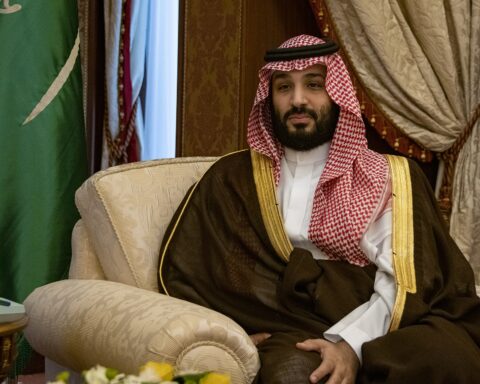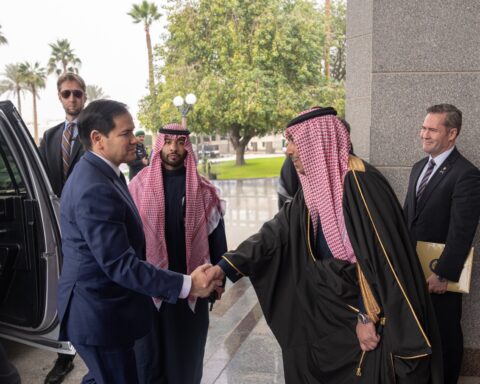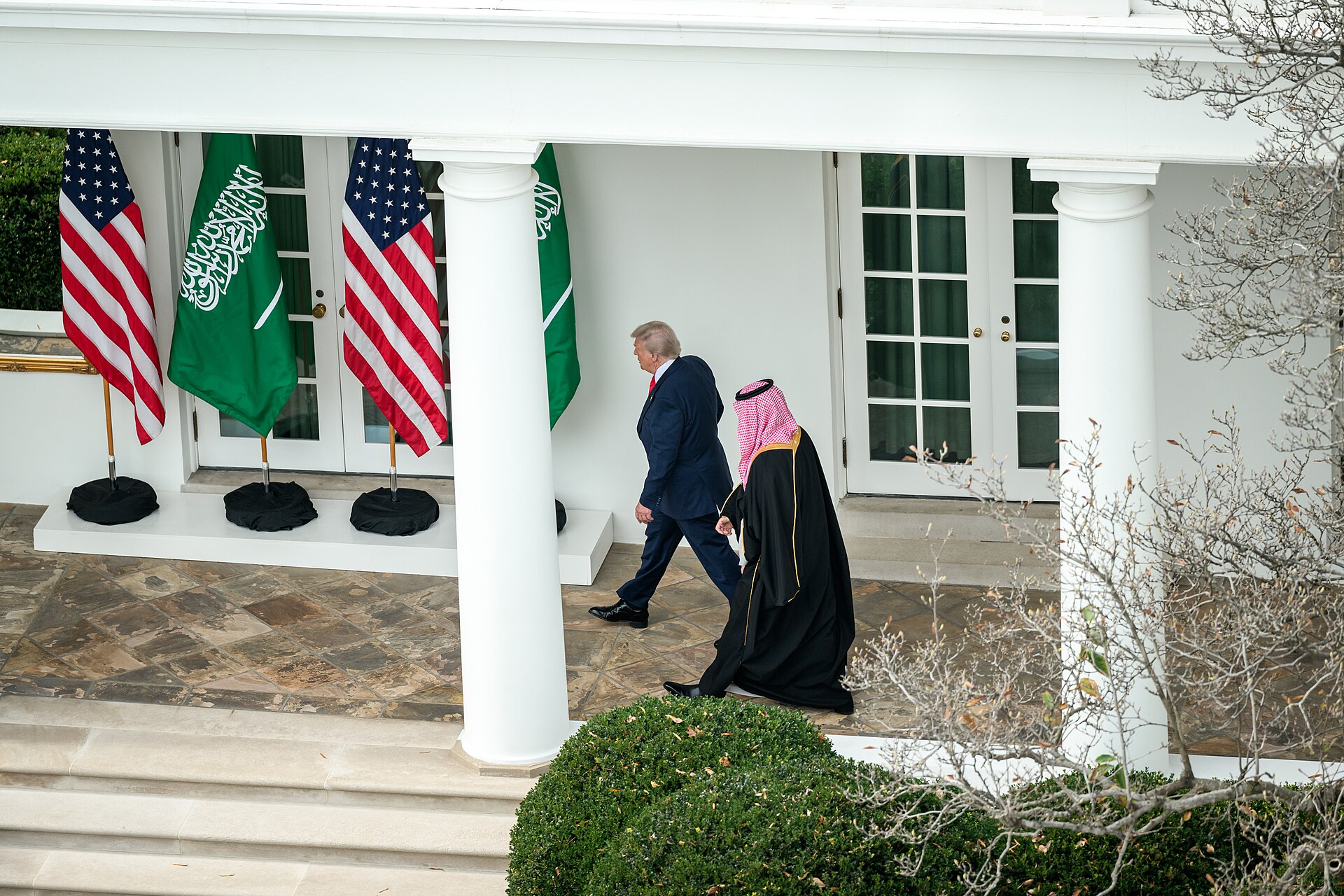

WASHINGTON — Crown Prince Mohammed bin Salman walked into the White House on November 18, 2025, carrying a number so large it sounded more like a threat than a promise: one trillion dollars. The pledge, delivered to President Donald Trump amid handshakes and alternating American and Saudi flags at the South Portico, represented a near-doubling of Riyadh’s earlier $600 billion commitment — and it arrived just three months before Iranian missiles would begin raining on Saudi cities. What that trillion dollars actually contains, whether Saudi Arabia can afford it, and what it purchases from Washington in return reveals a transactional architecture unlike anything in the 80-year history of the US-Saudi relationship. The answers matter far more now that American carrier groups are patrolling the Gulf and Saudi air defenses are firing in anger for the first time.
The value of that trillion-dollar pledge is further complicated by the Pentagon’s admission that a U.S. Tomahawk missile struck an Iranian girls’ school in Minab, killing 175 children. Saudi Arabia’s investment in the American alliance now carries a reputational cost that no dollar figure can easily offset.
Table of Contents
- How Did a $600 Billion Pledge Become $1 Trillion in Six Months?
- What Is Actually in the $1 Trillion Package?
- The $142 Billion Defense Centerpiece
- Can Saudi Arabia Afford $1 Trillion During a War?
- What Does Washington Give Saudi Arabia in Return?
- The Historical Price of American Protection
- Is the $1 Trillion Pledge Even Real?
- Why China Makes the $1 Trillion Deal Non-Negotiable for Washington
- The War That Changed the Math
- The Protection Premium — Pricing Security in the Age of Drone Warfare
- What Happens If the Money Never Arrives?
- Frequently Asked Questions
How Did a $600 Billion Pledge Become $1 Trillion in Six Months?
The escalation from $600 billion to $1 trillion followed a precise diplomatic choreography, each step calibrated to extract maximum concessions from Washington while signaling commitment to what both sides privately acknowledge is a protection arrangement dressed in the language of investment.
On January 23, 2025, Trump publicly stated at Davos that he would ask Saudi Arabia to “round out” its investment pledge to $1 trillion, according to NBC News. The framing was deliberate — presenting it as an American demand rather than a Saudi offer, letting MBS appear to concede rather than to beg. Four months later, during Trump’s May 13 visit to Riyadh, the White House announced $600 billion in Saudi investment commitments at the US-Saudi Investment Forum. The figure covered defense, artificial intelligence, energy, and technology deals, according to the White House fact sheet released that day.
Then came the November 18 escalation. MBS traveled to Washington and announced the increase to nearly $1 trillion during an Oval Office meeting. The same visit produced the Strategic Defense Agreement, Saudi Arabia’s designation as a Major Non-NATO Ally — the 20th country to receive the status — and approval of F-35 sales to the Kingdom. The compression of these announcements into a single visit was not coincidental. Each element reinforced the others: money flowed in one direction, security guarantees flowed in the other.
The arithmetic tells its own story. The original $600 billion equaled roughly 60 percent of Saudi Arabia’s entire GDP, according to International Monetary Fund data putting Saudi GDP at approximately $1.07 trillion in 2023. The $1 trillion revision effectively asks the Kingdom to invest the equivalent of its full annual economic output in American assets over four years. Paul Donovan, chief economist at UBS Global Wealth Management, noted that the pledge “is the equivalent of almost an entire year’s GDP for the kingdom” and warned it “may not therefore be honored in the near term,” according to CNBC reporting.
What Is Actually in the $1 Trillion Package?
Strip away the headline number and the package reveals a sprawling collection of defense contracts, technology partnerships, energy cooperation frameworks, and financial commitments spanning multiple sectors and decades. The specifics determine whether the number is transformative or theatrical.
The defense component, valued at $142 billion, represents the single largest category and the foundation of the entire arrangement. Technology and artificial intelligence account for approximately $100 billion, anchored by DataVolt’s $20 billion commitment to build AI data centers and energy infrastructure in the United States in partnership with Supermicro, according to Bisnow reporting. A consortium of American technology companies — Google, Oracle, Salesforce, AMD, and Uber — collectively committed $80 billion in technology investments across both countries. Oracle alone pledged $14 billion into Saudi digital cloud and AI infrastructure.
Three specialized investment funds add further structure. A $5 billion Energy Investment Fund targets joint energy projects. A $5 billion New Era Aerospace and Defense Technology Fund channels capital into military innovation. A $4 billion Enfield Sports Global Sports Fund extends the relationship into Saudi Arabia’s entertainment and sports diversification strategy, according to the White House fact sheet.
Nuclear energy cooperation, while lacking a specific dollar figure, may ultimately prove the most consequential element. The Joint Declaration on Completion of Negotiations on Civil Nuclear Energy Cooperation, signed in November 2025, establishes the legal foundation for what US officials describe as a “decades-long, multi-billion-dollar nuclear energy partnership,” according to the Arms Control Association. American companies are designated as “civil nuclear cooperation partners of choice.” US Energy Secretary Chris Wright stated explicitly: “No enrichment. In this agreement, this is just for construction of a power plant.” A formal Section 123 Agreement required for implementation still awaits Congressional review, with no timeline provided.
A Critical Minerals Framework deepens collaboration on supply chain diversification for rare earth minerals including dysprosium, terbium, neodymium, and praseodymium, according to a CSIS analysis. These materials are essential for advanced weapons systems, electric vehicles, and semiconductor manufacturing — areas where both countries seek to reduce dependence on Chinese supply chains.
| Category | Estimated Value | Key Elements | Status |
|---|---|---|---|
| Defense | $142 billion | F-35s, THAAD, Patriot, Abrams tanks, MQ-9B drones | Announced; requires Congressional approvals |
| Technology & AI | ~$100 billion | Data centers, cloud, AI infrastructure | Letters of intent signed |
| Nuclear Energy | Multi-billion (TBD) | Power plant construction, fuel supply | Joint Declaration signed; Section 123 pending |
| Specialized Funds | $14 billion | Energy, Aerospace/Defense Tech, Sports | Funds established |
| Critical Minerals | TBD | Rare earth supply chain diversification | Framework agreed |
| Remaining | ~$744 billion | Unspecified commercial investment | Aspirational |
The arithmetic reveals a significant gap. Defense ($142 billion), technology ($100 billion), and specialized funds ($14 billion) total approximately $256 billion. Nuclear energy and critical minerals lack firm dollar figures. That leaves roughly $744 billion — nearly three-quarters of the headline number — without public accounting. This pattern of front-loading specific defense and technology figures while leaving the bulk undefined echoes the structure of every previous Saudi-US mega-deal announcement.
The $142 Billion Defense Centerpiece
The White House called the defense component “the largest defense sales agreement in history.” The $142 billion spans five categories of military modernization that would transform Saudi Arabia’s armed forces over the next decade — assuming delivery timelines, Congressional approvals, and production capacity all align.
Air force advancement and space capabilities anchor the package, including future F-35 deliveries estimated at 48 aircraft and F-15SA upgrades toward the F-15EX standard. Air and missile defense adds THAAD batteries, valued at approximately $15 billion through Lockheed Martin, alongside additional Patriot systems — equipment now being tested in live combat conditions over Saudi airspace. Maritime and coastal security includes General Atomics MQ-9B SeaGuardian armed drones. Land forces modernization encompasses nearly 300 Abrams tanks from General Dynamics. Information and communication systems upgrades round out the fifth category.
The F-35 sale carries a significant caveat that illustrates the limitations of the relationship. Saudi F-35s will be downgraded compared to Israel’s version, lacking advanced weapons systems and electronic warfare equipment that Israel is uniquely permitted to integrate into its aircraft, according to Al-Monitor reporting. Washington must maintain Israel’s Qualitative Military Edge under US law, meaning Saudi Arabia will receive a deliberately inferior version of the aircraft it is paying billions to acquire.
The $142 billion figure itself demands context. The Stimson Center noted that this amount represents 176 percent of Saudi Arabia’s entire 2024 defense budget, meaning that even under ideal conditions, deliveries must be spread across many years. The center also questioned whether previous lavish spending had translated into genuine military capability, citing Saudi Arabia’s poor operational performance during the Yemen campaign. As of March 2026, the war with Iran is providing the first real-world stress test of the equipment Saudi Arabia has already purchased — and the results are mixed.
Can Saudi Arabia Afford $1 Trillion During a War?
Saudi Arabia’s fiscal position in early 2026 presents a paradox that defines the credibility of the entire pledge. The Kingdom is simultaneously richer and more financially strained than at any point in the past decade, and the war has amplified both conditions.
The Public Investment Fund managed $941.3 billion in assets by the end of 2024, surpassing its $880 billion target with a compound annual growth rate of 22 percent since 2016, according to Arab News. The PIF’s revised 2030 goal stands at $2.67 trillion, up from $1.87 trillion. Aramco’s market capitalization reached approximately $1.74 trillion in early March 2026, with shares gaining roughly 14 percent year-to-date as of March 9, according to Companies Market Cap data. Saudi Arabia ramped oil production to 10.882 million barrels per day in February 2026 — an 8 percent increase from January — according to OPEC data reported by Bloomberg on March 11.
Against these asset figures, the fiscal reality is less comfortable. Saudi Arabia’s 2025 budget deficit reached 276.6 billion riyals ($73.6 billion), approximately 5.5 percent of GDP — a five-year high, according to Bloomberg reporting. Oil revenues fell 20 percent year-on-year through much of 2025, and Aramco’s Q4 2025 net income dropped 20 percent to $17.8 billion. The PIF itself took an $8 billion writedown on megaprojects in August 2025, according to CNBC.
The war has scrambled these calculations. Brent crude surged above $114 per barrel following Iran’s attacks on Gulf energy infrastructure, roughly 60 percent higher than when the US and Israel first struck Iran on February 28, according to Euronews reporting. At $90-plus oil, Saudi Arabia generates substantially higher revenue. Bloomberg Economics estimated the Kingdom’s fiscal breakeven oil price at $94-97 per barrel, a threshold that current prices briefly exceeded. But when PIF domestic spending is included, the true breakeven rises to $111 per barrel, according to Bloomberg Economics.
Karen Young, a senior research scholar at Columbia University’s Center on Global Energy Policy, called the $1 trillion push “completely unrealistic” in a Bloomberg TV interview, noting that “FDI stock from Saudi Arabia into the United States is hovering around $10 billion, nowhere near 600 or a trillion.” Delivering on the pledge would require the Kingdom to multiply its American investment stock by a factor of 100. Maya Senussi, lead economist at Oxford Economics, warned that absent a rebound in energy prices, Saudi Arabia’s commitment to domestic investment “could restrict its ability to fulfil” overseas pledges within the four-year timeframe, according to Fortune reporting.
| Metric | Value | Source |
|---|---|---|
| PIF Assets Under Management | $941.3 billion (2024) | Arab News |
| Aramco Market Capitalization | $1.74 trillion (March 2026) | Companies Market Cap |
| Saudi GDP | $1.07 trillion (2023) | IMF |
| 2025 Budget Deficit | $73.6 billion (5.5% GDP) | Bloomberg |
| Fiscal Breakeven Oil Price | $94-97/barrel | Bloomberg Economics |
| Breakeven Including PIF Spending | $111/barrel | Bloomberg Economics |
| Current Saudi FDI in US | ~$10 billion | Columbia University CGEP |
| Oil Production (Feb 2026) | 10.882 million bpd | OPEC/Bloomberg |
| Brent Crude (March 2026) | $91-114/barrel | Market data |
The math suggests the $1 trillion is plausible only if interpreted generously — counting government procurement, private sector deals, PIF portfolio investments in US-listed assets, defense purchases, and technology contracts across a decade or longer. As a four-year cash commitment, it strains credibility. As a long-term directional signal of where Saudi capital flows, it begins to make more sense.
What Does Washington Give Saudi Arabia in Return?
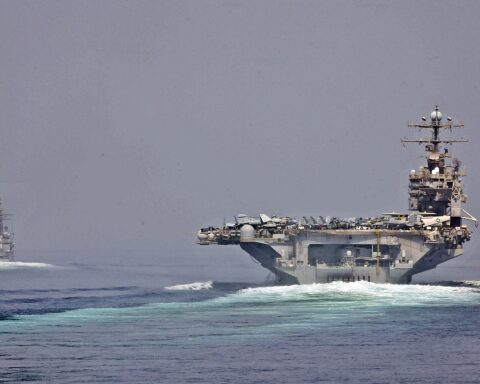
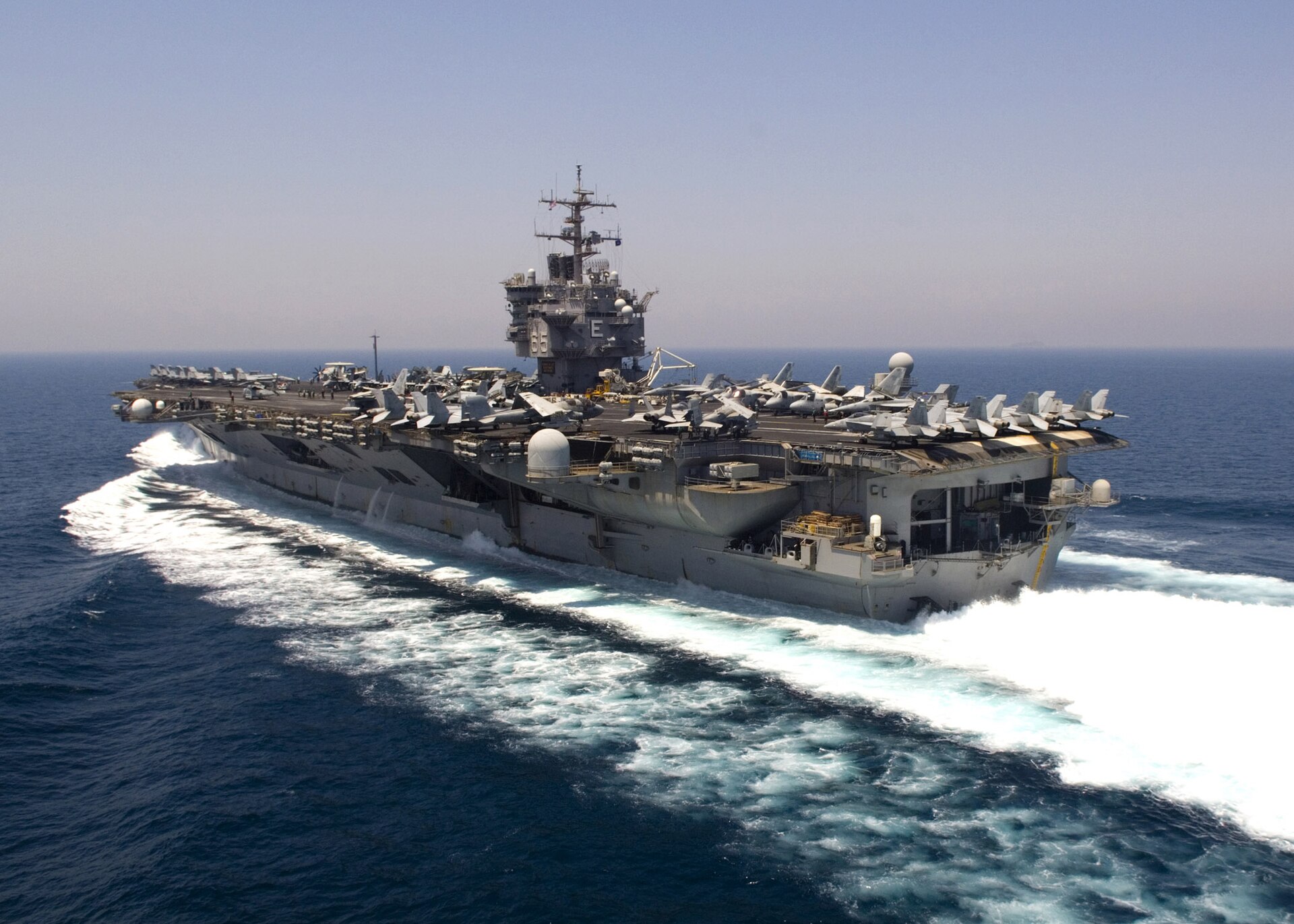
The answer is measured not in dollars but in aircraft carriers. As of March 2026, the United States has assembled the largest military force in the Middle East since the 2003 invasion of Iraq, with approximately 50,000 troops deployed across the region, according to Military Times reporting.
Three carrier strike groups now operate in or near the Gulf. The USS Abraham Lincoln strike group arrived January 26, 2026, carrying approximately 5,700 personnel. The USS Gerald R. Ford strike group, with three destroyers and 5,000-plus personnel, followed in February. The combined carrier air wings include F/A-18E Super Hornets, EA-18G Growlers, E-2 Hawkeyes, MH-60 helicopters, and F-35C Lightning IIs, according to CNN’s military deployment tracker.
At Prince Sultan Air Base in Saudi Arabia, approximately 2,700 American service members operate alongside 13 KC-135 Stratotanker aerial refueling aircraft, six E-3G Sentry AWACS surveillance planes, four E-11 BACN communications aircraft, and multiple C-130 transports, according to the Council on Foreign Relations’ force mapping project. An F-16 squadron provides air defense. Across the broader region, the US maintains 19 military facilities, eight of them permanent, in Bahrain, Egypt, Iraq, Israel, Jordan, Kuwait, Qatar, Saudi Arabia, Syria, and the UAE.
This is not a peacekeeping presence. Saudi Arabia is under sustained attack. Iran has launched over 500 ballistic missiles and 2,000 drones since March 1, targeting Saudi cities, oil infrastructure, and military bases. American interceptors, American intelligence, and American naval power form the core of the defensive architecture keeping Saudi Arabia’s critical infrastructure intact — and the bill is staggering.
The Center for Strategic and International Studies estimated the cost of Operation Epic Fury’s first 100 hours at $3.7 billion, breaking down to $891.4 million per day. That included $196 million in operational costs, $3.1 billion in munitions replacement, $1.7 billion in air defense interceptors alone, and $350 million in combat losses and repairs. Ninety-four percent of this spending — $3.5 billion — was unbudgeted. The Pentagon estimated the first six days cost $11.3 billion, according to The Hill. Daily operational costs continue at approximately $800 million to $1 billion, and the Pentagon has submitted an emergency funding request reportedly totaling $50 billion, according to Marketplace reporting.
“These pledges will of course have to face up to reality as indeed they are large.”Maya Senussi, Lead Economist, Oxford Economics
Viewed through this lens, Saudi Arabia’s $1 trillion pledge looks less like an investment package and more like a down payment on a defense arrangement that costs Washington far more than a trillion dollars to provide. The US is spending at a rate that could exceed $300 billion annually to defend the Gulf region. Against that figure, Saudi Arabia’s four-year $1 trillion commitment — even if fully honored — represents roughly 80 cents on the dollar of what Washington is spending to keep the Kingdom safe.
The Historical Price of American Protection
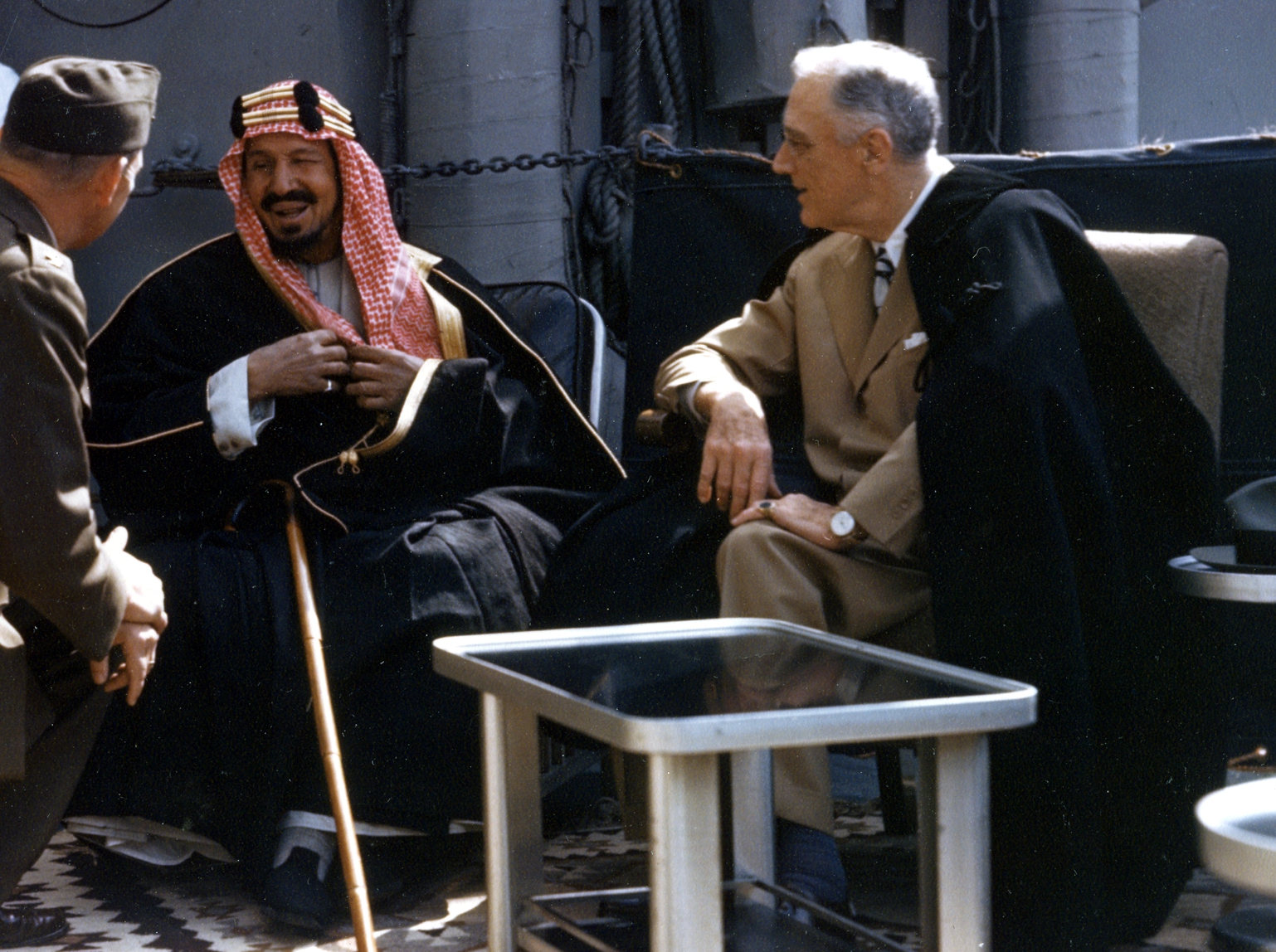
The transactional core of the US-Saudi relationship predates the discovery of Saudi oil as a strategic commodity. On February 14, 1945, President Franklin D. Roosevelt met King Abdul Aziz Ibn Saud aboard the USS Quincy at the Great Bitter Lake in Egypt. The meeting, dominated by disagreement over Palestine, established the foundational bargain that has endured for eight decades: American security guarantees for the Kingdom in return for access to affordable energy, according to Brookings Institution research published on the 75th anniversary of the meeting.
The financial architecture was formalized in 1974 when Prince Fahd bin Abd al Aziz met with Nixon, Kissinger, the Defense Secretary, and Treasury Secretary William Simon. The resulting Joint Commission on Economic Cooperation — and a secret parallel agreement — exchanged military aid and equipment for Saudi investment of oil-sale proceeds in US Treasuries. Kissinger coined the term “petrodollar recycling” to describe the mechanism. The arrangement never formally mandated exclusive dollar-denominated oil sales, contrary to popular belief, but it created a financial symbiosis that persists today.
During the 1990-91 Gulf War, the cost-sharing model was explicit. The total incremental US cost reached $61 billion. Allied contributions covered approximately $54 billion, with Kuwait, Saudi Arabia, and other Gulf states providing $36 billion. King Fahd initially balked at Secretary of State James Baker’s request, then agreed to $15 billion in cash. Germany and Japan covered $16 billion. The American taxpayer ultimately bore only about $7 billion net cost, according to NBC News analysis — a model of burden-sharing that subsequent administrations have failed to replicate.
Trump’s first attempt at updating the formula came in May 2017, when he signed a $110 billion arms deal during his inaugural foreign trip to Riyadh, with a stated value of $350 billion over ten years. The numbers were impressive. The follow-through was not. Bruce Riedel at the Brookings Institution called the deal “fake news,” describing it as “a generous collection of past and prospective deals, with very little representing binding commitments.” By 2025, only $34.6 billion in foreign military sales notifications had materialized — a materialization rate of approximately 31 percent over eight years, according to Stimson Center analysis.
| Deal | Year | Announced Value | Actual Delivery | Materialization Rate |
|---|---|---|---|---|
| Gulf War Cost-Sharing | 1990-91 | $36 billion (Gulf share) | $36 billion | 100% |
| Trump Arms Deal 1.0 | 2017 | $110 billion | $34.6 billion (through 2025) | ~31% |
| Trump Defense Deal 2.0 | 2025 | $142 billion | TBD | TBD |
| Full Investment Pledge | 2025 | $1 trillion | TBD | TBD |
If the 2017 precedent holds, the $142 billion defense component might yield approximately $44 billion in actual deliveries. Extrapolating further, the full $1 trillion could produce $300-350 billion in realized investment — still an enormous sum, but far from the headline figure. The Trump-MBS relationship thrives on spectacle, and both leaders have incentives to announce numbers that exceed what either side expects to deliver.
Is the $1 Trillion Pledge Even Real?
The skeptics are numerous, specific, and credentialed. Their objections fall into three categories: the numbers do not add up, the precedent is poor, and the structural capacity to deliver does not exist.
Ziad Daoud, Bloomberg’s chief emerging markets economist, called the $1 trillion figure “far-fetched.” Karen Young at Columbia University pointed to the yawning gap between aspiration and reality: Saudi FDI stock in the United States sits at approximately $10 billion. Reaching $1 trillion in four years would require a hundredfold increase — an expansion without precedent in modern economic history.
Paul Musgrave, associate professor of government at Georgetown University in Qatar, identified the Congressional bottleneck: “It’s one thing to announce big deals, but it’s another thing to actually have planes touching down and taking off from Saudi runways. And between here and there, there’s a lot of details. And when you start to get into the details about who’s going to transfer what technology at what point, that’s where Congress — which is, I think fair to say, a little bit more friendly toward Israel than towards Saudi Arabia — is going to have some input.” Congressional review is required for the F-35 sale, the Section 123 nuclear agreement, and any arms transfer that exceeds notification thresholds.
Bradley Bowman, senior director at the Foundation for Defense of Democracies, articulated three preconditions Washington should demand before delivering on its side: that Riyadh address concerns about its growing relationship with China, that the US follow the law regarding Israel’s Qualitative Military Edge, and that Saudi Arabia normalize relations with Israel — a condition that the Iran war has made politically impossible for MBS to accept.
The Stimson Center’s institutional analysis may be the most sobering. The think tank explicitly warned that “lessons from Trump’s 2017 defense agreement with Riyadh suggest expectations should be much more modest.” It noted that the $142 billion defense deal equals 176 percent of Saudi Arabia’s entire 2024 defense budget and questioned whether lavish spending has translated into genuine military capability, a concern sharpened by the Kingdom’s costly and inconclusive Yemen campaign.
Farouk Soussa at Goldman Sachs added a fiscal warning: Saudi Arabia’s deficit could double to $70 billion if oil drops to $65 per barrel, a price that seemed distant in March 2026 but was the market reality just months earlier. The pledge is sustainable only in a high-oil-price environment — which the Iran war has temporarily provided but which peace would reverse.
Why China Makes the $1 Trillion Deal Non-Negotiable for Washington
The most powerful argument for the pledge’s eventual realization is not economic but geopolitical: Beijing is the alternative buyer. Saudi Arabia has systematically cultivated its Chinese relationship as leverage against Washington, and the strategy is working.
Saudi Arabia has become the largest recipient of Chinese Belt and Road Initiative investments, averaging $5.5 billion annually. In 2024 alone, the Kingdom drew nearly $19 billion in BRI investments, according to the European Council on Foreign Relations. The March 11, 2026, announcement that Saudi Arabia signed a $5 billion deal to build Chinese Wing Loong-3 combat drones in Jeddah — during an active war in which American equipment is defending Saudi cities — demonstrates MBS’s willingness to diversify even at the most sensitive moments.
The military dimension extends beyond drones. Since 2019, Saudi military forces have engaged in maritime drills with Chinese counterparts, according to the Washington Institute for Near East Policy. Chinese naval escort task forces have conducted port calls in Saudi Arabia. Much of the Kingdom’s telecommunications network relies on Chinese firms including Huawei, which signed an ICT cooperation deal with the Saudi government and a separate memorandum of understanding with the King Abdullah Financial District for smart city applications, AI, WiFi-7, and 5G-A networks.
Every Chinese investment dollar in Saudi Arabia functions as a negotiating chip with Washington. The implicit message is clear: if American defense commitments falter or Congressional obstruction blocks arms deliveries, Riyadh has a willing alternative supplier for drones, missiles, surveillance technology, and telecommunications infrastructure. The $1 trillion pledge buys Washington’s commitment to remaining the primary partner. It also buys Riyadh’s commitment to keeping China at arm’s length — at least in the defense sector. Both sides understand that this arrangement persists only as long as the money and the weapons keep flowing.
The War That Changed the Math
The pledge was negotiated in peacetime. It is being tested in war. That distinction transforms the entire calculus.
When MBS walked into the White House in November 2025, Iran was a theoretical threat. By March 2026, Iranian missiles have struck Prince Sultan Air Base, where 2,700 Americans are stationed. A military projectile killed two foreign-born residents in Al-Kharj and injured twelve, representing the first civilian casualties on Saudi soil since the war began. Drones have targeted the Shaybah oilfield, the Ras Tanura complex, and cities across the Kingdom. The US Embassy in Riyadh itself was hit by drones on March 2.
The war has introduced variables neither side anticipated when negotiating the package. Saudi Arabia’s defense spending is surging in real time. The cost of intercepting a single Iranian drone or missile ranges from $35,000 for a shoulder-launched system to $4 million for a Patriot interceptor, and thousands have been fired. Aramco’s production facilities require continuous protection. The Kingdom’s Red Sea port capacity has been pushed to its limits as Gulf exports are rerouted away from the Strait of Hormuz, which Iran has partially closed to Western-allied shipping.
Simultaneously, war has boosted Saudi Arabia’s ability to pay. Brent crude surged above $114 per barrel, and Saudi production reached 10.882 million barrels per day — the highest level in years. At current prices and production rates, Saudi Arabia generates approximately $1 billion per day in oil revenue, according to calculations based on OPEC and market data. The war that threatens the Kingdom’s survival is also funding its most expensive alliance in history.
The coalition that has formed around Saudi Arabia underscores what the $1 trillion buys. Pakistan deployed air defenses and troops under the Strategic Mutual Defence Agreement signed in September 2025. Britain dispatched a Daring-class destroyer, Typhoon fighters, and F-35Bs to the region. Ukraine offered drone defense teams. This multinational response exists in large part because Saudi Arabia has distributed financial commitments across multiple partners — but the American presence dwarfs all others combined.
The Protection Premium — Pricing Security in the Age of Drone Warfare
Conventional analysis treats the $1 trillion as an investment figure and evaluates it by commercial standards — return on investment, economic multiplier effects, job creation. This framework misses the point entirely. The $1 trillion is better understood as a security premium: the price Saudi Arabia pays for the privilege of remaining under the American defense umbrella at a moment when that umbrella is the only thing between the Kingdom and Iranian missiles.
Three variables determine whether a security premium delivers value: the cost of the threat, the cost of alternative defense, and the cost of the premium itself. Mapping these variables across the current conflict reveals that the $1 trillion may be the most rational investment Saudi Arabia has ever made.
| Variable | Metric | Value | Source |
|---|---|---|---|
| Cost of the Threat | Iran’s daily missile/drone attacks | 500+ ballistic missiles, 2,000+ drones since March 1 | Pentagon briefings |
| Cost of the Threat | Oil infrastructure at risk | $1.74 trillion (Aramco market cap) | Companies Market Cap |
| Cost of the Threat | Daily oil revenue at risk | ~$1 billion/day at current prices | OPEC data |
| Cost of Alternative Defense | Saudi indigenous defense capacity | $75 billion annual defense budget | SIPRI |
| Cost of Alternative Defense | Chinese defense partnership (offered) | $5 billion (drone factory only) | Defense Security Asia |
| Cost of the Premium | $1 trillion over 4 years | $250 billion/year (if fully paid) | White House |
| Cost of the Premium | Realistic delivery (31% rate) | ~$78 billion/year | Stimson Center extrapolation |
| What the Premium Buys | US annual Gulf protection cost | $300+ billion/year (wartime) | CSIS, Pentagon estimates |
Even at a 31 percent materialization rate — matching the 2017 precedent — Saudi Arabia would be investing approximately $78 billion per year in the American relationship. In return, Washington spends over $300 billion annually to maintain the defense architecture that keeps Saudi oil flowing, Aramco’s $1.74 trillion market cap intact, and the Kingdom’s Vision 2030 megaprojects viable. By this measure, Saudi Arabia captures roughly $4 in security value for every $1 it invests. The conventional critique that the pledge is “unrealistic” misses the deeper reality: even partial fulfillment delivers extraordinary value to a country that cannot defend itself alone.
The contrarian conclusion is unavoidable. The $1 trillion pledge is not too expensive for Saudi Arabia. It is too cheap. Washington is providing more in security guarantees than Riyadh is paying in investment commitments. The real question is not whether Saudi Arabia can afford the pledge but whether the United States can afford to continue providing defense at below-market rates — and whether the next American president will demand a higher price.
What Happens If the Money Never Arrives?
History suggests that both sides expect slippage and have built their strategies accordingly. The 2017 deal’s 31 percent materialization rate was not treated as a failure by either government because the announced figure served its political purpose regardless of actual delivery. Trump could claim the “biggest deal in history.” MBS could claim American commitment. The gap between announcement and execution was a feature, not a bug.
The 2025 pledge follows the same logic at ten times the scale. If $300-350 billion in investment materializes over the next decade, both sides will declare victory. If the war ends and oil prices collapse, Saudi fiscal constraints will provide a face-saving reason to slow delivery. If Congressional obstruction blocks the F-35 or nuclear deal, Washington will absorb the blame while the broader relationship continues.
The danger lies not in underdelivery but in the political vulnerability the pledge creates. Senator Lindsey Graham has already threatened to kill the US-Saudi defense pact over Riyadh’s refusal to strike Iran directly. A future administration less sympathetic to Saudi Arabia — or one that reassesses the cost-benefit of Gulf defense commitments — could use the gap between promise and delivery as justification for reducing the American military presence. MBS is betting that no American president will voluntarily walk away from a $1 trillion revenue stream. He may be right. But the bet depends on enough money flowing to make the number credible, and on the American political system remaining stable enough to honor commitments across presidential transitions.
The most probable outcome sits between the extremes. Saudi Arabia will deliver substantially more than the 2017 precedent suggests, driven by the wartime urgency that did not exist in 2017. Washington will receive enough to sustain domestic political support for the relationship. The headline number will never be reached, and neither side will publicly acknowledge the shortfall. The relationship will endure not because the money is real but because the alternatives are worse for both parties.
Frequently Asked Questions
How much has Saudi Arabia actually invested in the United States?
Saudi foreign direct investment stock in the United States stands at approximately $10 billion, according to Karen Young at Columbia University’s Center on Global Energy Policy. The $1 trillion pledge would require a hundredfold increase from current levels. However, the figure includes defense procurement, technology contracts, PIF portfolio investments, and private sector deals — not just traditional FDI. Even so, the gap between current investment and the pledged amount is unprecedented in US-Gulf economic relations.
What is included in the $142 billion defense deal between the US and Saudi Arabia?
The defense package spans five categories: F-35 fighter jets and F-15 upgrades, THAAD and Patriot missile defense systems, MQ-9B SeaGuardian armed drones, nearly 300 Abrams tanks, and communications infrastructure. Key contractors include Lockheed Martin, General Dynamics, and General Atomics. Saudi F-35s will be downgraded compared to Israeli models under US law requiring maintenance of Israel’s Qualitative Military Edge. Congressional approval is required for major components.
Can Saudi Arabia afford to invest $1 trillion in the United States?
The PIF holds $941 billion in assets, Aramco’s market capitalization exceeds $1.74 trillion, and Saudi oil revenues at current war-driven prices approach $1 billion daily. However, the Kingdom ran a $73.6 billion budget deficit in 2025, and Goldman Sachs has warned the deficit could double at lower oil prices. Analysts describe the full $1 trillion target as unrealistic within four years, though partial delivery of $300-350 billion over a longer timeframe is plausible given Saudi asset levels.
What does Saudi Arabia receive in return for the $1 trillion pledge?
Washington provides three carrier strike groups, approximately 50,000 troops in the region, Patriot and THAAD air defense batteries, Major Non-NATO Ally status, F-35 sale approval, and civil nuclear energy cooperation. The current cost of US military operations to defend the Gulf exceeds $300 billion annually during wartime. Saudi Arabia also received the Strategic Defense Agreement signed in November 2025, which formalizes defense cooperation but does not include a mutual defense treaty.
How does the 2025 deal compare to Trump’s 2017 Saudi arms deal?
Trump announced a $110 billion arms deal in 2017 with a stated value of $350 billion over ten years. Only $34.6 billion in actual foreign military sales materialized through 2025, a materialization rate of approximately 31 percent. Brookings Institution senior fellow Bruce Riedel called the 2017 deal “fake news” — a collection of letters of intent rather than binding contracts. The Stimson Center has warned that the 2025 deal follows the same structural pattern and cautioned against expecting significantly higher delivery rates.
What role does China play in the Saudi-US investment negotiations?
China is the silent leverage point. Saudi Arabia is the largest recipient of Chinese Belt and Road investments, drawing $19 billion in 2024 alone. Riyadh signed a $5 billion deal for Chinese combat drone manufacturing during the current war. Huawei operates across the Kingdom’s telecommunications infrastructure. Every Chinese investment dollar functions as a negotiating chip with Washington, signaling that Riyadh has an alternative partner if American commitments falter. The $1 trillion pledge partly functions as Saudi Arabia’s promise to keep China at arm’s length in the defense sector.