
RIYADH — Saudi Arabia has assembled a wartime support network spanning four continents, fifteen countries, and three aircraft carrier strike groups — and yet not one partner has agreed to fire a single offensive shot against Iran. Twelve days into the most devastating military campaign the Persian Gulf has endured since 1991, the Kingdom finds itself defended but not avenged, shielded but not championed, surrounded by allies whose commitments stop precisely where Saudi Arabia’s strategic needs begin. The gap between the breadth of this coalition and the depth of its obligations represents the defining paradox of Mohammed bin Salman’s wartime diplomacy — and the most consequential test of the Saudi alliance architecture since the founding of the modern state.
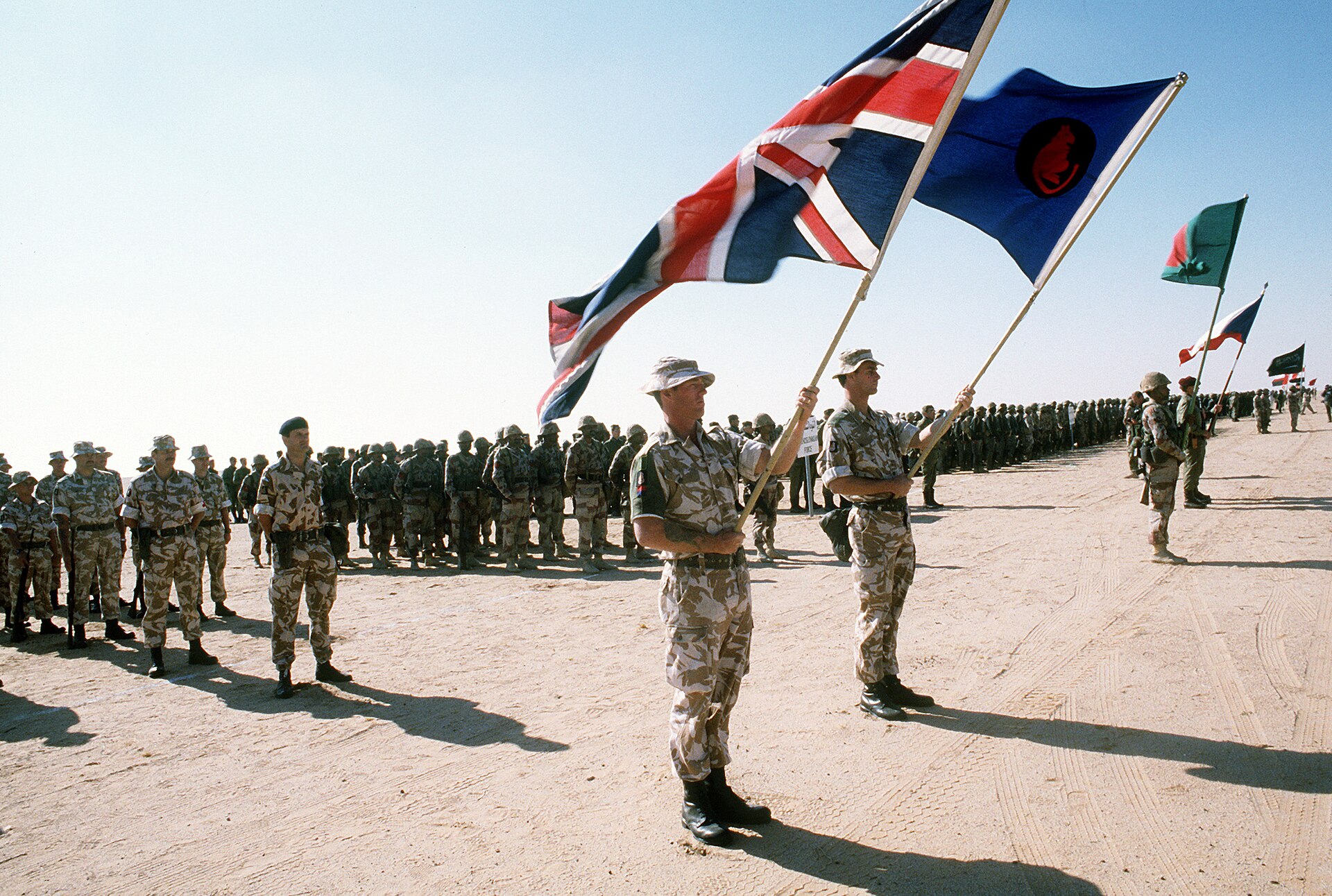
The contrast with the last major coalition on Saudi soil is instructive to the point of being painful. In 1991, a 42-nation alliance led by the United States deployed 800,000 troops to liberate Kuwait, with Egyptian armor, Syrian infantry, and British tank brigades fighting alongside Saudi forces on the ground. In 2026, the coalition defending the Kingdom against Iranian missiles and drones is technologically more sophisticated but strategically more hollow. Every ally has calibrated its commitment to avoid crossing the line from defense into co-belligerency — a distinction that protects their legal position under international law but leaves Riyadh absorbing punishing attacks with no credible path to deterrence through escalation.
Table of Contents
- The Anatomy of a Defensive-Only Coalition
- How Deep Is America’s Military Commitment to Saudi Arabia?
- What Has Pakistan Actually Deployed to the Kingdom?
- Why Did Britain Return to the Gulf After a Decade Away?
- The Ukraine Wildcard — Drone Killers From the Donbas to the Empty Quarter
- Is China an Ally, a Mediator, or an Opportunist?
- The GCC’s Hollow Mutual Defense
- Who Refused to Show Up?
- The Wartime Partner Reliability Index
- How Does This Coalition Compare to Desert Storm?
- What the Alliance Gap Means for Saudi Arabia’s Future
- Frequently Asked Questions
The Anatomy of a Defensive-Only Coalition
The coalition that has formed around Saudi Arabia in March 2026 defies easy categorization. It is not a formal alliance — there is no joint command, no shared rules of engagement, no combined operational headquarters. It is not a coalition of the willing in the 2003 sense — no partner except the United States and Israel has conducted offensive strikes against Iranian territory. And it is not a peacekeeping force — every participant has been drawn in by the practical necessity of defending its own personnel, assets, or treaty obligations rather than by any shared vision of what victory looks like.
What it resembles most closely is a series of bilateral arrangements radiating outward from Riyadh like spokes on a wheel, each calibrated to the specific political constraints and strategic interests of the partner in question. The United States provides the most capable military assets but insists on framing its presence as defensive. Pakistan has invoked a formal defense pact but keeps its troops behind a carefully drawn line. The United Kingdom permits American use of its bases but refuses to acknowledge co-belligerency. France has repositioned its carrier strike group but avoids direct engagement. Ukraine offers specialized drone-killing expertise in exchange for future weapons commitments. And China sends a peace envoy while quietly calculating whether the war serves or undermines its energy security.
The result is a coalition that can intercept missiles but cannot deter them — a distinction that matters more with each passing day of Iranian attacks. Analysis of the operational contributions from the fifteen countries involved reveals that fewer than four have placed combat-capable assets within range of Iranian targets, and only two — the United States and Israel — have actually used them offensively. The remaining thirteen partners have limited their involvement to some combination of air defense support, intelligence sharing, diplomatic backing, humanitarian assistance, or moral solidarity expressed through press releases.
How Deep Is America’s Military Commitment to Saudi Arabia?
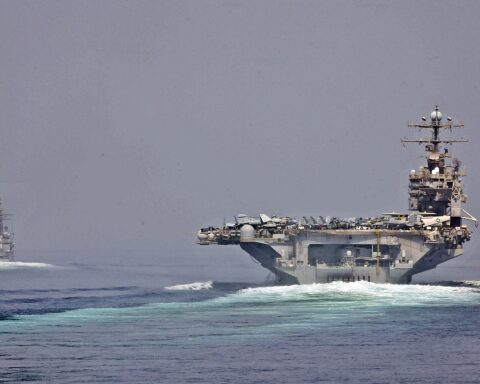
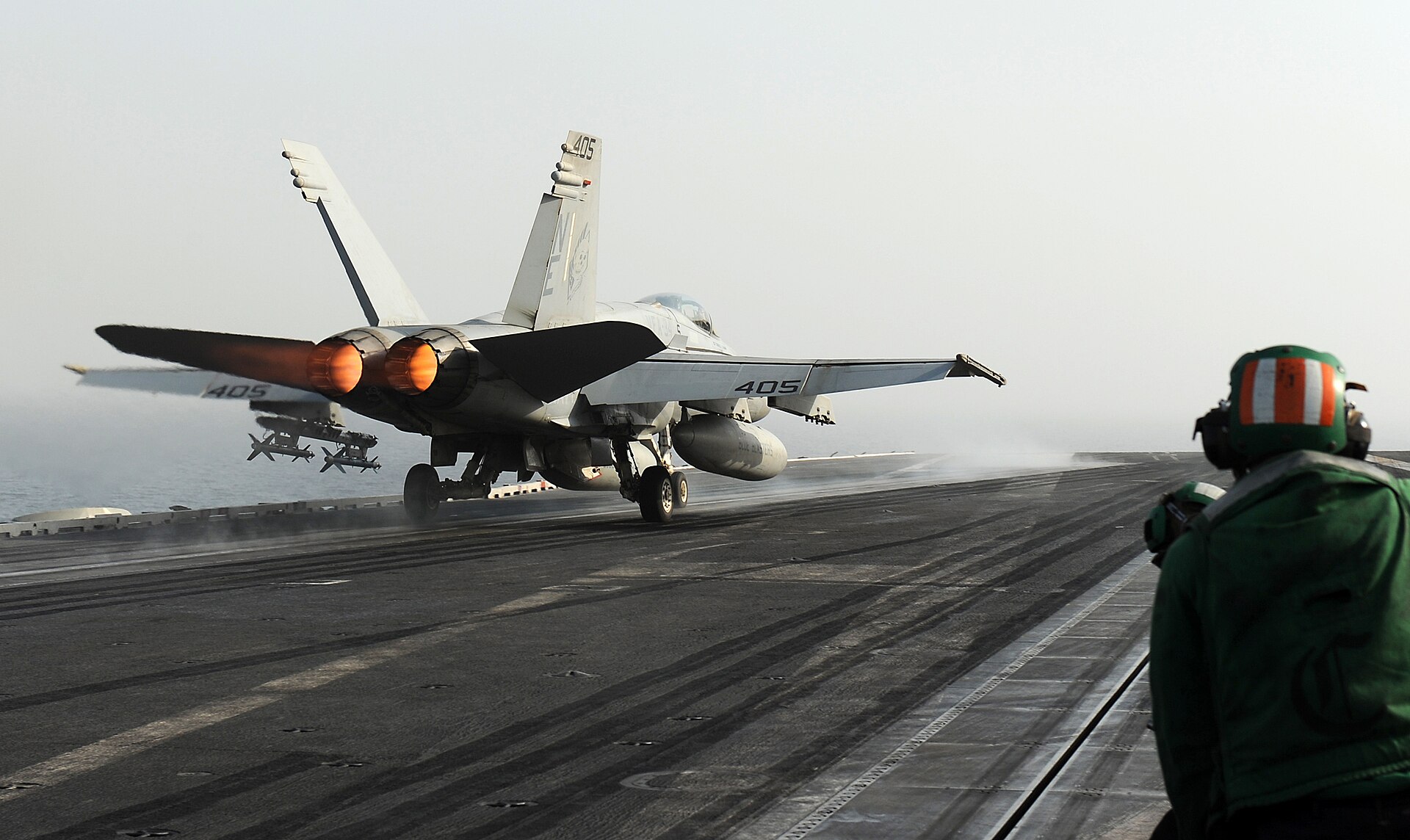
The United States has positioned its most formidable military concentration in the Middle East since the 2003 invasion of Iraq. Two carrier strike groups — the USS Abraham Lincoln in the Arabian Sea and the USS Gerald R. Ford off Israel’s coast — form the backbone of naval power projection, supported by more than 150 aircraft and sixteen surface warships. The Pentagon estimates between 40,000 and 50,000 American service members are now stationed across the region, according to CSIS analysis, with the Abraham Lincoln strike group alone bringing approximately 5,700 additional personnel when it arrived on January 26.
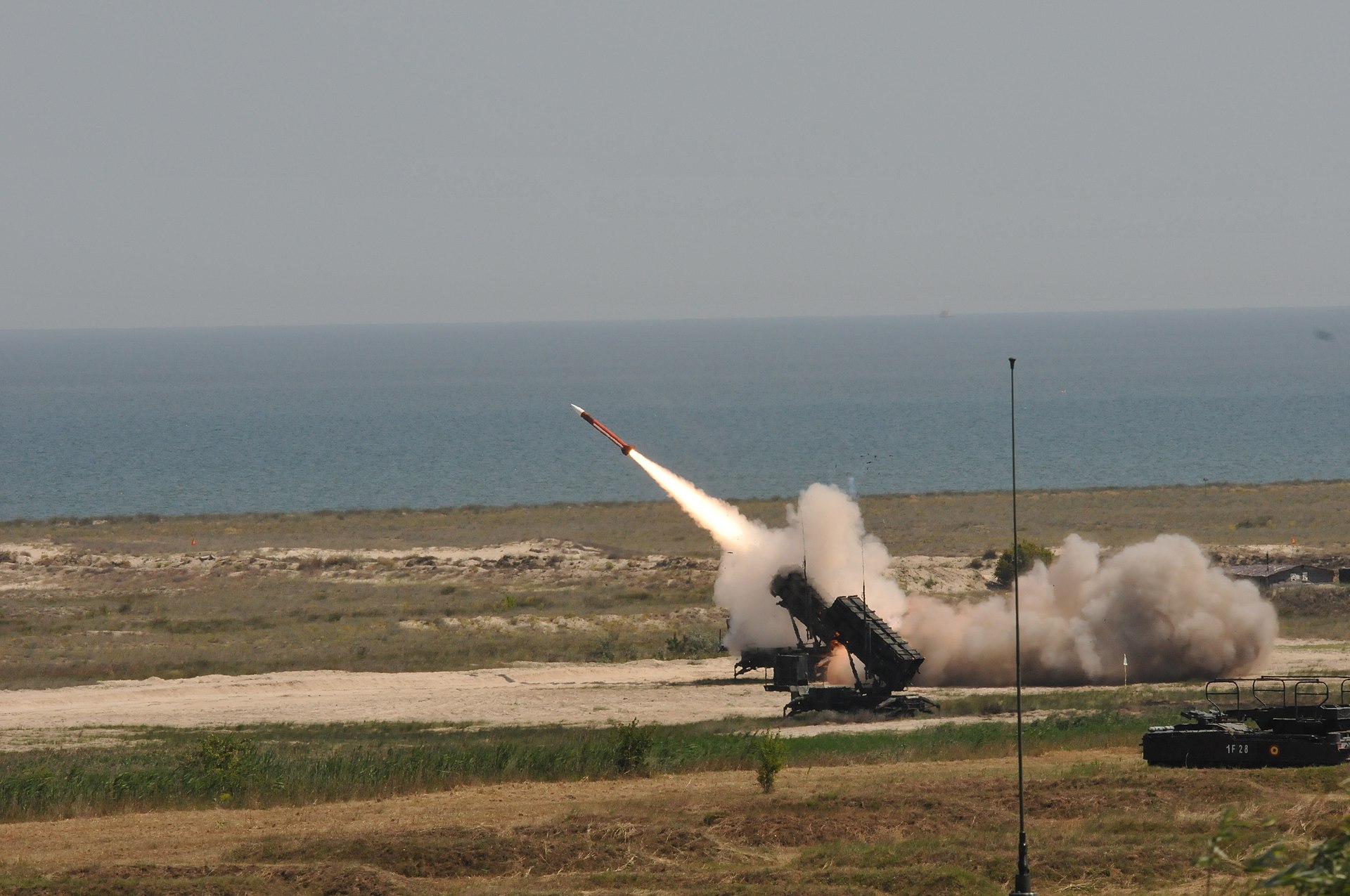
The air component is equally substantial. More than 120 aircraft have been deployed, including F-35 stealth fighters, F-22 air superiority jets, F-15Es, F-16s, E-3 Sentry AWACS aircraft, and EA-18G Growler electronic warfare platforms. THAAD and Patriot missile defense batteries have been positioned at Prince Sultan Air Base and other locations across the Gulf, and the Military Times reported that the naval armada represents the largest concentration of American warships in the region since five carrier battle groups assembled for Operation Iraqi Freedom in 2003.
Yet the American commitment comes wrapped in contradictions that Riyadh finds increasingly difficult to manage. Washington frames every deployment as defensive — protecting American bases, American personnel, and American allies from Iranian retaliation. The Pentagon has not offered to extend its air defense umbrella to cover Saudi economic infrastructure, and the question of whether the United States would escort commercial shipping through the Strait of Hormuz has produced conflicting signals. President Trump declared the Navy would escort ships “if necessary,” while White House Press Secretary Karoline Leavitt confirmed hours later that “the US Navy has not escorted a tanker or a vessel at this time.” The gap between American promises and American action would widen further when Trump’s call for allied warships at Hormuz produced silence from every capital he named.
Seven American service members have been killed and approximately 140 wounded since Operation Epic Fury began, according to Pentagon briefings. These casualties create domestic political pressure that simultaneously justifies the deployment and constrains its scope. Every American death strengthens the argument for protecting US forces in the Gulf while weakening the case for expanding that protection to Saudi commercial interests. MBS understands this dynamic — the degradation of America’s missile shield over Saudi Arabia is as much a political failure as a technical one.
What Has Pakistan Actually Deployed to the Kingdom?
Pakistan’s military relationship with Saudi Arabia is the oldest and deepest of any non-Western partner, and the September 2025 Strategic Mutual Defence Agreement elevated it from a historical courtesy to a binding treaty obligation. The agreement, signed in Riyadh by MBS and Pakistani Prime Minister Shehbaz Sharif, commits both nations to mutual defense — a framework that Brookings described as “the most significant bilateral defense pact in the Muslim world since the dissolution of the Baghdad Pact in 1979.”
Within 72 hours of the first Iranian strikes on Saudi territory, Pakistan invoked the defense pact and began moving military assets. Islamabad deployed air defense systems and troops to Saudi Arabia, though the exact numbers remain classified. Historical precedent suggests the scale could be significant — Pakistan has maintained between 10,000 and 20,000 troops in Saudi Arabia at various points since the 1970s, and former Saudi diplomat Ali Awadh Asseri has claimed Pakistan would deploy up to 100,000 troops if MBS requested them.
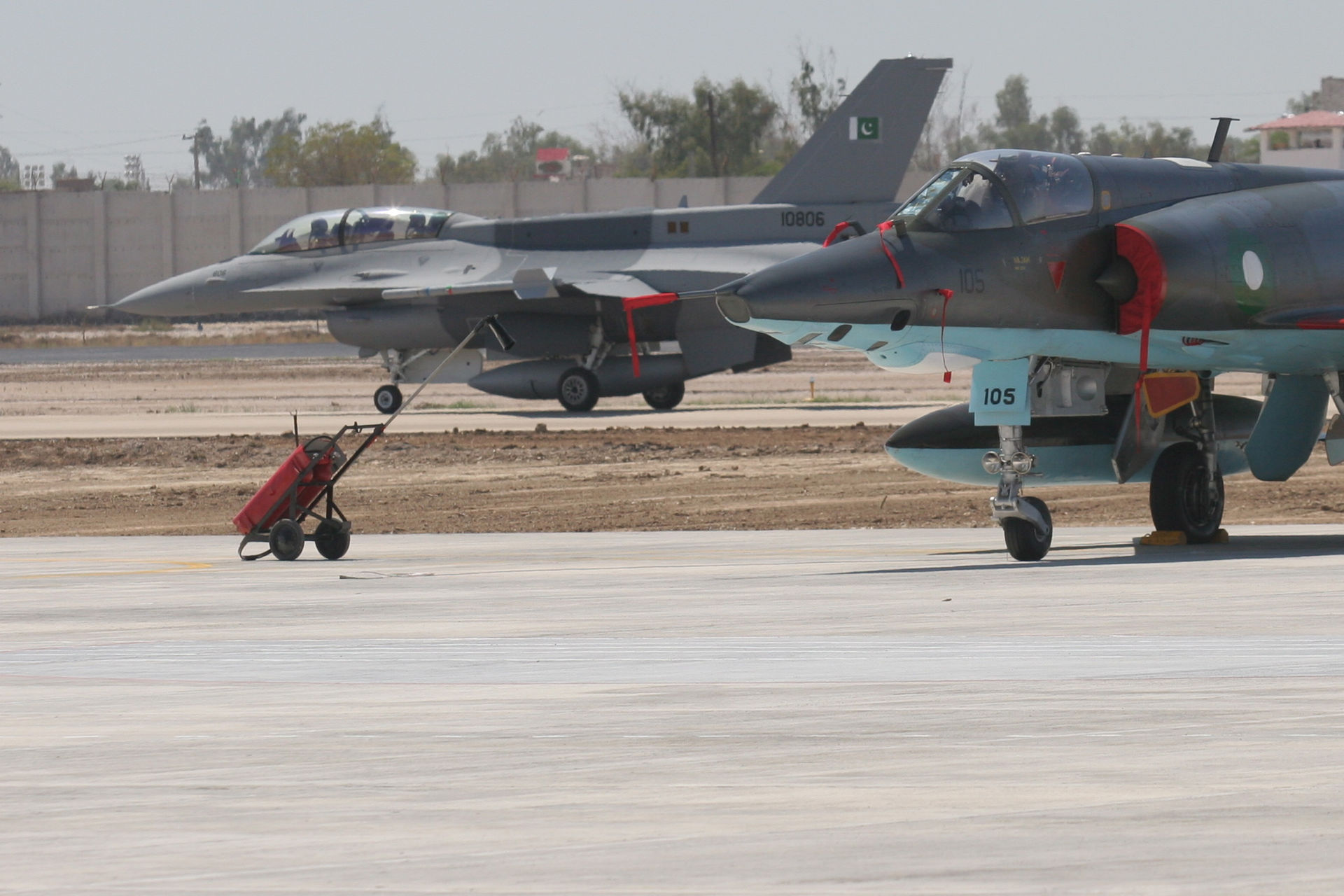
The practical contributions so far include air defense crews trained on Chinese-origin HQ-9 and Pakistani-modified systems, ground force contingents positioned at critical infrastructure sites, and intelligence-sharing arrangements that give Riyadh access to Pakistan’s signals intelligence capabilities. The Pakistan Air Force, which operates F-16C Block 52+ fighters alongside JF-17 Thunders developed jointly with China, has put units on alert for potential deployment, though Islamabad has been careful not to confirm whether Pakistani pilots are flying combat air patrols over Saudi airspace.
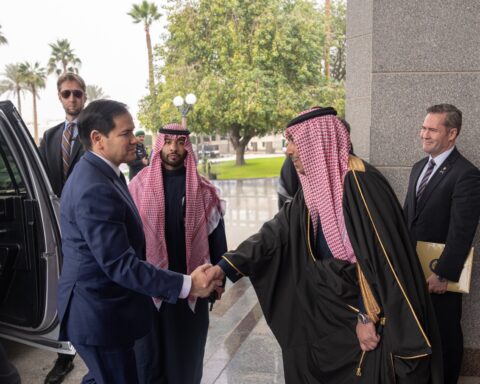
Prime Minister Shehbaz’s arrival in Riyadh on March 12, one day after speaking with Iran’s president, underscores the delicate position Islamabad occupies. Pakistan shares a 959-kilometer border with Iran, maintains trade relationships with Tehran, and has a Shia minority comprising roughly 15-20 percent of its 240 million population. Bloomberg reported that Shehbaz is attempting shuttle diplomacy between the two Gulf adversaries — a role that simultaneously validates Pakistan’s strategic importance and constrains its willingness to take sides in combat operations. The impossible choice Pakistan faces — honoring its defense pact with Riyadh without provoking its Iranian neighbor — defines the limits of even the Kingdom’s most committed ally.
Why Did Britain Return to the Gulf After a Decade Away?
The United Kingdom’s military engagement with the Gulf had atrophied steadily since the 2015 Strategic Defence and Security Review prioritized the Euro-Atlantic theater. British forces maintained a naval support facility in Bahrain and periodic destroyer deployments, but the expeditionary capability that once defined British power projection east of Suez had been allowed to rust. The Iran war reversed this trajectory with remarkable speed.
Within days of the first Iranian strikes, Prime Minister Keir Starmer authorized American forces to use British military bases for “defensive” operations — a legally significant distinction that Chatham House scholars have described as blurring the line between lawful self-defence and unlawful participation in war. HMS Dragon, a Type 45 Daring-class air defense destroyer fitted with Sea Viper missile systems, was redeployed from the English Channel to the Eastern Mediterranean. Two Wildcat helicopters armed with counter-drone Martlet missiles were dispatched to Cyprus. And the Royal Navy accelerated the operational readiness of HMS Prince of Wales, its second aircraft carrier, cutting the deployment notice from ten days to five.
Britain’s contribution is calibrated with characteristic legal precision. The UK has shot down Iranian drones and missiles over allied airspace in Qatar, Iraq, and Jordan — framing each engagement as collective self-defense under Article 51 of the UN Charter. But Starmer initially denied Trump’s pre-war request to use British bases for offensive strikes, conceding only the “defensive” formulation after Iranian missiles began hitting Gulf states. The distinction matters to London’s lawyers; it is largely invisible to Tehran’s military planners, who view any British participation as complicity.
The deeper significance of the British return lies not in its current military contribution — modest compared to American assets — but in what it signals about the post-war security architecture. A Britain that has recommitted to Gulf defense after a decade of drift becomes a potential cornerstone of the multilateral defense framework MBS has been seeking, a counterweight to American unpredictability, and a partner whose defense industry offers alternatives to the US monopoly on advanced weapons systems.
The Ukraine Wildcard — Drone Killers From the Donbas to the Empty Quarter
The most unexpected participant in Saudi Arabia’s defensive coalition is Ukraine, a country fighting its own existential war 3,000 kilometers away. President Volodymyr Zelenskyy’s offer to send drone defense teams to the Gulf states was initially dismissed by skeptics as a publicity stunt. It turned out to be one of the most operationally useful contributions any partner has made.
Ukraine deployed three specialized air defense teams to Qatar, the UAE, and Saudi Arabia during the first week of March, according to the Kyiv Independent, along with specialists to a US military base in Jordan. National Security and Defense Council Secretary Rustem Umerov traveled to the Gulf with military, intelligence, and defense officials to finalize what Kyiv described as “concrete agreements.” The teams brought with them something no other ally could offer — three years of combat experience against the exact Iranian drone systems now attacking Gulf states.
The Shahed-136 and Shahed-131 drones that Iran has launched against Saudi oil facilities, military bases, and civilian infrastructure are the same platforms Russia has purchased from Tehran and used against Ukrainian cities since 2022. Ukrainian forces have developed networks of acoustic sensors and microphones that recognize the distinctive sound signature of these drones, alerting interceptor teams in real time. This operational knowledge — earned at the cost of thousands of Ukrainian civilian lives — transfers directly to the Gulf theater.
The Defense Post reported that Saudi Arabia signed a contract with a Saudi arms firm for Ukrainian-made interceptor missiles, and the Kyiv Independent described negotiations for a separate “huge deal” involving additional defense systems. Zelenskyy is selling MBS weapons that Washington cannot deliver fast enough, and in exchange, Ukraine demands that countries seeking its counter-drone expertise assist Ukraine’s own defense — primarily through the provision of Patriot and similar air defense systems. The transaction transforms Ukraine from a supplicant begging for Western weapons into a security provider with unique battlefield expertise, and it gives Saudi Arabia access to proven drone-killing technology outside the bottleneck of American export controls.
Is China an Ally, a Mediator, or an Opportunist?
China’s involvement in the Iran war coalition defies the ally-adversary binary that structures Western thinking about wartime partnerships. Beijing has not deployed military assets, not provided weapons, not opened intelligence channels, and not joined any condemnation of Iran. And yet China may be the most strategically important external actor for Saudi Arabia’s long-term position — a reality that MBS understands better than his Western partners.
China’s special envoy for the Middle East, Zhai Jun, arrived in Riyadh on March 8 for meetings with Saudi Foreign Minister Prince Faisal bin Farhan, followed by talks with UAE officials and the GCC Secretary-General. The Stimson Center characterized Beijing’s shuttle diplomacy as “strategic facilitation” rather than mediation — a distinction that allows China to present itself as an honest broker while protecting its relationships with both Riyadh and Tehran.
The Chinese calculus is driven by energy security. Approximately 40 percent of China’s crude oil imports transit the Strait of Hormuz, and the 90 percent collapse in shipping traffic since the crisis began represents an immediate threat to the Chinese economy. Beijing’s interest in ending the war is not humanitarian but commercial — every day the Strait remains functionally closed costs Chinese industry billions in higher energy costs and supply chain disruptions. China Daily reported on March 12 that Beijing was “stepping up its diplomatic push for peace,” and the Chinese Foreign Ministry has repeatedly called for an immediate cessation of hostilities.
For MBS, China’s role offers a hedge that no Western partner provides. Beijing brokered the March 2023 Saudi-Iran rapprochement that temporarily reduced tensions between the two Gulf rivals — a diplomatic achievement that gave China credibility as a Gulf mediator and demonstrated that Washington is not the only power capable of shaping regional outcomes. If China can deliver a ceasefire or a framework for de-escalation, MBS gains a diplomatic partner whose leverage over Iran exceeds anything the US or Europe can offer. If China fails, the Kingdom loses nothing — Beijing’s involvement carries no political cost in Riyadh and marginal cost in Washington, which has larger concerns than Chinese diplomatic tourism.
The GCC’s Hollow Mutual Defense
The Gulf Cooperation Council was founded in 1981 partly as a collective security mechanism, but four decades later, the Iran war has exposed the gap between its diplomatic rhetoric and its military reality. The GCC Ministerial Council’s 50th Extraordinary Meeting on March 1, 2026, produced a statement condemning Iranian attacks “in the strongest terms” and invoking Article 51 of the UN Charter — the right of individual and collective self-defense. The Arab foreign ministers followed with their own collective defense declaration after Iran struck eight states in 36 hours.
But collective defense requires collective military capability, and the GCC has never developed one. The Peninsula Shield Force, headquartered at King Abdulaziz Military City in Hafr al-Batin, exists primarily as a ceremonial formation. GCC air defenses are nationally controlled with no integrated command structure, and the six member states operate different radar systems, missile defense platforms, and communications networks that were never designed to work together. As Breaking Defense reported, the initial Iranian barrage represented a “nightmare scenario” precisely because GCC air defense coordination “remains limited at best and operationally non-existent” beyond improvised deconfliction with American systems.
The alliance Iran never meant to build is real in the sense that all six GCC states now face a common Iranian threat for the first time in history. It is illusory in the sense that this shared threat has not yet produced shared military operations, shared command structures, or shared rules of engagement. Saudi Arabia, which accounts for roughly 65 percent of total GCC defense spending, remains the de facto shield for smaller members who contribute political solidarity but limited operational capability.
| Country | Attacked? | Military Response | Hosts US Forces? | Offensive Action? |
|---|---|---|---|---|
| Saudi Arabia | Yes — missiles, drones, ballistic | Active air defense, intelligence sharing | Yes — Prince Sultan AB | No |
| UAE | Yes — drones, cruise missiles | Active air defense | Yes — Al Dhafra AB | No |
| Bahrain | Yes — missiles, fuel depot hit | Active air defense, US Fifth Fleet coordination | Yes — NSA Bahrain | No |
| Kuwait | Yes — airport damaged, airspace closed | Airspace closure, air defense | Yes — Camp Arifjan | No |
| Qatar | Yes — Al Udeid targeted | Active air defense | Yes — Al Udeid AB | No |
| Oman | Yes — Salalah Port hit | Diplomatic mediation | Limited | No |
Who Refused to Show Up?
The countries that have not joined Saudi Arabia’s defensive coalition reveal as much about the Kingdom’s strategic position as those that have. Three notable absences define the limits of MBS’s diplomatic reach.
Egypt’s calculated silence is the most strategically significant. In 1991, Cairo deployed 40,000 troops and 400 tanks to Saudi Arabia — the second-largest Arab contribution to the Gulf War coalition. In 2026, President Abdel Fattah el-Sisi has offered verbal support for the GCC states while refusing any military contribution, according to analysis by the Foundation for Defense of Democracies. Egypt’s position, MEMRI documented, initially leaned toward sympathy for Iran while condemning attacks on fellow Arab states — a contortion that reflects Cairo’s dependence on American aid, its fear of Suez Canal disruption, and its unwillingness to antagonize a country whose proxy networks could threaten Egyptian interests in Libya, Sudan, and the Red Sea.
Turkey’s balancing act represents a different kind of refusal. President Recep Tayyip Erdogan condemned both the US-Israeli strikes on Iran and the Iranian retaliation against Gulf states, expressed “sadness” at the assassination of Ali Khamenei, and publicly stated that Turkish territory and airspace would not be used for attacks against Iran. Turkey’s NATO membership, its 534-kilometer border with Iran, its dependence on Iranian natural gas, and its domestic political dynamics make any meaningful support for Saudi Arabia politically toxic in Ankara. The EU Institute for Security Studies noted that Turkey has ramped up mediation efforts alongside Oman and Qatar — positioning itself as a peacemaker rather than a belligerent.
That balancing act has grown more precarious since March 13, when Iranian missiles triggered air raid sirens at Incirlik Air Base, the NATO facility in southern Turkey that houses approximately 50 American nuclear weapons.
Jordan presents a third variation. The Hashemite Kingdom was directly attacked by Iranian ballistic missiles and strongly condemned the strikes. But Jordan, which depends on Saudi and American aid for fiscal survival, has been careful to frame its response as national self-defense rather than alignment with the US-Israeli campaign against Iran. Amman cannot afford to be seen as a staging ground for attacks on a Muslim country — a lesson King Abdullah learned from his father’s experience during the 1991 Gulf War, when Jordan’s ambiguous stance cost it Saudi financial support for a decade.
India’s immobilization is the fourth critical absence. Nine million Indian citizens work in the Gulf states, and India imports approximately 40 percent of its crude oil from the region. Yet Prime Minister Modi has offered nothing beyond standard diplomatic expressions of concern, according to Bloomberg. India’s relationship with Iran — through which it accesses Central Asian markets and the Chabahar port — prevents any meaningful security commitment to Saudi Arabia, despite the Kingdom being India’s largest oil supplier.
The Wartime Partner Reliability Index
Mapping the fifteen countries that have contributed to Saudi Arabia’s defensive position against two axes — operational commitment and strategic reliability — produces a classification system that reveals the true structure of the coalition far more clearly than official statements or diplomatic communiques.
Operational commitment ranges from combat-ready forces on Saudi soil (Level 5) to diplomatic statements with no military component (Level 1). Strategic reliability measures whether the partner has followed through on commitments under pressure, or whether its support has eroded as costs have increased.
| Partner | Category | Operational Commitment (1-5) | Strategic Reliability (1-5) | Composite Score | Key Contribution |
|---|---|---|---|---|---|
| United States | Tier 1 — Anchor | 5 | 4 | 20 | 2 carrier groups, 50K troops, THAAD/Patriot, 150+ aircraft |
| Pakistan | Tier 1 — Treaty Ally | 4 | 4 | 16 | Air defense crews, ground troops, defense pact invoked |
| United Kingdom | Tier 2 — Active Defender | 3 | 4 | 12 | Type 45 destroyer, drone intercepts, base access |
| France | Tier 2 — Active Defender | 3 | 3 | 9 | Carrier Charles de Gaulle, Rafale jets, base access |
| Ukraine | Tier 2 — Specialist | 3 | 4 | 12 | Counter-drone teams, acoustic sensors, interceptor missiles |
| Australia | Tier 3 — Contributor | 2 | 3 | 6 | E-7A Wedgetail, AMRAAM missiles to UAE |
| Greece | Tier 3 — Contributor | 2 | 3 | 6 | 2 frigates, 4 F-16s to Cyprus |
| Spain | Tier 3 — Contributor | 2 | 2 | 4 | Cristobal Colon frigate to Cyprus |
| Italy/Netherlands | Tier 3 — Contributor | 2 | 2 | 4 | Naval assets to Eastern Mediterranean |
| China | Tier 4 — Mediator | 1 | 3 | 3 | Diplomatic envoy, ceasefire push |
| Japan/South Korea | Tier 4 — Affected Bystanders | 1 | 2 | 2 | Diplomatic support, energy crisis management |
| Egypt | Tier 5 — Absent Ally | 1 | 1 | 1 | Verbal solidarity only |
| Turkey | Tier 5 — Absent Ally | 1 | 1 | 1 | Mediation offer, no military support |
| India | Tier 5 — Absent Ally | 0 | 1 | 0 | Diplomatic statements only |
The index reveals a coalition that is top-heavy and shallow. The United States accounts for roughly 80 percent of total military capability deployed in Saudi Arabia’s defense, with Pakistan and the UK providing meaningful but secondary contributions. Below that tier, commitments diminish rapidly to the point of symbolic irrelevance. Thirteen of the fifteen partners have composite scores below 10, meaning their contributions amount to either specialized niche capabilities or diplomatic gestures with no military weight.
The most alarming finding is the cluster of Tier 5 absent allies — countries that might reasonably be expected to support Saudi Arabia based on historical relationships, geographic proximity, or economic interdependence but have chosen neutrality or worse. Egypt, Turkey, and India collectively represent over 1.6 billion people, three of the world’s twenty largest militaries, and centuries of engagement with the Gulf. Their absence from the coalition is not an oversight; it is a strategic calculation that MBS cannot afford to ignore.
How Does This Coalition Compare to Desert Storm?
The comparison between Saudi Arabia’s 2026 defensive coalition and the 1991 Gulf War coalition illuminates how fundamentally the strategic landscape has shifted in 35 years. Both coalitions were assembled in response to aggression against a Gulf state. Both were led by the United States. Both involved Saudi Arabia as the primary regional stakeholder. And yet the differences are more revealing than the similarities.
| Metric | Desert Storm 1991 | Iran War 2026 | Change |
|---|---|---|---|
| Countries involved | 42 | ~15 | -64% |
| Total coalition troops | ~800,000 | ~55,000 | -93% |
| Arab combat forces | Egypt (40K), Syria (14.5K), Saudi Arabia | Saudi Arabia only (defensive) | No Arab offensive forces |
| UN Security Council mandate | Yes (Resolution 678) | No (US unilateral + Israel) | No international legal authority |
| Offensive operations by allies | UK (43K troops), France (20K), Egypt, Syria, Gulf states | US and Israel only | No allied offensive action |
| Saudi territory attacked | Yes (Scud missiles, limited) | Yes (massive — drones, cruise, ballistic) | Vastly more attacks on Saudi soil |
| Coalition goal | Liberate Kuwait (clear, achievable) | Undefined (defend + hope war ends) | No articulated end state |
Three differences stand out. First, the 1991 coalition had explicit UN Security Council authorization — Resolution 678 provided legal cover for offensive military action, which gave allies like Egypt, Syria, and France the political justification to commit combat forces. The 2026 war lacks any comparable international mandate. The United States and Israel launched strikes on Iran without Security Council approval, and their allies cannot frame participation in offensive operations as enforcement of international law. This legal vacuum explains why every partner except the US and Israel has limited itself to defensive operations.
Second, the 1991 coalition included major Arab combat forces that fought alongside American and British troops. Egyptian armored divisions and Syrian infantry brigades operated in Saudi Arabia under a joint command structure that gave the coalition credible Arab legitimacy. In 2026, no Arab state has committed combat forces to offensive operations against Iran, and the GCC’s collective response has been limited to air defense and diplomatic statements. The absence of Arab combat forces transforms the conflict from a multinational response to aggression into an American-Israeli military operation that Gulf states endure rather than prosecute.
Third, the 1991 coalition had a clear, achievable military objective — liberate Kuwait. The 2026 coalition has no articulated end state. Is the goal to destroy Iran’s military capability? To force a ceasefire? To change the regime? To protect Saudi infrastructure until Iran runs out of missiles? Nobody in the coalition has publicly answered this question, and the absence of a shared objective makes sustained allied commitment increasingly difficult to maintain as costs accumulate.
What the Alliance Gap Means for Saudi Arabia’s Future
The gap between the coalition Saudi Arabia needed and the coalition it received will shape the Kingdom’s strategic posture for a generation. Three consequences are already becoming visible.
First, MBS will accelerate the diversification of Saudi Arabia’s defense supply chain beyond American systems. The war has demonstrated that the US monopoly on advanced weapons platforms gives Washington a veto over Saudi military options — what analysts have called an arms race that will outlast the missiles. The $5 billion deal to build Chinese combat drones in Jeddah, reported on March 11, signals the direction of travel. Saudi Arabia will continue purchasing American F-15s and Patriot batteries, but the war has created political space for diversification into Chinese, South Korean, Turkish, and Ukrainian systems that reduce dependence on any single supplier.
Second, the Saudi-Pakistani defense pact will deepen into the most consequential bilateral military relationship in the Muslim world. Pakistan is the only partner that has both invoked a formal treaty obligation and deployed forces to Saudi soil. The defense pact under Iranian fire has proven its operational relevance, and Riyadh will invest heavily in Pakistani military capacity as a hedge against American unreliability. The nuclear dimension — Pakistan is the only Muslim-majority nuclear weapons state — adds a deterrent layer that no other Saudi partner can provide, even if both governments publicly deny any nuclear sharing arrangement.
Third, the GCC will face unavoidable pressure to develop genuine collective defense capabilities or acknowledge that the organization’s security function is ceremonial. The war has demonstrated that six wealthy nations sharing a common threat cannot coordinate their air defenses, cannot share intelligence in real time, and cannot mount combined military operations without American systems serving as the connective tissue. Either the GCC develops an integrated air defense architecture with shared radar coverage, combined command, and interoperable systems — a project that would cost an estimated $30-50 billion and take a decade to build — or it concedes that Gulf security will remain permanently dependent on the United States.
The paradox of Saudi Arabia’s wartime coalition is that breadth has substituted for depth. Fifteen countries is more than enough to issue press releases. It is not enough to deter an adversary willing to absorb punishment indefinitely.
Strategic assessment, March 2026
The conventional wisdom holds that Saudi Arabia’s coalition demonstrates the Kingdom’s diplomatic success — MBS has rallied more countries to Saudi Arabia’s defense than any Saudi leader since King Fahd during the Gulf War. The evidence supports a more sobering conclusion. The coalition is broad precisely because its commitments are shallow. Every partner has calibrated its involvement to minimize domestic political risk, legal exposure, and strategic entanglement. The result is a defensive structure that can absorb Iranian attacks but cannot end them — a coalition built for endurance rather than victory, for survival rather than deterrence. Yet as analysis of Saudi Arabia’s non-belligerence strategy demonstrates, this alliance paradox may be less a failure of coalition-building than a feature of Riyadh’s deliberate restraint — a posture that converts shallow allied commitments into deep strategic returns.
MBS entered this war with more allies than any Saudi leader in history. He may emerge from it with a clearer understanding of what allies are actually worth — and a Kingdom more determined than ever to build the sovereign military capability that would make such alliances optional rather than essential. The House of Saud has survived for nearly a century by balancing external partnerships against internal strength. The Iran war is teaching its current ruler that the balance has shifted too far toward dependence — and that correction, when it comes, will reshape the Middle Eastern security order more profoundly than the war itself.
Frequently Asked Questions
How many countries are supporting Saudi Arabia in the 2026 Iran war?
Approximately fifteen countries have provided some form of support to Saudi Arabia during the 2026 Iran war, ranging from the United States’ deployment of two carrier strike groups and 50,000 troops to diplomatic statements from countries like India and Japan. However, only three partners — the US, Pakistan, and the UK — have deployed combat-capable military assets to the Gulf region, and only the United States and Israel have conducted offensive operations against Iran.
Has Pakistan sent troops to defend Saudi Arabia?
Pakistan invoked the September 2025 Strategic Mutual Defence Agreement within 72 hours of the first Iranian strikes on Saudi territory and deployed air defense systems and military personnel to the Kingdom. The exact troop numbers remain classified, but Pakistan has historically maintained between 10,000 and 20,000 troops in Saudi Arabia, and the defense pact commits both nations to mutual military assistance. Prime Minister Shehbaz Sharif arrived in Riyadh on March 12 for urgent talks with MBS while simultaneously maintaining diplomatic contact with Iran’s president.
Is the GCC fighting Iran as a unified military alliance?
The GCC condemned Iranian attacks at an emergency ministerial meeting on March 1, 2026, and invoked Article 51 of the UN Charter affirming collective self-defense rights. However, the GCC has not mounted unified military operations. Each member state operates its own air defense network independently, and the Peninsula Shield Force has not been activated for combat. Operational coordination exists primarily through improvised arrangements with American systems rather than GCC-to-GCC military integration.
Why has Egypt not joined the coalition defending Saudi Arabia?
Egypt has offered verbal support for the GCC states under Iranian attack but has refused any military contribution to Saudi Arabia’s defense. Cairo’s position reflects its dependence on American aid, fear of Suez Canal disruption, unwillingness to antagonize Iran’s proxy networks in neighboring countries, and a domestic political calculation that involvement in an American-initiated war against a Muslim country would be deeply unpopular. This contrasts sharply with 1991, when Egypt deployed 40,000 troops and 400 tanks to Saudi Arabia during the Gulf War.
What is China’s role in the Saudi Arabia-Iran war?
China has not provided military support to any party in the conflict but has deployed special envoy Zhai Jun to Riyadh, Abu Dhabi, and other regional capitals for what the Stimson Center describes as “strategic facilitation.” Beijing brokered the 2023 Saudi-Iran rapprochement and is positioning itself as a potential ceasefire mediator. China’s motivation is primarily economic — approximately 40 percent of its crude oil imports transit the Strait of Hormuz, and the 90 percent collapse in shipping traffic directly threatens Chinese energy security and industrial output.
How does the 2026 coalition compare to the 1991 Gulf War coalition?
The 1991 Gulf War coalition included 42 nations, 800,000 troops, combat forces from Egypt and Syria, and UN Security Council authorization. The 2026 coalition involves approximately fifteen countries, roughly 55,000 troops, no Arab offensive forces, and no UN mandate. The critical difference is that in 1991, allied nations fought alongside Saudi Arabia. In 2026, allied nations defend Saudi Arabia from Iranian retaliation for a war the US and Israel started — a distinction that limits every partner’s willingness to escalate beyond defensive operations.