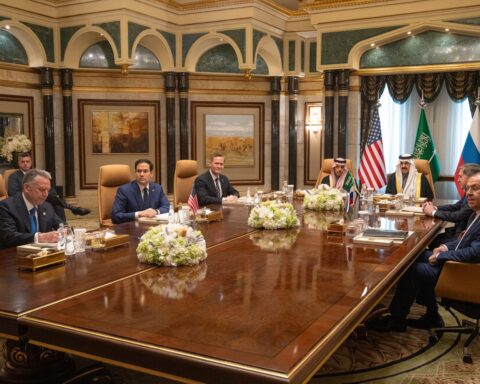
As tensions simmer in the Middle East, the United States finds itself at the heart of a complex diplomatic dance, striving to balance the competing interests of its regional partners while preventing the outbreak of a larger conflict. US National Security Adviser Jake Sullivan’s recent meeting with Saudi Crown Prince Mohammed bin Salman in Dhahran and ongoing talks between State Department officials and Iranian negotiators in Oman underscore Washington’s efforts to navigate the treacherous geopolitical landscape.
Central to the discussions between Sullivan and the Saudi Crown Prince is the normalization of relations with Israel, a move that could dramatically reshape the Middle East’s political dynamics. Saudi officials have hinted at the imminent completion of “semi-final” drafts of strategic agreements between the two countries, signaling a potential strengthening of the US-Saudi partnership. The Biden administration’s proposed deal with Saudi Arabia includes collaboration on a civilian nuclear program and security assurances, despite Riyadh’s reservations about Washington’s perceived leniency towards Tehran over the past three years.
Iran, meanwhile, has consistently warned Arab countries against normalizing ties with Israel. Supreme Leader Ali Khamenei’s remarks, which closely preceded Hamas’s unprecedented attack on Israel, have raised suspicions about Tehran’s involvement and awareness of the militant group’s plans. Iran’s UN representative confirmed the continuation of talks with US officials, highlighting the Biden administration’s keen interest in preventing regional escalation, particularly during an election year. However, Iran’s reiterated support for Hamas and other militant organizations receiving aid from Tehran further complicates the already fragile regional dynamics.https://houseofsaud.com/?p=18036&preview=true
The potential for nuclear proliferation adds another layer of complexity to the situation. US assistance to the Saudi nuclear program has prompted questions about Riyadh’s intentions and its willingness to coexist with a nuclear-threshold Iran. The Saudi Crown Prince’s assertion that if Iran obtained a nuclear weapon, Saudi Arabia would follow suit, has raised concerns among arms control advocates and US lawmakers about any potential US-Saudi nuclear agreement. A purely civilian Saudi nuclear program, however, might be linked to US security guarantees, hinting at a delicate balance of deterrence with Iran.
Iran, possessing sufficient fissile material for several nuclear warheads, appears to be leveraging its nuclear capabilities in its dealings with Israel and the United States. Iranian officials have threatened changes in nuclear policy if Israel targets the country’s nuclear sites or its regime, further heightening the stakes in the region.
As the United States endeavors to strike a balance between its regional partners’ often contradictory interests, the path to stability in the Middle East remains fraught with challenges. The intricate interplay between Saudi Arabia, Iran, Israel, and the US, coupled with the ever-present threat of nuclear proliferation, demands a skillful and nuanced approach from Washington’s policymakers. The outcome of these high-stakes negotiations will have far-reaching implications not only for the region but for the global balance of power in the years to come. The world watches with bated breath as the United States navigates this diplomatic tightrope, hoping to secure a more stable and peaceful future for the Middle East.