
MANAMA — The second tanker war in the Strait of Hormuz has already surpassed the first in every measurable dimension. Twenty-five days of conflict between Iran and a US-led coalition have halted 98 percent of commercial shipping through the world’s most important maritime chokepoint, a level of disruption that the original tanker war of 1984 to 1988 never came close to achieving across four full years of sustained hostilities. Where the first tanker war damaged 451 ships yet failed to disrupt more than 2 percent of Gulf transit traffic, the 2026 crisis has reduced daily tanker passages from 60 to fewer than one — an effective closure that has removed approximately 20 million barrels per day of oil from the market and triggered what the International Energy Agency calls the greatest global energy security challenge in history.
The parallels between 1988 and 2026 are striking enough that CNN, the US Naval Institute, and several think tanks have drawn direct comparisons in recent weeks. Iran is once again mining the strait, attacking commercial vessels, and threatening to choke global energy supplies. The United States is once again organizing convoy escorts and deploying naval power to keep the waterway open. Britain is once again leading mine-clearance operations. Yet the differences between the two conflicts reveal how fundamentally the balance of power in the Gulf has shifted — and why the playbook that worked in 1988 may fail catastrophically in 2026.
Table of Contents
- What Was the Original Tanker War?
- How Many Ships Were Attacked in Each Tanker War?
- The Insurance Battlefield
- Why Did Operation Earnest Will Succeed Where 2026 Convoys Have Failed?
- The Mine War Then and Now
- How Has Iran’s Arsenal Changed in Forty Years?
- The Hormuz Escalation Matrix
- The Oil Price Paradox
- Thirty Nations in Search of a Convoy Commander
- What Does the 1988 Endgame Tell Us About 2026?
- The Contrarian Case for a Faster Resolution
- The Saudi Pipeline That Did Not Exist in 1988
- Frequently Asked Questions
What Was the Original Tanker War?
The tanker war was a four-year campaign of attacks on commercial shipping in the Persian Gulf during the Iran-Iraq War, running from 1984 to 1988. It remains the most sustained period of attacks on merchant vessels since the Second World War and the closest historical precedent for the maritime conflict now unfolding in the same waters.
Iraq initiated the attacks in 1981, striking the Turkish-flagged Atlas I and later declaring the northern Gulf a prohibited war zone. Baghdad’s strategy was straightforward: destroy Iran’s ability to export oil through the Kharg Island terminal and strangle its war economy. Iran retaliated by attacking ships carrying Iraqi and Kuwaiti oil, reasoning that if its exports were threatened, no Gulf state’s shipping would be safe. By 1984, both sides were striking tankers with increasing frequency and diminishing restraint.
Over the four years of the tanker war, Iraq conducted 283 attacks on commercial vessels while Iran carried out 168, according to data compiled by the Strauss Center at the University of Texas and the US Naval History and Heritage Command. More than 30 million tons of shipping sustained damage. Approximately 239 petroleum tankers were struck, of which 55 — roughly 23 percent — were declared total losses or sunk. Yet the conflict’s most remarkable feature was not the violence but its limited effect: shipping through the Strait of Hormuz was never reduced by more than 2 percent. Tanker owners accepted higher insurance premiums, fitted their vessels with additional steel plating, and kept sailing.
The war drew the United States into direct naval engagement when Iraq mistakenly struck the USS Stark with two Exocet missiles in May 1987, killing 37 American sailors. That tragedy, paradoxically caused by a nominal US ally, catalysed Operation Earnest Will — the largest US naval convoy operation since the Second World War. It also led, through a chain of escalations, to the downing of Iran Air Flight 655 by the USS Vincennes in July 1988, killing all 290 passengers and crew in one of the deadliest aviation disasters in history.
The tanker war ended when the broader Iran-Iraq War reached a ceasefire on 8 August 1988. Shipping resumed fully within weeks. But the lesson that the world’s navies drew from the experience — that the strait could be kept open through convoy escort and superior firepower — would prove dangerously misleading four decades later.
How Many Ships Were Attacked in Each Tanker War?
The raw attack statistics of the two conflicts reveal a paradox: the 1980s tanker war produced far more individual ship attacks, yet caused vastly less economic disruption than the 2026 crisis.
Between 1984 and 1988, Iran and Iraq collectively struck 451 commercial vessels across four years, according to Lloyd’s War Risk Insurance data and the Strauss Center analysis. Iraq, using Mirage F1 fighters armed with Exocet anti-ship missiles, was responsible for approximately 80 percent of attacks through air-launched weapons. Iran relied on a combination of IRGC speedboat attacks, mine warfare, and Silkworm cruise missiles fired from coastal batteries.
The 2026 conflict has produced fewer individual attacks but with dramatically greater strategic effect. As of 25 March 2026, Iran has conducted at least 21 confirmed attacks on merchant vessels in the Persian Gulf and Gulf of Oman, according to tracking by Al Jazeera and the Combined Maritime Forces. These attacks have employed a far more diverse arsenal: ballistic missiles, cruise missiles, explosive-laden drone boats, aerial drones, and sea mines. The Thai-flagged Mayuree Naree was struck by two projectiles of unknown origin while transiting the strait, killing three crew members. Two fuel tankers in Iraqi waters were set ablaze by Iranian explosive-laden boats. The oil tanker Skylight was struck north of Khasab, Oman, killing two Indian crew members.
| Dimension | 1984-1988 Tanker War | 2026 Hormuz Crisis |
|---|---|---|
| Duration | 4 years (1984-1988) | 25 days (as of 25 March) |
| Ship attacks (total) | 451 | 21+ (confirmed) |
| Tankers sunk or total loss | 55 | 2 (confirmed) |
| Commercial traffic disruption | 2% | 98% |
| Daily tanker transits | ~55-60 (maintained) | <1 (effective shutdown) |
| Oil supply removed (bpd) | ~400,000 | ~20,000,000 |
| Peak insurance premium | 7.5% (Kharg Island trips) | 5% (all Gulf transits) |
| US military casualties | 37 (USS Stark) | Classified / ongoing |
| Civilian aviation incident | Iran Air 655 (290 killed) | None (airspace restricted) |
| Mines deployed by Iran | ~170 (estimated) | 12+ confirmed, more suspected |
| US warships deployed | 30+ | 40+ (estimated) |
| Coalition nations | ~5 | 30+ |
| IEA strategic release | No | Yes (coordinated) |
The critical distinction is not in the number of attacks but in their deterrent effect. In the 1980s, individual ship strikes raised insurance costs but did not halt traffic because tanker operators calculated that the probability of being hit remained acceptably low — fewer than 2 percent of transiting vessels were struck in any given year. In 2026, the combination of mining, drone swarms, and insurance market collapse has created a deterrent so comprehensive that 98 percent of normal shipping has simply stopped moving.
The Insurance Battlefield
The invisible weapon that has done more to close the Strait of Hormuz than any mine or missile is the war risk insurance premium. In both tanker wars, Lloyd’s of London and the broader marine insurance market served as an unofficial arbiter of which ships could sail and which could not. The difference is that in the 1980s, insurers kept the strait open. In 2026, they closed it.
During the original tanker war, war risk premiums for Gulf transits fluctuated between 1 percent and 7.5 percent of hull value, depending on the intensity of attacks. Trips to Iran’s Kharg Island terminal attracted the highest rates — 7.5 percent after the Saudi tanker Yanbu Pride was struck in May 1984. But for routine transits of the strait, premiums remained in the 1 to 3 percent range for most of the conflict. Lloyd’s paid out approximately $2 billion in total claims over the four-year war, half of which fell on the Lloyd’s market itself, according to the Strauss Center. The market absorbed these losses because the overall risk-to-reward ratio remained viable: tanker charter rates rose to compensate, and shipowners could still profit on the route.
The 2026 insurance crisis has been qualitatively different. Within days of the first Iranian strikes on commercial shipping in early March, war risk premiums surged from 0.125 percent to 5 percent of hull value — a fortyfold increase, according to Bloomberg and the Insurance Journal. For a very large crude carrier valued at $100 million, a single seven-day transit now costs $5 million in insurance alone. US, UK, and Israeli-flagged vessels face premiums three times higher than neutral-flagged ships, according to Lloyd’s List.
The premium increase alone would have been manageable. What broke the market was the decision by major Protection and Indemnity clubs — the mutual insurers that cover liability, pollution, and crew injury — to cancel war risk cover for the Persian Gulf entirely, as reported by Al Jazeera and Euronews in early March. Without P&I cover, a vessel cannot legally operate: ports will not accept it, cargo receivers will not discharge it, and flag states will not authorize its transit. The insurance cancellation created a de facto blockade more effective than Iran’s military threats.
The insurance market closed the Strait of Hormuz before Iran’s navy could. When P&I clubs cancelled war risk cover for Gulf transits, they accomplished in 72 hours what four years of Iranian mine warfare failed to achieve in the 1980s.Analysis of Lloyd’s List data, March 2026
Lloyd’s of London has since signalled willingness to work with the US government on a state-backed insurance facility — echoing the government-guaranteed war risk schemes that kept shipping moving during both world wars. But establishing such a facility requires legislative action, underwriting frameworks, and sovereign guarantees that take months, not days, to arrange. Trump’s proposed $20 billion Gulf insurance plan has, as of late March, failed to move a single tanker.
Why Did Operation Earnest Will Succeed Where 2026 Convoys Have Failed?
Operation Earnest Will ran from 24 July 1987 to 26 September 1988 and achieved something the 2026 coalition has not: it kept the oil flowing. Over 14 months, the US Navy completed 127 escort missions protecting 188 tanker transits through the Gulf, with no protected vessel lost to Iranian action. The operation was the largest American naval convoy effort since the Atlantic convoys of the Second World War, deploying more than 30 warships at its peak.
Three factors explain Earnest Will’s success — and all three are absent in 2026.
The first was the limited nature of Iran’s threat in the 1980s. Tehran’s naval assets consisted primarily of small speedboats operated by the IRGC Navy, shore-based Silkworm missiles with limited range, and a modest inventory of mines. The Iranian regular navy possessed a handful of frigates and corvettes, none of which could challenge the US Fifth Fleet in open water. When Iran tested America’s resolve, the result was Operation Praying Mantis on 18 April 1988 — the largest surface naval engagement since the Second World War, in which the US Navy sank one Iranian frigate, one fast-attack craft, and multiple speedboats while destroying two oil platforms. The first-ever exchange of missiles between surface warships in combat ended decisively in America’s favour. Iran’s naval provocations diminished sharply afterward.
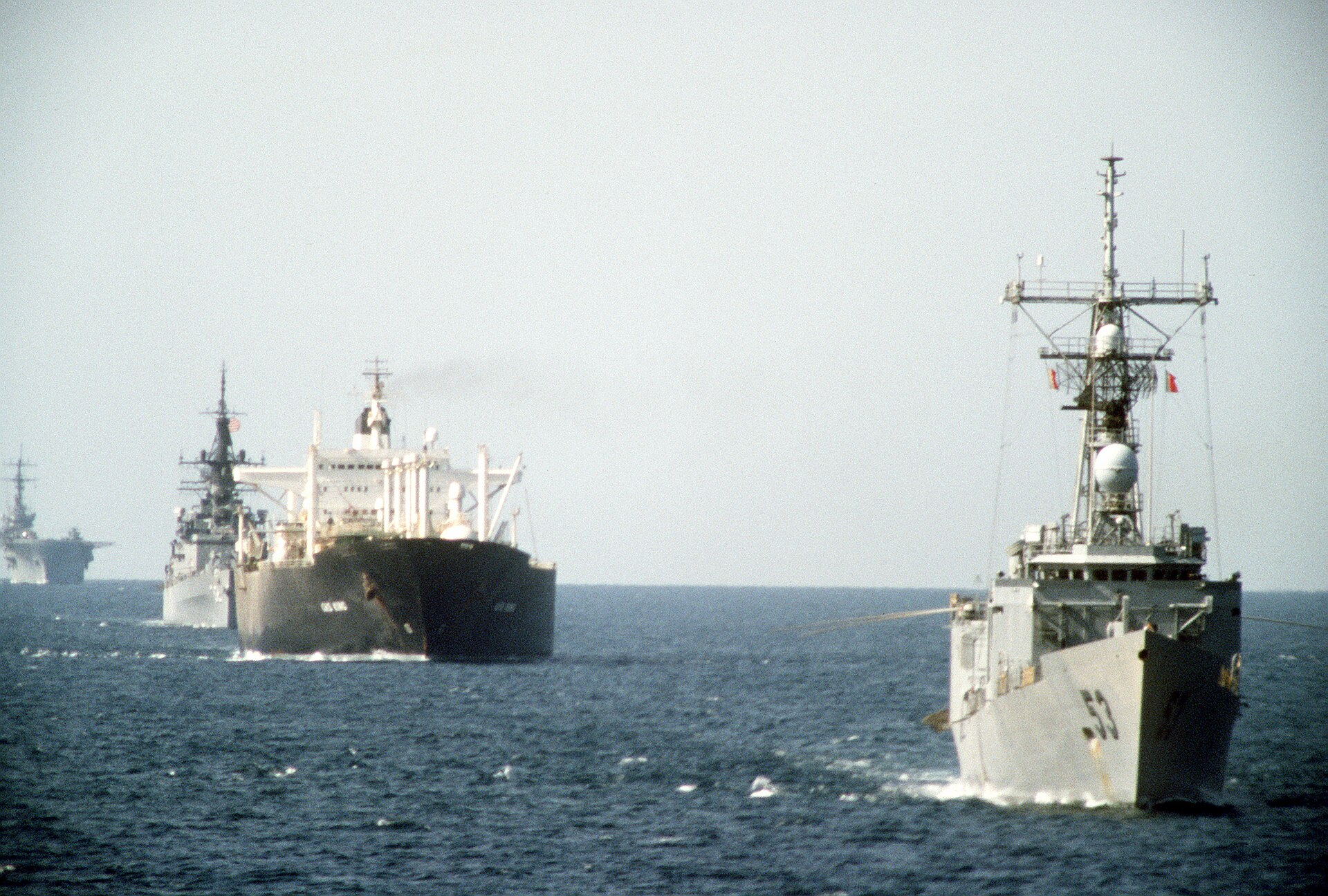
The second factor was the narrowness of Iran’s strategic objective. During the Iran-Iraq War, Tehran’s attacks on Gulf shipping were retaliatory — designed to impose costs on Iraq’s Gulf Arab allies, not to close the strait entirely. Iran itself needed Hormuz open to export the oil that funded its war against Iraq. This created a natural ceiling on escalation: Iran attacked enough ships to make a political statement but not enough to trigger the total closure that would have destroyed its own economy.
The third factor was the relative simplicity of the 1980s threat environment. Speedboats could be tracked by radar. Mines, while dangerous, were static and clearable. Shore-based missiles had predictable launch signatures. The US Navy could establish a defensive perimeter around convoy formations and suppress threats with overwhelming firepower.
None of these conditions hold in 2026. Iran’s current arsenal — including ballistic missiles, cruise missiles, swarm drones, explosive-laden unmanned surface vessels, and submarine-launched torpedoes — creates a multi-domain threat that convoy escorts cannot fully counter. Iran no longer needs Hormuz open because it no longer depends on Gulf oil exports to survive; the war has already destroyed most of its export infrastructure. And Iran’s strategic objective has shifted from coercion to denial: Tehran is not trying to impose costs on Gulf shipping but to prevent it entirely, as a means of internationalising the conflict and pressuring the US and its allies to halt military operations.
The Mine War Then and Now
Mine warfare has been Iran’s most persistent and effective naval weapon across both tanker wars. Mines are cheap to produce, difficult to detect, and psychologically devastating to shipping crews. A single mine costing a few thousand dollars can disable a vessel worth hundreds of millions.
During the 1980s tanker war, Iran deployed an estimated 170 mines in the Persian Gulf, primarily contact mines and moored mines placed by IRGC speedboats and the minelayer Iran Ajr. The most consequential was the mine that struck the USS Samuel B. Roberts on 14 April 1988, almost breaking the frigate in half and triggering Operation Praying Mantis four days later. Iran’s mining campaign was opportunistic rather than systematic — mines were laid in shipping lanes at irregular intervals, creating a persistent but manageable threat that slowed rather than stopped traffic.
The 2026 mine threat is categorically different. US forces have sunk 16 Iranian minelaying vessels since the conflict began, according to CNBC, yet at least a dozen confirmed mines remain in the strait — Iranian-manufactured Maham 3 and Maham 7 limpet mines, according to Axios. Iran’s Revolutionary Guard has warned that any attack on Iranian coastal territory would trigger the mining of all access routes throughout the Persian Gulf. The Stimson Center has identified five critical changes in Iran’s mine warfare capabilities since the 1980s: greater quantities, more sophisticated detonation mechanisms, deeper placement capability, improved camouflage, and the use of unmanned underwater vehicles for deployment.
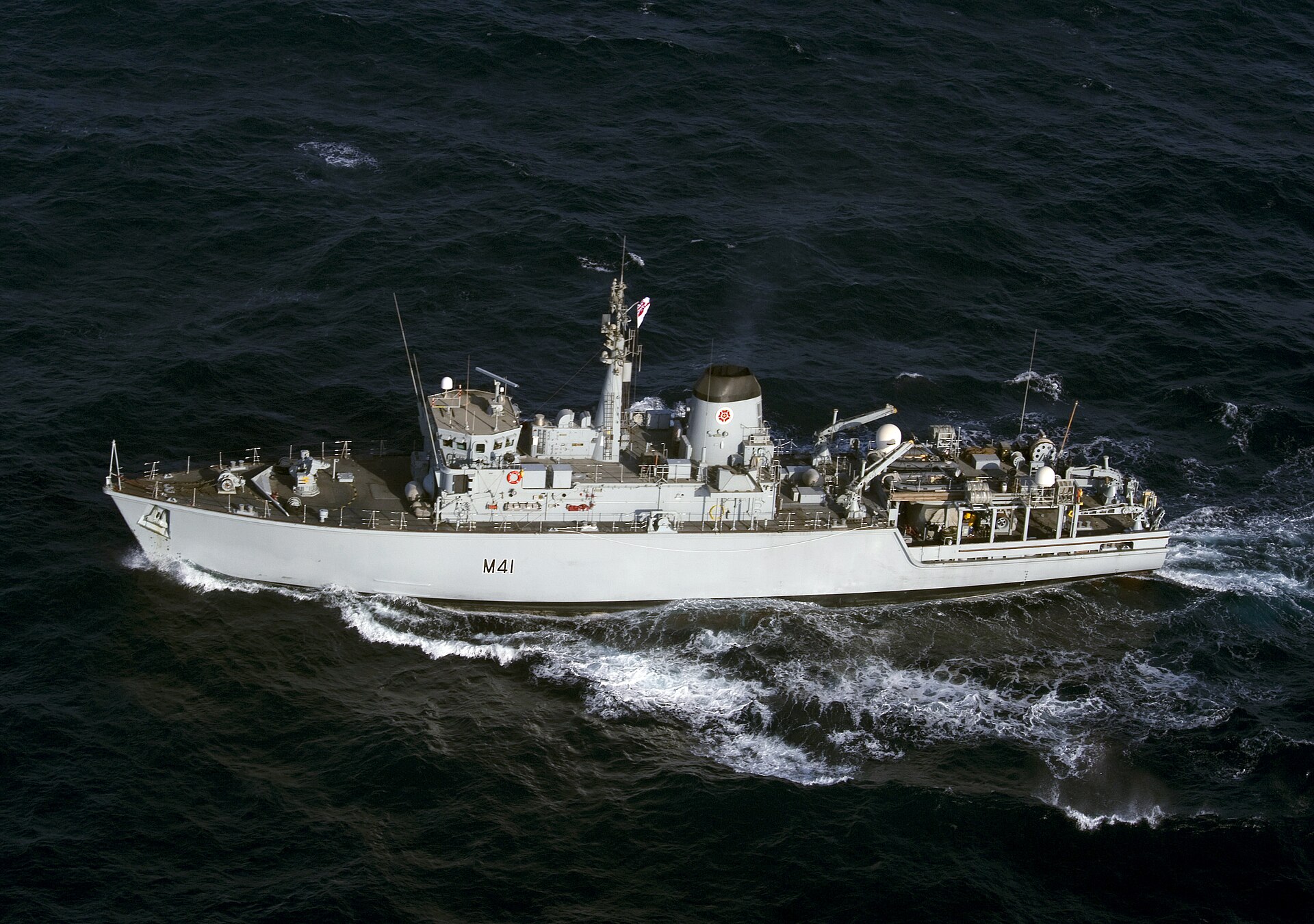
The mine-clearance challenge compounds the problem. In the 1980s, the US Navy maintained a substantial mine countermeasures fleet, including dedicated minesweepers and helicopter mine-sweeping squadrons. By 2026, America’s mine warfare capacity has atrophied dramatically. The US Navy’s only two dedicated mine countermeasures ships — both Avenger-class vessels — were spotted thousands of miles away in Asia at the start of the conflict, according to the defence outlet 19FortyFive. This is why Britain has been tasked with leading the mine-clearing coalition: the Royal Navy has maintained its mine countermeasures expertise and is organising a summit of 30 nations to coordinate clearance operations.
The historical precedent for how long mine clearance takes is sobering. After the 1973 Arab-Israeli War, it took two years to clear mines from the Suez Canal. After the 1991 Gulf War, mine clearance in Kuwaiti waters required months of intensive operations. The Strait of Hormuz, with its swift currents, deep channels, and proximity to Iranian shores, presents a uniquely difficult clearance environment. Even optimistic assessments suggest reopening the strait to normal commercial traffic will take many months — a timeline that the global economy cannot easily absorb.
How Has Iran’s Arsenal Changed in Forty Years?
The most dangerous difference between the first and second tanker wars is the transformation of Iran’s military capabilities. In the 1980s, Iran fought with a depleted inventory of pre-revolutionary American weapons, supplemented by limited Soviet and Chinese arms acquired through intermediaries. Its navy was a shadow of the force the Shah had built. Its air force was grounded by spare parts shortages. Its most effective naval weapon was the Revolutionary Guard speedboat — fast, expendable, and difficult to target, but incapable of threatening well-defended warships.
The Iran of 2026 fields an arsenal that its 1988 predecessors could not have imagined. Four decades of indigenous weapons development, accelerated by lessons learned from conflicts in Syria, Yemen, and Iraq, have produced a military force optimized for exactly the kind of maritime denial campaign now being waged in the strait.
| Capability | 1988 | 2026 |
|---|---|---|
| Anti-ship missiles | Silkworm (shore-based, limited range) | Noor, Qader, Khalij-e-Fars (multiple platforms, extended range) |
| Ballistic missiles | None (naval role) | Fateh-313, Emad, Sejjil (capable of striking Gulf ports) |
| Drones (aerial) | None | Shahed-136, Mohajer-6, Ababil-3 (swarm-capable) |
| Drone boats (USV) | None | Explosive-laden unmanned surface vessels (first confirmed strike in 2026) |
| Submarines | None operational | Fateh-class, Ghadir-class midget subs (mine/torpedo capable) |
| Mines | Contact/moored mines (~170 deployed) | Maham 3/7 limpet mines, UUV-deployed, sophisticated fuzing |
| IRGC fast attack craft | ~50 speedboats | 200+ armed fast boats, missile-equipped |
| Coastal defence | Fixed shore batteries | Mobile, concealed, road-mobile launchers along 1,000+ km coastline |
The Shahed-136 kamikaze drone, battle-tested extensively in Ukraine before being deployed against Gulf targets, represents the most significant shift in the threat calculus. At an estimated production cost of $20,000 to $50,000 per unit, according to defence analysts cited by CSIS, these drones impose a devastating cost asymmetry on defenders. Saudi Arabia has fired Patriot interceptors costing $3 million each to shoot down drones worth less than a used car. The mathematics of attrition favour the attacker when the cost ratio exceeds 100-to-1.
Equally significant is Iran’s development of explosive-laden unmanned surface vessels — essentially marine kamikaze drones. These drone boats, which Iran has been testing since the Houthi campaign in the Red Sea, scored their first confirmed strike of the war in Iraqi waters in March 2026, setting two fuel tankers ablaze, according to Al Jazeera. Unlike the manned speedboats of the 1980s, these vessels require no crew willing to risk death, can be launched in swarms from any coastal point, and are extremely difficult to detect against the radar clutter of the Gulf’s busy shipping lanes.
The Hormuz Escalation Matrix
The pattern of escalation in both tanker wars followed a recognisable structure, but the 2026 conflict has compressed four years of 1980s escalation into less than four weeks. A framework for comparing the two escalation trajectories reveals how much faster and further the second tanker war has progressed.
| Escalation Level | Description | 1984-1988 Timeline | 2026 Timeline |
|---|---|---|---|
| Level 1 | Selective attacks on enemy-flagged vessels | 1981-1983 (2+ years) | Day 1-3 (28 Feb – 2 Mar) |
| Level 2 | Attacks on neutral-flagged vessels serving enemy | 1984-1985 (1 year) | Day 4-7 (3-6 Mar) |
| Level 3 | Indiscriminate attacks on all commercial shipping | 1986-1987 (1 year) | Day 8-12 (7-11 Mar) |
| Level 4 | Mining of shipping lanes | 1987-1988 (sporadic) | Day 10-14 (9-13 Mar) |
| Level 5 | Direct attacks on foreign warships | 1987 (USS Stark, accidental) | Day 14+ (multiple incidents) |
| Level 6 | Major naval engagement | April 1988 (Op Praying Mantis) | Ongoing (US strikes on minelayers) |
| Level 7 | Effective closure of strait | Never achieved | Day 5-7 (effective closure) |
| Level 8 | Attacks on non-Gulf targets (ports, infrastructure) | Never achieved | Day 10+ (Gulf ports, airports, refineries) |
The 1980s tanker war took four years to progress from Level 1 to Level 6 and never reached Level 7. The 2026 conflict reached Level 7 within a week and Level 8 within two. This compression reflects both the greater destructive capability of Iran’s current arsenal and the fundamentally different strategic context: in the 1980s, Iran was fighting a defensive war against Iraq and had limited reasons to escalate beyond retaliation. In 2026, Iran is fighting an existential conflict against the United States and Israel and has every reason to maximise the economic pain it inflicts on its adversaries’ allies.
The escalation matrix also reveals a critical asymmetry in de-escalation dynamics. In the 1980s, each step up the escalation ladder was met with a proportional response that eventually led to a ceiling: Operation Praying Mantis established that the US would impose devastating costs for Iranian provocation, and Iran adjusted its behaviour accordingly. In 2026, the US has destroyed Iranian minelayers, struck coastal defences, and eliminated naval assets, yet Iran has continued to escalate — suggesting that the 1988-era assumption of rational deterrence may not hold when a regime perceives itself as fighting for survival.
The Oil Price Paradox
The oil market response to the two tanker wars confounds the intuitive expectation that greater disruption should produce greater price spikes. The 2026 crisis has removed approximately 50 times more oil from the market than the 1980s tanker war, yet the price increase has been proportionally smaller.
During the original tanker war, oil prices were already depressed by a global glut and Saudi Arabia’s decision to flood the market to punish OPEC quota cheaters. Crude fell from $30 per barrel in 1985 to below $10 by 1986 — and the tanker war’s disruptions, limited as they were, barely registered on price charts. The 2 percent reduction in Gulf shipping was absorbed by existing spare capacity and strategic reserves without significant market stress.
The 2026 crisis has pushed Brent crude from approximately $75 before the war to a peak of $126 per barrel — a 68 percent increase, according to Euronews and the Dallas Federal Reserve. This is substantial but less than the 1979-1980 oil shock (which saw prices triple) or even the hypothetical models that energy analysts had predicted for a Hormuz closure. The Dallas Fed estimates that the closure will reduce global GDP growth by 2.9 percentage points on an annualized basis in the second quarter of 2026, while Barclays projects sustained $100 oil would reduce global growth by 0.2 percentage points to 2.8 percent.
Three structural changes explain why prices have not gone higher. The first is the decline in global energy intensity: the world produces a dollar of GDP with far less oil than in the 1980s, cushioning the macroeconomic impact. The second is the existence of strategic petroleum reserves: the IEA coordinated a release from member states in mid-March, providing a temporary buffer. The third is the rapid activation of Saudi Arabia’s East-West Pipeline — the Petroline system to Yanbu on the Red Sea — which has brought an estimated 3.66 million barrels per day to market through an alternative route, partially offsetting the Hormuz closure.
Yet the price paradox conceals a more dangerous reality. The market is pricing in a relatively short disruption. If the Hormuz closure persists through the second and third quarters of 2026, existing buffers will be exhausted, strategic reserves will be depleted, and the pipeline bypass will reach its capacity ceiling. The Dallas Fed’s models show that a six-month closure would push oil to $140 to $180 per barrel and trigger a global recession comparable to 2008.
Thirty Nations in Search of a Convoy Commander
The coalition response to the 2026 Hormuz crisis is larger than anything assembled during the original tanker war — and paradoxically less effective. In the 1980s, the United States acted largely unilaterally, with limited support from Britain and France. Operation Earnest Will was a US-run operation with clear command authority, straightforward rules of engagement, and a single objective: escort reflagged Kuwaiti tankers through the strait.
The 2026 coalition includes more than 30 nations, according to British and American officials, spanning NATO members, Gulf Cooperation Council states, and Asian powers including India and Pakistan. Britain is leading the mine-clearance operation while the US provides the naval escort framework. France has contributed frigates. Greece has deployed Patriot air defence batteries to Saudi Arabia. South Korea and Japan have sent maritime surveillance assets.
This breadth of participation reflects the global nature of the crisis — the Hormuz disruption affects every oil-importing nation — but it also creates coordination challenges that did not exist in the 1980s. Rules of engagement differ between coalition partners. Some nations have declared neutrality while contributing assets. Others, like India, are simultaneously deploying warships to escort their own tankers while maintaining diplomatic relations with Tehran. The result is a coalition that is impressively large on paper but operationally fragmented.
The 1980s model of convoy escort also faces a fundamental challenge in 2026: there are no tankers to escort. In 1987, shipping continued through the strait, and the US Navy’s job was to protect vessels that were already sailing. In 2026, the insurance market has removed the vessels from the water before any escort can be offered. The convoy model requires ships willing to sail; the insurance market has ensured there are none.
What Does the 1988 Endgame Tell Us About 2026?
The original tanker war ended not because of a naval victory but because the broader war exhausted both combatants. Iran accepted UN Security Council Resolution 598 on 18 July 1988, and the ceasefire took effect on 8 August. Ayatollah Khomeini described accepting the resolution as “drinking poison” — an acknowledgement that Iran had fought for eight years against Iraq without achieving any of its war aims.
The endgame was accelerated by two critical events. The first was Operation Praying Mantis, which demonstrated that the US Navy could destroy Iran’s naval forces at will. The second was the downing of Iran Air Flight 655, which convinced Iran’s leadership that the United States was willing to accept catastrophic collateral damage to maintain its Gulf presence. Whether the Vincennes incident was a tragic error (the official US position) or a calculated warning (the widespread belief in Tehran), it signalled that continued escalation carried existential risks for Iran.
The 2026 parallel is imperfect but instructive. The US and Israeli military campaign has inflicted devastating damage on Iran’s military infrastructure, with 82,000 buildings destroyed according to the Iranian Red Crescent, cited by multiple wire services. Washington has delivered 15 conditions for a ceasefire, including demands for full Hormuz reopening and the surrender of Iran’s nuclear enrichment programme. Iran’s economy is under enormous strain, with oil exports crippled and power infrastructure degraded.
Yet two differences from 1988 argue against a rapid resolution. In the 1980s, Iran was fighting a two-front war — against Iraq on its western border and against the US Navy in the Gulf — and was militarily exhausted. In 2026, Iran has no land war to sustain and can focus its remaining capabilities entirely on asymmetric maritime denial. And whereas the 1988 ceasefire offered Iran an honourable exit from a war it had not started, the 2026 conflict asks Iran to accept terms of surrender from an adversary that initiated the attack — a fundamentally different political dynamic for any regime, let alone one built on revolutionary defiance.
The Contrarian Case for a Faster Resolution
The conventional analysis — that the 2026 crisis is worse than the 1980s and therefore harder to resolve — overlooks a counterintuitive dynamic: the very severity of the disruption may force a faster settlement than the 1980s precedent would suggest.
The original tanker war lasted four years precisely because its impact was manageable. Shipping continued. Oil flowed. Insurance costs rose but remained bearable. The world could tolerate the tanker war indefinitely because it imposed costs without creating a crisis. There was no urgency to resolve it, and so it dragged on until the broader war ended.
The 2026 crisis permits no such tolerance. The effective closure of the strait is destroying the economies of importing nations in real time. The Philippines has declared a national emergency. Japan and South Korea face industrial shutdown. European energy costs are spiralling. Global GDP is contracting. The political pressure on every government in the world to resolve the crisis is not proportional to the severity — it is exponential. A tanker war that could be tolerated for years in the 1980s cannot be tolerated for months in 2026.
This pressure creates a paradox: the worse the crisis, the stronger the incentive for both sides to negotiate. The Trump administration’s public claims of progress in peace talks — however exaggerated or premature — reflect a genuine awareness that the economic clock is ticking. Iran’s reported willingness to listen to “sustainable” proposals, despite publicly denying any dialogue, suggests that the pain is being felt in Tehran as well. Pakistan’s offer to host face-to-face talks provides a diplomatic venue that did not exist during the 1980s Tanker War.
The 1988 endgame took months from the first serious ceasefire proposals to the actual cessation of hostilities. The 2026 timeline may be compressed for the same reason the escalation was compressed: the stakes are too high for any party to wait. If the Hormuz closure extends beyond 60 to 90 days, the cascading economic consequences — fuel rationing in Asia, food supply disruptions across the Gulf, potential sovereign debt crises in oil-dependent developing nations — may force a settlement that pure military logic would not produce.
The Saudi Pipeline That Did Not Exist in 1988
Saudi Arabia’s position in the two tanker wars illustrates how four decades of strategic infrastructure investment have transformed the Kingdom’s vulnerability to Hormuz disruption — while simultaneously creating new risks.
In the 1980s, Saudi Arabia’s East-West Pipeline existed but served primarily as an emergency backup. The Petroline system, built in the early 1980s for precisely the scenario of Hormuz disruption, could transport a fraction of the Kingdom’s total output to the Red Sea port of Yanbu. Saudi Arabia’s oil exports overwhelmingly transited Hormuz, and a sustained closure would have been catastrophic.
By 2026, the pipeline network had been expanded to a design capacity of approximately 7 million barrels per day, according to Bloomberg. When Iran’s actions effectively closed the strait in early March, Aramco activated the Petroline system and began diverting crude to Yanbu within hours. Red Sea exports surged to a five-day rolling average of 3.66 million barrels per day — roughly half of pre-crisis export levels but enough to maintain Saudi Arabia’s position as the world’s largest oil exporter.
The pipeline bypass is a strategic asset that fundamentally changes the Hormuz calculus. In the 1980s, closing the strait would have shut off Saudi Arabia’s oil entirely. In 2026, it reduces Saudi exports by approximately half — painful but survivable. This is why the OPEC production dynamics of the second tanker war are so different from the first: Saudi Arabia can increase production and deliver it to market through Yanbu, effectively replacing some of the Iranian and Iraqi barrels that the war has removed.
Yet the Yanbu bypass also creates a new vulnerability. The Houthi movement in Yemen, an Iranian proxy, has targeted Red Sea shipping since 2023 and joined Tehran’s war in March 2026, according to reporting on the Sanaa government’s declaration of solidarity. If Iran’s allies succeed in disrupting Red Sea shipping as well, Saudi Arabia’s last export route would be compromised. The Yanbu Refinery was struck by Iranian-linked forces on 20 March 2026, demonstrating that the Red Sea corridor is not immune to the conflict that the pipeline was built to bypass.
The 1980s tanker war ended with the strait intact and Saudi Arabia’s export infrastructure unscathed. The 2026 conflict, regardless of its outcome, will permanently alter Saudi Arabia’s approach to energy security. The Kingdom is already diversifying export routes, accelerating pipeline capacity, and investing in storage facilities outside the Gulf — an infrastructure revolution driven by the same fear that motivated the original Petroline construction four decades ago.
Frequently Asked Questions
What was the tanker war of the 1980s?
The tanker war was a sustained campaign of attacks on commercial shipping in the Persian Gulf from 1984 to 1988 during the Iran-Iraq War. Iraq and Iran collectively struck 451 vessels, including 239 petroleum tankers, in an attempt to disrupt each other’s oil exports. Despite the attacks, shipping through the Strait of Hormuz was never reduced by more than 2 percent, and the conflict ended with the broader Iran-Iraq War ceasefire in August 1988.
How does the 2026 Hormuz crisis compare to the 1980s tanker war?
The 2026 crisis has achieved in 25 days what the 1980s tanker war failed to accomplish in four years: the effective closure of the Strait of Hormuz. While the 1980s conflict saw more individual ship attacks, the 2026 crisis has disrupted 98 percent of commercial transit through the strait, removed approximately 20 million barrels per day of oil from the market, and produced a fortyfold increase in insurance premiums. Iran’s advanced missile, drone, and mine capabilities have fundamentally changed the threat calculus since the 1988 precedent.
Why is mine clearance in the Strait of Hormuz so difficult?
The Strait of Hormuz presents extreme challenges for mine-clearing operations: swift currents, deep channels, proximity to hostile Iranian shores, and the use of sophisticated modern mines with advanced fuzing mechanisms. Historical precedents suggest clearance timelines of months to years — the Suez Canal required two years of mine clearance after the 1973 war. Britain is leading a coalition of 30 nations to conduct clearance operations, but analysts assess the strait is unlikely to return to normal commercial traffic in 2026.
What was Operation Earnest Will?
Operation Earnest Will was a US naval convoy operation from July 1987 to September 1988 that escorted reflagged Kuwaiti tankers through the Persian Gulf during the Iran-Iraq War. It was the largest American convoy operation since the Second World War, involving more than 30 warships and completing 127 escort missions with 188 tanker transits. No protected vessel was lost to Iranian action, making it a tactical success that established the template for Gulf naval operations.
Could a 2026 convoy operation reopen the strait?
Military analysts assess that a 1980s-style convoy operation alone cannot reopen the Strait of Hormuz in 2026 because the threat environment has fundamentally changed. Iran’s combination of ballistic missiles, drone swarms, sea mines, and unmanned surface vessels creates a multi-domain threat that exceeds the defensive capabilities of escort warships. More critically, the insurance market has removed commercial vessels from the water — there are currently no tankers willing to transit, regardless of military escort, because they cannot obtain the insurance coverage required to operate legally.
How has Saudi Arabia adapted to the Hormuz closure?
Saudi Arabia has activated its East-West Pipeline (Petroline) system, diverting crude oil to the Red Sea port of Yanbu at approximately 3.66 million barrels per day — roughly half of pre-crisis export levels. This pipeline bypass, with a design capacity of 7 million barrels per day, represents a strategic advantage that did not exist during the 1980s tanker war. However, Yanbu is now Saudi Arabia’s sole major export terminal, creating a new concentration of risk that Iranian-aligned forces have already begun to target.