
The Riyadh Metro is one of the most ambitious public transport projects ever built — a 176-kilometre, fully driverless network spanning six colour-coded lines and 85 stations that opened to the public in December 2024. For visitors, it is the fastest and cheapest way to move across a city that was previously almost entirely car-dependent. Whether you are heading from the airport to the city centre, exploring the Riyadh business district, or making your way to historic Al Batha, the metro connects all the places tourists actually need to reach. This guide covers every practical detail: lines, fares, how to buy tickets, key stations for sightseeing, rules on board, and how the metro connects to the rest of Riyadh’s public transport network. Before you travel, make sure you have the right visa — see our Saudi Arabia Visa Guide for everything you need to enter the Kingdom.
Lines: 6 lines (Blue, Red, Orange, Yellow, Green, Purple)
Network length: 176 km — Guinness World Record, world’s longest fully driverless metro
Stations: 85 stations across the city
Opening: December 2024 (Lines 1, 4, 6); full network operational January 2025
Hours: 5:30 AM – midnight (Sat–Thu); 10:00 AM – midnight (Fri)
Fare from: SAR 4 for a 2-hour Standard Class pass
Ticket app: Darb (iOS and Android, English and Arabic)
Airport link: Yellow Line (Line 4) direct to all terminals, ~35 min to city centre
Visa Required: Yes — tourist e-visa required
Tip: Download the Darb app before you land — buy a 3-day pass (SAR 20) for unlimited metro and bus travel, no physical card needed.
Overview: A Metro Built for a Car City
Riyadh was designed around the car. For decades, the Saudi capital had almost no public transport — getting anywhere meant owning a vehicle or relying on taxis. That changed fundamentally when King Salman inaugurated the Riyadh Metro on 27 November 2024, with passenger services launching on 1 December 2024.
The metro is the centrepiece of the King Abdulaziz Project for Riyadh Public Transport, a SAR 62 billion (approximately $22–25 billion) infrastructure programme managed by the Royal Commission for Riyadh City (RCRC). Three international consortia comprising 19 companies from 13 countries built the system over nearly a decade. The result is a network that Guinness World Records certified on 30 January 2025 as the world’s longest fully automated, driverless metro — surpassing Dubai’s Metro.
The metro operates in integration with Riyadh’s public bus network, which now covers over 1,000 km of routes. Both systems use the same Darb ticketing platform, meaning a single pass works on metro and buses alike. Within nine months of opening, the system had welcomed its 100 millionth passenger — a figure that reflects just how much demand had been suppressed by the absence of any alternative to the private car.
For international visitors, the metro is a straightforward, clean, and affordable way to reach the city’s main attractions. All station signage, announcements, and the Darb app are in both Arabic and English. Staff at hub stations speak English and are accustomed to helping tourists navigate.
The metro is part of Saudi Arabia’s Vision 2030 strategy, which includes a broad transformation of transport, tourism, and urban life. To understand how this fits into Riyadh’s wider travel landscape, see the full Saudi Arabia Travel Guide 2026.
The Six Lines Explained
Each line is identified by a number and a colour. Here is what each line covers and why it matters to visitors:
Line 1 — Blue Line (38 km, 25 stations)
The Blue Line is the backbone of the network, running north to south through the heart of the city along King Fahd Road. It connects the wealthy northern suburbs with the historic Al Batha district in the south and passes through the main commercial and business corridors. Most tourists will use the Blue Line more than any other. Key stations include King Abdullah Financial District (KAFD), STC (for Olaya Street), King Abdullah Road interchange, National Museum, and Al Batha. The line operates as a driverless elevated and underground hybrid.
Line 2 — Red Line (25.3 km, 14 stations)
The Red Line runs east–west along King Abdullah Road, crossing the city from west to east. It intersects with the Blue Line at the STC (Olaya) interchange, making it useful for reaching western residential areas and Riyadh’s University district. Visitors rarely need it unless staying in western Riyadh, but it is a useful cross-town connector.
Line 3 — Orange Line (40.7 km, 22 stations)
The longest line in the network, the Orange Line runs along Al Madinah Al Munawarah Road and Prince Saad Bin Abdurrahman I Road, covering the western and southwestern parts of the city. It serves Western Station, which is Riyadh’s inter-city bus hub, and Jeddah Road — useful if you are connecting to intercity buses or heading to the southwestern suburbs. This line was the last to open, on 5 January 2025.
Line 4 — Yellow Line (29.6 km, 17 stations)
The Yellow Line is the airport line and arguably the most important for arriving tourists. It connects King Khalid International Airport (all terminals, with dedicated Airport T1–2, T3–4, and T5 stations) to the King Abdullah Financial District in the city centre. The journey from the airport to KAFD takes approximately 35 minutes. From KAFD, transfer to the Blue Line to reach Olaya, Kingdom Centre, or Al Batha. The Yellow Line also serves Princess Nourah Bint Abdulrahman University (PNU), one of the world’s largest women-only universities.
Line 5 — Green Line (12.9 km, 12 stations)
The shortest line in the network, the Green Line runs along King Abdulaziz Road in a north–south direction on the eastern side of the city centre. It connects to the Blue Line at National Museum station. For visitors, it provides access to the Al Batha commercial district and the eastern urban core.
Line 6 — Purple Line (29.7 km, 11 stations)
The Purple Line runs along Abdurrahman Bin Awf Road on the western flank of the city. It connects to Lines 1 and 4 at KAFD. This line primarily serves western Riyadh residential areas and is less commonly used by tourists, though it forms part of the KAFD interchange hub that all visitors passing through the financial district will encounter.
Fares and Ticket Types
The Riyadh Metro uses a flat-fare, time-based ticketing model rather than a zone or distance-based system. This means a single pass covers unlimited trips across the entire metro and bus network for the duration of the pass — there is no separate fare to pay each time you board. Tickets are available in two classes:
Standard Class Fares
| Pass Type | Validity | Price (SAR) | Best For |
|---|---|---|---|
| 2-Hour Pass | 2 hours from activation | SAR 4 | Single journey or brief exploration |
| 3-Day Pass | 72 hours from first use | SAR 20 | Short city breaks (recommended for most tourists) |
| 7-Day Pass | 7 days from first use | SAR 40 | Week-long visits |
| 30-Day Pass | 30 days from activation | SAR 140 | Extended stays or residents |
First Class Fares
First Class carriages are quieter, less crowded, and offer wider seating. Prices are 2.5 times the Standard Class rate:
| Pass Type | Price (SAR) |
|---|---|
| 2-Hour Pass (First Class) | SAR 10 |
| 3-Day Pass (First Class) | SAR 50 |
| 7-Day Pass (First Class) | SAR 100 |
| 30-Day Pass (First Class) | SAR 350 |
Discounts
- Children under 6: Free — no ticket required
- Students, seniors (60+), and people with disabilities: 50% discount on all pass types
- Saturday to Thursday: 5:30 AM to midnight
- Friday: 10:00 AM to midnight
- Eating or drinking on the metro: SAR 100 fine. This includes all food and drink, even water. Do not eat on board.
- Strong-smelling items, perishable foods, feet on seats, sleeping in non-designated areas: SAR 200 fine.
- Smoking: SAR 200 fine. Smoking is banned throughout all metro premises, including platforms and station concourses.
- Using incorrect carriage (wrong gender section): subject to fine and removal.
- Blocking doors or aisles with luggage: enforced. Maximum luggage dimensions are 56 x 45 x 25 cm — standard carry-on size. Large suitcases must not block walkways.
- After clearing immigration and baggage, follow metro signage to the appropriate terminal station (T1–2, T3–4, or T5).
- Purchase a Darb pass at a TVM or use the Darb app QR code you downloaded before landing.
- Board the Yellow Line train in the direction of KAFD (King Abdullah Financial District).
- After approximately 35 minutes, alight at KAFD.
- Follow transfer signs to the Blue Line (Line 1).
- Take the Blue Line south towards Al Batha. For Olaya Street and Kingdom Centre area, alight at STC station (approximately 15 minutes from KAFD).
- Download Darb before you land. It works on international phones over Wi-Fi. Buy your first pass in the airport or on the plane — you will clear customs and walk straight to the metro gate without queuing at a machine.
- Buy the 3-day pass (SAR 20) for short visits. At SAR 4 per 2-hour window, you break even after five separate trips. On any active sightseeing day, you will easily exceed five journeys. The 3-day pass is almost always the best value for tourists.
- Check which terminal you arrive at. The three airport stations serve different terminals. Most international airlines use T1 or T2. Check your boarding pass before arriving.
- KAFD is always your transfer hub. Whether coming from the airport or heading out of the city, the King Abdullah Financial District station is the central interchange for Lines 1, 4, and 6. When in doubt, go to KAFD and orient from there.
- Friday mornings are quiet. If you want to ride without crowds and take photos of the striking station architecture, Friday mornings (after the 10:00 AM opening) are the emptiest time on the network.
- No food or drink, no exceptions. The SAR 100 fine is enforced. Finish your coffee before entering the station gates.
- Both Arabic and English. All announcements, signage, and app menus are in Arabic and English. You will not need to read Arabic to navigate.
- Validate before you board, not after. When using the Darb app, activate your QR code before approaching the gate — the code refreshes every 10 seconds so keep your phone screen on and the app open at the ticket screen.
- Riyadh Travel Guide 2026 — Complete guide to visiting Saudi Arabia’s capital
- Best Neighbourhoods in Riyadh — Where to stay and explore in the capital
- Uber and Careem in Saudi Arabia — App taxis explained for visitors
- ATMs and Banking in Saudi Arabia — Cards, fees and currency tips
- Saudi Arabia Travel Guide 2026 — The complete guide to visiting the Kingdom
- Saudi Arabia Visa Guide — Every visa type explained
- Jeddah Travel Guide 2026 — Saudi Arabia’s coastal city and Red Sea gateway
- AlUla Travel Guide 2026 — Hegra, Elephant Rock and the ancient Nabataean sites
- Dammam and Al Khobar Travel Guide — The Eastern Province and Arabian Gulf coast
At current exchange rates (approximately SAR 3.75 to USD 1), the 3-day pass works out to around $5.30 — making the Riyadh Metro one of the cheapest tourist transport options of any major city globally.
How to Buy Tickets: Three Methods
1. The Darb App (Recommended)
The Darb app is the easiest and most flexible way to pay. It works on both iOS (App Store) and Android (Google Play) and is fully available in English. To set up an account, you need a phone number and either a Saudi national ID or Iqama — but tourists can use their passport number in place of an ID number on registration.
Once registered, select a pass, pay by credit or debit card, and receive a QR code. The QR code updates every 10 seconds as a security feature. At the metro gate, scan the QR code to enter and exit. The Darb app also works for Riyadh public buses, shows live bus locations, and provides journey planning across the combined network. Download it before you arrive — it works without a Saudi SIM card over Wi-Fi or your home data roaming.
2. Ticket Vending Machines (TVMs)
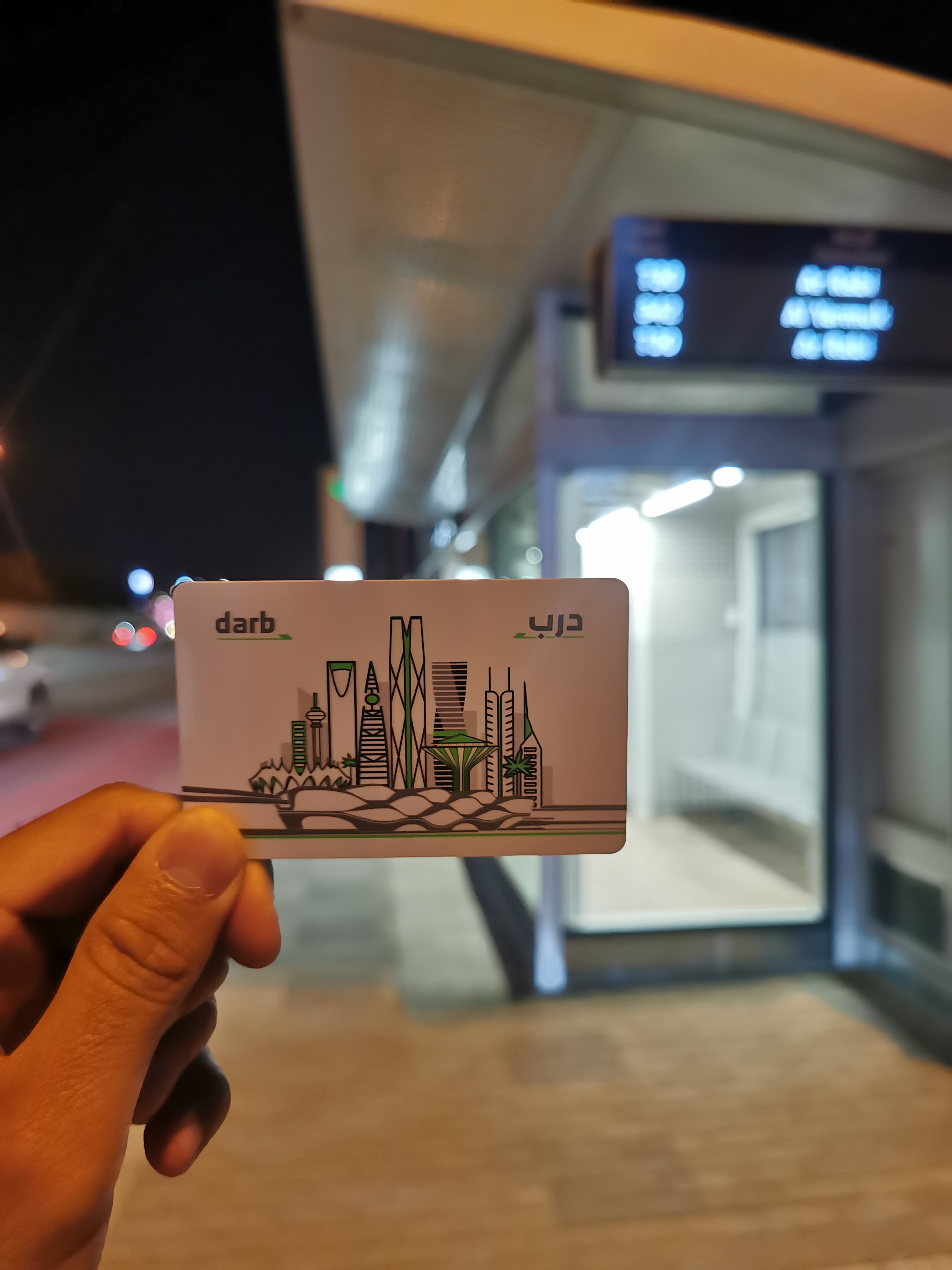
Every metro station has ticket vending machines that accept cash (Saudi riyals), debit cards, Mada, and Apple Pay. The machines have English-language menus. If you prefer a physical card rather than the app, purchase a Darb card from a TVM for SAR 10 (non-refundable card fee), then top it up with a minimum of SAR 5 and a maximum of SAR 200. The card can be reloaded at any TVM at any station. Cards are also sold at the ticket offices located in hub stations.
3. Ticket Offices
Staffed ticket offices operate at major interchange stations including King Abdullah Financial District (KAFD) and National Museum. Staff at these offices speak English and can assist with registration, pass selection, and card issues. If you have problems with the app or a vending machine, head to the nearest hub station ticket office.
Key Stations for Tourists
With 85 stations across the network, knowing which ones actually matter for sightseeing saves time. Here are the stations most relevant to visitors:
King Abdullah Financial District (KAFD) — Lines 1, 4, 6
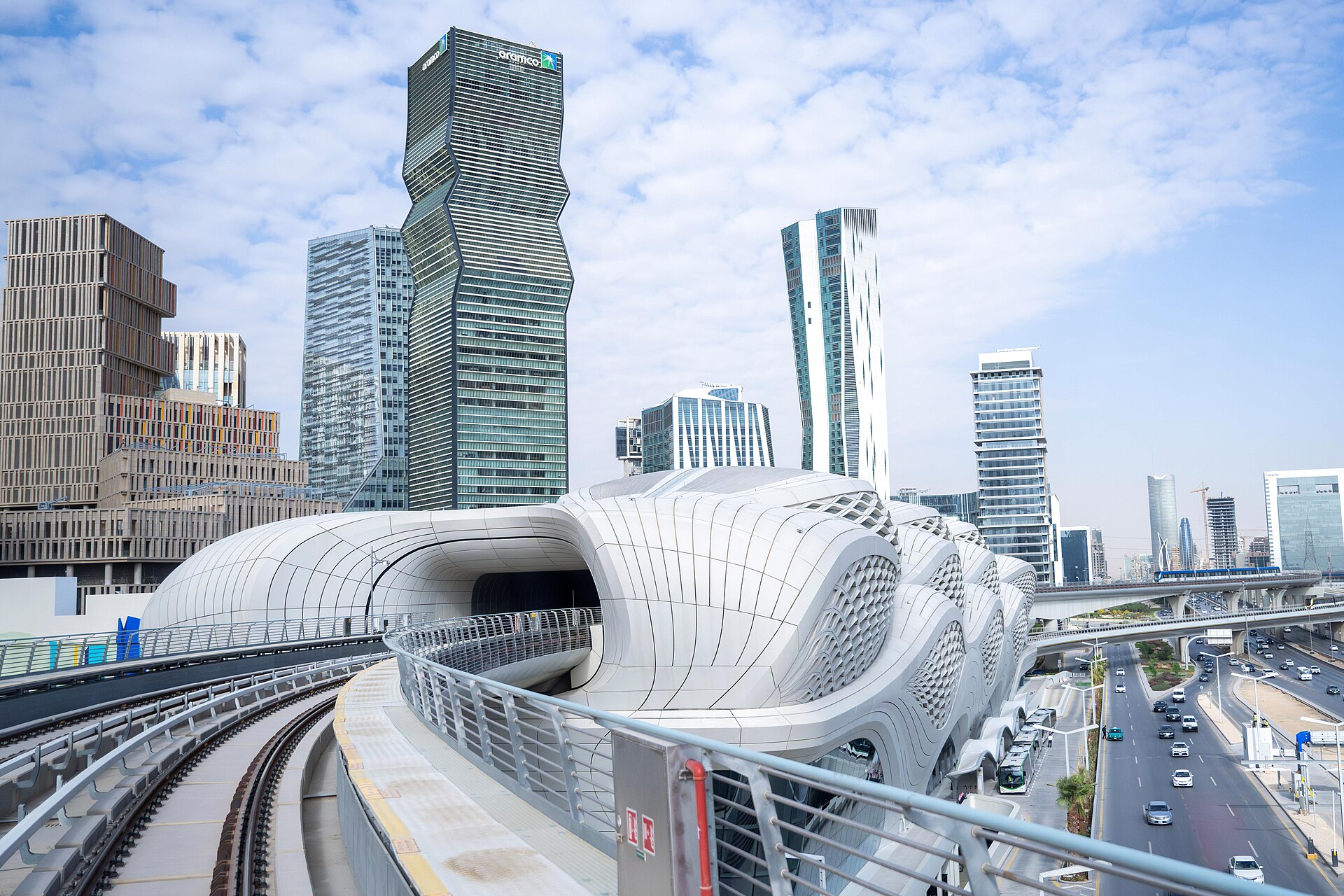
The most architecturally dramatic station on the network, designed by Zaha Hadid Architects and covering 8,150 square metres. KAFD is the main interchange hub connecting the Blue Line, Yellow Line (airport), and Purple Line. It sits inside the King Abdullah Financial District — a mixed-use development with tower offices, hotels, a grand mosque, and the KAFD Conference Centre. If arriving from the airport, this is where you transfer to the Blue Line for the rest of the city. The Aramco headquarters tower is directly adjacent.
STC Station (Olaya) — Lines 1 and 2
The STC station (originally called Olaya) is the key transfer point between the Blue and Red Lines and gives access to Olaya Street, Riyadh’s main commercial corridor. The Kingdom Centre — the landmark skyscraper with a sky bridge — is a short walk from here, as are the main luxury hotels, Faisaliah Tower, and Riyadh’s prime retail and restaurant district. The station sits at the intersection of King Abdullah Road and King Fahd Road. For tourists staying in the Olaya or Al Olaya neighbourhoods, this is your home station. See our guide to Riyadh’s best neighbourhoods for full accommodation context.
National Museum Station — Lines 1 and 5
This transfer station on the Blue and Green Lines is the second-largest on the network and one of the most important for sightseeing. It provides direct walking access to the National Museum of Saudi Arabia, Murabba Palace (the historic mud-brick palace of King Abdulaziz), and Al Murabba district — the old city core. If you are interested in Saudi history and culture, this station is essential. The museum itself covers 28,000 square metres across eight thematic halls.
Airport Stations — Line 4 (Yellow)
Three dedicated airport stations serve King Khalid International Airport: Airport T1–2, Airport T3–4, and Airport T5. Check which terminal your airline uses before boarding. The Yellow Line runs directly from all three terminal stations to KAFD in approximately 35 minutes. The service runs throughout operating hours, including early morning and late night, making it reliable for early or late flights. No luggage surcharge applies on the metro.
Al Batha Station — Lines 1 and 5
Al Batha is the southern terminus of the Blue Line and a key interchange with the Green Line. It gives access to the Al Batha district — the traditional market heart of Riyadh, with wholesale souqs, clothing markets, and the older commercial grid of the city. If you want to explore the more traditional face of Riyadh rather than the gleaming north, Al Batha station is your starting point.
Western Station — Line 3 (Orange)
Western Station on the Orange Line is Riyadh’s main intercity bus terminal, connecting to SAPTCO bus services towards Jeddah, Dammam, Abha, and other Saudi cities. If you are combining metro travel with intercity buses, this is the key node. The Orange Line also provides connections towards the western suburbs and the Jeddah Road corridor.
Operating Hours
The Riyadh Metro operates on the following standard schedule:
Friday hours are later because of the Friday congregational prayer, which is the main weekly worship service in Islam. Most of the city is quieter on Friday morning, and the metro reflects that. The best time to travel on Fridays is after 1:00 PM, once prayer and the midday rest period are past.
During peak hours (approximately 7:00–9:00 AM and 4:00–7:00 PM), trains run every 3 minutes on busier lines. Off-peak frequency is every 5–7 minutes. The system is fully automated so there are no driver shortages or operational gaps.
Ramadan note: During Ramadan, operating hours are significantly extended. In recent Ramadans, the metro has run until 2:00 AM or later. Check the official Darb app or the Royal Commission for Riyadh City social media accounts (@RiyadhTransport on X) for current Ramadan schedules, as hours are adjusted each year.
Rules, Etiquette, and Fines
The Riyadh Metro enforces its rules with on-the-spot fines. Ignorance of the rules is not an accepted excuse. Key points for visitors:
Carriage Sections
Each train has three types of carriage: Family/Women’s carriages (for women and family groups), Singles carriages (for men travelling alone), and First Class carriages (for holders of First Class passes). As a solo male visitor, use the Singles carriage. As a woman, you may use either the Women/Family carriage or First Class. Mixed-gender couples and family groups use the Family carriage. Signs at platform level and on train doors clearly mark each section.
Prohibited Actions and Fines
Accessibility
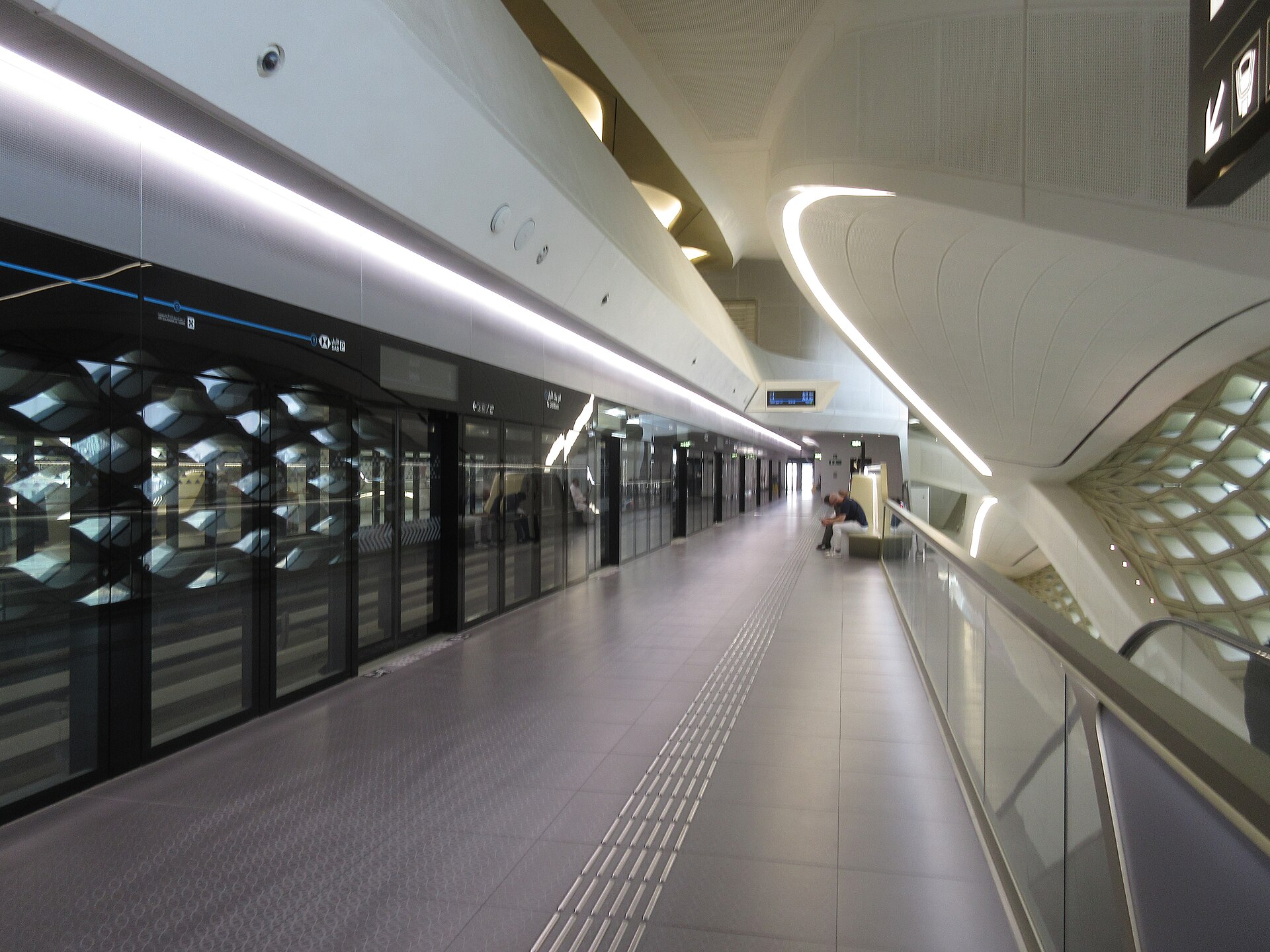
All 85 stations are fully accessible. Every station has lifts, ramps, tactile paving, and reserved seating on trains. Wheelchair users and passengers with disabilities receive 50% off all ticket types. Station staff are trained to assist passengers with mobility needs.
Photography
Photography in stations and on trains is generally tolerated for personal use. Avoid photographing other passengers, especially in the Women/Family carriages, and do not photograph security infrastructure or control rooms.
Getting to and from King Khalid International Airport
The Yellow Line (Line 4) is the definitive answer for airport transport in Riyadh. It serves all five terminals with dedicated stations and runs the full length of airport road to KAFD in the city centre, where you transfer to the Blue Line.
Step-by-step from airport to Olaya/city centre:
Total journey time from any airport terminal to the Olaya commercial district: approximately 50 minutes. Cost: SAR 4 on a 2-hour Standard Class pass. Compare this to a taxi, which costs SAR 60–100 depending on traffic and will take 30–60 minutes on a clear road but can take significantly longer during rush hour.
For advice on taxis and app-based transport alongside the metro, see our guide to Uber and Careem in Saudi Arabia.
Using the Metro Alongside Other Transport
The metro does not serve every corner of Riyadh — like most metro systems, it covers the main corridors but leaves many residential and peripheral areas off the network. Here is how to combine it with other options:
Metro + Bus
The Riyadh public bus network covers over 1,000 km of routes and integrates directly with the metro via the Darb ticketing system. The same Darb pass (app or physical card) works on both metro and bus — there is no additional fare. Bus stops are located adjacent to most metro stations. If your destination is between metro stations, a bus connection is usually the next best option. The Darb app shows real-time bus locations and arrival times.
Metro + Uber/Careem
For destinations the bus does not reach conveniently, Uber and Careem are both active in Riyadh. Take the metro as far as practical, then ride-share for the last portion of your journey. Both apps work with international credit cards. This hybrid approach — metro for the main corridor, ride-share for the final mile — is how most visitors and many residents now navigate the city. See our full guide to Uber and Careem in Saudi Arabia for pricing and tips.
Metro + Walking
Riyadh has invested heavily in pedestrian infrastructure around station exits, particularly at KAFD, STC/Olaya, and National Museum. That said, the city remains hot for most of the year (summer temperatures regularly exceed 45°C), so walking distances over 500 metres in summer months should be planned carefully. The metro itself is air-conditioned throughout — stations and trains maintain a comfortable 20–22°C regardless of outdoor temperatures. The best months for walking between metro stations and nearby attractions are November through February.
Money and Cards
Ticket vending machines accept Mada (the Saudi debit card network), Visa, Mastercard, and cash. Apple Pay works at TVMs. International cards generally function without issues. For broader advice on using ATMs and cards in Saudi Arabia, see our guide to ATMs and banking in Saudi Arabia.
Practical Tips for Visitors
Day Trips and Connections Beyond Riyadh
The metro covers the city itself, but Riyadh is also a base for excellent day trips. The Yellow Line connects to Western Station on the Orange Line for intercity SAPTCO buses. For destinations like Diriyah (the UNESCO World Heritage mud-brick ruins of the first Saudi state, located 20 minutes northwest of central Riyadh), the nearest metro approach is the Blue Line followed by a short taxi or Careem ride — no direct metro station yet serves Diriyah. For day trips to the Edge of the World escarpment, Al Kharj, or Ushaiger Heritage Village, taxis or hire cars remain necessary. See our Riyadh Travel Guide for the full picture of what to see in and around the capital.