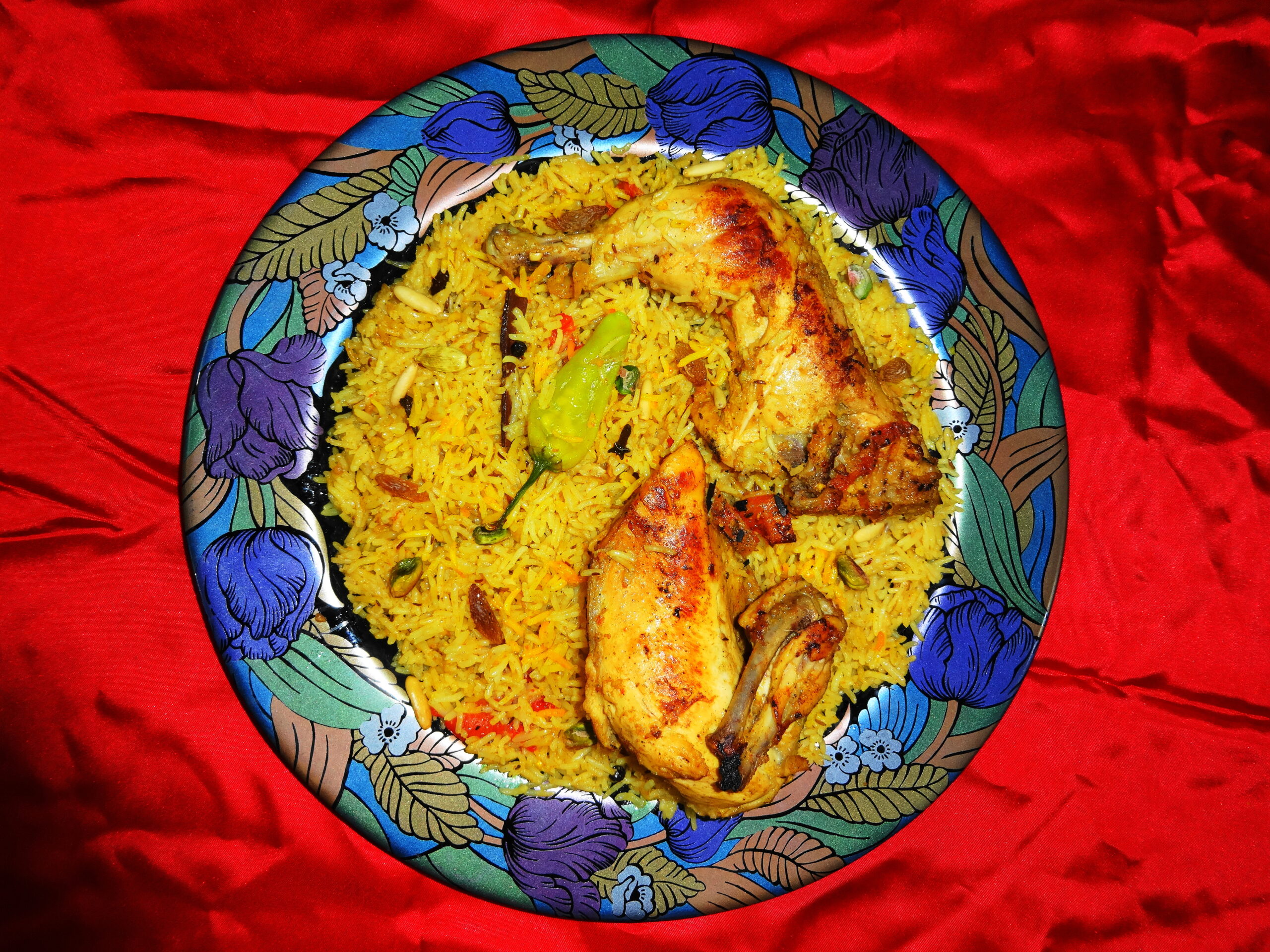

Saudi Arabian cuisine is one of the great underexplored food cultures of the Middle East — a tradition shaped by Bedouin desert heritage, the spice trade routes of the Hejaz, centuries of Hajj pilgrimage bringing flavours from across the Islamic world, and a modern restaurant scene that is evolving at startling speed.
This guide covers the traditional dishes you must try, the coffee culture that defines Saudi hospitality, the best restaurants in Riyadh and Jeddah, street food, Ramadan dining, and practical information on costs and customs.
The Essential Saudi Dishes
Kabsa — The National Dish
If you eat only one dish in Saudi Arabia, make it kabsa. This is the kingdom’s undisputed national dish — aromatic basmati rice cooked in spiced broth, topped with roasted or braised meat (typically chicken, lamb, or goat) and garnished with fried raisins, toasted almonds, and caramelised onions.
Kabsa’s distinctive flavour comes from a blend of spices including black lime (loomi), cardamom, cinnamon, cloves, and saffron. Every Saudi family has its own recipe, and regional variations abound — but the core combination of fragrant rice and tender meat is universal. Kabsa originates from the Najd (central plateau) but is eaten daily across the entire kingdom.
Where to try it: Virtually every traditional restaurant in Saudi Arabia serves kabsa. In Riyadh, look for restaurants along Olaya Street and in the Sulaimaniyah district. A plate of chicken kabsa at a local restaurant typically costs SAR 25-40 per person.
Mandi — The Slow-Smoked Speciality
Mandi takes the rice-and-meat formula and elevates it through cooking method. The name derives from the Arabic word “nada” (dew), referencing the moisture retained through the traditional cooking process — whole lamb or chicken is slowly roasted in an underground pit (tannour), suspended above hot coals, for several hours until the meat is falling-off-the-bone tender.
The result is smoky, intensely flavoured meat served over rice that has absorbed the drippings. Mandi has its roots in the Hadhramaut region of Yemen but has been thoroughly adopted across southern and western Saudi Arabia. It is particularly popular in Jeddah and the Hejaz.
Saleeg — The Saudi Risotto
Saleeg is a creamy, comforting rice dish from the Hejaz region — Saudi Arabia’s western coast, home to Jeddah, Makkah, and Madinah. Short-grain rice is cooked slowly in broth enriched with milk and butter until it reaches a porridge-like consistency, then topped with roasted chicken. It is frequently compared to Italian risotto for its texture, though the flavour profile — cardamom, black pepper, mastic — is distinctly Arabian.
Saleeg is soul food. It is what Saudi grandmothers make for comfort, what families eat on cold Hejazi evenings, and what Jeddah residents will argue is underrated compared to kabsa. Try it in Jeddah’s traditional restaurants in the Al-Balad historic district.
Jareesh — Ancient Grain Comfort Food
Jareesh is made from crushed wheat cooked slowly with yoghurt or broth until it becomes thick, creamy, and deeply nourishing. This dish dates back centuries to the Bedouin traditions of the Najd region, where it was a staple for desert-dwelling tribes who needed calorie-dense food that could be prepared with minimal ingredients.
The texture is similar to porridge or polenta — hearty and filling. It is typically served as a side dish alongside meat, though it can be a meal in itself. Jareesh is particularly popular during Ramadan, when its slow-release energy makes it ideal for suhoor (the pre-dawn meal).
Mutabbaq — The Stuffed Pastry
Mutabbaq (meaning “folded” in Arabic) is a thin, crispy pastry stuffed with spiced minced meat, egg, onions, and herbs, then pan-fried until golden. Think of it as a Saudi samosa crossed with a savoury crepe. Mutabbaq is street food at its best — cheap, satisfying, and available from hole-in-the-wall shops across every Saudi city.
Sweet versions filled with banana, cheese, or Nutella have become increasingly popular, particularly as an after-iftar treat during Ramadan. A mutabbaq typically costs SAR 5-15 depending on size and filling.
Haneeth — Slow-Roasted Lamb
Haneeth is whole lamb slow-roasted in a clay oven (tannour) until the meat is so tender it shreds with a fork. The lamb is rubbed with a mixture of spices before roasting and served on a bed of rice. This dish is a Yemeni-influenced speciality popular in Saudi Arabia’s southern and western regions.
Haneeth is a celebration dish — it appears at weddings, Eid gatherings, and large family meals. Ordering it at a restaurant typically serves 4-6 people and can cost SAR 200-400 for a whole lamb platter.
Madhbi — Stone-Grilled Chicken
From the Asir region in Saudi Arabia’s southwest comes madhbi — chicken marinated in a blend of spices and grilled on hot flat stones. The stone-grilling gives the chicken a distinctive smoky char while keeping the interior moist. It is typically served with flatbread, tomato chutney, and rice.
Gursan — Layered Bread and Stew
Gursan is a traditional Najdi dish consisting of thin rounds of bread layered with a rich vegetable and meat stew. The bread absorbs the broth, creating a satisfying, multi-textured meal. It is home cooking at its most fundamental — not widely available in restaurants but occasionally found in traditional eateries and heritage restaurants in Riyadh.
Shawarma — The Ubiquitous Street Staple
While not uniquely Saudi, shawarma is arguably the most-consumed street food in the kingdom. Stacked layers of marinated chicken or lamb rotate on a vertical spit, shaved to order and wrapped in Arabic bread with garlic sauce, pickles, and salad. Saudi shawarma tends to be heavy on the garlic sauce and lighter on the salad than its Levantine counterparts.
A chicken shawarma sandwich costs SAR 5-12. Every neighbourhood has multiple shawarma shops, and Saudis have strong opinions about which one is best.
Arabic Coffee — Gahwa and Saudi Hospitality
Coffee is not just a beverage in Saudi Arabia — it is a cultural institution, a symbol of hospitality, and an art form that has been practised for centuries. In 2015, Arabic coffee was inscribed on UNESCO’s Intangible Cultural Heritage list, shared between Saudi Arabia, the UAE, Oman, and Qatar.
Gahwa — Traditional Saudi Coffee
Traditional Saudi coffee (gahwa or qahwa) is unlike anything served in Western coffee shops. It is made from lightly roasted Arabica beans — often greenish-gold in colour — brewed with generous amounts of cardamom and sometimes saffron, cloves, or cinnamon. The result is a thin, aromatic, slightly bitter liquid that is nothing like espresso or filter coffee.
Gahwa is always served alongside dates — the sweetness of the dates complements the bitterness of the coffee. It is poured from a distinctive long-spouted pot (dallah) into small handleless cups (finjaan), filled only a quarter full. This is deliberate: it allows for multiple servings and keeps the coffee warm.
The Serving Ritual
In traditional Saudi culture, the coffee ceremony follows a strict protocol:
- The host or a designated server pours and serves each guest individually
- The most honoured guest is served first
- Coffee is always poured and served with the right hand
- The cup is filled only a quarter full — a full cup is considered an insult (it implies you want the guest to finish and leave)
- Guests accept at least one cup — refusing entirely is impolite
- To signal you have had enough, gently shake the cup side to side when handing it back
Regional Variations
| Region | Style | Distinguishing Features |
|---|---|---|
| Najd (Central — Riyadh) | Classic, strong | Heavy cardamom, formal ceremony, often accompanied by poetry recitation |
| Hejaz (Western — Jeddah) | Light, aromatic | Saffron or rose water added, served with sweets like maamoul (date-filled pastries) |
| Eastern Province | Gulf-influenced | Cloves or ginger added, served with mixed nuts |
| Southern (Asir) | Strong, smoky | Heavier roast, local honey sometimes served alongside |
Modern Coffee Culture
Saudi Arabia has experienced a coffee revolution in the past decade. Riyadh and Jeddah now host world-class specialty coffee shops that roast single-origin beans and compete at international barista championships. The kingdom has embraced the “third wave” coffee movement while simultaneously maintaining deep reverence for traditional gahwa.
An espresso or pour-over at a specialty cafe costs SAR 15-25 (approximately $4-7). A cappuccino averages SAR 15. Traditional gahwa at a heritage restaurant is typically SAR 10-15 for a pot.
Best Restaurants in Riyadh
Fine Dining
Zuma Riyadh — Named Restaurant of the Year 2025 by FACT Dining Awards, Zuma brings its internationally acclaimed Japanese izakaya-style cuisine to the Saudi capital. Known for precision cooking and a pulsing atmosphere. Expect to pay SAR 300-500 per person.
Cafe Boulud — Led by chef Nicolas Lemoyne, this is one of the Middle East’s most refined French kitchens. Elegant rooms with subtle Saudi touches in the plating. Expect SAR 350-600 per person.
Chotto Matte — Nikkei cuisine (Japanese-Peruvian fusion) featuring premium ingredients including Australian Jack’s Creek charcoal-grilled meat and Japanese A5 wagyu. SAR 250-450 per person.
Modern Saudi and Middle Eastern
Thara — Modern Saudi cuisine served in a space designed to evoke a traditional Najdi home. Refined versions of classic dishes including jareesh, machboos, and saleeg. One of the best places in Riyadh to experience elevated local cuisine. SAR 150-250 per person.
Al Sarab — Desert-themed dining with lantern-lit terraces, charcoal grills, and plates that draw on Saudi classics, coastal freshness, and the romance of the caravan trade. SAR 200-350 per person.
Casual and Street Food
Uncle Khalil’s BBQ — Helmed by Saudi Arabia’s self-proclaimed “Godfather of Smoked Meat,” serving Texas-style brisket sliced to order. Mains under SAR 100. A reflection of Saudi Arabia’s growing appetite for global street food traditions.
Al Baik — The legendary Saudi fast-food chain, founded in Jeddah in 1974 and now a national institution. Al Baik’s fried chicken and garlic sauce inspires a devotion that borders on religious. A meal costs SAR 15-30. Lines can be long — this is a feature, not a bug. Al Baik has a presence across the kingdom.
Best Restaurants in Jeddah
Fine Dining
Kuuru — Winner of best restaurant in Jeddah for three consecutive years at the FACT Dining Awards. Nikkei cuisine featuring signature dishes like Black Cod Criollo and Chicken Panca Truffle. SAR 300-500 per person.
ROKA — Japanese robatayaki cooking in a stunning location at Cascade, Jeddah Walk. Exclusive dishes, stellar service, and a terrace overlooking the Jeddah waterfront. SAR 250-450 per person.
Traditional
Al-Balad historic district restaurants — The old town of Jeddah (a UNESCO World Heritage Site) is home to numerous traditional restaurants serving Hejazi cuisine in centuries-old coral stone buildings. Saleeg, mutabbaq, and foul (fava bean stew) are the specialities. Meals cost SAR 30-80 per person.
Seafood
Jeddah’s location on the Red Sea gives it the best seafood scene in the kingdom. The fish market area near the Corniche sells fresh catch that can be cooked to order at adjacent restaurants. Grilled hammour (grouper), prawns, and lobster are popular. A fresh fish meal costs SAR 60-150 per person depending on the catch.
Street Food Essentials
Saudi street food is cheap, filling, and everywhere. Here is what to look for:
| Dish | Description | Price (SAR) | Where to Find |
|---|---|---|---|
| Shawarma | Shaved chicken or lamb in Arabic bread with garlic sauce | 5-12 | Every neighbourhood |
| Mutabbaq | Stuffed fried pastry (meat, egg, or sweet fillings) | 5-15 | Street-side shops, especially Jeddah |
| Foul medames | Stewed fava beans with lemon, olive oil, and spices — a breakfast staple | 10-20 | Breakfast spots and bakeries |
| Samboosa | Fried triangular pastries with meat or cheese filling | 1-3 each | Bakeries, especially during Ramadan |
| Kunafa | Shredded pastry with cheese, soaked in sugar syrup — a Levantine dessert adopted as Saudi Arabia’s favourite sweet | 10-25 | Sweet shops and dedicated kunafa restaurants |
| Tamees bread | Soft, thick, slightly sweet flatbread baked in a tandoor — an Afghan/Pakistani import now ubiquitous in Saudi bakeries | 1-3 | Neighbourhood bakeries |
Dining During Ramadan
Ramadan transforms the Saudi food experience. During the holy month, restaurants close during daylight fasting hours and reopen at sunset for iftar (the meal that breaks the fast). The result is a nightly food festival that is one of the most memorable dining experiences available in the kingdom.
Iftar
The iftar meal traditionally begins with dates and water or laban (a yoghurt drink), followed by soup (usually lentil), appetisers like samboosa and spring rolls, and a main course. Hotels and restaurants offer lavish iftar buffets that can include dozens of dishes. A hotel iftar buffet typically costs SAR 150-300 per person, while traditional restaurant iftars run SAR 50-100.
Suhoor
Suhoor is the pre-dawn meal eaten before the fast begins. It tends to be lighter — foul medames, bread, cheese, eggs, and of course dates. Many restaurants stay open until 3-4 AM for suhoor, and the late-night atmosphere in Saudi cities during Ramadan is electric.
For Non-Muslim Visitors
Non-Muslims are not required to fast during Ramadan, but eating, drinking, and smoking in public during fasting hours is prohibited. Most hotels serve food to non-fasting guests in screened-off areas. After sunset, you are welcome to join the communal iftar experience — many Saudis consider it an act of hospitality to invite visitors to share the meal.
No Alcohol — What to Drink Instead
Saudi Arabia prohibits the sale and consumption of alcohol throughout the kingdom. There are no exceptions for tourists, hotels, or restaurants. This is not a grey area — the prohibition is absolute.
What Saudi Arabia lacks in alcohol, it more than compensates for in non-alcoholic options:
- Arabic coffee (gahwa): The default drink. See the section above for the full cultural context.
- Saudi champagne: A sparkling mix of apple juice, lemon, and mint — refreshing and ubiquitous at celebrations and restaurants. Not actual champagne.
- Laban: A cold, slightly salty yoghurt drink served alongside most Saudi meals. An acquired taste that grows on you quickly.
- Fresh juices: Juice bars are everywhere. Fresh orange, pomegranate, mango, and mixed fruit juices cost SAR 10-20.
- Jallab: A sweet drink made from dates, grape molasses, and rose water, served with pine nuts and raisins. Popular during Ramadan.
- Vimto: A British blackcurrant cordial that has become inseparably associated with Ramadan in Saudi Arabia. Vimto sales spike dramatically during the holy month.
- Specialty coffee and tea: The kingdom’s specialty coffee scene rivals anything in Europe. Tea (shai) — typically black tea with mint or cardamom — is served after every meal.
Dining Costs — What to Budget
| Dining Level | Cost Per Person (SAR) | Cost Per Person (USD) | What to Expect |
|---|---|---|---|
| Street food / fast food | 15-30 | 4-8 | Shawarma, mutabbaq, Al Baik, foul |
| Budget restaurant | 30-60 | 8-16 | Kabsa, mandi, grilled meats — local restaurants |
| Mid-range restaurant | 80-180 | 21-48 | Quality Saudi or international cuisine, pleasant setting |
| Fine dining | 250-600 | 67-160 | Zuma, Kuuru, Cafe Boulud — world-class cuisine |
| Coffee (traditional gahwa) | 10-15 | 3-4 | Pot of gahwa with dates |
| Coffee (specialty cafe) | 15-25 | 4-7 | Espresso, pour-over, cappuccino |
| Fresh juice | 10-20 | 3-5 | Fresh-squeezed fruit juice |
By Middle Eastern standards, Saudi dining is moderately priced. Street food and local restaurants offer extraordinary value — you can eat well for SAR 30-50 per day if you stick to neighbourhood spots. The fine-dining scene in Riyadh and Jeddah, however, commands prices comparable to London or Dubai.
Dining Customs and Etiquette
Everything is Halal
All food in Saudi Arabia is halal by law. There is no need to look for halal certification or ask whether food is permissible — if it is being sold in the kingdom, it is halal. This applies to every restaurant, street stall, supermarket, and hotel. Pork products are not available anywhere in the country.
Eating with Your Hands
Traditional Saudi meals — particularly kabsa, mandi, and haneeth — are often eaten communally from a large shared platter, using the right hand. Many restaurants provide cutlery, but using your hands is considered the proper and more flavourful way to eat rice-and-meat dishes. Always use your right hand — the left hand is considered unclean in Arab dining culture.
Family Sections
Many traditional Saudi restaurants have separate seating areas: a “singles” section (typically for men dining alone or in male groups) and a “family” section (for families, couples, and women). This segregation has relaxed significantly in recent years — most modern restaurants and all international chains have mixed seating — but you may still encounter it in traditional establishments.
Tipping
Tipping is customary but not obligatory. A 10-15 per cent tip for good service is appreciated. Some restaurants add a service charge to the bill. At street food stalls and fast-food restaurants, tipping is not expected.
Meal Times
Saudi Arabians tend to eat later than most Western countries. Lunch is typically 1-3 PM, and dinner often starts at 9-10 PM or later. During Ramadan, the schedule shifts entirely around iftar (sunset) and suhoor (pre-dawn).
Food Safety
Saudi Arabia maintains rigorous food safety standards enforced by the Saudi Food and Drug Authority (SFDA). Tap water in major cities is safe for washing but bottled water is recommended for drinking — this is universal practice among both locals and visitors. Bottled water costs SAR 1-3 from any corner shop.
Street food hygiene standards are generally high. The kingdom’s strict food safety regulations and regular inspections mean that food poisoning is uncommon, even at market stalls and roadside eateries. That said, use standard travel precautions — eat at busy, high-turnover establishments, and in summer, be cautious with food that has been sitting out in the heat.
For more on planning your Saudi trip, see our transport guide or return to the Saudi Arabia Travel Guide hub.