
Best Canyons: Wadi Lajab (Jizan), Asir wadis, Tabuk
Best Season: October–April (avoid flash flood season)
Visa Required: Yes — tourist e-visa
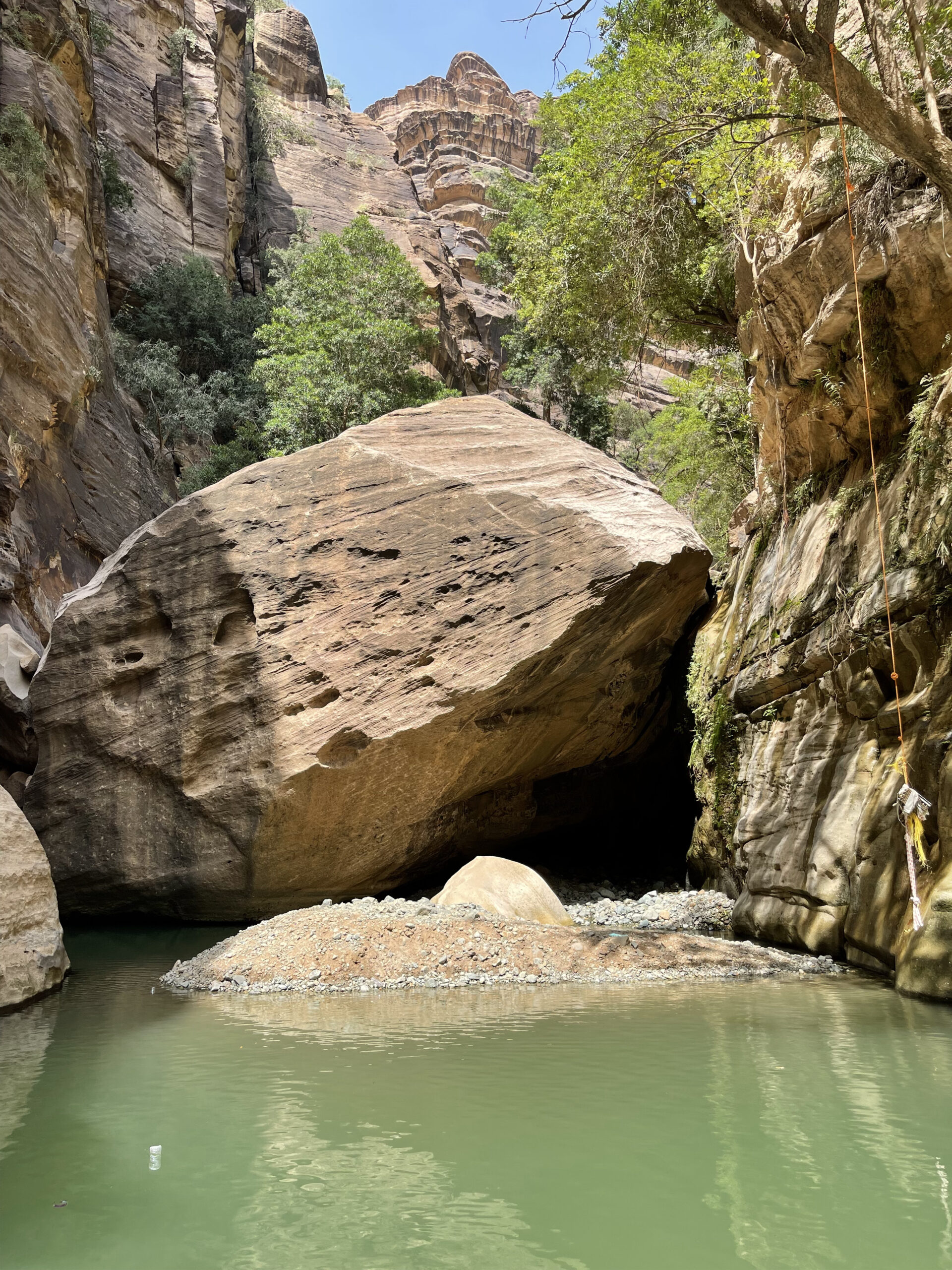
Wadi Lajab: 800m walls, permanent water, hanging gardens
Guide Required: Strongly recommended
Avoid: Any wadi after rainfall — flash flood risk
Saudi Arabia is not the destination most adventurers picture when they think of canyoning — and that is precisely the point. The kingdom’s southwestern highlands and the deep geological fractures of the Hejaz conceal a network of wadi canyons that rival anything in the Middle East. Towering sandstone walls, permanent water courses, hanging gardens fed by underground springs, and passages so narrow the light disappears entirely: this is a country whose canyoning credentials are only beginning to be understood by the wider world. For those already exploring the Saudi Arabia hiking guide, canyoning is the natural next step — a more technical, more immersive way to move through the same spectacular terrain.
Unlike the arid slot canyons of Jordan or the bone-dry gulches of the UAE, Saudi Arabia’s southwestern wadis carry water. In Jizan Province and the Asir highlands, monsoon-influenced rains from the Ethiopian highlands feed perennial streams that carve ever deeper into the basalt and granite of the Sarawat escarpment. The result is a landscape unlike anything else in the Arabian Peninsula: lush, green, echoing with birdsong, and split by channels that demand you swim, scramble, and abseil your way through. Consult the broader Saudi Arabia travel guide for essential logistics and context before setting out.
Wadi Lajab, Jizan: The Centrepiece
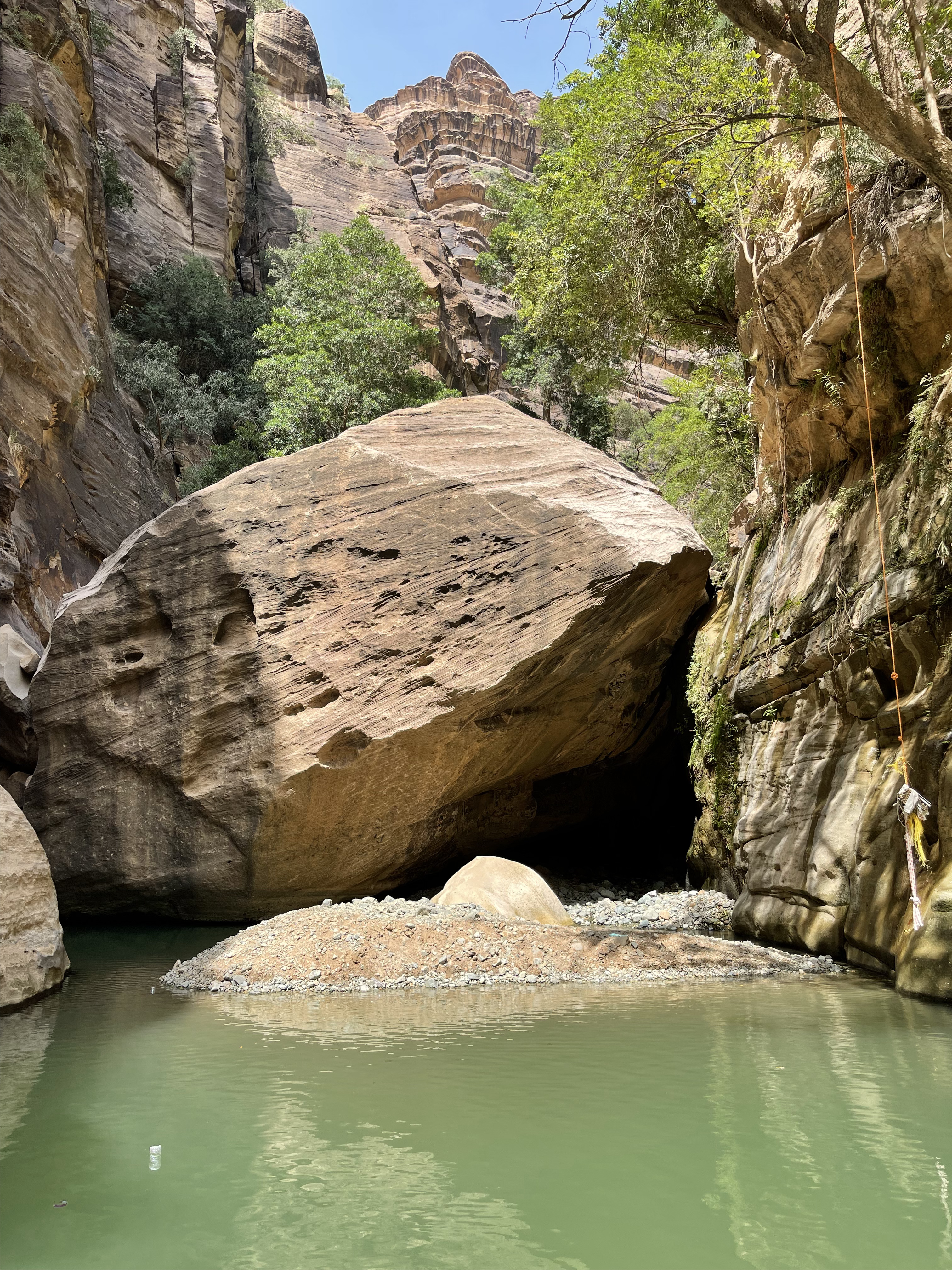
Every serious account of canyoning in Saudi Arabia begins in the same place: Wadi Lajab in Jizan Province. Known locally as the “green wadi” and sometimes translated as the “hanging valley,” this narrow canyon in the eastern reaches of Jizan Province is the kingdom’s most celebrated wadi descent — a roughly 11-kilometre corridor carved between the sheer flanks of Jebel al-Qahar, with walls that rise in places to over 300 metres and, by some accounts, reach 800 metres at the canyon’s most dramatic points.
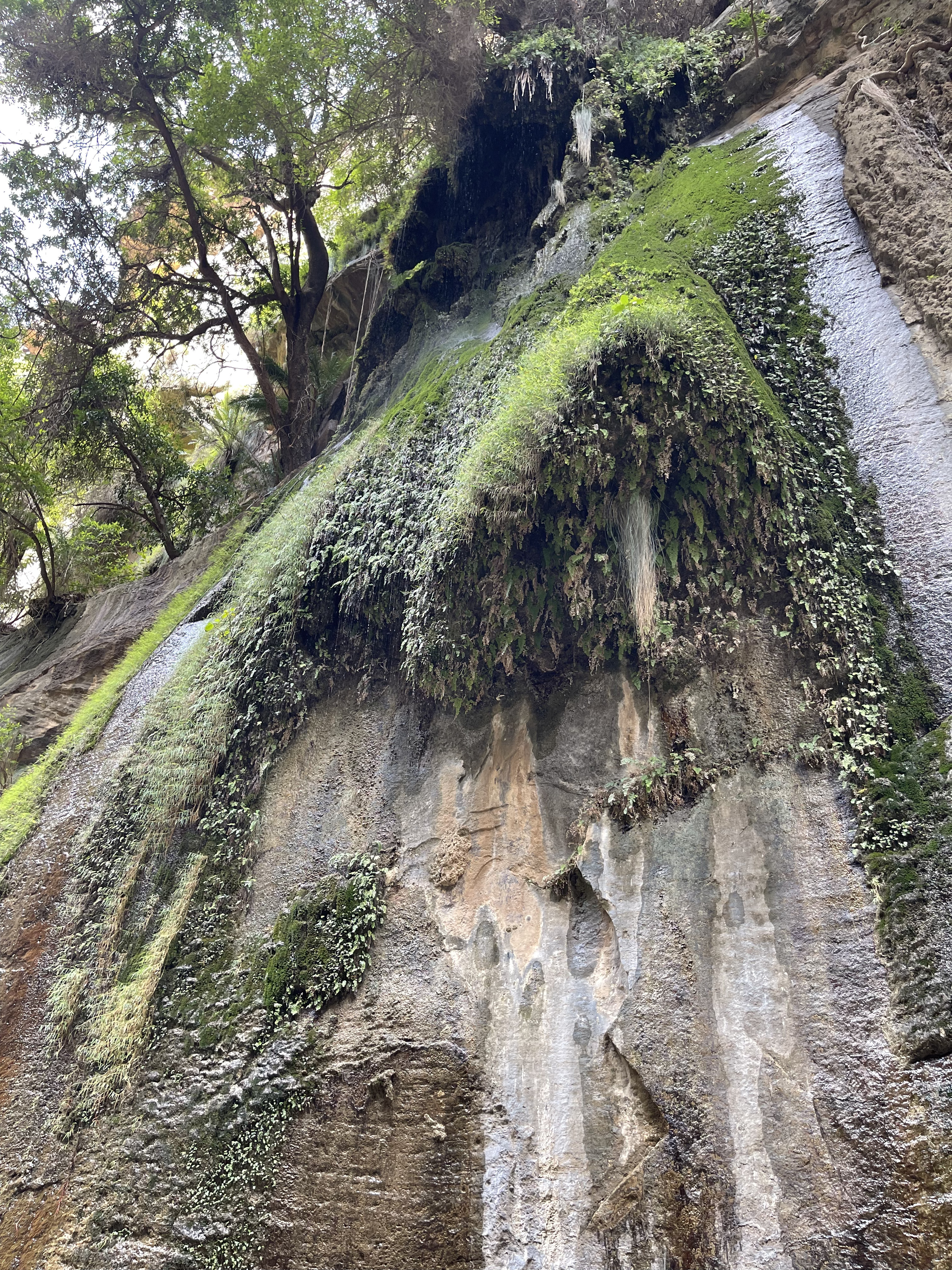
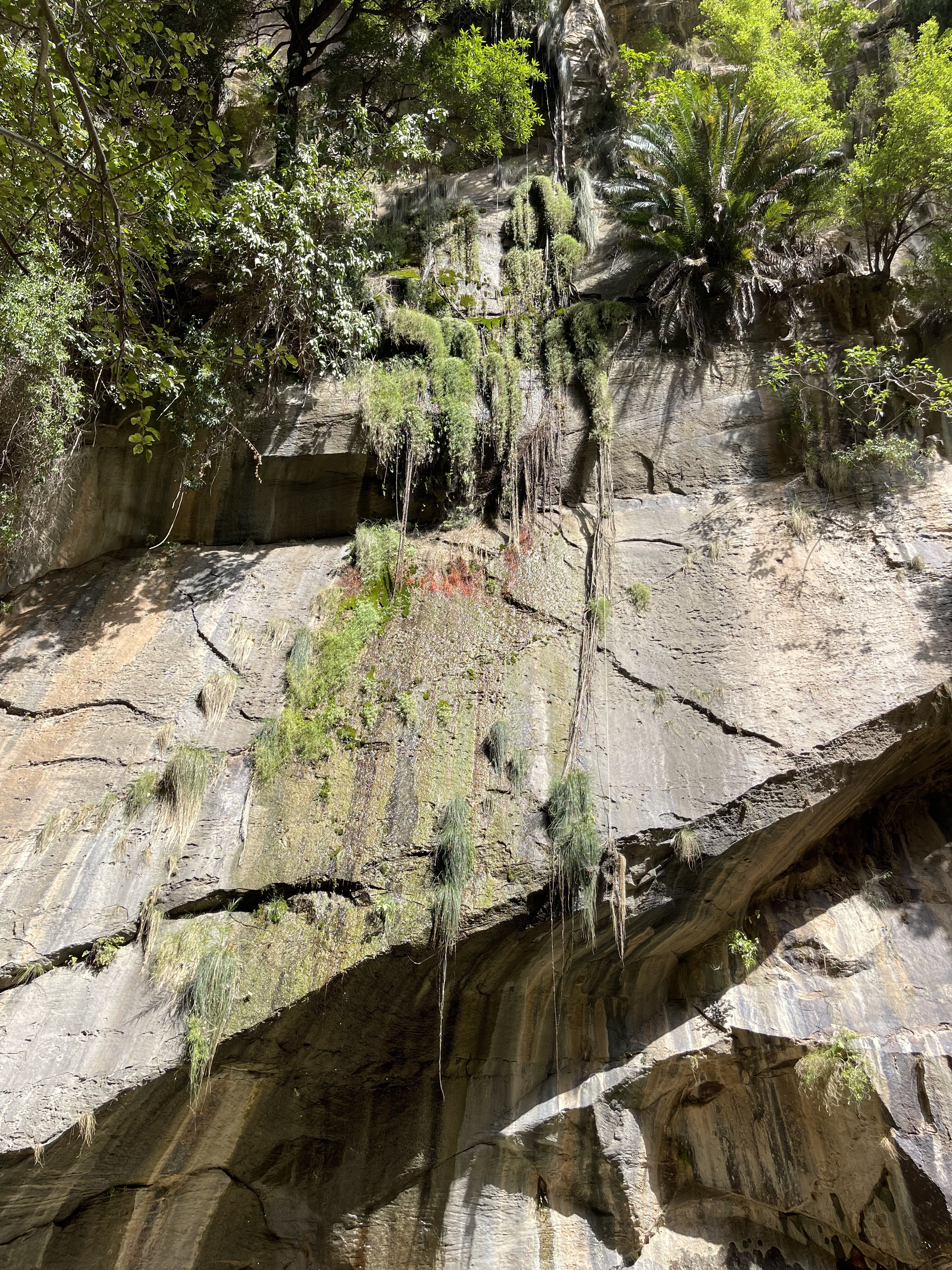
What sets Wadi Lajab apart from virtually every other Saudi wadi is its water. This is one of the only wadis in the country where water flows year-round — not as a trickle but as a genuine stream that pools into chambers deep enough for swimming, drops into small waterfalls between boulders, and sustains a riot of vegetation on every ledge and overhang. Palms grow up to 30 metres tall. Hanging gardens of ferns and creepers cling to the canyon walls. The air inside is cool and green-scented in a way that feels improbable at this latitude.
The canyoning itself is moderate in technical difficulty. There are no fixed rappels required to traverse the main canyon — the descent is accomplished on foot, wading through pools, scrambling over boulders, and at one point swimming through a submerged section that leads into a cave (a head torch is essential here). The slippery basalt underfoot demands water shoes with strong grip. The canyon can be explored in two to three hours at pace, but most visitors spend a full day. The narrowest passages require turning sideways.
Wadi Lajab lies approximately 120–125 km from Jizan city, a journey of around two hours by road. The final approach requires a 4×4 vehicle — the track from the nearest road becomes rough and rocky. Wadi Lajab is covered in more detail in our Jizan guide.
The Asir Highlands: Canyoning Above the Clouds
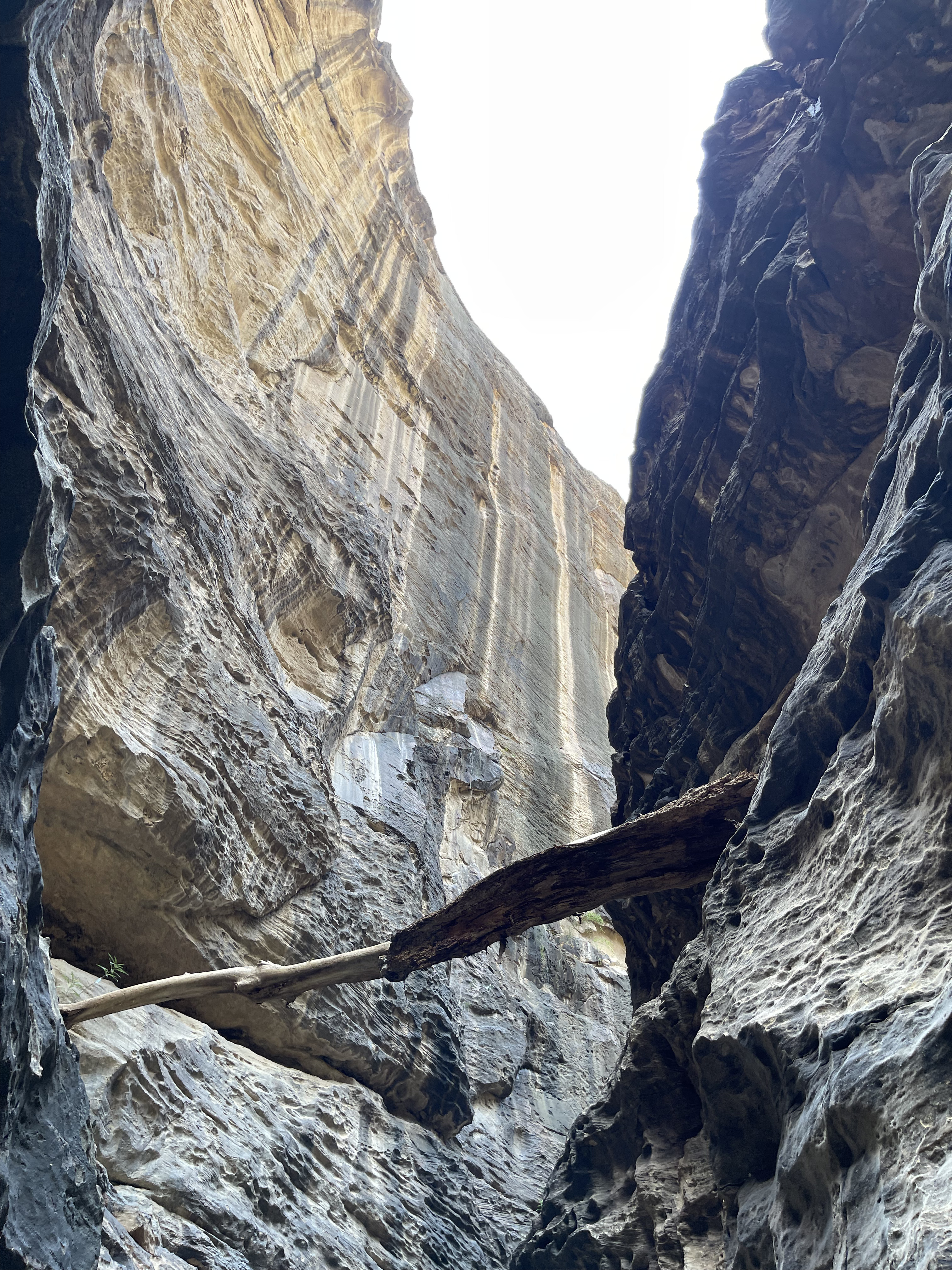
The Asir region centred on Abha offers a fundamentally different canyoning experience to Jizan — higher, cooler, and set against a backdrop of juniper-forested escarpment rather than tropical gorge. The Sarawat mountains rise above 3,000 metres here, and the wadis that drain their western flanks are carved deep into ancient basalt. Water is less continuous than at Wadi Lajab, but the scale of the terrain is extraordinary: canyon walls stained red, orange, and black by mineral seeps, with ibex sometimes visible on the ridgelines above.
The Asir wadis accessible from Abha — including the drainage channels below Rijal Almaa and the gorges above the Habala hanging village — offer a spectrum from family-friendly boulder walks to sections that require basic rope-work and confidence jumping into pools. Husaak Adventures, who operate The Outpost Tanomah in the Asir highlands, offer bespoke canyoning itineraries in this region. Their guides know the drainage systems intimately and can calibrate routes to the group’s experience level. Contact via WhatsApp: +966 50 139 6942.
The Asir highlands also connect naturally with Saudi Arabia’s most accessible high-altitude walk. Our Abha and Asir region guide covers the full range of activities available from the regional capital, including the Soudah cable car and Rijal Almaa heritage village. For those building a combined hiking and canyoning itinerary, our Saudi wadi walks guide and Saudi hiking trails guide provide the broader context.
Tabuk Region: Desert Canyons and Geological Drama
The canyoning landscape of Tabuk Province in northwestern Saudi Arabia is entirely unlike the green gorges of Jizan and Asir — and no less spectacular for it. Here the rock is sandstone and granite, the palette is ochre and rust, and the scale is geological in the most literal sense. Two sites stand out.
Al-Shaq: The Grand Canyon of Saudi Arabia
Al-Shaq — the name means “the tear” in Arabic — is a crack in the earth’s crust formed by the same tectonic forces that opened the Red Sea. Located roughly 4 km from the main Dhuba–Tabuk road near the village of Shiqry, the canyon extends for 70 kilometres with walls on both sides rising to 450 metres. The floor is accessible by 4×4 track, and while Al-Shaq is not a technical canyoning descent in the conventional sense, hiking its floor or scrambling along its rim provides the same sense of being engulfed by geological enormity. Tour operators in Tabuk include Arabia Trail (arabiatrail.net) who run guided 4×4 expeditions to the site.
Wadi Disah: Towers, Palms, and Blue Springs
Wadi Disah, accessible from Tabuk via a 2.5-hour drive, is a lush valley studded with sandstone towers and natural springs — a landscape that feels more Utah than Arabia. The valley’s permanent water source feeds palm groves and creates turquoise pools known locally as “The Blue Eye.” Guided adventure tours from Tabuk (available through GetYourGuide and local operators) include 4×4 transfer, exploration of the valley floor and rock formations, and traditional hospitality. The terrain here is walk-and-scramble rather than rope-assisted, suitable for reasonably fit beginners.
Madakhel Canyon, AlUla: For the Technical Canyoneer
The most technically demanding canyoning experience in Saudi Arabia currently on the market is Husaak Adventures’ full-day Madakhel canyon expedition in AlUla. Hidden deep within the Madakhel area of the AlUla region, this is raw canyoneering: vertical drops, narrow passages requiring rope work, cold water swims, and technical anchor-setting. The 8–10 hour full-day extreme experience is rated suitable for ages 16 and over with a reasonable fitness baseline. A shorter 5–6 hour “Twisted Maze” variation (priced at 776 SAR per adult) navigates the same tight passages with less vertical exposure. Both operate out of The Outpost AlUla and require pre-booking.
This sits at the harder end of what is available in Saudi Arabia — closer to a multi-pitch canyoneering objective than a guided wadi walk. See our Saudi rock climbing guide for related technical terrain in the AlUla and Tabuk regions.
Difficulty Levels at a Glance
Saudi Arabia’s canyoning sites span a genuine range of difficulty. Here is a rough classification:
| Canyon | Region | Difficulty | Technical Skills | Best For |
|---|---|---|---|---|
| Wadi Lajab | Jizan | Easy–Moderate | None required | Families, beginners, swimmers |
| Wadi Disah | Tabuk | Easy | None | All levels, scenic walk |
| Al-Shaq | Tabuk | Easy–Moderate | None | Hikers, geology enthusiasts |
| Asir wadis (Abha) | Asir | Moderate | Basic scrambling | Active hikers |
| Madakhel Canyon (Twisted Maze) | AlUla | Moderate–Hard | Ropes, confidence in water | Fit adults 16+ |
| Madakhel Canyon (Extreme) | AlUla | Hard | Full canyoneering technique | Experienced canyoneers |
Tour Operators
Independent access to many Saudi wadis is technically possible but not recommended without local knowledge — route-finding inside a canyon is disorienting, and the flash flood risk in unfamiliar terrain is real. The following operators have proven track records:
Husaak Adventures
The most established adventure tour operator in the Gulf, Husaak runs fixed-departure and bespoke canyoning experiences from two bases: The Outpost AlUla (Madakhel canyon) and The Outpost Tanomah in the Asir highlands. They have trained guides, safety equipment, and experience calibrating routes to group ability. Website: husaak.com. WhatsApp: +966 50 139 6942.
My Saudi Tours / Saudi Arabia Tours
These operators run guided day trips and multi-day adventures to Wadi Lajab from Abha and Jizan, including transport in 4×4 vehicles. Suitable for those who want the Wadi Lajab experience without organising self-drive logistics.
Riyadh Trips
Based in the capital, Riyadh Trips organises departures to Wadi Lajab for groups travelling from Riyadh — typically a weekend itinerary combining the canyon with the broader Jizan coastline. Useful for those based in Riyadh without their own 4×4.
Arabia Trail (arabiatrail.net)
Specialist for the Tabuk and AlUla regions, Arabia Trail offers 4×4-based adventures to Wadi Disah and the Al-Shaq canyon area with local expert guides.
Visit Saudi Official Booking (book.visitsaudi.com)
The Saudi Tourism Authority’s official booking portal lists regulated guided experiences including a full-day Wadi Lajab and Jebel Al-Qahar adventure. Pricing and availability are published on the site with online booking.
Essential Equipment and What to Pack
The gear requirements for Saudi canyoning depend sharply on the difficulty level and whether the canyon carries water. For Wadi Lajab and similar wet descents, the following are essential:
- Water shoes or grippy trainers: The basalt of Wadi Lajab is perpetually wet and exceptionally slippery. Specialist canyoneering shoes are ideal; solid-soled trainers you can submerge are an acceptable alternative. Flip-flops are dangerous.
- Dry bag or waterproof case: For phone, wallet, and any electronics. The cave section of Wadi Lajab requires swimming — nothing stays dry without protection.
- Head torch: Mandatory for the cave passage. A helmet-mounted torch is preferable to a hand torch, which leaves you crawling one-handed.
- Change of clothes: Sealed in a dry bag for after the descent. Driving wet for two hours back to Jizan is miserable.
- Two to three litres of water per person: There are no facilities inside the canyon. Despite the flowing stream, drinking wadi water without purification is inadvisable.
- Snacks and a packed lunch: Again, no services inside the canyon. Local flat rocks make excellent picnic spots.
- First-aid kit: For the standard minor injuries — slips on wet rock are the most common hazard.
- Small backpack: Waterproof or lined with a dry bag. Keep it light — you may need both hands free on boulder sections.
- Never enter a wadi if rain is falling anywhere in the catchment area. Check weather across the entire drainage system, not just at the canyon entrance.
- October to April is the safest window for canyoning in southwestern Saudi Arabia, with June to September carrying the highest flood risk due to the southwestern monsoon influence. Winter months (November to March) bring periodic heavy rains to the Asir and Jizan highlands — always check the forecast for the mountains above the canyon, not just the valley floor.
- Never camp or overnight on the canyon floor.
- Always tell someone where you are going and when to expect you back. Mobile signal is absent in most canyon sections.
- Travel with a guide on your first visit to any new canyon. Local guides understand the drainage behaviour and warning signs in a way that no online guide can fully replicate.
- Saudi Arabia Hiking Guide — trails, peaks, and long-distance routes across the kingdom
- Saudi Wadi Walks — gentler wadi explorations suitable for all fitness levels
- Saudi Rock Climbing — technical climbing in AlUla and Tabuk
- Saudi Hiking Trails — marked and unmarked trail routes region by region
- Abha and the Asir Region — the highland capital and its surroundings
- Jizan Guide — the coastal province that is Wadi Lajab’s gateway
- Saudi Arabia Visa Guide — how to apply for the tourist e-visa
For technical canyoneering at Madakhel or in the Asir wadis with rope-assisted sections, Husaak and other operators supply the technical kit: harness, helmet, descender, and ropes. Participants need only bring appropriate clothing and the items above. A neoprene wetsuit (3–5mm) is recommended for cold-water canyon swims during the winter months — the springs feeding these canyons are consistently cool.
Safety, Flash Floods, and When Not to Go
The single most serious hazard in Saudi Arabian wadis is not falling or getting lost — it is water. Flash floods in the kingdom’s southwestern wadis are fast, powerful, and receive almost no warning at canyon level. Rain falling on the escarpment above can send a wall of water through a narrow canyon floor within minutes, with no indication of rain at the entry point. The 2010 Jeddah floods and the 2016 Asir floods, both of which caused multiple fatalities, illustrate how rapidly conditions escalate.
The rules are simple and non-negotiable:
Physical Fitness and Preparation
Saudi Arabia’s canyoning sites demand different fitness profiles. Wadi Lajab is surprisingly accessible — the majority of visitors are families with children or travellers with no prior canyoning experience. The key physical demands are: balance on wet, uneven rock; the ability to swim at least 20 metres in calm water for the cave section; and the stamina for two to four hours of stop-start scrambling with a daypack. People with a fear of enclosed spaces should note that the cave passage, while short, is genuinely dark and low-ceilinged.
The Madakhel extreme route at AlUla is a different matter entirely. Eight to ten hours of sustained physical effort, vertical rope work, cold water immersion, and technical problem-solving demand a solid baseline of fitness and ideally some prior scrambling experience. Husaak requires participants to be at least 16 years old. Those who have completed guided canyoning in other countries — Wadi Mujib in Jordan, the Verdon Gorge in France, or similar — will find the skill set directly transferable.
Asir canyons sit in the middle ground. The altitude (most sites are above 1,500 metres) means exertion feels harder than at sea level, particularly for visitors acclimatising from coastal cities. Take the first hour slowly. The air is genuinely cold in winter mornings — a base layer and a wind shell are useful until the canyon walls trap warmth mid-morning.
Getting There and Practicalities
Most canyoning visitors to Saudi Arabia arrive on the tourist e-visa — check our Saudi Arabia visa guide for current requirements and the straightforward online application process. The Jizan gateway to Wadi Lajab is served by King Abdullah ibn Abdulaziz Airport (GIZ) with flights from Riyadh, Jeddah, and Dammam. Abha Regional Airport (AHB) serves the Asir region. Tabuk Airport (TUU) is the gateway for Wadi Disah and Al-Shaq.
A 4×4 vehicle is effectively non-negotiable for Wadi Lajab — the final approach track is impassable for standard cars. Most guided tours include 4×4 transport from the nearest town. Self-drivers should factor in two hours each way from Jizan city. Fuel and food should be purchased before leaving the city; there is nothing on the approach road.
Explore More Saudi Arabia Travel
Canyoning is one dimension of a broader adventure landscape in Saudi Arabia’s southwest. Extend your trip with the following guides: