WASHINGTON — No relationship in twenty-first-century geopolitics has been as nakedly transactional, as stubbornly durable, or as consequential as the one between Donald Trump and Mohammed bin Salman. It has survived a journalist’s dismemberment, a global pandemic, a rival American presidency, an oil price war, and now an active shooting conflict with Iran that has closed the Strait of Hormuz and sent crude past $120 a barrel. Through it all, the bond between the 47th president and the Saudi crown prince has endured not because of shared ideology or deep personal affection, but because each man possesses something the other cannot obtain elsewhere. Trump needs Saudi capital to fund his domestic ambitions and validate his dealmaker mythology. MBS needs American security guarantees to underwrite his $3.3 trillion Vision 2030 transformation and, as of March 2026, to protect his kingdom from Iranian missile salvos. The result is the most consequential codependency in modern diplomacy — and arguably the most dangerous.
From the sword dance at Murabba Palace in May 2017 to the F-35 flyover at the White House in November 2025, the Trump-MBS axis has reshaped arms export policy, redrawn the boundaries of acceptable authoritarianism in American foreign relations, created a private-equity back channel that has funneled billions to the president’s son-in-law, and now drawn Saudi Arabia into the most significant military confrontation the Middle East has seen since the Gulf War. Nine years into this partnership, the question is no longer whether it will survive the next crisis. The question is whether the rest of the world can survive the choices it produces.
Table of Contents
- The Sword Dance and the Orb — How It All Began in 2017
- Who Is the Real Intermediary Between Trump and MBS?
- The Khashoggi Test — How Far Would Trump Go to Protect MBS?
- Oil as Weapon — The 2020 Price War and the Phone Call That Ended It
- The Biden Interregnum — MBS Plays Washington Against Beijing
- What Did MBS Promise When Trump Returned to Power?
- The November 2025 White House Visit — Seven Years of Exile Ends
- The F-35 Gambit — Why Saudi Arabia Got America’s Best Fighter Jet
- The Kushner Question — $2 Billion, Zero Profits, and a Senate Investigation
- Trump Inc. in the Kingdom — Real Estate, Licensing, and the Emoluments Shadow
- Did MBS Get the War He Wanted?
- The Transactional Scorecard — Who Has Gotten More From This Alliance?
- The Israel Problem — Why Normalization Keeps Failing
- Can This Alliance Survive What Comes Next?
- Frequently Asked Questions
The Sword Dance and the Orb — How It All Began in 2017
The foundation of the Trump-MBS relationship was laid not in a bilateral meeting or a phone call, but in a calculated gamble by the Saudi royal court. In March 2017, barely two months into the Trump presidency, a young deputy crown prince named Mohammed bin Salman attended a lunch at the White House. Across the table sat Jared Kushner, the president’s 36-year-old son-in-law and senior adviser. The two men were almost exactly the same age — Kushner was 36, MBS was 31 — and both had been handed extraordinary power by older men who trusted family over institutions. The lunch lasted longer than scheduled. By the time MBS returned to Riyadh, the Saudis had identified their channel into the Trump White House.
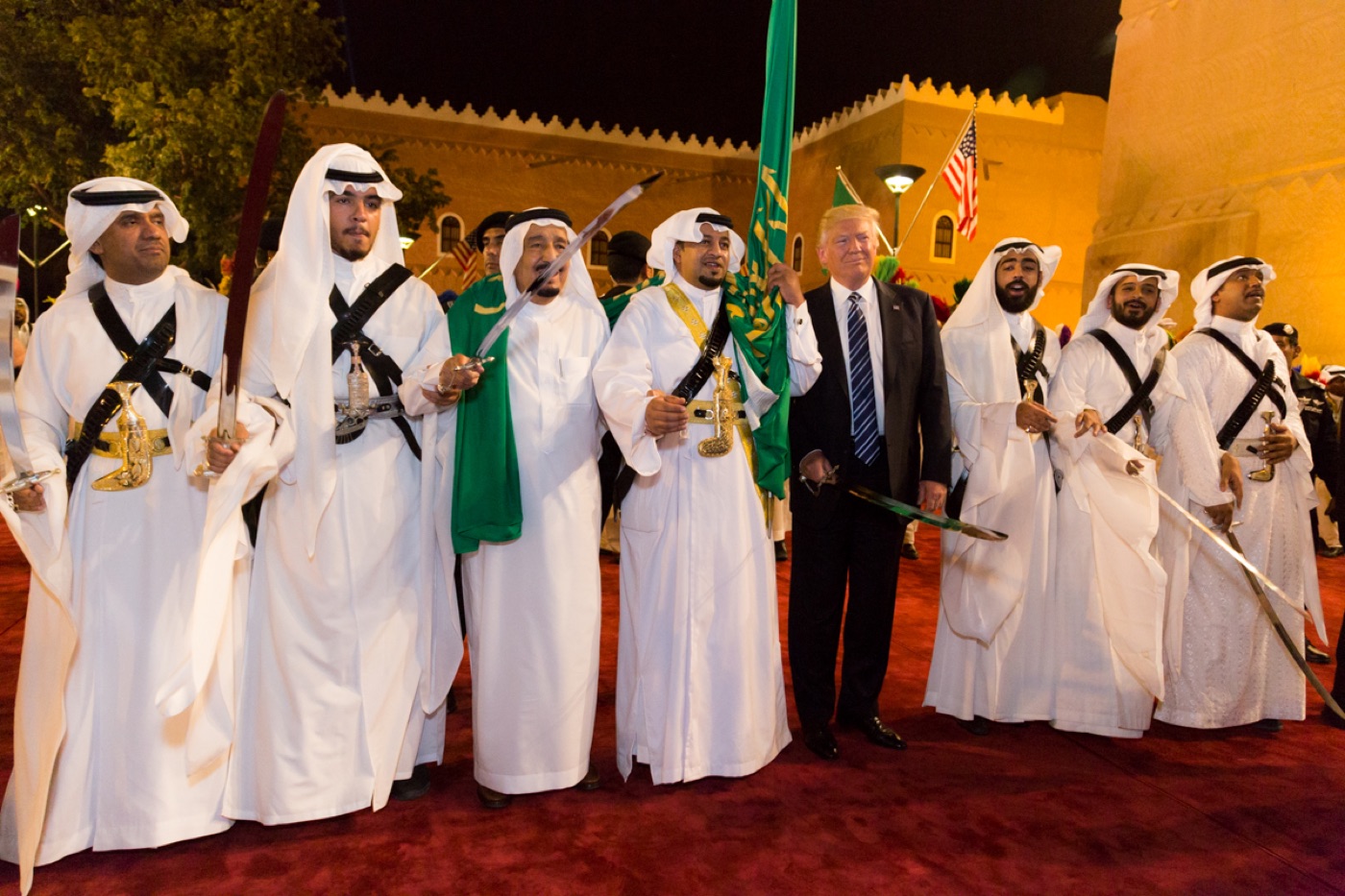
Two months later, Trump made the most symbolically significant decision of his early presidency: he chose Riyadh as the destination for his first foreign trip. No American president had ever begun with Saudi Arabia. The message was unmistakable. The Obama era — with its Iran nuclear deal, its cool distance from Gulf monarchies, its lectures on human rights — was over. In its place came a presidency that spoke the language Riyadh understood best: money, weapons, and mutual enemies.
That transactional relationship now faces its sharpest test. Senator Lindsey Graham, one of the Senate’s most influential voices on the US-Saudi alliance, has threatened to kill the mutual defense pact unless the Kingdom joins the Iran campaign — demanding a price for the protection MBS has spent years negotiating.
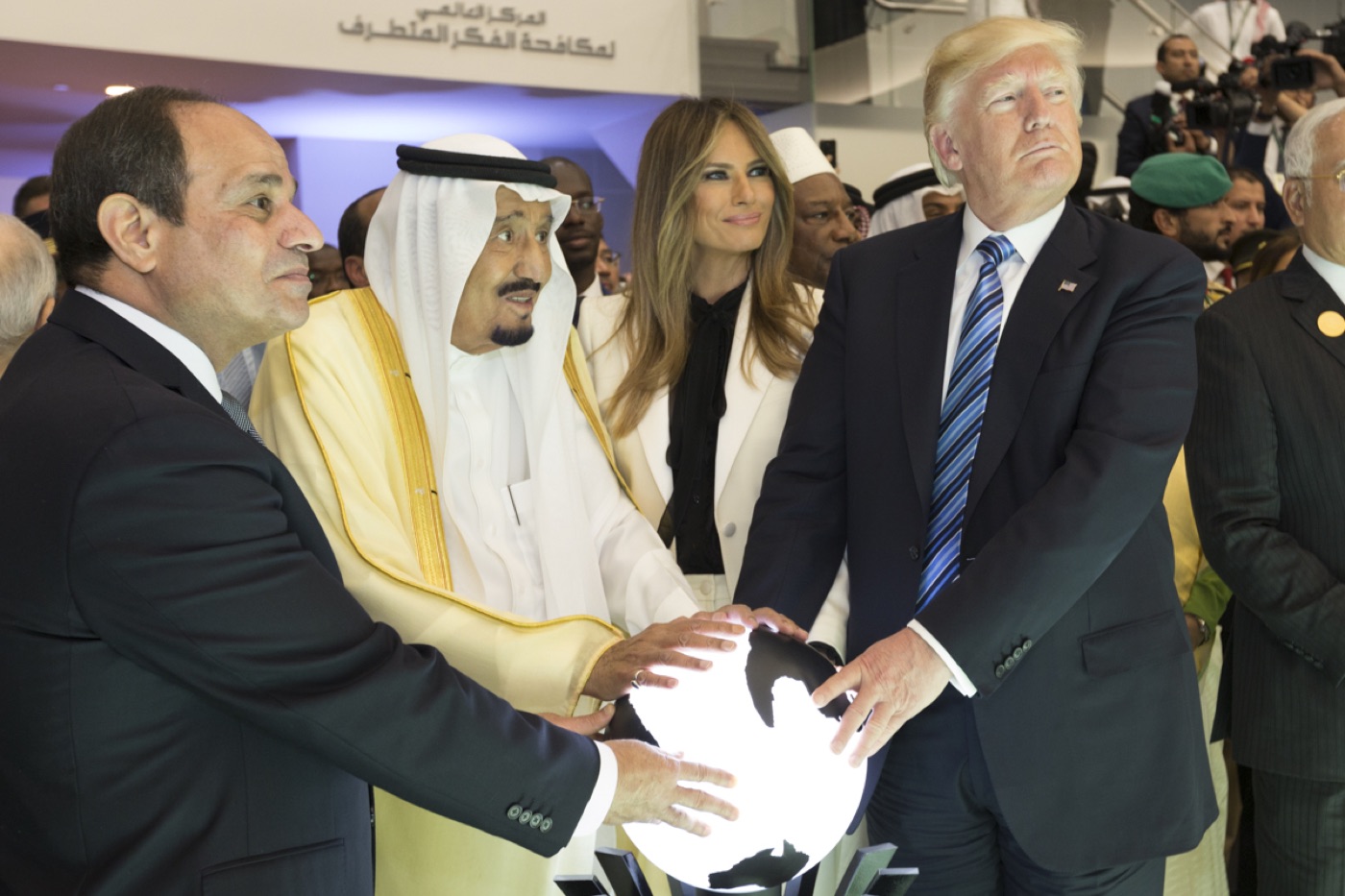
The Riyadh summit of May 2017 produced imagery that would define the relationship for years. There was Trump swaying with a ceremonial sword at Murabba Palace, flanked by Saudi dignitaries in white thobes. There was the glowing orb — Trump, King Salman, and Egyptian President Abdel Fattah el-Sisi placing their hands on an illuminated globe at the opening of the Global Center for Combating Extremist Ideology, a photo that instantly became a meme and, inadvertently, a symbol of the transactional opacity that would characterize the years ahead. And there was the headline number: $110 billion in arms sales, announced with the fanfare of a corporate merger.
The $110 billion figure was, from the beginning, more aspiration than reality. A Brookings Institution analysis found that by 2025, only approximately $34.6 billion in actual Foreign Military Sales notifications had been filed with Congress, and the historical delivery rate for such notifications hovered around 30 percent. The real value of the deal lay not in the hardware it produced but in the political cover it provided. For Trump, it was proof that his transactional approach to foreign policy could produce numbers bigger than anything Obama had managed. For MBS, it was proof that the new American president would treat Saudi Arabia not as a problematic ally to be managed but as a premier customer to be courted.
The pattern repeated at far larger scale in November 2025 when MBS raised the investment commitment to nearly $1 trillion — a figure whose true contents and wartime implications reveal the deepening financial architecture of the alliance.
Behind the scenes, the Riyadh summit achieved something more consequential than any arms deal. It established the personal chemistry — and the power dynamic — that would govern the relationship. Trump was enchanted by the scale of Saudi hospitality, the deference of the royal court, and the sheer size of the numbers being discussed. According to Michael Wolff, Trump reportedly told friends after MBS was elevated to crown prince in June 2017 that the Saudis had made the right choice. The comment reflected a belief that would prove remarkably persistent: that MBS was, in some sense, Trump’s man in Riyadh.
Who Is the Real Intermediary Between Trump and MBS?
Every consequential bilateral relationship has an architecture — official channels, back channels, and the informal networks that often matter more than both. The Trump-MBS relationship has three distinct communication layers, and understanding them is essential to understanding how decisions get made.
The official channel runs through Prince Khalid bin Salman, MBS’s younger brother, who served as Saudi ambassador to the United States from 2017 to 2019 before becoming deputy defense minister and, in 2025, defense minister. Khalid is the family’s Washington specialist — fluent in English, trained as a fighter pilot, educated at Georgetown. He handles the institutional relationship: defense contracts, diplomatic communiques, the formal architecture of alliance management. When the State Department needs to deliver a message to MBS, it goes through Khalid’s office.
The direct channel is the phone line between Trump and MBS themselves. The two leaders speak regularly and, according to multiple reports, with a candor that alarms their respective national security staffs. A classified 2019 phone call between Trump and MBS remains unreleased despite demands from 37 House members led by Eugene Vindman, who described the contents as shocking and used the term “quid pro quo.” Khashoggi’s widow, Hatice Cengiz, called the reported contents “highly disturbing.” The call’s classification level — and the bipartisan resistance to its release — suggests the conversation contained commitments or assurances that would be politically explosive if made public.
Then there is the Kushner channel, which operates in the space between government and private interest. Jared Kushner’s role as the primary back channel between Trump and MBS predates his father-in-law’s first term and has continued, in a different form, since he left government. During the first Trump administration, Kushner was the man MBS called when he wanted to bypass the State Department, the Pentagon, and the intelligence community. After Trump left office, Kushner launched a private equity firm that received $2 billion from the Saudi sovereign wealth fund — a transaction that has raised questions about whether the line between diplomacy and personal enrichment was ever meaningfully observed.
The Khashoggi Test — How Far Would Trump Go to Protect MBS?
On October 2, 2018, the Washington Post columnist Jamal Khashoggi walked into the Saudi consulate in Istanbul to obtain paperwork for his upcoming marriage. He never walked out. Turkish intelligence, which had bugged the consulate, recorded what happened next: Khashoggi was killed and dismembered by a 15-member Saudi team that had flown in from Riyadh. The CIA subsequently concluded, with high confidence, that the operation had been approved by Mohammed bin Salman.
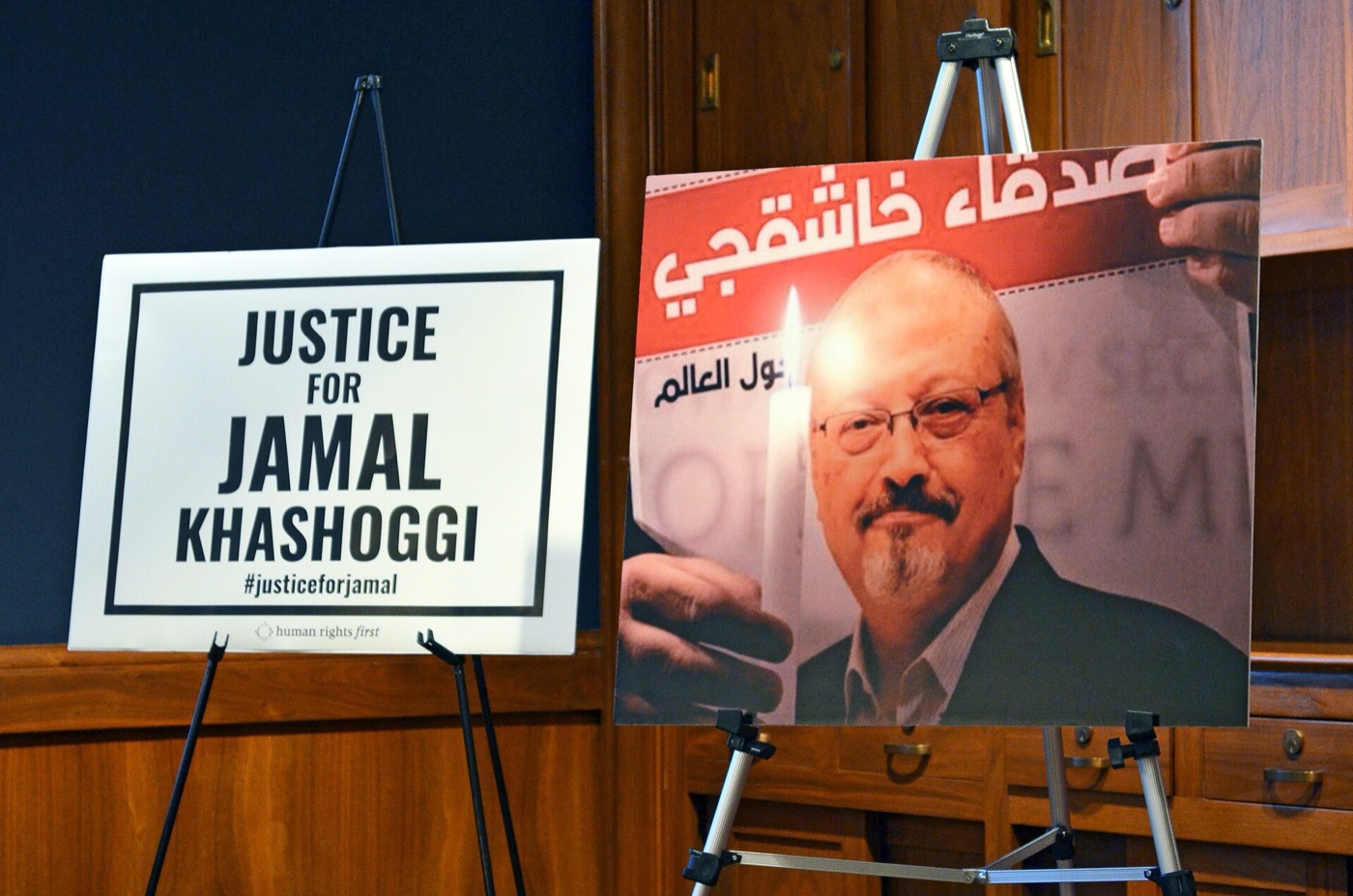
The Khashoggi murder was the first existential test of the Trump-MBS relationship — and it revealed, with brutal clarity, how far Trump was willing to go to protect the Saudi crown prince. The president’s initial response was to cast doubt on the CIA’s findings. His formal statement, released on November 20, 2018, opened with the extraordinary words: “The world is a very dangerous place!” It continued with a litany of Saudi economic commitments and concluded with a formulation that would become infamous: “Maybe he did and maybe he didn’t!” in reference to MBS’s role in the killing.
“I saved his ass. I was able to get Congress to leave him alone. I was able to get them to stop. He says very strongly that he didn’t do it. Bob, they spent $400 billion over a fairly short period of time.”
Donald Trump to Bob Woodward, recorded January 22, 2020, published in “Rage”
Trump’s private remarks were even more revealing than his public ones. In a recorded conversation with journalist Bob Woodward on January 22, 2020 — later published in Woodward’s book “Rage” — Trump discussed MBS with the candor of a man who understood exactly what he had done and why. The admission laid bare the core logic of the relationship: Saudi money bought Saudi impunity.
The U.S. Senate was not so compliant. In a rare bipartisan rebuke, senators unanimously passed a resolution blaming MBS for Khashoggi’s murder. Legislation was introduced to block arms sales to Saudi Arabia, impose sanctions on officials involved in the killing, and demand an end to American support for the Saudi-led war in Yemen. Trump vetoed five separate measures. Each veto was, in effect, a down payment on the relationship — a signal to MBS that the American president would absorb domestic political damage to protect their partnership.
The Khashoggi crisis established a pattern that has repeated throughout the Trump-MBS relationship. MBS takes an action that appalls the international community. Washington’s foreign policy establishment demands consequences. Trump intervenes to shield MBS, citing economic interests and strategic necessity. The crisis passes. The relationship deepens. The precedent that accountability can be purchased with investment pledges becomes further entrenched.
Oil as Weapon — The 2020 Price War and the Phone Call That Ended It
If the Khashoggi crisis tested Trump’s willingness to protect MBS from political consequences, the oil price war of March 2020 tested something different: MBS’s willingness to inflict economic pain on Trump’s America when Saudi interests demanded it.
In early March 2020, as the COVID-19 pandemic began shuttering the global economy, OPEC+ negotiations between Saudi Arabia and Russia collapsed. Moscow refused Riyadh’s demand for deeper production cuts. MBS responded with a move that stunned energy markets: Saudi Arabia flooded the market, boosting production to near-maximum capacity and slashing official selling prices. Brent crude collapsed from $50 to below $20. American shale producers — many of them major Republican donors — faced bankruptcy.
The man who felt the pressure most acutely was Harold Hamm, the Oklahoma oil tycoon and prominent Trump supporter. Hamm and other shale executives warned the White House that collapsing oil prices would devastate the American energy sector, cost hundreds of thousands of jobs in swing states, and potentially cost Trump the 2020 election. The message reached the Oval Office with the urgency of a campaign emergency.
On April 2, 2020, Trump called MBS. According to Reuters, the president delivered an ultimatum: cut production or face the withdrawal of American military support from the kingdom. The threat was unprecedented — no American president had ever explicitly conditioned the Saudi security guarantee on oil production decisions. It was also effective. Within days, OPEC+ agreed to the largest coordinated production cut in history: 9.7 million barrels per day.
The episode revealed the relationship’s fundamental dynamics more clearly than any diplomatic communique. MBS had demonstrated that he was willing to weaponize oil production against American economic interests when provoked. The same willingness to use production as a strategic tool is visible in the 2026 crisis, where OPEC+ chose to increase output even as Iranian drones struck Saudi refineries — a decision that serves both Riyadh and Washington simultaneously. Trump had demonstrated that he was willing to threaten the cornerstone of the alliance — the American security umbrella — when his political survival was at stake. Both men had shown that they viewed the relationship not through the lens of alliance obligations but through the lens of transactional leverage. And both had discovered that the other’s pressure point was existential: for Trump, electoral viability; for MBS, physical security.
The oil crisis also illuminated a structural vulnerability that would return with devastating effect in 2026. Saudi Arabia’s economy depends on oil revenues that can be disrupted by geopolitical shocks — whether self-inflicted, as in the 2020 price war, or externally imposed, as in the Iranian drone strikes on Ras Tanura. Each disruption increases Saudi dependence on the American security guarantee and, by extension, on the personal relationship between the Saudi leader and the American president. The 2020 oil war proved that MBS was willing to accept short-term economic pain to achieve strategic objectives. The 2026 Iran conflict is testing whether the kingdom can absorb the kind of sustained damage that no amount of strategic willingness can offset.
The Biden Interregnum — MBS Plays Washington Against Beijing
The four years of the Biden presidency, from January 2021 to January 2025, were not a pause in the Trump-MBS story. They were the period in which MBS demonstrated, with calculated precision, what happens when Washington tries to impose consequences on the relationship.
Joe Biden entered office having called Saudi Arabia a “pariah” during his 2020 campaign. He released the intelligence community’s assessment of MBS’s role in the Khashoggi murder. He froze certain arms sales. He attempted, fitfully, to restore the distance between the White House and the Saudi royal court that had existed under Obama. MBS took note — and responded with a strategy designed to maximize American anxiety.
The first signal came through oil. In October 2022, weeks before the U.S. midterm elections, OPEC+ announced a production cut of 2 million barrels per day. The timing was widely interpreted as a deliberate rebuke of the Biden administration, which had publicly lobbied for increased production. Biden’s July 2022 visit to Jeddah — immortalized by the fist bump photo with MBS — had produced only a minimal and temporary production increase. The Saudis had taken the photo opportunity and delivered nothing of substance.
The second signal came through Beijing. In December 2022, Chinese President Xi Jinping visited Riyadh and received a welcome that deliberately exceeded any reception given to an American president. Chinese fighter jets flew escort with green smoke trails in the colors of the Saudi flag. Xi attended three separate summits — bilateral, GCC, and Arab League — in a display of diplomatic courtship that would have been unthinkable a decade earlier. The visit produced tangible results: a $7 billion currency swap agreement between the Saudi and Chinese central banks, the first yuan-denominated Saudi oil sale, and Saudi Arabia’s acceptance of an invitation to join BRICS, which it formally entered in January 2024.
Saudi Finance Minister Mohammed al-Jadaan amplified the message by publicly announcing the kingdom’s openness to trading oil in non-dollar currencies. The statement sent tremors through Washington’s foreign policy establishment. A Stimson Center analysis concluded that the Saudis were “flirting with de-dollarization to get Washington’s attention” — a diplomatic pressure tactic rather than a genuine strategic pivot, but one that was remarkably effective at concentrating American minds.
The Biden interregnum revealed something fundamental about MBS’s strategic calculus. The Saudi crown prince did not need Trump personally — he needed a transactional American president who would prioritize commercial interests over human rights concerns and strategic conditionality. Biden’s attempt to impose values-based conditions on the relationship had not reformed Saudi behavior. It had simply pushed MBS to demonstrate that Saudi Arabia had alternatives. By the time Trump won the 2024 election, MBS had accumulated maximum leverage: he could present himself as the partner who had been driven away by Democratic moralism and who could be brought back — at a price.
The four-year estrangement also demonstrated a truth that Washington’s foreign policy establishment has been reluctant to acknowledge. Saudi Arabia under MBS is not a status quo power content to operate within the American-led order. It is a revisionist power — one that accepts American security guarantees when convenient, cultivates Chinese and Russian relationships when useful, and treats every interaction as a negotiation in which nothing is given away for free. The Biden team attempted to manage this reality through traditional diplomatic tools: summits, communiques, carefully calibrated public statements. MBS managed it through raw leverage: oil production decisions, Chinese state visits, and the implicit threat that Saudi capital and intelligence cooperation could flow elsewhere. The approach that produced results was not the one taught at the Kennedy School.
What Did MBS Promise When Trump Returned to Power?
Trump’s first phone call after his January 2025 inauguration was to Mohammed bin Salman. The symbolism was unmistakable: the first foreign leader the new president chose to contact was the crown prince who had kept the relationship warm throughout the Biden years, largely through the Kushner connection. MBS reciprocated with a pledge that would define the early months of Trump’s second term: $600 billion in Saudi investment and trade with the United States over four years.
The $600 billion figure — later raised to “almost $1 trillion” — was staggering in its ambition and strategically vague in its details. CNBC analysts noted that the pledges “aren’t done deals yet,” and independent assessments by NeverNEOM and other Saudi-watchers pointed to a severe liquidity crisis at the Public Investment Fund that would make delivering on such commitments extraordinarily difficult. The PIF’s assets under management had grown rapidly, but much of its capital was locked in illiquid domestic megaprojects — NEOM, The Line, Diriyah Gate, the Red Sea Project — that were consuming cash rather than generating returns.
But the number served its purpose. For Trump, it was a headline that validated his return to the White House and his approach to foreign policy. For MBS, it was an opening bid in a negotiation that would culminate in the most significant upgrade of the U.S.-Saudi relationship since the 1945 meeting between Franklin Roosevelt and King Abdulaziz aboard the USS Quincy.
In May 2025, Trump embarked on a Gulf tour that produced over $300 billion in announced agreements. At a press conference in Riyadh, Trump called MBS “your greatest representative” and added, with characteristic directness, “I like him a lot. I like him too much.” The remark drew polite laughter from the assembled journalists and diplomats. It also captured, in seven words, the essential character of a relationship that operates at the intersection of personal affection, financial interest, and strategic calculation.
The November 2025 White House Visit — Seven Years of Exile Ends
For seven years after the Khashoggi murder, Mohammed bin Salman avoided setting foot in the United States. The crown prince traveled freely to Europe, Asia, and the Gulf, but the country that served as his kingdom’s primary security guarantor remained off-limits — not because of any formal ban, but because the political risks of a Washington visit were deemed too high. The Khashoggi murder had generated active lawsuits in American courts, and the Saudi legal team was not confident that MBS’s claim to sovereign immunity would survive a challenge.
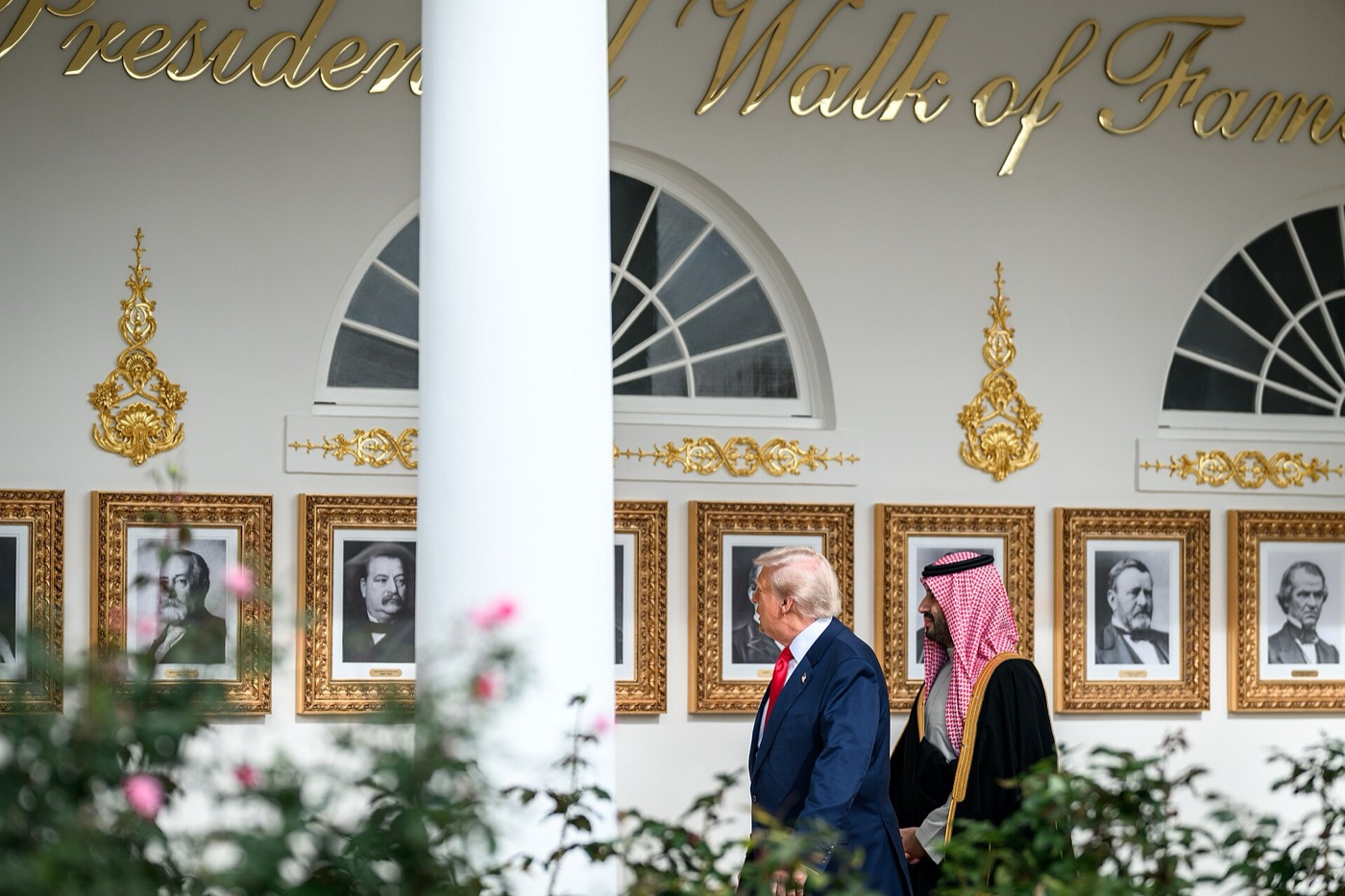
That calculus changed with Trump’s return to the White House. On November 18, 2025, MBS arrived in Washington for a state visit that was designed, from first moment to last, as a demonstration of restored status. F-35 stealth fighters flew overhead as MBS’s motorcade approached the White House. Cannon salutes thundered from the South Lawn. Horse guards in ceremonial dress lined the driveway. A red carpet stretched from the diplomatic entrance to the Oval Office. A black-tie dinner followed, attended by Silicon Valley executives, private equity titans, and the upper echelon of the Washington establishment.
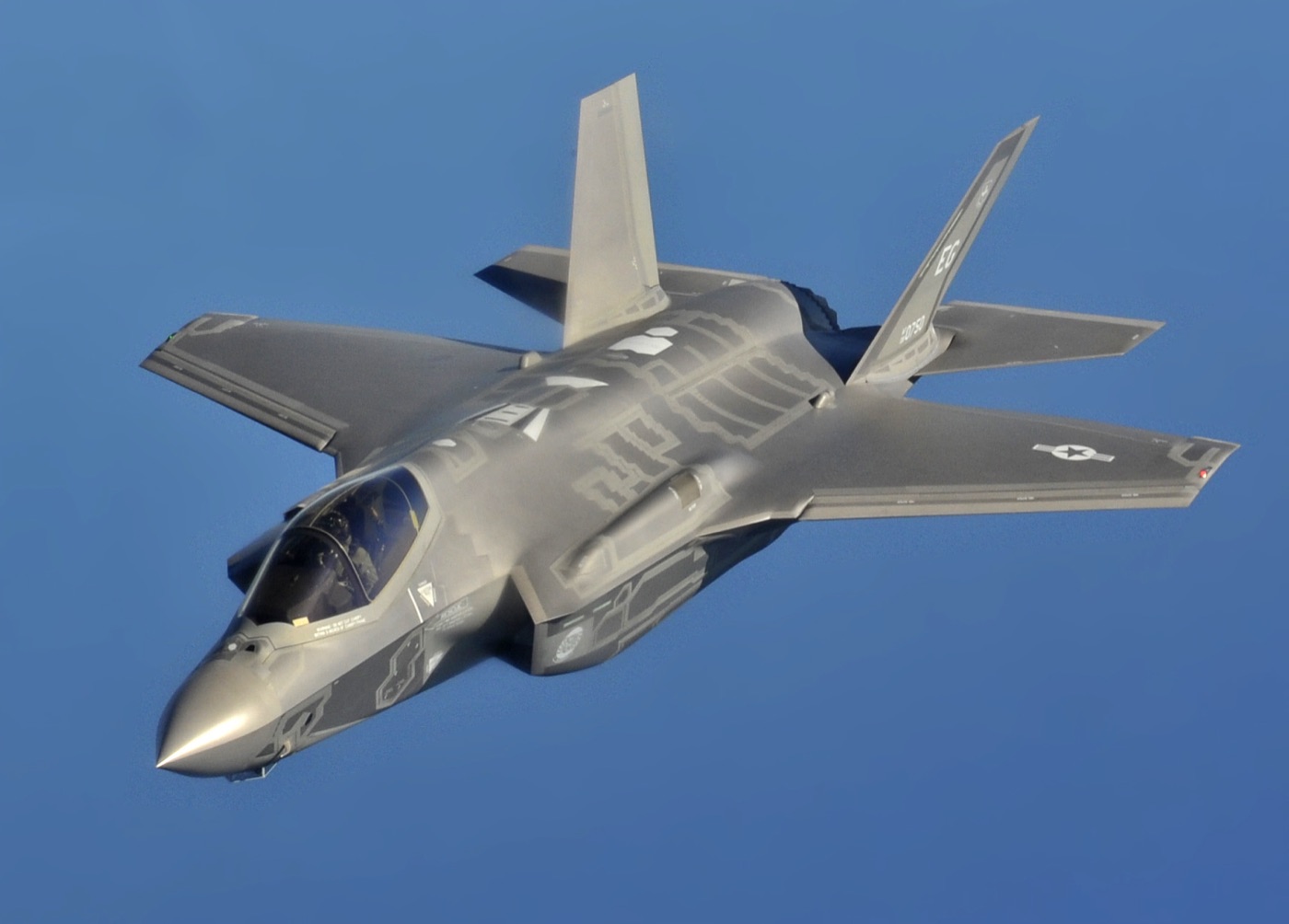
The visit produced a cascade of announcements, each more significant than the last. Saudi Arabia was designated a “major non-NATO ally” — a legal status that unlocks access to advanced weapons systems, priority delivery of defense equipment, and cooperative research and development programs. A Strategic Defense Agreement was signed, formalizing the security relationship that had previously operated on an informal, transactional basis. And the centerpiece: authorization for Saudi Arabia to purchase 48 F-35 Lightning II stealth fighters, making the kingdom the first Arab nation to receive America’s most advanced combat aircraft.
When ABC’s Mary Bruce asked Trump about Khashoggi during a joint press appearance, the president’s response was swift and dismissive. “Things happen,” he said, before turning on the reporter for “embarrassing our guest.” The exchange was, in its own way, a more honest articulation of the relationship’s moral framework than any diplomatic statement. Khashoggi was dead. The deals were signed. And the man who had been accused of ordering the murder was standing in the White House Rose Garden, newly anointed as America’s most favored non-NATO ally.
“Things happen.”
President Donald Trump, responding to a question about the murder of Jamal Khashoggi during MBS’s White House visit, November 2025
MBS raised his investment pledge during the visit from $600 billion to “almost $1 trillion.” A conference of American investors was convened at the Four Seasons in Georgetown, with representatives from BlackRock, Blackstone, Goldman Sachs, and multiple Silicon Valley firms. The message was clear: the Saudi sovereign wealth fund was open for business, and the Trump White House was the door through which American capital should enter.
The F-35 Gambit — Why Saudi Arabia Got America’s Best Fighter Jet
The authorization of 48 F-35 Lightning II stealth fighters for Saudi Arabia was, by any measure, the most consequential arms transfer decision of the Trump presidency. It reversed decades of American policy maintaining Israel’s “qualitative military edge” — the doctrine, enshrined in law since 2008, that the United States would ensure Israel’s military technology advantage over any regional rival. No Arab nation had previously been approved to receive the F-35. The decision to sell them to Saudi Arabia represented a fundamental rewriting of the rules governing American arms exports in the Middle East.
The F-35 decision cannot be understood outside the context of the broader bargain Trump was attempting to construct. The Abraham Accords of 2020 had established a template: Arab nations would normalize relations with Israel in exchange for American weapons and security guarantees. The UAE had received F-35 authorization as part of its normalization agreement, though delivery had been repeatedly delayed over technology transfer concerns. Saudi Arabia’s F-35 approval was intended to incentivize a similar normalization, but MBS had consistently linked any deal to Palestinian statehood — a condition that Netanyahu’s government could not and would not accept.
The Iran war has since rendered this calculus moot. The conflict that was supposed to pave the way for Saudi-Israeli recognition has instead destroyed the normalization process entirely, with MBS publicly abandoning a deal that 99 percent of his population rejected.
The result was a paradox at the heart of the Trump-MBS relationship. Saudi Arabia received the F-35s without delivering normalization. Israel lost its qualitative military edge guarantee without gaining a peace agreement. And the United States handed its most advanced fighter to a nation whose human rights record included the extrajudicial killing of a Washington Post columnist. The transaction worked for Trump (a massive arms deal to announce) and for MBS (the most advanced military hardware in the region). It worked for almost no one else.
Defense analysts have estimated the full lifecycle cost of the Saudi F-35 program — including spare parts, maintenance, training, and infrastructure — at between $20 billion and $30 billion over 30 years. For the American defense industry, particularly Lockheed Martin, it represented a generational revenue stream. For Saudi Arabia’s air defense architecture, it represented a qualitative leap that would take a decade to fully integrate but that signaled, immediately and unmistakably, the depth of the American commitment.
The Kushner Question — $2 Billion, Zero Profits, and a Senate Investigation
On January 21, 2021 — the day after Donald Trump left the White House — Jared Kushner incorporated a private equity firm called Affinity Partners. Six months later, Saudi Arabia’s Public Investment Fund invested $2 billion in the fund. The timeline alone raised questions. The substance of the investment raised far more.
The PIF’s own screening panel had recommended against the investment. Internal documents, later obtained by congressional investigators, revealed that the panel cited the “inexperience of the management” — Kushner had no prior private equity experience — warned that the kingdom would bear the “bulk of the investment and risk,” and flagged significant “public relations risks.” MBS personally overruled the screening panel’s recommendation and directed the investment to proceed.
By 2024, Affinity Partners had returned no profits to its investors. But it had collected approximately $157 million in management fees, of which an estimated $87 million came from the Saudi government. The annual management fee — approximately $25 million — was paid regardless of performance, a structure that guaranteed Kushner a substantial income stream irrespective of whether the fund generated any returns for its Saudi investors.
Senator Ron Wyden, then chair of the Senate Finance Committee, opened an investigation into the arrangement. His office suggested that the Affinity Partners structure might function as a compensation scheme that circumvented the Foreign Agents Registration Act — a mechanism through which a foreign government could reward a former official for services rendered while in office without triggering the legal disclosure requirements that would apply to a direct payment. Kushner denied any impropriety and noted that the fund’s investors included non-Saudi entities as well.
In September 2025, with Trump back in the White House, the Kushner-Saudi financial relationship produced its most dramatic transaction yet: Affinity Partners intermediated a $55 billion acquisition of Electronic Arts by the PIF. The deal made Kushner’s firm the broker for one of the largest sovereign wealth fund acquisitions in history — a position that generated substantial fees and cemented Affinity Partners’ role as the preferred intermediary between Saudi capital and American assets.
The Kushner factor illuminates something essential about the Trump-MBS relationship that purely diplomatic analysis misses. The relationship does not exist solely at the level of heads of state. It is embedded in a web of private financial interests — investments, management fees, deal intermediation, licensing agreements — that create incentives extending far beyond any single policy decision. When Trump protects MBS from political consequences, he is not only serving strategic interests or personal affinity. He is protecting a financial ecosystem that enriches his own family.
Trump Inc. in the Kingdom — Real Estate, Licensing, and the Emoluments Shadow
The Kushner investments are the most scrutinized Saudi financial connection to the Trump family, but they are not the only one. The Trump Organization’s business dealings with Saudi-linked entities have created a parallel set of financial entanglements that place a sitting president’s family business interests in direct alignment with a foreign government’s diplomatic objectives.
The most prominent project is Trump Plaza Jeddah, a luxury development partnership with Dar Global, a Saudi-listed real estate company with close ties to the Saudi establishment. The project — which includes apartments, townhouses, and commercial office space — is valued at over $1 billion. Dar Global’s licensing agreements with the Trump Organization generated approximately $21.9 million in payments in 2024 alone.
The arrangement is not technically a conflict of interest under current American law, because the president is exempt from most federal conflict-of-interest statutes. But it creates a structural incentive that is impossible to ignore: the Trump family’s private financial interests are directly served by maintaining a warm relationship with the Saudi government and its allied business class. Every arms deal, every diplomatic concession, every vetoed sanctions bill operates in the shadow of this financial alignment.
The emoluments question — whether payments from foreign governments to a president’s business interests constitute the kind of foreign emoluments prohibited by the Constitution — was litigated extensively during Trump’s first term without producing a definitive judicial resolution. The Saudi connections are larger and more direct than those that prompted the original lawsuits. But with a sympathetic Congress and a conservative judiciary, the constitutional question is unlikely to be adjudicated before the financial arrangements have achieved their purpose.
Did MBS Get the War He Wanted?
The most consequential — and most dangerous — chapter in the Trump-MBS story is being written in real time. The Washington Post reported that in the months leading up to Operation Epic Fury — the U.S.-Israeli strikes on Iran’s nuclear facilities launched on February 28, 2026 — MBS made multiple private calls to Trump lobbying for military action against Iran’s nuclear program. The crown prince warned that Iran would become “stronger and more dangerous” if allowed to continue enriching uranium, and urged preemptive strikes before Tehran reached weapons capability.
Publicly, MBS maintained support for a diplomatic solution to the Iranian nuclear question. The gap between his private lobbying and public positioning has been a defining feature of Saudi diplomacy throughout the crisis. Khalid bin Salman, serving as defense minister, conveyed messages to Washington that aligned with the more hawkish position, while Saudi foreign ministry channels continued to emphasize dialogue. The Saudi-Israeli intelligence coordination that facilitated the strikes added another layer of complexity to a relationship that MBS had always managed through deliberate ambiguity.
When the strikes came, Iran retaliated. Drones hit the Ras Tanura refinery — Saudi Aramco’s crown jewel — taking approximately 550,000 barrels per day offline. The U.S. Embassy compound in Riyadh was struck, with the Washington Post reporting that the attack hit the CIA station housed within. Iranian drones and missiles also targeted facilities in the UAE, Qatar, Bahrain, and Kuwait, transforming what had been billed as a precision strike against nuclear facilities into a regional conflagration.
By March 6, the consequences of this war had driven Saudi Arabia to intensify its direct diplomatic backchannel to Tehran, deploying multiple channels in a desperate bid to end a conflict that MBS had lobbied for in principle but never anticipated in its current, destructive form.
On March 1, Trump called MBS. According to the White House readout, the president told the crown prince that “Washington stands with the Kingdom.” MBS then convened a call with Gulf leaders urging them to “avoid steps that could further inflame tensions” — a remarkable pivot from the man who had spent months lobbying for the very strikes that had inflamed them. Oil prices surged approximately 20 percent. The Strait of Hormuz was effectively closed to commercial traffic. Aramco’s East-West Pipeline became the kingdom’s only viable oil export route.
The Iran war has exposed the deepest contradiction in the Trump-MBS relationship. MBS lobbied for a war whose consequences he is now absorbing. Vision 2030’s financial architecture depends on stable oil revenues and foreign investment flows, both of which have been disrupted by the conflict. The 13 million foreign workers who power the Saudi economy are trapped in a country under active missile attack. And the American security guarantee that MBS has spent nine years cultivating is being tested not in the abstract but under fire.
The Transactional Scorecard — Who Has Gotten More From This Alliance?
Nine years into the Trump-MBS relationship, it is possible to construct a preliminary accounting of what each side has given and received. The ledger reveals an alliance that has delivered enormous personal and political benefits to both leaders while generating substantial costs for their respective publics and institutions.
| Category | What MBS Got | What Trump Got |
|---|---|---|
| Arms Sales | $34.6B in FMS notifications; 48 F-35s authorized | Headlines, defense industry revenue, donor satisfaction |
| Khashoggi | Five vetoes blocking sanctions; de facto impunity | Preserved relationship; Saudi arms revenue continued |
| Investment Pledges | MNNA status; Strategic Defense Agreement | $600B-$1T headline numbers for domestic messaging |
| Kushner Channel | Direct back channel bypassing State/Pentagon | $2B PIF investment in Kushner’s fund; $87M+ in fees |
| Trump Business | Favorable U.S. diplomatic posture | $21.9M in licensing fees (2024); Trump Plaza Jeddah |
| Oil Production | OPEC+ coordination maintained | Price stabilization before 2020 election |
| Iran War | American military strikes on Iranian nuclear sites | Wartime presidency narrative; defense spending surge |
| Israel Normalization | F-35s delivered without normalization | Failed to deliver Saudi-Israel peace deal |
The scorecard suggests that MBS has been the more effective transactional operator. Saudi Arabia has received concrete security deliverables — weapons, alliance status, military protection — while offering pledges that remain largely unfulfilled. The $600 billion to $1 trillion in investment commitments exist primarily as announced intentions rather than deployed capital. The normalization that was supposed to justify the F-35 sale has not materialized. And the war that MBS lobbied for has generated costs that are being borne not only by Iran but by Saudi Arabia itself.
Trump’s side of the ledger is more personal than institutional. The financial benefits to the Trump family — Kushner’s management fees, the Trump Organization’s licensing revenue, the pipeline of Saudi-connected real estate deals — are tangible and quantifiable. The strategic benefits to the United States are more contested. The alliance has not produced Israeli-Saudi normalization, has not prevented the Iran conflict, has not curbed Saudi human rights abuses, and has not demonstrably reduced the risk of oil price volatility. What it has produced is a bilateral relationship that serves the personal interests of both leaders while leaving the structural challenges of the Middle East largely unaddressed.
The Israel Problem — Why Normalization Keeps Failing
The single greatest strategic prize that the Trump-MBS relationship has failed to deliver is Saudi-Israeli normalization. The Abraham Accords of 2020 — which produced normalization agreements between Israel and the UAE, Bahrain, Sudan, and Morocco — were explicitly designed as stepping stones to the grand prize: Saudi recognition of Israel. Six years later, that prize remains out of reach.
The obstacle is not lack of effort. Both Trump and MBS have expressed interest in a normalization deal. The November 2025 White House visit was, in part, intended to advance the framework. But MBS has consistently linked any agreement to a pathway toward Palestinian statehood — a condition that Benjamin Netanyahu’s governing coalition, which includes settler maximalists and religious nationalists, cannot accept without collapsing. Trump was reportedly “disappointed and angry” after a November 2025 exchange in which MBS reiterated this condition.
The normalization stalemate exposes a limit of transactional diplomacy. Trump’s approach assumes that every problem has a price — that sufficient incentives can overcome any obstacle. MBS’s insistence on Palestinian statehood is not a negotiating position that can be bought off with additional F-35s or investment pledges. It reflects a calculation about domestic legitimacy, Islamic world leadership, and the long-term stability of the Saudi monarchy that transcends the bilateral relationship. The kingdom houses Islam’s two holiest cities. Any Saudi king who normalized relations with Israel while Palestinians lack a state would face a legitimacy crisis that no amount of American weapons could resolve.
The failure to deliver normalization has practical consequences for the alliance. It means that the F-35 sale — which was partially justified as an incentive for normalization — appears, in retrospect, as a concession made for nothing. It means that the Saudi-Israeli security cooperation that has developed in the shadow of the Iran threat remains covert and deniable, unable to develop into the kind of formal alliance that could reshape the Middle East’s security architecture. And it means that the Trump administration’s signature Middle East initiative — a grand bargain linking Saudi normalization with Israeli concessions and American security guarantees — remains, like so many of the relationship’s announced deals, a headline without a contract.
Can This Alliance Survive What Comes Next?
The Trump-MBS relationship faces four structural pressures that will test its durability in the months and years ahead, each more serious than the crises it has already survived.
The first is the Iran war itself. MBS lobbied for strikes that have now drawn Saudi Arabia into an active conflict. Ras Tanura’s shutdown, the Hormuz closure, and the oil price surge have created economic damage that no amount of American diplomatic reassurance can offset. If the conflict escalates further — if Houthi forces open a second front from Yemen, if Iranian missiles penetrate Saudi air defenses and hit population centers, if the economic disruption triggers a domestic legitimacy crisis — MBS will need Trump to deliver not pledges but military resources. And the question of whether the United States is prepared to fight a sustained war to defend Saudi Arabia has never been answered.
The second is the investment delivery gap. The headline numbers — $600 billion, $1 trillion — were designed for press conferences, not balance sheets. Delivering on even a fraction of these commitments would require the PIF to deploy capital at a rate that exceeds its current liquidity. Vision 2030’s megaprojects are consuming vast sums. NEOM alone has an estimated price tag of $500 billion. If the investment pledges fail to materialize — if they turn out to be, like the 2017 arms deal, aspirational figures rather than binding commitments — the relationship will face a credibility crisis that no amount of personal chemistry can resolve.
The third is China. MBS’s cultivation of Beijing during the Biden years was partly tactical — a way to pressure Washington — but it also reflected a genuine strategic hedge. The $7 billion currency swap, the yuan-denominated oil trades, the BRICS membership: these are not gestures. They are the infrastructure of an alternative alignment. If MBS concludes that the American security guarantee is unreliable — and the Iran war may be testing exactly that conclusion — the China option becomes less a pressure tactic and more a strategic direction. Trump’s transactional approach, ironically, reinforces this logic. If everything is for sale, then Saudi Arabia’s security alignment is, by definition, available to the highest bidder.
The fourth pressure is time. Trump will leave office by January 2029 at the latest. MBS, assuming no crisis of succession, could rule for decades. The crown prince’s strategic horizon extends far beyond any American presidential term. The investments he is making — in defense capabilities, in economic diversification, in alternative partnerships — are designed to reduce Saudi Arabia’s dependence on any single American president. The irony of the Trump-MBS relationship is that its very transactional nature incentivizes MBS to build the hedges that will eventually diminish Trump’s leverage.
| Date | Event | Significance |
|---|---|---|
| Mar 2017 | Kushner-MBS White House lunch | Established back channel that bypasses official diplomacy |
| May 2017 | Riyadh summit; $110B arms deal announced | First foreign trip; set tone for transactional relationship |
| Jun 2017 | MBS elevated to Crown Prince | Trump reportedly told friends Saudis “put our man on top” |
| Oct 2018 | Khashoggi murder | Trump shields MBS; vetoes five congressional measures |
| Jan 2020 | Trump tells Woodward he “saved his ass” | Confirms transactional logic: Saudi money buys impunity |
| Apr 2020 | Oil price war; Trump threatens MBS | 9.7M bpd cuts — largest in history; mutual leverage revealed |
| Jan 2021 | Kushner launches Affinity Partners | PIF invests $2B despite internal panel objections |
| Dec 2022 | Xi Jinping visits Riyadh | MBS signals China alternative during Biden presidency |
| Jan 2025 | Trump calls MBS first after inauguration | $600B investment pledge; relationship fully restored |
| May 2025 | Trump Gulf tour | $300B+ in agreements; “I like him too much” |
| Nov 2025 | MBS White House visit | MNNA status; F-35 deal; “things happen” on Khashoggi |
| Feb 2026 | Operation Epic Fury strikes Iran | War MBS privately lobbied for; Iran retaliates against Saudi targets |
| Mar 2026 | Ras Tanura hit; Hormuz closed | Saudi Arabia absorbs consequences of the war it encouraged |
The Contrarian Case — What If This Is Exactly How Alliances Should Work?
The conventional criticism of the Trump-MBS relationship — that it is too transactional, too tolerant of authoritarianism, too entangled with private financial interests — rests on an assumption that American foreign policy should be primarily values-driven. But there is a contrarian case, grounded in realist international relations theory, that the Trump-MBS model may be more honest and more stable than the values-based approach it replaced.
The argument runs as follows. Every American alliance in the Middle East has always been transactional at its core. The Roosevelt-Abdulaziz pact of 1945 was oil-for-security. The Carter Doctrine of 1980 was a military guarantee in exchange for stable energy supplies. The Bush-era relationship with Saudi Arabia survived 15 of the 19 September 11 hijackers holding Saudi citizenship. The Obama administration continued selling arms to Riyadh while publicly criticizing the Saudi-led war in Yemen. What Trump has done is not fundamentally different in substance — it is different in transparency. The transactional nature of the relationship is explicit rather than hidden behind diplomatic euphemism.
The realist case also argues that the Biden approach — treating Saudi Arabia as a “pariah,” conditioning arms sales on human rights improvements, maintaining diplomatic distance — produced worse outcomes for American interests than Trump’s transactional embrace. Biden’s moralism did not improve Saudi human rights. It did not save Khashoggi. It did not prevent OPEC+ production cuts. What it did was push MBS toward China, weaken American influence in the Gulf, and leave the United States with less leverage when the Iran crisis erupted.
The counterargument is equally forceful. A foreign policy that cannot distinguish between a journalist’s murder and a trade negotiation is not realism — it is amoralism. And a relationship in which the president’s family receives hundreds of millions of dollars from the partner government is not transparent transactionalism — it is corruption wearing the mask of strategy. The debate between these positions is, in some sense, the central debate in American foreign policy. And the Trump-MBS relationship is its most vivid case study.
There is, however, a third position that transcends the realist-idealist divide. It holds that the real problem with the Trump-MBS relationship is not that it is transactional — all alliances ultimately rest on mutual interest — but that the transactions are personal rather than institutional. When arms deals coincide with licensing fees to the president’s family business, when diplomatic protection coincides with billion-dollar investments in the president’s son-in-law’s fund, when foreign policy decisions cannot be separated from private financial incentives, the line between legitimate statecraft and institutionalized corruption becomes indistinguishable. A transactional alliance between nations is realism. A transactional alliance between bank accounts is something else.
The Personal Dynamics — What Each Leader Sees in the Other
Strip away the geopolitics, the arms deals, and the investment pledges, and the Trump-MBS relationship is, at its core, a bond between two men who recognize something of themselves in the other. Both inherited their positions — Trump from his father’s real estate empire, MBS from the House of Saud. Both bypassed established hierarchies to seize power at relatively young ages. Both view loyalty as the supreme political virtue and institutions as obstacles to be circumvented. Both communicate in the language of deals rather than principles.
Trump has called MBS “a great guy” and reportedly considers him his favorite foreign leader. The affection appears genuine, but it is also instrumentalized. Trump’s warmth toward MBS is inseparable from his appreciation of Saudi spending. The Hoover Institution assessed that the relationship is “based on pragmatism rather than emotion” on MBS’s side — a clinical evaluation that captures the asymmetry at the relationship’s heart.
For MBS, Trump is the ideal American president: one who does not lecture about human rights, who speaks the language of commerce, who values personal relationships over institutional processes, and who can be relied upon to prioritize the bilateral relationship over domestic political pressure. But MBS is not sentimental. His cultivation of the China relationship during the Biden years demonstrated that his commitment is to Saudi interests, not to Trump personally. If a future American president offered better terms, MBS would adapt accordingly. The relationship is durable because it is useful, not because it is deep.
The fundamental asymmetry is this: Trump views MBS primarily as a revenue source — a man who can write checks large enough to validate Trump’s dealmaker self-image and enrich his family’s business interests. MBS views Trump primarily as a security guarantor — a man who can provide the weapons, the alliance status, and the military umbrella that Saudi Arabia needs to pursue its transformation while managing the Iranian threat. Each leader gets what he values most from the other. But neither fully trusts the other, because each understands that the other’s commitment is contingent on the transaction continuing to deliver.
The transactional nature of the Trump-MBS relationship faces its most complex test yet as Saudi Arabia pursues a multi-track diplomatic strategy that includes mediating between the United States and Iran. An analysis of Saudi Arabia’s simultaneous role as peace broker in four conflicts reveals how the Kingdom leverages its alliance with Washington while maintaining channels to America’s adversaries.
Frequently Asked Questions
How did Trump and MBS first meet?
The relationship began through Jared Kushner, who met MBS at a White House lunch in March 2017. Kushner and MBS — then 36 and 31 respectively — developed a personal connection that became the primary back channel between the two governments. Trump’s first foreign trip to Riyadh in May 2017 cemented the relationship, producing a $110 billion arms deal announcement and the now-iconic photos of the sword dance and glowing orb ceremony.
Why did Trump protect MBS after the Khashoggi murder?
Trump explicitly linked his protection of MBS to Saudi economic commitments. In a recorded conversation with journalist Bob Woodward, Trump said he “saved his ass” and cited $400 billion in Saudi spending. He vetoed five congressional measures that would have imposed consequences on Saudi Arabia, framing the decision as a choice between accountability and economic interests. The episode established that Saudi investment pledges could purchase de facto impunity from American political consequences.
How much money has the Trump family received from Saudi Arabia?
Jared Kushner’s Affinity Partners received a $2 billion investment from Saudi Arabia’s Public Investment Fund in 2021, generating approximately $157 million in management fees by 2024, with an estimated $87 million coming from the Saudi government. The Trump Organization’s licensing deal with Dar Global for Trump Plaza Jeddah generated approximately $21.9 million in 2024. Additional Saudi-connected revenue streams include hotel bookings, event hosting, and other business relationships that are not fully disclosed.
What is the significance of the F-35 sale to Saudi Arabia?
The authorization of 48 F-35 stealth fighters for Saudi Arabia in November 2025 made the kingdom the first Arab nation to receive America’s most advanced combat aircraft. The decision reversed the long-standing U.S. policy of maintaining Israel’s qualitative military edge in the region. The full lifecycle cost of the program is estimated at $20-30 billion over 30 years, making it one of the largest arms deals in history.
Did MBS lobby Trump for the Iran strikes?
According to the Washington Post, MBS made multiple private calls to Trump in the months before Operation Epic Fury, lobbying for military action against Iran’s nuclear facilities. The crown prince warned that Iran would become “stronger and more dangerous” if allowed to continue enrichment. Publicly, MBS maintained support for diplomacy. When Iran retaliated by striking Saudi targets including the Ras Tanura refinery, MBS pivoted to calling for restraint — urging Gulf leaders to avoid steps that could further escalate the conflict he had privately encouraged.
What role does Jared Kushner play in the Trump-MBS relationship?
Kushner serves as the primary back channel between Trump and MBS, a role that has continued in different forms since the first Trump administration. During his time in government, Kushner bypassed traditional diplomatic channels to communicate directly with MBS. After leaving office, he launched Affinity Partners, which received $2 billion from the PIF despite objections from the fund’s internal screening panel. In September 2025, the firm intermediated a $55 billion PIF acquisition of Electronic Arts.
How has the Iran war affected the Trump-MBS relationship?
The Iran war has simultaneously deepened the relationship’s necessity and exposed its contradictions. MBS lobbied for the strikes but is now absorbing their consequences, including drone attacks on Ras Tanura, the Hormuz closure, and disruption to Vision 2030’s economic plans. The conflict has made Saudi Arabia more dependent on American military support than at any time since the 1991 Gulf War, giving Trump maximum leverage but also maximum responsibility for outcomes he cannot fully control. The Strait of Hormuz standoff has crystallized this tension: Trump has threatened Iran with “death, fire, and fury” over the oil blockade, while MBS has carefully avoided committing Saudi forces to the escalating battle for control of the strait.