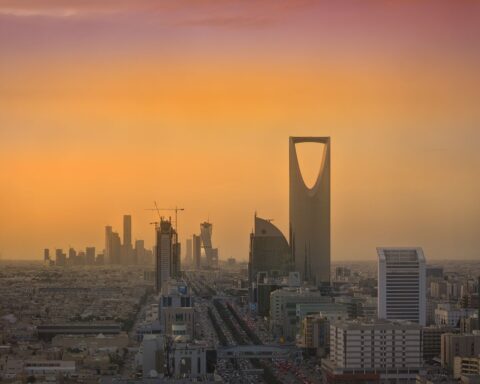

A news analysis by Bloomberg has revealed that Saudi Arabia’s grand Vision 2030, an economic overhaul sketched by Crown Prince Mohammed bin Salman back in 2016, is struggling under financial strain as the kingdom continues to largely bankroll the ambitious project with its own resources, rather than procuring much-needed foreign capital.
The Vision 2030 program was envisioned to shift the country’s dependency from oil and aim for $100 billion in annual foreign direct investment by 2030; a target that overshadows its past accomplishments and amounts to an increase of 50% of what India currently garners.
However, statistical analysis done between 2017-2022 showed the nation attracted an average of just north of $17 billion per year in foreign direct investments. For 2023, the Saudi Investment Ministry has set an optimistic goal of $19 billion in foreign direct investments.
Showcasing its intentions to modernize, Saudi Arabia partnered with Lucid, a U.S.-based electric vehicle manufacturer. Despite this, it was the Saudi kingdom that found itself shouldering the load, recently injecting $1 billion into Lucid, taking their total investment from the Public Investment Fund (PIF) to $5.4 billion. Lucid is now heavily backed by PIF, adding to the growing list of companies in which PIF is the major shareholder.
The idea behind the Lucid assembly project in Saudi Arabia was to project the oil-dependent country as a premier global hub for future industries, thereby enticing foreign investment. However, this investment reliance on the Kingdom indicates that the hurried economic reforms are mainly being financed by Riyadh’s coffers.
Karen Young, a respected political economist focused on the Gulf at the Columbia University Center on Global Energy Policy, stated that “the government had to provide significant incentives for Lucid to come,” pointing towards the Kingdom’s financial involvement.
Troubling signs
An assessment of the 2030 goal seems elusive at the moment, with Bloomberg’s report alluding to a hesitation among foreign investors, as advised by bankers, legal counsellors, and those aware of Saudi Arabia’s investment promotions. The cautious response has led the government to rethink its approach, contemplating to bankroll a significant portion of the economic transformation from its own reserves.
Simultaneously, large-scale initiatives intended to rejuvenate the country’s $1.1 trillion economy are seeing a shrink in scale. The Saudi government is relying on bonds worth billions to plug the unexpected budget deficit it faced last year. The manner in which the government allocates funds will influence both national and international investments, alongside its critical oil policies that sway global markets.
Cashing in on investment
Prince Mohammed’s strategy includes courting foreign investors to bring in expert knowledge and funding for mega-projects, like Neom—a $500 billion initiative to convert the remote north-western desert region into a carbon-free technology and robotics hub. Despite substantial marketing and promotions, Neom has yet to register substantial progress in securing funding.
The delay in regulatory approvals for Neom has stirred apprehensions among potential investors, discouraged by the seeming ambiguity and untested legalities concerning contracts and investments.
Despite the country’s restrained cash reserves, Saudi Arabia is intensifying efforts to secure foreign investment. One recent example: soliciting neighboring Kuwait to invest over $16 billion in the Neom project and others.
All eyes on oil?
However, regardless of companies like US-based Air Products committing to joint ventures at Neom, Saudi Arabia continues to take on nearly all financing duties, implying it’s still majorly public sector-dominated. The impact of Saudi Arabia’s spending strategies will be far-reaching, determining its domestic projects, global private assets, and investments in Wall Street and governments alike.
This financial strain may force the Kingdom to turn to its primary resource—oil. This has led to a strategy that strengthens the Public Investment Fund as the central spending authority, assigning it an additional $164 billion stake in Saudi Aramco, which is projected to yield a minimum of $20 billion in dividends this year.
Reining in expectations
The PIF, managing approximately $900 billion in assets, only had $15 billion in cash reserves as of September 2023. Straight from the horse’s mouth, the PIF’s governor admitted the institution had already directed nearly a third of its capital towards global investments and aims to allot a further 20-25%.
On his part, Finance Minister Mohammed al-Jadaan has recognized the shortfall in funding and hinted at issuing further debt. He revealed a discrepancy after examining the Kingdom’s projected revenue against Vision 2030’s far-reaching financial requirements.
This realization has forced the nation to reconsider its plan, possibly delaying or cutting down costly projects to fulfil Vision 2030. The Finance Minister mentioned in a podcast that some ventures will need to be deferred or even shut down to bridge these financial gaps. According to Bloomberg, some insiders familiar with the matter relayed that some Vision 2030 projects will indeed be scaled down or discontinued.
This development underscores how Saudi Arabia continues to rely on robust oil prices to support its diversification efforts, hinting that the nation’s grand plan might need to be grounded in reality.