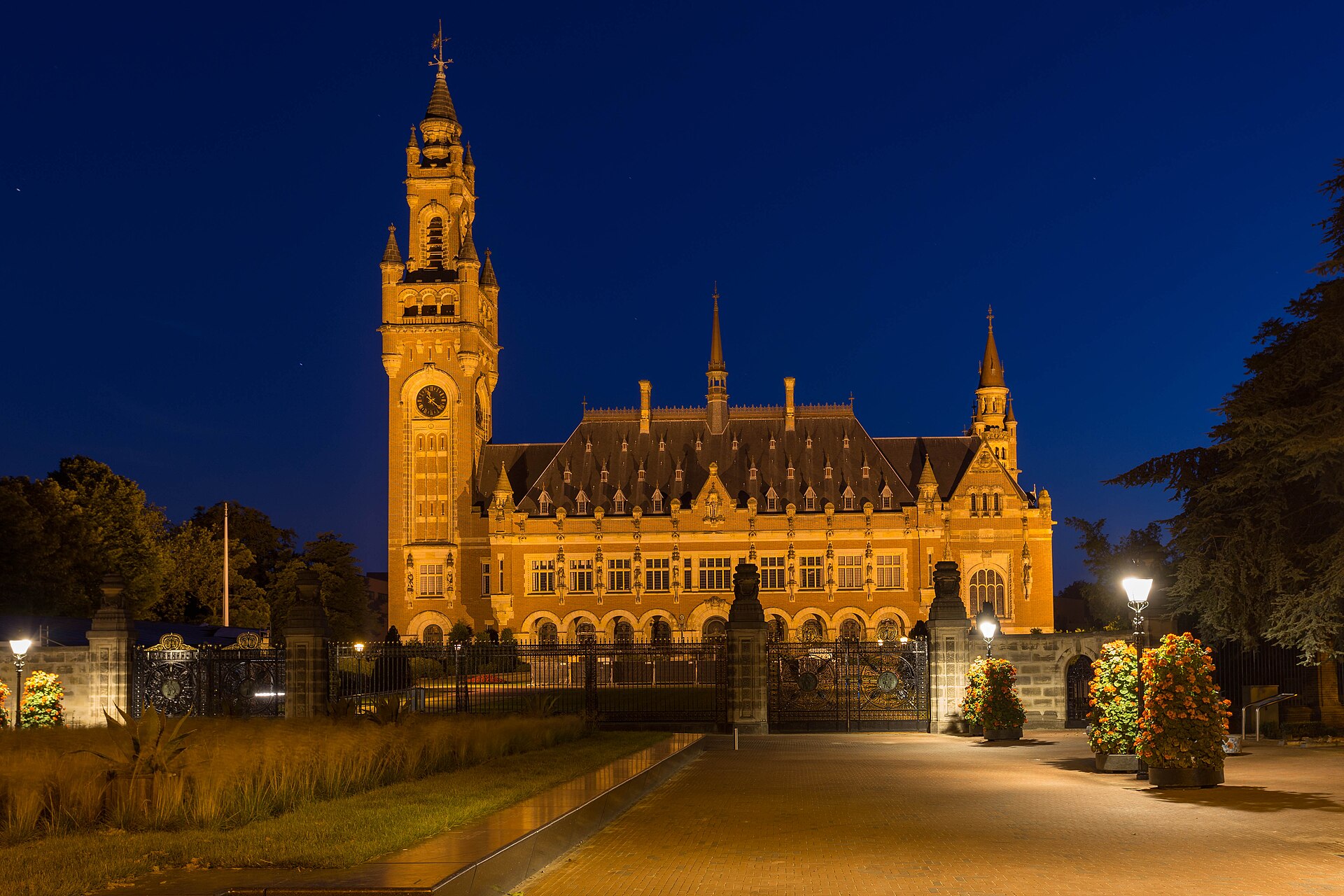

THE HAGUE — Twenty-eight days into the most consequential military confrontation since the 2003 invasion of Iraq, neither the United States nor Iran has formally declared war. No state has invoked the procedures of the United Nations Security Council to authorise force. No international tribunal has been asked to rule on the legality of the first strike. The result is a conflict that has killed hundreds, displaced millions, and shut down the world’s most important oil chokepoint — all while operating in a legal vacuum that every belligerent exploits and none is willing to close. The question that will define not just this war but the next fifty years of international order is deceptively simple: who broke the law first?
The answer matters far beyond the battlefields of Isfahan and the skies above Riyadh. It determines whether Saudi Arabia — a kingdom that did not fire the first shot, did not order the first strike, and did not choose this war — can claim reparations from Tehran or will instead face claims from Tehran’s lawyers at The Hague. It shapes whether Iran’s de facto seizure of the Strait of Hormuz can be challenged in any court, or whether twenty-eight days of uncontested control have already established a new legal reality. And it decides whether the April 6 deadline that President Donald Trump has set for Iran’s power grid carries the force of a lawful ultimatum or the weight of a war crime.
Table of Contents
- Did the United States and Israel Have Legal Authority to Strike First?
- What Does Article 51 Actually Permit?
- Iran’s Retaliation and the Limits of Self-Defence
- The Strait of Hormuz and the UNCLOS Impasse
- Can Iran Legally Close the Strait of Hormuz?
- The Toll Booth That Rewrites Maritime Law
- Saudi Arabia Between Neutrality and Belligerency
- Is Targeting Civilian Power Infrastructure a War Crime?
- Where Does the International Criminal Court Stand?
- The Conflict Legitimacy Scorecard
- The Contrarian Case for Iran’s Legal Position
- What the Legal War Means for the April 6 Deadline
- Frequently Asked Questions
Did the United States and Israel Have Legal Authority to Strike First?
The February 28 strikes that killed Supreme Leader Ali Khamenei, senior Islamic Revolutionary Guard Corps commanders, and an estimated 200 civilians in Tehran and Isfahan were, by any measure, the most consequential military action of the twenty-first century. They were also, according to a growing consensus among international law scholars, illegal.
The legal case against the strikes rests on the foundational prohibition in the United Nations Charter. Article 2(4) forbids states from using or threatening force against the territorial integrity or political independence of any state. The only exceptions are authorisation by the Security Council under Chapter VII, or self-defence under Article 51 in response to an armed attack. Neither condition was met on February 28.
No Security Council resolution authorised the strikes. The United States did not seek one. The legal justification offered by the White House rested instead on Article 51 self-defence, citing what National Security Adviser Mike Waltz described as an “imminent and gathering threat” from Iran’s nuclear programme and its network of proxy forces across the Middle East. The administration pointed to Iran’s October 2024 missile barrage against Israel, its acceleration of uranium enrichment to near-weapons-grade levels, and intelligence — never publicly disclosed — that Tehran was preparing a coordinated attack on US bases and Israeli territory.
International law scholars have largely rejected this reasoning. Professor Marko Milanovic of the University of Reading, writing in the European Journal of International Law, called the strikes “clearly illegal, in that they are a breach of the UN Charter, which prohibits unilateral resort to force between states.” The Lieber Institute at West Point — hardly a pacifist institution — noted that “there was no Iranian armed attack on US or Israeli territory immediately before the strikes of February 28, and without such an attack, states must rely on anticipatory self-defense, which some states view as lawful only when an attack is imminent.”
The distinction between preemptive and preventive war is not academic. Preemptive self-defence — striking when an attack is imminent and unavoidable — has grudging acceptance in customary international law, dating to the Caroline doctrine of 1837, which required that the “necessity of self-defence” be “instant, overwhelming, and leaving no choice of means, and no moment for deliberation.” Preventive war — striking to prevent a future threat that has not yet materialised — has no legal basis. The International Court of Justice affirmed in its 2005 Armed Activities ruling that even genuine security threats do not justify the use of force absent an imminent attack.
The February 28 strikes fall closer to preventive war than preemptive self-defence. Iran had not attacked the United States or Israel in the days preceding the strikes. The nuclear programme, while alarming, had not produced a weapon. The intelligence about coordinated attacks, even if accurate, described a capability rather than an imminent operation. Thomas Franck, the late Columbia University professor whose work on self-defence remains canonical, wrote decades before this conflict that “the negotiators [of the UN Charter] deliberately closed the door on any claim of anticipatory self-defense.” The door that Franck described as closed was not merely opened on February 28 — it was blown off its hinges.
What Does Article 51 Actually Permit?
Article 51 of the UN Charter is forty-two words long and has generated more legal scholarship than any other provision in international law. It states: “Nothing in the present Charter shall impair the inherent right of collective or individual self-defence if an armed attack occurs against a member of the United Nations, until the Security Council has taken the measures necessary to maintain international peace and security.” The critical phrase is “if an armed attack occurs” — present tense, conditional, requiring an actual attack as a triggering condition.
On 26 March, six Arab nations invoked Article 51 in a joint declaration claiming self-defense rights against Iran, the first collective legal assertion of that right in the current conflict.
Three schools of interpretation have competed since the Charter’s adoption in 1945. The restrictive school, dominant in the Global South and reaffirmed at the 2024 Non-Aligned Movement summit, holds that self-defence is permissible only after an armed attack has begun. The expansive school, favoured by the United States, Britain, and Israel, argues that the Charter preserves a pre-existing customary right of anticipatory self-defence when an attack is imminent. The most aggressive interpretation, advanced by the Bush administration in 2002 and now implicitly adopted by the Trump administration, extends the right to preventive action against gathering threats that may never materialise.
Even under the most permissive reading, two conditions must be satisfied for force to be lawful. Necessity requires that peaceful alternatives have been exhausted or are plainly unavailable. Proportionality requires that the force used is limited to repelling or preventing the threat. The February 28 strikes raise serious questions on both counts.
On necessity: diplomatic channels with Iran remained open through intermediaries, including Oman and Qatar. The Joint Comprehensive Plan of Action, while moribund, had not been formally abandoned by all parties. The International Atomic Energy Agency retained inspectors in Iran. The argument that force was the only option requires ignoring options that remained on the table.
On proportionality: the assassination of a head of state, the destruction of military and civilian infrastructure across multiple cities, and the killing of approximately 200 civilians in the first night of strikes exceeds any reasonable definition of proportionate response to a threat that had not yet manifested as an armed attack. The ICJ’s 1996 advisory opinion on nuclear weapons established that even in self-defence, the principles of distinction, proportionality, and necessity apply. The February 28 strikes tested every boundary of those principles.
Iran’s Retaliation and the Limits of Self-Defence
If the legal case against the initial strikes is strong, Iran’s response has weakened whatever moral and legal high ground Tehran initially occupied. Beginning on March 1, Iran launched hundreds of ballistic missiles and drones at targets across six countries — Israel, Saudi Arabia, the United Arab Emirates, Bahrain, Kuwait, and Qatar. The strikes killed at least 30 people across the Gulf states, including migrant workers, hotel guests, and residents of apartment buildings who had no connection to any military target.
Iran’s legal justification for these attacks rests on Article 51 self-defence — the same provision it argues the United States and Israel violated. Tehran’s position is straightforward: Iran was the victim of an armed attack, and it has the inherent right to respond in self-defence. On this narrow point, Iran’s legal case is considerably stronger than Washington’s. The February 28 strikes were unquestionably an “armed attack” within the meaning of Article 51, giving Iran a right of response that even the most restrictive interpreters of the Charter would acknowledge.
The problem is that Iran’s response has violated the same proportionality and distinction requirements that bind all parties under international humanitarian law, regardless of whether their cause is legally justified. The Geneva Conventions and their Additional Protocols require combatants to distinguish between military objectives and civilian objects, to refrain from attacks expected to cause disproportionate civilian harm, and to take all feasible precautions to minimise civilian casualties.
Iran’s missile and drone attacks on Gulf hotels, airports, residential neighbourhoods, and desalination facilities fail every one of these tests. The strikes on Kuwait’s Mina Al-Ahmadi oil facility, which killed two civilians, targeted infrastructure essential to the survival of the civilian population. The attacks on Saudi Arabia’s Eastern Province, which struck residential areas in Dammam and Dhahran, made no apparent effort to distinguish between military and civilian targets. Amnesty International documented at least eleven civilian deaths from Iranian strikes on Gulf hotels, airports, and homes in a single twenty-four-hour period on March 18, according to its March 20 field report.
Tehran’s argument that these Gulf states are legitimate targets because they host US military bases introduces a legal theory that, if accepted, would transform the entire law of armed conflict. The proposition that hosting a foreign military base makes an otherwise neutral state a legitimate target would expose Japan, South Korea, Germany, Italy, and dozens of other countries to lawful attack in any future conflict involving the United States. No state — including Iran’s allies — has endorsed this theory in principle, even as Iran applies it in practice.
The Strait of Hormuz and the UNCLOS Impasse
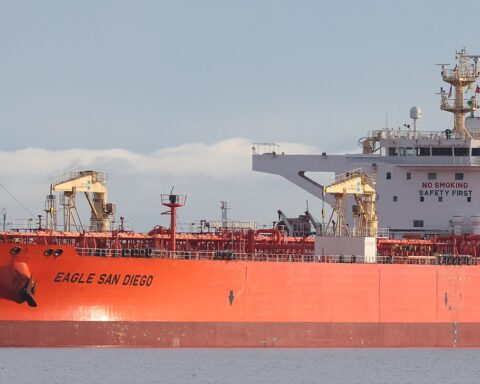
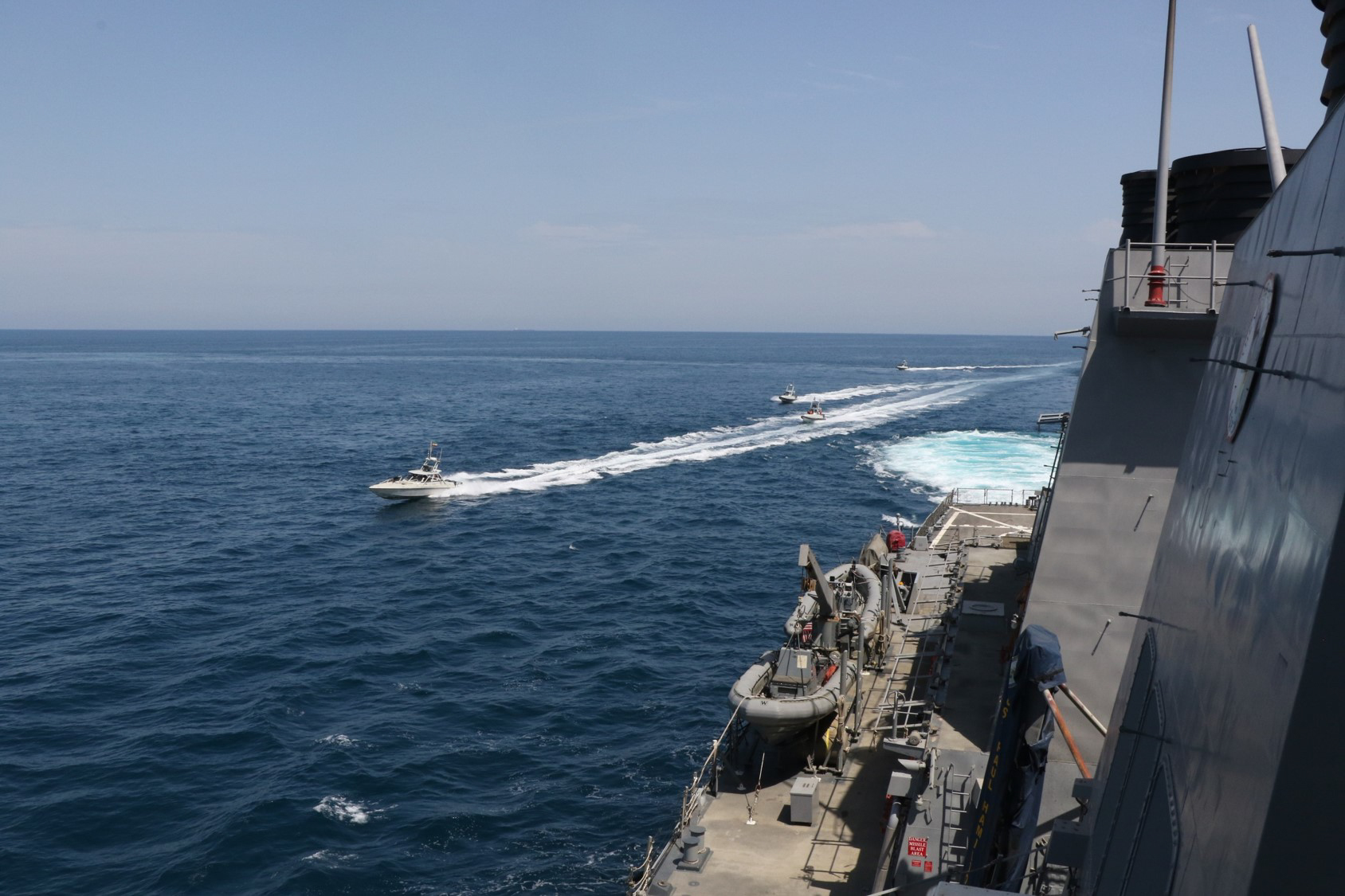
The legal battle over the Strait of Hormuz may prove more consequential than any argument about the first strike. Twenty percent of the world’s oil and liquefied natural gas passes through the 33-kilometre-wide waterway between Iran and Oman. Since March 1, 2026, Iran’s Islamic Revolutionary Guard Corps has imposed what amounts to a naval blockade, stopping, inspecting, and in some cases seizing commercial vessels. At least five tankers have been damaged, two crew members have been killed, and approximately 150 ships remain stranded, according to Lloyd’s List Intelligence data from March 25.
The legal framework governing the Strait of Hormuz is the United Nations Convention on the Law of the Sea, specifically Part III, Articles 37 through 44, which establish the regime of “transit passage” for straits used for international navigation. Article 38 provides that all ships and aircraft enjoy the right of transit passage, which “shall not be impeded.” Article 44 explicitly prohibits coastal states from suspending transit passage for any purpose.
The application of these provisions to the current crisis is complicated by an extraordinary legal fact: neither the United States nor Iran has ratified UNCLOS. The United States signed the convention in 1994 but the Senate has never ratified it. Iran signed in 1982 and attached a declaration stating that the transit passage regime was a contractual benefit for parties to the convention, not a codification of pre-existing customary international law. Iran’s position, maintained consistently for more than four decades, is that only states that have ratified UNCLOS are entitled to transit passage rights.
This creates what Lawfare’s James Kraska has called “an extraordinary legal paradox.” The United States asserts that transit passage is customary international law binding on all states, including non-parties like Iran, while itself refusing to ratify the convention that codified those rights. Iran asserts that transit passage is purely conventional law, binding only on parties, while itself refusing to ratify the convention that established the obligations of coastal states. Both positions are internally coherent. Neither is obviously correct. And the resulting legal ambiguity — which scholars at the Rasanah International Institute for Iranian Studies, the American Society of International Law, and the European Journal of International Law have all identified as a structural vulnerability — is now being exploited in real time.
Can Iran Legally Close the Strait of Hormuz?
Iran cannot legally close the Strait of Hormuz under any plausible interpretation of international law. The right of transit passage through international straits is recognised as customary law by an overwhelming majority of states, regardless of Iran’s persistent objection. The International Court of Justice affirmed the customary nature of freedom of navigation in its 1949 Corfu Channel case, holding that Albania could not obstruct passage through the strait between Corfu and the Albanian mainland, even during a period of tension. The principle has been reaffirmed in subsequent ICJ decisions and is recognised by every major maritime power.
Iran’s claim to be a “persistent objector” to the customary law of transit passage — a doctrine that allows states to exempt themselves from emerging customary rules by consistently objecting during their formation — faces serious legal obstacles. The persistent objector doctrine is itself contested, with scholars like Charney and Stein arguing that it has no foundation in state practice. Even those who accept the doctrine note that it requires consistent, public objection from the earliest stages of a norm’s development. Iran’s objection dates to its 1982 declaration upon signing UNCLOS, but the right of transit passage has roots in customary law stretching back centuries before UNCLOS, as the ICJ recognised in Corfu Channel.
The practical consequence is that Iran’s blockade of the Strait of Hormuz is almost certainly illegal under international law, regardless of whether one analyses it through the lens of UNCLOS, customary law, or the law of armed conflict. Even during wartime, belligerents may not close international straits. The Montreux Convention of 1936, governing the Turkish Straits, and the Treaty of Constantinople of 1888, governing the Suez Canal, both establish that international waterways must remain open even in times of conflict. No comparable treaty governs Hormuz specifically, but the principle is well-established.
None of this changes the fact that Iran has closed the strait in practice. The gap between what international law prohibits and what states actually do is the defining feature of this conflict. Iran’s blockade is illegal, but no court has jurisdiction to order its lifting, no navy has attempted to break it by force, and the 150 ships stranded in the waterway are governed not by UNCLOS but by the IRGC’s rules of engagement.
The Toll Booth That Rewrites Maritime Law
On March 26, Al Jazeera reported that Iran has established what amounts to a toll booth system for the Strait of Hormuz. Ships seeking passage must submit to IRGC inspection, identify their cargo and destination, and receive clearance from Iranian naval authorities. Vessels flagged to countries participating in military operations against Iran — including the United States, Israel, and Britain — are denied passage outright. Vessels from neutral states, including China, India, and Japan, are permitted to transit after inspection, provided they pay what Iranian officials describe as a “transit security fee.”
Iran’s Foreign Minister Abbas Araghchi formalised this arrangement in a letter to the International Maritime Organization, stating that “non-hostile vessels” would be permitted passage. The formulation is legally significant. By conditioning transit on “non-hostility” as defined by Tehran, Iran is asserting a sovereign right to determine who may use an international waterway — a right that no coastal state possesses under any interpretation of maritime law. UNCLOS Article 44 explicitly states that coastal states shall not hamper transit passage and shall give appropriate publicity to any danger to navigation. It does not grant coastal states the right to designate which ships are “hostile” and exclude them.
The toll booth has deeper implications. If Iran can condition passage through Hormuz on political alignment, every coastal state bordering an international strait has a precedent for doing the same. Turkey could charge transit fees through the Bosphorus. Indonesia could designate “hostile” vessels in the Strait of Malacca. Egypt could selectively close the Suez Canal based on a ship’s flag state. The entire edifice of freedom of navigation — the legal principle that has underpinned global trade since the seventeenth century — rests on the premise that international waterways cannot be weaponised by coastal states. Iran’s toll booth challenges that premise, and twenty-eight days of international acquiescence is beginning to establish the very precedent that maritime lawyers have warned about for decades.
Iran’s five conditions for ending the war include “recognition of Iran’s sovereignty over the Strait of Hormuz,” according to CNBC’s reporting of Tehran’s March 25 counter-proposal to the American 15-point peace plan. If this condition is accepted, even partially, the legal framework governing international navigation through the world’s most important oil chokepoint will be fundamentally and permanently altered.
Saudi Arabia Between Neutrality and Belligerency
Saudi Arabia’s legal position in this conflict is among the most precarious of any party. The Kingdom did not initiate hostilities, did not participate in the February 28 strikes, and has not formally declared war on Iran. Under the traditional law of neutrality, codified in the 1907 Hague Conventions, Saudi Arabia should enjoy the protections of a neutral state: its territory should be inviolable, its commercial shipping should be free from interference, and belligerents should refrain from conducting military operations on or over its soil.
Those protections have been shattered. Iran has launched hundreds of missiles and drones at Saudi territory, killing at least two people, damaging critical infrastructure in the Eastern Province, and forcing the Kingdom to expend billions of dollars in air defence interceptors. Saudi Arabia has responded by expelling Iran’s military attache and four embassy staff on March 21, a step that stopped short of severing diplomatic relations but signalled a decisive shift from neutrality toward confrontation.
The critical legal question is whether Saudi Arabia’s decision to grant the United States access to King Fahd Air Base — confirmed by the Wall Street Journal on March 24 — transforms the Kingdom from a neutral state into a co-belligerent. Under the Hague Conventions, a neutral state must not allow its territory to be used by a belligerent for military operations. The United Nations General Assembly Resolution 3314 of 1974, which defines aggression, includes in Article 3(f) “the action of a State in allowing its territory, which it has placed at the disposal of another State, to be used by that other State for perpetrating an act of aggression against a third State.”
If US forces at King Fahd Air Base conduct strikes against Iranian targets, Iran can argue that Saudi Arabia has forfeited its neutral status and become a co-belligerent, making Saudi military installations legitimate targets under international humanitarian law. This is precisely the argument that Iran’s UN representative advanced in a March 15 letter to the Security Council, warning that states hosting bases used for strikes against Iran “bear responsibility for the consequences.”
| Scenario | Legal Status | Protections | Iran’s Legal Right to Strike |
|---|---|---|---|
| No base access, no participation | Neutral | Full neutral protections | None — attacking neutral state is aggression |
| Base access for logistics only | Grey zone | Disputed | Weak — logistical support may not cross threshold |
| Base access for combat operations | Co-belligerent | Forfeited | Military installations become lawful targets |
| Active participation in strikes | Belligerent | None | Full range of military targets permissible |
Crown Prince Mohammed bin Salman faces an impossible legal calculation. Remaining neutral preserves Saudi Arabia’s claim to reparations and limits Iran’s legal justification for further strikes. Joining the war eliminates ambiguity and allows Saudi forces to strike back, but forfeits the legal protections that have constrained — however imperfectly — Iran’s targeting of the Kingdom. The Wall Street Journal reported that MBS is “close to a decision” on formal participation. Whatever he decides, the legal consequences will outlast the war itself.
Is Targeting Civilian Power Infrastructure a War Crime?
President Trump’s threat to destroy Iran’s power grid — first issued on March 22, paused for five days on March 23, then extended to April 6 on March 26 — is one of the most legally significant threats in the history of modern armed conflict. The question is not whether the threat is politically significant. The question is whether carrying it out would constitute a war crime.
The legal framework is well-established. Article 54 of Additional Protocol I to the Geneva Conventions prohibits attacks on “objects indispensable to the survival of the civilian population,” including drinking water installations and supplies, and agricultural areas. Article 56 provides special protection for “works and installations containing dangerous forces,” including dams, dykes, and nuclear electrical generating stations. The International Committee of the Red Cross has extended this principle to cover electricity infrastructure that serves the civilian population, noting that “sweeping or anticipatory classification of the entire electricity grid of a country as a military objective is prohibited.”
Amnesty International’s March 23 statement was unequivocal: Trump’s threat to destroy Iran’s power plants constitutes “a threat to commit war crimes.” The organisation noted that under Article 52 of Additional Protocol I, attacks may only be directed at military objectives — objects which by their nature, location, purpose, or use make an effective contribution to military action, and whose partial or total destruction offers a definite military advantage. A power grid that supplies hospitals, water treatment facilities, and 85 million civilians cannot meet this definition without the kind of sweeping military-objective classification that IHL explicitly forbids.
The precedent of Russia’s systematic attacks on Ukraine’s civilian energy infrastructure is directly relevant. The ICC issued arrest warrants for Russian officials involved in the destruction of Ukrainian power plants, and the UK government’s joint statement to the OSCE Ministerial Council in 2025 explicitly condemned the attacks as violations of IHL. If destroying Ukraine’s power grid is a war crime when Russia does it, destroying Iran’s power grid is a war crime when the United States does it. The legal standards do not change based on who is pulling the trigger.
Iran’s attacks on Gulf civilian infrastructure face the same legal scrutiny. The strikes on Saudi desalination plants, residential areas, and commercial airports violate the same provisions of IHL. Iran has targeted objects indispensable to the survival of the civilian population in at least four Gulf states, killing civilians and disrupting essential services. Tehran’s argument that Gulf states hosting US bases are legitimate targets does not extend to civilian water treatment facilities and apartment buildings.
The uncomfortable truth is that both sides of this conflict have committed or threatened acts that meet the legal definition of war crimes under the Geneva Conventions. The asymmetry lies not in the law but in the likelihood of accountability.
Where Does the International Criminal Court Stand?
The International Criminal Court was established precisely for conflicts like this one — situations where national courts are unable or unwilling to prosecute war crimes. Twenty-eight days into the Iran war, the ICC has issued no warrants, opened no investigations, and made no public statements about the conflict. The silence is not accidental. It reflects a jurisdictional architecture that was designed to catch small-state atrocities while letting great powers pass through the gaps.
The Rome Statute, which established the ICC, grants the court jurisdiction over war crimes, crimes against humanity, genocide, and the crime of aggression. Jurisdiction attaches in three ways: when the crime occurs on the territory of a state party, when the accused is a national of a state party, or when the Security Council refers a situation to the court. None of these pathways currently reaches the Iran war’s principal actors.
The United States, Israel, and Iran are not parties to the Rome Statute. Their nationals cannot be prosecuted by the ICC unless the Security Council refers the situation — and the United States would veto any such referral. The crime of aggression, added to the ICC’s jurisdiction in 2017, applies only when both the aggressor state and the victim state are parties to the Rome Statute, a condition that no combination of states in this conflict satisfies.
| Pathway | Requirements | Applicability | Likelihood |
|---|---|---|---|
| Territorial jurisdiction | Crime on ICC party territory | Jordan (party) has been struck | Low — limited scope |
| Nationality jurisdiction | Accused is national of party | No principal actors are ICC parties | None |
| Security Council referral | Chapter VII referral | US veto blocks any referral | None |
| Iran ad hoc declaration | Iran accepts ICC jurisdiction (Art. 12(3)) | Iran could file, as Palestine did in 2014 | Medium — strategic value |
| Universal jurisdiction | National courts of third states | European courts could act | Low — political barriers |
There is one pathway that has received insufficient attention. Article 12(3) of the Rome Statute allows any state — even a non-party — to accept ICC jurisdiction over crimes committed on its territory by filing a declaration with the court’s registrar. Palestine used this mechanism in 2014. Ukraine used it twice before ratifying the Rome Statute in 2024. Iran could file an identical declaration, granting the ICC jurisdiction over strikes on Iranian soil, thereby enabling the court to investigate and prosecute those responsible for the February 28 attacks and subsequent bombardment. The strategic value of such a move would be immense: it would shift the legal battlefield from the Security Council, where the United States holds a veto, to a court where it does not.
Tehran has not yet taken this step, and may never do so — the IRGC’s own conduct would also fall under scrutiny. But the option remains available, and its mere existence shapes the negotiating dynamics around the April 6 deadline. Every civilian casualty in Iran strengthens the legal case for an ICC declaration. Every hospital destroyed, every power plant hit, every apartment building reduced to rubble adds to a dossier that Iran can submit to The Hague whenever the political calculation favours doing so.
The Conflict Legitimacy Scorecard
The legal positions of each major party to the Iran war can be assessed across six dimensions of international law. The following scorecard evaluates each party’s adherence to the foundational principles of jus ad bellum (the right to resort to war) and jus in bello (the conduct of war), drawing on the analysis of legal scholars at the Lieber Institute, the European Journal of International Law, Amnesty International, and the International Committee of the Red Cross.
| Legal Dimension | United States | Israel | Iran | Saudi Arabia |
|---|---|---|---|---|
| Jus ad bellum (right to use force) | Weak | Weak | Strong | N/A (non-belligerent) |
| Proportionality of response | Disputed | Disputed | Weak | Moderate |
| Distinction (military vs civilian targets) | Moderate | Moderate | Weak | Strong |
| Maritime law compliance | Strong | Strong | Weak | Moderate |
| Diplomatic law compliance | Strong | Moderate | Moderate | Strong |
| ICC accountability exposure | Low | Medium | Medium | Low |
The scorecard reveals a pattern that defies the simple narratives offered by any party. The United States and Israel hold the weakest legal position on the question of the first strike — the most fundamental question in the law of armed conflict. Iran holds the strongest jus ad bellum case as the victim of an armed attack but has systematically undermined its position through indiscriminate retaliatory strikes against civilian targets in six countries and an illegal blockade of the Strait of Hormuz. Saudi Arabia occupies the most defensible legal position as a non-belligerent victim of unprovoked attacks, but risks forfeiting that position with every step toward formal participation in the conflict.
The scorecard should be read not as a definitive legal judgement but as a framework for understanding why the peace negotiations are so difficult. Each party has legal vulnerabilities that the others can exploit. Each party’s strongest legal argument is undermined by its weakest. The result is a conflict where every side has enough legal ammunition to prevent accountability for any side — a stalemate in the courtroom that mirrors the stalemate on the battlefield.
The Contrarian Case for Iran’s Legal Position
Western commentary on the Iran war has largely treated the conflict as a contest between American and Israeli security interests on one side and Iranian aggression on the other. The legal reality is more uncomfortable. Iran’s legal position on the central question — who had the right to use force first? — is stronger than the coalition’s, and the international legal community knows it.
The Non-Aligned Movement, representing 120 states and more than half the world’s population, issued a statement on March 5 condemning the February 28 strikes as “a violation of the sovereignty and territorial integrity of the Islamic Republic of Iran” and calling for “the immediate cessation of all military operations.” The statement explicitly rejected the doctrine of preventive self-defence and reaffirmed the primacy of the UN Charter’s prohibition on the use of force. China and Russia echoed these positions at the Security Council.
The legal scholars who have assessed the conflict have been remarkably uniform in their conclusions. The European Journal of International Law published three separate analyses in its first two weeks, all concluding that the initial strikes lacked legal justification. The Lieber Institute at West Point — the US military’s own centre for the law of armed conflict — acknowledged that the strikes raised “serious questions” about necessity and proportionality. SBS News in Australia reported that six out of seven international law experts it consulted concluded the strikes were illegal.
This does not make Iran a sympathetic actor. Tehran’s indiscriminate attacks on Gulf civilians, its blockade of the Strait of Hormuz, and its refusal to distinguish between military and civilian targets have squandered whatever legal advantage the first strike conferred. But the fundamental legal question — who violated the UN Charter first? — has only one credible answer, and it is not Iran.
The implications for Saudi Arabia are profound. If the February 28 strikes are ultimately judged to be illegal — a determination that could come from the ICJ, a future UN commission of inquiry, or the verdict of legal history — then the entire chain of events that followed, including Iran’s attacks on the Kingdom, flows from an unlawful act committed by Saudi Arabia’s allies. The Kingdom did not choose this war. Its people are paying for it. And the legal framework that should have prevented it was ignored by the very powers that designed it.
The legal case for the February 28 strikes is not merely weak. It is the weakest case for the use of force by a major power since the 2003 invasion of Iraq — and that precedent should give every state in the Middle East pause about the durability of the rules-based order.
Professor Marko Milanovic, European Journal of International Law, March 2026
What the Legal War Means for the April 6 Deadline
President Trump’s April 6 deadline — the date by which Iran must begin reopening the Strait of Hormuz or face the destruction of its power grid — sits at the intersection of every legal question this conflict has raised. The deadline itself is a threat to use force against civilian infrastructure, which Amnesty International has already characterised as a “threat to commit war crimes.” Carrying it out would generate the strongest possible case for an Iranian ICC declaration under Article 12(3), potentially exposing American and Israeli military and political leaders to international prosecution for decades to come.
For Saudi Arabia, the April 6 deadline presents a legal paradox. If the United States destroys Iran’s power grid and Iran retaliates with an escalated campaign against Gulf infrastructure — as Tehran has promised — the Kingdom faces devastating attacks that its air defence systems may struggle to absorb. But if the Kingdom joins the strikes, it forfeits its legal status as a non-belligerent and loses the strongest card it holds in any future reparations claim.
The 15-point American peace proposal, delivered to Tehran through Pakistani intermediaries, includes several provisions with significant legal implications: a one-month ceasefire, a rollback of Iran’s nuclear programme, limits on ballistic missiles, sanctions relief, and the reopening of the Strait of Hormuz. Iran’s five counter-demands — an end to all military operations, guarantees against future attack, payment of war damages, a comprehensive ceasefire across all fronts, and recognition of sovereignty over the Strait of Hormuz — are equally legal in character.
The gap between the two positions is not merely political. It is legal. The United States demands that Iran accept responsibility for the Hormuz blockade and nuclear programme without acknowledging the illegality of the first strike. Iran demands recognition of sovereignty over an international waterway and reparations for an attack it credibly argues was illegal. Neither side can accept the other’s terms without conceding a legal argument that shapes not just this war but the precedent for every conflict that follows.
Pakistan, which has confirmed that it is facilitating indirect talks between Washington and Tehran, has proposed hosting face-to-face negotiations. The Saudi royal family is not at the negotiating table but shapes every calculation at it. Riyadh’s decision on whether to join the war formally, whether to press the United States for legal accountability, and whether to support or oppose Iran’s ICC option will determine not just the outcome of this conflict but the architecture of the post-war legal order in the Middle East.
The legal war will outlast every missile. Long after the April 6 deadline passes, long after Hormuz reopens or remains closed, long after the last drone is intercepted over Riyadh, the questions raised in these twenty-eight days will be argued in courtrooms, at the United Nations, and in the pages of international law journals. Who had the right to strike first? Can a coastal state weaponise an international strait? At what point does hosting a military base make you a party to a war? When does civilian infrastructure become a legitimate target?
The answers to these questions will define the rules of war for a generation. And the fact that they remain unanswered twenty-eight days into the most destructive conflict of the century is itself the most damning indictment of the international legal order that was supposed to prevent it.
Frequently Asked Questions
Was the US-Israeli first strike on Iran on February 28 legal under international law?
The February 28 strikes are widely regarded by international law scholars as illegal under the United Nations Charter. Article 51 permits self-defence only in response to an armed attack, and no Iranian armed attack had occurred or was demonstrably imminent. The strikes more closely resemble preventive war — striking a future threat — which has no legal basis under the Charter, customary international law, or any ICJ ruling. Even under the most expansive interpretation of anticipatory self-defence, the requirements of necessity and proportionality were not satisfied.
Does Iran have the legal right to close the Strait of Hormuz?
Iran does not have the legal right to close the Strait of Hormuz. Transit passage through international straits is protected under UNCLOS Articles 38 through 44, which state that passage “shall not be impeded” and cannot be suspended. Although Iran has not ratified UNCLOS, the overwhelming majority of states and international law scholars regard transit passage as customary international law binding on all states. The International Court of Justice affirmed the customary nature of freedom of navigation through international straits in its 1949 Corfu Channel ruling.
Is Saudi Arabia considered a party to the Iran war under international law?
Saudi Arabia’s legal status is ambiguous and evolving. The Kingdom has not declared war, has not conducted offensive military operations, and has primarily engaged in defensive air defence operations against incoming Iranian missiles and drones. However, the March 24 decision to grant the United States access to King Fahd Air Base for military operations moves Saudi Arabia closer to co-belligerent status under UNGA Resolution 3314. If US forces use the base for strikes against Iran, Saudi Arabia risks forfeiting its neutral protections under the 1907 Hague Conventions.
Could the ICC prosecute leaders for war crimes committed during the Iran war?
Current ICC jurisdiction is limited because the United States, Israel, and Iran are not parties to the Rome Statute. However, Iran could accept ICC jurisdiction by filing a declaration under Article 12(3), as Palestine did in 2014 and Ukraine did in 2024. This would allow the court to investigate crimes committed on Iranian territory, including the February 28 strikes and subsequent bombardment. The Security Council could also refer the situation, but the United States would veto any such referral. European courts could exercise universal jurisdiction over specific war crimes cases.
Would destroying Iran’s power grid constitute a war crime?
The destruction of Iran’s civilian power infrastructure would likely constitute a war crime under Articles 52 and 54 of Additional Protocol I to the Geneva Conventions, which protect civilian objects and objects indispensable to the survival of the civilian population. The ICRC has stated that classifying an entire national electricity grid as a military objective is prohibited under international humanitarian law. Amnesty International has already characterised Trump’s threat to destroy Iran’s power plants as “a threat to commit war crimes.” The precedent of ICC warrants for Russian officials involved in destroying Ukraine’s power grid applies equally.