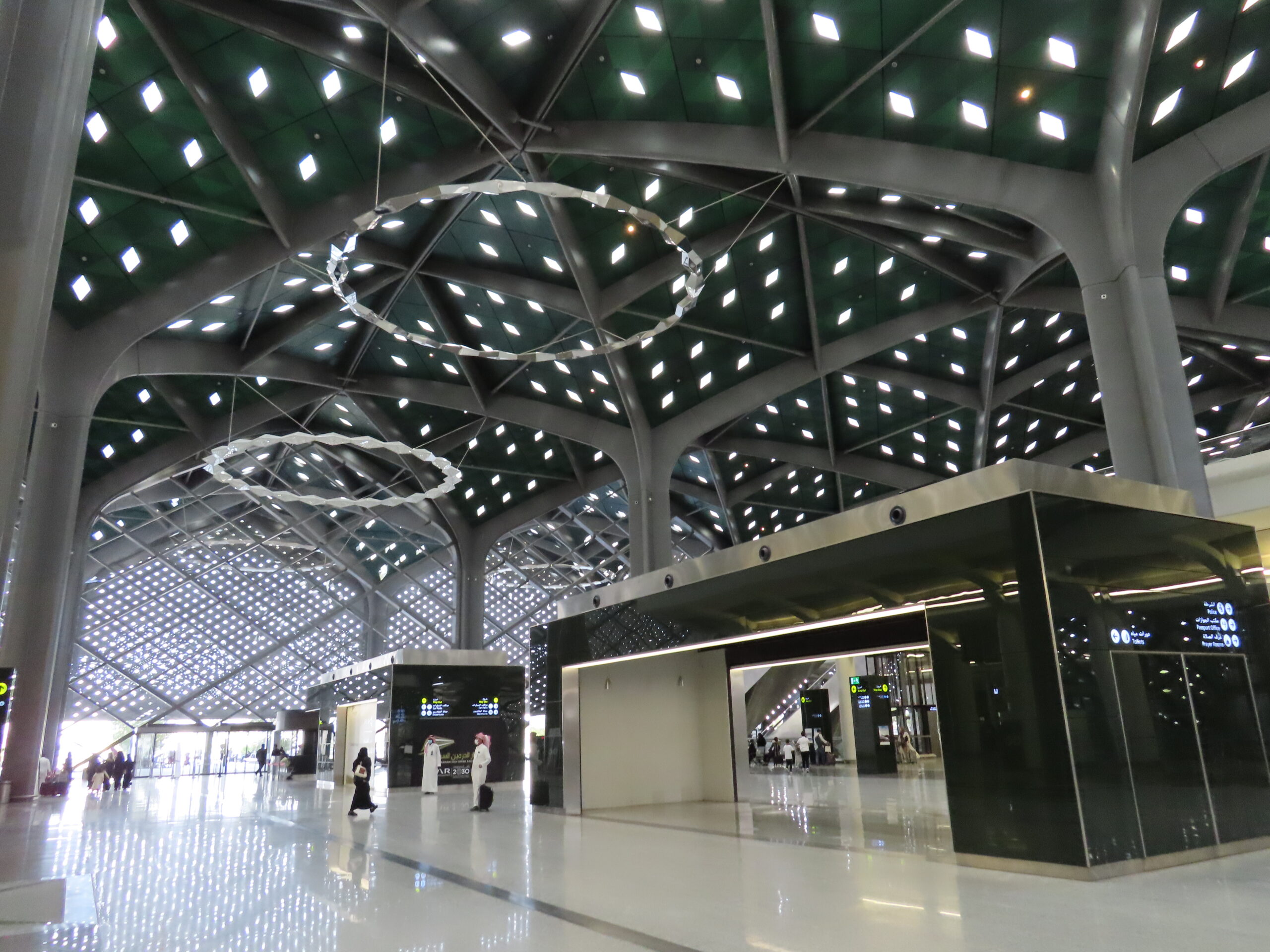

Saudi Arabia is vast — the kingdom covers 2.15 million square kilometres, roughly the size of Western Europe. Distances between major cities are enormous: Riyadh to Jeddah is 950 kilometres, Riyadh to Dammam is 400 kilometres, and Jeddah to Madinah is 420 kilometres. Getting around efficiently requires understanding the full range of transport options, from the brand-new Riyadh Metro to domestic budget airlines and long-distance trains.
This guide covers every major transport mode available to travellers in 2026, with routes, fares, practical tips, and the hard-won knowledge of what actually works on the ground.
Riyadh Metro — The World’s Longest Driverless Metro
The Riyadh Metro opened in phases between December 2024 and January 2025, making it one of the newest metro systems in the world — and, according to Guinness World Records, the longest fully automated driverless metro network on the planet. The system spans 176 kilometres across six colour-coded lines with 85 stations.
The Six Lines
| Line | Colour | Route | Key Stations | Opened |
|---|---|---|---|---|
| Line 1 | Blue | North-South (Olaya Street corridor) | KAFD, Olaya, Al Suwaidi | December 2024 |
| Line 2 | Red | East-West (King Abdullah Road) | King Abdullah Road stations | December 2024 |
| Line 3 | Orange | Central (King Fahd Road — Airport) | Airport, King Fahd Road | January 2025 |
| Line 4 | Yellow | King Khalid Road corridor | Central Riyadh stations | December 2024 |
| Line 5 | Green | King Abdulaziz Road corridor | Diplomatic Quarter | December 2024 |
| Line 6 | Purple | Southern loop | Southern Riyadh | December 2024 |
Fares and Tickets
The metro uses a zone-based fare system with four ticket types:
| Ticket Type | Price (SAR) | Validity |
|---|---|---|
| Single Journey (2 hours) | 4 | Unlimited transfers within 2 hours |
| 3-Day Pass | 20 | Unlimited rides for 3 consecutive days |
| Weekly Pass | 40 | 7 days from first use |
| Monthly Pass | 140 | 30 days from activation |
Children under 6 travel free with an accompanying adult. Tickets can be purchased through the Darb app (the official Riyadh transport platform) or from vending machines at every station.
Operating Hours
The metro runs from 5:30 AM to midnight on Saturday through Thursday. On Fridays, services begin at 10:00 AM to accommodate Friday prayers. During Ramadan, hours are typically extended, with services running until approximately 3:00 AM to accommodate the shifted schedule of daily life.
Practical Tips
- All 85 stations are air-conditioned with free Wi-Fi and platform screen doors.
- The Darb app shows real-time arrivals and allows route planning across the entire network.
- Line 3 (Orange) connects directly to King Khalid International Airport — the journey from the airport to central Riyadh takes approximately 23 minutes, a transformative improvement over the previous taxi-dependent airport transfer.
- The metro has designated family sections on every train — women travelling alone or with children should look for these carriages.
- Peak hours (7-9 AM and 4-7 PM) see the heaviest usage. Off-peak travel is significantly more comfortable.
Haramain High-Speed Railway — Makkah to Madinah
The Haramain High-Speed Railway (HHR) connects Saudi Arabia’s two holiest cities, Makkah and Madinah, via Jeddah and King Abdulaziz International Airport. Operating at speeds up to 300 km/h, it has transformed travel along the western Hejaz corridor.
Stations
| Station | Location | Access Notes |
|---|---|---|
| Makkah | Rusayfah District, near 3rd Ring Road | Close to Masjid al-Haram; accessible to Muslims only |
| Jeddah | Central Jeddah | Well-connected to city centre |
| King Abdulaziz International Airport | KAIA, Jeddah | Direct airport link |
| King Abdullah Economic City (KAEC) | Rabigh, near Hejaz Gate | For KAEC residents and visitors |
| Madinah | Al Hadra District | Approximately 10 minutes from Masjid al-Nabawi |
Fares and Classes
| Route | Economy (SAR) | Business (SAR) | Travel Time |
|---|---|---|---|
| Makkah — Madinah | 145-170 | 240-280 | 2 hours 20 minutes |
| Jeddah — Makkah | 55-70 | 95-120 | 35-45 minutes |
| Jeddah — Madinah | 100-130 | 180-220 | 1 hour 50 minutes |
Economy class seats are arranged 2+2 per row, business class 2+1. All trains are air-conditioned with luggage storage areas and a bistro car. Tickets can be booked via the official HHR portal (hhr.sa), third-party platforms like arabiantrains.com, or at station ticket offices.
Practical Tips
- Book in advance, particularly during Umrah season and around Ramadan. Trains fill up quickly on Thursday evenings and Friday mornings.
- Schedules may vary during Hajj — additional services are typically added, but the entire Hejaz rail network operates under intense pressure during the pilgrimage.
- Non-Muslims should note that the Makkah station is within the haram boundary. If travelling between Jeddah and Madinah, the train passes through without stopping at Makkah for non-Muslim passengers on certain services — check when booking.
- The airport station provides a seamless air-to-rail transfer for passengers arriving at KAIA and heading to Makkah or Madinah.
SAR North Line — Riyadh to the Northern Borders
The Saudi Arabia Railway (SAR) North Line runs from Riyadh northward through Majmaah, Qassim (Buraydah), Hail, Al Jouf (Sakaka), and onward to Qurayyat near the Jordanian border. This is the kingdom’s longest conventional rail route, serving both passengers and freight.
Route and Key Stops
The full route from Riyadh to Qurayyat covers approximately 1,250 kilometres. Key stations include:
- Riyadh — the starting point, with connections to the metro and bus networks
- Majmaah — north of Riyadh
- Qassim (Buraydah) — the agricultural heartland
- Hail — approximately 590 kilometres from Riyadh, gateway to the northern desert
- Sakaka (Al Jouf) — the northern olive-growing region
- Qurayyat — near the Jordanian border
Classes and Fares
SAR operates two classes: Economy and Business. The railway’s official website (sar.com.sa) offers discounts of up to 55 per cent for advance online bookings compared to walk-up station prices. Services typically depart in the afternoon — the earliest northbound departure is around 15:05.
Practical Tips
- Book via sar.com.sa (click “En” top left for English) or at station counters.
- The North Line is a slower, more comfortable alternative to driving for reaching Hail, Al Jouf, and the northern regions.
- No morning departures are available on the northern route — plan accordingly.
- The journey from Riyadh to Hail takes approximately 4-5 hours by rail.
SAR East Line — Riyadh to Dammam
The original Saudi passenger railway, the SAR East Line connects Riyadh to Dammam and the Eastern Province via Hofuf (Al Ahsa). This is one of the most practical routes for business travellers commuting between the capital and the oil-producing eastern region.
The journey from Riyadh to Dammam takes approximately 3.5 to 4 hours. Economy and Business classes are available, with comfortable seating and air conditioning. Book via sar.com.sa.
Domestic Airlines — Saudia, flynas, flyadeal
Given the distances involved, flying is often the most practical way to cover the major inter-city routes. Saudi Arabia’s domestic airline market is competitive, with three carriers offering frequent services between all major cities.
The Three Carriers
| Airline | Type | Fleet | Strengths |
|---|---|---|---|
| Saudia (SV) | Full-service flag carrier | Wide-body and narrow-body fleet | Largest network, lounges, loyalty programme (Alfursan), included baggage |
| flynas (XY) | Low-cost carrier | Airbus A320 family | Budget fares from SAR 195, growing international network |
| flyadeal (F3) | Low-cost carrier (Saudia subsidiary) | Airbus A320neo | Lowest fares from SAR 95, modern fleet, domestic focus |
Key Domestic Routes and Approximate Fares
| Route | Flight Time | Budget Carrier (SAR) | Saudia (SAR) | Frequency |
|---|---|---|---|---|
| Riyadh — Jeddah | 1h 45m | 150-350 | 300-600 | 20+ daily |
| Riyadh — Dammam | 1h 10m | 120-280 | 250-450 | 10+ daily |
| Jeddah — Madinah | 55m | 120-250 | 200-400 | 8+ daily |
| Riyadh — Abha | 1h 30m | 150-300 | 280-500 | 5+ daily |
| Riyadh — Tabuk | 1h 50m | 150-350 | 300-550 | 3+ daily |
| Jeddah — Tabuk/AlUla | 1h 30m | 150-300 | 280-500 | 3+ daily |
Fares are approximate one-way prices and vary by booking time, season, and demand. Budget carrier fares do not typically include checked baggage.
Booking Tips
- Book directly through airline apps or websites for the best prices. Third-party aggregators like Skyscanner are useful for comparison but occasionally show phantom fares.
- flynas and flyadeal often run promotional sales around Saudi National Day (23 September) and other national holidays, with domestic fares as low as SAR 95.
- During Hajj, flights to and from Jeddah are heavily loaded. Book as far in advance as possible.
- Carry-on size limits are strictly enforced on budget carriers — check dimensions before arriving at the airport.
- King Khalid International Airport (Riyadh) is well-served by the new Metro Line 3, making airport transfers significantly easier than in the past.
Intercity Buses — SAPTCO/SAT
The Saudi Public Transport Company (SAPTCO), operating under the SAT Transportation brand, runs intercity bus services connecting over 106 cities and hubs across the kingdom through 31 routes. This is the most budget-friendly way to travel between cities.
Key Routes and Fares
| Route | Fare (SAR) | Approximate Travel Time |
|---|---|---|
| Riyadh — Jeddah | 135 | 9-10 hours |
| Riyadh — Dammam | 86 | 4-5 hours |
| Riyadh — Abha | 167 | 10-11 hours |
| Jeddah — Taif | 109 | 2-3 hours |
| Dammam — Al Ahsa | 26 | 1.5-2 hours |
Classes
SAPTCO offers Economy, Business, and VIP classes on most routes. VIP buses feature wider seats, more legroom, and on-board entertainment. Economy fares start as low as SAR 20 on short routes.
Booking
Book via the SAT Transportation website (satrans.com.sa) or app up to 30 days in advance. Payment methods include Mada (local debit), Visa, Mastercard, STC Pay, and SADAD. For popular routes like Riyadh to Jeddah, booking 2-3 days ahead is recommended.
Practical Tips
- Buses are air-conditioned but carry a light layer — Saudi bus air conditioning tends to be aggressive.
- Major bus stations are modern and well-maintained. Riyadh’s main SAPTCO terminal is in the south of the city.
- Long-distance services typically include a rest stop for food and prayers.
- This is the best option for budget travellers — the Riyadh to Dammam bus at SAR 86 compares to SAR 120-280 for the same route by budget airline.
Car Rental
Renting a car gives you the most flexibility, especially for reaching destinations like the Edge of the World escarpment near Riyadh, the Asir mountain villages, or road-tripping between AlUla and Tabuk. Saudi Arabia’s road network is modern and well-maintained, with multi-lane highways connecting all major cities.
Requirements
- Minimum age: 21 years (some agencies require 25 for premium vehicles)
- Valid driving licence — if your licence is not in English or Arabic, you need an International Driving Permit (IDP)
- Valid passport and visa
- Credit card for the security deposit
- Insurance is typically included in the rental, but verify comprehensive coverage
Major Rental Companies
International brands (Hertz, Sixt, Budget, Avis) operate at all major airports and in city centres. Local operators like Yahma and Theeb often offer competitive rates, particularly for longer rentals.
Driving Tips
- Speed cameras are everywhere. Saudi Arabia uses an extensive network of fixed and mobile speed cameras (called “Saher”). Fines are automatically linked to the vehicle registration and start at SAR 500 for minor speeding. Pay attention to posted limits.
- Drive on the right. Road signage is in Arabic and English.
- Fuel is cheap. Petrol prices in Saudi Arabia are among the lowest in the world — approximately SAR 2.33 per litre for 91-octane as of early 2026. A full tank for a standard sedan costs around SAR 100-120.
- Desert driving requires preparation. If venturing off main highways (e.g., to the Edge of the World or desert camps), carry extra water, ensure your phone has signal, and inform someone of your route. Four-wheel drive is recommended for unpaved roads.
- Riyadh traffic is intense. The capital has some of the region’s worst congestion, particularly on King Fahd Road and the Eastern Ring Road during rush hours. The new metro has eased pressure somewhat, but expect delays.
- Mobile phone use while driving is illegal — fines are steep and strictly enforced.
Ride-Hailing — Uber and Careem
Ride-hailing apps have transformed urban transport in Saudi Arabia. Both Uber and Careem (a Dubai-founded company acquired by Uber in 2020) operate extensively across all major cities.
Which App to Use
| App | Service Tiers | Payment | Best For |
|---|---|---|---|
| Uber | UberX, UberBLACK, UberVAN | Card, cash | International travellers already using Uber |
| Careem | Careem Go, Careem Business, Careem Max | Card, cash, Careem Pay | Wider coverage in Saudi Arabia, local loyalty perks |
Typical Fares
A standard ride within Riyadh or Jeddah typically costs SAR 12-50 depending on distance. Approximate benchmarks:
- Short city trip (5 km): SAR 12-20
- Medium city trip (10 km): SAR 30-50
- Airport to city centre (Riyadh): SAR 50-80 (or free via Metro Line 3)
- Airport to city centre (Jeddah): SAR 80-120
Surge pricing applies during peak hours, major events (Riyadh Season, F1 race weekend), and at airport pick-up during busy arrivals periods. Both apps show the estimated fare before you confirm.
Practical Tips
- Careem tends to have broader driver availability outside major city centres. In smaller cities like Tabuk or Abha, Careem often has more drivers than Uber.
- Tipping is customary — 10 per cent is standard. Both apps allow in-app tipping.
- Women can and do use ride-hailing services alone. Both apps have safety features including trip sharing and emergency contacts.
- During Hajj, ride-hailing in the Jeddah-Makkah corridor becomes extremely expensive and unreliable. Pre-arranged transport is advisable.
Traditional Taxis
Metered taxis still operate in all major Saudi cities, though ride-hailing apps have largely overtaken them for convenience. Traditional taxis are white sedans with a green side stripe and a roof light.
Fares start at approximately SAR 10-15, with a per-kilometre charge of SAR 2-3. In practice, fares are often negotiated rather than metered, particularly for longer trips or airport runs. Using a ride-hailing app generally provides more transparency on pricing.
Airport taxi ranks at KAIA (Jeddah) and KKIA (Riyadh) operate on a queue system with fixed or semi-fixed fares to common destinations.
Getting from the Airport to the City
Riyadh — King Khalid International Airport (KKIA)
- Metro Line 3 (Orange): Direct connection to central Riyadh in approximately 23 minutes. SAR 4 single fare. By far the best option since the metro opened.
- Uber/Careem: SAR 50-80 to central Riyadh, 30-45 minutes depending on traffic.
- Taxi: SAR 60-100, negotiated or metered.
Jeddah — King Abdulaziz International Airport (KAIA)
- Haramain Railway: Direct high-speed rail connection from the airport station to Jeddah city centre, Makkah, and Madinah.
- Uber/Careem: SAR 80-120 to central Jeddah or the Corniche, 30-50 minutes.
- Taxi: SAR 100-150 to central Jeddah.
Dammam — King Fahd International Airport (KFIA)
- Uber/Careem: SAR 60-100, 25-35 minutes to Dammam or Al Khobar.
- Taxi: SAR 80-120.
- Note: KFIA is one of the largest airports in the world by area but is located 30+ kilometres from Dammam city centre. There is no rail connection.
Transport Comparison — Riyadh to Jeddah
To illustrate the trade-offs, here is a comparison of all options for the most-travelled domestic route:
| Mode | Time | Cost (SAR) | Comfort | Best For |
|---|---|---|---|---|
| Flight (budget) | 1h 45m + airport time | 150-350 | Medium | Speed, convenience |
| Flight (Saudia) | 1h 45m + airport time | 300-600 | High | Baggage included, comfort |
| SAPTCO Bus | 9-10 hours | 135 | Medium | Budget travellers |
| Rental Car | 8-9 hours | 200-350/day + fuel (~SAR 80) | High (your schedule) | Flexibility, scenic route |
There is no direct train between Riyadh and Jeddah — a planned high-speed rail link (the “Saudi Landbridge”) has been discussed for years but is not yet under construction.
Practical Advice for Getting Around
Download These Apps Before You Arrive
- Darb — Riyadh metro and public transport
- Uber and/or Careem — ride-hailing
- SAR (sar.com.sa) — railway booking
- Saudia, flynas, or flyadeal — domestic flights
- Google Maps — navigation and directions (Google Maps coverage in Saudi Arabia is excellent and up-to-date)
Payment
International credit and debit cards are accepted across all major transport systems. The local Mada debit card system is ubiquitous. Cash is still accepted for taxis and some bus services, but digital payment is increasingly the default.
Language
Transport signage is bilingual (Arabic and English) throughout the kingdom. Metro announcements are in Arabic and English. Ride-hailing apps function in English. At bus stations and taxi ranks, basic English is usually understood, though Arabic phrases help in smaller cities.
Women Travellers
Women can use all forms of transport independently. The Riyadh Metro has designated family carriages. Women have been legally permitted to drive since June 2018 and can rent cars on the same terms as men. Ride-hailing apps include safety features for women travelling alone.
For more on planning your trip, see the best time to visit guide or return to the Saudi Arabia Travel Guide hub.