
Al Balad is the ancient heart of Jeddah and one of the most atmospheric historic quarters anywhere in the Middle East. Inscribed as a UNESCO World Heritage Site in 2014, this labyrinthine district of coral-stone tower houses, carved wooden balconies, and centuries-old mosques tells the story of a city that served as the gateway to Makkah for over a millennium. Whether you are visiting Jeddah for the first time or returning to explore deeper, Al Balad is an essential stop. For a complete overview of everything the city offers beyond its old quarter, see our Jeddah Travel Guide 2026, which covers the corniche, the food scene, diving, and the Formula 1 circuit.
This guide covers the history and UNESCO status of Al Balad, its most important buildings and mosques, the distinctive Roshan architecture that defines the skyline, detailed walking routes, where to eat and shop, and all the practical information you need to plan a visit in 2026.
Best Time to Visit: November to February (daytime highs of 25-30°C; comfortable for walking)
Getting There: Central Jeddah, 25 km from King Abdulaziz International Airport; reachable by taxi, Uber, or city bus
Visa Required: Yes — tourist e-visa available online
Budget: $30-60 USD per day (entry to the district is free; museums SAR 0-10; meals SAR 15-80)
Must-See: Nassif House Museum, Al-Shafi’i Mosque, Souk Al-Alawi
Avoid: Visiting during midday in summer — temperatures exceed 40°C and most shops close
History of Al Balad: From Trading Port to UNESCO World Heritage Site
The name “Al Balad” translates simply as “the town” in Arabic, reflecting its status as the original settlement from which modern Jeddah grew. The city’s origins date to at least the 7th century AD, when it was established as a major port on Indian Ocean trade routes, channelling goods and pilgrims toward Makkah. Jeddah served twin functions throughout its history: as a commercial hub linking the Red Sea, East Africa, South Asia, and the Mediterranean, and as the primary arrival point for Muslim pilgrims undertaking the Hajj.
These roles attracted merchants from across the Islamic world, and by the 19th century the city’s elite had constructed the distinctive multi-story tower houses that define Al Balad today. Built from coral stone harvested from Red Sea reefs and bound with a lime-based plaster, these buildings rose four to seven stories and featured the ornate Roshan (rawasheen) wooden bay windows that remain Al Balad’s architectural signature.
The City Wall and Gates
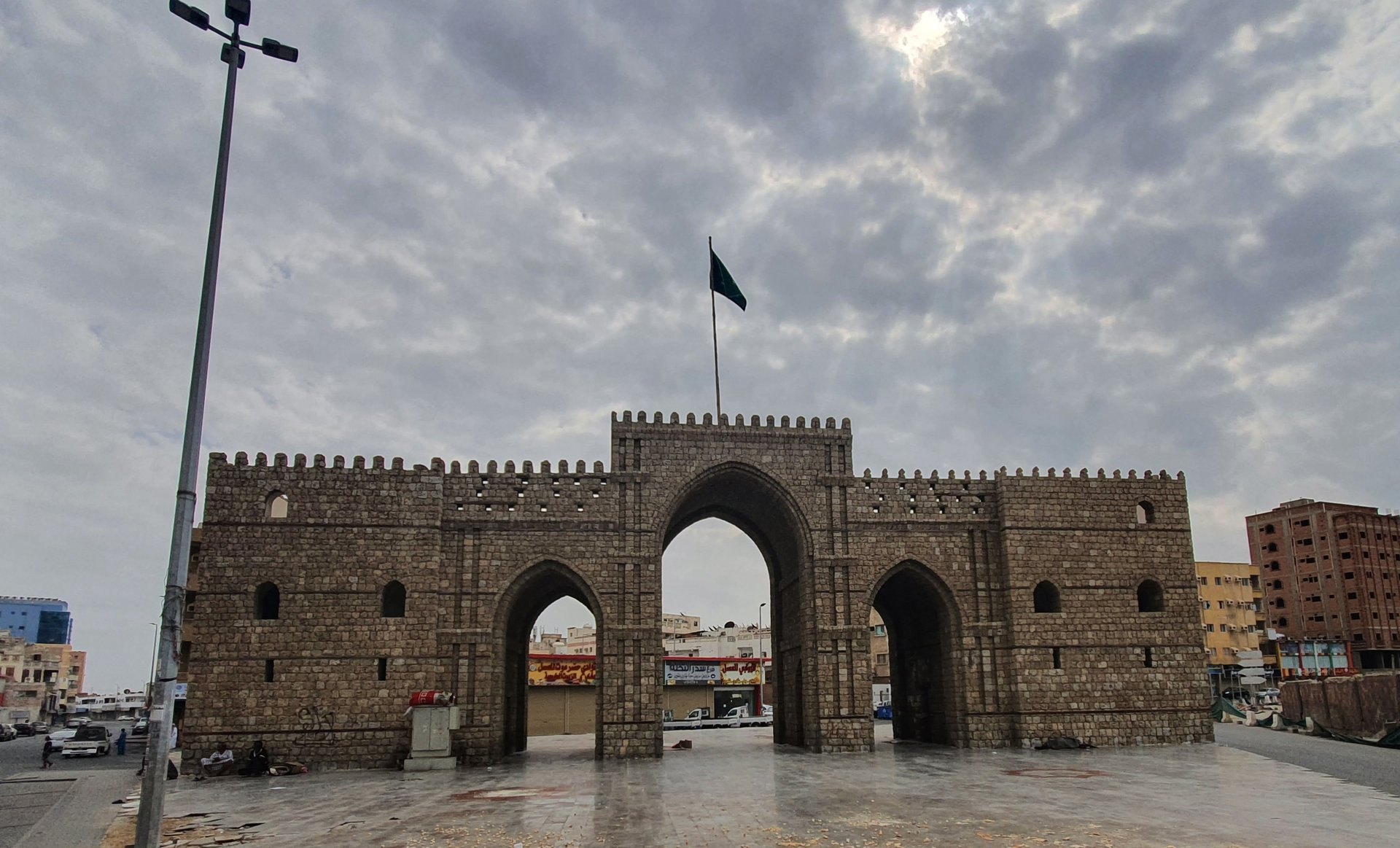
In the early 16th century, the Mamluk Sultan of Egypt, Al-Ashraf Qansuh al-Ghawri, ordered the fortification of Jeddah against Portuguese naval threats. His admiral, Hussein Al-Kurdi, constructed a defensive wall from coral stone — the same material as the district’s buildings — encircling the city with watchtowers, cannons, and eight gates (babs). The most significant of these were Bab Makkah on the eastern side, which opened toward the holy city, and Bab al-Sharif to the south. In 1947, the wall was demolished as the city expanded beyond its confines, but Bab Makkah has been preserved and reconstructed as a historic monument that today marks the entrance to Al Balad from the east.
UNESCO World Heritage Inscription (2014)
In June 2014, “Historic Jeddah, the Gate to Makkah” was inscribed on the UNESCO World Heritage List as Saudi Arabia’s third World Heritage Site. The inscription recognises Al Balad under three criteria of Outstanding Universal Value:
- Criterion (ii): Al Balad demonstrates an important exchange of human values, building materials, and architectural techniques across the Red Sea region over centuries of maritime trade.
- Criterion (iv): It is the only surviving urban ensemble of the distinctive Red Sea coastal architectural tradition, once shared by port cities on both shores of the Red Sea.
- Criterion (vi): The district is directly associated with the Hajj pilgrimage, both symbolically and architecturally, as the historic gateway through which millions of pilgrims passed on their way to Makkah.
The UNESCO-listed core zone encompasses approximately 17.1 hectares containing more than 600 historic structures. This is one of the sites covered in our wider guide to travelling across Saudi Arabia, which includes all six of the Kingdom’s World Heritage Sites.
Top Attractions in Al Balad
Al Balad is a living district rather than a manicured open-air museum. Some buildings have been immaculately restored, others are crumbling gently, and life carries on in the souks and mosques in between. Here are the essential stops.
Nassif House Museum (Beit Nassif)
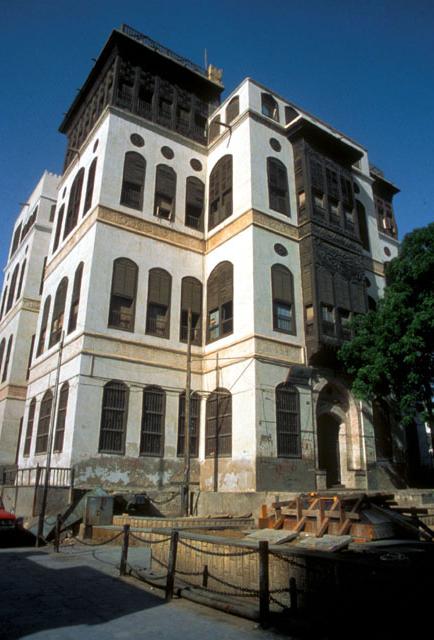
The most famous building in Al Balad, Nassif House was constructed in the late 1800s for Omar Nasseef Efendi, who served as governor of Jeddah. The four-story coral-stone house is notable for its grand staircase, its elaborately carved Roshan windows, and a large neem tree in its courtyard — historically one of the only trees in the walled city. In 1925, King Abdulaziz ibn Saud accepted the surrender of Jeddah at this house, making it a site of national historical significance. The building was converted into a museum and cultural centre in 2009.
Visiting: Nassif House Museum is generally open daily (closed Fridays), from 8:00 AM to 12:00 PM and 5:00 PM to 9:00 PM. Admission is free. Hours may vary, so it is advisable to check before visiting. The house sits on a small square off Souk Al-Alawi, making it easy to include in a walking route through the district.
Al-Shafi’i Mosque
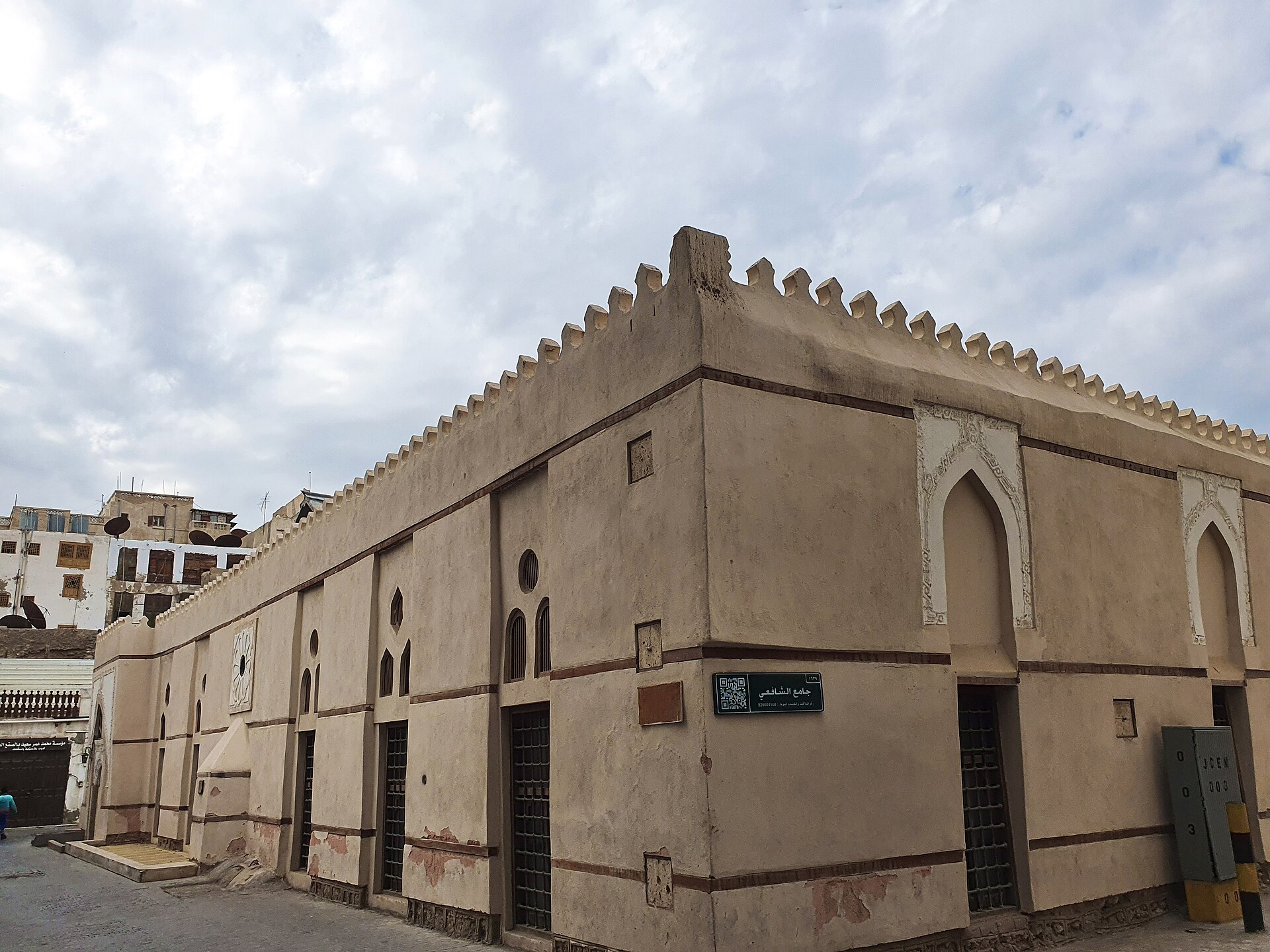
Established in 1250 AD (649 AH), Al-Shafi’i Mosque is the oldest mosque in Jeddah and one of the oldest on the Red Sea coast. It was built by King Muzaffar Suleiman bin Saad Eddin Shahinshah II of the Ayyubid dynasty in Yemen, who followed the Shafi’i school of Islamic jurisprudence. The mosque’s minaret is considered the oldest in the Hijaz region. In 1539, an Indian merchant named Khawaja Muhammad Ali funded a major reconstruction, importing carved timber columns from Yemen. Archaeological work during recent restoration uncovered artefacts suggesting the mihrab may date back nearly 1,400 years.
The mosque has been fully restored in recent years and is open to visitors outside of prayer times. Free guided tours lasting approximately 30 minutes are available. The mosque showcases a hypostyle design with coral-stone walls and intricate wooden elements.
Matbouli House Museum
Owned by the same family of spice merchants for more than 400 years, Matbouli House is a privately run museum that offers a glimpse into the domestic life of Al Balad’s trading families. The four-story building features beautiful decorated Roshan windows on its facade and contains antique furniture, old gramophones, and household artefacts from across the centuries. The museum is located on Al-Qossani Alley.
Visiting: Open daily, typically from 5:00 PM to 10:00 PM (some sources indicate morning hours as well — confirm locally). Admission is SAR 10 per person. Tours are not provided in English, but the exhibits are largely visual and self-explanatory.
Sharbatly House
Another outstanding example of Hijazi domestic architecture, Sharbatly House has been carefully restored to showcase the full spectrum of traditional building techniques. Its Roshan windows are among the most photogenic in Al Balad, with deeply carved wooden lattice screens in rich brown tones. The house is periodically open for cultural events and exhibitions.
teamLab Borderless Jeddah
One of the more unexpected additions to the district, teamLab Borderless has opened a permanent exhibition space in a restored historic building within Al Balad. The Tokyo-based digital art collective creates immersive, flowing installations that respond to visitor movement — a striking contrast with the 800-year-old surroundings. Tickets should be booked in advance through the teamLab website.
Roshan Architecture: Al Balad’s Defining Feature
The most visually striking element of Al Balad is its Roshan (also written rawasheen or rawashin) — the projecting wooden bay windows and enclosed balconies that extend from the upper floors of the coral-stone tower houses. These are not merely decorative; they represent a sophisticated response to the extreme climate and cultural requirements of life on the Red Sea coast.
How Roshan Windows Work
Each Roshan serves multiple practical functions:
- Ventilation: The lattice screens catch coastal breezes and funnel them into the interior, creating natural cross-ventilation in a city where summer temperatures routinely exceed 40°C.
- Privacy: The wooden mashrabiya lattice allows residents — particularly women — to observe street life while remaining unseen from below, fulfilling cultural expectations of domestic privacy.
- Light control: The intricate lattice patterns filter harsh sunlight into soft, dappled patterns on interior floors and walls, reducing glare and heat gain.
- Additional space: By projecting outward from the building’s structural walls, Roshan windows add usable floor area to upper-story rooms — a valuable advantage in the cramped quarters of a walled city.
Construction Materials and Techniques
The buildings themselves are constructed from blocks of coral limestone, harvested from reefs along the Red Sea coast and cut into regular blocks. The coral stone is naturally porous, providing limited insulation and allowing the walls to breathe. External surfaces were traditionally finished with lime plaster. The Roshan screens were carved from imported hardwoods — often teak from India or Java — and joined using traditional carpentry techniques without nails. Some of the most elaborate screens feature geometric and floral patterns of astonishing complexity.
This architectural tradition was once shared by port cities on both coasts of the Red Sea, including Suakin in Sudan and Massawa in Eritrea. Today, Al Balad contains the last substantial surviving urban ensemble of this building style, which is one of the principal reasons for its UNESCO inscription.
Walking Routes Through Al Balad
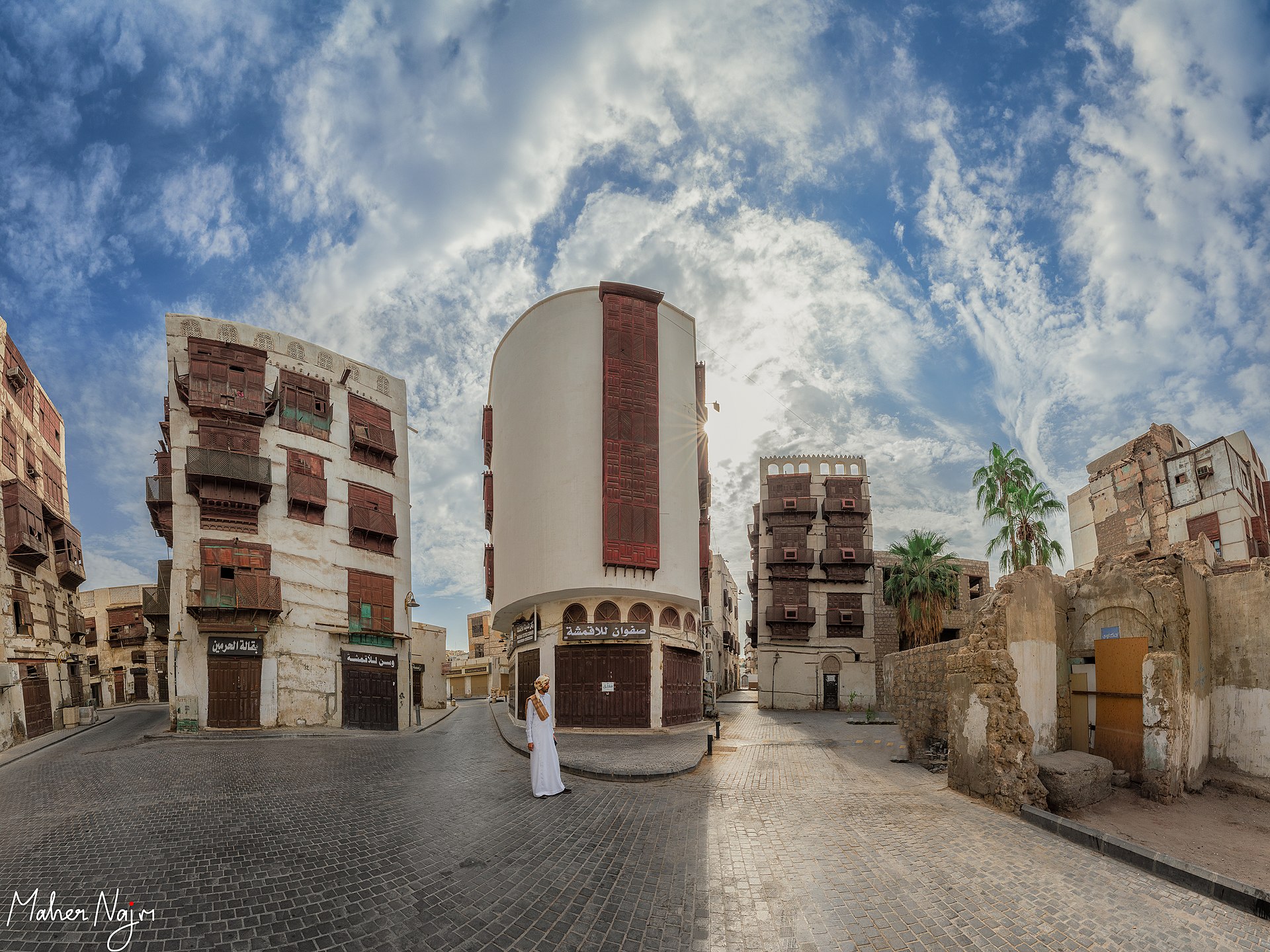
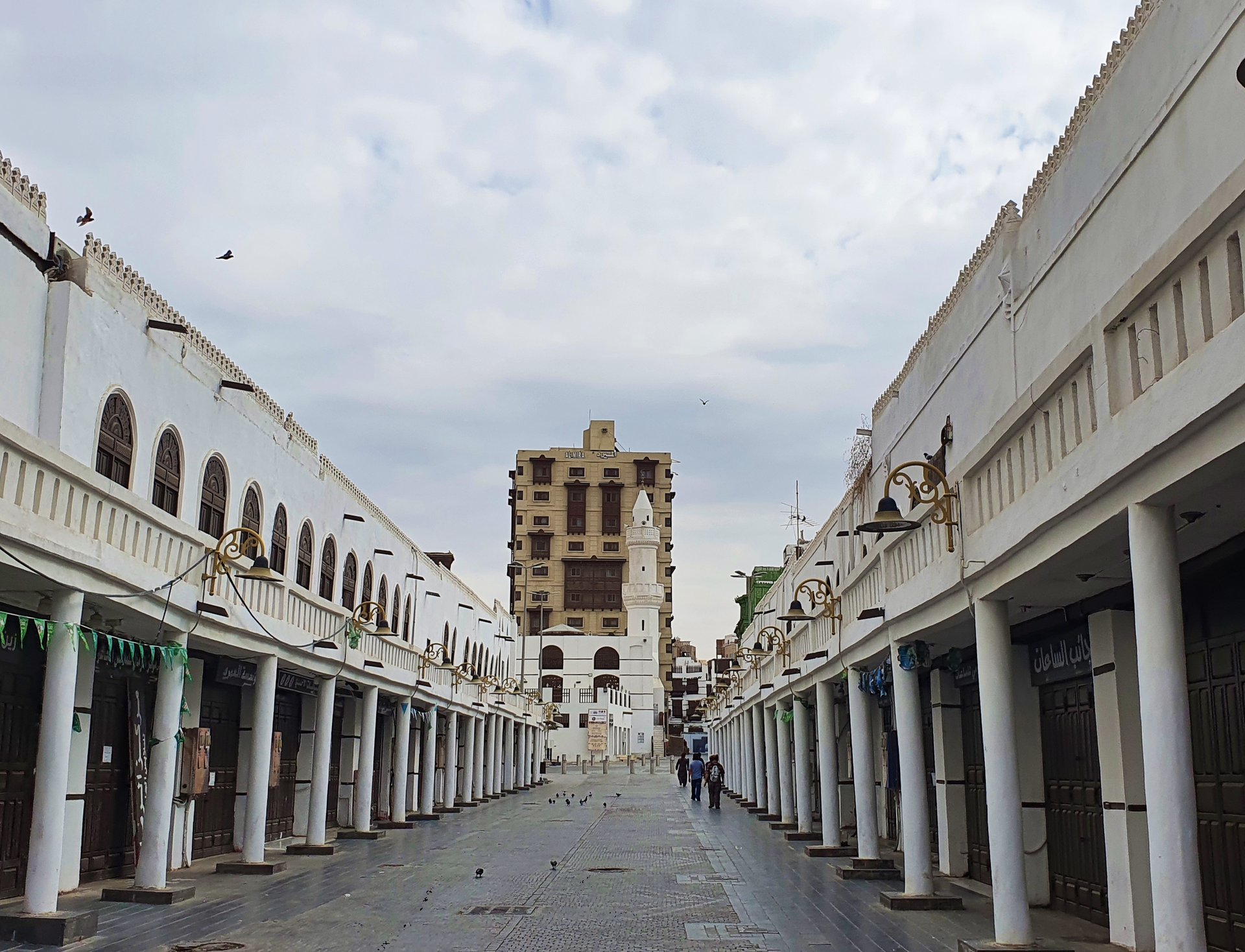
Al Balad is best explored on foot. The district is compact — roughly 700 metres east to west and 900 metres north to south — and its narrow alleys are largely pedestrianised. Allow three to four hours for a thorough visit, including museum stops and time in the souks.
The Heritage Circuit (2-3 hours)
Start at Bab Makkah, the reconstructed eastern gate, to orient yourself historically. From the gate, walk west along Al-Dahab Street (Gold Street), where jewellery shops line both sides of a covered arcade. This feeds naturally into Souk Al-Alawi, the main market street, which runs roughly north-south through the heart of the district. Turn north to reach Nassif House, which sits on a small square just off the souk. After visiting the museum, continue north to Al-Shafi’i Mosque. From the mosque, work your way through the residential alleyways to the west, where you will find some of the best-preserved Roshan facades in the district, including Sharbatly House. End your circuit at Matbouli House Museum on Al-Qossani Alley.
The Souk and Food Route (2-3 hours, best after 5 PM)
For a more atmospheric experience, arrive around sunset. Begin at Souk Al-Alawi as the shops open for the evening. Browse the spice merchants, incense sellers, and textile vendors. Walk south toward Souk Al-Attarin (the perfumers’ souk), where oud, sandalwood, and frankincense are sold in their raw forms. Continue to Al-Dahab Street for gold and jewellery. Stop for dinner at one of the traditional seafood restaurants near the souk (see below), and finish with Arabic coffee at one of the heritage courtyard cafes.
Tip: If you visit in the morning, the streets are quieter and the light is better for photography, but most shops will be closed. The souks come alive after the Maghrib (sunset) prayer. For the best experience, consider two visits — one in daylight for architecture and museums, one in the evening for souks and food.
Guided Walking Tours
Several operators offer guided walking tours of Al Balad, typically lasting 2-3 hours. These are worth considering if you want to understand the architectural details and historical context in depth. GetYourGuide lists tours from approximately SAR 200-400 per person, including a local guide who can explain the significance of individual buildings and navigate the maze of alleyways. The Jeddah Travel Guide has more options for tours across the city.
Shopping in Al Balad: Souks and Markets
The souks of Al Balad have been in continuous operation for centuries, and they remain among the most authentic traditional markets in Saudi Arabia. Unlike the sanitised souks found in some Gulf cities, these are working markets where locals shop alongside visitors.
Souk Al-Alawi
The main commercial artery of Al Balad, Souk Al-Alawi stretches through the centre of the district, selling everything from handicrafts and traditional clothing to rugs, carpets, and household goods. It is the best starting point for a shopping expedition and the souk most likely to have what you want.
Souk Al-Dahab (Gold Street)
Rows of jewellery shops line this covered arcade near the Bab Makkah entrance, displaying gold in the traditional Gulf style — heavy, ornate, and sold by weight. Prices are based on the daily gold price plus a markup for craftsmanship. This is a good place to buy traditional Saudi jewellery as a souvenir, though you should compare prices at several shops before committing.
Souk Al-Attarin (Perfumers’ Souk)
The most aromatic corner of Al Balad, this souk specialises in oud (agarwood incense), bukhoor (incense blends), sandalwood, frankincense, and traditional perfume oils. You will also find mounds of spices — cumin, cardamom, saffron, turmeric — and dried herbs. Prices are generally reasonable, and vendors are happy to explain their products.
Bargaining etiquette: Bargaining is expected in Al Balad’s souks. Start by offering around 50% of the vendor’s initial price and negotiate from there. Keep the exchange friendly — vendors generally enjoy the process. Fixed-price shops will tell you upfront that prices are not negotiable.
What to Buy
| Item | Where to Find It | Price Range (SAR) |
|---|---|---|
| Oud incense (raw chips) | Souk Al-Attarin | 50-500+ depending on grade |
| Bukhoor (incense blend) | Souk Al-Attarin | 20-100 |
| Gold jewellery | Souk Al-Dahab | 500+ (sold by weight) |
| Spices (saffron, cardamom) | Souk Al-Alawi / Al-Attarin | 10-80 per bag |
| Traditional textiles / abayas | Souk Al-Alawi | 50-300 |
| Prayer beads (misbaha) | Souk Al-Alawi | 10-100 |
| Wicker baskets | Souk Al-Alawi | 15-50 |
For modern shopping in Jeddah, including malls and international brands, see our guide to shopping in Jeddah.
Where to Eat and Drink in Al Balad
Al Balad has a growing number of restaurants and cafes, ranging from no-frills local joints to heritage-setting restaurants in restored buildings. The food scene here leans toward traditional Hijazi and Red Sea cuisine — fresh seafood, rice dishes, and aromatic spice blends.
Restaurants
Albasali — A local institution for traditional seafood in the heart of Al Balad. The menu features the catch of the day, succulent shrimp, and rice dishes cooked in the Hijazi style. The setting is basic but the food is authentic, and it is well-known among Jeddah residents. Budget around SAR 40-80 per person.
Al Nada Fish Market — A quaint spot in the district where you select your fish from the day’s catch and have it grilled and spiced to order, served with rice and salad. It is more of a market-restaurant hybrid than a formal dining room, which adds to the experience.
Nagi Al-Harbi — When you want grilled meats rather than fish, this unfussy restaurant serves mixed grills and traditional meat dishes with honest Jeddah charm. Portions are generous and prices are low.
Kathmandu Restaurant — A popular choice among locals for Nepalese and Indian food, offering momos (steamed dumplings), aromatic curries, and flavourful rice platters. A welcome change of pace if you have been eating fish for several days.
Cafes
Roshan Cafe — Set inside a restored heritage building, this cafe pairs Arabic coffee and modern drinks with the architectural beauty of a traditional Hijazi interior. The Roshan windows above your table are the real attraction. A good mid-walk rest stop.
Alnay Cafe — A more casual and affordable option for coffee and desserts, blending Western and traditional Saudi cafe culture. Good for recharging without a long sit-down.
Tip: Look out for the small heritage courtyard cafes tucked inside old houses. These hidden gems serve Arabic coffee, pastries, and light meals in settings that feel far removed from the 21st century. Ask locals for recommendations — they change frequently as new spaces are restored and opened.
For a wider look at Jeddah’s food scene — from high-end restaurants to street food — see the dining section of our Jeddah Travel Guide.
The Al Balad Restoration: A $3.6 Billion Transformation
Al Balad is in the middle of a massive, long-term restoration and redevelopment programme overseen by the Al Balad Development Company, a subsidiary of Saudi Arabia’s Public Investment Fund (PIF). This is one of the flagship cultural projects of Saudi Vision 2030, the Kingdom’s economic diversification strategy.
What Is Being Done
The project runs from 2025 to 2038 and encompasses three critical interventions:
- Heritage building restoration: More than 600 historic structures are being restored, with priority given to the most architecturally significant buildings and those at greatest risk of collapse.
- Waterfront reconnection: Al Balad was originally a port city, but modern development severed its connection to the sea. The project includes a new waterfront marina that will restore the district’s relationship with the Red Sea.
- Mixed-use development: New hotels, retail spaces, offices, and cultural venues are being woven into the historic fabric, creating a living district rather than a frozen monument.
Heritage Hotels
In 2024, the Jeddah Historic District Programme announced the restoration of three historic houses — Jokhdar House, Al-Rayyis House, and Kedwan House — and their conversion into boutique heritage hotels. These are the first of what will eventually be more than 3,300 hotel rooms across the district, ranging from mid-scale to luxury. A hospitality investment portfolio of $3.6 billion has been launched to fund this expansion.
By 2035, the project aims to attract over 20 million tourists annually and create 25,000 jobs, with more than 770,000 square metres of commercial space for offices and retail. For the visitor in 2026, the practical impact is that parts of Al Balad are under construction, but most of the key attractions remain accessible, and the completed restorations are stunning.
Where to Stay Near Al Balad
There are limited hotel options within Al Balad itself in 2026, as the heritage hotel programme is still in its early stages. Most visitors stay in central Jeddah and visit Al Balad as a half-day or full-day excursion. The most convenient options are hotels along the Jeddah Corniche or in the Al-Balad / Al-Hindawiyah area, which puts you within walking distance of the district.
| Hotel / Area | Distance to Al Balad | Price Range | Notes |
|---|---|---|---|
| Hotels near Bab Makkah | Walking distance | SAR 150-350/night | Budget options; basic but convenient |
| Corniche area hotels | 5-10 min by car | SAR 400-1,200/night | Sea views; mid-range to upscale |
| Al-Hamra district | 10-15 min by car | SAR 500-2,000/night | International brands; business-class |
| Heritage hotels (opening 2025-2026) | Inside Al Balad | TBC | Restored historic houses; boutique |
For a comprehensive overview of accommodation across the Kingdom, see our Saudi Arabia Hotels Guide.
Getting to Al Balad
From King Abdulaziz International Airport
Al Balad is approximately 25 kilometres south of the airport. A taxi or Uber ride takes 25-40 minutes depending on traffic and costs approximately SAR 50-80. Careem (the regional ride-hailing app) is also widely available.
By Car
If you are driving, parking near Al Balad can be challenging. There is a large public car park near Bab Makkah, and several smaller lots around the district perimeter. Do not attempt to drive into the narrow streets of the old quarter itself.
By Public Transport
The SAPTCO city bus network serves stops near Al Balad. Jeddah’s public transport infrastructure continues to expand under Vision 2030 plans. Check locally for the latest routes and schedules.
On Foot from the Corniche
If you are staying along the Jeddah Corniche, Al Balad is a manageable walk of about 2 kilometres from the northern end of the waterfront. However, in summer this is inadvisable due to the heat.
Best Time to Visit Al Balad
Jeddah has a hot desert climate tempered by Red Sea humidity. Al Balad is an outdoor walking experience, so timing matters.
| Season | Months | Temperature Range | Verdict |
|---|---|---|---|
| Winter (peak) | November – February | 21-30°C (70-86°F) | Ideal — comfortable for walking all day |
| Spring | March – April | 24-34°C (75-93°F) | Good — warm but manageable; mornings best |
| Summer | May – September | 30-41°C (86-106°F) | Challenging — extreme heat and humidity; visit after dark only |
| Autumn | October | 28-36°C (82-97°F) | Moderate — warming down from summer |
Tip: Even in winter, carry a water bottle, wear sunscreen, and dress modestly. Women should cover their shoulders and knees (this is Saudi Arabia), and men should avoid sleeveless tops. A headscarf is not legally required for non-Muslim women but is appreciated in the older, more conservative parts of the district. You will need a valid Saudi Arabia visa to enter the country — the e-visa process is straightforward and takes minutes.
Practical Tips for Visiting Al Balad
Safety
Al Balad is generally safe for tourists, including solo female travellers. The district is well-patrolled and benefits from the Saudi government’s heavy investment in its restoration. Use normal urban precautions — keep valuables out of sight, and be aware of your surroundings in the quieter residential alleys.
Photography
Al Balad is one of the most photogenic places in Saudi Arabia. The best light for photographing the Roshan facades is in the morning (7:00-10:00 AM) when the sun hits the western-facing buildings. The souks photograph best in the evening when the warm lighting creates atmosphere. Be respectful when photographing people — ask permission first, especially in the more residential areas.
What to Wear
Dress modestly — this is both a cultural expectation and a practical necessity. Lightweight, loose-fitting clothing in natural fabrics works best. Comfortable walking shoes are essential; the streets are paved but uneven in places. Sandals are fine for the main streets but closed-toe shoes are better if you plan to explore the narrower alleys and construction-adjacent areas.
Money
Most souk vendors accept cash only (Saudi Riyals). Some of the larger shops and all of the cafes and restaurants accept card payments. There are ATMs near Bab Makkah and on the edges of the district. The exchange rate in 2026 is approximately SAR 3.75 to USD 1.
Language
Arabic is the primary language, and English proficiency in the souks is variable. Many vendors speak basic transactional English. In the restaurants and cafes, English menus are increasingly common. Google Translate works well for Arabic if you need it.
Accessibility
Al Balad’s narrow, uneven streets and multi-story buildings without lifts make it challenging for visitors with mobility impairments. The main commercial streets (Souk Al-Alawi, Al-Dahab Street) are the most accessible. The restored museums are gradually improving accessibility, but this remains a work in progress.
Combining Al Balad with Other Jeddah Attractions
A visit to Al Balad pairs naturally with other Jeddah highlights. In the morning, explore the historic district, then spend the afternoon on the Jeddah Corniche — the 30-kilometre seafront promenade with sculptures, parks, and waterfront restaurants. Diving enthusiasts should also explore the Red Sea diving sites accessible from Jeddah, which rank among the best in the world. If you are visiting during the Formula 1 season, the Jeddah Corniche Circuit is a short drive from the old city.
Frequently Asked Questions
Is Al Balad free to visit?
Yes. The district itself is freely accessible 24 hours a day, with no entrance fee. Individual museums may charge small admission fees (SAR 0-10).
How long should I spend in Al Balad?
A minimum of 2-3 hours for the main highlights. If you want to explore the souks thoroughly, visit multiple museums, and eat in the district, plan for 4-5 hours or split your visit across two sessions (morning and evening).
Can I visit Al Balad without a guide?
Absolutely. The main streets and attractions are easy to navigate on foot without a guide. However, a guided tour adds significant context to the architecture and history. Informational plaques and QR codes are being installed throughout the district as part of the restoration programme.
Is Al Balad under construction?
Parts of the district are affected by the ongoing restoration programme (2025-2038). The major attractions — Nassif House, Al-Shafi’i Mosque, the main souks — remain open and accessible. Some side streets may be blocked by scaffolding or construction barriers.
What is the nearest hotel to Al Balad?
Budget hotels near Bab Makkah are the closest options, within walking distance of the district. The first heritage hotels within Al Balad itself (restored historic houses) began opening in late 2024 and early 2025.
Explore More Saudi Arabia Travel Guides
- Jeddah Travel Guide 2026 — The complete guide to Saudi Arabia’s Red Sea city
- Jeddah Corniche — Saudi Arabia’s iconic seafront promenade
- Shopping in Jeddah — Best malls, souks and markets
- Saudi Arabia Diving Guide — The Red Sea’s underwater world
- Saudi Arabia Travel Guide 2026 — The complete guide to visiting the Kingdom
- Saudi Arabia Visa Guide — Every visa type explained