
Main Event: King Abdulaziz Camel Festival (December–January)
Location: Al-Sayahid desert, 120km northeast of Riyadh
Prize Fund: SAR 300M+ (King Abdulaziz Festival)
Visa Required: Yes — tourist e-visa
Entry: Free to watch
Avoid: Arriving outside the December–January festival window if the King Abdulaziz Festival is your primary goal
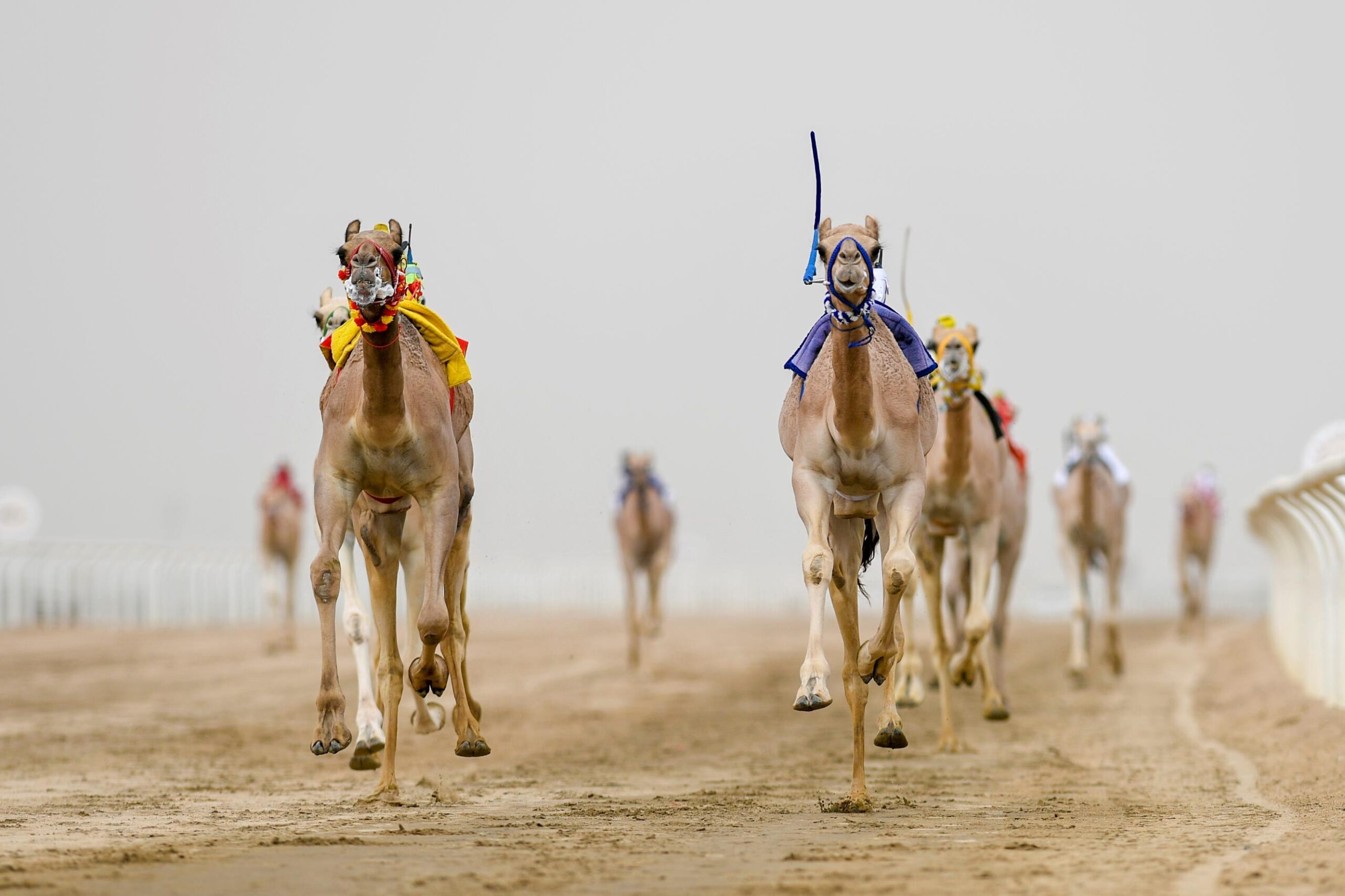
Of all the spectacles the Kingdom has to offer visitors, few are as viscerally strange and genuinely thrilling as camel racing. Thousand-kilogram animals accelerating to 65 km/h across open desert, tiny robot jockeys strapped to their humps, trainers in convoys of trucks bellowing encouragement through mounted speakers — it is sport as theatre, heritage as living institution. If your Saudi Arabia travel guide has a single bucket-list entry for cultural immersion, this should be it. This guide covers every major event — from the world’s richest camel festival at al-Sayahid to the intimate weekly track races around Riyadh and Taif — plus everything you need to know to actually get there, find a spot on the rail, and understand what you are watching.

Why Camel Racing Matters in Saudi Arabia
The camel is not merely a racing animal in Saudi culture — it is a foundational symbol. For millennia the dromedary was the engine of Bedouin civilisation: transport, trade, warfare, sustenance, poetry, and status all flowed through the herd. A man’s camels told you everything about him. When Ibn Battuta crossed Arabia in the fourteenth century, the camels that carried him were already the subject of competitive pride between tribes.
Organised racing as a formal sport developed relatively recently. In 1964, under the patronage of King Faisal bin Abdulaziz, the first significant sanctioned race took place, providing an institutional framework for what had always been informal tribal competition. The Saudi Camel Racing Federation was subsequently established to govern the sport, set distance standards, register animals, and organise the national calendar. Today there are hundreds of registered tracks across the Kingdom, from the purpose-built amphitheatre at al-Sayahid — covering more than 225 km² of the al-Dahna Desert — down to modest dirt strips beside farming villages in Hail and Najran.
In 2015, UNESCO inscribed camel racing on its list of intangible cultural heritage associated with camels, recognising the practice as a living tradition spanning the entire Arabian Peninsula. Vision 2030 has since elevated the sport further: camel racing is explicitly positioned as a vehicle for heritage tourism, domestic entertainment, and soft-power projection. Prize money has scaled accordingly — the seventh edition of the King Abdulaziz Camel Festival in 2022 posted an award fund of SAR 300 million, making it comfortably the richest camel competition on earth.
“The camel connects us to everything our grandfathers were. When a great camel wins, it is not just the owner who feels pride — the whole tribe feels it.”
— Saudi camel breeder quoted in AramcoWorld
The Race Format: What Actually Happens
A camel race in Saudi Arabia follows a structure that will feel familiar to horse racing fans, but with several distinctive features that make it unlike any other sport on earth.
The Track and the Animals
Races are run on straight or looped desert tracks. Standard distances depend on the age and category of the animal: young camels (degh, under five years) typically race over 4–6 km; mature animals (jel, over five) cover 8–10 km and in championship events up to 22 km. Camels are capable of brief sprint speeds approaching 65 km/h and can sustain approximately 40 km/h over a full race distance — remarkably quick for an animal of their size and build.
Animals race in categories segmented by age, sex, and breed. Female camels (nagas) are generally the preferred racing animals and command the highest prices at auction. Stallions race separately from geldings. Coastal camels (sawahil), bred along the Red Sea and Gulf fringes, form their own distinct category: recognisable by their red colouring, larger heads, and elongated frame.
On a major race day at a festival, upwards of 100 camels may compete in a single heat, the pack spreading across the full width of the track — an astonishing sight and a logistical feat. At the King Abdulaziz Camel Festival, some 38,000 registered camels compete across the full month-long programme, spread across multiple tracks operating simultaneously.
The Robot Jockey Revolution
For most of camel racing’s modern history, young children — some as young as four — rode as jockeys. Their light weight was valued; the human rights abuses were severe and extensively documented. In 2004, the UAE became the first Gulf state to formally ban child jockeys. Qatar followed in 2005; Saudi Arabia phased them out across the same period.
The technology that replaced them was developed from 2001 onwards, with the first successful model built by Rashid Ali Ibrahim of the Qatar Scientific Club. The robot jockey — known commercially through companies such as Dubai-based Bait al Thiqa — is a remotely operated device weighing between 4 and 5.3 kg, shaped loosely in human form and secured to the camel’s back by a corset harness. It carries a speaker through which the trainer’s voice is transmitted directly to the animal, and a whipping arm capable of 21 rotational strokes to urge greater speed.

During a race, trainers follow the course in a convoy of SUVs and pickup trucks alongside the track perimeter, remote controls in hand, shouting commands through handheld units that patch through to the robot’s speaker. The result is surreal: a thundering pack of camels trailed by a slow-motion motorcade, voices echoing across open desert. Bait al Thiqa now employs more than 65 people across three UAE branches; the technology has spread to every serious camel racing nation on the Peninsula.
The King Abdulaziz Camel Festival
The centrepiece of the Saudi camel racing calendar — and by most measures the largest and most valuable camel event anywhere in the world — is the King Abdulaziz Camel Festival at al-Sayahid.
Location and Scale
The festival takes place at al-Sayahid village in the al-Dahna Desert, situated between Rumah and al-Rumahiyah, approximately 120 km northeast of Riyadh. The site covers more than 225 km² — a purpose-built camel city in the desert, with multiple race tracks, a dedicated accommodation zone of roughly 1.1 million square metres, a heritage market, museum, poetry and dialogue venue, falcon area, and food stalls selling traditional Arabian fare.
The festival runs for 30 to 45 days each year, typically from early December through to early January. The 10th edition ran from December 2025 to January 2026, drawing more than 3,000 international visitors from over 50 countries — evidence of the event’s growing draw beyond the Gulf region. Approximately 38,000 registered camels make the journey to al-Sayahid each year.
The Prize Structure
Prize money at the King Abdulaziz Festival has escalated dramatically since its inception. The sixth edition (2021) distributed SAR 250 million in awards; the seventh edition posted SAR 300 million — the highest award fund ever recorded in the sport. The competition is divided into 75 individual camel contests across six broad categories, with ten crowned champion positions. Prizes range from individual category awards up to the grand champion title — the Bayraq (“flag”) — which brings cash prizes and a winning camel that can subsequently be sold for up to $3 million at private auction.
The Beauty Pageant: Mazayen al-Ibl
Alongside the races, the festival hosts Mazayen al-Ibl — literally “most beautiful camel” — a competition that is equal parts livestock show, cultural ceremony, and high-stakes auction market. Judges assess animals against a precise standard that has been codified over generations: the head must be appropriately sized; the lips should droop and fully cover the teeth; the neck must be long, thin, and gently curved; the hump well-rounded and proportionately positioned; the eyes large and lashed; the nose long with a slightly broad bridge.
Animals compete in categories by colour (dark-skinned mijahim and multiple grades of light-skinned maghateer, from pure white wodh through yellow sheal to red homor), by age (degh under five, jel over five), and by the size of the herd entered. A separate category is reserved for sawahil coastal camels. Every animal is fitted with a microchip storing ownership details, and each is individually inspected before appearing before judges. Disqualification for cosmetic enhancement — Botox injections have been used to reshape lips and noses — is taken seriously and results in permanent bans.

What Visitors Can Do at al-Sayahid
The festival is free to attend for general visitors. Beyond the races and judging, the site offers more than 20 distinct activities across 18 locations. These include camel milking and feeding demonstrations, camel riding experiences, the Al-Oqailat Museum (chronicling the heritage of the region’s tribal families), a traditional folk market with crafts, spices, camping equipment and camel-supply merchants, and regular poetry dialogue events — the classical Arabian oral tradition of nabati verse competitions, closely linked to camel culture. A restaurant overlooking the main track provides food and viewing for those wanting a more comfortable perch; the on-site snack bar serves the general crowd.
SAUDIA Holidays offers integrated travel packages combining flights, accommodation at al-Sayahid, and ground transport specifically designed around the festival. Independent travellers arriving from Riyadh typically drive the 120 km northeast on Highway 65 toward Rumah, with the festival site well-signposted from the main road. There is no public transport; a rental car or organised tour is necessary.
The Crown Prince Camel Festival — Taif, September
For travellers visiting Saudi Arabia in the summer months when the King Abdulaziz Festival is dormant, the Crown Prince Camel Festival in Taif provides a second major fixture on the calendar. Held annually at Taif Camel Square, the seventh edition in September 2025 broke a world record: more than 100,000 camels were registered on the opening day alone. Prize money exceeded SAR 50 million across five official categories, with the headline Crown Prince Camel Festival Cup in the Heel (general and open) category paying SAR 1.5 million to its champion.
The Taif festival is notable for its expanding inclusion of human riders alongside the robot jockey heats. The 2025 edition featured 249 races in total, including five ridden races for 78 men and women from eight countries — Saudi Arabia, UAE, Oman, Kuwait, Yemen, Bahrain, Algeria, and the United Kingdom. Women’s races, contested over 2 km, drew particular attention as Saudi women riders claimed first-ever victories at a national camel festival in 2024. The Hail region also has a strong regional racing tradition worth exploring if you venture north of Riyadh.
The Custodian of the Two Holy Mosques Camel Festival — Janadriyah
A third major fixture in the calendar is the Custodian of the Two Holy Mosques Camel Festival, held at the historic Janadriyah Village on the outskirts of Riyadh. The third edition kicked off on January 23, 2026, running for ten days with daily sessions from 1 PM to 9 PM. The festival is free to enter and set against the backdrop of Janadriyah’s broader heritage village — one of Riyadh’s most established cultural destinations — with more than 60 vendor booths, restaurants, craft stalls, and a continuous programme of performances and camel-riding activities.
For visitors already in Riyadh who cannot reach al-Sayahid, Janadriyah is the accessible alternative: the heritage village is around 45 km north of central Riyadh and easily reached by taxi or rental car. The atmosphere is more family-oriented and less overwhelming in scale than the main King Abdulaziz Festival, making it a good choice for first-time visitors to camel racing.
The AlUla Camel Cup — April
The most internationally visible camel racing event in Saudi Arabia is the AlUla Camel Cup, held annually in April at the Mughayra Heritage Sports Village within the broader AlUla valley. The AlUla Camel Cup is invitation-only for the animals: participants must have posted top-three finishes in qualifying events including the King Abdulaziz Festival and Crown Prince Festival. The 2024 prize pool exceeded $6.4 million (approximately SAR 24 million), making it the single most lucrative race meeting on the calendar.
What distinguishes AlUla from the other festivals is the setting. Races unfold against a backdrop of ancient Nabataean sandstone cliffs, the same formations that frame the Hegra archaeological site. Four days of competition, 4–8 km race distances, and premium spectator infrastructure make it the most packaged experience for international tourists — particularly those already visiting AlUla for Hegra, Dadan, and Jabal Ikmah. There are plans to develop a full professional Camel Racing League based around the AlUla format as part of the broader sports tourism strategy under Vision 2030.
Weekly and Regional Racing
The major festivals are the headline events, but camel racing happens weekly across Saudi Arabia from October through April. Regular race meetings take place at tracks on the outskirts of Riyadh, Taif, Jeddah, Al Nafud, and As Sulayyil. Race days are typically Saturday and Sunday, running from approximately 2 PM to 6 PM. Admission is free. Seating is informal — spectators line the rail, often in family groups on one side and single men on the other, with a hospitality area for guests of the camel owners. A trackside snack bar is standard.
These local meetings lack the organisation and signage of the major festivals, but they offer something more authentic: a window into the sport as a local institution rather than a managed tourist spectacle. Arabic is the working language; the crowd is overwhelmingly Saudi; and the post-race conversation between trainers, owners, and breeders at the rail is where the real culture of camel racing lives. Bring a guide or a Saudi contact if you want to understand what is being discussed — the subtleties of breeding lines, training regimes, and race tactics are topics Saudis will discuss with genuine enthusiasm if they know you are interested.
A fine racing camel is not born in a season. Bloodlines are studied the way breeders study horse pedigrees — going back four, five, sometimes six generations.
Practical Guide for Visitors
Getting In
All major camel racing events in Saudi Arabia are free to attend for general spectators. You will need a valid Saudi tourist e-visa to enter the country — see our complete Saudi Arabia visa guide for the application process, costs, and restrictions. There is no ticket to book for the festivals themselves; you simply arrive, park, and walk in. The King Abdulaziz Festival at al-Sayahid does offer VIP viewing packages starting from SAR 150 for those who want access to the restaurant overlooking the main track.
Getting There
Al-Sayahid (King Abdulaziz Festival): Drive from Riyadh on Highway 65 northeast toward Rumah. The site is approximately 120 km from the city centre — allow 90 minutes from central Riyadh. No public transport serves the site; a rental car is essential. Festival signage is extensive in both Arabic and English once you clear the urban limits.
Janadriyah (Custodian of the Two Holy Mosques Festival): Approximately 45 km north of central Riyadh via King Khalid Road. Taxis and ride-hailing apps (Careem, Uber) are a practical option from the city.
Taif (Crown Prince Festival): Taif is 75 km east of Mecca, roughly 80 km from Jeddah. Domestic flights connect Riyadh with Taif’s Taif Regional Airport. The festival’s Camel Square venue is on the city’s outskirts; taxis are straightforward.
AlUla (AlUla Camel Cup): The closest airport is Prince Abdul Majeed bin Abdulaziz Airport (ULH), which receives regular connections from Riyadh and Jeddah. From the airport, AlUla valley is approximately 25 km; shuttle services operate during the Cup period.
What to Bring and Wear
Modest dress is expected. Men should wear trousers covering the knee; women should wear loose clothing covering arms and legs, with a headscarf available though not mandatorily required for non-Muslim tourists at outdoor sporting events. The desert sun at al-Sayahid in December and January can be deceptively strong midday — sunscreen, a hat, and water are essential. Evening temperatures drop sharply; a warm layer is needed after sunset. Sand is everywhere; closed shoes are more practical than sandals. A telephoto lens is useful for race photography — the track distances are long and the action moves fast.
When to Go
The King Abdulaziz Camel Festival runs December through early January and is the unambiguous headline event. The Custodian of the Two Holy Mosques Festival at Janadriyah overlaps in January, offering a Riyadh-based alternative. For spring travellers, the AlUla Camel Cup in April is the premium experience. Summer visitors should target the Taif Crown Prince Festival in September. Weekly track racing runs from October through April across the main cities. If you are combining camel racing with other equestrian heritage — falconry, horse riding, or the Saudi Cup horse racing experience — plan around the winter season when Riyadh’s social calendar is at its richest.
Photography and Etiquette
Photography of the racing is entirely welcome and expected. Exercise caution when photographing the camel owners and trainers — ask permission before pointing a camera at individuals. Women in the Saudi crowd are generally not to be photographed; err on the side of caution. At Mazayen al-Ibl beauty competitions, photography of the camels is freely permitted and the animals are often presented specifically for documentation. Do not approach the animals from behind without the trainer’s guidance — a startled camel can kick with significant force.
Beyond the Races: Camel Trekking and Hands-On Experiences
If watching the sport from the rail leaves you wanting a more direct encounter, Saudi Arabia’s expanding adventure tourism infrastructure has options. The King Abdulaziz Festival itself offers camel riding, milking, and feeding experiences within the festival compound. For longer immersive desert experiences, dedicated operators run multi-day camel treks through the Empty Quarter and Hejaz ranges — an entirely different way to experience the animal at the heart of this sport. See our guide to camel trekking in Saudi Arabia for operators, routes, and what to expect on a multi-day desert journey.
The Hail region in northwestern Saudi Arabia offers a particularly concentrated camel culture: large herds, breeding farms open to visitors, and regular regional racing. Hail’s heritage is deeply intertwined with the camel economy, and several tour operators in the city offer half-day visits to working farms where you can observe training routines and see the robot jockeys being fitted and calibrated before a race day.
Explore More Saudi Arabia Travel Guides
- Saudi Arabia Travel Guide 2026 — Complete Kingdom guide
- Camel Trekking in Saudi Arabia — Desert treks on camelback
- Falconry in Saudi Arabia — The ancient art
- Horse Riding in Saudi Arabia — Stables and desert rides
- Hail Region — Desert heartland
- Saudi Arabia Visa Guide — Every visa type explained
- Saudi Cup Horse Racing — The world’s richest race day