
Best Locations: AlUla, Wadi Disah, Asir, Diriyah
Golden Hour: Year-round desert light
Visa Required: Yes — tourist e-visa
Permits: Required for some heritage sites
Guided Tour From: ~$2,250 USD (group) / $4,790 USD (workshop)
Avoid: Photographing people/government buildings without permission
Saudi Arabia has opened one of photography’s last great frontiers. Where other destinations have been documented to exhaustion, the Kingdom’s landscapes remain strikingly undershot — thousand-year-old Nabataean tombs carved into rose-red cliffs, canyon valleys that have barely changed since the incense trade, mountain ranges draped in mist above the Red Sea. For photographers willing to go, the rewards are extraordinary. This guide, part of the Saudi Arabia Travel Guide 2026, covers everything you need: tour operators, the best locations, permit rules, golden hour timings, and how to protect your equipment in extreme desert conditions.
Why Saudi Arabia Is a Photographer’s Dream
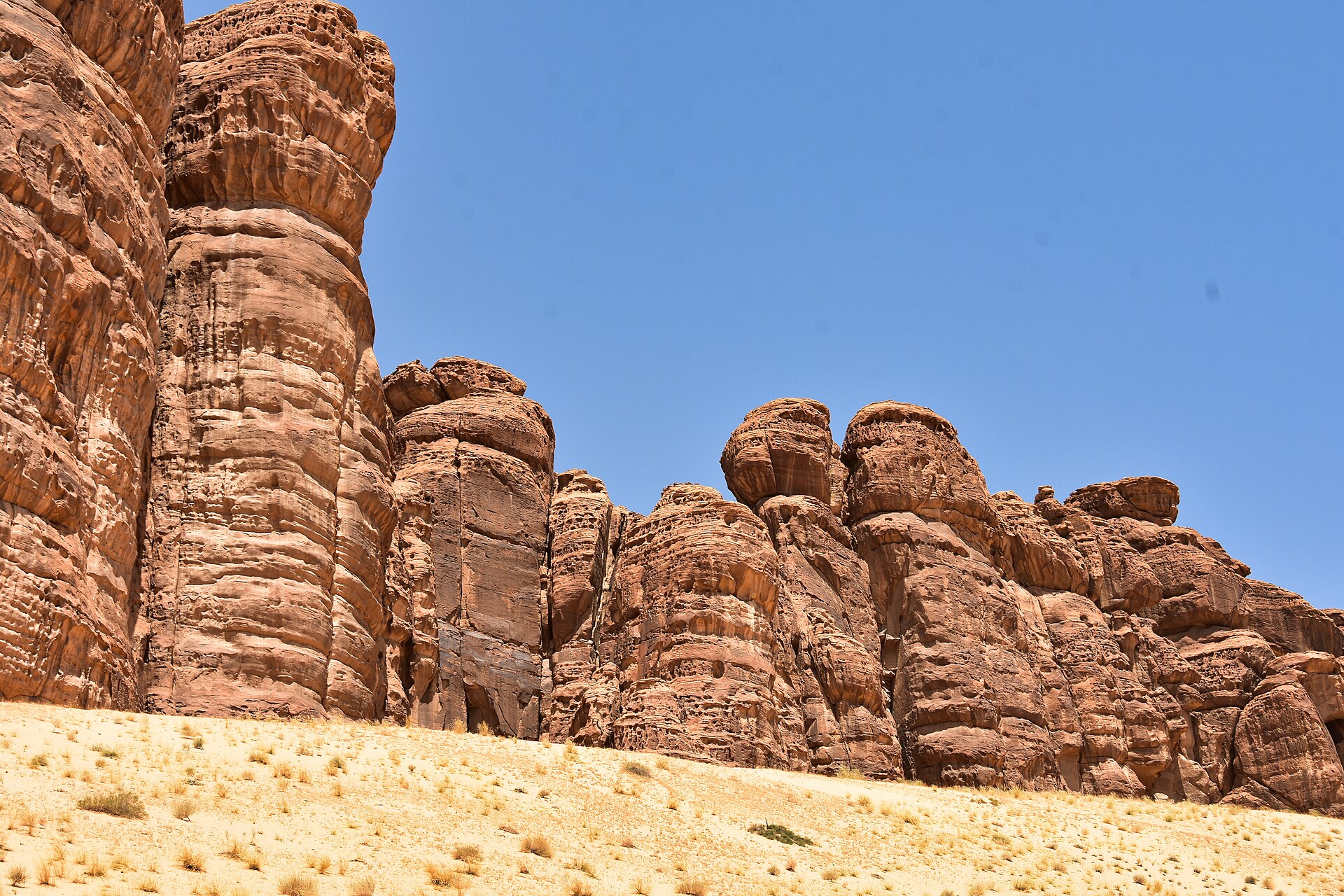
Few countries reward serious photographers the way Saudi Arabia does right now. The combination of factors is almost unprecedented: ancient geological formations that took 60 million years to sculpt, archaeology spanning Nabataean, Dadanitic, Thamudic and Lihyanite civilisations, traditional mountain villages clinging to escarpments, and desert light of extraordinary quality — warm, directional and long-lasting at both ends of the day.
Tourism only opened to independent international visitors in 2019, meaning the photographic potential of most locations is essentially uncharted. There are no queues at Elephant Rock at sunrise. The tombs of Hegra glow in isolation. Wadi Disah’s 15-kilometre canyon can be explored without passing another photographer. That window will not last indefinitely — but for now, Saudi Arabia offers what Iceland and Patagonia offered a generation ago: raw, unmediated landscape on terms set by the photographer, not the crowd.
Top Photography Locations in Saudi Arabia
AlUla — The Centrepiece
AlUla is the undisputed headline destination. Located in the Hejaz mountains of northwestern Saudi Arabia, this ancient oasis sits in a valley flanked by towering sandstone formations that shift from amber to deep crimson as the light changes. The photographic range here is exceptional: Nabataean heritage, surrealist rock sculpture, traditional mud-brick architecture, date palm groves, and some of the darkest night skies in the Middle East.
The most photographed single landmark in the Kingdom is Elephant Rock (Jabal Al-Fil) — a 52-metre freestanding sandstone monolith carved by millions of years of wind erosion into the unmistakable silhouette of an elephant. It opens daily from 16:00, positioning the site perfectly for late-afternoon golden-hour work. Arrive at least 90 minutes before sunset to secure a clean foreground angle; by 17:30 the rocks turn an intense burnt orange that justifies the journey in itself.
For landscape architecture, Jabal Ikmah is an open-air gallery of ancient inscriptions covering an entire cliff face — thousands of Dadanitic, Lihyanite, Thamudic and Nabataean carved texts that photograph beautifully in raking early-morning light. Unlike many Saudi heritage sites, Jabal Ikmah is relatively accessible on a standard AlUla tour. Read the full guide to AlUla and Hegra for a complete breakdown of each site.
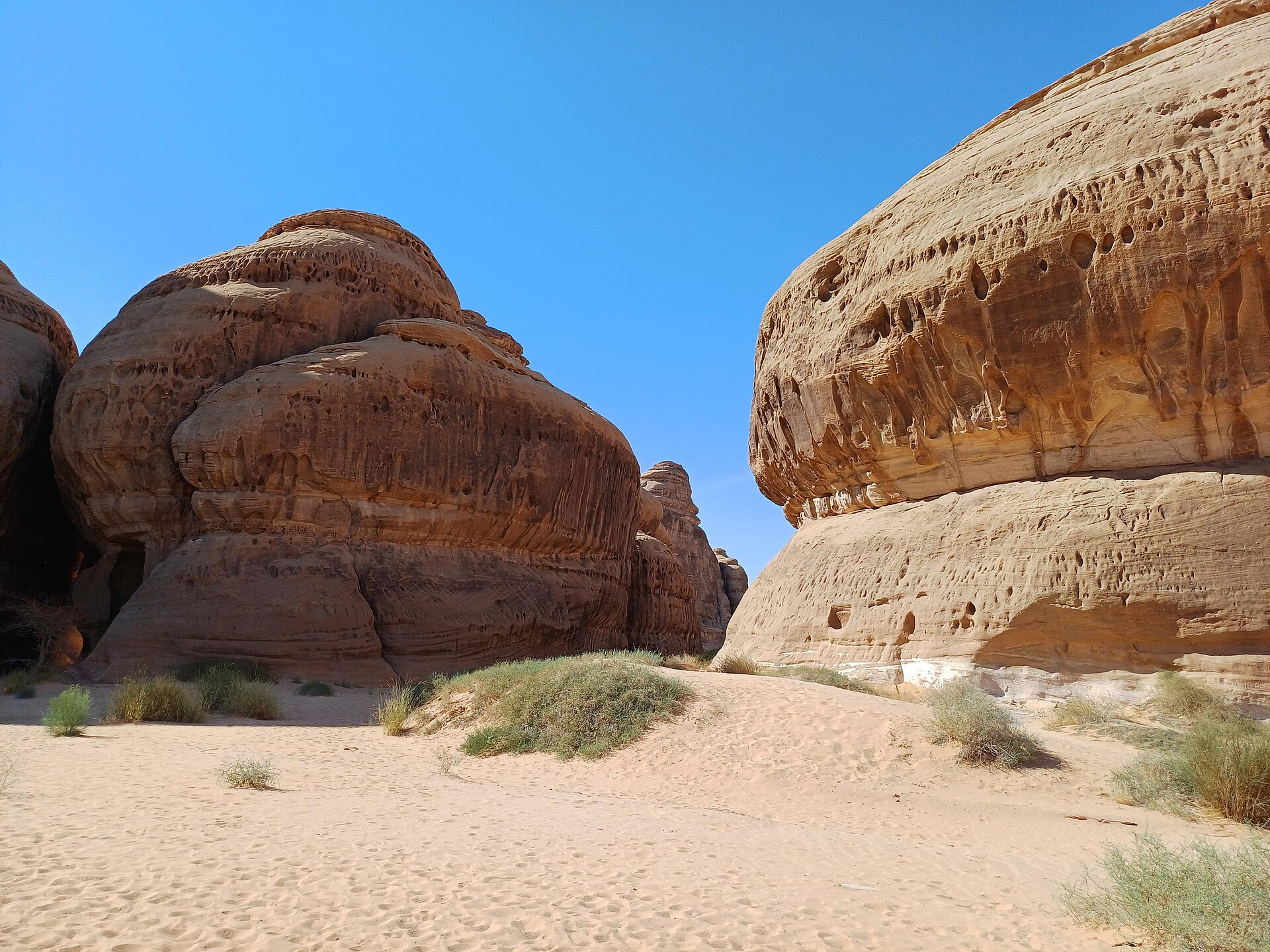
The Gharameel district of AlUla holds some of the most otherworldly formations — a maze of wind-sculpted mushroom rocks, stone needles and isolated columns that read almost like an alien landscape under blue-hour or astrophotography conditions. In 2024 the area was designated an International Dark Sky Reserve, making it one of the finest astrophotography locations in the world. See the guide to Saudi Arabia stargazing for full details on night sky photography here.
Hegra (Madain Saleh) — Saudi Arabia’s Petra
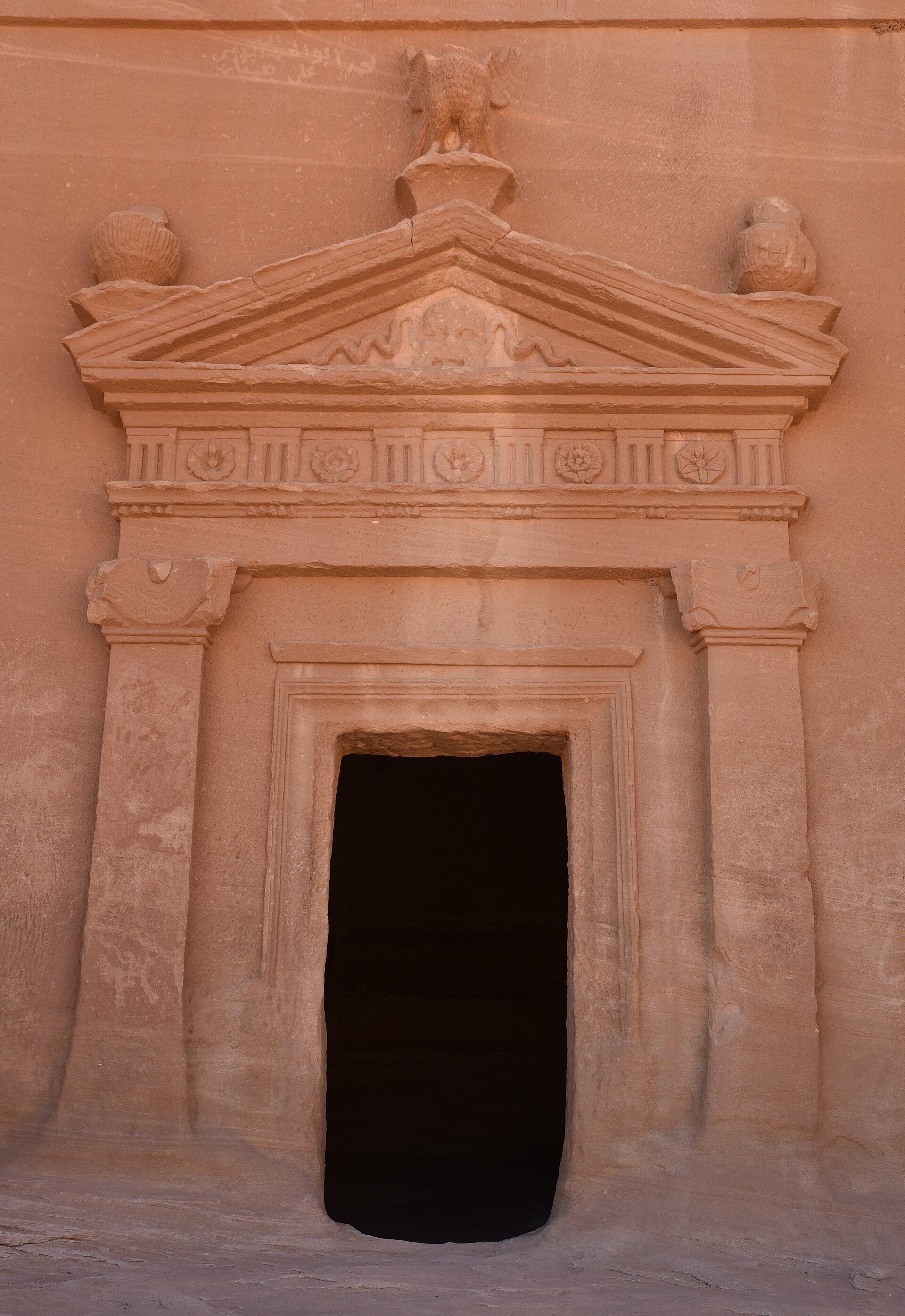
Hegra is Saudi Arabia’s first UNESCO World Heritage Site and arguably its single most photogenic location. The 131 preserved Nabataean tombs — cut directly into the sandstone massifs by master craftsmen between the 1st century BC and 1st century AD — are monumental in scale and near-perfect in condition. Unlike Petra, there is no tourist infrastructure crowding the shots. The facades are clean. The foreground is desert.
The key photographic challenge at Hegra is the sheer size of the tombs: the largest, the Qasr Al Farid (the Lonely Castle), stands 22 metres high and requires a very wide angle — 16mm or wider on full frame — to capture in full. The best light falls on the east-facing facades from 30 minutes after sunrise to about 09:00, when the low angled sun picks out every carved detail in sharp relief. Afternoon light suits the west-facing tombs.
Access to Hegra requires booking through Experience AlUla — independent self-drive access to the archaeological site is not permitted. Tours depart in vintage Land Rovers, open-top 4x4s or hop-on hop-off buses. Photography is permitted freely within the site; commercial shoots and professional lighting equipment require advance permission from the Royal Commission for AlUla (RCU). For deeper coverage of the site, see the AlUla and Hegra guide.
Wadi Disah — The Secret Canyon
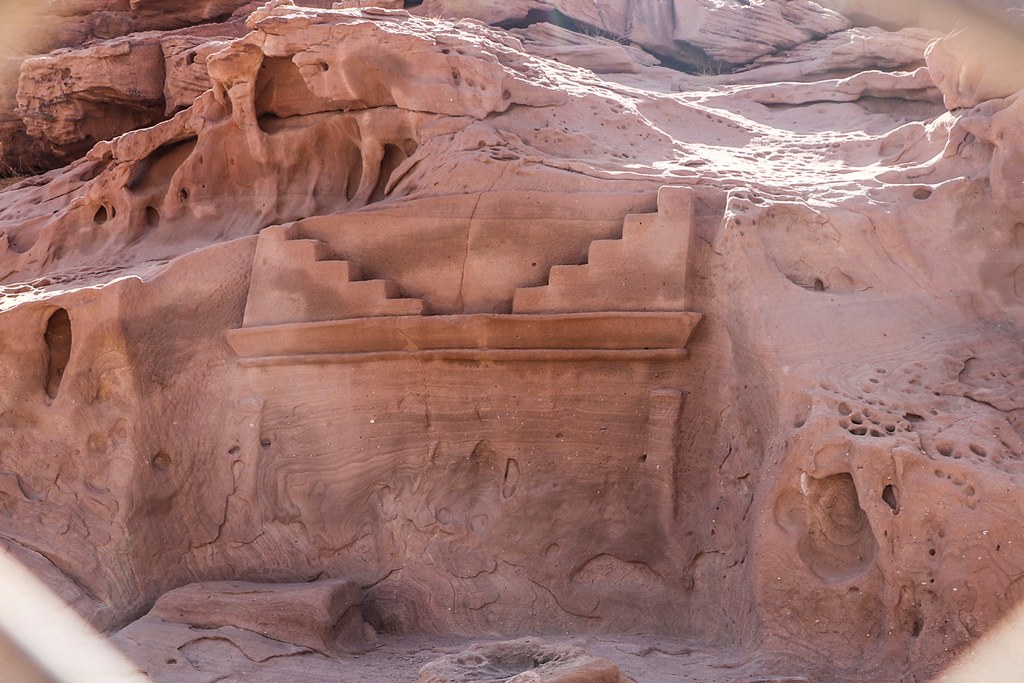
Located in the Tabuk region roughly 80 kilometres south of Tabuk city, Wadi Disah (also called Wadi Qaraqir) is a 15-kilometre sandstone canyon that remains significantly less visited than AlUla despite being equally spectacular. The canyon walls reach 300 metres in height in places, and the valley floor is threaded with palm groves and freshwater springs — an abrupt contrast to the surrounding desert. Ancient Nabataean tomb facades are carved directly into the canyon walls.
Unlike the heavily managed AlUla experience, Wadi Disah rewards self-drive or off-road exploration. The gorge narrows dramatically in its southern section, creating natural frames and compression effects that benefit telephoto lenses (200–400mm) as much as ultra-wide work. Dawn light from the eastern rim is exceptional; at midday the high canyon walls create natural diffusion. See the dedicated guide to Tabuk and Wadi Disah for access logistics and road conditions.
Asir — Mountains, Mist and Colour
The Asir region in the southwest of Saudi Arabia offers a completely different visual vocabulary from the northwest. The Asir Mountains rise to over 3,000 metres above sea level, and during winter and early spring they are regularly shrouded in mist and cloud. The traditional villages of the region — colourfully painted mud-brick houses clinging to vertiginous escarpments — have been compared architecturally to the villages of Yemen and Morocco.
Rijal Almaa, a village outside Abha that has been inhabited continuously for over 3,000 years, is one of the most photogenic traditional settlements in the Arabian Peninsula. Its multi-storey tower houses, decorated with coloured stones and geometric patterns, are at their most striking in the low morning light. The nearby Asir National Park offers high-altitude forest landscapes — rare in Saudi Arabia — that photograph well in overcast conditions.
Diriyah — Mud-Brick Architecture in the Capital
The UNESCO-listed At-Turaif district of Diriyah, on the northwestern outskirts of Riyadh, is the ancestral home of the Al Saud dynasty and one of the finest examples of Najdi mud-brick architecture in the world. Tightly packed towers, fortified walls and the characteristic geometric patterns of the Najdi style make it an exceptional location for architectural photography. The site is open to independent visitors and is well-lit for evening visits. For the full Saudi Instagram and photography spots guide, Diriyah ranks among the top five locations in the country.
The Empty Quarter (Rub’ al Khali) — Dunes Without End
For classic desert landscape photography, nowhere compares to the Rub’ al Khali — the Empty Quarter — the largest continuous sand desert in the world at approximately 650,000 square kilometres. The highest dunes, reaching 250 metres in the Uruq Bani Ma’arid area, create the flowing, graphic compositions that define desert photography: curving crests, knife-edge ridges, and the alternation of light and shadow across immense curved surfaces. Access is possible from the town of Shaybah in the east or from the UAE in the south; a guide with a 4WD convoy is essential.
Guided Photography Tours — Who to Book With
A growing number of specialist photography tour operators now run dedicated workshops in Saudi Arabia, most running between October and March when temperatures are manageable and the light is best.
Max Rive Photography
Max Rive, the Dutch award-winning landscape photographer, runs a dedicated Saudi Arabia photography tour and workshop that covers both Wadi Disah and AlUla. The itinerary begins in Tabuk, with arrival at Tabuk Regional Airport before 17:00 on Day 1. Days 2–3 focus on Wadi al-Disah, shooting mountain formations with cave and stone patterns at sunset. The group then moves to AlUla for the final days, targeting the iconic rock formations at both sunrise and sunset. The package includes all processing videos and Rive’s presets. The total value is approximately $2,250 USD; current pricing and open dates are on his website.
Ollie Taylor Photography
Landscape and astrophotography specialist Ollie Taylor runs a Saudi Arabia workshop specifically focused on the Gharameel region of AlUla — the International Dark Sky Reserve. Participants travel deep into the desert with experienced guides to photograph geological formations under star-filled skies. The workshop includes planning and post-production instruction. Taylor has been running photography workshops since 2014 and the Saudi Arabia tour represents one of his flagship offerings. Pricing and dates are available at ollietaylorphotography.com.
Isabella Tabacchi Photography
Italian landscape photographer Isabella Tabacchi runs a small-group Saudi Arabia tour priced at USD 4,790 (including a non-refundable USD 1,500 deposit). February is the preferred timing, when temperatures are around 20°C, allowing maximum outdoor shooting time. The tour focuses on Al Disah Valley in the Tabuk region and includes personalised coaching, editing sessions, and portfolio review. The 2026 tour sold out; 2027 dates are available at isabellatabacchi.com.
Landscape Nomads
Landscape Nomads offers a dedicated 5-day immersion in Wadi al-Disah, based in apartments within the valley itself — directly adjacent to the key shooting locations. Days are structured around early-morning first-light sessions and sunset caves shoots. Days 4–5 push into the southern valley to locations known only to local guides, with optional night-sky sessions. Breakfasts from the local fruit farm are included. Details at landscapenomads.com.
Aytek Cetin Photography
Turkish landscape photographer Aytek Cetin leads immersive multi-destination tours covering AlUla, Wadi Disah, Tabuk and NEOM — offering a broader geographic sweep than most single-destination workshops. The itinerary is built around dramatic light conditions and his tours are led personally. Current pricing and availability at aytekcetin.com.
Young Pioneer Tours
Young Pioneer Tours offer bespoke photography tour packages for Saudi Arabia, noting that — as the country recently opened to tourists — this is the optimal window to document locations before they become mainstream. They can construct tailored itineraries for all media needs, from solo trips to larger group productions. Their approach suits photographers who want flexibility rather than a fixed workshop format. See youngpioneertours.com.
Self-Drive Photography — Planning Your Own Route
Self-drive photography in Saudi Arabia is entirely feasible and, for many locations, superior to guided tours simply because it gives you complete control over timing. A tourist e-visa is required before arrival — see the full Saudi Arabia visa guide 2026 for the step-by-step process. The e-visa is issued within minutes online and allows stays of up to 90 days per year.
The most productive self-drive photography circuit combines Tabuk → Wadi Disah → AlUla → Hegra, covering approximately 600 kilometres. Roads are excellent throughout; a standard rental car is sufficient for Wadi Disah and AlUla. A 4WD is advisable if you want to explore deeper into the canyon or access more remote Hegra outliers. The drive from Wadi Disah to AlUla takes around 3–4 hours on the main highway. Plan 2–3 days in Wadi Disah and 3–4 days in AlUla to photograph each location properly at both golden hours.
Timing is critical. The best overall season is October to March: temperatures range from 10–25°C in AlUla, and the lower sun angle throughout the day means softer, more directional light compared to summer. April through September brings temperatures above 40°C in most locations — shooting is effectively limited to the hour after sunrise and the hour before sunset, with the rest of the day unworkable. Winter (December–February) can occasionally bring overcast skies that provide exceptional diffuse light for heritage site photography.
Photography Permits and Rules
Understanding Saudi Arabia’s photography rules is essential before visiting heritage sites or engaging in any commercial work. A full breakdown is in the dedicated Saudi Arabia photography rules guide; the key points are summarised here.
Personal Photography
Personal, non-commercial photography is generally unrestricted in public outdoor spaces, including at most of Saudi Arabia’s natural landmarks. At heritage sites like Hegra and Jabal Ikmah, photography is permitted from designated pathways. Tripods are often viewed as professional equipment — at some managed sites they require advance notice or a permit even for personal use. Always ask the site guide before setting up a tripod inside a managed archaeological zone.
Commercial Photography
Any photography intended for commercial use — advertising, stock licensing, paid assignments — requires a photography permit from the Saudi Film Commission (or in AlUla, from the Royal Commission for AlUla). Permits are issued per-project and specify the locations, dates, and equipment covered. The Saudi Film Commission permit process has become significantly more streamlined since 2021 but still requires advance planning; allow 4–6 weeks minimum for commercial projects.
Drone Photography
Drone rules are among the strictest in the region. As of 2025, foreign visitors cannot independently register drones or obtain GACA (General Authority of Civil Aviation) flight permits — only Saudi residents with a national ID can register unmanned aerial vehicles. All drones must be registered before flight, must stay below 150 metres altitude, and must remain within visual line of sight. Sensitive areas — government buildings, military facilities, royal palaces, airports and their surrounds — are absolute no-fly zones. Even photographically irrelevant flights near these zones can be interpreted as a security risk. In practice, foreign photographers should assume drone use is not possible without a production company partner who can handle GACA registration and sponsorship.
Cultural and Privacy Rules
Photographing people in Saudi Arabia without explicit consent is a serious cultural and legal issue. Women, families and children are particularly sensitive subjects; pointing a camera at a person without their permission — even in a public space — can result in confrontation or police involvement. Markets, traditional souqs and populated areas require a particularly careful approach. When in doubt, put the camera down and ask first. A friendly interaction in Arabic (even a few basic phrases) almost always results in a warm yes. Never photograph government buildings, military installations, embassies or royal residences.
Golden Hour and Light Conditions
Saudi Arabia’s desert light is, by any objective measure, extraordinary. The combination of low atmospheric humidity, minimal pollution and high altitude at many sites creates conditions where the first and last light of the day are prolonged, warm and directional for considerably longer than in more temperate climates.
In AlUla in November, for example, golden hour begins approximately 60 minutes before sunset and lasts nearly 40 minutes — significantly longer than the 15–20 minutes you might expect in northern Europe. The sandstone formations amplify this warm light, glowing in shades of amber, terracotta and deep red that cannot be reproduced in post-production if the underlying light wasn’t there. Sunrise shoots add a subtle blue-hour quality to the same formations.
For specific timings: Elephant Rock opens at 16:00 daily and the best golden-hour shots happen between 17:30 and the 40 minutes before sunset (which varies by season). The east-facing Hegra tombs are best in the first two hours after sunrise. Wadi Disah’s high canyon walls create natural shadows throughout the day, with the narrowest sections best in mid-morning when the sun reaches the valley floor. See the broader Saudi Arabia photography spots guide for additional location-specific timing notes.
AlUla has also become a world-class astrophotography destination since the Gharameel area received its International Dark Sky Reserve designation. Milky Way photography is possible from late winter through early autumn; the reserve is progressively replacing its lighting infrastructure with dark-sky-compliant downlighting. For planning astrophotography sessions, the Saudi Arabia stargazing guide covers lunar calendars, best positions and tour options.
Equipment Tips for Desert and Heat Photography
The Saudi desert environment is demanding on photographic equipment in ways that differ from other challenging climates. Heat, blown sand, and the extreme transition from air-conditioned interiors to outdoor conditions are the primary threats.
Sand and Dust Protection
Fine desert sand penetrates everything. Use a weather-sealed camera body if you have one; if you don’t, use a neoprene rain sleeve for added protection. Never change lenses in wind — even a brief gust can deposit enough fine particles on a sensor to require professional cleaning. Carry a rocket blower and soft brush at all times. Lens hoods serve double duty in the desert: they block direct sun and provide a physical barrier to airborne dust. Zip-lock freezer bags make excellent emergency weather protection for bodies and lenses.
Keep your camera bag closed when not actively shooting. Grit and dust will accumulate in a bag left open on the ground faster than in almost any other environment. A roll-top drybag-style camera bag provides better protection than traditional flap closures in sandy conditions.
Heat Management
Modern mirrorless and DSLR bodies overheat in prolonged direct sun above 35°C — not necessarily from the air temperature alone, but from solar radiation hitting the black body directly. Keep your camera in a light-coloured or reflective bag or shade it with a lens cloth when not shooting. Store memory cards and batteries in an insulated pouch: lithium batteries discharge faster in heat, and extreme temperatures accelerate this. Carry at least double the number of batteries you think you need.
The midday break — typically 11:00 to 15:00 — is a necessary part of desert photography schedules, not just for the photographer’s comfort but for equipment welfare. Use this time in air-conditioned accommodation to back up cards, charge batteries and clean equipment. Do not transition directly from cold air conditioning to the outside heat with lenses mounted — condensation can form on optical surfaces. Allow 15 minutes in a transitional temperature before shooting.
Recommended Lens Kit
For desert landscape photography in Saudi Arabia, a practical three-lens kit covers almost all situations: a wide-angle zoom (16–35mm or equivalent) for canyon walls and tomb facades, a standard zoom (24–70mm) for general flexibility with fewer lens changes in dusty conditions, and a telephoto (100–400mm) for compressing distant rock formations and isolating details on cliff faces. A solid carbon-fibre tripod is essential for dawn and dusk shooting; bring a ballhead with a built-in spirit level for the precise horizon control that desert compositions demand. UV filters on every lens act as inexpensive sacrifice layers against wind-driven particles.
Best Times to Visit
The optimal photography season is November through February. Temperatures are manageable (15–25°C in AlUla, cooler in Asir), the low winter sun provides extended golden hours throughout the day, and clear skies are the norm. December and January occasionally bring overcast days with beautiful diffused light — excellent for heritage site shooting without harsh shadows. March and early April are still workable but temperatures begin climbing. Ramadan (which falls in different calendar months each year) can affect access hours at some sites and should be checked before booking.
Avoid May through September for intensive outdoor photography. Daily maxima regularly exceed 45°C in AlUla and the Tabuk region, and outdoor shooting is essentially limited to the first 60 minutes after sunrise and the last 60 minutes before sunset.
Explore More
- Saudi Arabia Travel Guide 2026 — the complete hub
- Photography Rules in Saudi Arabia — permits, drones, cultural etiquette
- AlUla and Hegra Guide — the full breakdown of Saudi Arabia’s greatest site
- Saudi Arabia Stargazing — astrophotography locations and dark sky reserves
- Tabuk and Wadi Disah — canyon photography in the northwest
- Saudi Arabia Visa Guide 2026 — e-visa, costs and application process