
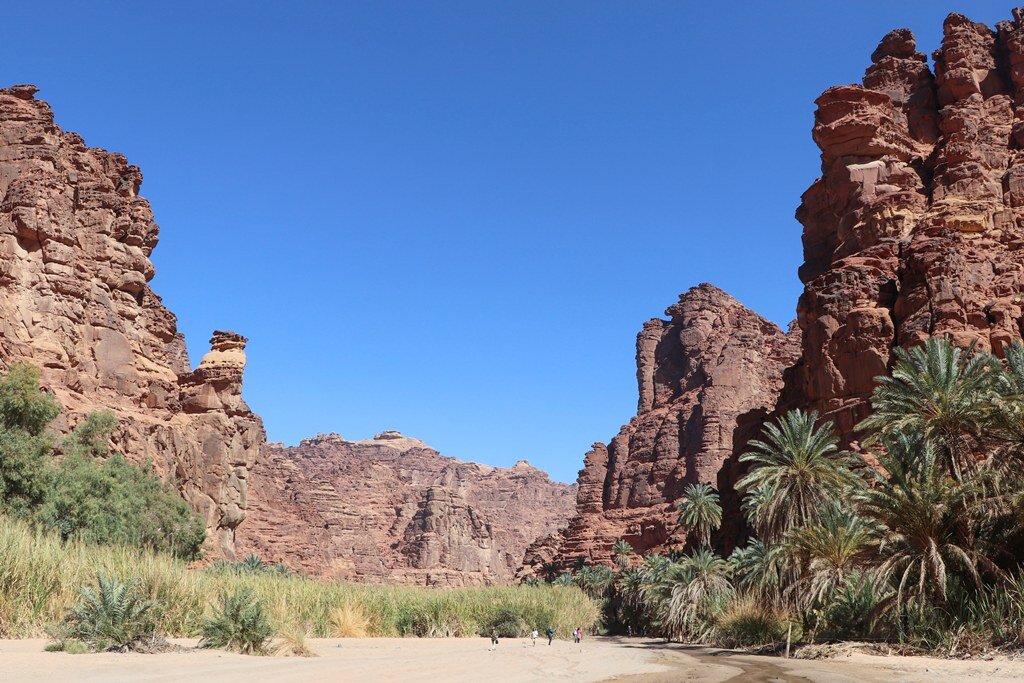
Wadi Disah — also known as Wadi Qaraqir — is a 15-kilometre-long canyon cutting through the Jebel Qaraqir sandstone massif in Tabuk Province, northwest Saudi Arabia. With towering red cliffs rising up to 500 metres, spring-fed streams nourishing palm groves, and Nabataean tomb facades carved into the rock, this is one of the most dramatic natural landscapes in the Arabian Peninsula. Often called Saudi Arabia’s Grand Canyon, Wadi Disah combines raw geological spectacle with genuine archaeological significance — and remains far less crowded than better-known destinations. Whether you are planning a day trip from Tabuk City or a multi-day camping expedition, this guide covers everything you need to know to visit Wadi Disah in 2026.
Best Time to Visit: October to March (daytime highs of 15–25 °C / 59–77 °F)
Getting There: 250 km south of Tabuk City via Route 8900 (approximately 2.5–3 hours by car); 4WD required for the final 27 km inside the wadi
Visa Required: Yes — tourist e-visa
Budget: $50–$120 USD per day (fuel, local 4×4 hire, food); no entry fee to the canyon itself
Must-See: Sandstone canyon walls, Nabataean tomb facades, natural palm-lined springs
Avoid: Visiting in summer (June–August), when temperatures exceed 40 °C and conditions are dangerous for hiking
What Is Wadi Disah?
The Arabic name “ad-Disah” translates roughly to “the valley of dense palms,” and the description is accurate. Three separate canyons converge in this area, forming a network of wadis that cut through the western edge of the Arabian Plateau. The main canyon — running roughly east to west through the Jebel Qaraqir massif — is the section most visitors explore.
At the eastern entrance, the cliff walls already exceed 100 metres in height. As you travel west, the gap between the canyon floor and the tallest ridges widens to around 500 metres. The geological forces responsible are straightforward: over millions of years, streams cutting headward into low-dipping massive sandstone have carved deep canyons with near-vertical walls. Erosional outliers survive as buttes and pillars of varied shapes — formations that inevitably draw comparisons to Jordan’s Wadi Rum and the American Southwest.
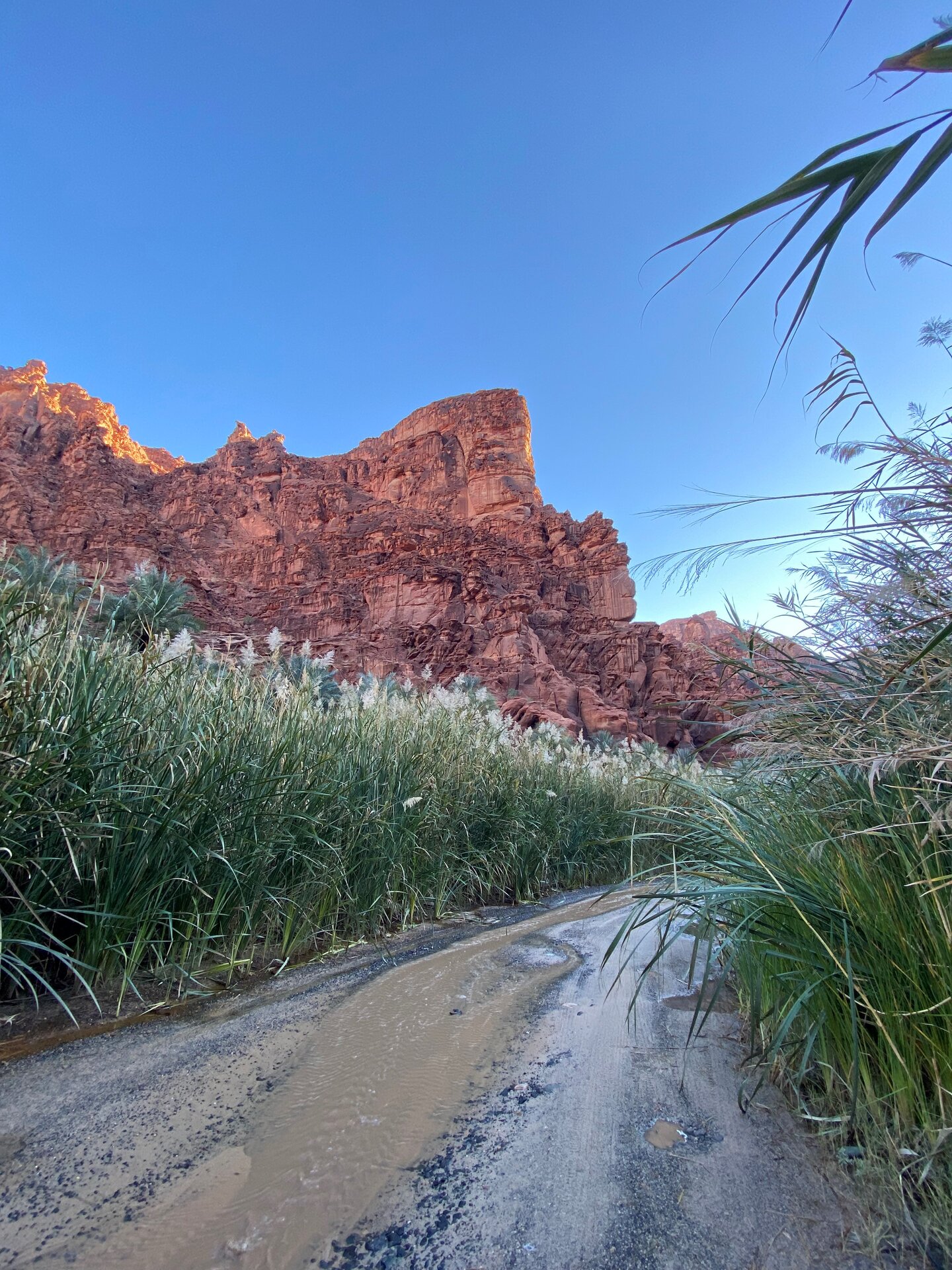
But Wadi Disah differs from those arid counterparts in one important way: water. Natural springs — including al-Zarqa’, al-Qitar, al-Tarif, and al-Namtiyah — flow year-round from the base of the sandstone, sustaining a dense ribbon of vegetation along the canyon floor. Tall grasses, papyrus, oleander, henna bushes, and forests of date palms thrive in this narrow corridor, creating a startling contrast against the dry red rock overhead.
Why Visit Wadi Disah?
Most international visitors to Saudi Arabia gravitate toward Riyadh, Jeddah, or the Nabataean tombs at Hegra in AlUla. Wadi Disah offers something different: a landscape that feels genuinely wild, with minimal tourist infrastructure and no crowds. Here is what makes it worth the journey from Tabuk:
- Geological drama. Sandstone cliffs in shades of ochre, rust, and copper rise hundreds of metres on either side of you. The scale is immense — photographs rarely capture the full height of the walls.
- Year-round springs and vegetation. The perennial water flow through the canyon creates a microclimate unlike anything else in northwest Saudi Arabia. Walking between palm groves with cliffs overhead is a genuinely surreal experience.
- Nabataean archaeology. Tomb facades, inscriptions in Nabataean and early Arabic Kufic script, and settlement ruins connect Wadi Disah to the same civilisation responsible for Petra in Jordan and Hegra in AlUla.
- Solitude. While visitor numbers are growing, Wadi Disah is still far less visited than AlUla or the Red Sea coast. On a weekday outside peak season, you may have entire stretches of canyon to yourself.
- Adventure access. The canyon offers a spectrum of activity — easy walks along the valley floor, scrambles up side wadis, wild camping under the stars, and birdwatching in the palm groves.
- Hire a local 4×4 driver. Local drivers wait at the wadi entrance and offer jeep tours. A full circuit typically costs 200–300 SAR ($53–$80 USD) per vehicle, not per person. Negotiate before you set off, and if you are travelling with other tourists, consider splitting the cost.
- Book a guided tour from Tabuk. Several operators — including Dadan Saudi Tours and WadiTrip — run full-day excursions from Tabuk that include 4×4 transport, a guide, and meals. Expect to pay 400–600 SAR ($107–$160 USD) per person for a group tour.
- Water: Bring at least 3 litres per person per day. There are no shops or refill points inside the wadi.
- Food and snacks: Stock up in Tabuk. The village of Al Disah has very limited supplies, and there is nothing inside the canyon.
- Sun protection: Hat, sunscreen, and sunglasses are essential. The canyon floor can reflect heat off the sandstone walls.
- Sturdy footwear: Hiking boots or trail shoes with good grip. You will cross rocky terrain and shallow streams.
- Warm layers: If visiting October to March, nights inside the canyon are cold. A fleece or down jacket is necessary for camping.
- Offline maps: Mobile signal is minimal or nonexistent inside the wadi. Download offline maps of the area before you leave Tabuk.
- First aid kit: The nearest medical facility is in Al Disah village or Tabuk City. Carry basic supplies.
- NEOM and the Gulf of Aqaba coast: The futuristic megaproject zone and its Red Sea coastline lie to the northwest of Tabuk. The beaches and coral reefs around Sharma and Gayal are among the most pristine in Saudi Arabia.
- Al-Bad’ (Caves of Shuaib): Ancient Nabataean and Midianite tombs carved into rock near the town of Al-Bad’, roughly 225 km northwest of Tabuk on the road toward the Gulf of Aqaba. Often called the “Caves of Jethro” in reference to the biblical and Quranic figure.
- Tabuk Castle: A historic Ottoman-era fortress in the centre of Tabuk City, associated with the Prophet Muhammad’s expedition to Tabuk in 630 CE. Recently restored and open to visitors.
- Jabal al-Lawz: A dramatic mountain peak southeast of Tabuk, sometimes covered in snow during winter months. Popular with hikers and photographers.
- Tabuk City hotels: The widest selection of accommodation is in Tabuk, 250 km north. International chains including Hilton Garden Inn Tabuk and Holiday Inn Tabuk operate here, alongside budget local hotels. See our Saudi Arabia Hotels Guide for booking tips.
- Al Disah village guesthouses: A small number of local guesthouses and rest houses operate in and around Al Disah village. These are basic but functional, and offer the advantage of proximity to the canyon entrance.
- Wild camping: As described above, camping inside the wadi is permitted and is the most immersive way to experience the canyon. Come fully self-sufficient.
- Tabuk Travel Guide — complete guide to northwest Saudi Arabia, including NEOM, Wadi Disah, and the Gulf of Aqaba
- NEOM Travel Guide — the futuristic megaproject and Red Sea coastline
- AlUla Travel Guide — ancient Nabataean tombs, desert landscapes, and cultural festivals
- Hegra (Mada’in Salih) Guide — Saudi Arabia’s first UNESCO World Heritage Site
- Abha and the Asir Region — highlands, cool climate, and dramatic mountain scenery
- Riyadh Travel Guide — the capital city, from Edge of the World to Diriyah
- Jeddah Travel Guide — the Red Sea gateway, Al-Balad old town, and the Corniche
- Hajj 2026 Guide — pilgrimage planning, Mecca, and Medina
- Medina Travel Guide — the Prophet’s city and its historic sites
- Saudi Arabia Hotels Guide — where to stay across the Kingdom
- Saudi Arabia Visa Guide — every visa type explained, including the tourist e-visa
Getting to Wadi Disah
By Air
The nearest airport is Tabuk Regional Airport (TUU), located 5 km from the centre of Tabuk City. Saudia, Flynas, and Flyadeal operate direct domestic flights to Tabuk from Riyadh, Jeddah, and Dammam. Air Arabia flies direct to Tabuk from Dubai. International visitors will typically connect through Riyadh or Jeddah and take a domestic flight onward.
By Road from Tabuk
From Tabuk City, the drive to the village of Al Disah takes approximately 2.5 to 3 hours (250 km) via Route 8900. The road is paved and in good condition — a standard rental car will get you to the village without difficulty. The small town of Al Disah has basic supplies, but you should stock up on food, water, and fuel in Tabuk before setting out, as options along the way are limited.
Entering the Wadi
From Al Disah village, the road continues to the mouth of the canyon. Here, the asphalt gives way to a graded dirt track that runs approximately 27 km into the wadi. A 4WD vehicle is essential for this section — the terrain includes soft sand, stream crossings, and rocky patches. If you are driving a standard rental car, you have two options:
What to See and Do at Wadi Disah
Walk the Canyon Floor
The main draw is simply walking through the canyon itself. The full length of Wadi Disah stretches approximately 15 km, making a round-trip hike of about 14 km from the entrance. The terrain is generally rated as moderate — mostly flat with some rocky sections and shallow stream crossings — and does not require technical climbing gear. Allow 4 to 6 hours for a full exploration at a relaxed pace.
The canyon floor changes character as you move deeper. Near the entrance, the walls are lower and the vegetation sparse. Further in, the cliffs close in and grow taller, and the palm groves become denser. The most dramatic scenery is typically found in the middle and western sections of the wadi, where the cliff faces reach their maximum height.
Explore the Nabataean Archaeological Sites
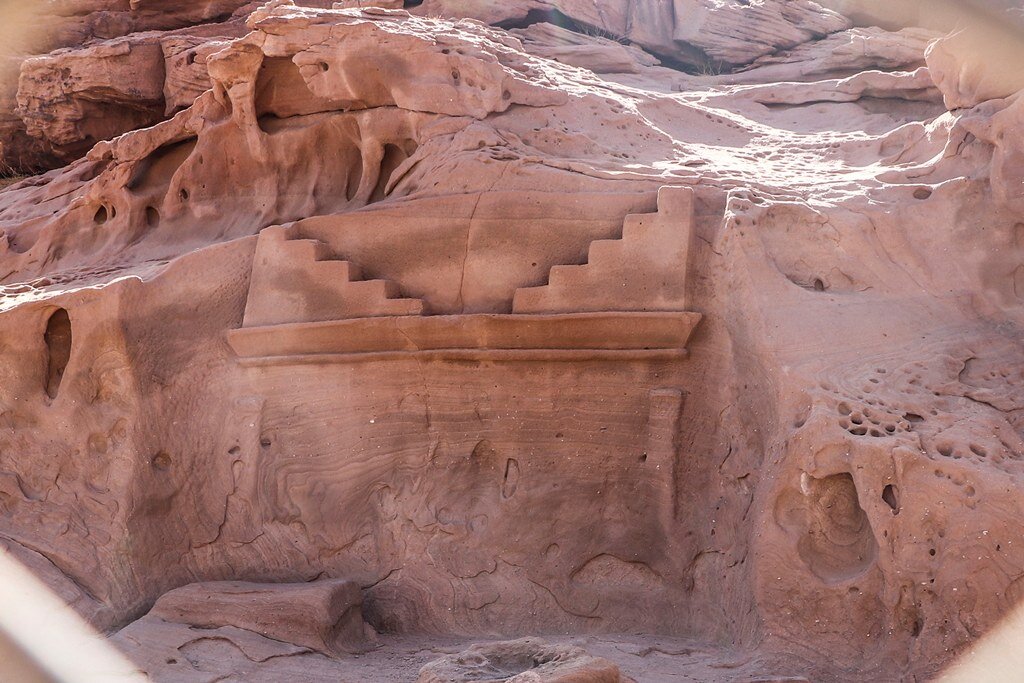
Wadi Disah was not always empty. The canyon sits within a broader area of Nabataean settlement — the same civilisation that built the famous rock-cut facades at Petra and at Hegra. In Wadi Disah, you will find unfinished Nabataean tomb facades carved into the lower cliff faces, their stepped crowstep designs clearly recognisable to anyone familiar with Petra or Mada’in Salih.
The broader Al Disah area also contains remnants of residential settlements — including the archaeological sites known as al-Musharraf, al-Sukhnah, and al-Maskunah — as well as petroglyphs and inscriptions in both Nabataean and later Arabic Kufic script. These are not behind fences or ropes; you can walk right up to them. Treat them with respect — do not touch or mark the carvings.
Visit the Natural Springs
Several named springs flow from the base of the canyon walls, feeding the permanent watercourse that runs through the wadi. Al-Zarqa’ (“the blue”) is the most frequently visited, with clear water pooling among reeds and grasses. The springs support the dense palm forests that give the valley its name, and create small oasis-like pools that attract birdlife.
Wild Camping
Camping inside Wadi Disah is permitted, and dozens of suitable spots exist along the canyon floor. However, there are rules to observe: campfires are not allowed (the vegetation is too dense and the fire risk too high), and ground-level sleeping is discouraged — a rooftop tent or elevated camp setup is recommended. Bring all supplies with you, including water purification if you plan to use spring water for drinking.
The experience of sleeping inside the canyon — with sandstone walls silhouetted against a sky dense with stars, and the only sound the wind moving through the palms — is reason enough to spend a night. There is no light pollution and no mobile signal in most of the wadi.
Birdwatching and Wildlife
The permanent water and dense vegetation make Wadi Disah a relative hotspot for wildlife in an otherwise arid region. Birdwatchers may spot raptors soaring along the cliff thermals, and smaller species in the palm groves. Gazelles have been recorded in the area. The wadi falls within the boundaries of the Prince Mohammed bin Salman Royal Reserve, a conservation area established by the Public Investment Fund in 2018 that covers a vast swathe of northwest Saudi Arabia.
When to Visit Wadi Disah
The best months to visit are October through March. During this window, daytime temperatures range from approximately 15 to 25 °C (59 to 77 °F), making hiking comfortable and camping pleasant. Nights can be cold — dropping to near freezing in December and January — so bring warm layers if you plan to camp.
From April to May and in September, conditions are manageable but increasingly hot, with daytime temperatures climbing toward 35 °C (95 °F). Early-morning starts are essential.
June through August should be avoided entirely. Temperatures routinely exceed 40 °C (104 °F), and the combination of intense heat, limited shade outside the canyon floor, and the physical demands of hiking makes summer visits genuinely dangerous.
Rainfall is rare but not impossible, particularly in winter. Flash flooding is a real risk in any wadi system — if rain is forecast, do not enter the canyon. Check weather conditions in Tabuk before you set out.
Practical Tips for Visiting Wadi Disah
What to Pack
Vehicle and Fuel
Fill your tank in Tabuk. There are fuel stations along Route 8900, but availability can be inconsistent. If you are driving your own 4WD, ensure your tyres are in good condition and you know how to reduce tyre pressure for sand driving. If you do not have a 4WD, do not attempt the track inside the wadi — you will get stuck.
Permits and Entry
As of early 2026, there is no formal entry fee or permit required to visit Wadi Disah. The area is open to visitors, though this may change as the Wadi ad-Disah Development Project under the Prince Mohammed bin Salman Royal Reserve continues to develop the site. International visitors need a valid Saudi tourist e-visa, which can be obtained online before arrival.
Respect the Environment
Wadi Disah is a protected area within the Royal Reserve. Take all rubbish with you — there are no waste collection points. Do not pick plants, disturb wildlife, or touch archaeological sites. Campfires are prohibited. The canyon has survived largely intact for millennia; it is the responsibility of every visitor to keep it that way.
Combining Wadi Disah with Other Tabuk Attractions
Wadi Disah is one of several remarkable destinations in Tabuk Province. If you are spending several days in the region, consider combining your visit with:
For a broader exploration of the Kingdom, see our guides to AlUla, Abha and the Asir Region, and the Hajj and pilgrimage routes.
Where to Stay Near Wadi Disah
There are no hotels inside Wadi Disah itself. Your accommodation options are:
Wadi Disah Development Project
On 20 November 2018, the Public Investment Fund (PIF) announced the Wadi ad-Disah Development Project as part of the broader Prince Mohammed bin Salman Royal Reserve. The project aims to develop sustainable tourism infrastructure while preserving the valley’s natural environment and wildlife. As of 2026, development is ongoing but the canyon remains accessible to independent visitors. Future plans may include improved trails, visitor centres, and managed camping facilities — but for now, the experience remains refreshingly unmanicured.
This development sits within the broader context of Saudi Arabia’s Vision 2030 tourism strategy, which aims to diversify the economy beyond oil and develop the Kingdom’s natural and cultural assets for international visitors.