
Renting a car is the single most liberating decision you can make when visiting Saudi Arabia. The Kingdom covers 2.15 million square kilometres — roughly the size of Western Europe — and its greatest treasures sit hundreds of kilometres apart, connected by some of the best-maintained highways in the Middle East. Whether you are planning a cross-country road trip from Riyadh to the sandstone canyons of AlUla, a weekend drive through the Asir highlands, or simply need the flexibility to explore a city on your own schedule, this guide covers everything you need to know: licence requirements, costs, insurance, rental companies, road rules, fuel prices, and the best driving routes in the Kingdom. It is part of our comprehensive Saudi Arabia travel guide and companion to our dedicated Saudi Arabia car rental overview.
Best Time to Drive: October to March (cooler temperatures, better visibility)
Getting There: Major airports in Riyadh (RUH), Jeddah (JED), and Dammam (DMM) all have on-site rental counters
Visa Required: Yes — tourist e-visa
Budget: $30–$50/day for a compact; $80–$133/day for SUV or premium; fuel under $0.60/litre
Must-Know: International Driving Permit strongly recommended; Saher speed cameras everywhere; minimum age 21
Avoid: Driving in summer midday heat (tyres and engines overheat); renting without full CDW insurance
Who Should Rent a Car in Saudi Arabia?
Not every visitor needs a rental car. If you are spending three days in Riyadh and plan to use ride-hailing apps like Uber and Careem, a rental may be unnecessary. But in these scenarios, a car transforms your trip:
- Road-trippers: The 1,395 km Highway 40 from Jeddah to Dammam, the Edge of the World escarpment outside Riyadh, and the drive through the Hejaz Mountains to Abha and Asir are among the great drives of the Arabian Peninsula.
- AlUla visitors: While organised tours exist, having your own vehicle lets you reach Elephant Rock at golden hour, drive to Dadan at your own pace, and explore the surrounding wadis. See our AlUla travel guide for full route details.
- Eastern Province explorers: The Dammam and Al Khobar corniche, Half Moon Bay, and the Hofuf oasis are spread across a wide area with limited public transport.
- Budget travellers on longer stays: Weekly and monthly rates (from $200/week or $800/month) can be cheaper than daily ride-hailing, especially outside Riyadh and Jeddah.
- Families: Car seats, extra luggage space, and the freedom to stop when children need a break make rentals the practical choice for families.
- Valid passport (for tourists) or Iqama residence permit (for residents)
- National driving licence from your home country
- International Driving Permit (strongly recommended)
- Credit card in the renter’s name for the security deposit (debit cards are generally not accepted)
- Printed or digital copy of your tourist e-visa
- Airport surcharge: Picking up at an airport terminal often adds a 10–15% concession fee.
- One-way drop-off: Returning the car at a different city (e.g., pick up in Riyadh, drop off in Jeddah) may incur a fee of SAR 500–1,500.
- Mileage caps: Some local companies include only 200–300 km/day. Lumi includes 300 km/day as standard; exceeding it costs SAR 0.50–1.00/km.
- Young driver surcharge: SAR 30–50/day for drivers aged 21–24.
- Additional driver fee: SAR 25–50/day per additional named driver.
- Late return: Returning the car more than 30 minutes late may be charged as a full extra day.
- Hertz: Extensive fleet, strong global loyalty programme (Gold Plus Rewards), reliable for airport pick-up.
- Avis: Winner of Saudi Arabia’s Leading Car Rental Company award in 2019 (World Travel Awards). Good nationwide coverage.
- Budget: Owned by the same parent company as Avis. Won the World Travel Awards multiple years from 2014–2018. Competitive economy rates.
- Sixt: German operator with a premium fleet. Good option for luxury and sports cars.
- Enterprise / National / Alamo: All three brands (same parent company) operate in Saudi Arabia. Enterprise has counters at all major airports.
- Europcar: Solid European brand with locations in Riyadh, Jeddah, and Dammam.
- Lumi (formerly United Car Rentals): Named Saudi Arabia’s Leading Car Rental Company in 2020. Known for competitive online pricing, a generous 300 km/day allowance, and a large fleet of newer vehicles. Strong presence across the Kingdom.
- Theeb Rent A Car: One of the oldest and largest Saudi rental companies. Over 40 branches nationwide. Particularly strong in Riyadh and the Eastern Province. Offers both conventional and Sharia-compliant rental agreements.
- Hanco Rent A Car: Well-established local operator with competitive rates, especially for longer-term rentals.
- Yelo: Budget-focused digital-first operator. Convenient app-based booking and competitive pricing for economy cars.
- Windscreen cracks and chips
- Tyre punctures and replacements
- Headlight damage
- Underbody and roof damage
- Damage caused by driving off-road (unless explicitly permitted)
- Damage while driving under the influence of alcohol or drugs
- Urban areas: 50–80 km/h (varies by road; watch signs carefully)
- Ring roads and expressways: 80–120 km/h
- Intercity highways: 120–140 km/h
- Seatbelts are mandatory for all passengers, front and rear.
- Mobile phone use while driving is strictly prohibited. Use a hands-free mount.
- Right on red is not permitted unless a green arrow is showing.
- Give way to vehicles already in a roundabout (traffic in the circle has priority).
- Flash-to-pass: On highways, drivers in the fast lane may flash their headlights to signal you to move right. This is standard practice, not aggression.
- Camel crossings: On intercity highways, particularly between Riyadh and the Empty Quarter, watch for camel crossing signs. A collision with a camel can be fatal. Reduce speed at dusk and dawn.
- Pray-time parking: During prayer times, some businesses close for 20–30 minutes. Traffic often drops suddenly as drivers pull over. Do not park on highways.
- Gasoline 91 (regular): SAR 2.18/litre (approximately $0.58/litre or $2.20/US gallon)
- Gasoline 95 (premium): SAR 2.33/litre (approximately $0.62/litre or $2.35/US gallon)
- Diesel: SAR 1.79/litre (approximately $0.48/litre or $1.81/US gallon)
- Do not move the vehicles. Leave all cars in their post-accident positions unless directed by a police officer. Moving them can interfere with fault assessment.
- Ensure safety. Turn on hazard lights. If on a highway, move passengers to the roadside barrier.
- Document everything. Take photos and video from multiple angles: damage to all vehicles, licence plates, road conditions, traffic signs, and any injuries.
- Report the accident. Call 920000560 (Najm hotline) or use the Najm mobile app (available on iOS and Android). For serious accidents with injuries, also call 999 (police) and 997 (ambulance).
- Provide your documents. The attending officer will need your passport, visa, home-country driving licence, IDP, and the digital car registration (Istimara) provided by the rental company.
- Receive your report. The official Najm accident report arrives within 24 hours by SMS or through the Najm app. This report is essential — no workshop in Saudi Arabia can repair a vehicle without it.
- Contact the rental company. Call the company’s emergency number (found on the rental agreement and key fob tag). They will handle the rest of the insurance and repair process.
- Book online in advance for the best rates and guaranteed vehicle class.
- Check mileage allowances. If you are planning a multi-city road trip, look for unlimited mileage or negotiate a higher cap.
- Download Google Maps offline maps for your driving region. Mobile data coverage can be patchy on remote desert highways.
- Bring a phone mount. Holding your phone while driving is a SAR 1,000 fine. A windscreen or dashboard mount is essential for navigation.
- Inspect the car thoroughly. Photograph every scratch, dent, and mark before driving off. Walk around the car with the agent and ensure all pre-existing damage is recorded on the rental agreement.
- Check the spare tyre and ensure the jack and wheel spanner are present. On desert roads, a flat tyre is a real possibility.
- Confirm the fuel policy. Most companies operate a full-to-full policy. Note the fuel level when you collect and return the car at the same level.
- Ask for a Salik/toll tag if the company provides one (currently, Saudi Arabia does not have a widespread toll road system, but this may change as new infrastructure is built).
- Carry water. Always have at least 3–5 litres per person when driving outside cities, particularly in summer.
- Never let the tank drop below quarter-full on intercity drives.
- Avoid driving between 11 am and 3 pm in summer (June–August). Tyre blowouts are common in extreme heat, and asphalt can soften.
- Use the Waze app for real-time traffic, speed camera alerts, and police checkpoint warnings. It is widely used by Saudi drivers.
- Night driving: Intercity highways are generally well-lit, but secondary roads outside cities are not. Watch for unlit vehicles and camels on the road after dark.
- Return the car with the same fuel level to avoid a refuelling surcharge (typically SAR 3–4/litre — double the pump price).
- Photograph the car at return, including the odometer and fuel gauge.
- Get a signed return receipt. The deposit hold on your credit card typically releases within 7–14 business days.
- Uber and Careem: Available in all major cities. Careem (owned by Uber) has deeper coverage in suburban areas. Cost-effective for city-only trips.
- Private drivers: Many hotels can arrange a driver for day trips. Expect SAR 500–800/day including fuel.
- SAPTCO buses: The Saudi national bus service connects major cities. Riyadh to Jeddah takes approximately 10 hours and costs SAR 150–250. Comfortable but inflexible.
- SAR (Saudi Arabia Railways): The Haramain High-Speed Railway connects Jeddah, Makkah, and Medina. The North-South Railway connects Riyadh to Qassim, Hail, and the phosphate regions.
- Domestic flights: Saudia and flynas offer frequent, affordable domestic flights. Riyadh to Jeddah takes 2 hours and costs from SAR 200–400 one-way.
- October–March (peak driving season): Temperatures range from 15–30°C in most regions. Perfect for road trips. This is also peak tourist season, so book rental cars early, especially around Saudi National Day (September 23), Riyadh Season events, and the Hajj period.
- April–May and September: Shoulder season. Warmer but manageable, especially in highland areas like Abha and Taif.
- June–August: Temperatures in Riyadh and the Eastern Province regularly exceed 45°C. Desert driving is genuinely dangerous in midday heat. If you must drive in summer, travel in early morning or after sunset.
- Ramadan: Driving during Ramadan is generally calmer during the day, but the 30 minutes before iftar (the evening fast-breaking meal) can see aggressive driving as people rush home. Stay off the roads during this window.
- Saudi Arabia Travel Guide 2026 — The complete guide to visiting the Kingdom
- Saudi Arabia Car Rental Overview — Prices, rules, and best road trips at a glance
- Riyadh Travel Guide 2026 — The capital city and gateway to the Edge of the World
- Jeddah Travel Guide 2026 — Gateway to the Red Sea and starting point for the Hejaz mountain drive
- AlUla Travel Guide 2026 — Hegra, Elephant Rock, and Saudi Arabia’s most spectacular landscapes
- Abha and Asir Travel Guide — The cool highlands of southwestern Saudi Arabia
- Dammam and Al Khobar Travel Guide 2026 — The Eastern Province coast and Al-Ahsa Oasis
- Saudi Arabia Hotels Guide — Where to stay across the Kingdom
- Saudi Arabia Visa Guide 2026 — Every visa type explained
Requirements for Renting a Car
Driving Licence
Saudi Arabia recognises valid national driving licences from 67 countries for a period of up to 90 days after entry. If you hold a licence from the UK, US, Canada, Australia, most EU member states, or any GCC country, you can legally drive in the Kingdom with your home licence alone.
However, an International Driving Permit (IDP) is strongly recommended for all tourists and is effectively required by most rental companies. The IDP serves as an official Arabic and English translation of your licence and costs approximately $35 from your national automobile association (AAA in the US, AA in the UK, NRMA in Australia). If your licence is not in Latin script — for example, licences from China, Japan, South Korea, or Russia — you will need either an IDP or a notarised Arabic translation.
Practical tip: Even if your home licence is technically accepted, always carry an IDP. Police officers at checkpoints and Saher camera violation disputes go more smoothly with a universally recognised document. Apply at least two weeks before travel.
Age Requirements
You must be at least 21 years old and have held a valid licence for a minimum of one to two years (policies vary by company). For luxury vehicles, sports cars, and high-performance models, the minimum age rises to 25. Drivers under 25 may face a young-driver surcharge of SAR 30–50/day at some companies.
Documents to Have Ready
How Much Does It Cost?
Car rental prices in Saudi Arabia are competitive by global standards. Fuel is extremely cheap (see below), and daily rates are lower than in most European countries.
| Vehicle Category | Daily Rate (approx.) | Weekly Rate | Monthly Rate | Best For |
|---|---|---|---|---|
| Economy (Toyota Yaris, Hyundai Accent) | $30–$40 | $180–$250 | $700–$900 | City driving, solo travellers |
| Compact SUV (Hyundai Tucson, Kia Sportage) | $45–$65 | $270–$400 | $900–$1,200 | Couples, light off-road |
| Full-size SUV (Toyota Fortuner, Nissan Patrol) | $70–$100 | $400–$600 | $1,200–$1,800 | Families, desert driving |
| Premium/Luxury (BMW 5 Series, Mercedes E-Class) | $100–$133 | $550–$800 | $1,600–$2,500 | Business, special occasions |
Money-saving tip: Book online at least 7 days in advance. Lumi, Theeb, and international aggregators like Discover Cars and Rentalcars.com frequently offer 15–23% online discounts compared to walk-in rates. Weekly packages typically save 20–30% over the equivalent daily rate.
Hidden Costs to Watch For
Best Car Rental Companies in Saudi Arabia
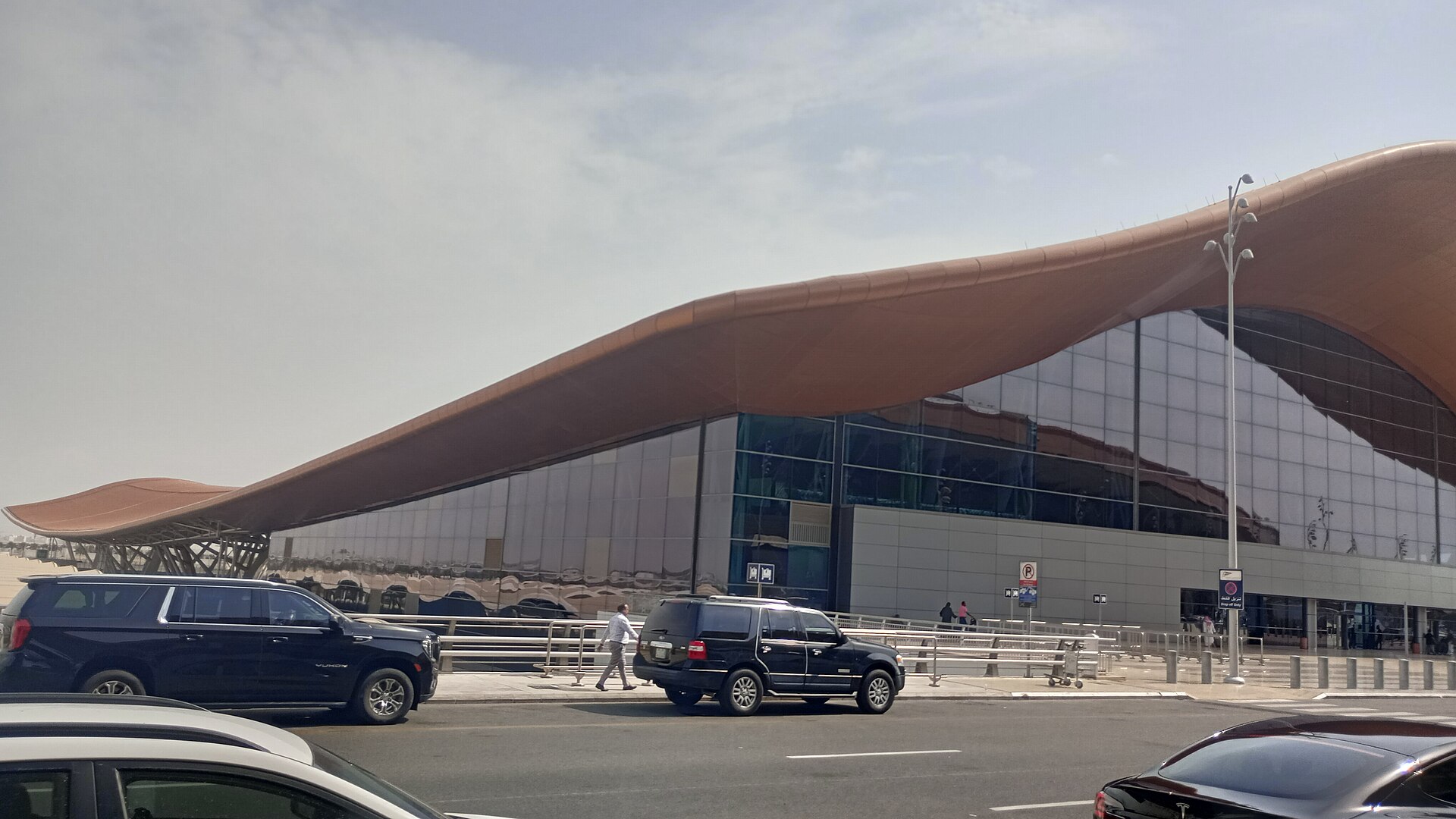
The Saudi car rental market is a mix of well-known international brands and strong local operators. All major providers have counters at the Kingdom’s three main airports — King Khalid International (Riyadh), King Abdulaziz International (Jeddah), and King Fahd International (Dammam).
International Brands
Local Operators
Which should you choose? International brands offer familiar loyalty programmes and standardised insurance terms. Local operators like Lumi and Theeb typically offer better value, larger fleets, and more personalised service. If you are making a long road trip through remote areas, Theeb’s extensive branch network provides better roadside support coverage.
Insurance: What You Need to Know
Insurance is the area where most tourists either overpay or, worse, leave themselves dangerously underinsured. Understanding the Saudi system will save you money and stress.
Types of Coverage
| Coverage Type | What It Covers | Typical Excess (Deductible) | Included in Base Rate? |
|---|---|---|---|
| Third-party liability | Damage to other vehicles/property | None | Always included (legally required) |
| Collision Damage Waiver (CDW) | Damage to your rental vehicle | SAR 5,000–18,768 | Usually included |
| Theft Protection (TP) | Theft of the vehicle | SAR 5,000–10,000 | Usually included with CDW |
| Super CDW / Full Protection | Reduces excess to zero; adds glass, tyres, underbody | Zero | Optional add-on ($10–$25/day) |
| Personal Accident Insurance (PAI) | Medical costs for you and passengers | Varies | Optional add-on |
What Standard CDW Does Not Cover
Be aware that standard CDW typically excludes:
Our recommendation: If you are planning any desert or gravel driving — including the paved-but-sandy approaches to sites like the Edge of the World or Elephant Rock — upgrade to full protection. The extra $10–$25/day is negligible compared to the SAR 18,768 (approx. $5,000) excess you could face with basic CDW. Third-party providers like RentalCover.com also offer comprehensive excess reduction policies from around $8–$12/day.
Driving Rules and Road Safety
Saudi Arabia drives on the right-hand side of the road. If you are coming from the UK, Australia, Japan, or any left-hand-driving country, give yourself extra time to adjust, especially at roundabouts and highway on-ramps.
Speed Limits
The Saher Camera System
Saudi Arabia operates one of the most advanced traffic enforcement systems in the world. The Saher system consists of over 8,200 smart cameras (2025 MOI data) that monitor speeding, phone use, seatbelt violations, unsafe lane changes, and running red lights. Saher cameras also perform average speed tracking between fixed points, so slowing down just for the camera will not help.
Key fines for tourists to know:
| Violation | Fine (SAR) | Approx. USD |
|---|---|---|
| Speeding (up to 25 km/h over limit) | 150–300 | $40–$80 |
| Speeding (25+ km/h over limit) | 900–2,000 | $240–$535 |
| Mobile phone use while driving | 1,000 | $267 |
| Seatbelt not worn | 300–1,500 | $80–$400 |
| Running a red light | 3,000–6,000 | $800–$1,600 |
| Not carrying a valid licence | 1,000–2,000 | $267–$535 |
Important for rental car drivers: Saher fines are attached to the vehicle, not the driver. The rental company will charge your credit card for any fines incurred during your rental period, often with an administration fee of SAR 50–100 per violation. Fines now appear within 24 hours on the Absher app. If you believe a fine was issued in error, you can challenge it through Absher or the Najm app within 30 days, uploading evidence such as your rental agreement showing you were not driving at that time.
Essential Driving Tips
Fuel Prices and Refuelling
One of the greatest advantages of driving in Saudi Arabia is the cost of fuel. Aramco sets petrol prices quarterly, and as of April 2026 the rates are:
For context, these prices are roughly one-third of what you would pay in the UK or Germany, and about half of US prices. A full tank in a compact car costs around SAR 100–130 ($27–$35).
Finding Petrol Stations
Petrol stations are abundant in cities and along major intercity highways. The major networks include Aramco, SASCO, Neft, and Fuelax. Google Maps and Waze both show petrol stations along your route, including real-time availability data. On remote desert roads, fill up whenever you pass a station — gaps of 150–250 km between stations are possible on routes like the road to the Edge of the World or through the Rub’ al Khali.
Fuel tip: Most rental cars in Saudi Arabia take Gasoline 91. Check the fuel cap or rental agreement before filling up. Using 95 when 91 is specified is fine but unnecessarily expensive; using 91 in a car that requires 95 can cause engine knock.
What to Do If You Have an Accident
Saudi Arabia has a centralised accident-reporting system called Najm (Najm for Insurance Services). Understanding the process before you need it will save you significant stress.
Step-by-Step After an Accident
Emergency numbers: Police: 999 | Ambulance: 997 | Najm: 920000560 | Civil Defence (fire): 998 | Highway Patrol: 993
Best Driving Routes in Saudi Arabia
A rental car unlocks some of the most spectacular road trips in the Middle East. Here are the routes that justify renting a car on their own.
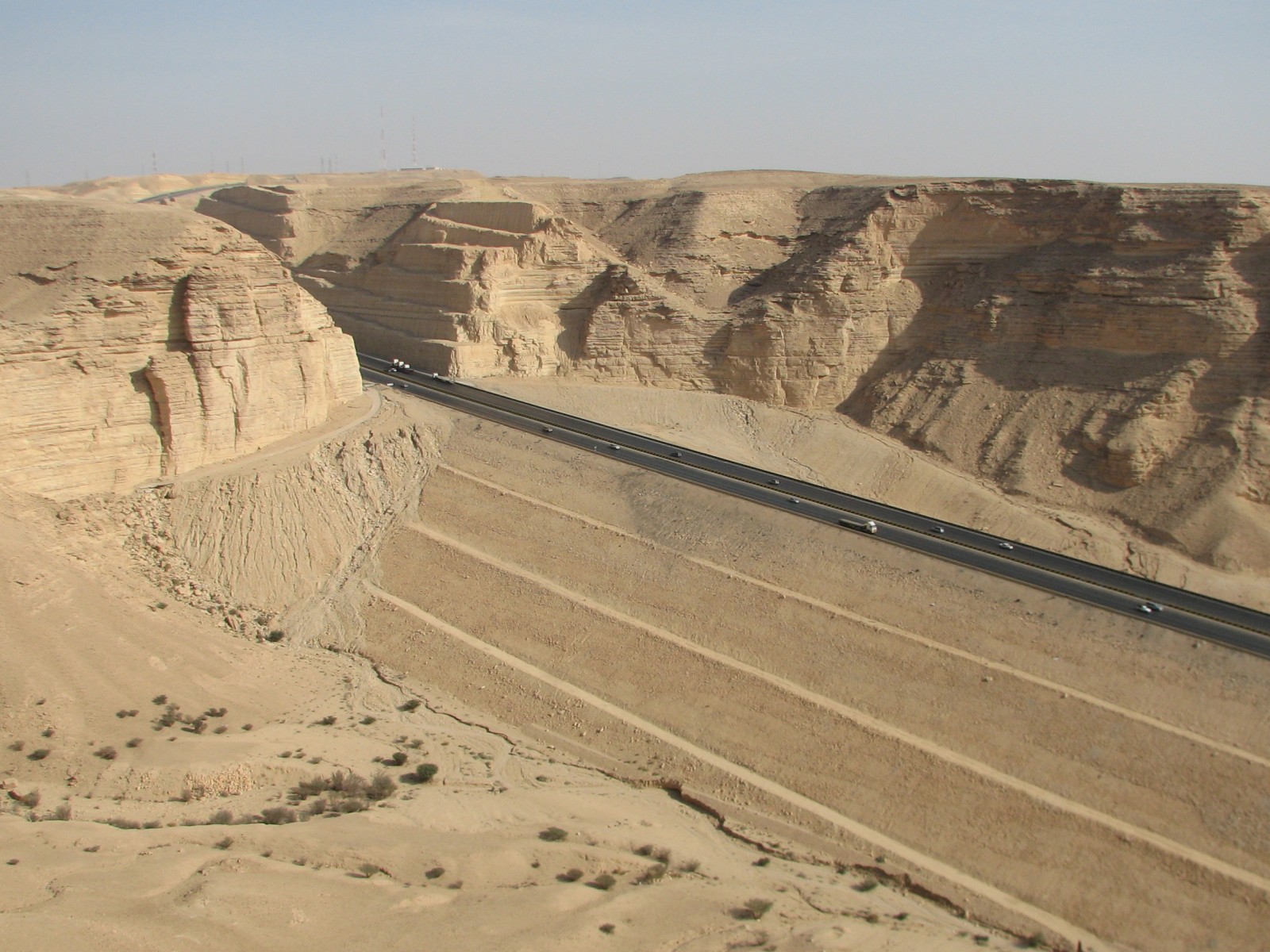
Riyadh to the Edge of the World (90 km)
The Jebel Fihrayn escarpment, known as the Edge of the World, is a 90-minute drive from central Riyadh. The final 15 km is unpaved but manageable in a 2WD SUV with higher clearance. Arrive by 3 pm to catch golden-hour light on the cliff face. Bring water — there are no facilities.
Jeddah to Taif via the Hejaz Mountains (170 km)
This drive climbs from sea level to over 1,800 metres through hairpin switchbacks and misty mountain valleys. Jeddah to Taif takes approximately 2.5–3 hours. Stop at the Al Hada viewpoint for panoramic views over the escarpment.
Highway 40: Riyadh to Jeddah (950 km)
The classic east-west crossing. Highway 40 is a six-lane controlled-access highway running 1,395 km from Dammam to Jeddah via Riyadh. The Riyadh–Jeddah section takes 8–9 hours of non-stop driving. Break it with an overnight in Taif. The stretch through the Tuwaiq Escarpment south of Riyadh is visually stunning.
AlUla Circuit (from Medina, 300 km one-way)
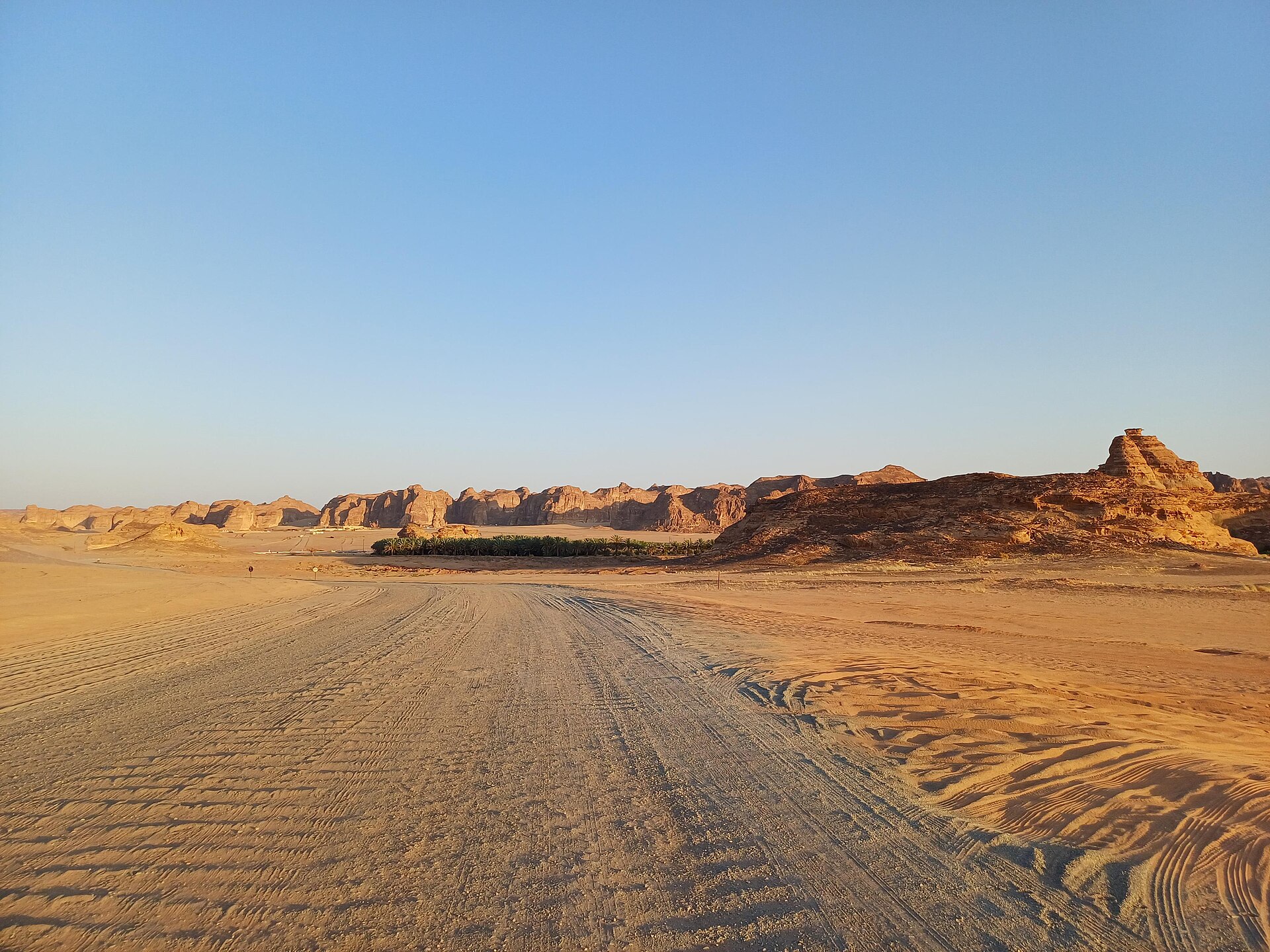
Drive from Medina northwest through the volcanic Harrat Rahat lava fields to AlUla. The landscape shifts from basalt plateaus to the red sandstone canyons around Hegra (Saudi Arabia’s first UNESCO World Heritage Site). Allow 3–4 days to explore Elephant Rock, Dadan, and the AlUla Old Town.
The Asir Mountain Road: Taif to Abha (500 km)
One of the most underrated drives in the Middle East. The road follows the Sarawat mountain ridge through juniper forests, terraced villages, and cloud-covered passes. Abha and the Asir region feel like a different country from the desert plains. Best driven November to February.
The Eastern Province Coast: Dammam to Hofuf (150 km)
From Dammam and Al Khobar, drive south to the Al-Ahsa Oasis — the world’s largest, with 2.5 million date palms — and the Unesco-listed Al-Ahsa cultural landscape. Stop at Half Moon Bay for a swim on the way.
Practical Tips for a Smooth Rental Experience
Before You Pick Up
At the Counter
On the Road
Returning the Car
Navigation and Connectivity
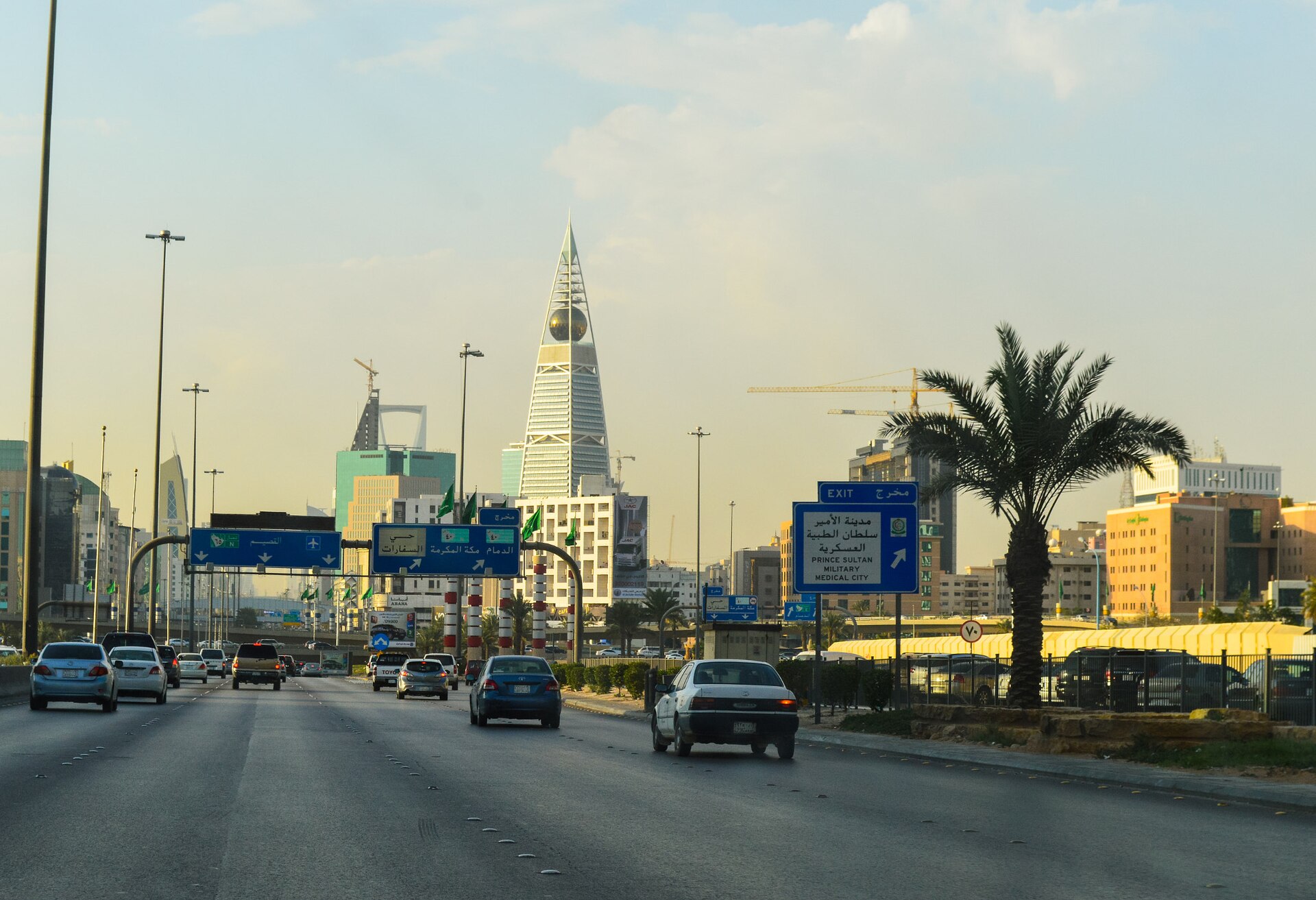
Saudi Arabia’s road signage is bilingual (Arabic and English) on all major highways and most urban roads. Highway signs follow international conventions with green boards for motorway directions and blue for local routes.
Google Maps is the most reliable navigation app for Saudi Arabia, with excellent coverage of even remote desert tracks. Waze is popular for real-time traffic and speed-camera alerts. Download offline maps before heading to remote areas — 4G coverage from STC, Mobily, and Zain is excellent in cities and along major highways, but drops off in desert areas far from settlements.
A local SIM card with data is highly recommended. Tourist SIMs from STC or Zain are available at airport kiosks from SAR 75–100 ($20–$27) for 10–30 GB of data, valid for 30 days. See our visa guide for more on arrival practicalities.
Women Driving in Saudi Arabia
Women have been legally permitted to drive in Saudi Arabia since June 2018. Female tourists can rent and drive cars on the same terms as male tourists — the same licence requirements, age minimums, and insurance options apply. All major and local rental companies serve female customers without distinction.
In practice, women report no issues driving anywhere in the Kingdom, including in rural and conservative areas. The change has been widely normalised, and women now represent a growing share of Saudi Arabia’s licensed drivers.
Alternatives to Renting a Car
If a full rental does not suit your trip, consider these alternatives:
Seasonal Considerations
When you drive matters almost as much as where you drive: