
Saudi Arabia’s heritage villages are among the most compelling reasons to visit the Kingdom. Scattered across mountain ranges, desert plateaus, and coastal plains, these preserved settlements reveal centuries of architectural ingenuity, tribal identity, and adaptation to extreme landscapes. From the quartz-studded towers of Rijal Almaa in the Asir highlands to the yellow mud-brick corridors of Ushaiger on the Najd plateau, each village tells a distinct story of the communities that built it. This guide covers the six most significant heritage villages open to visitors today — essential stops on any Saudi Arabia travel itinerary focused on history and culture.
Best Time to Visit: October to March (cooler temperatures across all regions)
Getting There: Domestic flights to Abha, Al Baha, AlUla, or Riyadh, then drive to villages
Visa Required: Yes — tourist e-visa available online
Budget: $50–120/day (entry fees are minimal; transport and accommodation are the main costs)
Must-See: Rijal Almaa (Asir), Dhee Ayn marble village (Al Baha), At-Turaif Diriyah (Riyadh)
Avoid: Visiting June–August when lowland temperatures exceed 45°C and mountain villages are crowded with domestic tourists
Why Saudi Arabia’s Heritage Villages Matter
The Kingdom holds eight UNESCO World Heritage Sites, and several more villages sit on the Tentative List awaiting inscription. What makes Saudi heritage villages distinctive is their diversity: Najdi mud-brick architecture in the central plateau looks nothing like the coral-stone merchant houses of Jeddah’s Al-Balad or the seven-story stone towers of the Asir highlands. Each building tradition evolved in direct response to local climate, available materials, and defensive requirements.
Under Vision 2030, the Saudi government has invested billions in heritage restoration. The Diriyah Gate Development alone represents a multi-billion-dollar transformation of the First Saudi State’s capital. The Royal Commission for AlUla has partnered with UNESCO to restore AlUla’s Old Town. In the southwest, the Soudah Peaks project announced by Crown Prince Mohammed bin Salman in September 2023 is bringing new infrastructure to Rijal Almaa and the Asir highlands.
For travellers, the practical result is that sites that were difficult to reach five years ago now have paved roads, visitor centres, and guided experiences — without losing the authenticity that makes them worth the journey.
Rijal Almaa — The Painted Towers of Asir
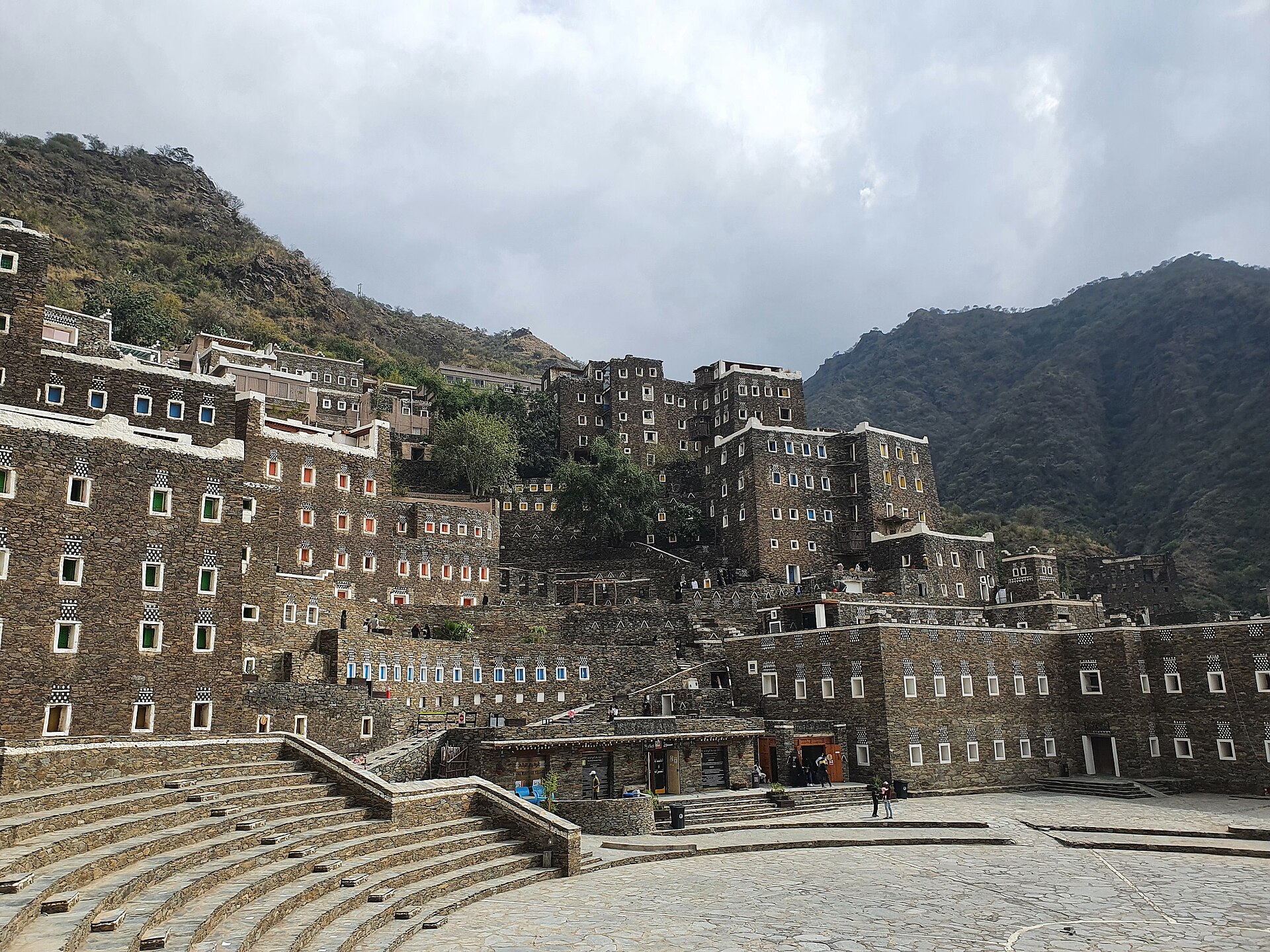
Rijal Almaa is the single most visually striking heritage village in Saudi Arabia. Located approximately 50 kilometres west of Abha in the Sarawat Mountains of Asir province, the village consists of around 60 multi-story stone fortresses, some rising seven to eight stories. The buildings are constructed from local stone and clay, their facades studded with lumps of sugar-white quartz that catch the mountain light. Wooden window shutters and doors are painted in vivid blues, greens, and reds.
History and Significance
The village is over 900 years old and sits on a historic trade corridor between Yemen and the Hejaz. It served as a commercial and cultural hub for the Almaa tribe, one of the Rijal sub-tribes of Asir. The village is on UNESCO’s Tentative List (added 2015) and is being prepared for full World Heritage nomination.
The interiors of many buildings feature Al-Qatt Al-Asiri, a traditional mural art form developed and applied exclusively by women. This 200-year-old painting technique uses bold geometric patterns in bright colours and was inscribed on UNESCO’s Intangible Cultural Heritage list in 2017 — making it one of the few living art traditions in the Arabian Peninsula with international recognition.
What to See
The Rijal Almaa Heritage Museum, housed in the Al-Alwan Palace at the centre of the village, contains over 2,000 antiquities and documents across 19 exhibition sections. Displays include manuscripts, agricultural tools, weapons, traditional costumes, and examples of Al-Qatt Al-Asiri art in situ. The village itself is compact enough to explore on foot in two to three hours, though photographers will want longer.
Practical Details
- Entry fee: Free (may change as Soudah Peaks development progresses)
- Getting there: 50 km west of Abha by road. Fly to Abha Regional Airport (AHB) from Riyadh or Jeddah, then drive or arrange a tour
- Best combined with: Abha city, Habala hanging village, Al Soudah viewpoint
- Time needed: 2–4 hours
- Entry fee: SAR 10 (~$2.70) for visitors over 12; sometimes free during special events
- Opening hours: 7:00 AM to 7:00 PM daily
- Getting there: 24 km from Al Baha city. Fly to Al Baha Domestic Airport (ABT) or drive from Taif (approximately 2.5 hours)
- Best combined with: Al Baha city, Hiking in the Sarawat Mountains
- Time needed: 1.5–3 hours
- Tip: Bring cash in small denominations; card payment is unreliable
- Entry fee: Free
- Getting there: 200 km northwest of Riyadh (~2-hour drive). No public transport; self-drive or arrange a private tour
- Best combined with: A Riyadh day trip, Edge of the World (Jebel Fihrayn)
- Time needed: 1.5–2.5 hours
- Tip: Visit early morning or late afternoon for the best light on the golden walls
- Salwa Palace: The largest structure, covering 10,000 square metres. Built in 1765, it served as the seat of government and royal residence. Its scale demonstrates the ambition of the early Saudi rulers
- Bayt Al-Mal: The state treasury building
- At-Turaif Bathhouse: An unusually well-preserved example of Arabian bathing culture
- Bujairi Terrace: Adjacent to At-Turaif, this restored area now houses restaurants, cafes, and retail spaces overlooking the historic district
- Entry fee: SAR 100 (~$27) for the Diriyah Pass, which includes At-Turaif and Bujairi Terrace access
- Opening hours: Saturday–Wednesday 10:00 AM to midnight; Thursday 10:00 AM to 1:00 AM; Friday 2:00 PM to 1:00 AM
- Getting there: 20 minutes by car from central Riyadh. Taxis and ride-hailing apps available
- Best combined with: Riyadh city sights, Wadi Hanifah walk, National Museum
- Time needed: 2–4 hours (evening visits recommended for atmosphere)
- Getting there: Fly to AlUla (ULH) from Riyadh or Jeddah; the Old Town is in the centre of AlUla
- Best combined with: Hegra (Mada’in Saleh), Elephant Rock, Dadan archaeological site
- Best time: October to March. AlUla hosts a winter arts and culture festival (typically December–March)
- Time needed: 1.5–3 hours for the Old Town; plan at least 2–3 days for the wider AlUla area
- Entry fee: Free to walk through the district; guided walking tours SAR 150–300 (~$40–80) for 3–4 hours
- Getting there: Central Jeddah, easily accessible by taxi or ride-hailing
- Best combined with: Jeddah Corniche, Jeddah waterfront, floating mosque
- Time needed: 2–4 hours
- Saudi Arabia Travel Guide 2026 — The complete guide to visiting the Kingdom
- Abha and Asir Travel Guide — Explore the cool highlands of the southwest
- AlUla Travel Guide 2026 — Hegra, Elephant Rock, and ancient trade routes
- Riyadh Travel Guide 2026 — Diriyah, museums, and the modern capital
- Jeddah Travel Guide 2026 — Al-Balad, the Corniche, and Red Sea coast
- Saudi Arabia Hiking Guide — Mountain trails and desert treks across the Kingdom
- Saudi Arabia Visa Guide — Every visa type explained
Dhee Ayn — The Marble Village of Al Baha
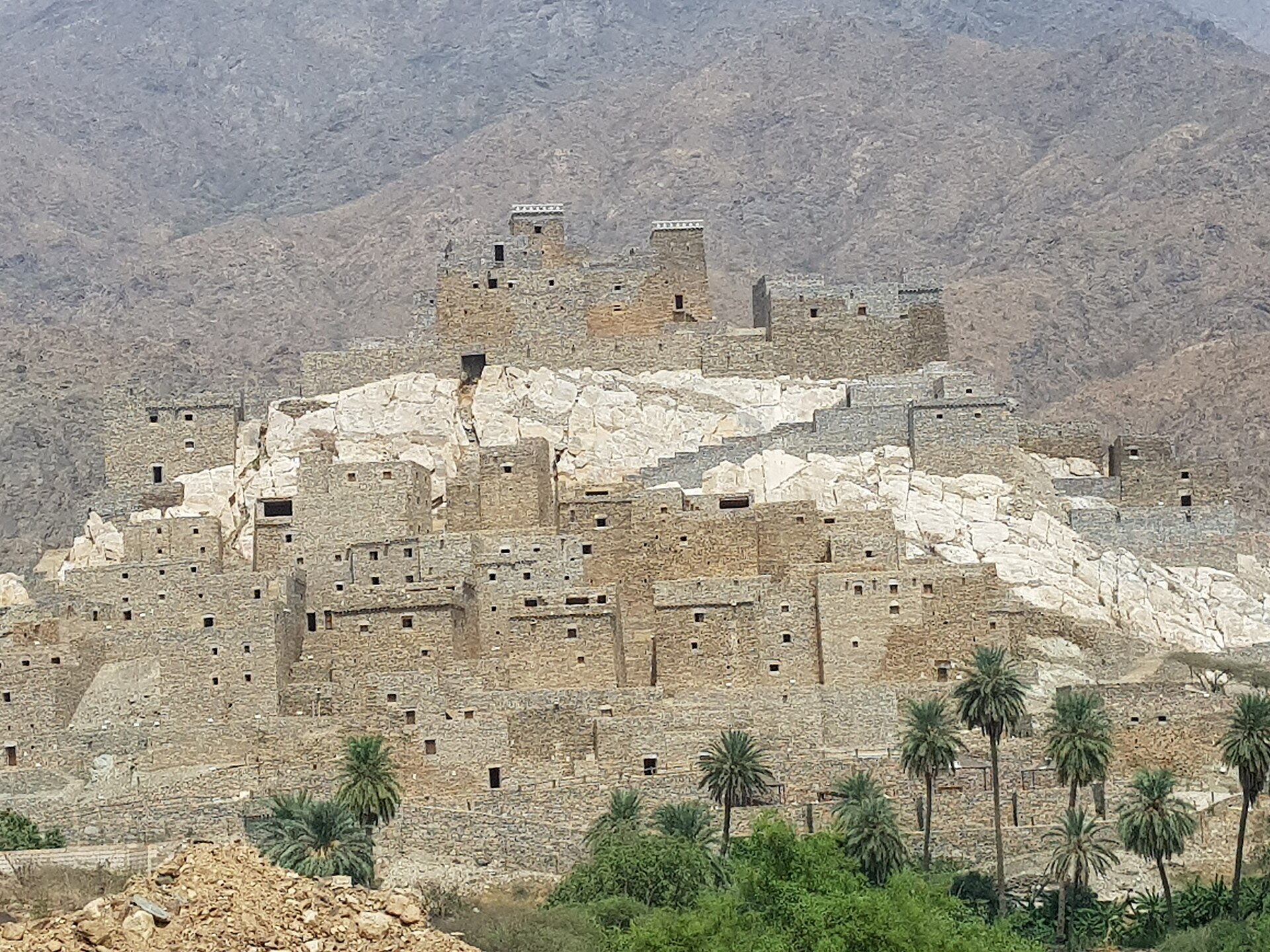
If Rijal Almaa is the most colourful heritage village, Dhee Ayn (also written Thee Ain or Zee Ayn) is the most dramatic. Located approximately 24 kilometres from Al Baha city in the Al-Mikhwat area, the village occupies a steep white marble hill — the geological feature that gives it the nickname “the Marble Village.” It is also on UNESCO’s Tentative List.
Architecture and Layout
The village consists of 49 buildings ranging from one to four stories: nine single-story structures, 19 two-story, 11 three-story, and 10 four-story buildings. Construction uses flat polished stones stacked in a load-bearing wall system called Medamik, which gives the facades a distinctive layered texture. Roofs are beamed with sider (jujube) wood, and larger rooms feature decorative interior columns called al-zafer.
The village is named after a perennial spring that flows from the neighbouring mountains. The base of the hill is ringed by banana plantations, palm groves, basil, and guava trees — an unexpectedly lush setting that makes the approach from the car park one of the most photogenic walks in Saudi Arabia.
History
The village dates back approximately 400 years. It witnessed several tribal conflicts, including battles between the Zahran and Ghamd tribes and the Turkish army of Muhammad Ali Pasha during the Ottoman campaigns in the Hejaz. The Saudi Commission for Tourism and National Heritage invested SAR 15 million (approximately $4 million) in its restoration.
Practical Details
Ushaiger — The Najdi Mud-Brick Village
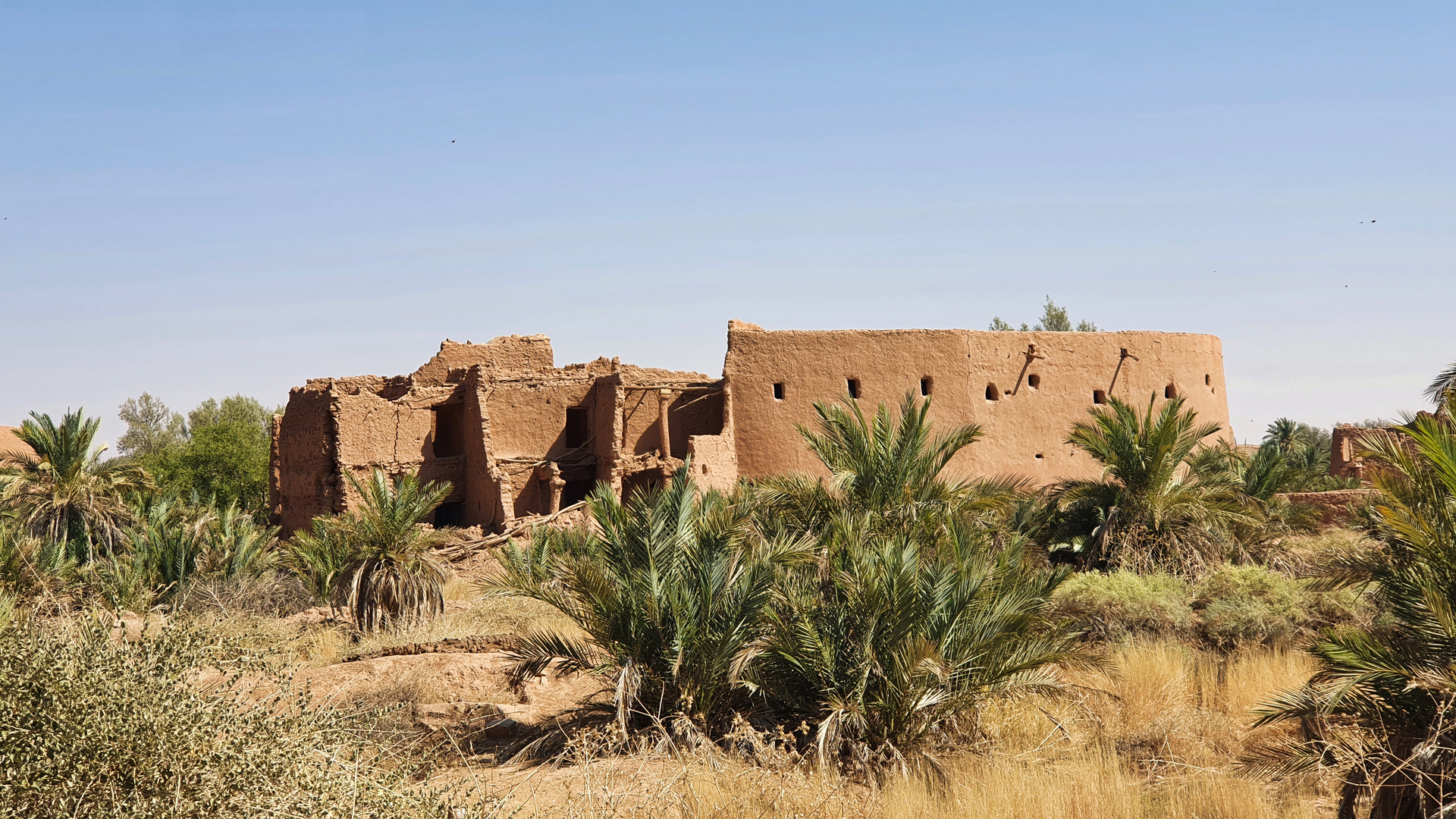
Ushaiger offers the most accessible heritage village experience from Riyadh. Located 200 kilometres northwest of the capital on the Najd central plateau, the village has been continuously settled for over 1,500 years — making it one of the oldest inhabited towns in central Arabia.
Why Ushaiger Was Important
Ushaiger sat on a critical stopping point for Hajj and Umrah pilgrims travelling from Kuwait, Iraq, and Iran to Mecca. Its abundant water sources and oasis setting made it a vital rest station on the overland pilgrimage route. The village’s name means “little blonde one” in Arabic, a reference to the golden-yellow colour of its mud-brick walls.
Architecture
The village contains approximately 400 mud houses and 25 mosques, plus watchtowers. Classic Najdi architecture is on full display: yellow mud-brick walls, distinctive triangular windows, and ornately carved wooden doors branded with geometric patterns of circles, disks, and tribal motifs. Shaded winding alleyways connect the buildings, designed to funnel cooling breezes through the settlement during the brutal Najd summers.
Over 100 buildings have been restored using traditional environmentally friendly materials — mud and limestone — through a community-supported programme. Several houses still carry the names of their original families and are open to visitors. The village museum, the first major building past the entrance gates, houses local artefacts and historical displays.
Practical Details
At-Turaif, Diriyah — Birthplace of the Saudi State
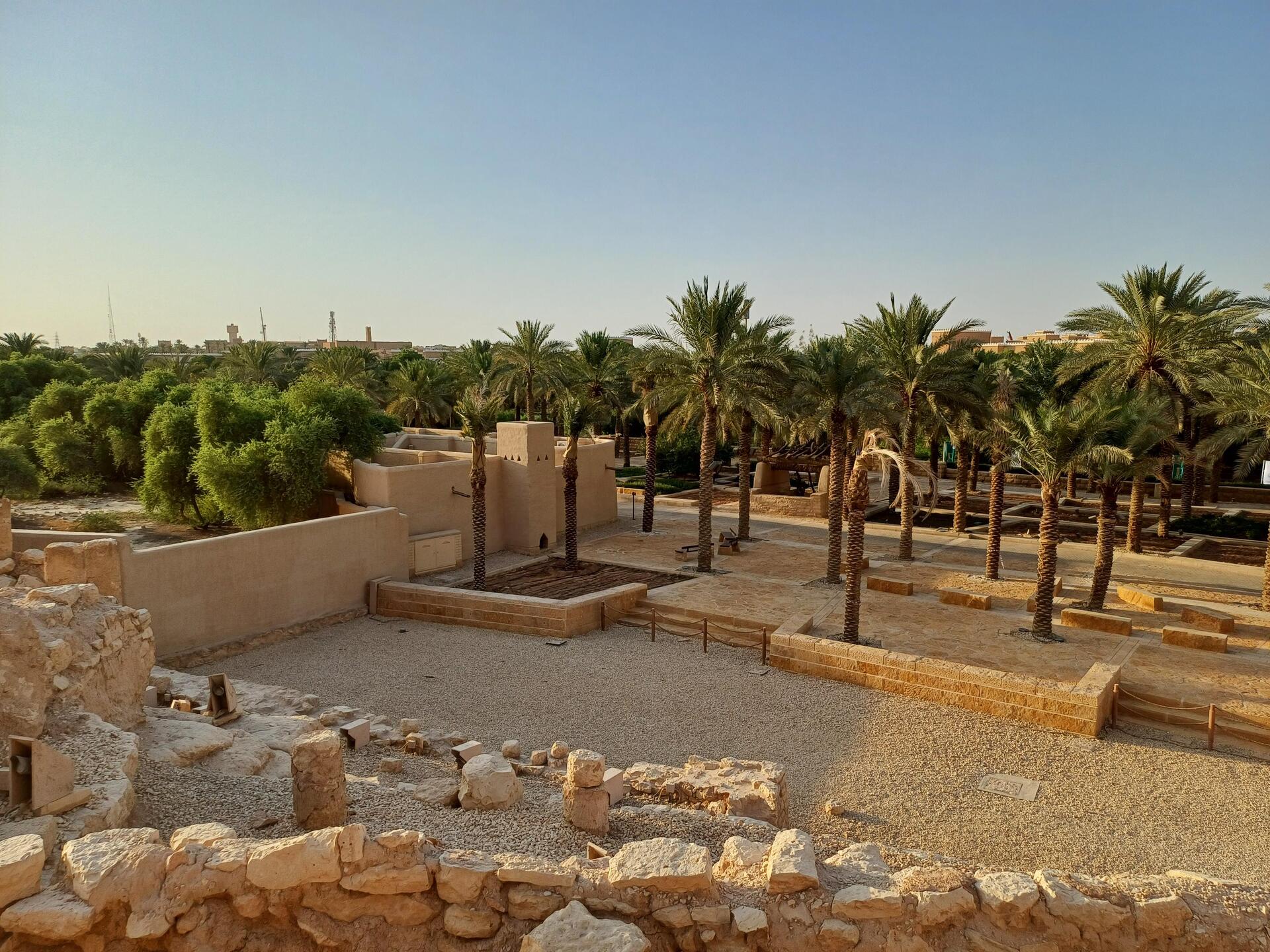
At-Turaif is the most historically significant heritage site in Saudi Arabia. Located in Diriyah on the western banks of Wadi Hanifah, just 20 minutes from central Riyadh, the district was the original home of the House of Saud and the capital of the First Saudi State from 1727 to 1818, when it was destroyed by Ottoman forces.
UNESCO inscribed At-Turaif as a World Heritage Site on 31 July 2010 for its outstanding example of Najdi architectural style. The site is now fully restored as part of the massive Diriyah Gate Development, a multi-billion-dollar project transforming the surrounding area into a cultural and lifestyle destination.
What to See
Practical Details
AlUla Old Town — Gateway to Hegra
AlUla Old Town, known locally as Al-Deira, is a 700-year-old settlement in the AlUla Valley of northwestern Saudi Arabia. Unlike the mountain villages of the south, AlUla’s architecture reflects its role as a waypoint on the ancient incense trade route. The town contains 870 residential units of mud-brick construction, separated by narrow winding alleys, with ancient mosques and market areas.
Residents abandoned the settlement in the 1980s as the mud-brick structures deteriorated. The Royal Commission for AlUla, in partnership with UNESCO, has since restored Market Street and launched the “Live Museum” experience, where local storytellers called Rawis guide visitors through the ruins, sharing oral histories and demonstrating traditional crafts.
Practical Details
Historic Jeddah — Al-Balad
Al-Balad, the historic centre of Jeddah, represents an entirely different architectural tradition. Inscribed as a UNESCO World Heritage Site in 2014 as “Historic Jeddah, the Gate to Makkah,” Al-Balad’s buildings are constructed from coral stone quarried from the Red Sea coast — a technique that has virtually disappeared elsewhere.
The district’s multi-story merchant tower houses are famous for their ornate Roshan windows: projecting wooden screens with intricate Mashrabiya latticework that provided privacy and natural ventilation in Jeddah’s humid climate. These facades, some dating to the 19th century, reflect the multicultural influences of a port city that served as the primary gateway for Muslim pilgrims arriving by sea for centuries.
In May 2019, Crown Prince Mohammed bin Salman announced a multi-billion-dollar restoration programme. The first phase, valued at $13.3 million, covers 56 historical buildings. Notable sites include Naseef House (now a museum) and Souq Al-Alawi, a traditional market that remains active.
Practical Details
Comparing Saudi Arabia’s Heritage Villages
| Village | Region | UNESCO Status | Entry Fee | Architecture | Time Needed |
|---|---|---|---|---|---|
| Rijal Almaa | Asir (southwest) | Tentative List | Free | Stone/quartz towers, 7–8 stories | 2–4 hours |
| Dhee Ayn | Al Baha (southwest) | Tentative List | SAR 10 | Stone on marble hill, 1–4 stories | 1.5–3 hours |
| Ushaiger | Riyadh (central) | None | Free | Najdi mud-brick, carved doors | 1.5–2.5 hours |
| At-Turaif, Diriyah | Riyadh | Inscribed 2010 | SAR 100 | Najdi mud-brick, palatial | 2–4 hours |
| AlUla Old Town | Al Madinah (northwest) | Near Hegra site | Varies | Mud-brick, incense route | 1.5–3 hours |
| Al-Balad, Jeddah | Makkah (west coast) | Inscribed 2014 | Free | Coral stone, Roshan windows | 2–4 hours |
Best Time to Visit
October to March is the ideal window for all heritage villages. Daytime temperatures range from 18–30°C across most regions during these months. The mountain villages of Asir and Al Baha are somewhat cooler year-round due to altitude, but winter months remain preferable even there.
Avoid June through August when lowland temperatures routinely exceed 45°C. The mountain villages attract heavy domestic tourism during Saudi school holidays (typically June–July), which means crowded sites and fully booked accommodation in Abha and Al Baha.
Ramadan note: During Ramadan, opening hours at heritage sites may be reduced. Restaurants and cafes near villages may be closed during daylight hours. Check locally before planning a visit during this period.
Planning a Heritage Village Itinerary
It is possible to see several heritage villages on a single trip, though the Kingdom’s size means you will need to prioritise. Here are three practical routes:
The Southern Highlands Route (4–5 days)
Fly to Abha. Visit Rijal Almaa and the Asir highlands (2 days), then drive to Al Baha for Dhee Ayn (1 day), continuing north to Taif (1–2 days). This route captures the most architecturally diverse villages and some of Saudi Arabia’s best mountain hiking.
The Riyadh Heritage Route (2–3 days)
Based in Riyadh, visit At-Turaif in Diriyah (half day), then make a day trip to Ushaiger (full day including the drive). Add a day for the National Museum and Masmak Fortress to complete the historical picture. This is the easiest route logistically and ideal if time is limited.
The Grand Circuit (10–14 days)
Riyadh (At-Turaif, Ushaiger) → fly to AlUla (Old Town, Hegra) → fly to Abha (Rijal Almaa) → drive to Al Baha (Dhee Ayn) → drive to Jeddah (Al-Balad). This covers all six villages and gives the most complete picture of Saudi Arabia’s architectural heritage. Book domestic flights in advance — Saudi domestic air routes are expanding but popular sectors sell out, especially during the October–March high season.
Practical Tips for Visiting Heritage Villages
What to Wear
Conservative dress is expected at all sites. Both men and women should cover shoulders and knees. Women are no longer required to wear abayas or cover their hair (the rule was relaxed for tourists), but a headscarf is recommended when visiting mosques within heritage villages. Comfortable walking shoes are essential — many villages have uneven stone paths and steep terrain.
Photography
Photography is generally permitted at all heritage sites and villages. Always ask permission before photographing individuals, especially women. Interior photography rules may vary — the Rijal Almaa museum, for example, allows photography in most sections. Drone photography typically requires advance permission from the Saudi General Authority of Civil Aviation.
Guided Tours
Diriyah and AlUla have well-organised tour programmes with professional English-speaking guides. The heritage villages of Asir and Al Baha may have informal local guides. Professional guided tours typically cost SAR 150–300 ($40–80) for three to four hours. At Ushaiger, local families occasionally offer spontaneous guided walks through their ancestral homes.
Getting a Visa
Citizens of over 49 countries can obtain a Saudi tourist e-visa online. The process takes minutes and grants a one-year multiple-entry visa. Full details, including eligible nationalities and the application process, are in our Saudi Arabia visa guide.
Where to Stay
Accommodation near heritage villages varies widely. Riyadh and Jeddah offer the full range from budget to luxury. Abha has mid-range hotels and a growing number of mountain lodges. Al Baha has limited options — book ahead. AlUla has expanded rapidly with luxury resorts including Habitas and Banyan Tree, plus more affordable options in town. For a full breakdown, see our Saudi Arabia hotels guide.