
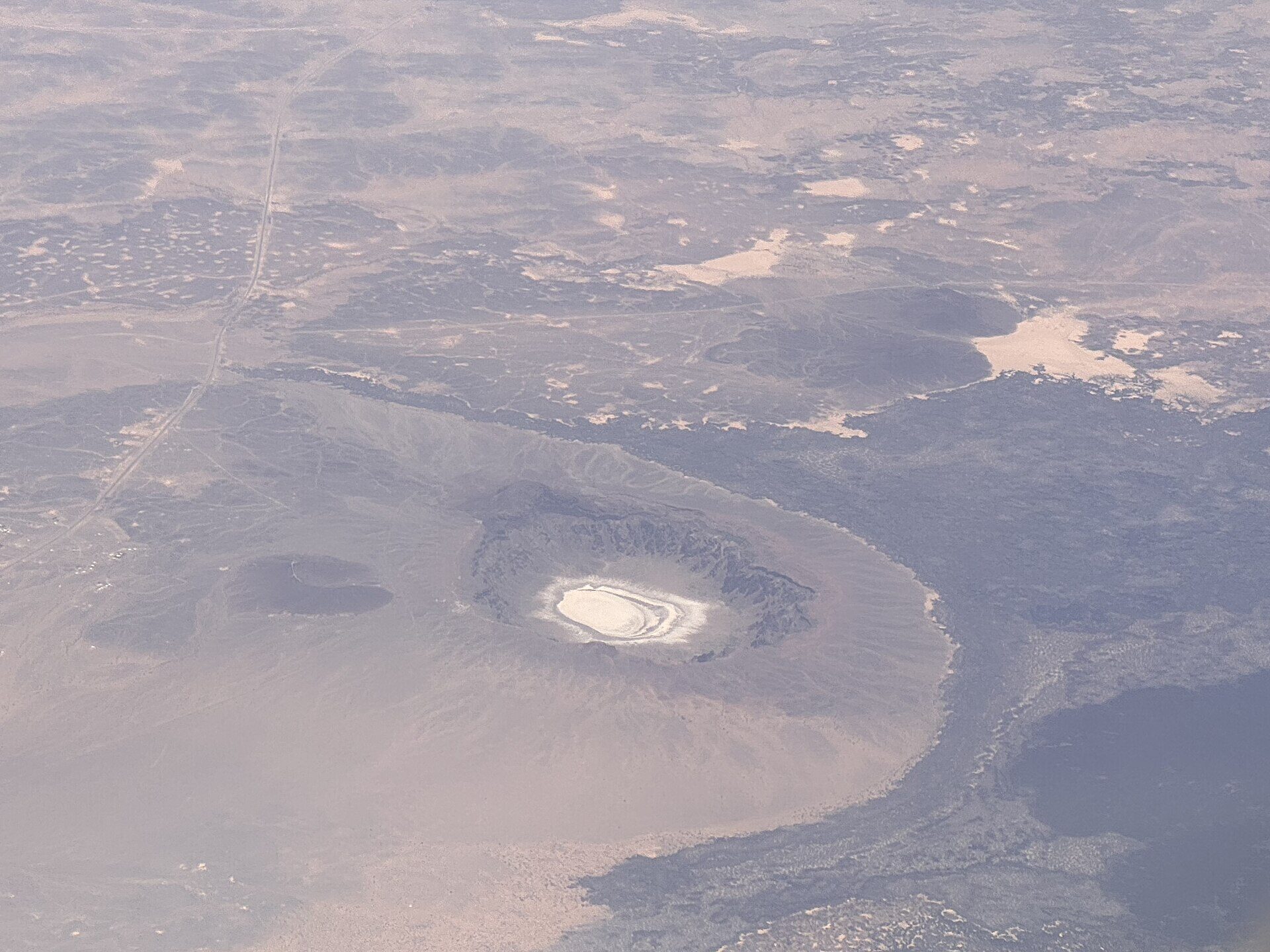
Al Wahbah Crater is one of Saudi Arabia’s most extraordinary natural landmarks — a vast volcanic maar nearly 2.3 kilometres across and 250 metres deep, with a brilliant white salt floor that looks like a frozen lake dropped into the middle of a black lava field. Located in Makkah Province on the western edge of the Harrat Kishb basalt plateau, the crater sits roughly 250 km north of Taif and around 270 km northeast of Jeddah. Whether you are building a broader Abha and Asir highlands itinerary or specifically chasing geological wonders, Al Wahbah deserves a full day — and ideally an overnight camp to catch the Milky Way above the rim. In 2024, UNESCO and the International Union of Geological Sciences (IUGS) named it one of the world’s top 100 geological heritage sites, selected from 174 nominations across 64 countries.
Best Time to Visit: October – April (cooler months; summer exceeds 50 °C)
Getting There: ~3 hours by car from Taif, ~4 hours from Jeddah; paved road to the rim parking area
Visa Required: Yes — tourist e-visa
Budget: Free entry; budget USD 30–60/day for fuel, food and camping gear
Must-See: Crater rim viewpoint at sunrise, the white salt floor, Harrat Kishb lava field
Avoid: Visiting mid-summer (extreme heat) or starting the descent after 10 AM
What Is Al Wahbah Crater?
Al Wahbah — also called Maqla Tamiyyah in local Arabic — is a maar crater, formed approximately 1.15 million years ago when rising basaltic magma hit an underground water table and triggered a violent phreatomagmatic explosion. The resulting steam blast carved a near-circular depression through both Neoproterozoic basement rock and two layers of Quaternary basanite lava. What remains is an eroded tuff ring surrounding sheer walls that drop 250 metres to a flat floor covered in gypsum and sodium phosphate crystals — the evaporite residue of seasonal rainwater pools that collect and evaporate inside the crater.
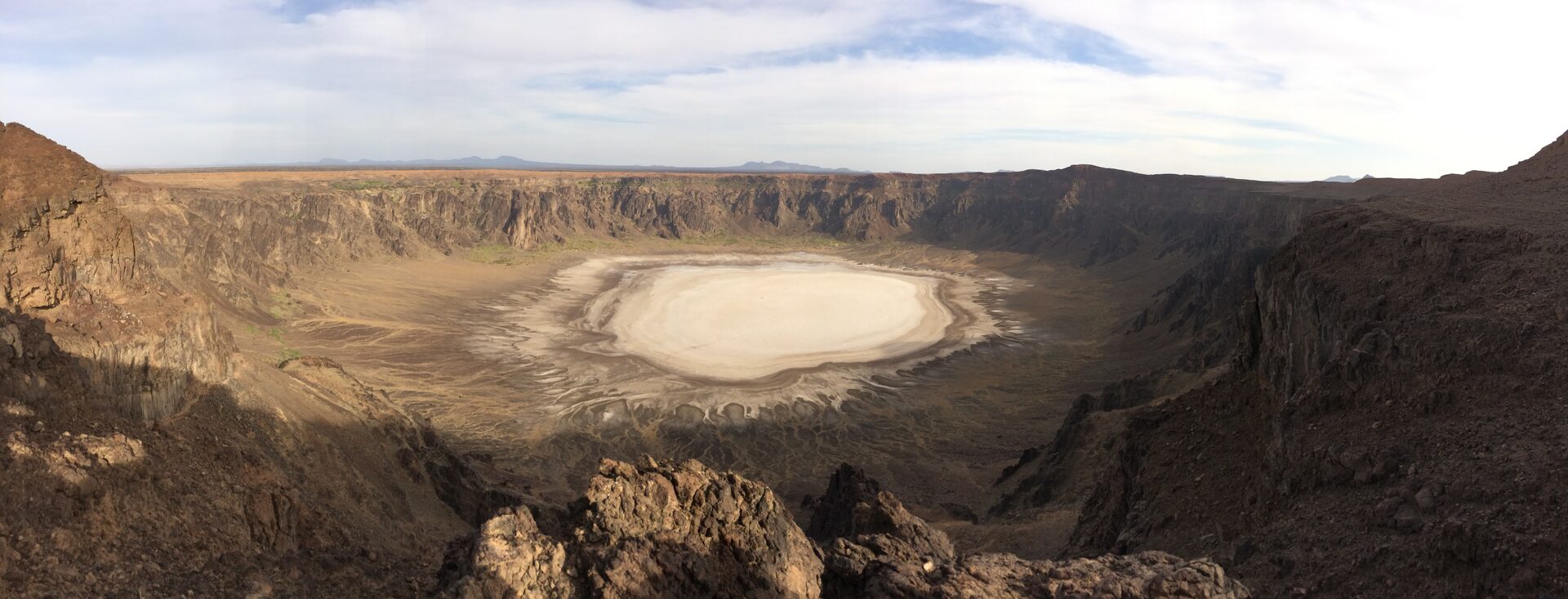
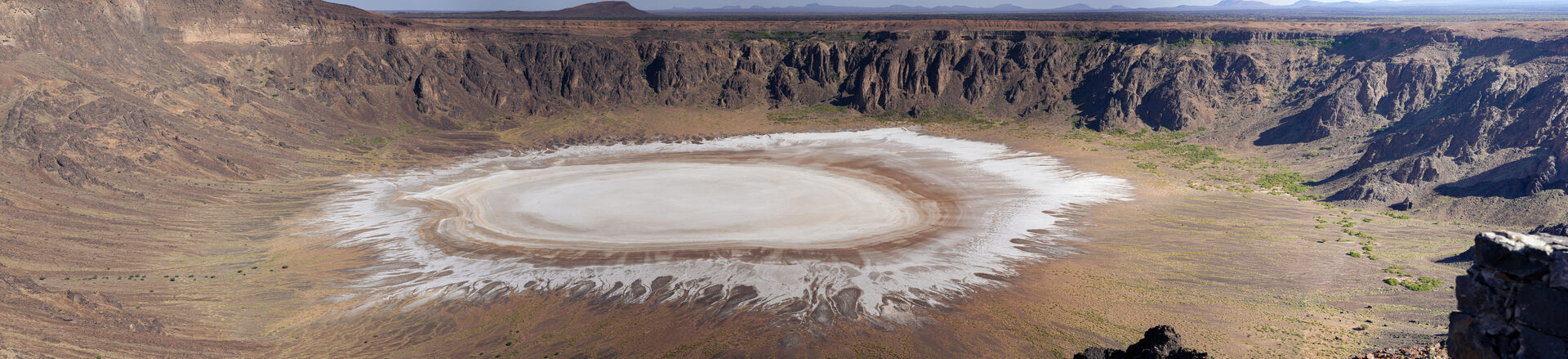
The visual effect is striking: a brilliant white disc set against dark volcanic cliffs, all surrounded by the flat black expanse of the Harrat Kishb lava field. It is the largest and deepest volcanic crater in Saudi Arabia. The crater is slightly elongated on a northwest-to-southeast axis, with scalloped, near-vertical walls on most sides and a single navigable descent route on the northern rim.
Activities at Al Wahbah Crater
Hiking Down to the Crater Floor
The headline experience at Al Wahbah is the descent to the crater floor. A rough trail on the northern side of the rim is the only route down; the rest of the perimeter consists of near-vertical cliffs. The descent covers roughly 250 metres of elevation loss over about 1.5 km of trail and takes 45–60 minutes going down. The return climb is harder — budget 60–90 minutes depending on fitness and heat. The path includes steep, loose-rock sections that require careful footing, particularly on the way back up.
On the crater floor, you can walk across the white salt pan — an eerie, crunching surface that feels more like a dry lakebed than the inside of a volcano. The floor is largely flat and easy to walk, though it can be soft and muddy after rain. The scale is difficult to appreciate until you are standing at the centre looking up at 250-metre walls on every side.
Practical tip: Start your descent before 8 AM. The crater floor has zero shade and temperatures climb rapidly after mid-morning. Carry at least 2–3 litres of water per person. Wear sturdy hiking shoes with ankle support — trail runners are not ideal on the loose scree sections.
Walking the Crater Rim
For those who prefer to stay on top, a full circumnavigation of the crater rim takes approximately 3 hours. The terrain is uneven volcanic rock, and there are no marked trails — you are picking your way along the edge, with dramatic views down into the crater from every angle. The northwestern section offers the most photogenic perspectives, particularly in early morning when the rising sun hits the white floor at a low angle. If you are planning a longer trip through Saudi Arabia’s volcanic landscapes, the Harrat lava fields guide covers the broader geological context.
Photography
Al Wahbah is widely regarded as one of the most photogenic natural sites in Saudi Arabia. The key shots include:
- Sunrise from the eastern rim: The low sun illuminates the white floor while the far wall remains in shadow — maximum contrast
- The descent trail: Looking back up from partway down captures the scale of the walls
- Crater floor looking up: Standing on the salt pan with 360-degree cliff walls gives the sense of being on another planet
- Panoramic sweeps: The flat desert horizon beyond the crater rim provides a clean backdrop for wide compositions
- Water: Minimum 3 litres per person per day; more if descending in warm weather
- Food: All meals and snacks for your visit
- Sun protection: Wide-brimmed hat, high-SPF sunscreen, UV-rated sunglasses, lip balm
- Footwear: Sturdy hiking boots with ankle support for the descent trail
- Clothing: Layers — desert temperature swings between day and night are severe
- Navigation: Offline GPS maps downloaded before departure (mobile signal is unreliable)
- First aid kit: Including blister treatment, electrolyte sachets, and any personal medications
- Rubbish bags: Pack everything out
- The ascent is harder than you expect. Getting down takes 45 minutes; getting back up on a steep, loose trail in heat takes 60–90 minutes. Several visitors have required rescue after running out of water or energy on the climb.
- There is no shade. The crater floor and the descent trail are fully exposed from about 9 AM onward.
- Rangers patrol the area. While enforcement varies, descent into the crater is not always formally permitted. Check current rules on arrival and follow ranger instructions.
- Wind at the rim. Gusts can be strong and unexpected. Stay well back from the edge, especially when walking the rim trail.
- No medical facilities nearby. The nearest hospital is in Taif, 3 hours away. Carry a first aid kit and know basic desert survival.
- Parking area: A large paved lot at the main viewpoint on the rim
- Visitor centre: A small building with geological displays explaining the crater’s formation (hours are inconsistent — do not rely on it being open)
- Shaded shelters: Several picnic-style shelters around the rim with seating areas
- Small mosque: Adjacent to the parking area
- Waste bins: Available but bring your own bags as backup
- Restrooms: Exist but may be locked or unstocked — carry your own supplies
- Harrat Kishb and Saudi Arabia’s lava fields — the volcanic field surrounding the crater, with 175 cones and multiple accessible formations
- Cave exploration sites — lava tubes and sinkholes formed in the same volcanic systems
- Saudi Arabia’s nature reserves — several are accessible from the western highlands corridor
- Day 1: Jeddah to Al Wahbah (4 hours), afternoon rim walk, sunset photography, camp overnight
- Day 2: Pre-dawn descent to crater floor, return by mid-morning, drive to Taif (3 hours)
- Day 3: Taif rose farms, Al Hada cable car, Al Shafa mountains
- Day 4: Drive south toward Asir National Park or return to Jeddah
- Abha and Asir Travel Guide — The complete guide to Saudi Arabia’s highlands from Taif to Abha
- Saudi Arabia Lava Fields — Explore Harrat Kishb and the Kingdom’s volcanic landscapes
- Stargazing in Saudi Arabia — The best dark-sky locations across the Kingdom
- Saudi Arabia Hiking Guide — Trails, mountains and canyons for every level
- Cave Exploration in Saudi Arabia — Lava tubes, sinkholes and guided tours
- Asir National Park Guide — Hiking, wildlife and the complete visitor guide
- Wadi Disah Guide — Saudi Arabia’s Grand Canyon explored
- Saudi Arabia Travel Guide 2026 — The complete guide to visiting the Kingdom
- Saudi Arabia Visa Guide — Every visa type explained
A wide-angle lens (16–24 mm on full frame) is essential. The crater is too large to capture from the rim with anything longer. Drone photography is spectacular here, though check current Saudi Civil Aviation Authority regulations before flying.
Camping and Stargazing
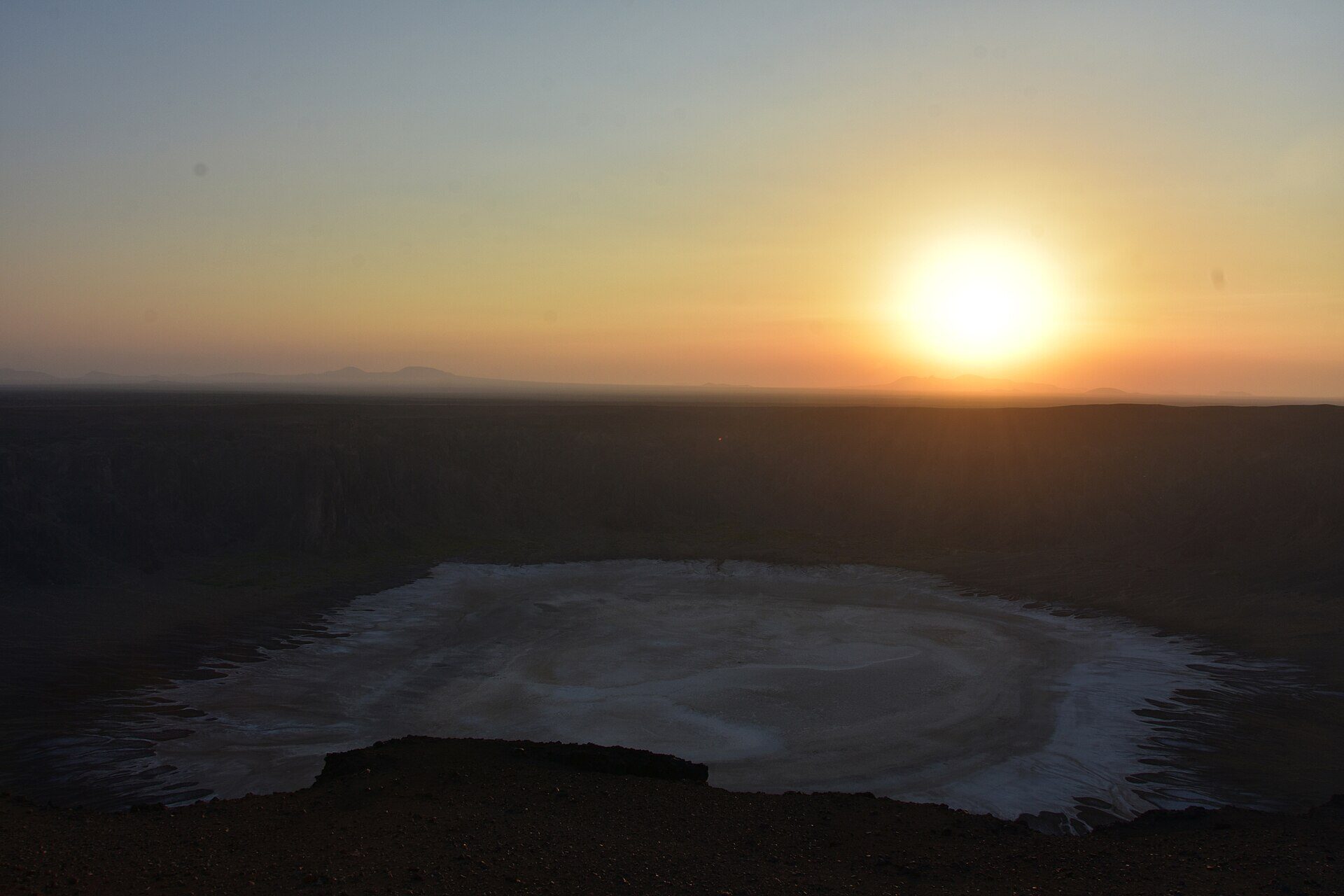
The real magic of Al Wahbah comes after dark. The crater’s remote location in the Harrat Kishb means there is virtually zero light pollution — this is one of the finest stargazing locations in Saudi Arabia. On clear nights, the Milky Way is vividly visible from horizon to horizon. Many visitors specifically plan an overnight trip to combine the sunset rim walk, a night of astrophotography, and a pre-dawn descent to the crater floor.
There are no designated campsites, but the area around the parking lot and slightly back from the rim offers flat ground for tents. One important tip: the crater rim itself is extremely exposed and can be very windy at night. Camp slightly further back, sheltered by the low ridge, for a more comfortable sleep. Winter nights can drop to near freezing, so bring warm layers even if the daytime forecast is mild.
Camping checklist: All water and food (no shops for 100+ km), tent rated for wind, sleeping bag rated to 5 °C for winter trips, headlamp, camp stove, and a bag for all your rubbish — leave nothing behind.
Exploring the Harrat Kishb Volcanic Field
Al Wahbah sits within the Harrat Kishb, a volcanic field covering approximately 6,000 square kilometres with 175 volcanic cones ranging from 2 million years old to a few hundred thousand years. The surrounding landscape of black basalt flows, scoria cones, and tuff rings is worth exploring if you have a 4WD and a sense of adventure. Notable formations include Jabal Aslaj and Jabal Hil, the latter featuring a 300-metre-wide crater that was once filled by a lava lake. For a deeper dive into Saudi Arabia’s volcanic landscapes, see our guide to the Harrat lava fields.
How to Get to Al Wahbah Crater
From Taif
The most common approach is from Taif, roughly 250 km and 3 hours to the north. Take the highway north toward Makkah, then branch northeast on Route 15 and follow signs toward the crater. The final stretch is on a paved road that ends at a parking area on the crater rim. The road has been improved under Saudi tourism development initiatives and is now accessible to regular cars, though a high-clearance vehicle or 4WD is recommended for comfort on the rougher final sections and for any exploration of the wider Harrat Kishb area.
From Jeddah
From Jeddah, the drive is approximately 270 km and takes around 4 hours. Head east toward Taif, then north. Alternatively, take the highway north and approach from the west. Both routes eventually converge on the same approach road to the crater.
From Riyadh
Al Wahbah is a long drive from Riyadh — roughly 900 km one way. It is better combined with a wider western Saudi road trip. Fly to Jeddah or Taif and drive from there. If you are exploring the wider region, the Saudi Arabia travel guide can help you plan a multi-city route.
Essential driving tips: Fill up fuel before leaving the last town — there are no petrol stations near the crater. Carry a spare tyre. Drive with GPS navigation loaded (mobile signal is patchy). The road is unmarked in the final section — if in doubt, follow the tracks. Tell someone your plans and expected return time.
Best Time to Visit Al Wahbah Crater
The ideal window is October through April. Within this range:
| Season | Temperature | Conditions | Recommendation |
|---|---|---|---|
| Nov – Feb | 15–28 °C (day) / 5–12 °C (night) | Cool, dry, occasional wind | Best for hiking and camping |
| Oct & Mar – Apr | 25–38 °C (day) / 12–20 °C (night) | Warm but manageable with early starts | Good shoulder season |
| May – Sep | 40–50+ °C (day) / 25–35 °C (night) | Extreme heat, no shade at crater | Avoid — dangerous for hiking |
For photography, the clearest skies tend to be December through February. For stargazing, any moonless night from October to April is excellent — check the lunar calendar before booking your trip.
What to Bring
Al Wahbah is remote. There are no shops, restaurants, or reliable water sources anywhere near the crater. Pack as if you are entirely self-sufficient:
If camping, add a wind-rated tent, sleeping bag, headlamp, and camp stove. The Saudi Arabia hiking guide has a complete desert gear checklist that applies here.
Safety Considerations
Al Wahbah is not dangerous for prepared hikers, but it has caught out the underprepared. Key points:
Facilities at the Crater
The site has been developed with basic visitor infrastructure:
There are no food or water vendors at the site and no camping equipment rental.
Combining Al Wahbah with Other Destinations
Taif
Most visitors use Taif as their base. The city is known as Saudi Arabia’s unofficial summer capital and the “City of Roses” for its fragrant Taif rose farms. Key attractions include the Al Hada Mountain cable car — the longest in Saudi Arabia at 4.2 km — the Al Shafa mountain villages with their terraced farms and panoramic views, and the historic Shubra Palace. If you are building a highlands itinerary, our Abha and Asir travel guide covers the full mountain region from Taif south to Abha.
Natural Landmarks Nearby
For visitors interested in Saudi Arabia’s geological sites, Al Wahbah pairs well with:
Multi-Day Itineraries
A strong 3–4 day itinerary from Jeddah or Taif could include:
For a dedicated outdoor adventure trip, combine Al Wahbah with the best hiking trails in Saudi Arabia — several are within a day’s drive of the crater.
Visa and Entry Requirements
All international visitors to Saudi Arabia need a valid visa. The Saudi tourist e-visa is available online for citizens of 60+ countries and takes minutes to process. It grants a one-year, multiple-entry stay of up to 90 days per visit. The Saudi Arabia visa guide covers every visa type, processing times, and requirements in detail.
Al Wahbah itself has no entry requirements or permits beyond the national visa. There is no entrance fee.