
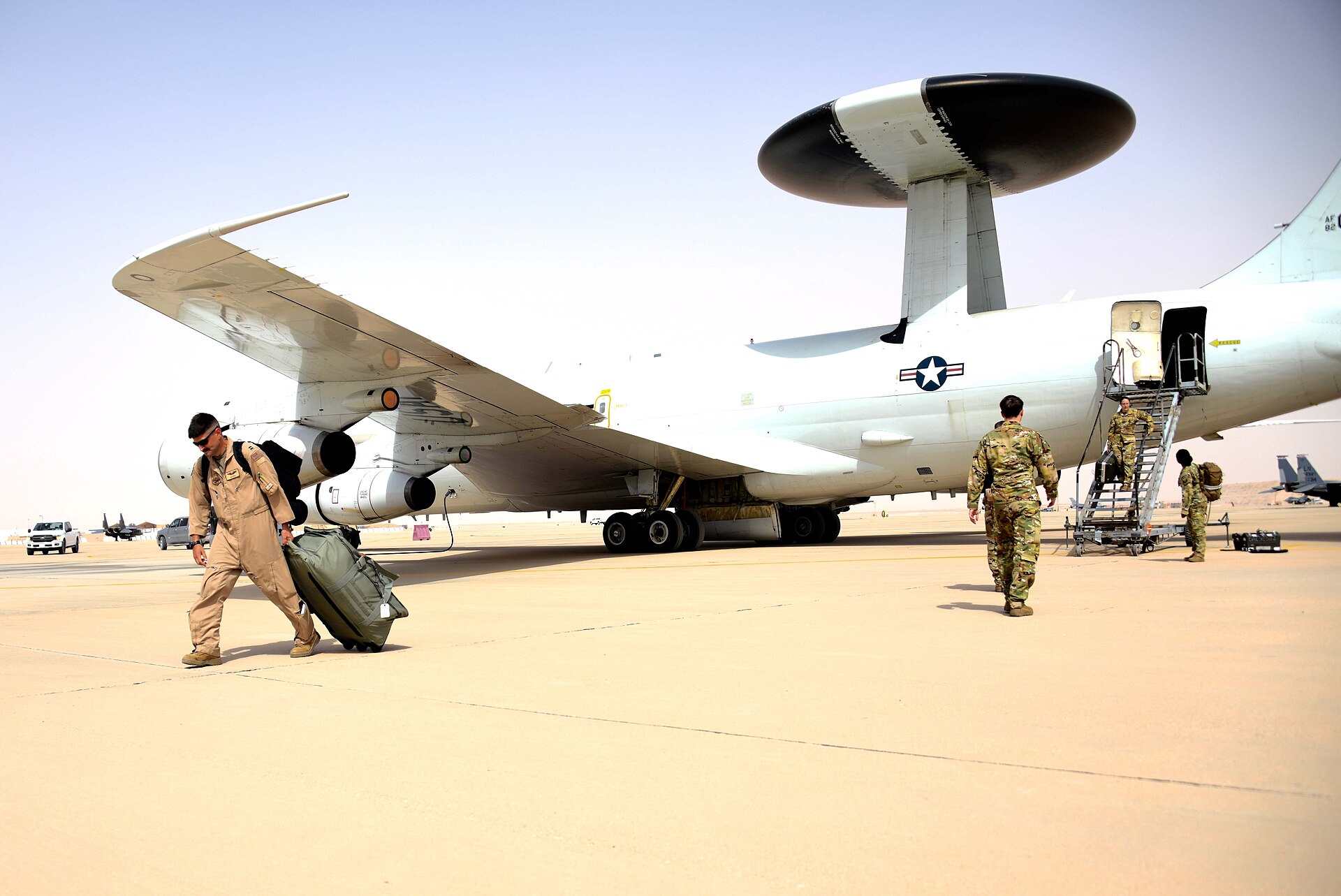
RIYADH — Iran’s repeated strikes on Prince Sultan Air Base in al-Kharj, Saudi Arabia, have destroyed at least three KC-135 Stratotanker aerial refueling aircraft and one E-3 Sentry AWACS radar plane, wounded 15 US service members — one of whom later died — and forced the US Air Force to evacuate its remaining tanker fleet from the base, according to satellite imagery analysis and Pentagon statements compiled through early April 2026.
The damage extends beyond the airframes. KC-135s are the aircraft that allow American fighters to reach deep targets inside Iran. Each one destroyed does not merely remove a plane from inventory — it contracts the geographic radius within which the US can sustain combat operations. With nine Stratotankers now removed from the operational equation through strikes and a crash, and the surviving tankers dispersed to locations farther from the theater, the air campaign that President Donald Trump has branded Operation Epic Fury is losing the logistical scaffolding it requires to function at full capacity.
Table of Contents
- Wave 84 and the March 27 Mass-Casualty Strike
- The Tanker Attrition Campaign
- What Does Losing an E-3 Sentry Mean for US Air Operations?
- Tehran’s Targeting Logic
- Where Does Saudi Arabia Stand on Strikes Against Its Own Soil?
- From Southern Watch to True Promise: Prince Sultan Air Base in Context
- Frequently Asked Questions
Wave 84 and the March 27 Mass-Casualty Strike
The most consequential single attack on Prince Sultan came on March 27 as part of True Promise 4’s Wave 84. The strike package consisted of at least six ballistic missiles and 29 unmanned aerial vehicles, according to Associated Press reporting via Al Jazeera. Fifteen US service members were wounded, five of them seriously, the Pentagon confirmed.
Army Sgt. Benjamin N. Pennington, 26, of Glendale, Kentucky, subsequently died of injuries sustained at the base, according to Military Times. He became one of the first US combat fatalities on Saudi soil since the Khobar Towers bombing in 1996.
Commercial satellite imagery verified by NBC News showed the tail section of an E-3 Sentry lying at an angle on the ground, surrounded by debris — the clearest visual confirmation that Iran had destroyed one of the US Air Force’s most capable airborne early warning and control aircraft. The IRGC claimed the E-3 was “100% destroyed,” a claim the satellite imagery appeared to substantiate.
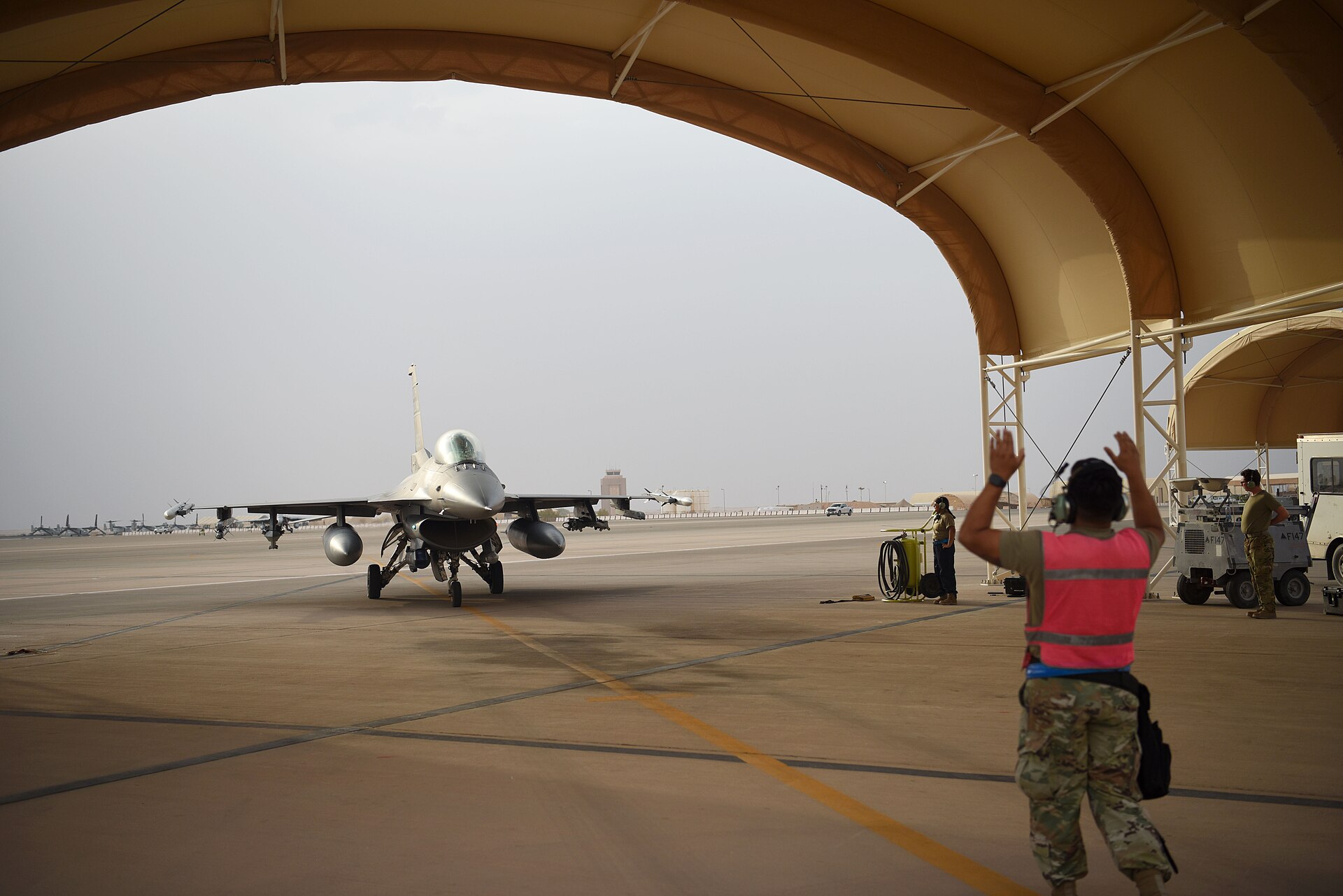
Wave 84 also struck KC-135 refueling aircraft parked on the ramp, adding to damage inflicted in earlier waves. IRGC Brigadier General Majid Mousavi stated the strikes targeted “the accommodation of US pilots and aircrew in al-Kharj” — an indication that Iran was aiming not only at hardware but at the personnel who operate it, according to PressTV reporting carried by GlobalSecurity.
The Tanker Attrition Campaign
The March 27 strike was not the first time Iranian munitions reached Prince Sultan’s flight line. On March 13, a separate attack damaged five KC-135 Stratotankers on the ground, according to Military Times and The Aviationist. Satellite imagery analyzed by Defence Security Asia subsequently confirmed three KC-135s destroyed outright, with Western officials citing five aircraft damaged or destroyed cumulatively through that strike alone.
Pre-war satellite imagery had shown approximately 22 KC-135 Stratotankers staged at Prince Sultan, according to Defence Security Asia. That concentration — nearly a quarter of the active KC-135 fleet parked at a single base within range of Iranian ballistic missiles — represented what Defence Security Asia characterized as a deliberate Iranian target set: “Iranian planners may have deliberately targeted the vulnerable connective tissue of U.S. airpower rather than only seeking symbolic retaliation, thereby testing whether forward-deployed American enabler fleets can survive under concentrated missile and drone pressure.”
The cumulative toll through early April stands at eight KC-135s destroyed or damaged by strikes across the March 13 and March 27 attacks, plus a ninth Stratotanker that crashed in Iraq on March 12, killing six airmen, according to Air Force Technology. Nine aircraft removed from the operational equation out of an estimated 150 to 200 KC-135 and KC-46A tankers deployed regionally at the start of operations, per Army Recognition.
After the March strikes, the US Air Force evacuated surviving KC-135s from Prince Sultan to dispersed locations, according to Defence Security Asia and the Times of Islamabad. The evacuation acknowledged what the strikes had demonstrated: concentrated tanker parking at a fixed, known base within Iranian missile range was untenable.
Trump disputed the extent of the damage in late March. Four of the five tankers initially reported damaged had “virtually no damage” and were already back in service, the president said, according to the Jerusalem Post. One had “slightly more damage but would soon be in the air.” The satellite imagery told a different story.
What Does Losing an E-3 Sentry Mean for US Air Operations?
The E-3 Sentry destroyed at Prince Sultan was one of approximately six deployed to the Middle East from a total US fleet of 16 aircraft, of which roughly half were mission-capable before the war began. Kelly Grieco, a senior fellow at the Stimson Center, laid out the arithmetic in Defense News on April 1.
Five aircraft means accepting either a single continuous orbit or periodic gaps when a second cannot be regularly sustained. In those gaps, the air picture degrades, air battle management is less effective and the theater’s ability to coordinate a complex, multi-aircraft operation becomes significantly more constrained.
— Kelly Grieco, Senior Fellow, Stimson Center, Defense News, April 1, 2026
The E-3 is not a combat aircraft. It is the platform that makes combat aircraft effective in coordinated operations — managing the airspace, directing intercepts, tracking threats, deconflicting friendly formations. Losing one does not remove a shooter from the sky. It removes the brain that tells shooters where to go.
PressTV framed the E-3’s destruction in cost terms: a $700 million aircraft eliminated by a Shahed-136 drone that costs approximately $20,000 to manufacture. The cost-exchange ratio — even accounting for Iranian exaggeration on pricing — illustrated a structural problem for the US side of the conflict.
Tehran’s Targeting Logic
Grieco offered the most concise characterization of what Iran was doing at Prince Sultan and across its broader strike campaign. “Iran’s going after the radars that detect threats, the tankers that keep jets flying, and the AWACS that direct the battle,” she told Defense News. “That’s a counter-air campaign. Adapted to what Iran can actually do. And the damage is real.”
The pattern was consistent across multiple waves. Iran was not attempting to destroy American fighter aircraft in the air or on the ground — a task that would require sustained precision against hardened shelters and dispersed assets. Instead, it targeted the enablers: the tankers without which fighters cannot reach deep targets, the AWACS without which complex strikes cannot be managed, and — per General Mousavi’s statement — the aircrew billets where the humans who operate these systems sleep.
A CSIS analysis published in early 2026 described Iran’s broader war strategy as a decision to “eschew calibrated retaliation for unbridled escalation.” The targeting of Prince Sultan fit that framework. Iran was not sending a signal with a single strike and waiting for diplomatic response. It was conducting a sustained attrition campaign against specific categories of American military capability.
On April 2, True Promise 4’s Wave 90 struck al-Kharj again, alongside Ahmad al-Jaber and Ali al-Salem Air Bases in Kuwait, according to PressTV. The debris from intercepts and strike remnants over al-Kharj had become a recurring feature of daily life in the area. Whatever had survived evacuation at Prince Sultan remained under threat.
Each KC-135 Stratotanker can transfer up to approximately 200,000 pounds of fuel per sortie, according to the US Air Force. Without tanker support, fighter aircraft must carry larger internal fuel fractions at the expense of weapons loads, or simply cannot reach targets deep inside Iranian territory, as Army Recognition and Responsible Statecraft have noted. Fewer tankers means either fewer sorties, shorter-range sorties, or lighter-armed sorties.
Where Does Saudi Arabia Stand on Strikes Against Its Own Soil?
Before February 28, 2026, Gulf states including Saudi Arabia communicated to Washington that they would not permit their territory to be used for offensive operations against Iran. CSIS characterized the outcome bluntly: “they were catastrophically wrong.” Saudi territory became a primary staging ground for US air operations — and, consequently, a primary target for Iranian retaliation.
The kingdom has absorbed at least 38 missiles and 435 drones from late February through March 2026, according to compiled strike data. Saudi Arabia’s response has been layered and, at times, contradictory. Crown Prince Mohammed bin Salman has been building out air defense capability without waiting for Washington’s approval. The kingdom received Major Non-NATO Ally status from Trump — a designation that expedites weapons transfers but does not constitute a mutual defense treaty.
Riyadh issued no specific public statement on US troop casualties at Prince Sultan, according to PBS News and The Intercept. A US service member died on Saudi soil, and the host nation said nothing publicly.
Saudi Arabia expelled Iran’s military attache on March 21 following an Iranian strike on Yanbu, yet the Saudi foreign minister maintained daily contact with his Iranian counterpart in parallel, according to the Christian Science Monitor. The kingdom was simultaneously hardening against Iran and keeping a diplomatic channel open — a dual posture that made strategic sense given the 36-hour decision window before Trump’s April 6 deadline to resume strikes on Iran’s power grid.
Saudi state media, according to MEMRI, began expressing support for regime change in Tehran — a rhetorical escalation that would have been unthinkable during the 2023 Saudi-Iranian rapprochement brokered by China. The oil weapon that Saudi Arabia holds but has not deployed against Iran remained a separate variable in that calculation.
From Southern Watch to True Promise: Prince Sultan Air Base in Context
Prince Sultan Air Base is not a facility the United States built for this war. It is a facility it returned to. The base served as a major US hub during the 1991 Gulf War, then hosted operations for Southern Watch, Enduring Freedom, and Iraqi Freedom before closing to American forces in 2003. The 378th Air Expeditionary Wing reactivated there on December 17, 2019, according to Military Times — a reopening driven by rising tensions with Iran that, at the time, fell short of open conflict.
The base’s location — roughly 100 kilometers south of Riyadh in the Najd desert — placed it within range of Iranian ballistic missiles but far enough from the Persian Gulf coast to provide depth against shorter-range cruise missile threats. That calculus assumed the primary threat would be a limited Iranian response to a discrete provocation, not a sustained campaign of the kind True Promise 4 became. Twenty-two KC-135s parked on open ramp space were configured for power projection, not survival under persistent bombardment.
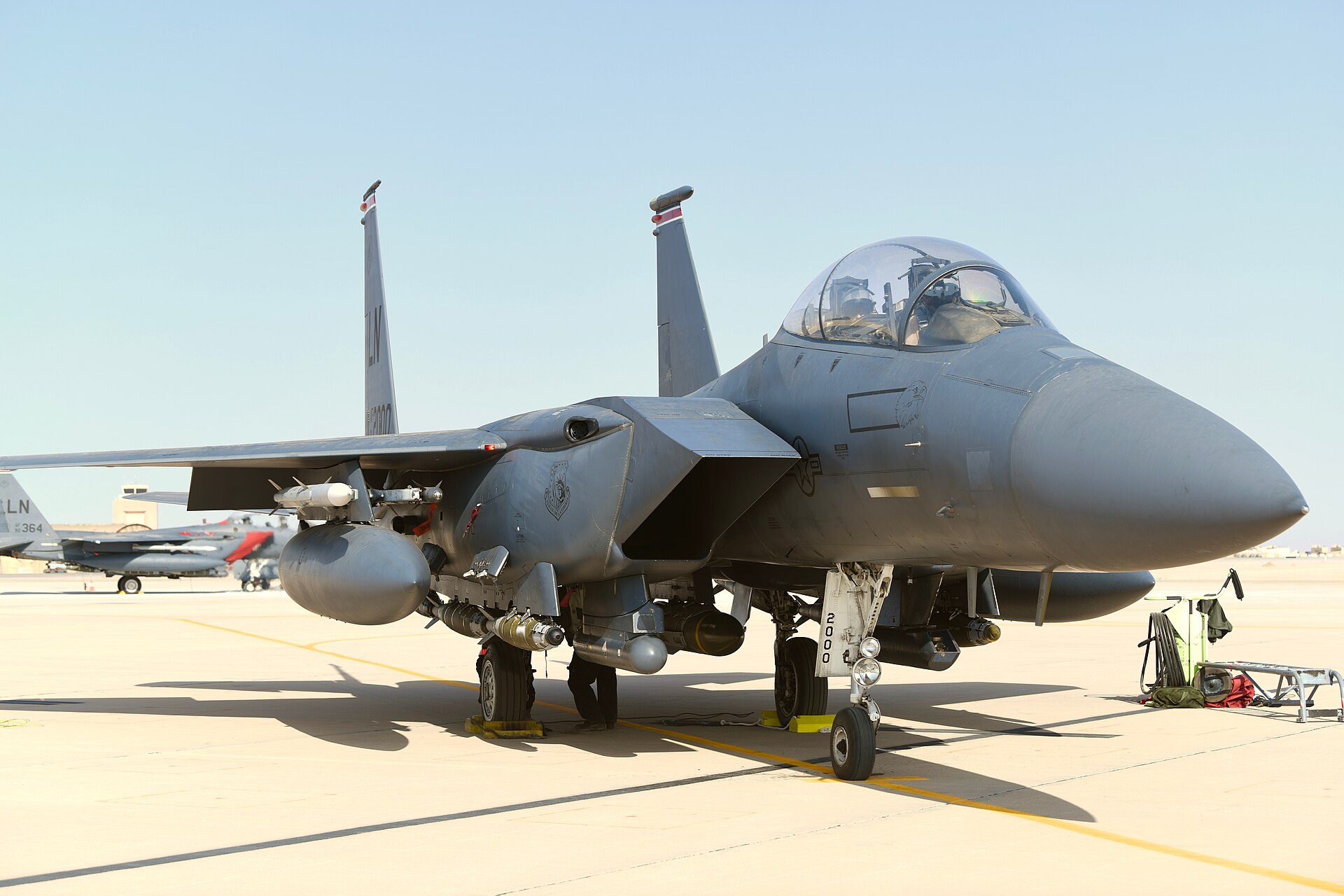
The US has now struck over 12,300 targets inside Iran under Operation Epic Fury, according to NPR reporting on April 3 citing CENTCOM figures. But the campaign is being sustained by a logistics chain that Iran is methodically degrading — one tanker, one AWACS, one aircrew billet at a time. The loss of an F-15E Strike Eagle over Iran added further pressure to an air campaign already contending with enabler attrition.
Trump paused strikes on Iran’s power grid until April 6 at 8:00 PM Eastern, according to Al Jazeera — framing the pause as a final window for Iranian concessions. Iran, meanwhile, continued launching. Wave 90 on April 2 demonstrated that whatever pressure the US air campaign was exerting on Iranian military infrastructure, it had not yet degraded Iran’s capacity to strike Saudi and Kuwaiti bases with mixed missile-and-drone packages.
| Date | Event | Aircraft Affected | Source |
|---|---|---|---|
| March 12 | KC-135 crash in Iraq (non-strike) | 1 destroyed, 6 airmen killed | Air Force Technology |
| March 13 | True Promise 4 strike on PSAB | 5 damaged, 3 confirmed destroyed | Military Times; Defence Security Asia |
| March 27 | Wave 84 strike on PSAB | Additional KC-135s struck | NBC News; The Aviationist |
| Post-March 27 | Evacuation of surviving tankers | Remaining fleet dispersed | Defence Security Asia; Times of Islamabad |
| April 2 | Wave 90 strikes al-Kharj again | Damage assessment pending | PressTV |
Frequently Asked Questions
How many KC-135 Stratotankers does the US Air Force operate globally?
The US Air Force maintains a total fleet of approximately 396 KC-135 Stratotankers across active duty, Air National Guard, and Air Force Reserve units. The aircraft first entered service in 1957 and has been repeatedly upgraded, but no replacement at comparable scale exists — the KC-46A Pegasus is entering service slowly and in smaller numbers. The loss of nine airframes in a single theater over three weeks represents the fastest attrition rate for the type since its introduction nearly seven decades ago.
What is Operation True Promise 4 and how many waves has it involved?
True Promise 4 is the IRGC’s designation for its sustained strike campaign against US and allied military positions in the Persian Gulf region. Unlike previous True Promise operations — which were single, discrete retaliatory salvos — True Promise 4 has been conducted in sequential waves over weeks, with Wave 90 on April 2 being the most recent confirmed. The campaign has struck targets in Saudi Arabia, Kuwait, Bahrain, and the UAE, using combinations of ballistic missiles, cruise missiles, and one-way attack drones. Iran has framed the operation as a response to US strikes under Operation Epic Fury.
Can the US Air Force conduct deep strikes into Iran without KC-135 tanker support?
In theory, certain platforms — the B-2 Spirit and B-52 Stratofortress — have sufficient range to strike Iranian targets from bases outside the Gulf region without refueling. However, the tactical fighter fleet — F-15Es, F-16s, F/A-18s — that executes the bulk of daily strike sorties requires aerial refueling to reach targets beyond Iran’s western border provinces. Without adequate tanker support, these aircraft must either launch from bases closer to Iran (increasing their vulnerability), reduce weapons loads to carry more fuel, or accept that large portions of eastern and central Iran are beyond operational reach.
Has Saudi Arabia’s air defense system intercepted any of the Iranian strikes on Prince Sultan?
Saudi and US forces have intercepted portions of incoming salvos using Patriot PAC-3 batteries and other air defense systems stationed in the region. However, the consistent pattern of ground damage at Prince Sultan — confirmed by commercial satellite imagery across multiple strikes — indicates that interception rates have been insufficient to prevent steady attrition of parked aircraft. The mixed-threat packages Iran employs, combining ballistic missiles with slower drones, are designed to saturate and complicate layered air defenses. Saudi Arabia has been actively expanding its air defense architecture independently of US systems, a process that predates the current conflict but has accelerated since February 2026.
What is the April 6 deadline Trump set and how does it relate to the al-Kharj strikes?
Trump paused US strikes on Iran’s civilian power grid until April 6 at 8:00 PM Eastern, framing the pause as a final opportunity for Iran to agree to negotiations. The deadline creates a compressed decision window for all parties. For Saudi Arabia, the question is whether expanded US strikes on Iranian infrastructure — which would likely trigger intensified Iranian retaliation against Gulf targets including Prince Sultan — serve or harm Riyadh’s interests. The continued Iranian strikes on al-Kharj in the interim period suggest Tehran intends to maximize pressure on US forward-deployed assets regardless of the diplomatic timeline.