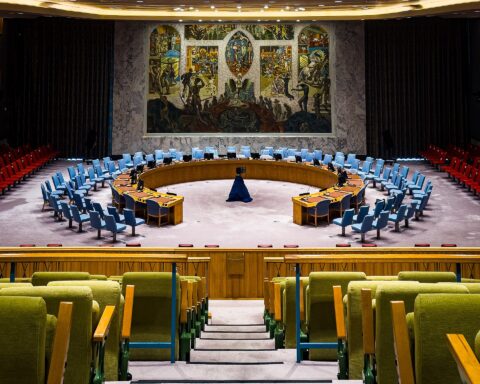
RIYADH — The United States declared a naval blockade of the Strait of Hormuz on April 12, 2026. Saudi Arabia said nothing. Not a word from the Royal Court, the Ministry of Foreign Affairs, or the Saudi Embassy in Washington. The Kingdom’s most prominent security communication of the day was a summons of Iraq’s ambassador over drone attacks — a bilateral complaint that addressed a different threat entirely. This silence is not an omission. It is a structural position, engineered over six weeks of war, in which any spoken word — endorsement or opposition — converts Saudi Arabia from a damaged bystander into an active participant in a confrontation it cannot survive at current air defense stockpiles. The silence has a mechanical expiry: the first US Navy enforcement action against a vessel carrying Iranian crude will force Riyadh to declare a position whether it wants to or not.
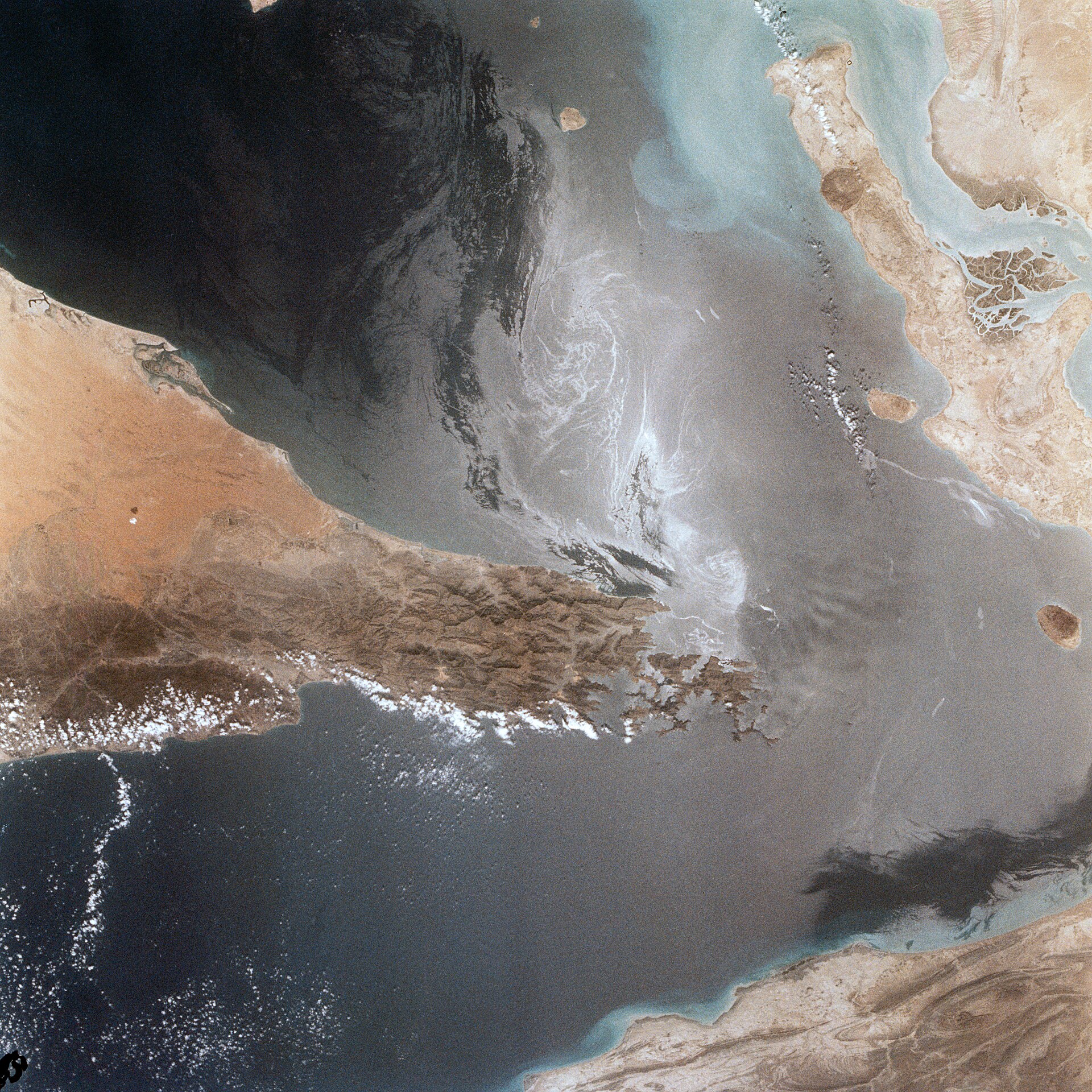
Table of Contents
- Why Has Saudi Arabia Said Nothing About the US Blockade?
- The Co-Belligerency Trap: What IRGC Doctrine Means for Saudi Infrastructure
- What Happens If Saudi Arabia Endorses the Blockade?
- What Happens If Saudi Arabia Opposes It?
- The Araghchi Calls: Iran Pre-Positioned the Gulf Before Trump Moved
- Can Saudi Arabia Sustain Silence Past the First Enforcement Contact?
- The Hajj Clock: April 18 as Structural Deadline
- PAC-3 Arithmetic and the Defense Gap
- Frequently Asked Questions
Why Has Saudi Arabia Said Nothing About the US Blockade?
Saudi Arabia has issued no public statement on the US naval blockade of the Strait of Hormuz because both available responses — endorsement and opposition — carry existential risk. Endorsing the blockade places Saudi energy infrastructure under IRGC co-belligerency targeting doctrine. Opposing it ruptures the US security relationship at the moment Saudi Arabia’s PAC-3 missile defense stockpile sits at approximately 400 rounds, down 86 percent from pre-war levels. Silence is the only position that avoids both outcomes simultaneously.
This is a pattern, not a lapse. Since the war began on February 28, Saudi Arabia has broken public silence only in response to direct attacks on its territory, OPEC+ process decisions, and bilateral military agreements. It has not commented on the Islamabad talks from which it was excluded. It has not responded to the UAE’s demand that Iran pay reparations for 2,819 missiles. It has not addressed the IRGC Navy’s declaration of “full authority” over Hormuz.
Max Becker-Hicks of the New Lines Institute identified the approach directly: “Saudi Silence as Deliberate Strategy.” The US defense commitment to Saudi Arabia, he wrote, is “largely conditional and susceptible to domestic political pressures.” Saudi Arabia lacks a formal mutual defense treaty with the United States. There is no Article 5 equivalent. There is no binding obligation for Washington to defend Riyadh if Tehran retaliates against Saudi targets in response to US enforcement actions conducted from Saudi-hosted bases.
The blockade declaration arrived via Truth Social. Trump announced that the US Navy would “effective immediately” begin “BLOCKADING any and all Ships trying to enter, or leave, the Strait of Hormuz” and would “seek and interdict every vessel in International Waters that has paid a toll to Iran.” The platform of delivery matters: Saudi Arabia was not consulted in advance, and the announcement carried no multilateral framework, no coalition structure, and no mechanism for host-nation consent.
The silence has precedent
On March 2, Fahad Nazer of the Saudi Embassy in Washington responded to New York Times and Washington Post reports that MBS had privately urged Trump toward regime change in Iran. His denial was calibrated: “At no point in all our communication with the Trump Administration did we lobby the President to adopt a different policy. The Kingdom of Saudi Arabia has been consistent in supporting diplomatic efforts to reach a credible deal with Iran.” The statement corrected the record without taking a position on the war itself. The same structural logic applies to the blockade.
The Middle East briefing 3,000+ readers start their day with.
One email. Every weekday morning. Free.
Camille Lons of the European Council on Foreign Relations described Saudi Arabia as inside a “strategic impasse,” forced onto “the front line” of a war it actively sought to avoid. The impasse is not psychological. It is positional. Saudi Arabia hosts US military assets at Prince Sultan Air Base. It operates the East-West Pipeline to Yanbu that currently bypasses Hormuz at 7 million barrels per day. It holds the world’s largest spare production capacity. Every one of these assets becomes a target classification question the moment Riyadh speaks.
The Co-Belligerency Trap: What IRGC Doctrine Means for Saudi Infrastructure
Five days before Trump declared the blockade, IRGC Brigadier General Ebrahim Zolfaqari, spokesman for Khatam al-Anbiya Central Headquarters, issued a statement that redrew the targeting framework for the entire Gulf. “Regional American partners should know that, until now we have exercised significant restraint for the sake of good neighbourliness and have taken precautions in selecting retaliatory targets,” Zolfaqari said on April 7, “but from now on, all such precautions have been removed.”
He added that the IRGC intended to deprive “the Americans and its allies of regional oil and gas for years.”
The April 7 statement eliminated the IRGC’s own distinction between “tolerated host nation” and “co-belligerent target.” Under the pre-April 7 framework, Saudi Arabia could host US forces while receiving a degree of Iranian restraint — strikes on Saudi territory were retaliatory and selective, not systematically aimed at destroying export capacity. Under the post-April 7 framework, that restraint no longer applies. The blockade lands in a threat environment where the IRGC has already declared open season on US-linked energy infrastructure across the Gulf.
Seth G. Jones, Harold Brown Chair at CSIS, identified the specific targets: Abqaiq, processing more than 7 million barrels per day; Ras Tanura, handling 3.4 million barrels per day; and Yanbu, at 1.3 million barrels per day. These three facilities, Jones assessed, are Iran’s most likely escalation targets if Saudi Arabia becomes “operationally integrated into US economic warfare against Tehran.”
A Saudi endorsement of the blockade — even a statement of support without operational participation — provides the predicate for that integration claim. The IRGC does not require a formal alliance treaty to designate co-belligerency. It requires a public statement it can cite.
The pipeline is already a live target
On April 8, the day the ceasefire nominally took effect, an IRGC drone struck a pumping station on the East-West Pipeline. The pipeline carries crude from the Eastern Province to the Red Sea port of Yanbu — the same infrastructure Saudi Arabia is relying on to bypass Hormuz. The strike demonstrated that the IRGC treats Yanbu-bound infrastructure as a legitimate target under existing conditions, before any Saudi statement on the blockade.
IEA Executive Director Fatih Birol said he had received reassurances from “highest authorities in Saudi Arabia” that the East-West Pipeline is “well protected.” The reassurance was directed at global markets. It was not a public position on the blockade, and it was delivered through an energy official, not a foreign ministry.
Mona Yacoubian, CSIS Middle East Program Director, described the IRGC’s strategic logic as “unbridled escalation — horizontal expansion across nations and vertical escalation from military to civilian to energy infrastructure,” triggered by threats to regime survival. A naval blockade of Iran’s only major export route constitutes precisely such a threat.
| Facility | Capacity (bpd) | Function | Prior Strike History |
|---|---|---|---|
| Abqaiq | 7,000,000+ | Central processing | Houthi drone/missile strike, Sept 2019 |
| Ras Tanura | 3,400,000 | Eastern Province export terminal | Struck March 2, 2026 |
| Yanbu | 1,300,000 | Red Sea export terminal | SAMREF refinery struck April 3, 2026 |
| East-West Pipeline | 7,000,000 (max) | Hormuz bypass to Yanbu | Pumping station struck April 8, 2026 |
| Jubail | N/A (petrochemical) | SABIC/Sadara industrial complex | Missile debris fire April 7, 2026 |
What Happens If Saudi Arabia Endorses the Blockade?
A Saudi endorsement of the US naval blockade would accomplish three things simultaneously, all of them damaging to Riyadh. It would provide the IRGC with a public predicate to reclassify Saudi energy infrastructure from collateral damage to primary target. It would bind Saudi Arabia to a US enforcement operation it has no treaty obligation to support and no capacity to sustain independently. And it would collapse the diplomatic channel that Iranian FM Araghchi opened on April 9 when he called Saudi FM Faisal bin Farhan — the first publicly confirmed direct Iran-Saudi call since the war began.
The targeting reclassification is the immediate risk. Saudi Arabia has intercepted 799 drones and 95 missiles — 894 total through April 7 — at an implied cost of $3.49 billion, calculated across approximately 2,400 PAC-3 rounds expended at a manufacturing cost of roughly $1.45 million per round. Those intercepts were conducted under conditions where the IRGC maintained residual restraint toward non-military Saudi targets. Endorsing the blockade removes the basis for that restraint.
Kristian Coates Ulrichsen of the Arab Center in Washington described the broader dynamic: Gulf states face “growing doubts about the reliability of US security guarantees.” Washington’s actions, he wrote, “exposed the Gulf states to harm rather than providing deterrence or protection.” An endorsement would accept that exposure without any corresponding guarantee of protection.
The diplomatic cost is equally concrete. Saudi Finance Minister Mohammed al-Jadaan was in Islamabad on April 11, one day before the blockade declaration, described by Arab News as offering “a show of economic support” for the Pakistan-hosted talks. Saudi FM Faisal bin Farhan provided what Pakistan Today characterized as “indirect facilitation.” This positioning — present but not at the table, supportive but not party to the outcome — dissolves the moment Riyadh takes a side on the blockade.
What Happens If Saudi Arabia Opposes the Blockade?
Opposition to the blockade carries a different set of structural risks, centered on the US security relationship at a moment when Saudi Arabia’s air defense depends on American systems, munitions, and intelligence sharing that Washington can withdraw. Opposing the blockade would place Saudi Arabia in public alignment with France and the United Kingdom — both of which have declined to participate — but against the United States, which operates the air defense architecture that has kept Abqaiq, Ras Tanura, and Riyadh itself intact since February 28.
The PAC-3 stockpile is at approximately 400 rounds. Lockheed Martin’s Camden, Arkansas facility produces 620 rounds per year. Poland refused a Patriot battery transfer on March 31. No other NATO ally has offered to backfill. Saudi Arabia’s air defense depends on continued US resupply — and that resupply depends on a political relationship that public opposition to the President’s signature wartime initiative would damage.
Michael Ratney, former US Ambassador to Saudi Arabia and now at CSIS, assessed that Saudi Arabia has “little confidence” the current war will eliminate Iranian threats or that the US will protect them if they escalate. Opposition to the blockade would test whether that “little confidence” has any remaining basis at all.
“Saudi Arabia right now is taking on the responsibility of the entire global economy.”— Mohammed Alhamed, Saudi geopolitical analyst, Christian Science Monitor, April 1, 2026
The burden Alhamed described does not come with a corresponding voice. Saudi Arabia was excluded from the Islamabad bilateral between Vance and Ghalibaf — talks that ended on April 12 without a deal on Iran’s nuclear commitments, an outcome Riyadh has a direct interest in but no seat to negotiate. Opposing the blockade would not earn Riyadh a seat at the table. It would remove the US security umbrella without replacing it.
The Araghchi Calls: Iran Pre-Positioned the Gulf Before Trump Moved
Three days before the blockade declaration, on April 9, Iranian Foreign Minister Abbas Araghchi called all six GCC foreign ministers with what multiple sources described as identical “deterrence warning” messages. The Saudi Ministry of Foreign Affairs confirmed Faisal bin Farhan received the call. Al Arabiya reported the call without disclosing its content beyond the fact that it occurred.
Araghchi’s calls came the same day the UAE demanded Iran pay reparations for 2,819 missiles fired at Emirati territory. Saudi Arabia said nothing about the reparations demand — endorsing a reparations framework would open the door to Iranian counter-claims regarding the legality of US military operations conducted from Prince Sultan Air Base and other Saudi-hosted facilities.
Araghchi’s GCC circuit served a specific function: it pre-positioned all six Gulf states as audiences for the next Iranian escalation signal. When the IRGC Navy responded to the blockade declaration by stating that the Strait remains “open for the safe passage of non-military vessels in accordance with specific regulations” but that “any attempt by military vessels to pass through the Strait of Hormuz will be dealt with severely,” the statement bifurcated civilian and military traffic. Saudi tankers are technically civilian. But under Zolfaqari’s April 7 framework — “all precautions removed” — the distinction between civilian vessels owned by states hosting US forces and military vessels is already collapsed.
The six calls also carried a secondary function: they established a record of Iranian diplomatic engagement with every Gulf state simultaneously. If any GCC member endorses the blockade, Iran can point to the April 9 calls as evidence that it offered a diplomatic alternative three days before the US acted unilaterally. Saudi Arabia’s silence preserves the value of having received the call without having responded to the ultimatum embedded in it.
The April 11 destroyer transit and the IRGC response
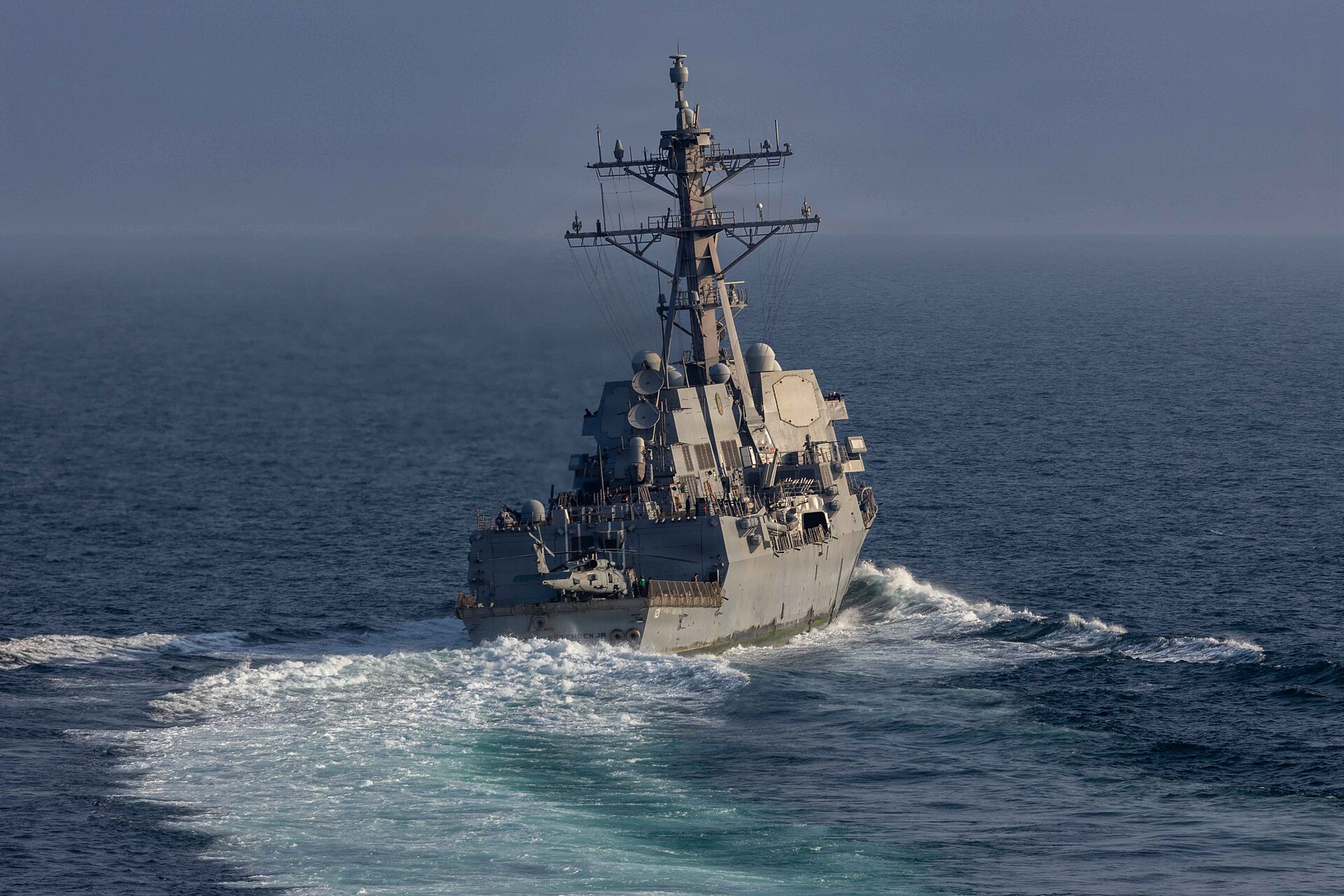
One day before the blockade declaration, on April 11, USS Frank E. Peterson and USS Michael Murphy transited the Strait of Hormuz — the first US warship passage since the war began on February 28. The IRGC challenged the ships by radio: “This is the last warning. This is the last warning.” The US vessel responded: “Passage in accordance with international law. No challenge is intended to you, and I intend to abide by rules of our government’s ceasefire.”
At least one destroyer reportedly turned back after an IRGC drone launch. The exchange established the operational conditions that the blockade will now attempt to change: the IRGC treats US military transit as a provocation requiring warning, and the US frames its passage as legal routine. The blockade converts that legal routine into an enforcement posture. Saudi Arabia hosts the bases from which enforcement assets would operate — and has said nothing about whether those bases are available for that purpose.
Retired Admiral James Stavridis called the blockade “a big task, and it’s a big gamble,” estimating it would require two carrier strike groups for air cover, 12 destroyers or frigates outside the Gulf, and approximately six warships inside. The naval arithmetic alone implies a presence that cannot be sustained without regional basing — basing that Saudi Arabia provides but has not publicly authorized for blockade operations.
Can Saudi Arabia Sustain Silence Past the First Enforcement Contact?
Saudi silence on the blockade functions only as long as the blockade remains declaratory rather than kinetic. The first US Navy boarding, seizure, or diversion of a vessel carrying Iranian crude — or the first IRGC response to such an action — will compel every Gulf state to declare whether it supports, opposes, or is neutral toward the enforcement operation being conducted from bases on its territory. Neutrality is not available to a state hosting the enforcer’s air force.
The Islamabad talks collapsed on April 12 after 21 hours, with Iran refusing to commit to halting nuclear weapons development. With the diplomatic track stalled, the blockade becomes the default US policy instrument. Its operational tempo will accelerate.
Currently, 17 vessels per day transit Hormuz, down from a pre-war average of 138, according to Windward.ai data from April 11. Some 325 tankers are stranded in the Gulf, with over 600 vessels total unable to move. The blockade adds a US enforcement layer on top of an already-constricted waterway. Every vessel that approaches the Strait now faces two gatekeepers: the IRGC, which claims regulatory authority and collects tolls, and the US Navy, which has declared it will interdict any vessel that paid those tolls.
Saudi Arabia’s own tankers must transit this environment. The East-West Pipeline to Yanbu handles 7 million barrels per day at maximum capacity, but Yanbu’s effective export ceiling is approximately 5.9 million barrels per day, leaving a structural gap of 1.1 to 1.6 million barrels per day compared to pre-war Hormuz throughput. Saudi crude that cannot reach Yanbu must either sit in storage or attempt Hormuz — where it will encounter both the IRGC toll system and the US blockade.
| Metric | Pre-War | Current (April 12) | Gap |
|---|---|---|---|
| Daily Hormuz transits | 138 vessels | 17 vessels | -88% |
| Stranded tankers (Gulf) | 0 | 325 | — |
| Total stranded vessels | 0 | 600+ | — |
| East-West Pipeline capacity | 7M bpd (max) | 7M bpd (restored post-April 8) | Operational |
| Yanbu export ceiling | N/A | ~5.9M bpd | 1.1-1.6M bpd below pre-war Hormuz |
| Saudi fiscal break-even | $78-84/bbl (pre-war) | $108-111/bbl (war-adjusted) | ~$13-16 above Brent ($95-96) |
| Aramco May OSP (Arab Light Asia) | Set at +$19.50/bbl | $17-20 underwater | — |
The Iraq summons as a silence boundary marker
Saudi Arabia’s decision to summon Iraq’s ambassador on April 12 — the same day as the blockade declaration — illustrates the boundary conditions of the silence. The Kingdom will speak when directly attacked, when the attacker is a state it can pressure bilaterally, and when the response does not implicate the US-Iran confrontation. Iraq-origin drone attacks meet all three conditions. The US blockade meets none of them.
The Hajj Clock: April 18 as Structural Deadline
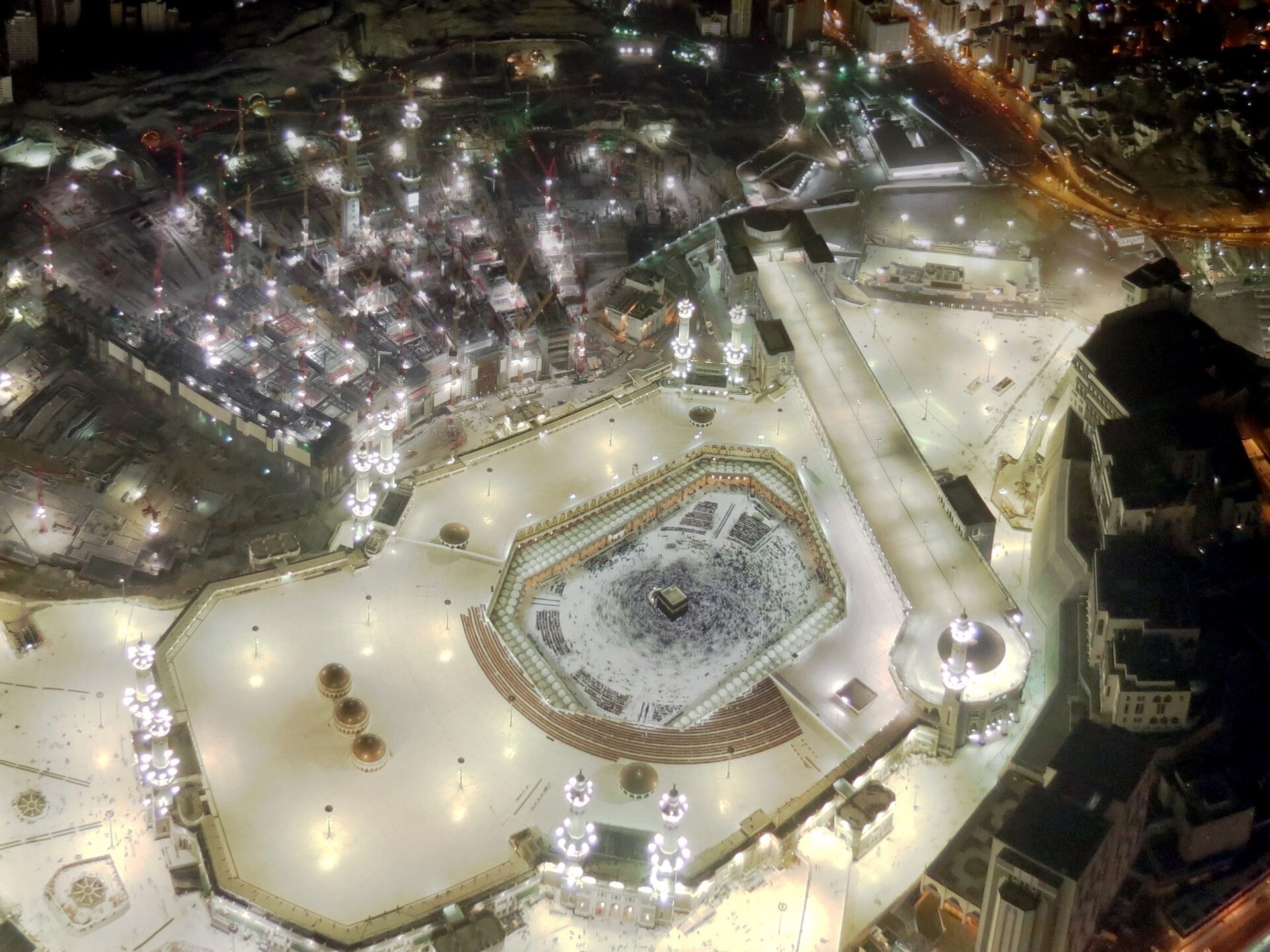
The silence operates under a calendar constraint that neither Washington nor Tehran controls. Hajj arrivals open on April 18. Pakistan’s 119,000 pilgrims begin arriving the same day. Indonesia’s 221,000 pilgrims begin departures on April 22 — the same day the ceasefire expires. There is no extension mechanism for the ceasefire. Iran has zero pilgrims, having been barred from Hajj.
Saudi Arabia’s Custodian of the Two Holy Mosques title, held since 1986, carries an obligation to guarantee pilgrim safety that supersedes all other diplomatic considerations. A blockade-triggered escalation during Hajj arrivals would force Saudi Arabia to choose between hosting US enforcement operations and protecting millions of pilgrims from the retaliatory strikes those operations might provoke. The 1987 precedent — in which 402 people died in clashes between Iranian pilgrims and Saudi security forces, leading to an 87 percent quota cut and a three-year Iranian boycott — demonstrates that Hajj security failures carry consequences measured in decades.
The April 18 date is not arbitrary. It is the day the Umrah cordon seals and Hajj arrivals begin simultaneously. From April 18 onward, Mecca and Medina operate under security protocols that assume a permissive external environment. A naval blockade of the Strait of Hormuz, with IRGC threats of severe response to military vessels, is not a permissive external environment.
Abdulaziz Sager, chairman of the Gulf Research Center, offered a framework that applies directly: “The lesson of this war is that dialogue on its own is not enough if it [is not] backed by deterrence and defense systems.” The problem Saudi Arabia faces is that its deterrence systems are depleted and its defense systems depend on the same country conducting the blockade.
PAC-3 Arithmetic and the Defense Gap
The material basis for Saudi silence is a number: 400. That is the approximate remaining inventory of PAC-3 MSE interceptor rounds — 86 percent depleted from pre-war levels — after 43 days of war. The Camden, Arkansas production line manufactures 620 rounds per year. At pre-ceasefire interception rates — 894 total intercepts through April 7 — the remaining stockpile would last approximately 19 days of full-intensity conflict.
Poland refused a Patriot battery transfer on March 31. No NATO ally has offered an alternative. The $16.5 billion emergency arms package that the US authorized went to the UAE, Kuwait, and Jordan — not to Saudi Arabia. The Kingdom’s air defense replenishment depends entirely on the US bilateral relationship, which a public position on the blockade — in either direction — would strain.
The IRGC has fired more than 500 ballistic missiles and 2,000 UAVs at GCC targets since February 28, according to the New Lines Institute. The ceasefire that nominally took effect on April 8 has not fully halted launches — Kuwait intercepted 28 drones and Bahrain intercepted 31 drones and 6 missiles in the post-ceasefire period. If the blockade triggers a resumption of full-scale IRGC strikes on Saudi territory, 400 PAC-3 rounds stand between Abqaiq’s 7 million barrels per day and an Iranian missile.
The Jubail SABIC incident on April 7 demonstrated a related vulnerability: all 11 ballistic missiles targeting the Jubail industrial complex were intercepted, but missile debris caused a fire at the SABIC facility. PAC-3 success does not equal infrastructure protection. Ras Tanura sits 65 to 73 kilometers from Jubail — within the same Patriot battery coverage footprint, forcing triage decisions between the two facilities during simultaneous salvos.
13,000 Pakistani troops and the SMDA framework
Saudi Arabia has 13,000 Pakistani troops deployed to the Eastern Province under the Saudi-Pakistan Mutual Defense Agreement signed in September 2025. This deployment provides ground-level force protection for energy infrastructure but does not address the air defense gap. Pakistan’s military contribution operates under a bilateral framework that is separate from the US security relationship — and separate from the blockade. Saudi silence on the blockade does not affect the SMDA deployment. A Saudi statement on the blockade could.
“The US defense commitment to Saudi Arabia is largely conditional and susceptible to domestic political pressures.”— Max Becker-Hicks, New Lines Institute, 2026
The conditionality Becker-Hicks described operates in both directions. The US expects Saudi Arabia to support — or at minimum not oppose — its wartime operations. Saudi Arabia expects the US to provide defense systems in return. The blockade strains this exchange because it increases the threat to Saudi infrastructure (by escalating the US-Iran confrontation) while offering Saudi Arabia no additional defense capability and no consultation over timing or scope.
The MBS-Macron call and what it did not say
On April 11, one day before the blockade, MBS spoke with French President Macron. The joint communique called for “full and safe freedom of navigation in the Strait of Hormuz as soon as possible” and confirmed both leaders would “remain in close contact to contribute to de-escalation.” France subsequently confirmed it would not participate in the US blockade. The United Kingdom similarly declined.
The MBS-Macron communique is the closest Saudi Arabia has come to a public position on Hormuz enforcement — and it is constructed to avoid one. “Freedom of navigation” is a statement of principle, not an endorsement of a specific enforcement mechanism. The communique does not name Iran as responsible for restricting navigation. It does not endorse or oppose the US approach. It commits only to “de-escalation” — a word that encompasses both the blockade and alternatives to it.
Saudi Arabia signed that communique and nothing else. The Iranian Embassy in Japan, responding to the blockade on April 12, said it “would disastrously backfire, crippling the Strait of Hormuz traffic, imperiling U.S. forces, sending oil prices skyrocketing, and shattering the global economy.” Saudi Arabia’s silence places it equidistant between that assessment and Trump’s Truth Social declaration. Equidistance, in a war where Riyadh hosts the enforcer’s aircraft, has a limited shelf life.
| Event | Date | Saudi Response | Category |
|---|---|---|---|
| War begins / first strikes on Saudi territory | Feb 28 | Confirmed attacks, called for restraint | Direct attack |
| NYT/WaPo MBS lobbying reports | March 2 | Nazer denial (correction only) | Reputational defense |
| OPEC+ April 5 meeting | April 5 | Output pause confirmed | Process (OPEC+) |
| Pakistan troop deployment (SMDA) | Ongoing | Bilateral confirmation | Bilateral defense |
| UAE reparations demand to Iran | April 9-12 | No statement | Silence |
| Araghchi call to Saudi FM | April 9 | Confirmed call occurred; no content disclosed | Minimal acknowledgment |
| Exclusion from Islamabad bilateral | April 11-12 | No statement | Silence |
| MBS-Macron call | April 11 | Freedom of navigation language; no US blockade mention | Principled but non-committal |
| US naval blockade declaration | April 12 | No statement | Silence |
| Iraq drone attacks | April 12 | Summoned Iraqi ambassador | Direct attack (bilateral response) |
Frequently Asked Questions
Has Saudi Arabia ever publicly opposed a US military operation in the Gulf?
Saudi Arabia declined to join the US-led coalition for the 2003 invasion of Iraq, denying basing rights for offensive operations while quietly permitting use of Prince Sultan Air Base for command-and-control functions. The distinction — refusing public endorsement while allowing operational support — mirrors the current blockade posture. In 1990, by contrast, Saudi Arabia publicly requested US military deployment to defend against Iraq’s invasion of Kuwait, providing the legal basis for Operation Desert Shield. The difference in both cases was whether the operation directly threatened Saudi territory with retaliation.
Could Saudi Arabia participate in the blockade without a public statement?
Operational participation without public endorsement is technically possible — Saudi ports could service US naval vessels, Saudi airspace could remain open for enforcement patrols, and Saudi intelligence could contribute to vessel tracking — all under existing Status of Forces arrangements that predate the blockade. However, Iranian satellite surveillance and maritime monitoring would detect increased US naval activity at Saudi ports within hours. The IRGC does not require a press release to identify co-belligerency; it requires observable operational integration. A blockade enforcement posture requires carrier strike group presence, double-digit destroyer deployments, and sustained port activity — none of which can be concealed from a state with ballistic missile reconnaissance capabilities that has been tracking Prince Sultan Air Base throughput since February 28.
What is the legal status of the US blockade under international law?
A naval blockade is traditionally an act of war under international law, requiring either a UN Security Council authorization or a state of declared belligerency. The US has not declared war on Iran. Russia and China vetoed the most recent UNSC Hormuz resolution. The US blockade therefore operates in a legal grey zone similar to the “quarantine” framework the Kennedy administration used during the 1962 Cuban Missile Crisis, which avoided the term “blockade” precisely because of its legal implications. For Saudi Arabia, the legal ambiguity compounds the silence calculation: endorsing an action of uncertain legality creates liability under international maritime law that Saudi Arabia’s own tanker fleet would bear.
How long can Saudi Arabia sustain current export levels through Yanbu alone?
The Yanbu bottleneck — a 1.1 to 1.6 million barrel-per-day ceiling gap against pre-war Hormuz throughput — is partially offset by Saudi domestic consumption (approximately 3.5 million barrels per day) and OPEC+ output restraint, but the gap does not close. The fiscal consequence is the figure that matters: Goldman Sachs estimates the war-adjusted Saudi deficit at $80-90 billion against the official $44 billion projection. That gap widens approximately $3-4 billion per month for every month Hormuz remains below pre-war throughput — an arithmetic that the blockade, if it triggers resumed IRGC strikes on the East-West Pipeline, can accelerate sharply.
What would force Saudi Arabia to break silence on the blockade?
Three scenarios would compel a public Saudi position. First, a US enforcement action that results in an Iranian military response targeting Saudi territory — distinguishable from existing IRGC strikes by being explicitly attributed to the blockade. Second, a blockade-related incident involving a Saudi-flagged vessel, either boarded by the US Navy or attacked by the IRGC. Third, a US request for explicit Saudi authorization to use Saudi-based assets for blockade enforcement, which would require a formal response. The MBS early-March guidance to GCC allies — avoid steps that could “trigger a response by Tehran or its proxies” — suggests Riyadh will resist all three for as long as physically possible.