
Hegra is Saudi Arabia’s most important archaeological site — a 2,000-year-old Nabataean city carved into the sandstone outcrops of AlUla, and the Kingdom’s first UNESCO World Heritage Site. Often called “Saudi Arabia’s Petra,” Hegra is in many ways better preserved than its Jordanian counterpart, with over 110 monumental tombs still bearing the inscriptions that identify who was buried there, who carved them, and when. If you are planning an AlUla travel itinerary, Hegra is the one attraction you cannot miss — it is the centrepiece of any visit to northwest Saudi Arabia and one of the most awe-inspiring ancient sites anywhere in the world.
This guide covers everything you need to know to visit Hegra in 2026: the history behind the tombs, what each tomb area contains, how to book tours, what to bring, and how to make the most of your time at this extraordinary open-air museum spanning more than 13 kilometres of desert landscape.
Best Time to Visit: October to March (cooler desert temperatures, 15-25°C)
Getting There: Fly to AlUla International Airport (ULH) from Riyadh, Jeddah, or Dubai; Hegra is 22 km from AlUla town
Visa Required: Yes — tourist e-visa available online
Budget: SAR 95-1,500 per person (USD 25-400) depending on tour type
Must-See: Qasr al-Farid, Qasr al-Bint tombs, the Diwan at Jabal Ithlib
Avoid: Visiting in summer (June-August) when temperatures exceed 45°C
Why Hegra Matters: History of Saudi Arabia’s First UNESCO Site
Hegra — known historically as al-Hijr and more recently as Madain Saleh — was the second-largest city in the Nabataean Kingdom, surpassed only by the capital at Petra in modern-day Jordan. The Nabataeans were originally pastoral nomads who became phenomenally wealthy by controlling the incense trade routes that connected southern Arabia, the Mediterranean, and the wider ancient world. At its peak between the 1st century BC and the 1st century AD, Hegra served as the kingdom’s southern gateway, a thriving commercial hub where caravans carrying frankincense, myrrh, and spices paused on their long journey north.
What makes Hegra exceptional among Nabataean sites is the state of its preservation. While Petra’s tombs have been weathered and stripped of many inscriptions over centuries of exposure and habitation, Hegra’s 111 monumental tomb facades remain remarkably intact. More than 90 of them still carry their original Nabataean inscriptions — legal documents carved in stone that record the name of the tomb owner, their family lineage, the sculptor who carved the facade, the date of construction (referenced to the reign of specific Nabataean kings), and even legal prohibitions against selling or altering the burial chamber.
UNESCO inscribed Hegra as a World Heritage Site in 2008, making it the first property in Saudi Arabia to receive this designation. The inscription recognised both the site’s outstanding universal value as the largest conserved Nabataean settlement south of Petra and the exceptional preservation of its funerary architecture and hydraulic engineering, including approximately 130 wells that once sustained the desert city.
The Nabataeans: Master Builders and Traders
The Nabataeans emerged as a distinct civilisation around the 4th century BC, gradually transitioning from nomadic herding to settled life as they accumulated enormous wealth from controlling trade routes. Their genius was threefold: they mastered water management in one of the world’s driest environments, they developed a distinctive architectural style that blended influences from Egypt, Greece, and Mesopotamia, and they maintained political independence through shrewd diplomacy with the great empires of the ancient world.
At Hegra, the Nabataeans demonstrated their engineering prowess by carving an elaborate system of wells and water channels into the bedrock. They also practised oasis agriculture, growing date palms and grain in the Wadi al-Qura (Valley of Villages) that stretches through the AlUla region. The site’s location at the crossroads of trade routes connecting the Arabian Peninsula, Egypt, and the Levant made it indispensable to the incense trade that drove the ancient economy.
The Roman Annexation and Decline
In 106 AD, the Roman Empire annexed the Nabataean Kingdom, incorporating it into the new province of Arabia Petraea. The Romans preferred sea routes along the Red Sea over the overland caravan trails, and Hegra gradually lost its commercial importance. The city continued to be inhabited during the Roman period — archaeological evidence suggests a Roman military presence until approximately the 4th century AD — but the era of great tomb construction ended. During the Islamic period, the site served as a stop along the Levantine Hajj route connecting Damascus to Mecca, but its ancient significance was largely forgotten by the wider world until European travellers began documenting it in the 19th century.
The Tomb Areas: What You Will See at Hegra
Hegra’s tombs are not scattered randomly across the desert. They are organised into distinct clusters, each carved into a particular sandstone outcrop or hillside. The site covers more than 13 km² of open archaeological landscape in Wadi al-Qura, and guided tours typically visit four or five key areas. Understanding these clusters before you arrive will help you appreciate what you are seeing and make the most of your time at each stop.
Qasr al-Farid: The Lonely Castle
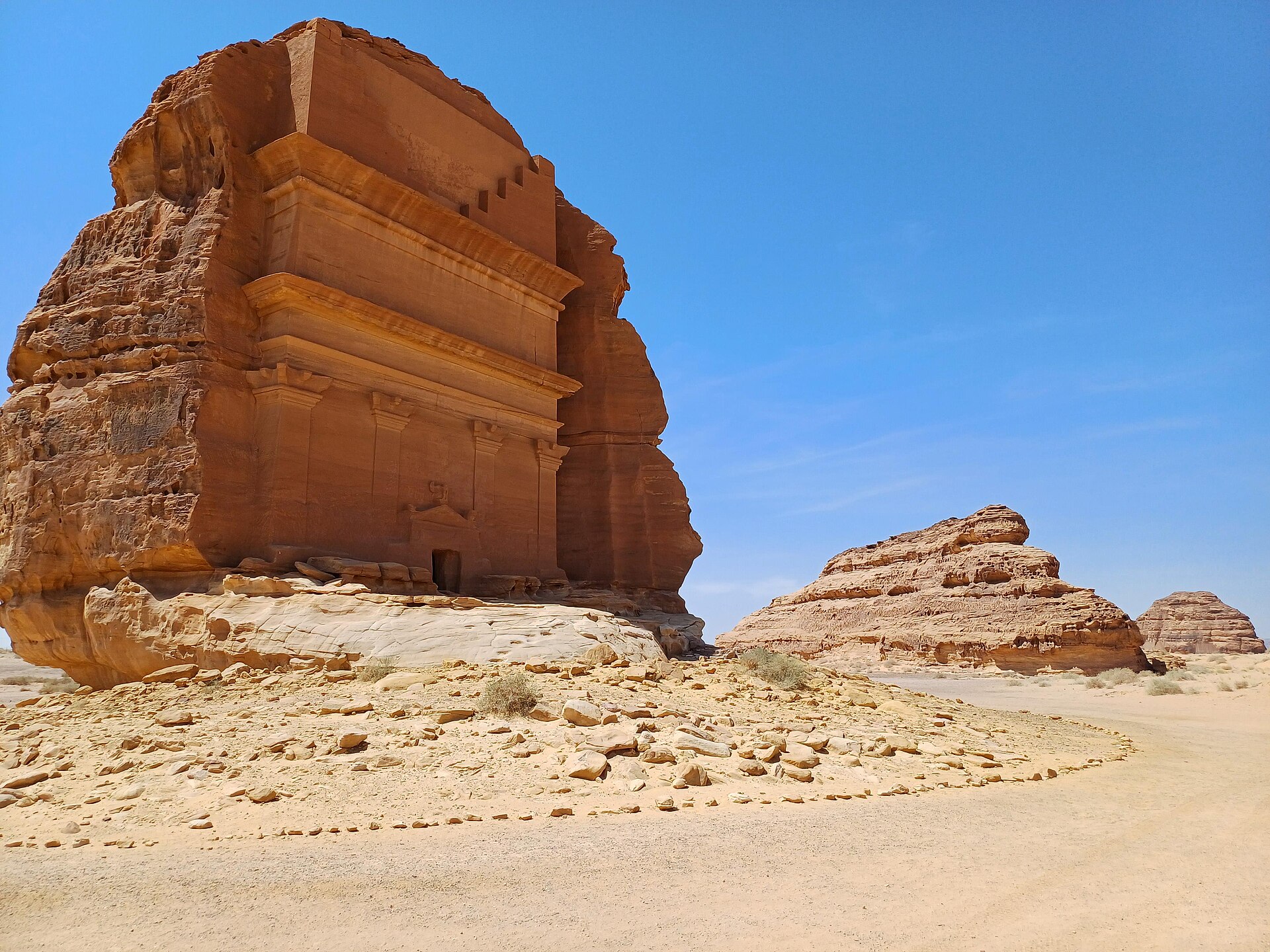
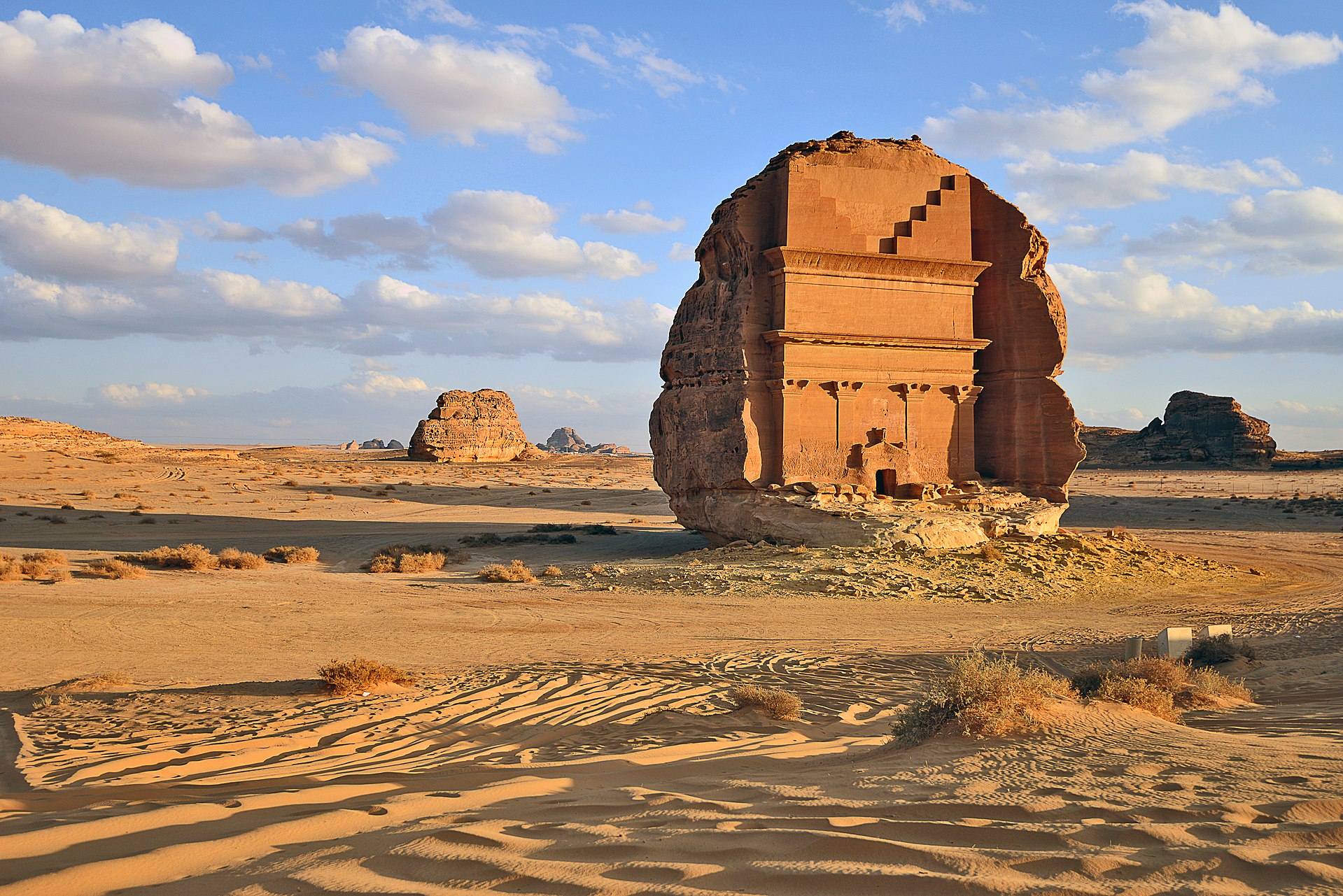
No image of Hegra is more iconic than Qasr al-Farid. This single monumental tomb, carved into a massive freestanding sandstone boulder, stands completely alone in the desert — separated from all other tomb clusters. Known as the Tomb of Lihyan son of Kuza, it rises approximately 22 metres and features a unique four-column facade, a departure from the two-column design used on every other tomb at the site.
Qasr al-Farid is famously unfinished. The upper sections of the facade are fully carved with Nabataean capitals and decorative elements, but the lower portion remains rough and incomplete. This incomplete state is actually one of its greatest archaeological gifts: it reveals that the Nabataeans carved their tombs from the top down, working methodically from the summit of the rock face toward ground level. The unfinished lower section shows the marks of tools and the stages of the sculpting process that are invisible on completed tombs. Scholars believe construction was halted — possibly due to the death of the patron or the Roman annexation — leaving a permanent record of Nabataean building techniques.
Qasr al-Bint: The Largest Tomb Cluster
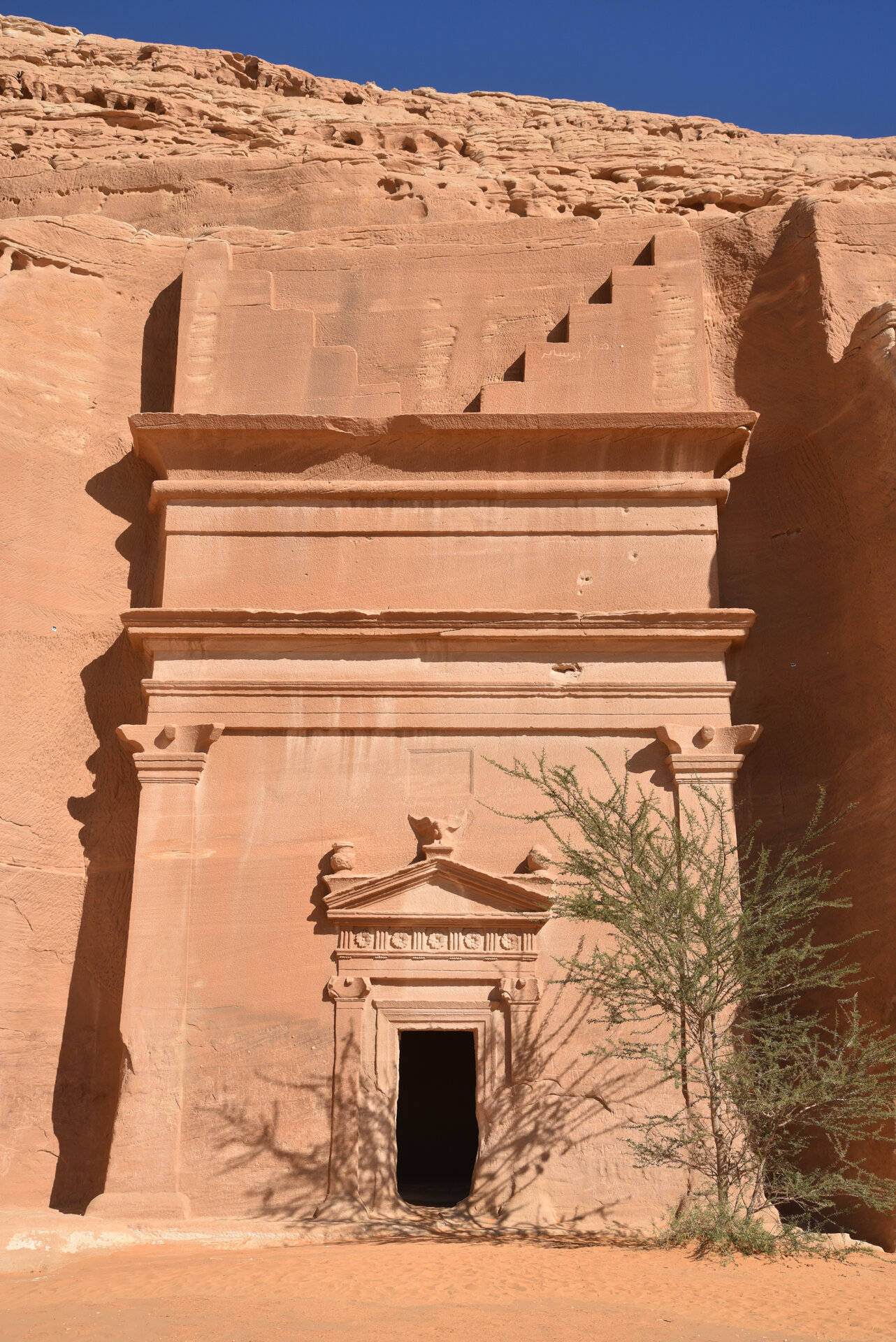
Qasr al-Bint — the “Palace of the Maiden” — is the name given to both the largest individual tomb facade at Hegra and the cluster of more than 30 tombs surrounding it. The main tomb stands 16 metres high and features an elaborately carved entrance with Egyptian-influenced cornices and decorative staircases. Above the doorway, a Nabataean inscription records that the tomb was carved by the sculptor Hoor ibn Ahi for Hani ibn Tafsy, his family, and his descendants, in the 40th year of the reign of King Aretas IV (al-Haritha), dating it to approximately 31 AD.
The Qasr al-Bint cluster gives you the clearest sense of how a Nabataean necropolis functioned as a community. The tombs vary dramatically in size and ornamentation — from grand facades with multiple columns and elaborate carvings to smaller, undecorated chambers — reflecting the social hierarchy of Hegra’s population. Walking among these tombs, you can read the evolution of Nabataean architectural taste over several decades.
Jabal Ithlib: The Sacred Mountain
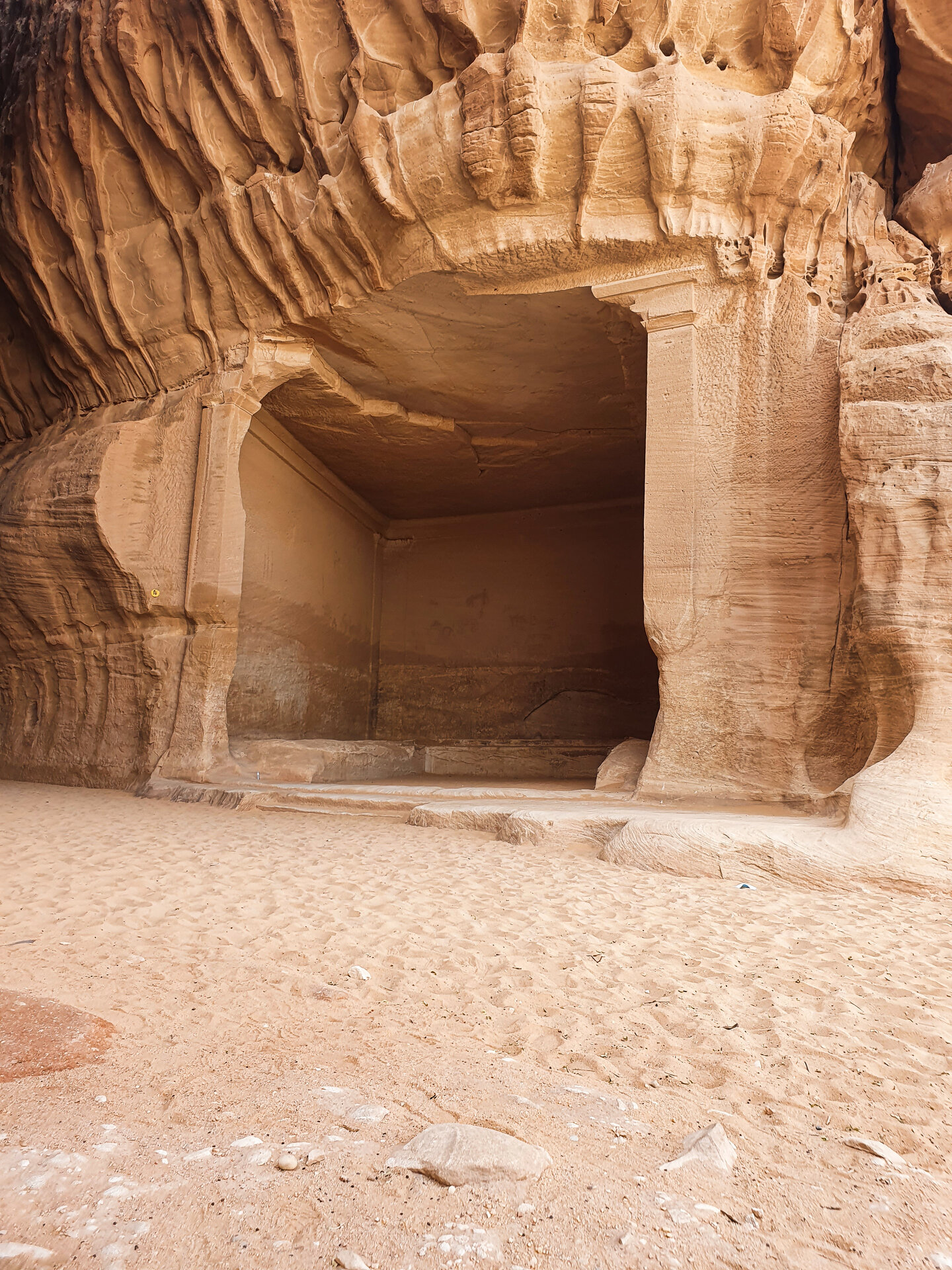
Located at the northeast corner of the site, Jabal Ithlib served a different purpose from the tomb clusters. This imposing mountain was a sacred precinct — a place of religious gathering rather than burial. The approach takes you through a narrow siq (canyon passage) lined with small niches carved into the rock walls, which once held religious offerings or cult images.
The highlight of Jabal Ithlib is the Diwan — a large rectangular chamber carved into the cliff face, measuring 12.8 by 9.9 metres with a ceiling height of 8 metres. Three stone benches line the interior walls, identifying it as a triclinium: a formal banqueting hall used for sacred feasts associated with the Nabataean deity Dushara. The Diwan’s wide entrance suggests that ceremonies and feasts often extended into the open space in front of the chamber. Approximately 36 rock inscriptions have been discovered on and around Jabal Ithlib, some dating back to the Lihyanite period that preceded the Nabataeans.
Jabal al-Ahmar: The Red Mountain
The tombs of Jabal al-Ahmar (Red Mountain) occupy a sandstone outcrop in the southeastern part of the site. This cluster contains 18 catalogued tombs dating from 16 to 61 AD. The area gained international attention in 2014 when heavy rains shifted a sand dune, revealing a previously hidden and entirely undisturbed tomb — a reminder that Hegra likely still holds archaeological secrets beneath its desert sands.
Al-Khuraymat: The Largest Concentration
Al-Khuraymat is the largest single grouping of tombs at Hegra, with 53 catalogued burial chambers. Many of these are simpler in design than the grand facades of Qasr al-Bint or Qasr al-Farid, suggesting they belonged to less wealthy members of Hegra’s society. The cluster offers an important counterpoint to the showpiece tombs: not every Nabataean could afford a monumental facade, but even the humbler burials at Al-Khuraymat demonstrate careful workmanship and respect for the dead.
How to Visit Hegra: Tours, Tickets, and Logistics
Entry to Hegra is exclusively through official guided tours organised by Experience AlUla, the Royal Commission for AlUla’s tourism arm. You cannot enter the site independently. Tickets can be purchased online at experiencealula.com or at the Hegra Visitor Centre.
Tour Options and Prices
| Tour Type | Duration | Price (SAR) | Price (USD) | Details |
|---|---|---|---|---|
| Hegra Standard Tour | ~3 hours | 95 | ~25 | Guided bus tour covering main tomb clusters and Qasr al-Farid |
| Hegra Hop-On Hop-Off | Self-paced | 150 | ~40 | Flexible bus circuit; explore at your own pace with multiple stops |
| Vintage Land Rover Tour | 2 hours | 1,500 | ~400 | Private vintage Land Rover with driver and Rawi (storyteller) guide; up to 7 passengers |
Booking Tip: Book your Hegra tour at least 2-3 days in advance during peak season (October-March). Tours can sell out, especially on weekends. Children aged 0-4 enter free on the Hop-On Hop-Off tour.
Getting to the Hegra Visitor Centre
All Hegra tours depart from the Hegra Visitor Centre, located approximately 22 km from AlUla town centre. You need to arrive directly by car, taxi, or via the Darb AlUla transport app — there is no shuttle service from the Winter Park visitor area. Arrive at least 15 minutes before your scheduled tour time. Complimentary refreshments including pomegranate juice and date cookies are offered at the entrance.
Opening Hours
Hegra is open daily from 08:00 to 17:00, with tour departures approximately every 10 minutes during peak season (November through February). During Ramadan, operating hours may vary — check directly with Experience AlUla for updated timings. Summer hours may also be adjusted due to extreme heat.
Hegra vs Petra: How Saudi Arabia’s UNESCO Site Compares
Visitors who have been to Petra in Jordan inevitably draw comparisons. While both sites were built by the Nabataeans, Hegra offers a distinctly different experience. Understanding the differences will help you appreciate what makes this site special in its own right, rather than seeing it as merely “the other Petra.”
| Feature | Hegra (Madain Saleh) | Petra (Jordan) |
|---|---|---|
| UNESCO Status | Inscribed 2008 | Inscribed 1985 |
| Number of Tombs | 111+ monumental facades | 800+ structures (tombs and other) |
| Inscriptions | Exceptionally well preserved; 90+ tombs have original Nabataean text | Most inscriptions lost to weathering and reuse |
| Crowds | Relatively few visitors; intimate experience | Over 1 million annual visitors; very busy |
| Access | Guided tour only (bus or Land Rover) | Self-guided; walk freely |
| Physical Difficulty | Minimal walking; vehicle-based tour | Extensive walking; hilly terrain |
| Landscape | Flat desert with scattered sandstone outcrops | Narrow canyon (Siq) opening to monument facades |
| Role in Nabataean Kingdom | Second city; southern trade gateway | Capital city; political and religious centre |
Hegra’s greatest advantage is its epigraphy. Nowhere else in the Nabataean world can you read so many original tomb inscriptions, complete with dates, names, and legal clauses. For anyone interested in ancient history, this alone makes Hegra worth the journey. The smaller crowds also mean you can photograph the tombs without hundreds of other tourists in the frame — a stark contrast to Petra’s Treasury, which is permanently surrounded by visitors.
What to Wear and Bring
Hegra is an open desert site with very little shade. Preparation is essential, especially if you are visiting outside the cooler winter months.
- Clothing: Dress modestly, covering shoulders and knees. This is both culturally appropriate and practical sun protection. Lightweight, breathable fabrics in light colours work best.
- Footwear: Sturdy, closed-toe shoes with good grip. The terrain is a mix of sand, gravel, and uneven rock. Sandals are not recommended.
- Sun protection: Hat or cap, high-SPF sunscreen, and sunglasses. There is virtually no natural shade among the tombs.
- Water: Carry at least 1.5 litres per person. Refreshments are available at the Visitor Centre but not throughout the site.
- Camera: Photography is freely permitted at Hegra, but drones and professional filming equipment require special authorisation from the Royal Commission for AlUla.
Photography Tip: The best light at Hegra falls during the late afternoon, when the sandstone facades glow a deep amber and long shadows add dramatic depth to the tomb carvings. If your tour timing allows, choose an afternoon departure.
When to Visit Hegra
The best time to visit Hegra is between October and March, when daytime temperatures range from a comfortable 15-25°C. This coincides with AlUla’s peak tourism season, when the region’s cultural programming — including music festivals, art installations, and special events — is at its most active.
- October-November: Warm days (20-28°C), pleasant evenings. Crowds building but still manageable. Excellent photography light.
- December-February: Peak season. Daytime highs of 15-22°C, but nights can drop to 5°C. Book tours and accommodation well in advance.
- March-April: Temperatures rising (22-32°C) but still comfortable for morning tours. Fewer crowds than peak season.
- May-September: Extreme heat, regularly exceeding 40-45°C. Not recommended for outdoor sightseeing. Some tours may operate with reduced schedules.
Getting to AlUla and Hegra
Hegra is located 22 km from the town of AlUla in the Medina Province of northwest Saudi Arabia. International visitors will need a valid Saudi tourist e-visa, which can be obtained online in minutes.
By Air
AlUla International Airport (ULH) — formerly Prince Abdul Majeed bin Abdulaziz Airport — receives daily domestic flights from Riyadh (~2 hours), Jeddah (~1.5 hours), and Dammam, plus international connections from Dubai (3 flights/week) and Doha (twice weekly via Qatar Airways). The airport has been refurbished to handle 600,000 passengers annually, with expansion to 6 million planned by 2030 as part of the Kingdom’s tourism development.
By Road
AlUla is approximately a 3-hour drive from Medina and 3 hours from Tabuk, making it accessible as part of a broader northwest Saudi road trip. The highways are well-maintained and well-signposted. Car rental is available at both Medina and Tabuk airports, and driving gives you the flexibility to explore AlUla’s wider landscape at your own pace. Note that the drive from Jeddah takes 7-8 hours and from Riyadh approximately 10 hours — flying is strongly recommended from both cities.
Getting Around AlUla
Within AlUla, the Darb AlUla app provides on-demand transport between hotels, attractions, and the Hegra Visitor Centre. Taxis are also available, and most hotels in AlUla can arrange transfers. If you have rented a car, the drive from AlUla town to the Hegra Visitor Centre takes about 20 minutes along a clearly marked road.
Where to Stay When Visiting Hegra
AlUla’s accommodation has expanded significantly in recent years, with options ranging from luxury resorts to budget-friendly hotels. There are currently over 1,000 rooms available, with expansion underway to 2,000 rooms by 2027.
- Luxury: Banyan Tree AlUla offers five-star glamping in the Ashar Valley, with tented villas set among sandstone formations. Habitas AlUla provides boutique desert-camp luxury. Both are ideal if you want to stay immersed in the landscape.
- Mid-range: Shaden Resort and the AlUla Adrere Hotel offer comfortable rooms with desert views. Both are within driving distance of Hegra and AlUla’s other attractions.
- Budget: Several guesthouses and budget hotels in AlUla town offer simple, clean accommodation. Most are located on the town’s outskirts, near the main road.
Accommodation Tip: During peak season (December-February), AlUla hotels book up fast. Reserve at least 3-4 weeks in advance. A three-night stay is recommended to visit Hegra, Elephant Rock, Dadan, and the Old Town.
Other AlUla Attractions to Combine with Hegra
Hegra is the headline act, but the AlUla region holds far more than a single archaeological site. Plan at least two to three full days in the area to explore these essential nearby attractions.
Elephant Rock (Jabal al-Fil)
This natural sandstone formation resembles a giant elephant with its trunk reaching toward the ground. Located just north of AlUla town, Elephant Rock is particularly spectacular at sunset when the rock glows orange and red. There is a café area at the base where you can enjoy Arabic coffee while watching the light change.
Dadan and Jabal Ikmah
The ruins of Dadan — capital of the ancient Lihyanite and Dedanite kingdoms that predated the Nabataeans — sit just outside AlUla Old Town. The Lion Tombs here, carved with guardian lion figures, are among the oldest funerary structures in the region. Nearby Jabal Ikmah is an “open library” of thousands of ancient rock inscriptions in multiple languages, providing evidence of AlUla’s role as a crossroads of civilisations for over 7,000 years.
AlUla Old Town
The abandoned mud-brick village of AlUla Old Town dates to at least the 12th century and offers a fascinating walk through narrow alleyways past over 900 collapsed and partially standing houses, shops, and mosques. The Old Town was inhabited until the 1980s and is now being carefully restored as a heritage precinct.
Maraya Concert Hall
The world’s largest mirrored building, Maraya (meaning “mirror” in Arabic) is a 9,740 m² structure clad entirely in reflective panels that mirror the surrounding desert landscape. It hosts concerts, exhibitions, and cultural events throughout the peak season and is worth visiting for the architecture alone.
Hegra in Islamic Tradition
The Quran refers to the site of al-Hijr in connection with the Thamud, a pre-Islamic Arabian people who are described as having carved homes in the mountains. Sura 15 (Al-Hijr) takes its name from the site. Islamic tradition associates the area with the Prophet Salih, who was sent to the Thamud people. Archaeological evidence suggests settlement at the site dates back approximately 5,000 years, long before the Nabataean period, supporting the tradition of deep historical roots. For visitors interested in the intersection of archaeology and faith, Hegra adds a layer of significance that extends beyond classical antiquity. You can explore more at our Islamic heritage sites guide.
Practical Tips for Visiting Hegra
- Read before you go: Hegra’s guides (known as Rawis, or storytellers) provide context during the tour, but having background knowledge of Nabataean history makes the experience far richer. The Saudi UNESCO sites guide is a good starting point.
- Bring binoculars: The inscriptions on upper portions of tomb facades can be difficult to read from ground level. Binoculars or a zoom lens will help you appreciate the carved text.
- Visit in the afternoon: If you have a choice, opt for a late-morning or afternoon tour. The sandstone facades photograph best in warm, angled light rather than harsh midday sun.
- Combine with stargazing: AlUla has some of the darkest skies in Saudi Arabia. Several operators offer desert stargazing experiences that pair beautifully with a day at Hegra.
- Allow three nights in AlUla: One day for Hegra, one for Dadan/Old Town/Elephant Rock, and one for desert experiences, hiking, or relaxation. Rushing through in a single day means missing most of what the region offers.
- Respect the site: Do not touch, climb, or lean against the tomb facades. Do not remove any stones, pottery shards, or other material. Rangers accompany every tour group to ensure the site is protected.
Accessibility and Facilities
Hegra is more accessible than many ancient sites. Because the standard and Vintage Land Rover tours are vehicle-based, visitors with limited mobility can still experience most of the site. The Hegra Visitor Centre has modern facilities including toilets and a small shop. However, walking at individual tomb stops can involve uneven, sandy ground, so sturdy footwear is still essential.
Hegra’s Future: Ongoing Excavations and Development
Hegra is far from fully excavated. The Kingdoms Institute, established in 2021 as part of the Royal Commission for AlUla, continues archaeological research across the region’s 7,000-year timeline. New discoveries are expected — the 2014 uncovering of a hidden tomb at Jabal al-Ahmar demonstrated that the site still holds secrets. The Journey Through Time Masterplan envisions AlUla as a global cultural destination with five distinct heritage districts, 15 new cultural facilities, and over 5,000 hotel rooms. Hegra sits at the heart of this vision.
In a sign of the times, Hegra became the first UNESCO World Heritage Site to be digitised and placed in the metaverse on the Decentraland platform — meaning you can preview the tombs virtually before visiting in person.
Explore More Saudi Arabia Travel Guides
- AlUla Travel Guide 2026 — Complete guide to Hegra, Elephant Rock, desert camps, and ancient Arabia
- Saudi Arabia UNESCO World Heritage Sites — Every UNESCO site in the Kingdom, with visitor information
- Saudi Arabia Desert Safari Guide — Dune bashing, camping, and the Empty Quarter
- Best Photography Spots in Saudi Arabia — Where to capture the Kingdom’s most stunning landscapes
- Saudi Arabia Travel Guide 2026 — The complete guide to visiting the Kingdom
- Saudi Arabia Visa Guide — Every visa type explained