
AlUla and Petra are the two greatest Nabataean archaeological sites on Earth, separated by roughly 640 kilometres of desert and a single international border. Both feature monumental rock-cut tombs carved into sandstone cliffs, both are UNESCO World Heritage Sites, and both sit at the heart of ancient incense trade routes that once connected Arabia Felix to the Mediterranean. If you are planning an AlUla travel itinerary or considering a combined trip through northwestern Saudi Arabia and southern Jordan, the question is inevitable: which Nabataean city deserves your time? This guide compares AlUla and Petra across every dimension that matters to a traveller — history, architecture, crowds, cost, logistics, and the sheer experience of standing before 2,000-year-old carved facades in the desert silence.
Best Time to Visit: October–March (both sites); avoid summer heat above 40°C
Getting There: AlUla via direct flights to ULH airport; Petra via Amman then 3 hrs south
Visa Required: Saudi e-visa for AlUla + Jordan Pass for Petra
Budget: AlUla $120–400/day; Petra $80–250/day
Must-See: Hegra tombs (AlUla), The Treasury & Monastery (Petra)
Avoid: Trying to see both sites in under 5 days — each needs 2–3 days minimum
The Nabataean Connection: A Shared Civilisation
The Nabataeans were a nomadic Arab people who rose to prominence from the 4th century BCE by controlling the incense trade routes carrying frankincense, myrrh, and spices from southern Arabia northward to Gaza, Damascus, and Rome. At its peak around the 1st century BCE, the Nabataean kingdom stretched from the Sinai Peninsula to the Hejaz, with Petra as the capital and Hegra (Madain Saleh) as the southern capital — the largest Nabataean settlement south of Petra.
The two cities were connected by the Incense Road, a network of caravan routes running roughly north-south through the Hejaz. Traders would stop at Hegra before continuing the 10- to 14-day journey north to Petra, then onward to Mediterranean ports. Both cities thrived on the same commerce, worshipped the same gods (Dushara, Al-Uzza, Allat), and carved their tombs and temples from the same rose-tinted sandstone. Yet each developed distinctive architectural traditions shaped by local geology, earlier inhabitants, and proximity to different cultural influences.
Understanding this shared heritage transforms both visits. At Hegra, you are walking through the southern frontier of an empire whose beating heart lay to the north. At Petra, you are standing in the capital that funded and directed the construction 640 kilometres to the south. Visiting both completes the picture in a way that neither site can achieve alone — and is well worth incorporating into a broader Saudi Arabia travel plan.
AlUla: Saudi Arabia’s Open-Air Museum
What You Will See
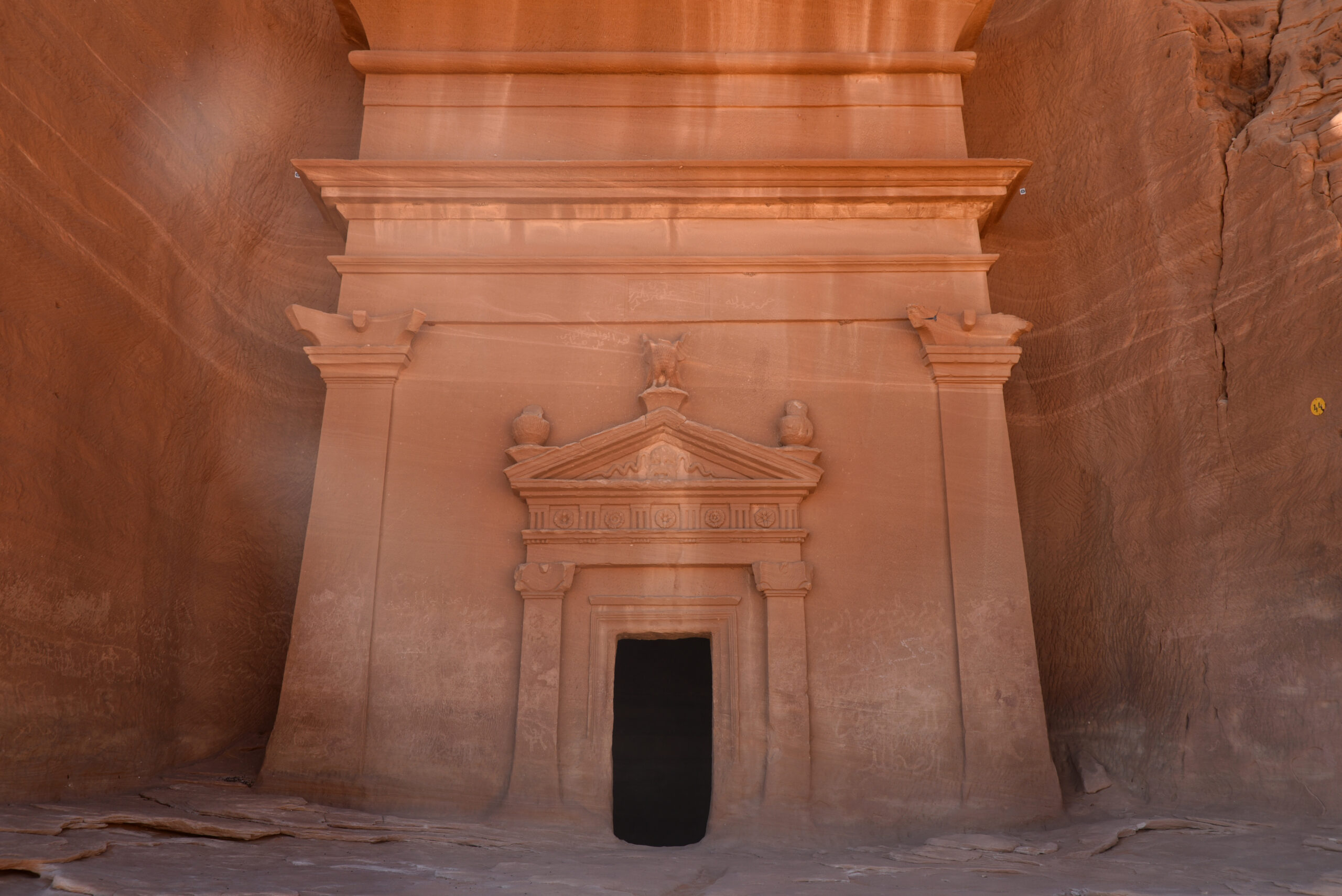
AlUla is not a single archaeological site but an entire valley of layered civilisations spanning over 7,000 years. The headline attraction is Hegra (Madain Saleh), inscribed as a UNESCO World Heritage Site in 2008 — Saudi Arabia’s first. Hegra contains 111 monumental rock-cut tombs, of which 94 are decorated with elaborate carved facades featuring eagles, sphinxes, Medusa heads, and Nabataean inscriptions dating ownership, construction, and curses against tomb violators. The site is spread across a vast desert plain punctuated by sandstone outcrops, and most tombs are accessible only on guided tours organised by the Royal Commission for AlUla.
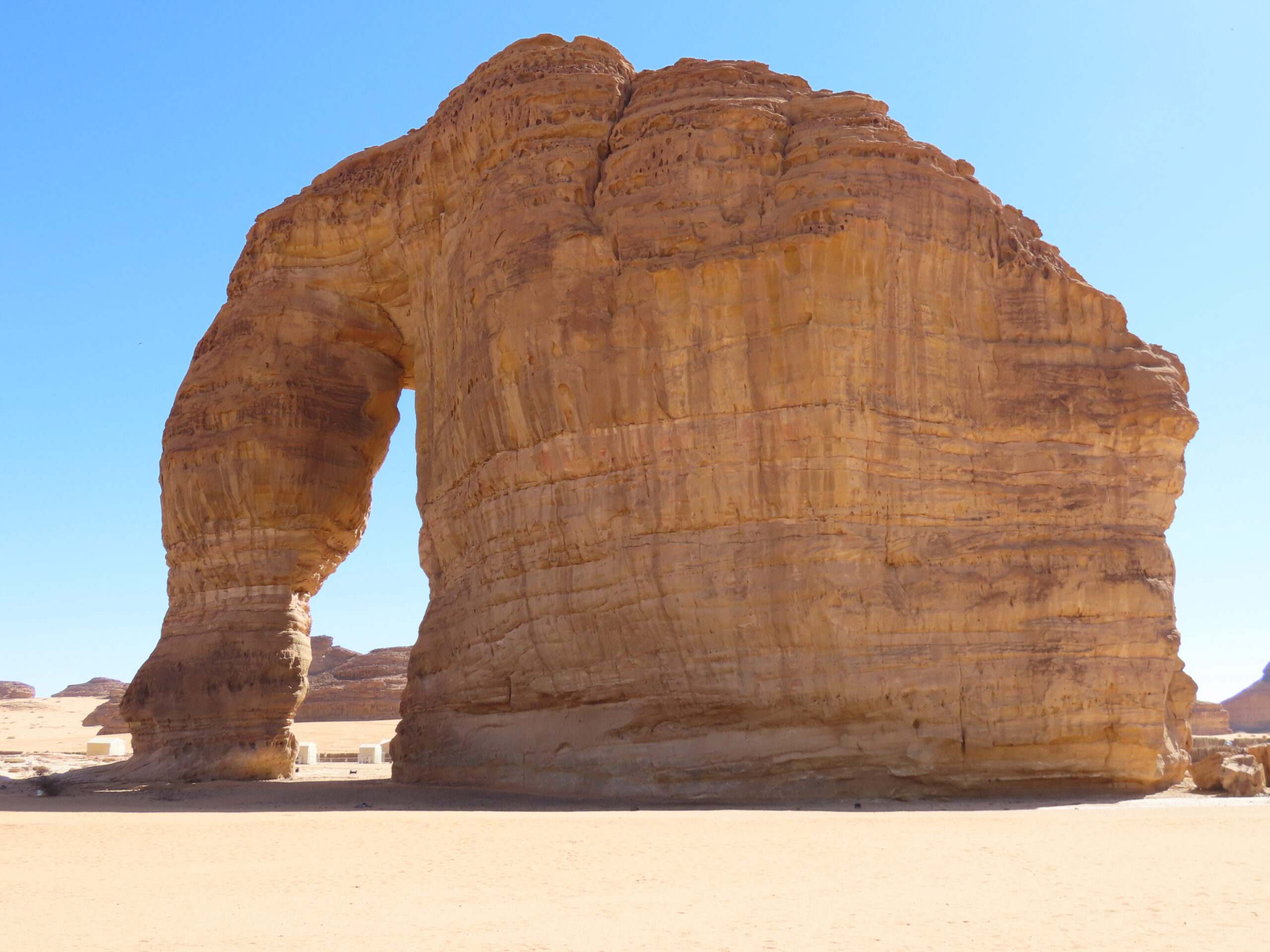
Beyond Hegra, AlUla offers Dadan, the capital of the pre-Nabataean Dadanite and Lihyanite kingdoms (c. 9th–2nd century BCE), with its lion-guarded cliff tombs carved centuries before the Nabataeans arrived. Jabal Ikmah, an open-air library of roughly 300 inscriptions in Aramaic, Dadanitic, Thamudic, and Minaic scripts, documents millennia of travellers and worshippers passing through the valley. The natural landmark of Elephant Rock (Jabal AlFil) draws visitors at sunset, while the partially restored AlUla Old Town — with its 900 mudbrick houses and 400 shops — evokes the medieval caravan trade.
The contemporary addition of Maraya, the world’s largest mirrored building and a concert hall hosting international performers, reflects the Royal Commission’s ambition to blend ancient heritage with modern cultural programming. The Winter at Tantora festival (typically December through early January) is the peak cultural season, bringing music, art installations, and culinary events to the valley.
The AlUla Experience
AlUla’s defining quality is solitude. With roughly 300,000 visitors per year (the Royal Commission is targeting one million by 2030), the site is a fraction as crowded as Petra. The desert landscape between tombs is vast and empty. Guided tours at Hegra typically include no more than 20–30 people, and it is entirely possible to stand alone before a 2,000-year-old facade with no other visitor in sight. The trade-off is that AlUla is heavily managed: you cannot explore Hegra independently, and access to most heritage sites requires advance booking through the Experience AlUla platform.
Accommodation ranges from budget hotels at around $67–79 per night to the ultra-luxury tented camps of Our Habitas AlUla ($700–1,200/night) and Banyan Tree AlUla ($800+/night), with mid-range options like Shaden Resort at roughly $120/night. New properties opening in 2026 include Hyatt Place AlUla and The Chedi Hegra, which will expand the mid-range market. A comfortable mid-range day in AlUla — accommodation, meals, site entry, and transport — runs $250–400.
Petra: The Rose-Red Capital
What You Will See
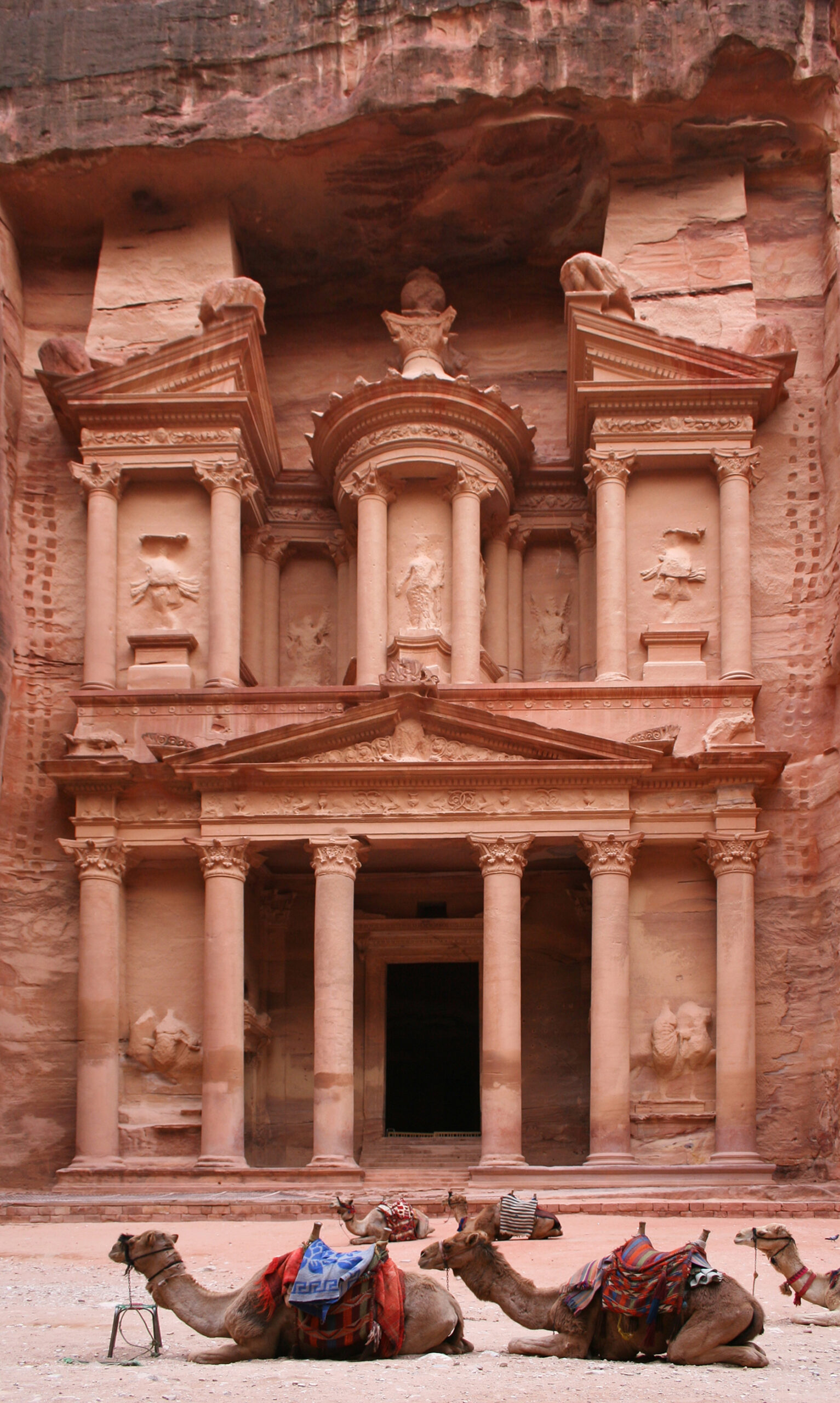
Petra needs little introduction. Carved into rose-red sandstone cliffs in what is now southern Jordan, it served as the Nabataean capital from roughly the 4th century BCE until the Roman annexation in 106 CE. The site was inscribed as a UNESCO World Heritage Site in 1985 and named one of the New Seven Wonders of the World in 2007. It contains over 800 carved structures — tombs, temples, a theatre, a colonnaded street, churches, and water channels — spread across a rugged valley system covering approximately 264 square kilometres.
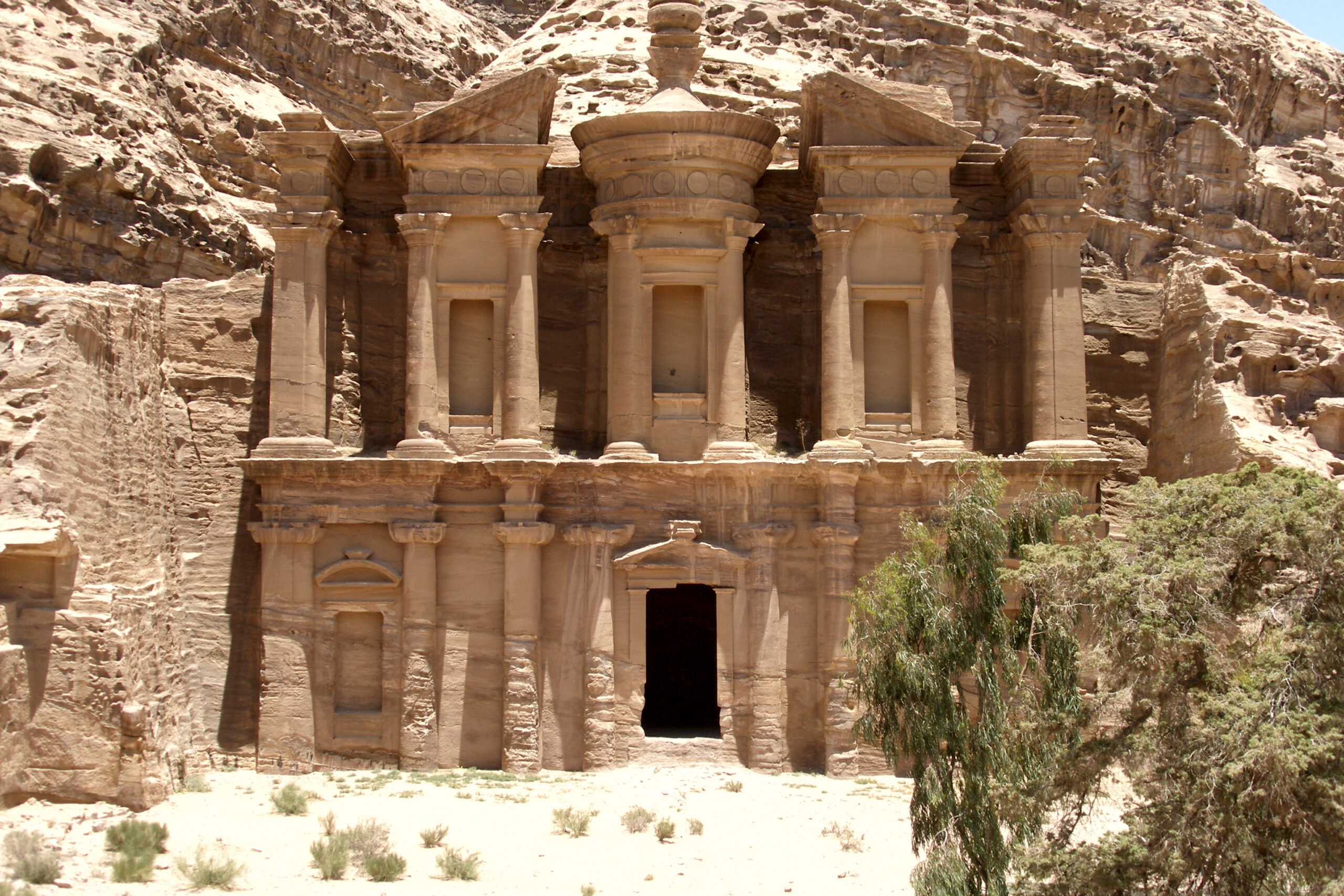
The approach through the Siq, a 1.2-kilometre narrow gorge with walls rising up to 80 metres, is one of archaeology’s great theatrical entrances. It culminates in the sudden reveal of Al-Khazneh (The Treasury), the iconic 40-metre Hellenistic facade believed to have been built around 40 CE as a royal mausoleum. Beyond the Treasury, the Street of Facades, Royal Tombs (Urn Tomb, Silk Tomb, Corinthian Tomb, Palace Tomb), the Roman Theatre, and the Colonnaded Street fill a full day of exploration. The demanding climb of 800+ rock-cut steps to Ad Deir (The Monastery) — 47 metres wide and 48 metres high — rewards with Petra’s largest monument and panoramic desert views.
The Petra Experience
Petra’s defining quality is scale. There is simply more here — more tombs, more architecture, more trails, more history layered across Nabataean, Roman, Byzantine, and Crusader periods. You could spend a week and still find new corners. The Siq-to-Treasury reveal is a genuinely emotional moment that few archaeological sites anywhere can match.
The trade-off is crowds. Petra welcomed 582,550 visitors in 2025 (up 27% from 2024), and the Siq creates a bottleneck that funnels everyone through the same narrow corridor. By mid-morning in peak season, the Treasury plaza is thick with tour groups, horse carriages, and selfie sticks. The best strategy is to enter at opening (6:00 AM) and walk directly to the Monastery before the crowds arrive, then work backward through the site.
Accommodation in the adjacent town of Wadi Musa is mature and competitive: budget guesthouses from $18–35/night, solid mid-range hotels at $45–80/night, and the well-positioned Movenpick Resort Petra right at the entrance gate ($150–250/night). A comfortable mid-range day runs $150–250 — significantly cheaper than AlUla.
Head-to-Head Comparison
| Factor | AlUla (Hegra) | Petra |
|---|---|---|
| UNESCO Status | Inscribed 2008 | Inscribed 1985; New Seven Wonders 2007 |
| Number of Carved Monuments | 111 tombs | 800+ structures |
| Annual Visitors | ~300,000 | ~583,000 (2025) |
| Entry Fee | From SAR 150 (~$40) | 50 JOD (~$71) for 1 day |
| Best Budget Option | Heritage pass (~$55–75) | Jordan Pass (from 70 JOD / ~$99 — includes visa + 1-day Petra) |
| Time Needed | 2–3 days | 2–3 days (1 day is rushed) |
| Walking Difficulty | Moderate — shuttles available within Hegra | Strenuous — 12–20 km/day, 800+ steps to Monastery |
| Crowds | Minimal; guided groups of 20–30 | Significant; Siq bottleneck in peak season |
| Accommodation Range | $67–1,200/night | $18–250/night |
| Daily Budget (Mid-Range) | $250–400 | $150–250 |
| Historical Layers | Dadanite, Lihyanite, Nabataean | Nabataean, Roman, Byzantine, Crusader |
| Night Experience | Stargazing, Maraya concerts | Petra by Night (candles in the Siq, 30 JOD) |
| Independent Exploration | Limited — guided tours required for Hegra | Fully independent; explore at your own pace |
Architecture: Similar but Distinct
Both sites showcase the Nabataean signature style — monumental facades carved directly into sandstone cliffs, with tombs hollowed out behind the ornamental exterior. But the architectural traditions diverge in revealing ways.
Petra’s Grandeur
Petra’s tombs feature elaborate Hellenistic and Roman ornamentation: Corinthian columns, pediments, friezes, and figurative sculpture reflecting the capital’s cosmopolitan connections with the Greco-Roman world. The Treasury alone shows Egyptian, Greek, and Mesopotamian influences blended into a uniquely Nabataean composition. As the capital and seat of Nabataean kings, Petra attracted the finest artisans and the largest budgets. The scale is grander, the ornamentation more refined, and the architectural ambition more visible.
Hegra’s Eclecticism
Hegra’s tombs are generally simpler in their facade decoration but more eclectic in their influences, reflecting the site’s position as a southern frontier trading post. Many tombs incorporate pre-Nabataean Dadanite and Lihyanite elements — stepped crowning (crow-step patterns) and cleaner geometric designs that predate the Hellenistic fashions seen at Petra. The inscriptions at Hegra are remarkably well preserved (the dry Saudi climate is less erosive than Jordan’s seasonal rains), and many tombs carry dated inscriptions naming the owner, the mason, and legal penalties for misuse — providing a level of biographical detail largely absent at Petra.
For architectural spectacle, Petra wins. For inscriptional richness, preservation quality, and pre-Nabataean layering, Hegra offers what Petra cannot.
Getting to Each Site
Reaching AlUla
AlUla International Airport (ULH) receives direct flights from Riyadh, Jeddah, and Dubai. The airport has been expanded to handle growing visitor numbers. Alternatively, AlUla is approximately 300 km north of Medina by road (~3 hours), making it a feasible add-on to a Hajj or Umrah pilgrimage. If you are coming from Tabuk, the drive south takes roughly 4 hours. You will need a Saudi tourist e-visa, which is available online for citizens of 49 countries and typically approved within minutes.
Reaching Petra
Most travellers fly into Amman’s Queen Alia International Airport, then drive roughly 3 hours south to Wadi Musa (the town adjacent to Petra). Budget travellers can take the JETT bus from Amman ($11 one-way). The Jordan Pass (from 70 JOD / ~$99) bundles the Jordanian visa fee with Petra entry — essential for most nationalities and the best-value way to visit.
Combined Trip: AlUla to Petra
The overland route from AlUla to Petra runs approximately 640 km via the Haql–Aqaba border crossing, taking 9–10 hours by car. This is feasible for adventurous road-trippers — the route passes through dramatic Hejaz desert scenery and the Gulf of Aqaba coastline. You will need to exit Saudi Arabia through the Haql (Durra) border post and enter Jordan at Aqaba, then drive north to Wadi Musa. Alternatively, you can fly from AlUla to Amman via Riyadh or Jeddah, though this adds time and cost. A combined itinerary works best with 5–7 days: 2–3 days in AlUla, a travel day, and 2–3 days in Petra.
Tip: If you are combining both sites, start with AlUla. The smaller scale and guided format provide an excellent introduction to Nabataean civilisation before you encounter Petra’s overwhelming vastness. You will notice details at Petra that would have passed you by without the Hegra context.
Best Time to Visit
Both AlUla and Petra share a similar optimal window: October through March, when daytime temperatures settle into the 15–28°C range. Summer at both sites pushes above 40°C and makes extended outdoor exploration miserable.
Within that window, there are nuances. AlUla’s peak season runs from mid-December through early January during Winter at Tantora, when the cultural programming is richest but accommodation prices spike and advance booking is essential. Petra’s quietest months are November and February — after the autumn rush and before the spring crowds. Petra by Night runs several evenings per week and is worth the 30 JOD for the experience of walking the candlelit Siq.
For a combined trip, late October or February offers the best balance: comfortable temperatures at both sites, manageable crowds, and lower accommodation prices than peak season.
Which Is Better for Families?
AlUla is the more family-friendly option. The guided tour format means less navigation stress, shuttle buses reduce walking distances within Hegra, and the terrain is flatter and less physically demanding. Elephant Rock is an easy sunset outing that children enjoy, and the open desert landscape holds obvious appeal for young explorers. Several AlUla hotels cater to families with connecting rooms and activity programmes.
Petra is a magnificent experience for older children and teenagers who can handle the physical demands — the 800+ steps to the Monastery, the heat, and distances of 12–20 km in a full day of exploration. For young children or anyone with mobility limitations, Petra’s terrain is a genuine challenge. Horse carriages run through the Siq and donkeys are available for parts of the climb, though animal welfare concerns have led many travellers to avoid them.
Which Is Better for Photography?
Both sites are extraordinary for photography, but in different ways. Petra offers the Siq’s dramatic light-and-shadow play, the Treasury’s theatrical framing, and the sheer variety of 800+ carved structures across shifting light conditions throughout the day. The challenge is photographing the Treasury without crowds — arrive at dawn.
AlUla offers something rarer: the ability to photograph monumental Nabataean tombs with no people in the frame at all. The desert lighting is extraordinary, the sandstone colours shift dramatically through golden hour, and the landscape context — isolated tombs rising from flat desert plains — creates compositions that Petra’s canyon-enclosed setting cannot match. Stargazing photography in AlUla’s low-light-pollution desert is a bonus that Jordan’s more developed Wadi Musa cannot compete with.
The Verdict: Which Should You Choose?
Choose AlUla if: you value solitude over spectacle, want a curated and managed heritage experience, are combining with a wider Saudi Arabia itinerary, prefer luxury desert accommodation, or want to see pre-Nabataean civilisations (Dadanite, Lihyanite) alongside the Nabataean sites. AlUla is also the better choice if you have already visited Petra and want the complementary perspective.
Choose Petra if: you want the single most dramatic archaeological reveal in the Middle East (the Siq-to-Treasury approach), prefer independent exploration at your own pace, are travelling on a tighter budget, want to combine with other Jordanian highlights (Wadi Rum, Jerash, the Dead Sea), or are prioritising sheer scale and variety of carved monuments.
Choose both if: you have 5–7 days and want the complete Nabataean story. Seeing Hegra and Petra together — the southern frontier and the imperial capital — is one of the most rewarding archaeological journeys in the world. The overland route through the Hejaz desert and down to Aqaba is an adventure in itself.
Our recommendation: If you can only visit one, Petra remains the must-see — its scale and the Treasury reveal are unmatched. But if you are already in Saudi Arabia, AlUla is not a consolation prize. It is a quieter, deeper, and in some ways more intimate encounter with the same civilisation. The ideal trip includes both.
Practical Tips for Both Sites
- Footwear: Sturdy walking shoes are essential at both sites. Petra’s terrain is rougher; hiking boots recommended. AlUla is manageable in comfortable trainers.
- Water: Carry at least 2 litres per person per day. Both sites have limited shade. Petra has some vendor stalls along the route; AlUla’s guided tours typically include water.
- Sun protection: High-SPF sunscreen, a hat, and sunglasses are non-negotiable at either site.
- Booking: AlUla requires advance booking for Hegra tours via experiencealula.com. Petra is walk-up, but buying the Jordan Pass online in advance saves time and money.
- Cash: Both sites accept cards at main ticket offices, but carry local currency (SAR for AlUla, JOD for Petra) for vendors and small purchases.
- Guides: Mandatory at Hegra, optional at Petra. Hiring a local guide at Petra ($30–50 for a half-day) dramatically enriches the experience.
- AlUla Travel Guide 2026 — The complete guide to visiting AlUla, Hegra, and the surrounding valley
- Elephant Rock, AlUla — How to visit Jabal AlFil, AlUla’s most photographed natural landmark
- AlUla Old Town — Exploring the medieval mudbrick heart of the AlUla valley
- Tabuk Travel Guide — Exploring Saudi Arabia’s northwest, from NEOM to the Gulf of Aqaba
- Saudi Arabia Travel Guide 2026 — The complete guide to visiting the Kingdom
- Saudi Arabia Visa Guide — Every visa type explained