
Quick Facts: Saudi Arabia Grand Prix
| Detail | Information |
|---|---|
| Official Name | Formula 1 STC Saudi Arabian Grand Prix |
| Circuit | Jeddah Corniche Circuit |
| Circuit Length | 6.174 km (3.836 mi) — 27 turns |
| Race Type | Night race (floodlit street circuit) |
| Lap Record | 1:30.734 — Lewis Hamilton (2021) |
| Top Speed | 322+ km/h (200+ mph) |
| First Held | 2021 |
| Contract Until | 2030 |
| 2026 Status | Cancelled (Middle East conflict) |
| Airport | King Abdulaziz International (JED) — 15 km from circuit |
| Time Zone | AST (UTC+3) |
Introduction: Why the Saudi Arabia Grand Prix Matters
Since its debut in 2021, the Saudi Arabian Grand Prix at the Jeddah Corniche Circuit has established itself as one of the most dramatic fixtures on the Formula 1 calendar. Held under floodlights along the Red Sea coast, the race combines blistering speed — average lap speeds exceeding 250 km/h make it the fastest street circuit in F1 — with the kind of close-quarters wheel-to-wheel action that street racing demands.
The event is part of Saudi Arabia’s broader ambition to position itself as a global entertainment and sporting destination under Vision 2030. For travelling fans, Jeddah offers a compelling package: world-class racing, a vibrant cultural scene anchored by the UNESCO-listed Al Balad district, Red Sea beaches, and a hospitality infrastructure that continues to expand rapidly.
This guide covers everything you need to plan a trip to the Saudi Arabia Grand Prix — from ticket categories and hotel recommendations to cultural etiquette and what to do beyond the circuit. Whether you are a seasoned F1 traveller or considering your first Grand Prix abroad, the information here will help you make the most of race weekend in Jeddah.
Note: The 2026 Saudi Arabian Grand Prix, originally scheduled for 17-19 April, was officially cancelled by Formula 1 due to the ongoing conflict in the Middle East. The race is expected to return to the calendar in future seasons — Saudi Arabia’s hosting contract runs through 2030. This guide remains fully relevant for future editions of the event.
The Jeddah Corniche Circuit: A Technical Overview
Designed by Carsten Tilke and constructed in record time for the 2021 inaugural race, the Jeddah Corniche Circuit runs along the city’s Red Sea waterfront. At 6.174 kilometres, it is the third-longest circuit on the F1 calendar, behind only Spa-Francorchamps and Las Vegas.
Circuit Characteristics
The track features 27 corners — 16 left-handers and 11 right-handers — that flow together in a fast, sweeping rhythm quite unlike a typical street circuit. Where Monaco demands patience and precision at low speed, Jeddah rewards commitment and bravery at high speed. Cars routinely exceed 322 km/h on the long straights, and the average lap speed of roughly 250 km/h is second only to Monza on the entire calendar.
Three DRS zones provide overtaking opportunities, particularly into the heavy braking zone at Turn 1 and the hairpin at Turn 27. The S-shaped section around Turns 22-24, threading between concrete walls at enormous speed, is among the most exhilarating sequences in modern F1.
Key Corners and Viewing Highlights
| Section | What Happens | Best Viewed From |
|---|---|---|
| Turns 1-2 | Heavy braking from DRS zone — prime overtaking spot | Main Grandstand B |
| Turns 8-10 | High-speed sweeps along the Red Sea waterfront | Central Grandstand D |
| Turn 13 | Tight hairpin — high G-forces, potential lock-ups | Concert stage area (GA) |
| Turns 22-24 | Blind, high-speed S-curves between walls | Limited visibility (better on screens) |
| Turn 27 | Final hairpin into DRS zone — last-lap drama | Main Grandstand A |
| Start/Finish Straight | Grid starts, pit stops, podium ceremony | Main Grandstand A |
Race Winners at Jeddah
| Year | Winner | Team |
|---|---|---|
| 2021 | Lewis Hamilton | Mercedes |
| 2022 | Max Verstappen | Red Bull |
| 2023 | Sergio Pérez | Red Bull |
| 2024 | Max Verstappen | Red Bull |
| 2025 | Oscar Piastri | McLaren |
Tickets: Categories, Prices and What to Expect
The Saudi Arabian Grand Prix offers a range of ticket options from affordable general admission through to premium hospitality experiences. Compared to Abu Dhabi or Singapore, Jeddah represents reasonable value — particularly at the general admission and grandstand tiers.
Ticket Tiers Overview
| Category | 3-Day Pass (approx.) | Best For | Key Features |
|---|---|---|---|
| General Admission | From $30 / €26 | Budget-conscious fans | Roaming access, fan zones, big screens, concert access |
| Central Grandstand D | From $110 / €108 | On-track action lovers | Views of Turns 8-10 and 16-18 with Red Sea backdrop |
| Main Grandstand B | From $155 / €152 | Start/finish enthusiasts | Turns 1-2, grid views, partial pit lane visibility |
| Main Grandstand A | From $250+ | The full experience | Pit lane, start/finish, podium ceremony, team garages |
| Premium Lounge | From $3,360 / €3,360 | Hospitality seekers | Covered seating, premium catering, views of Turns 1, 2 and 5 |
| Premium Suite | From $4,095 / €4,095 | Corporate entertaining | Private suite, premium dining, dedicated service |
| Paddock Club | From $9,660 | Ultimate access | Pit lane walks, driver appearances, gourmet dining, open bar (non-alcoholic) |
Single-day tickets are also available, typically ranging from around $29 for Friday practice to $85 for Sunday’s race day at the general admission level. Early bird discounts of 10-20% are common when tickets first go on sale, usually in October or November for the following year’s race.
Which Grandstand Should You Choose?
For first-time visitors, Main Grandstand A delivers the quintessential Grand Prix experience — you will see the grid form up, pit stops unfold, and the podium celebration at close range. If your budget is tighter, Central Grandstand D offers excellent on-track viewing with the Red Sea as a dramatic backdrop, and at roughly half the price of the main grandstand.
General admission is remarkably affordable for an F1 race and gives you freedom to explore the circuit, though you will be watching from behind fences and relying on large screens for much of the action. The trade-off is access to all fan zones and the after-race concerts, which are included with every ticket.
Where to Stay: Hotels in Jeddah for F1 Weekend
Jeddah’s hotel stock has grown significantly since the Grand Prix arrived, though the city still has fewer international chain properties than Dubai or Abu Dhabi. Expect to pay a premium during race weekend — booking three to four months in advance is advisable.
Luxury (From $350-550+ per night)
| Hotel | Distance to Circuit | Highlights |
|---|---|---|
| The Ritz-Carlton Jeddah | ~3 km (Al Hamra, Southern Corniche) | Beachfront setting, world-class spa, multiple restaurants |
| Park Hyatt Jeddah — Marina, Club and Spa | ~14 km | Marina views, Egyptian cotton bedding, private beach |
| Hilton Jeddah | ~5 km | Corniche location, rooftop pool, business-friendly |
| Assila, Luxury Collection (Marriott) | ~17 km | Elegant interiors, central location, excellent dining |
Mid-Range (From $100-250 per night)
| Hotel | Distance to Circuit | Highlights |
|---|---|---|
| Hotel Galleria Jeddah (Curio Collection by Hilton) | ~12 km | Modern design, mall-adjacent, competitive pricing |
| Casablanca Grand Hotel | ~8 km | Well-reviewed, comfortable rooms, good value |
| Hyatt House Jeddah Sari Street | ~14 km | Extended-stay style, kitchen suites, pool |
Budget (From $38-100 per night)
| Hotel | Distance to Circuit | Highlights |
|---|---|---|
| Millennium Al Masar | ~2 km (walkable to Corniche) | Pool, parking, close to waterfront |
| Ewaa Express Hotel — Al Hamra | ~4 km | Clean, functional, great for short stays |
| Blue Diamond Hotel Jeddah | ~6 km | Modern rooms, competitive rates |
Local aparthotels represent particularly good value in Jeddah. Many are well-rated, offer kitchen facilities, and cost a fraction of what the international chains charge — especially useful during race weekend when hotel premiums apply.
Getting There: Flights, Transfers and Local Transport
Flights to Jeddah
King Abdulaziz International Airport (IATA: JED) serves as the main gateway, located approximately 15 kilometres from the Jeddah Corniche Circuit — roughly a 20-30 minute drive depending on traffic.
Jeddah is well-connected internationally. Saudia (the national carrier) operates extensive routes from Europe, Asia, and Africa. Emirates, Etihad Airways, Qatar Airways, Turkish Airlines, and several European carriers also serve the airport with direct flights from major hubs including London, Paris, Frankfurt, Istanbul, Dubai, and Kuala Lumpur.
For visitors already in Saudi Arabia, domestic flights from Riyadh to Jeddah take approximately 90 minutes and run frequently on Saudia and flynas.
Airport Transfers
From King Abdulaziz International Airport to your hotel or the circuit:
| Option | Cost (approx.) | Journey Time | Notes |
|---|---|---|---|
| Uber / Careem | $10-20 | 20-30 minutes | Most convenient; widely available in Jeddah |
| Airport Taxi | $15-25 | 20-30 minutes | Metered; available at arrivals |
| SAPTCO Bus | $3-5 | 40-60 minutes | Budget option; less convenient for luggage |
| Hotel Transfer | Often complimentary | 20-30 minutes | Check with your hotel at booking |
| Car Rental | From $40/day | Self-drive | Enterprise, Europcar, Kayak at airport |
Getting to the Circuit
Uber and Careem are by far the most practical way to reach the Jeddah Corniche Circuit from most hotels. Journey times from central Jeddah are typically 20-30 minutes, though allow extra time on race day when traffic intensifies. Many organised F1 travel packages include return circuit transfers.
If you rent a car, be aware that local driving conventions differ from European or North American norms — left turns are frequently replaced by U-turn systems, and lane discipline can be relaxed. Road signs include English translations. Parking near the circuit is available but fills up quickly on race day.
Race Weekend Schedule
The Saudi Arabian Grand Prix follows F1’s standard three-day format, with all sessions held in the evening and night to take advantage of cooler temperatures and the spectacular floodlit atmosphere.
| Day | Session | Typical Time (Local / AST) |
|---|---|---|
| Friday | Free Practice 1 | 17:30 |
| Friday | Free Practice 2 | 21:00 |
| Saturday | Free Practice 3 | 17:30 |
| Saturday | Qualifying | 21:00 |
| Sunday | Race (50 laps) | 21:00 |
Gates typically open several hours before the first session each day, allowing time to explore fan zones, visit merchandise shops, and soak in the pre-race atmosphere. Support race sessions (Formula 2, Formula 3, or Porsche Sprint Challenge) fill the gaps between F1 sessions.
Entertainment Beyond the Track
After-Race Concerts
One of the standout features of the Saudi Arabian Grand Prix is the nightly after-race concert series, included with all circuit tickets at no extra charge. The concert stage is located near Turn 13, and past headline acts have included Shakira, Pitbull, Kygo, Usher, Jennifer Lopez, and Major Lazer. Performances typically begin shortly after the final chequered flag each evening.
Fan Zones and Activities
The circuit features two major fan zones — the Main Fan Zone behind the main grandstand and the Central Fan Zone — offering a wide range of entertainment:
- F1 racing simulators and VR experiences
- Karting, RC car racing, and obstacle courses
- Escape rooms and laser tag
- Live driver interviews and autograph sessions
- F1-themed art installations and craft stations
- Food trucks and dining from the Jeddah Yacht Club
- Official F1 merchandise shops
- Women: shoulders, chest, and knees should be covered. Loose trousers, maxi dresses, and long-sleeve tops work well. A headscarf is not required for non-Muslim women but is respectful in traditional areas like Al Balad
- Men: long trousers are advisable rather than shorts. T-shirts and team merchandise are perfectly acceptable at the circuit
- Hospitality suites: smart-casual dress is expected — no beachwear or sports shorts
Opening and Closing Ceremonies
The Grand Prix weekend kicks off with a spectacular opening ceremony featuring drone shows, DJ sets, and live performances. After Sunday’s race, the closing ceremony includes a full podium celebration, fireworks display, and a final round of live entertainment.
What to Do in Jeddah Beyond the Circuit
Jeddah is Saudi Arabia’s most cosmopolitan city, and race weekend provides an excellent excuse to explore it. Here are the highlights worth building into your trip.
Al Balad: The UNESCO Historic District
The ancient heart of Jeddah, Al Balad dates to the 7th century and earned UNESCO World Heritage status in 2014. The district is famous for its traditional Hijazi architecture — towering coral-stone houses adorned with ornate wooden Roshan windows and mashrabiya latticework screens. Key stops include the Al-Shafi’i Mosque (Jeddah’s oldest, dating back over 1,400 years), the Nassif House Museum showcasing traditional manuscripts and maps, and the Al-Alawi Market for spices, Arabian perfumes, jewellery, and handicrafts. Al Balad comes alive after sunset when locals and visitors fill its narrow streets, cafes, and restaurants.
The Jeddah Corniche
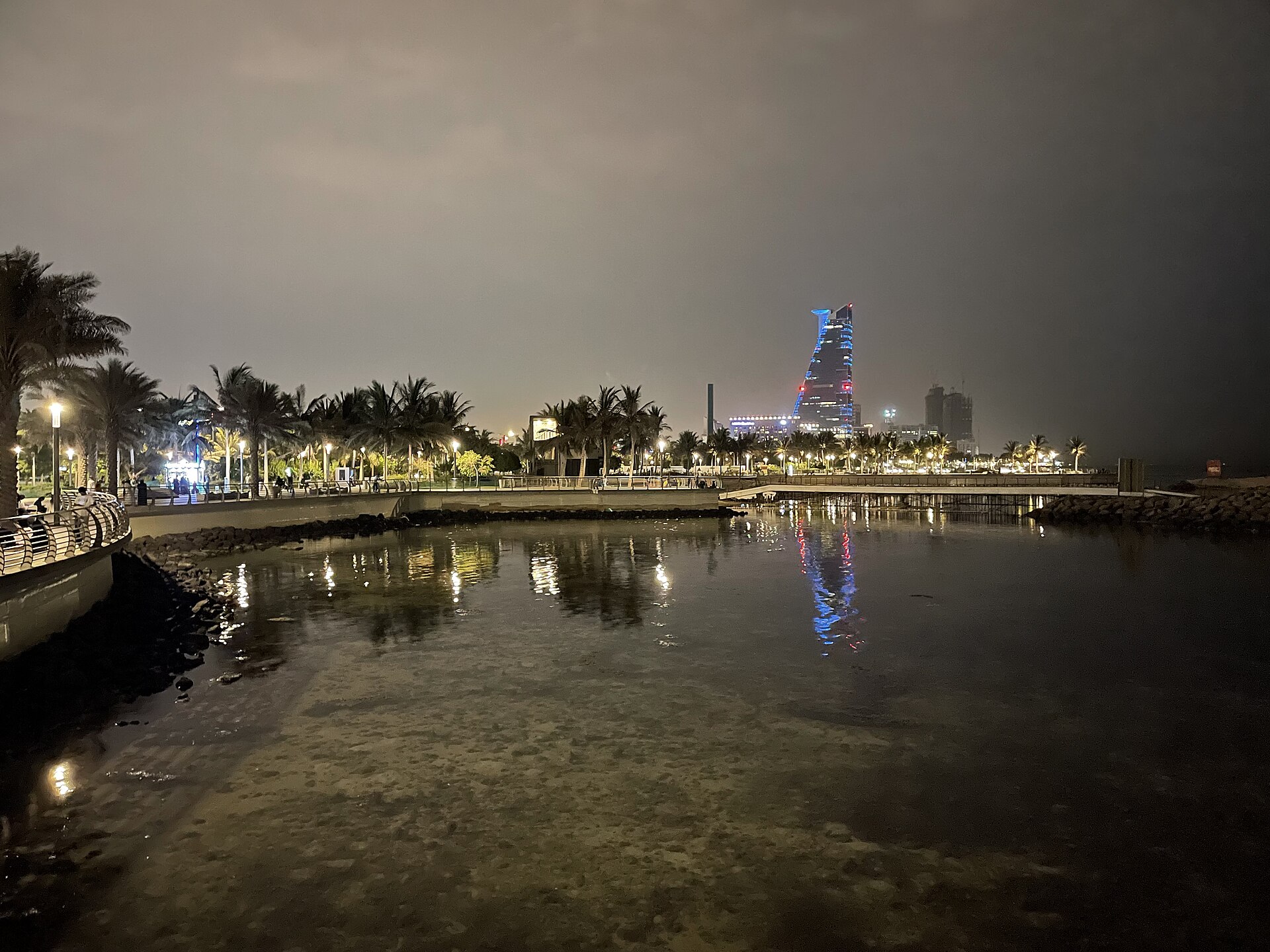
Stretching over 30 kilometres along the Red Sea coast, the Corniche is one of the world’s great urban waterfronts. Wide pathways, green lawns, playgrounds, and an extraordinary collection of public art sculptures make it ideal for walking or cycling. The King Fahd Fountain — the world’s tallest, shooting water 312 metres into the air — is visible from much of the Corniche and is particularly dramatic at night.
The Floating Mosque
Built in 1985 at the northern end of the Corniche, the Fatima Al-Zahra Mosque appears to float on the Red Sea when the tide is high. It is one of Jeddah’s most photographed landmarks and is open to visitors outside prayer times.
Red Sea Activities
The warm, clear waters of the Red Sea offer excellent snorkelling and diving. Bayada Island, roughly 40 minutes offshore, is a popular day-trip destination with coral reefs, kayaking, and swimming. Several operators run boat trips from the Jeddah marina, and the diving here is genuinely world-class — the Red Sea’s coral ecosystems are among the most biodiverse on earth.
Dining
Jeddah’s restaurant scene reflects its position as a historic trading port. Expect excellent Hijazi cuisine (try saleeg, a creamy rice dish, or mandi, slow-cooked lamb with spiced rice), alongside Lebanese, Turkish, Indian, and increasingly varied international options. The Al Balad area and the Corniche waterfront both offer strong concentrations of restaurants.
Cultural Tips and Practical Advice
Saudi Arabia has opened considerably to international visitors since 2019, but it remains a conservative society with specific customs that visitors should respect. Here is what F1 fans need to know.
Dress Code
There is no formal dress code enforced at the Grand Prix itself — organisers have confirmed that fans should dress as they would for any F1 event. However, Saudi cultural norms apply, and visitors are advised to dress modestly:
For a more detailed guide to clothing expectations across the Kingdom, see our Saudi Arabia Dress Code Guide.
Alcohol
Alcohol is illegal in Saudi Arabia, with no exceptions for tourists or special events. This applies everywhere — the circuit, hotels, restaurants, and hospitality suites. The Paddock Club and premium lounges serve premium non-alcoholic beverages and mocktails instead. This is one of the most significant differences from other F1 venues and catches some first-time visitors off guard.
Visa Requirements
Most nationalities can obtain a Saudi tourist e-visa online before travel or a visa on arrival. The process has been significantly streamlined since 2019. Check the official Visit Saudi website for the latest eligibility list and fees. For a step-by-step walkthrough, see our Saudi Arabia Visa Guide.
Prayer Times
Saudi Arabia observes five daily prayer times, during which some shops and restaurants may close briefly (typically 15-30 minutes). Be patient and plan accordingly, particularly for Friday midday prayers, which are the most widely observed. At the circuit itself, prayer rooms are available and the event schedule accommodates prayer times.
Weather
The Grand Prix typically falls in March or April, when Jeddah’s climate is warm but not yet at peak summer intensity. Expect daytime temperatures of 30-35°C (86-95°F), dropping to a more comfortable 22-26°C (72-79°F) in the evening when the racing takes place. Humidity can be moderate. Bring sunscreen for daytime activities and a light layer for air-conditioned spaces.
Currency and Payments
The Saudi Riyal (SAR) is the local currency, pegged to the US dollar at roughly 3.75 SAR to $1. Credit and debit cards (Visa, Mastercard) are widely accepted at hotels, restaurants, and the circuit. Apple Pay and Google Pay work at most modern establishments. ATMs are plentiful.
Photography
Photography is welcome at the circuit and at tourist sites, but avoid photographing individuals without their permission — this is considered particularly important in Saudi culture. Do not photograph military or government installations.
Budget Planner: How Much Does the Saudi GP Cost?
One of the advantages of the Jeddah Grand Prix is that it is more affordable than several comparable F1 events, particularly Abu Dhabi and Singapore. Here is a rough guide to total costs for a three-night trip.
| Expense | Budget | Mid-Range | Premium |
|---|---|---|---|
| 3-Day Circuit Ticket | $30 (GA) | $155 (Main B) | $3,360+ (Hospitality) |
| Hotel (3 nights) | $120-300 | $300-750 | $1,050-1,650+ |
| Flights (return, from Europe) | $300-500 | $500-900 | $2,000+ (business) |
| Airport Transfers | $20-40 | $30-50 | $80+ (private) |
| Circuit Transport (3 days) | $30-60 | $60-90 | Included in packages |
| Food and Drink (3 days) | $60-100 | $150-250 | $400+ |
| Spending Money / Activities | $50-100 | $100-200 | $300+ |
| Total Estimate | $610-1,130 | $1,295-2,395 | $7,190+ |
These figures exclude visa fees (typically $100-130 for the e-visa) and travel insurance. For a comprehensive breakdown of costs across the Kingdom, see our Saudi Arabia Cost Guide.
How Jeddah Compares to Other Middle East GPs
With four Formula 1 races in the broader Middle East region (Saudi Arabia, Bahrain, Qatar, and Abu Dhabi), fans have choices. Here is how Jeddah stacks up.
| Factor | Jeddah | Abu Dhabi | Bahrain | Qatar (Lusail) |
|---|---|---|---|---|
| Circuit Type | Street circuit | Purpose-built (Yas Marina) | Purpose-built (Sakhir) | Purpose-built (Lusail) |
| Race Time | Night | Twilight/Night | Night | Night |
| Ticket Prices | Low to moderate | Moderate to high | Low to moderate | Moderate |
| Hotel Costs | Moderate | High | Moderate | High (limited stock) |
| Entertainment | Concerts, fan zones | Concerts, Yas Island attractions | Limited | Moderate |
| Alcohol | Prohibited | Available | Available (licensed venues) | Available (limited) |
| Racing Character | Ultra-fast, dramatic | Season-finale prestige | Traditional, consistent | High-speed, modern |
| Tourism Appeal | High (Red Sea, Al Balad) | Very high (theme parks, beaches) | Moderate | High (Doha, desert) |
Jeddah’s key advantages are affordability (particularly tickets and food), the unique character of the ultra-fast street circuit, and the cultural depth of the city itself. Abu Dhabi offers a more polished, resort-style experience with alcohol available, while Bahrain provides the most straightforward and affordable race weekend in the region.
The Future: Qiddiya and Beyond
Saudi Arabia’s F1 ambitions extend beyond Jeddah. A purpose-built circuit at Qiddiya, the vast entertainment mega-project near Riyadh, is under development with an estimated investment of $500 million. Designed by Hermann Tilke and former F1 driver Alex Wurz, the Qiddiya Speed Park will feature 21 corners, including a first corner elevated 20 storeys above ground level.
The Qiddiya circuit could be operational as early as 2028 and is expected to eventually replace Jeddah on the F1 calendar, though Saudi motorsport officials have expressed interest in hosting two races per season if an agreement can be reached with Formula 1. For fans, this means the Saudi Arabian Grand Prix is likely to evolve considerably over the coming years — with Jeddah remaining the venue in the near term and Qiddiya representing the long-term future.
For the latest developments on Saudi Arabia’s major events, see our Saudi Arabia Events 2026 calendar.
Frequently Asked Questions
Is the Saudi Arabian Grand Prix happening in 2026?
No. Formula 1 officially cancelled the 2026 Saudi Arabian Grand Prix (originally 17-19 April) due to the ongoing Middle East conflict. The race is not being replaced on the 2026 calendar. Saudi Arabia’s hosting contract runs through 2030, so the event is expected to return in future seasons when conditions permit.
Can you drink alcohol at the Jeddah F1 Grand Prix?
No. Alcohol is prohibited throughout Saudi Arabia, including at the circuit, in hotels, and in hospitality suites. This applies to all visitors regardless of nationality. Premium non-alcoholic beverages and mocktails are available in hospitality areas.
What should I wear to the Saudi Arabia Grand Prix?
There is no special dress code for the event, but Saudi cultural norms apply. Dress modestly — women should cover shoulders, chest, and knees; men should opt for long trousers rather than shorts. F1 team merchandise and casual wear are perfectly acceptable at the circuit. Hospitality areas require smart-casual attire.
How do I get from the airport to the Jeddah Corniche Circuit?
King Abdulaziz International Airport is approximately 15 km from the circuit. Uber and Careem are the most convenient options, costing around $10-20 for the 20-30 minute journey. Airport taxis, hotel shuttles, and the SAPTCO bus service are also available.
Do I need a visa to attend the Saudi Arabia Grand Prix?
Most nationalities can obtain a Saudi tourist e-visa online before travel. The visa application process is straightforward and typically takes 24-48 hours. Check the official Visit Saudi portal for the latest eligibility and fees. See our Saudi Arabia Visa Guide for a full walkthrough.
Which grandstand is best at the Jeddah Corniche Circuit?
Main Grandstand A offers the most complete experience — pit lane views, start/finish line, and the podium ceremony. Central Grandstand D provides excellent on-track action at a lower price. General admission is remarkably affordable and includes access to all fan zones and concerts.
Is Jeddah safe for F1 fans?
Under normal circumstances, Jeddah is a safe city for international visitors. Saudi Arabia has invested heavily in security infrastructure for major events. The 2026 cancellation was a precautionary measure related to the broader regional conflict, not specific security concerns in Jeddah itself. Standard travel precautions apply.
Will the Saudi Grand Prix move to Qiddiya?
Yes, eventually. A purpose-built circuit is under construction at Qiddiya near Riyadh, with a potential opening as early as 2028. It is expected to replace Jeddah as the Saudi Arabian Grand Prix venue, though Saudi officials have discussed the possibility of hosting two races per season.
Plan Your Saudi Arabia Trip
The Saudi Arabian Grand Prix is one of the most distinctive events on the F1 calendar — a night race on the world’s fastest street circuit, in a city that blends ancient Arabian heritage with ambitious modernity. While the 2026 edition has been sidelined by regional events, the race is expected to return, and Jeddah remains one of Saudi Arabia’s most rewarding destinations for international visitors year-round.
For more on travelling in Saudi Arabia, explore our Travel section, including guides to Jeddah, visas, dress code, and costs.