
Al-Masjid an-Nabawi — the Prophet’s Mosque — is the second holiest site in Islam and the spiritual heart of Medina. Built by the Prophet Muhammad himself in 622 CE, the mosque is where he preached, governed, and was ultimately laid to rest beneath what is now the iconic Green Dome. For the millions of Muslims who travel to Saudi Arabia each year for Hajj and Umrah, a visit to the Prophet’s Mosque is among the most profound experiences of a lifetime. Unlike Mecca, there is no ritual obligation to visit Medina — but virtually every pilgrim does, drawn by the hadith that a prayer in this mosque is worth a thousand prayers elsewhere. This guide covers everything you need to know: how to visit the Rawdah, what to expect inside, practical logistics, and how to make the most of your time in the Prophet’s city.
Best Time to Visit: October – March (cooler temperatures, 25–30 °C)
Getting There: Fly to Prince Mohammad bin Abdulaziz International Airport (MED), or take the Haramain High-Speed Railway from Mecca or Jeddah
Visa Required: Yes — tourist e-visa or Umrah/Hajj visa
Budget: $80–$250/day (hotels near the Haram range from $40–$400/night)
Must-See: The Rawdah (Riyadul Jannah), the Green Dome, Jannatul Baqi cemetery
Avoid: Visiting during peak summer (June–August) when temperatures exceed 43 °C
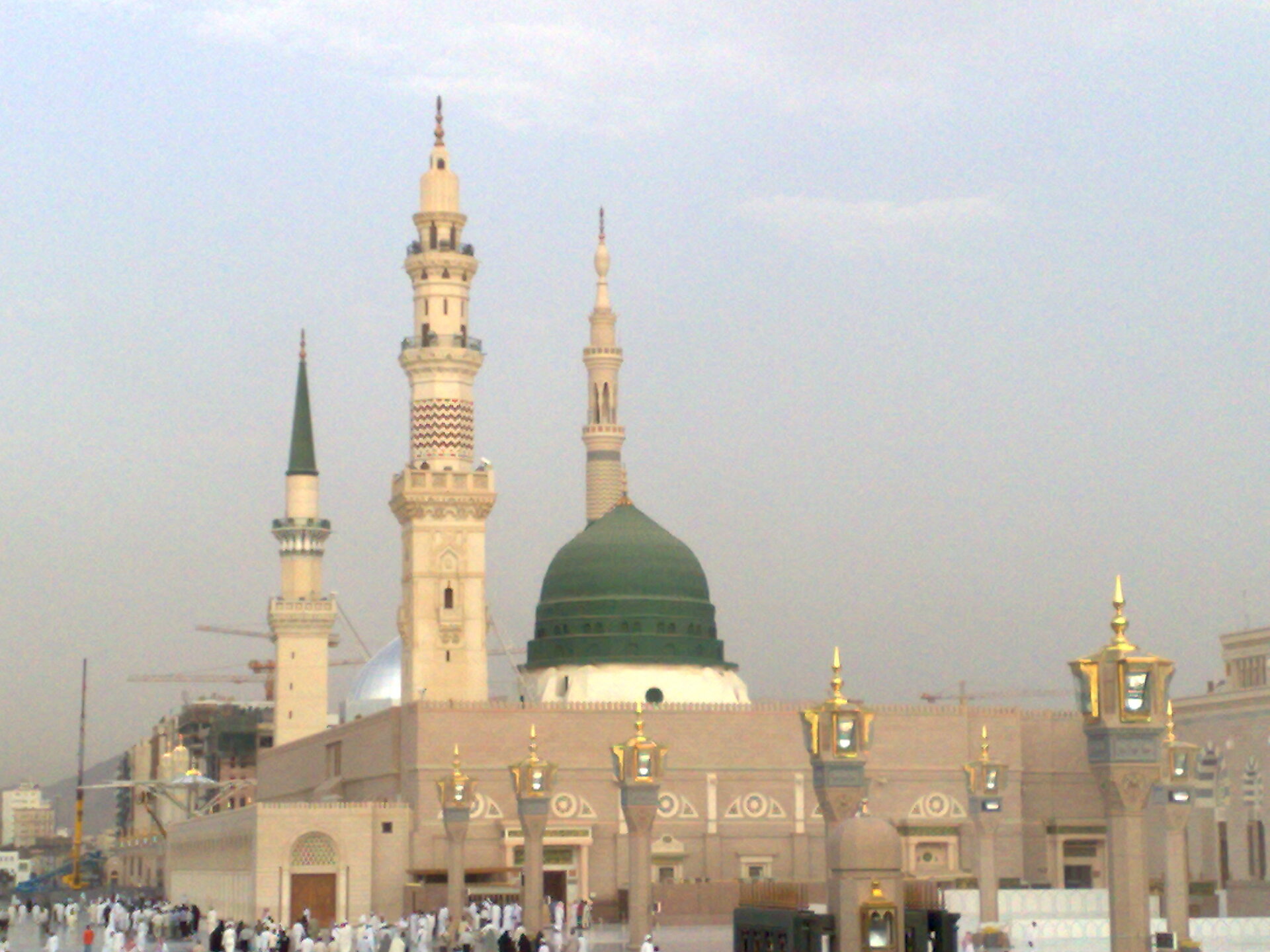
History and Significance of the Prophet’s Mosque
The Prophet’s Mosque was originally built in 622 CE — the year of the Hijra — when Muhammad arrived in Medina (then called Yathrib) after emigrating from Mecca. The site had been a burial ground and date-drying yard. Muhammad purchased it and, together with his companions, built a simple open-air structure of palm trunks and mud-brick walls measuring roughly 30 by 35 metres. It served simultaneously as a place of worship, a community centre, a court of law, and a school for teaching the Quran.
During the Prophet’s lifetime, the mosque was expanded once. After his death in 632 CE, he was buried in the adjacent chamber of his wife Aisha. The first two Rashidun caliphs — Abu Bakr (d. 634) and Umar ibn al-Khattab (d. 644) — were later buried beside him in the same chamber.
Expansions Through the Centuries
The mosque has undergone at least ten major expansions over 1,400 years:
- Umayyad expansion (705–715 CE): Caliph al-Walid I rebuilt the mosque in stone, incorporating the burial chamber into the mosque structure for the first time and adding the first mihrab and minarets.
- Abbasid and Mamluk periods: Further expansions added the first dome over the burial chamber in 1279 CE — originally an unpainted wooden cupola.
- Ottoman period: Sultan Mahmud II rebuilt the dome in 1818 CE. It was first painted its distinctive green in 1837 CE, giving it the name it carries today.
- First Saudi expansion (1951–1955): King Abdulaziz nearly doubled the mosque’s area, adding new wings and reinforced concrete construction.
- Second Saudi expansion (1985–1992): King Fahd’s massive project expanded the prayer area to 98,500 square metres and added the famous retractable umbrellas and the courtyard with mechanical shade structures.
- Third Saudi expansion (ongoing): The current project aims to increase the mosque’s footprint from 414,000 to 1.56 million square metres, with a prayer area nearly doubling from 390,000 to 912,000 square metres. When complete, the mosque will accommodate over 1.6 million worshippers simultaneously.
- Ustuwanat al-Hannanah (the Weeping Pillar): Where a palm-trunk pillar reportedly wept when the Prophet began using the minbar instead of leaning against it during sermons.
- Ustuwanat Aisha: The pillar of Aisha, where she reported the Prophet once said that if people knew the virtue of praying at this spot, they would draw lots for it.
- Ustuwanat al-Tawbah (the Pillar of Repentance): Where Abu Lubabah tied himself in repentance until forgiven by Allah.
- Ustuwanat al-Wufud: The Pillar of Delegations, where the Prophet received visiting delegations from across Arabia.
- Download the Nusuk app from the Apple App Store or Google Play Store. Search for “Nusuk” — avoid unofficial APK files.
- Register your account using your passport number, Umrah/Hajj visa details, or Iqama (Saudi residence permit).
- Navigate to Permits on the home screen and select “Noble Rawdah.”
- Choose your gender — men and women have separate time slots and entry points.
- Select your date and time slot. Men’s slots are typically available throughout the day. Women’s slots are available after Fajr prayer until 11:00 AM, and again after Isha prayer until 2:00 AM.
- Confirm and receive your QR code. This is your entry permit — screenshot it or keep the app accessible on your phone.
- Arrive early. Head to the mosque courtyard well before your booked time slot. Security staff will check your QR code permit on the Nusuk app.
- Men enter via Gate 37. Women enter via Gate 25 (Bab Uthman ibn Affan).
- You will have approximately 10 minutes inside the Rawdah — enough time for two rak’ahs of Tahiyyatul Masjid (greeting prayer) and personal du’a (supplication).
- Stay calm and composed. The area is small and crowded. Do not push or rush. Move with the flow of other visitors.
- Dress modestly. Women must wear hijab; men should wear long trousers and sleeved shirts.
- Gates 24 and 25 (Bab Uthman ibn Affan): Primary women’s entrance, and the required entry point for Rawdah visits.
- Gate 16: For women accessing the general prayer area (no Rawdah access through this gate).
- Morning session: After Fajr prayer until 11:00 AM
- Evening session: After Isha prayer until 2:00 AM
- Keep your voice low. The mosque is a place of prayer and contemplation. Loud conversation is strongly discouraged.
- Do not take photographs inside the main prayer halls or near the sacred chamber. Photography in the courtyards and exterior areas is generally acceptable.
- Do not block pathways. After praying, move aside so others can access the space.
- Respect those in prayer. Do not walk directly in front of someone who is praying.
- Mobile phones should be on silent. Ringtones and phone calls inside the mosque are deeply disruptive.
- Do not eat inside the prayer halls. Zamzam water is available at designated distribution points throughout the mosque.
- Enter with your right foot and recite the du’a for entering a mosque.
- Comfortable slip-on shoes — you will remove them frequently
- A small prayer rug (optional — carpets are provided, but a personal one offers comfort in the courtyards)
- Sunscreen and a hat for the outdoor areas and courtyard
- A water bottle — Zamzam water is available inside, but you will want hydration for walking
- Your smartphone with the Nusuk app installed and your Rawdah permit ready
- A small Quran or du’a book — many visitors read while waiting
- Dar Al Taqwa Hotel: Steps from the main entrance to the Prophet’s Mosque. One of Medina’s most established luxury hotels with direct Haram views.
- Pullman Zamzam Madina: Located just 200 metres from the mosque, offering premium rooms with mosque-view balconies.
- The Oberoi Medina: Five-star luxury with impeccable service and a prime location near the Haram.
- Madinah Hilton: Approximately 300 metres from the mosque, known for elegant accommodations and reliable service.
- Crowne Plaza Madinah: Steps from the mosque and adjacent to a shopping mall — excellent value for the location.
- Millennium Taiba Hotel: Solid mid-range option with comfortable rooms and proximity to the Haram.
- Millennium Al Aqeeq Hotel: A large property with 505 rooms, slightly further from the mosque but well-connected.
- Arrive for Fajr prayer. The mosque is least crowded at dawn, and the spiritual atmosphere in the quiet early hours is unmatched. The Rawdah area is also most accessible in the hours after Fajr.
- Learn the du’as in advance. Memorise or write down the supplications for entering the mosque, visiting the Prophet’s grave, and praying in the Rawdah. Having them prepared means you can focus on the moment rather than scrambling for text.
- Use the Nusuk app strategically. Book your Rawdah permit as soon as you arrive in Medina. If your preferred slot is unavailable, check back frequently — cancellations open new spots regularly.
- Explore beyond the mosque. Dedicate at least half a day to visiting Masjid Quba, Mount Uhud, and the other historical sites of Medina. These places deepen your understanding of early Islamic history.
- Pace yourself. Many visitors try to spend every moment inside the mosque. While admirable, it is physically exhausting — especially in summer. Take breaks, hydrate, and rest at your hotel between prayers.
- Visit the Prophet’s Mosque Exhibition. Located near the mosque complex, this exhibition showcases the history of the mosque’s expansions, architectural models, and artefacts from its 1,400-year history. Entry is free.
- Carry a portable charger. Your phone battery will drain quickly between the Nusuk app, GPS navigation, and the tendency to check prayer times — keep a power bank handy.
- Know your gates. The mosque has over 40 numbered gates. Identify the gate closest to your hotel and the gate for your specific destination (Rawdah, general prayer hall, women’s section) before arriving.
- Hajj 2026 Guide — Everything you need to know about performing Hajj this year
- Medina Travel Guide — The complete guide to the Prophet’s city
- Mecca for Muslim Travellers — City guide for Hajj and Umrah visitors
- Umrah for First Timers — Step-by-step guide to your first Umrah
- Umrah Packing List — What to bring for men and women
- Saudi Arabia Travel Guide 2026 — The complete guide to visiting the Kingdom
- Saudi Arabia Visa Guide — Every visa type explained
Key Areas Inside the Mosque
The Green Dome (Al-Qubbah al-Khadra)
The Green Dome is the most recognisable feature of the Prophet’s Mosque, rising above the southeastern corner of the complex. Beneath it lies the Hujrah — the sacred chamber containing the graves of the Prophet Muhammad, Abu Bakr al-Siddiq, and Umar ibn al-Khattab. The chamber itself is enclosed by walls and a brass grille; visitors cannot enter the burial room but can see the exterior and offer salutations (salam) from the designated area nearby.
The Rawdah (Riyadul Jannah)
The Rawdah — meaning “Garden” — is the area between the Prophet’s pulpit (minbar) and his burial chamber. The Prophet Muhammad said: “Between my house and my pulpit is a garden from the gardens of Paradise.” This area, marked by green carpeting that distinguishes it from the red carpeting of the rest of the mosque, measures approximately 22 by 15 metres. It is the single most sought-after prayer space in the mosque, and visiting it requires advance booking through the Nusuk app (see the section below).
The Mihrab and Minbar
The mosque contains several mihrabs (prayer niches indicating the direction of Mecca). The most significant is the Mihrab al-Nabawi, which marks the spot where the Prophet led prayers. The minbar (pulpit) nearby is where the Prophet delivered his Friday sermons. The current minbar is a marble structure, though the original was a simple three-stepped wooden platform made from tamarisk wood.
The Pillars (Ustuwanat)
Several pillars within the mosque carry historical significance and are named for events associated with them:
The Minarets and Courtyard
The mosque has ten minarets, each standing 104 metres tall, added during the 1994 renovation. The courtyards surrounding the mosque feature 27 retractable domes and enormous mechanised umbrellas — each one stretching 17 by 18 metres and standing 17 metres high. Together they shade approximately 143,000 square metres of outdoor space. Water-misting fans are attached to the umbrella pillars, keeping the courtyard comfortable even on scorching summer days.
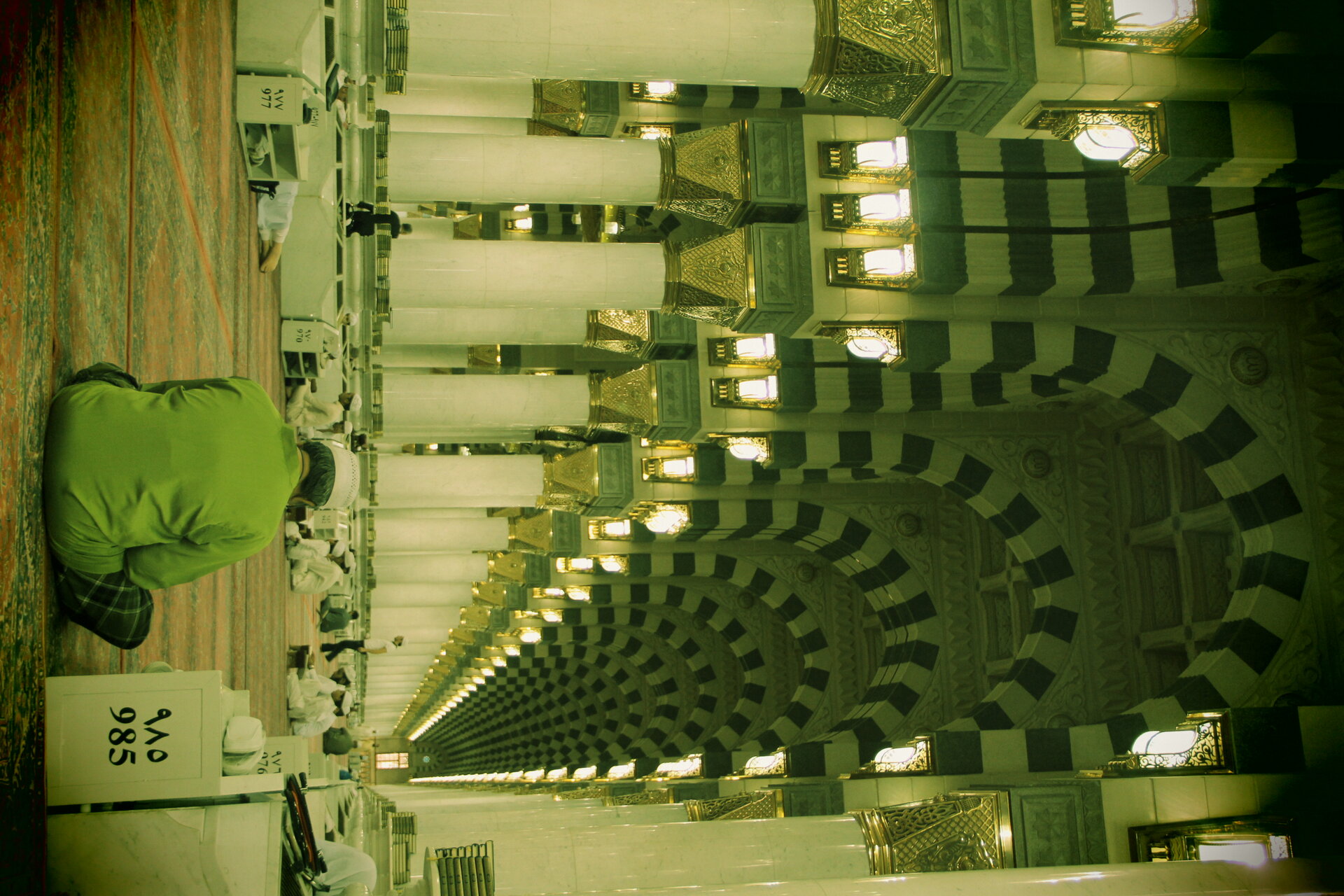
Visiting the Rawdah: Booking and Rules
The Rawdah is the most spiritually significant area within the Prophet’s Mosque, and access is carefully managed. Since 2025, all visitors must book a permit through the official Nusuk app before visiting.
How to Book a Rawdah Visit
Tip: As of early 2025, the previous one-visit-per-year restriction has been lifted. Visitors can now request multiple Rawdah visits using the app’s Instant Track feature, provided they remain in the vicinity of the mosque. Permits refresh approximately every 20 minutes. Book as soon as you arrive in Medina for the best slot selection.
On the Day of Your Rawdah Visit
Sending Salutations at the Prophet’s Grave
After visiting the Rawdah, visitors can proceed to the grille area outside the sacred chamber to offer salutations to the Prophet Muhammad, Abu Bakr, and Umar. The traditional greeting is: “As-salamu alayka ya Rasulallah” (Peace be upon you, O Messenger of Allah). Maintain a low voice, do not crowd the area, and move along once you have offered your greetings to allow others the same opportunity.
Guide for Women Visitors
The Prophet’s Mosque has dedicated sections and entrance gates for women. Understanding the layout in advance will make your visit smoother and more rewarding.
Entry Gates for Women
Women can enter the mosque through gates 12, 13, 14, 23, 24, 25, 26, 27, 28, 29, and 30. The most commonly used are:
Women’s Rawdah Hours
Women have designated times for visiting the Rawdah:
Women are escorted to the Rawdah in groups organised by nationality. Book your permit through the Nusuk app and arrive at Gate 25 with your QR code ready.
Dress Code
Women must wear an abaya (or equivalent loose, full-length covering) and a secure headscarf. Ensure your hijab is pinned firmly — you will be in a crowded space and it must stay in place. Niqab (face covering) is optional. Comfortable, slip-on shoes are strongly recommended, as you will need to remove them at the entrance. For a detailed breakdown of what to wear across Saudi Arabia, see our Saudi Arabia dress code guide.
Etiquette Inside the Prophet’s Mosque
The Prophet’s Mosque is a place of deep reverence. Observing proper etiquette is both a spiritual obligation and a practical necessity in a space that hosts millions of visitors each year.
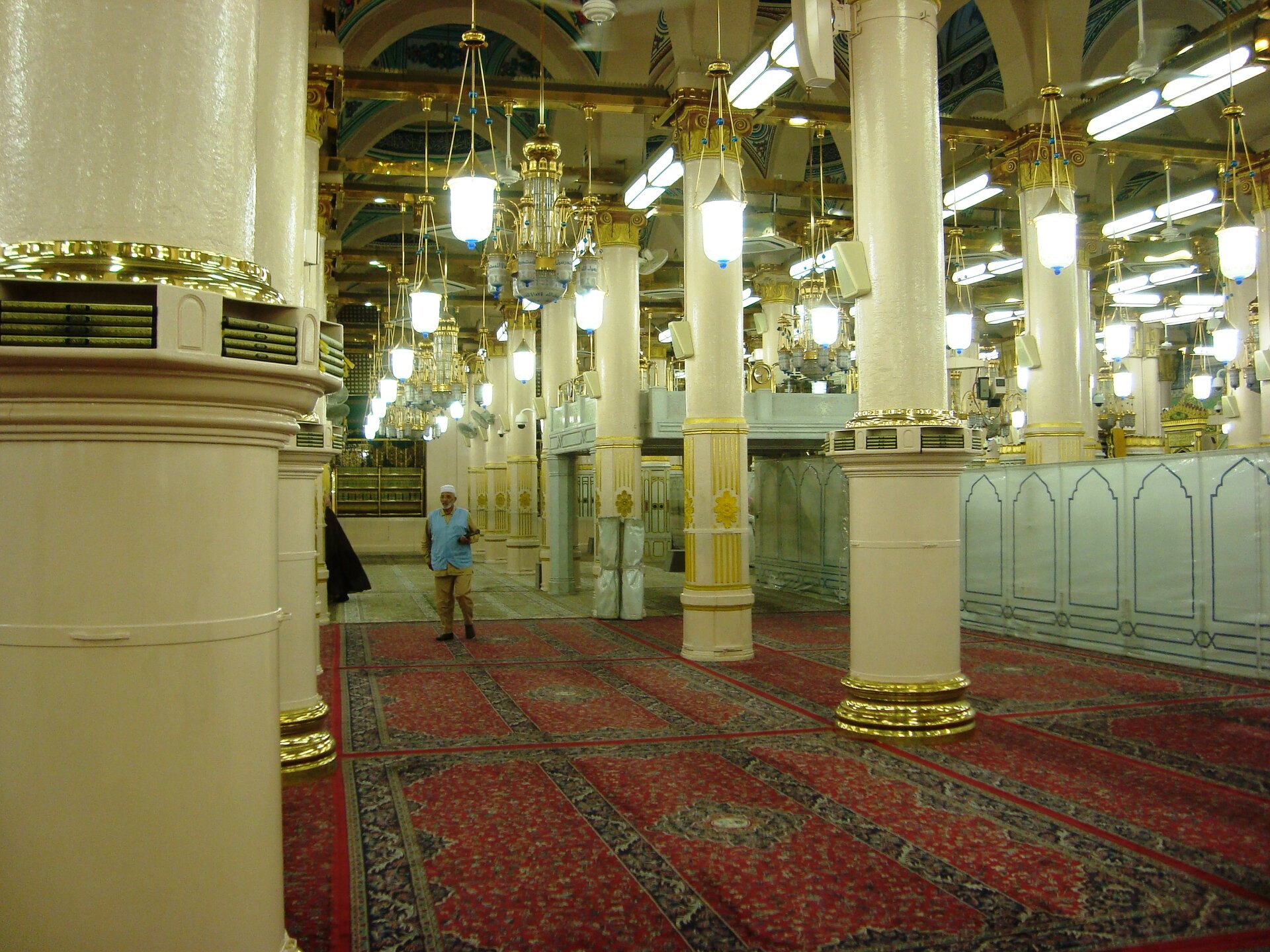
Nearby Historical Sites
Medina is rich with Islamic history beyond the Prophet’s Mosque itself. Many of these sites are within walking distance or a short drive, and most pilgrims visit them as part of their Medina itinerary.
Jannatul Baqi (Cemetery of Baqi)
Located directly adjacent to the eastern wall of the Prophet’s Mosque, Jannatul Baqi is the oldest Islamic cemetery in Medina. It is the final resting place of many of the Prophet’s family members, companions, and early Islamic scholars — including Uthman ibn Affan (the third caliph), Fatimah (the Prophet’s daughter, according to some traditions), Hasan ibn Ali, and the wives of the Prophet. The cemetery is open to male visitors after certain prayers. Women are generally not permitted to enter but can view it from outside the walls.
Masjid Quba
Located approximately 3.5 kilometres south of the Prophet’s Mosque, Quba Mosque holds the distinction of being the first mosque ever built in Islam. The Prophet Muhammad laid its foundations upon his arrival in Medina in 622 CE, before the Prophet’s Mosque itself was built. A hadith states that praying two rak’ahs in Masjid Quba is equivalent in reward to performing Umrah. The mosque underwent a stunning renovation in 2023–2024, transforming it into a modern architectural landmark while preserving its historical significance. It is easily reached by taxi or the free shuttle buses that operate between the two mosques.
Mount Uhud and the Martyrs’ Cemetery
Mount Uhud lies about 5 kilometres north of the Prophet’s Mosque. This is where the Battle of Uhud took place in 625 CE — one of the most significant military engagements in early Islamic history. At the foot of the mountain is the Shuhada (Martyrs’) Cemetery, where the fallen companions are buried, including Hamzah ibn Abd al-Muttalib, the Prophet’s uncle and one of Islam’s greatest warriors. The site is accessible by taxi and is a deeply moving place to visit.
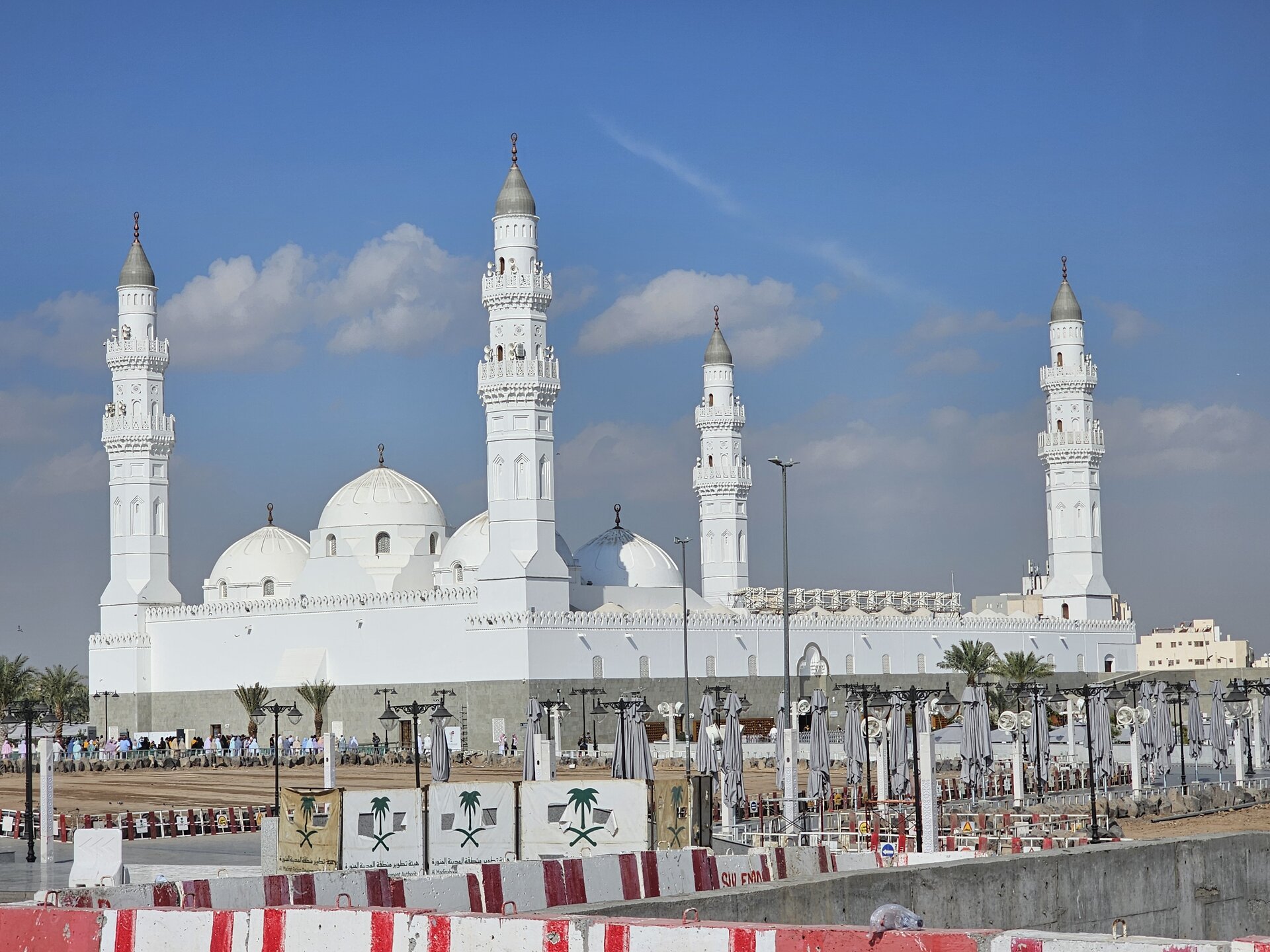
Masjid al-Qiblatayn (Mosque of the Two Qiblas)
This mosque, located northwest of the city centre, is where the Prophet Muhammad received the revelation to change the direction of prayer (qibla) from Jerusalem to Mecca. It is one of the earliest mosques in Islamic history and a popular stop for visitors exploring Medina’s sacred sites.
Practical Information
Getting to Medina
By air: Prince Mohammad bin Abdulaziz International Airport (IATA: MED) receives direct flights from major cities across the Middle East, South Asia, Southeast Asia, and Africa. Domestic flights connect from Riyadh, Jeddah, and Dammam. The airport is about 15 kilometres from the Prophet’s Mosque — a 20-minute taxi ride costing approximately 50–80 SAR ($13–$21 USD).
By rail: The Haramain High-Speed Railway connects Medina to Mecca via Jeddah and King Abdullah Economic City, with trains travelling at up to 300 km/h. The journey from Mecca to Medina takes approximately 2.5 hours. Tickets can be booked through the Saudi Railways (SAR) app or website.
By road: Medina is connected to Riyadh (approximately 900 km), Jeddah (approximately 420 km), and other Saudi cities by well-maintained highways. Car rental and intercity buses (SAPTCO) are available options.
Visa Requirements
All visitors to Saudi Arabia need a valid visa. Most nationalities can obtain a tourist e-visa online within minutes, which permits visits to Medina and the Prophet’s Mosque. If you are travelling specifically for Umrah or Hajj, you will need the corresponding pilgrimage visa, which can be arranged through the Nusuk platform. Non-Muslims are not permitted inside the Haram area of Medina (the area immediately surrounding the Prophet’s Mosque), though they may visit other parts of the city.
Opening Hours
The Prophet’s Mosque is open 24 hours a day, every day of the year, following a directive from King Salman. You can enter at any time for prayer and general visitation. The five daily prayers are observed at their designated times, and the mosque becomes especially busy during Friday prayers (Jumu’ah) and Ramadan.
Accessibility
The mosque is fully wheelchair-accessible. Ramps are installed at all major entrances, including King Abdul Aziz Door, King Saud Door, King Fahd Door, Al-Hijra Door, Quba Door, and Bilal Door. A dedicated administration within the mosque supervises the distribution of wheelchairs for visitors who need them. Escalators and lifts connect the different levels of the mosque.
What to Bring
For a complete list of what to pack for your pilgrimage, see our Umrah packing list. For visiting the Prophet’s Mosque specifically, essentials include:
Where to Stay Near the Prophet’s Mosque
Medina has hundreds of hotels clustered within walking distance of the Haram. Proximity is the most important factor — staying close means you can attend all five daily prayers without difficulty. For more accommodation options across the Kingdom, see our Saudi Arabia hotels guide.
Luxury Hotels (from $150–$400/night)
Mid-Range Hotels (from $60–$150/night)
Budget Hotels (from $35–$60/night)
Budget options are plentiful along the streets radiating from the Haram. Expect clean, basic rooms — most offer little more than a bed, air conditioning, and Wi-Fi, but location near the mosque is the trade-off. Booking platforms like Booking.com and the Nusuk app list verified options.
Booking Tip: Prices spike dramatically during Ramadan, Hajj season, and school holidays. If you are planning a visit during these peak periods, book at least 2–3 months in advance. Outside peak season, walk-in rates can be surprisingly affordable. For detailed information on Umrah costs and budgeting, see our dedicated guide.
Best Time to Visit
Medina sits in a desert climate with scorching summers and pleasant winters. Your comfort — and the quality of your worship experience — will vary significantly depending on when you visit.
| Season | Months | Temperature | Crowd Level | Notes |
|---|---|---|---|---|
| Winter | Dec – Feb | 11–27 °C (52–81 °F) | Moderate | Best weather for outdoor exploration; cool evenings |
| Spring | Mar – Apr | 18–35 °C (64–95 °F) | Moderate–High | Comfortable; Ramadan may fall in this period |
| Summer | May – Sep | 28–43 °C (82–109 °F) | High (Hajj season) | Extremely hot; Hajj brings massive crowds |
| Autumn | Oct – Nov | 20–35 °C (68–95 °F) | Low–Moderate | Excellent compromise — warm but bearable, fewer crowds |
Ramadan Note: Visiting during Ramadan is spiritually rewarding but practically demanding. The mosque will be at peak capacity, especially during Taraweeh prayers. If this is your first visit, consider coming outside Ramadan so you can explore at a more relaxed pace. For a broader view of planning your Saudi Arabia trip, see our main travel guide.