
Falconry is not merely a pastime in Saudi Arabia — it is the national sport, a living heritage stretching back thousands of years, and a cultural symbol woven into the Kingdom’s identity from its founding to the present day. For visitors planning a Saudi Arabia travel itinerary, witnessing falconry in person offers one of the most genuinely distinctive cultural experiences available anywhere in the world. Whether you attend the world’s largest falconry festival on the outskirts of Riyadh, watch elite birds compete at the AlUla Falcon Cup against a backdrop of ancient sandstone, or join a guided desert experience where you fly a falcon yourself, the sport reveals a side of Saudi Arabia that no museum or shopping mall can replicate.
This guide covers everything a visitor needs to know: the history and cultural significance of falconry in Arabia, the species of falcon you will encounter, the major festivals and events where you can watch or participate, practical details on booking experiences, and the Kingdom’s growing conservation programmes that are helping to protect these magnificent birds for future generations.
Best Time to Visit: October to March (falconry season; major festivals in October, December–January, and February)
Getting There: Most events are near Riyadh (King Khalid International Airport) or AlUla (Prince Abdul Majeed bin Abdulaziz Airport)
Visa Required: Yes — tourist e-visa available for 63 nationalities
Budget: Festival entry is free; guided falconry experiences from $150–$400 per person; falcon auctions are for spectating unless you have deep pockets
Must-See: King Abdulaziz Falconry Festival (Riyadh), AlUla Falcon Cup, International Saudi Falcons and Hunting Exhibition
Avoid: Visiting in summer (April–September) when there are no major falconry events and temperatures exceed 45°C
A Brief History of Falconry in Arabia
Falconry — known in Arabic as al-Bayzarah — has been practised on the Arabian Peninsula for at least 4,000 years. Archaeological evidence from Mesopotamia and the Levant suggests that Bedouin tribes were among the earliest peoples to train raptors for hunting, long before the practice reached Europe via the Crusades. In the harsh desert environment where food was scarce, falcons were not status symbols but survival tools: a trained saker or peregrine falcon could catch houbara bustards, stone curlews, and hares that would feed an entire family.
The falcon’s place in Saudi identity runs deeper than mere utility. When the first Saudi state was established three centuries ago, the falcon was adopted as a symbol of power, precision, and nobility. It was used as a token of peace in resolving tribal disputes, and prized falcons were exchanged as diplomatic gifts between rulers — a tradition that continues today. The falcon appears on Saudi Arabia’s national emblem, on the currency, and across government institutions.
In 2010, UNESCO inscribed falconry on the Representative List of the Intangible Cultural Heritage of Humanity, recognising Saudi Arabia alongside the UAE, Qatar, Morocco, and other nations as custodians of this living tradition. The inscription cemented what Saudis already knew: falconry is not a relic of the past but a thriving cultural practice that continues to evolve.
From Survival to Sport
The transition from subsistence hunting to organised sport accelerated in the twentieth century. As urbanisation reshaped Saudi society, falconry shifted from a Bedouin necessity to an elite pursuit — though one with deep popular roots. The establishment of the Saudi Falcons Club in 2017 by royal order brought falconers under a single institutional umbrella for the first time, professionalising the sport, launching international competitions, and funding conservation programmes. Today, the club organises the world’s largest falconry festival and holds three Guinness World Records for the number of participating falcons.
Falcon Species You Will Encounter
Saudi falconers work primarily with four species, each with distinct characteristics that make them suited to different styles of hunting and competition. Understanding the differences will deepen your appreciation of any falconry event you attend.
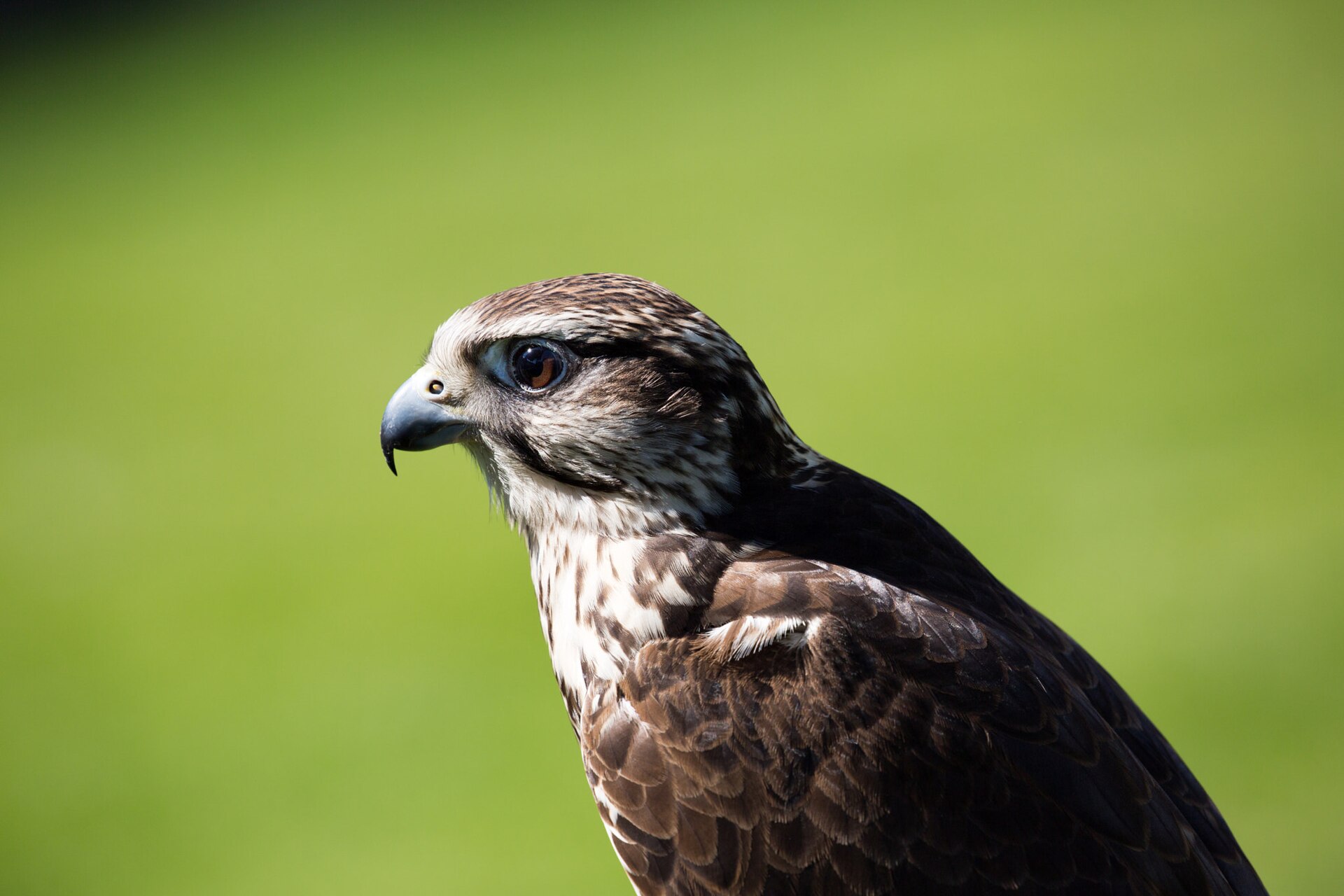
Saker Falcon (Falco cherrug)
The saker is the king of Arabian falconry. Known for its patience, disease resistance, and devastating speed — capable of reaching 300 km/h in a dive — the saker has been the Arab falconer’s bird of choice for centuries. Ancient Arabian falconers classified their birds into three grades: al-Nadir (the strongest and largest), al-Wasat (mid-sized), and al-Mahqoor (the smallest). A top-grade saker can fetch extraordinary prices at auction — a single bird sold for SAR 1.2 million ($320,000) at the International Falcon Breeders Auction in Malham in 2024.
The saker is classified as Endangered on the IUCN Red List, making the Kingdom’s conservation efforts (discussed below) a matter of global ecological importance.
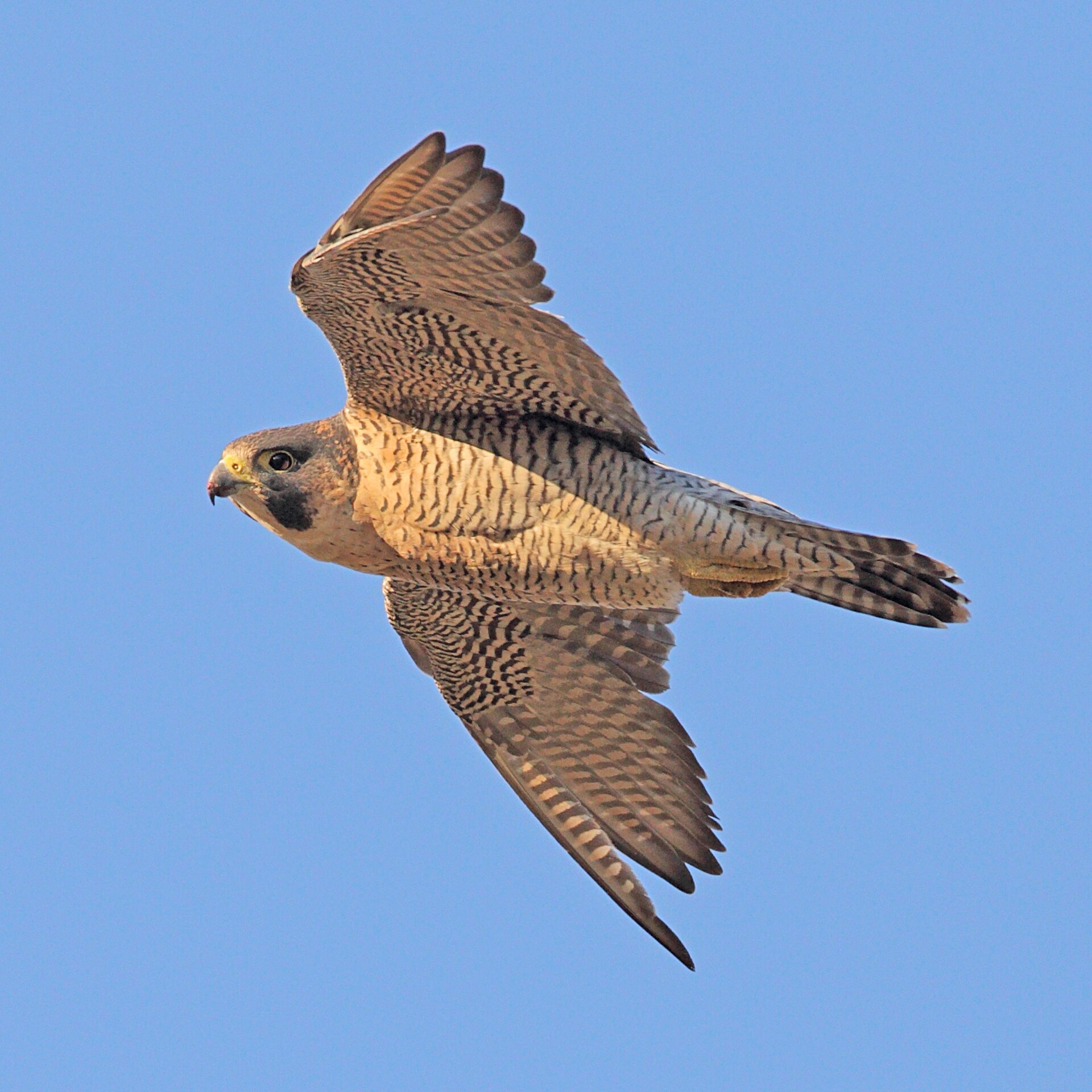
Peregrine Falcon (Falco peregrinus)
The peregrine — called the “jewel of the sky” by Arab falconers — is the fastest animal on Earth, capable of diving at speeds exceeding 320 km/h. Its eyesight is approximately eight times sharper than a human’s, allowing it to spot prey from extraordinary distances. The Shaheen peregrine, a subspecies found across the Middle East and South Asia, is particularly valued in Gulf falconry circles.
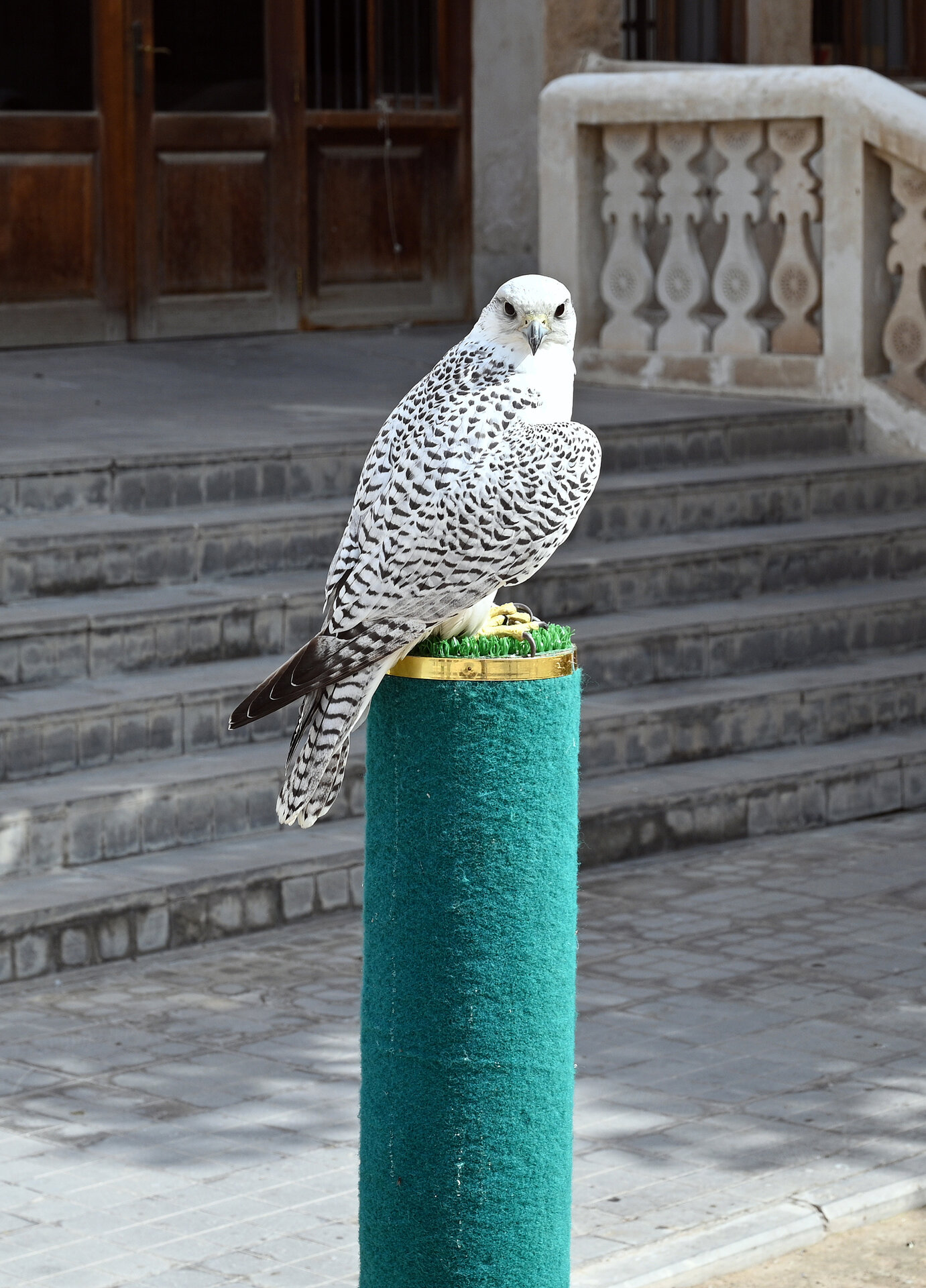
Gyrfalcon (Falco rusticolus)
The gyrfalcon is the largest of all falcon species, native to the Arctic and sub-Arctic regions. White gyrfalcons are spectacularly beautiful and command the highest prices at auction — a white gyrfalcon from an American breeder sold at a Saudi auction for SAR 1.75 million ($466,667), setting a world record. Gyrfalcons are rare in the wild desert environment but highly prized for competitive racing and mazayen (beauty) contests.
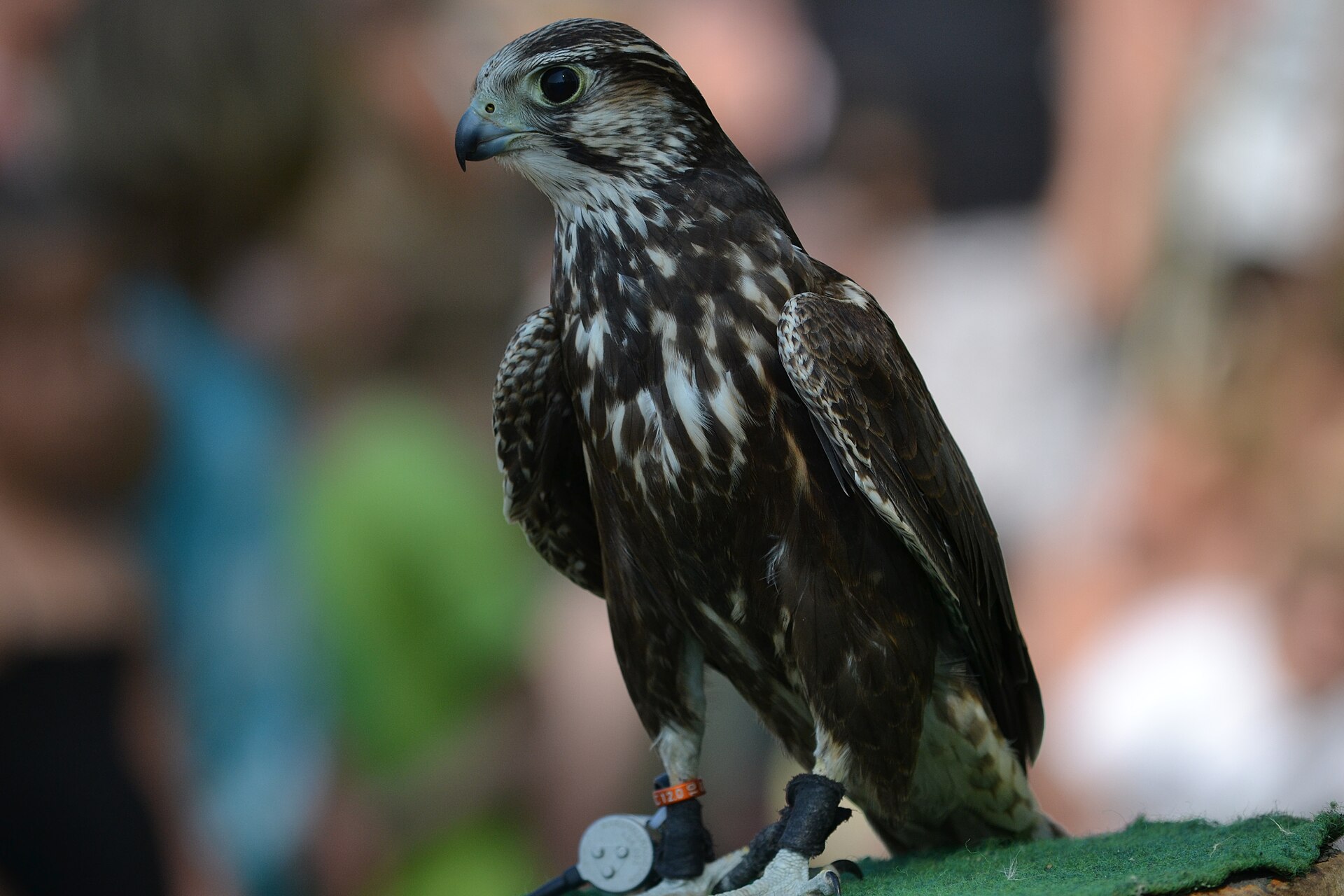
Lanner Falcon (Falco biarmicus)
The lanner is less common in Saudi competitions but still used for hunting, particularly by falconers who value its adaptability and calmer temperament. It is considered a good training bird for less experienced handlers.
Conservation note: Saudi Arabia prohibits the hunting of saker falcons, peregrine falcons, and lanner falcons in the wild to protect declining populations. All competition and breeding birds are captive-bred or legally imported.
Where to Experience Falconry in Saudi Arabia
Saudi Arabia offers more falconry experiences than any other country. From world-class festivals to intimate desert encounters, there is something for every visitor — whether you are a seasoned birder, a family with children, or a culture-curious traveller exploring Saudi Arabia for the first time. Many of these events take place in or near Riyadh, making them easy to combine with a city break.
King Abdulaziz Falconry Festival (KAFF)
The King Abdulaziz Falconry Festival is the world’s largest gathering of falcons and falconers, and it has earned three Guinness World Records for the number of participating birds. Organised by the Saudi Falcons Club, KAFF runs for approximately two to three weeks between late December and mid-January each year at the club’s headquarters in Malham, north of Riyadh.
The 2025/2026 edition ran from 25 December 2025 to 10 January 2026, featuring falconers from nine countries. The festival offered 139 competition rounds and 1,012 prizes worth over SAR 38 million (~$10 million) across two main disciplines:
- Al-Milwah: A 400-metre lure race where falcons are timed sprinting to a swinging lure. The fastest birds complete the course in seconds, and the competition is divided by species and category.
- Al-Mazayen: A falcon beauty and fitness contest judging plumage quality, body condition, eye clarity, and overall physical form.
New categories in 2025/2026 included a Nova Race, a Mongolian Falcons Race, two Shalfa King races, a schools race, and — for the first time — a women’s race, reflecting the growing participation of Saudi women in falconry.
Beyond competition, KAFF offers visitors falcon-handling workshops, a falconry museum, heritage market stalls, art exhibitions, desert camps, cultural performances, and family-friendly attractions including camel rides and archery. Entry is free, but online registration is required. The festival is approximately 90 minutes north of central Riyadh by car.
Visitor tip: Arrive in the late afternoon when the racing intensifies and the desert light is spectacular for photography. Bring a telephoto lens — falcons move fast.
International Saudi Falcons and Hunting Exhibition
Held annually in early October at the Riyadh International Convention and Exhibition Center in Malham, this ten-day exhibition is the world’s largest of its kind. The 2025 edition featured more than 1,300 exhibitors and brands from over 45 countries and attracted a record 700,000 visitors — the highest attendance in its history.
The exhibition combines falconry with outdoor pursuits: hunting equipment, camping gear, desert vehicles, and traditional crafts. Highlights include:
- International Falcon Breeders Auction: Running from early October to mid-November, this is where the world’s finest falcons change hands. Past record bids have exceeded SAR 1.2 million.
- Melwah Racing Championship: 200-metre speed trials for elite falcons, held during the exhibition period.
- Interactive experiences: Falcon-calling shows, equestrian performances, go-karting, camel rides across an 800-square-metre arena, archery ranges, and shooting ranges.
- Mongolian Falcons Area: Featuring rare breeds not commonly seen in the Gulf region.
- Children’s Falconers’ Village: Where younger visitors can interact with falcons and learn the basics of handling.
Admission is free with online registration through the Saudi Falcons Club website (sfc.org.sa).
AlUla Falcon Cup
The AlUla Falcon Cup is one of the most prestigious falconry competitions in the world, set against the breathtaking desert landscape of northwest Saudi Arabia. The 2025 edition ran from 9 to 15 February at the Mughayra Heritage Sports Village in AlUla, featuring over 2,000 elite falcons from six species competing in aerial displays, high-stakes races using cutting-edge tracking technology, and beauty contests.
What makes the AlUla Falcon Cup special is the setting. AlUla — home to Hegra (Mada’in Saleh), Elephant Rock, and the Dadan archaeological site — provides a spectacular natural amphitheatre for the sport. Attending the Falcon Cup can easily be combined with a wider AlUla itinerary exploring the region’s UNESCO-listed Nabataean tombs and dramatic rock formations.
Guided Falconry Experiences
If your visit does not coincide with a festival, you can still experience falconry through guided operators who offer private and small-group excursions into the desert. These typically involve:
- An introduction to falconry history and technique from an experienced falconer
- Hands-on training: wearing the gauntlet, calling a falcon to your arm, and learning basic handling
- Watching a live hunting demonstration (ethical and controlled) in the open desert
- Traditional refreshments and, in some cases, a desert camp meal
Operators such as Experience Falconry (experience-falconry.com) offer full-day experiences in the Saudi desert, priced from approximately $150 to $400 per person depending on group size and itinerary. Booking is essential, particularly during peak season (November to February).
If you are combining falconry with other desert safari experiences such as dune bashing or camel trekking, several operators in the Riyadh area offer combination packages.
The Language of Falconry: Key Arabic Terms
Understanding a few Arabic falconry terms will transform your experience from passive observation to genuine appreciation. In 2025, the King Salman Global Academy for Arabic Language (KSGAAL) launched a dedicated Falconry Terminology Dictionary in cooperation with the Saudi Falcons Club, formalising the specialised vocabulary that falconers have passed down orally for generations.
| Arabic Term | Meaning |
|---|---|
| Al-Bayzarah | Falconry — the art and practice of training and hunting with falcons |
| Milwah / Melwah | A lure or decoy used in training and racing; also the name for the 400-metre sprint race |
| Mazayen | Beauty contest for falcons, judging plumage, form, and condition |
| Haddad Al-Tayr | Long-distance release training, where falcons are sent over great distances to build endurance |
| Al-Nadir | The strongest and largest grade of falcon chick |
| Al-Wasat | A mid-sized falcon chick |
| Al-Mahqoor | The smallest and lightest falcon chick |
| Burqa | The leather hood placed over a falcon’s head to keep it calm before release |
| Mangalah | The falconer’s leather gauntlet, worn on the arm to carry the bird |
| Sabbuq | Leather jesses attached to a falcon’s legs for control during training |
| Wakri | A specific falcon type prized in Saudi breeding programmes |
The Falcon Economy: Auctions, Prices, and Passports
Falconry in Saudi Arabia is big business. The Kingdom’s auction circuit attracts buyers and breeders from across the Gulf, Central Asia, and Europe, and the prices for top-tier birds can rival those of thoroughbred racehorses.
Auction Prices
At the International Falcon Breeders Auction in Malham — the Kingdom’s premier marketplace for elite birds — prices start at around $3,000 for a basic hunting falcon and can reach extraordinary heights:
- $134,000 (SAR 500,000): A Saudi-bred “Hur” category saker falcon, the most expensive domestically bred bird in Middle East auction history at the time of sale.
- $320,000 (SAR 1.2 million): A record-breaking falcon sold at the 2024 Malham auction.
- $466,667 (SAR 1.75 million): A white gyrfalcon from an American breeder — the current world record for the most expensive falcon ever sold at auction.
Factors that determine price include species, colour (white gyrfalcons command the highest premiums), size, training level, lineage, and performance history in competition.
Falcon Passports
Yes, falcons travel with passports. Gulf states issue official falcon passports that allow birds to fly on commercial airlines across the region. The UAE government alone issued over 28,000 falcon passports between 2002 and 2013. These three-year documents allow falcons to travel to Saudi Arabia, Bahrain, Kuwait, Pakistan, Morocco, Oman, Qatar, and Syria — they were introduced partly to combat smuggling of endangered species.
Several airlines — including Qatar Airways, Emirates, Etihad, and Royal Jordanian — permit falcons in the cabin, often perched on their owner’s arm or on a dedicated seat. Qatar Airways allows up to six falcons per cabin, with rates ranging from $115 to $1,620 per bird. In a widely reported 2017 incident, a Saudi prince purchased 80 plane tickets to fly his falcons home, filling nearly 30 rows of a commercial aircraft.
Conservation: The Hadad Programme and Wildlife Protection
Saudi Arabia is increasingly investing in falcon conservation, driven by the recognition that the very species that define its cultural heritage are under threat. The saker falcon is classified as Endangered, and wild peregrine populations face pressure from habitat loss and illegal trapping.
The Hadad Programme
The Hadad programme is Saudi Arabia’s flagship falcon reintroduction initiative, developed through a partnership between the Saudi Falcons Club, the National Center for Wildlife, and international partners including aviary experts from Oregon State University. The programme focuses on captive breeding and release:
- As of 2025, the programme has bred 151 chicks and achieved a milestone in increasing the population of endangered Al-Wakri falcons to 14.
- Under the Hadad 2026 initiative, the Saudi Falcons Club released saker and peregrine falcons at Kazakhstan’s Altyn-Emel National Park, extending conservation efforts beyond Saudi borders.
NEOM Rewilding
At NEOM in the northwest, the giga-project is working with the Saudi National Center for Wildlife and the Saudi Falcon Club to monitor, protect, and rewild falcon populations. NEOM’s vast protected landscape — spanning desert, mountain, and coastal ecosystems — provides a controlled environment for reintroduction programmes.
King Khalid Wildlife Research Center
Located in northeastern Riyadh, the King Khalid Wildlife Research Center was established in 1987 for the preservation and captive breeding of Saudi Arabia’s endangered wildlife, including raptors. While not open to general tourism, its work underpins the scientific foundation of the Kingdom’s falcon conservation efforts.
The Hunting Tradition: Quarry and Ethics
Traditional Arabian falconry centred on hunting houbara bustards (Chlamydotis undulata) — large, shy desert birds that presented a worthy challenge for trained falcons. The houbara rises into the air in spiralling evasion patterns when pursued, making it one of the most demanding quarry species. Other traditional prey included stone curlews, desert hares, and various small birds.
The houbara bustard is now classified as Vulnerable by the IUCN, with a global population estimated between 50,000 and 100,000. Saudi Arabia and other Gulf states have faced international scrutiny over hunting pressure on houbara wintering grounds, particularly in Pakistan where Gulf falconers traditionally hunted between December and February.
In response, Saudi Arabia has increasingly promoted falcon racing as an alternative to hunting. The Saudi Falcons Club explicitly champions competition-based falconry — milwah races and mazayen contests — to reduce pressure on wild prey species while preserving the sport’s cultural essence. This shift is reflected in the design of KAFF and other festivals, which focus on speed, beauty, and breeding rather than live hunting.
When to Go: The Falconry Calendar
Falconry in Saudi Arabia is a winter sport. The season runs from approximately October to March, coinciding with cooler temperatures and the migration of prey species through the Arabian Peninsula. Here is a month-by-month breakdown of key events:
| Month | Event | Location |
|---|---|---|
| October | International Saudi Falcons and Hunting Exhibition (10 days, early Oct) | Malham, north of Riyadh |
| October–November | International Falcon Breeders Auction | Malham, north of Riyadh |
| December–January | King Abdulaziz Falconry Festival (KAFF) | Malham, north of Riyadh |
| February | AlUla Falcon Cup (7 days, mid-Feb) | Mughayra Heritage Sports Village, AlUla |
| November–March | Private guided falconry experiences available | Various desert locations near Riyadh |
The best time to visit Saudi Arabia for falconry is December or February: December combines KAFF with the Riyadh Season entertainment programme, while February pairs the AlUla Falcon Cup with the wider AlUla Moments cultural season.
Practical Information for Visitors
Getting to Falconry Events
Most major falconry events take place in Malham, approximately 90 kilometres north of Riyadh. The Saudi Falcons Club headquarters there is accessible by car or ride-hailing apps (Uber and Careem operate throughout Riyadh). There is no public transport to Malham, so renting a car or arranging a private transfer is recommended.
For the AlUla Falcon Cup, fly into Prince Abdul Majeed bin Abdulaziz Airport (ULH) in AlUla, served by domestic flights from Riyadh and Jeddah on Saudia and flynas. The Mughayra Heritage Sports Village is within driving distance of central AlUla.
Entry and Registration
All major Saudi Falcons Club events require free online registration through sfc.org.sa. Registration typically opens several weeks before each event. Walk-up attendance may be possible but is not guaranteed during peak days.
What to Wear
Falconry events take place outdoors in the desert. Wear comfortable, modest clothing appropriate for Saudi Arabia’s dress code: long trousers or a loose skirt, covered shoulders, and closed-toe shoes suitable for sandy terrain. A hat and sunscreen are essential even in winter. Temperatures at desert events in December and January can be pleasant during the day (18–25°C) but drop sharply after sunset (8–12°C), so bring layers.
Photography
Falconry festivals are extremely photogenic and photography is encouraged. A telephoto lens (200mm or longer) is essential for capturing birds in flight. For general festival photography, a standard zoom will suffice. Always ask permission before photographing individual falconers, particularly women participants.
Visa Requirements
All international visitors need a valid visa. Citizens of 63 countries can obtain a Saudi tourist e-visa online in minutes, valid for one year with multiple entries. Apply before you travel — the process is straightforward and fully digital.
Combining Falconry with Other Activities
Falconry events pair naturally with other Saudi cultural and outdoor experiences. Consider combining your trip with:
- Camel racing — another traditional Arabian sport with major events in the same season
- Horse riding experiences in the desert around Riyadh
- Stargazing in the desert at night after an evening falconry event
- Edge of the World, a spectacular natural viewpoint 90 minutes from Riyadh
- Food tours in Riyadh or Jeddah, exploring Saudi culinary traditions
Falconry and Saudi Arabia’s Future
Falconry sits at an unusual intersection in modern Saudi Arabia: it is simultaneously ancient and forward-looking. The Saudi Falcons Club uses GPS tracking technology in races, DNA profiling for breeding records, and veterinary science that rivals any medical facility. At the same time, the emotional connection between falconer and bird — the long hours of patient training, the thrill of the hunt, the bond forged through trust — is unchanged from what Bedouin falconers experienced a thousand years ago.
Under Vision 2030, Saudi Arabia is positioning falconry as a tourism asset and a conservation model. The Hadad programme aims to restore wild falcon populations across Central Asia. The festivals grow larger and more international each year. And the introduction of categories for women and children signals that the sport is widening its base rather than remaining the preserve of elite male collectors.
For the visitor, falconry offers something increasingly rare in modern travel: a cultural experience that is authentically rooted, visually spectacular, and impossible to replicate anywhere else. Whether you attend the thundering chaos of KAFF, the refined elegance of the AlUla Falcon Cup, or a quiet morning in the desert with a falconer and his bird, the experience will stay with you long after you leave the Kingdom.
Explore More Saudi Arabia Travel Guides
- Saudi Arabia Travel Guide 2026 — The complete guide to visiting the Kingdom
- Camel Racing in Saudi Arabia — Where to watch, when, and how to attend
- Horse Riding in Saudi Arabia — Stables, desert rides, and equestrian experiences
- Desert Safari Guide — Dune bashing, camping, and the Empty Quarter
- Camel Trekking in Saudi Arabia — Best routes and operators across the Kingdom
- Saudi Arabia Visa Guide — Every visa type explained