
Saudi Arabia’s roads are modern, well-maintained and increasingly safe, but they operate under a set of rules that differ meaningfully from those in Europe, North America or East Asia. Whether you are planning a road trip across the Kingdom or simply renting a car for a weekend in Riyadh, understanding Saudi traffic law before you turn the key will save you money, stress and potentially your licence. This guide, part of our complete Saudi Arabia travel guide, covers every rule, fine, camera system and practical tip you need to drive confidently on Saudi roads in 2026.
Best Time to Visit: October to March (cooler temperatures, better driving conditions)
Getting There: Fly into Riyadh (RUH), Jeddah (JED) or Dammam (DMM); rental desks at every major airport
Visa Required: Yes — tourist e-visa available for 63 nationalities
Budget: $40–$80/day (rental car + fuel + tolls)
Must-Know: Saher speed cameras everywhere, zero alcohol tolerance, 24-point licence system
Avoid: Driving at night on unlit rural highways — camel collisions are a genuine hazard
Speed Limits by Road Type
Saudi Arabia uses the metric system. Every road sign displays distances in kilometres and speeds in km/h. Speed limits are clearly posted and enforced by a dense network of AI-powered cameras. The table below summarises the standard limits you will encounter.
| Road Type | Speed Limit | Notes |
|---|---|---|
| School zones | 40 km/h | Strictly enforced during school hours |
| Residential areas | 50 km/h | Common in older city neighbourhoods |
| Urban main roads | 60–80 km/h | Ring roads and arterials in Riyadh, Jeddah, Dammam |
| Dual carriageways | 100–120 km/h | Inter-city expressways |
| Major highways | 120–140 km/h | Some newer stretches allow 140 km/h — posted clearly |
Buffer zones: On roads posted at 120 km/h or below, a 10 km/h buffer is applied before a fine triggers. On roads posted at 140 km/h, the buffer narrows to just 4 km/h. Do not rely on these buffers — treat the posted limit as absolute.
The Saher Camera System
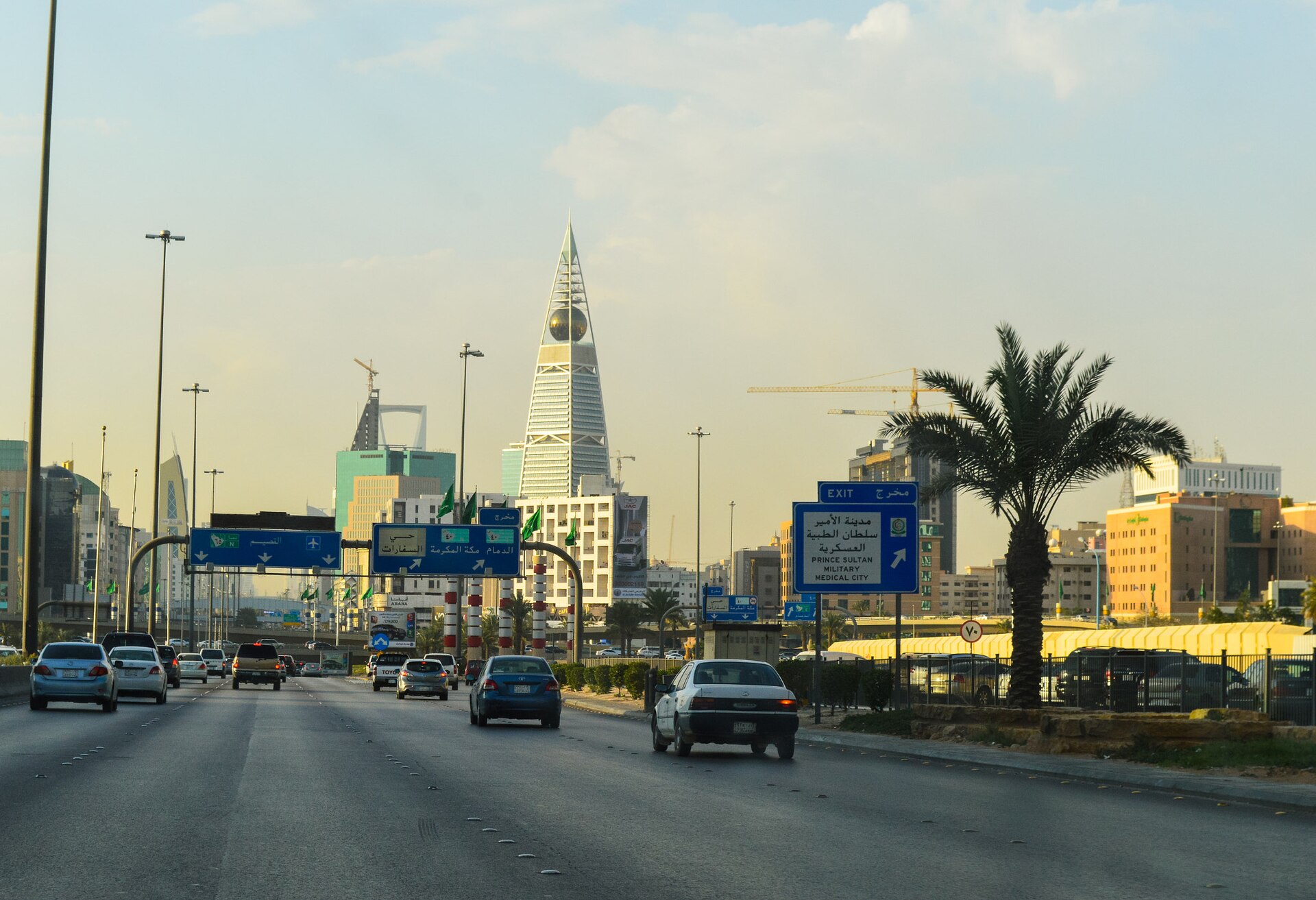
Saher (Arabic for “vigilant”) is Saudi Arabia’s nationwide automated traffic enforcement network. Launched in 2010 and upgraded continuously since, it now comprises over 8,200 AI-powered cameras covering highways, city streets and intersections across the Kingdom. Saher is not a novelty — it is the primary mechanism by which fines are issued, and it is remarkably efficient.
What Saher Cameras Detect
- Instantaneous speeding — a single camera catches you exceeding the limit at a fixed point
- Average speed — two cameras calculate your average speed over a stretch of road, so slowing near a camera and accelerating after will not help
- Red-light running — cameras at signalised intersections photograph violators
- Seatbelt violations — AI image recognition detects whether driver and front passenger are belted
- Mobile phone use — the system can identify hand movements near the driver’s ear
- Lane violations — sudden or illegal lane changes are flagged
- First time reaching 24 points: Licence suspended for 3 months
- Second time reaching 24 points: Licence suspended for 6 months
- Third time reaching 24 points: Licence permanently revoked
- Valid home-country driving licence — must have been held for at least one year
- International Driving Permit (IDP) — strongly recommended and effectively required by all major rental companies. Obtain this in your home country before travelling. It provides an official Arabic/English translation of your licence.
- Passport with valid visa — your Saudi tourist e-visa or visa on arrival stamp
- Credit card in the driver’s name — required for the security deposit
- Minimum driving age: 18 years (private vehicles), 20 years (public/heavy vehicles)
- Minimum rental age: 21 years at most companies. Luxury and sports cars typically require the driver to be 25 or older. Drivers under 25 may face a young driver surcharge.
- Move to safety — pull vehicles to the hard shoulder if possible. Switch on hazard lights and place a warning triangle behind your vehicle.
- Do not leave the scene — this is a criminal offence.
- Report via Najm — call the Najm hotline at 920000560, use WhatsApp at the same number, or report through the Najm app (free, available on iOS and Android). Najm is the official insurance claims body established by the Saudi Central Bank (SAMA).
- Document everything — photograph the scene from multiple angles, including all vehicles, road signs and damage.
- Wait for the Najm surveyor — they will assess the scene, determine fault and issue a report, usually within 24 hours via SMS.
- Collect the report — use it to file an insurance claim. For rental cars, the rental company will guide you through the process.
- Call 997 for an ambulance (Saudi Red Crescent)
- Call 993 for traffic police (Muroor)
- Call 112 for general emergencies
- Do not move injured people unless they are in immediate danger
- Log into the Absher app (requires registration)
- Navigate to Services > Traffic Violations
- Select your vehicle to view all outstanding fines
- Pay directly via the Absher app
- Pay through Saudi bank apps (Al Rajhi, SNB, SABB)
- Pay at ATMs of Saudi banks
- Vehicle: A 4WD with high clearance is essential. Standard saloon rental cars will get stuck in soft sand.
- Equipment: Carry a tyre pressure gauge and compressor (deflate for sand, re-inflate for tarmac), tow straps, a shovel, recovery boards and a GPS device.
- Water: Carry at least 10 litres per person for desert excursions.
- Tell someone: Share your planned route and expected return time with your hotel or a contact.
- Mobile coverage: Many desert areas have limited or no mobile signal. Download offline maps before departing.
- Travel insurance: Ensure your travel insurance covers off-road driving and recovery — many standard policies exclude it.
- Riyadh to AlUla via Hail — 1,600 km through changing desert landscapes, with a stop at Buraydah’s famous date market
- Jeddah to Abha via Taif and Al Baha — mountain roads, cloud forests and cooler temperatures in the Asir highlands
- Dammam to Al Ahsa Oasis — 160 km to the world’s largest oasis, a UNESCO World Heritage Site
- Jeddah coastal drive to Al Lith — Red Sea views, quiet beaches and coral reefs
- Drive on the right. Saudi Arabia follows right-hand traffic.
- Road signs are bilingual — Arabic and English on all major routes.
- Parking is generally free in most areas, though Riyadh and Jeddah have expanded paid parking zones managed through the Mawqif app.
- Tolls: Saudi Arabia does not have conventional toll roads. The Salik-style automatic toll systems used in the UAE do not yet operate here.
- Petrol stations are full-service in many locations — attendants will pump fuel for you at no extra charge.
- Keep your documents accessible — police checkpoints are common on highways between cities and near sensitive areas.
- Download the Najm and Absher apps before your trip — they are essential tools. See our guide to essential apps for Saudi Arabia travel.
- Saudi Arabia Travel Guide 2026 — The complete guide to visiting the Kingdom
- Driving in Saudi Arabia — Roads, international licence requirements and general driving overview
- Saudi Arabia Car Rental Guide — Prices, companies and road trip routes
- Women Driving in Saudi Arabia — What changed and what it means for tourists
- Is Saudi Arabia Safe for Tourists? — Honest security guide for visitors
- Saudi Arabia Visa Guide — Every visa type explained
Fines are typically issued within 24 hours and appear on the Absher app, linked to your licence plate or Iqama (residency ID). As a tourist with a rental car, the fine will be charged to the credit card on file with the rental company unless you settle it first.
Speeding Fines: The Complete Table
Saudi Arabia’s speeding fines escalate sharply with each bracket. On roads with limits of 120 km/h or below, the graduated penalty structure is as follows.
| Speed Over Limit | Fine (SAR) | Fine (USD approx.) | Black Points |
|---|---|---|---|
| Up to 10 km/h over (within buffer) | No fine | — | 0 |
| 10–20 km/h over | 150–300 | $40–$80 | 0 |
| 20–30 km/h over | 300–500 | $80–$133 | 0 |
| 30–40 km/h over | 800–1,000 | $213–$267 | 6 |
| 40–50 km/h over | 1,200–1,500 | $320–$400 | 6 |
| 50+ km/h over | 1,500–2,000 | $400–$533 | 6+ |
Tip for tourists: Rental companies typically add an administration fee of SAR 50–100 on top of each traffic fine they process on your behalf. Checking the Absher app or asking the rental desk before returning the car lets you handle fines directly and avoid the surcharge.
Other Major Traffic Fines
Speeding is not the only violation that will cost you. Saudi traffic law covers a wide range of offences, and penalties are serious.
| Violation | Fine (SAR) | Additional Penalty |
|---|---|---|
| Running a red light | 3,000 | 6 black points + 7-day vehicle impoundment |
| Driving under the influence | 20,000–60,000 | 1 month to 3 years imprisonment + 5-year licence revocation |
| Using mobile phone while driving | 500–900 | 2 black points |
| Not wearing seatbelt | 150–300 | Per offence, applies to all occupants |
| Child without car seat (under 10) | 300 | Per child, enforced at checkpoints |
| Driving without valid licence | 1,000–2,000 | Vehicle may be impounded |
| Driving without insurance | 150 | Repeated every 15 days until insured — up to SAR 3,600/year |
| Reckless driving / drifting | 20,000–60,000 | Vehicle confiscation + possible imprisonment |
| Driving without headlights at night | Up to 2,000 | — |
| Expired vehicle registration (Istimara) | 500–900 | No grace period (changed 2025) |
The 24-Point Black Points System
Saudi Arabia operates a cumulative penalty points system. Each violation adds a set number of “black points” to your driving record within a single Hijri year. The consequences of accumulation are severe.
For tourists on an international driving permit, black points attach to the permit and can be shared with your home country’s licensing authority through international agreements. More practically, accumulating serious violations may result in your rental company refusing further service.
Licence and Document Requirements for Tourists
Before you pick up a rental car at King Khalid Airport, King Abdulaziz Airport or King Fahd Airport, ensure you have the right documents.
What You Need to Carry
Important: Saudi Arabia recognises physical home licences from 67 countries for up to 90 days. If your licence is not in Latin script — for example, licences from China, Japan, South Korea or Russia — you must carry either an IDP or a notarised Arabic translation. Digital copies of licences are not accepted at police checkpoints or rental counters. Always carry the original physical documents.
Age Requirements
Women Driving in Saudi Arabia
Since June 2018, women have had full legal rights to drive in Saudi Arabia. There are no gender-based restrictions on road access, car rental or licensing. By 2025, over 2.1 million Saudi women held driving licences — 28 per cent of all licence holders in the Kingdom. Female visitors face no additional requirements and can rent and drive freely.
Essential Road Rules Every Driver Must Know
Seatbelts
Seatbelts have been compulsory for all occupants since 2000. Front and rear passengers must be belted. Saher cameras now detect seatbelt violations automatically.
Mobile Phones
Using a handheld mobile phone while driving is illegal. This includes texting, calling and even holding the phone near your ear. Hands-free Bluetooth systems are permitted. Saher cameras can detect phone use through AI image analysis.
Alcohol — Zero Tolerance
Saudi Arabia prohibits all alcohol. The legal blood alcohol limit is effectively zero. Any trace of alcohol results in severe penalties: fines of SAR 20,000–60,000, imprisonment of one month to three years, and a licence ban of at least five years. This is one rule tourists should take absolutely seriously — the alcohol laws in Saudi Arabia apply without exception.
Child Safety
Children under 10 must be secured in an appropriate child seat or booster. Since January 2026, this is enforced at highway checkpoints with a SAR 300 fine per child. Children under 12 are not permitted in the front seat.
Right on Red
Turning right at a red traffic light is permitted in Saudi Arabia unless a sign specifically prohibits it. You must yield to pedestrians and oncoming traffic before turning.
Overtaking
Overtaking is permitted only from the left side. Undertaking (passing on the right) is a traffic violation. On multi-lane highways, stay in the right lane unless overtaking.
Camera Detectors
Speed camera detection devices and radar warning systems are illegal in Saudi Arabia. Having one in your vehicle — even unused — is a violation.
Driving Without Physical Documents
Since a 2025 Interior Ministry circular, officers do not accept digital copies of driving licences shown on a phone screen. Driving without a physical licence results in a SAR 150 fine. Always carry the original document.
Fuel Prices and Stations
Saudi Arabia remains one of the cheapest places in the world to fill a tank, despite subsidy reforms under Vision 2030. As of April 2026, fuel prices are set monthly by Saudi Aramco.
| Fuel Type | Price per Litre (SAR) | Price per Litre (USD) |
|---|---|---|
| Gasoline 91 (regular) | 2.18 | $0.58 |
| Gasoline 95 (premium) | 2.33 | $0.62 |
| Gasoline 98 (high-performance, introduced January 2026) | 2.94 | $0.78 |
| Diesel | 1.79 | $0.48 |
Fuel stations are abundant on major highways and in cities. On remote desert roads — particularly routes through the Empty Quarter or between Tabuk and AlUla — stations can be 150–200 km apart. Always fill up before leaving a city for a desert excursion.
Road Safety: Hazards to Know
Camel Crossings
This is not folklore — it is one of the most serious hazards on Saudi roads. Camels wander freely across desert highways, particularly at night. A collision with an adult camel (which can weigh 600–1,000 kg) at highway speed is often fatal. Warning signs featuring a camel silhouette in a red triangle mark high-risk zones, but animals can appear on any unlit stretch.
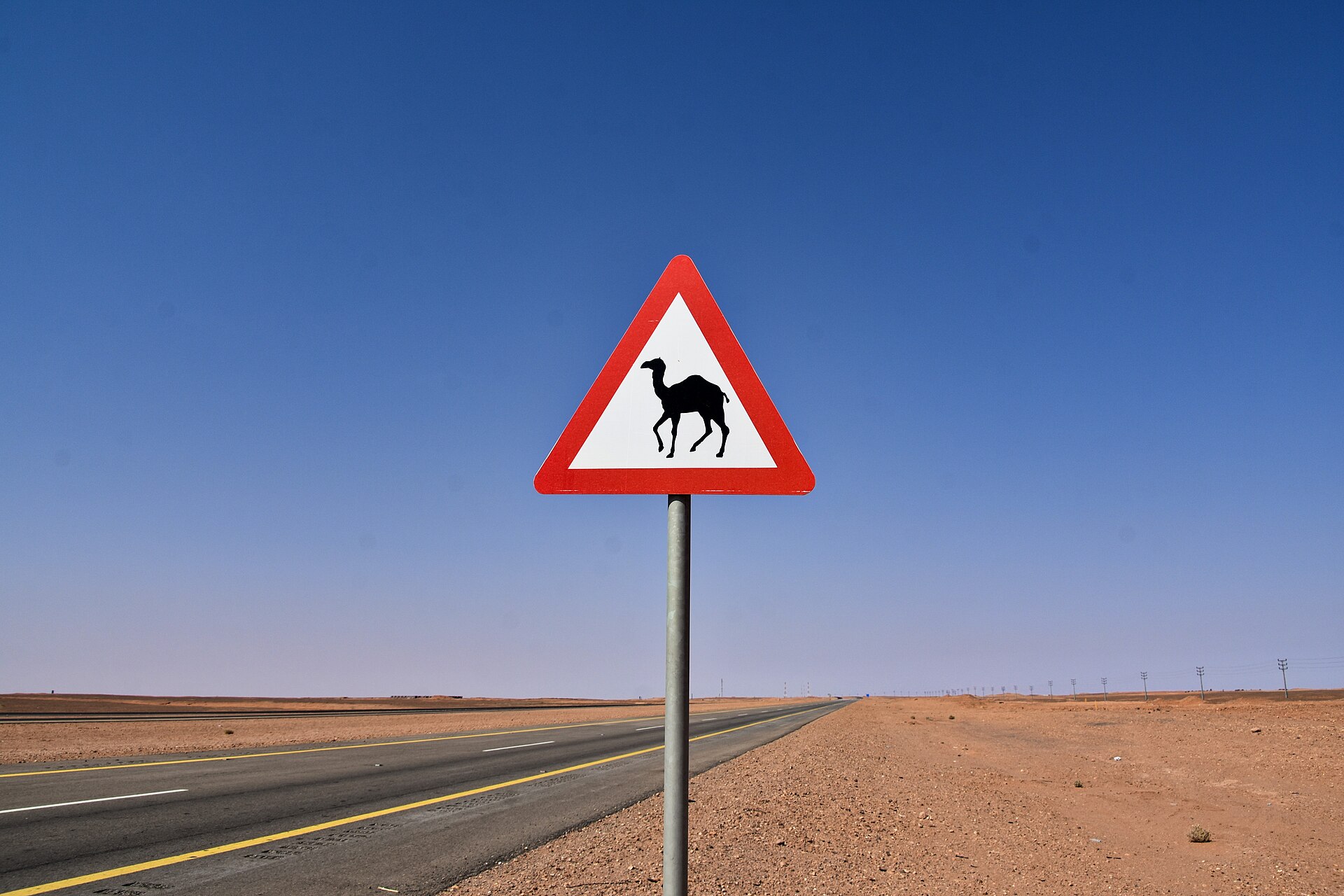
Night driving warning: Use high beams on unlit rural roads to maximise visibility, but dip them for oncoming traffic. Camels’ eyes do not reflect headlights well, making them extremely difficult to spot. Reduce speed to 80–100 km/h on unlit desert stretches after dark, even if the posted limit is higher. If you can avoid driving between dusk and dawn on rural highways, do so.
Sandstorms
Saudi Arabia experiences sandstorms (haboob) primarily between March and May. Visibility can drop to near zero within minutes. If caught in a sandstorm, pull off the road as far as possible, switch on hazard lights, switch off headlights (so following drivers do not mistake you for a moving vehicle), and wait it out. Check the Saudi Arabia weather guide before long drives.
Flash Floods
Desert rainfall is rare but intense. Wadis (dry valleys) can fill with fast-moving water within minutes. Never cross a flooded road or drive through standing water in a wadi. Several tourists and residents die in Saudi flash floods every year. If you are hiking or walking in wadis, watch for darkening skies upstream.
Summer Heat
Between May and September, temperatures in Riyadh, Dammam and the interior regularly exceed 45 degrees Celsius. Carry at least 5 litres of water per person in the vehicle. Tyre blowouts increase significantly in extreme heat — check tyre pressure before long journeys. Engine overheating is a real risk in traffic jams during peak summer.
Aggressive Driving Culture
Saudi drivers have improved markedly in recent years thanks to Saher enforcement and awareness campaigns, but tailgating, sudden lane changes and high-speed undertaking still occur, particularly on highways around Riyadh and Jeddah. Drive defensively, keep a generous following distance, and avoid the far-left lane unless overtaking.
What to Do After an Accident
Saudi Arabia has a well-structured accident reporting system. Knowing the process in advance will help you stay calm if the worst happens.
Minor Accidents (No Injuries)
Serious Accidents (Injuries or Major Damage)
If you need medical attention after an accident, see our guide to the best hospitals in Saudi Arabia for tourists.
Key Emergency Numbers
| Service | Number |
|---|---|
| General emergency | 112 |
| Traffic police (Muroor) | 993 |
| Highway patrol | 996 |
| Ambulance (Red Crescent) | 997 |
| Police | 999 |
| Najm (insurance claims) | 920000560 |
Checking and Paying Traffic Fines
All traffic fines in Saudi Arabia are managed through the Absher app, the government’s digital services platform. As a tourist, you may not have a full Absher account, but you can check fines through your rental company. For residents, the process is straightforward.
How to Check Fines
How to Pay
30-day objection window: If you believe a fine was issued in error, you have 30 days from when it appears on Absher to lodge an objection. After 30 days, the fine becomes final. Unpaid fines can prevent vehicle registration renewal and, for residents, can block Iqama renewal.
Driving During Ramadan
The holy month of Ramadan changes driving patterns significantly. Roads are quieter during the daytime as many people reduce activities while fasting. However, the period around sunset (Iftar) sees a sharp spike in fast, sometimes erratic driving as people rush home to break their fast. Be especially cautious in the 30–60 minutes before the Maghrib prayer. After Iftar, streets come alive again, particularly around malls and restaurants, with heavy traffic lasting until the early hours.
Desert and Off-Road Driving
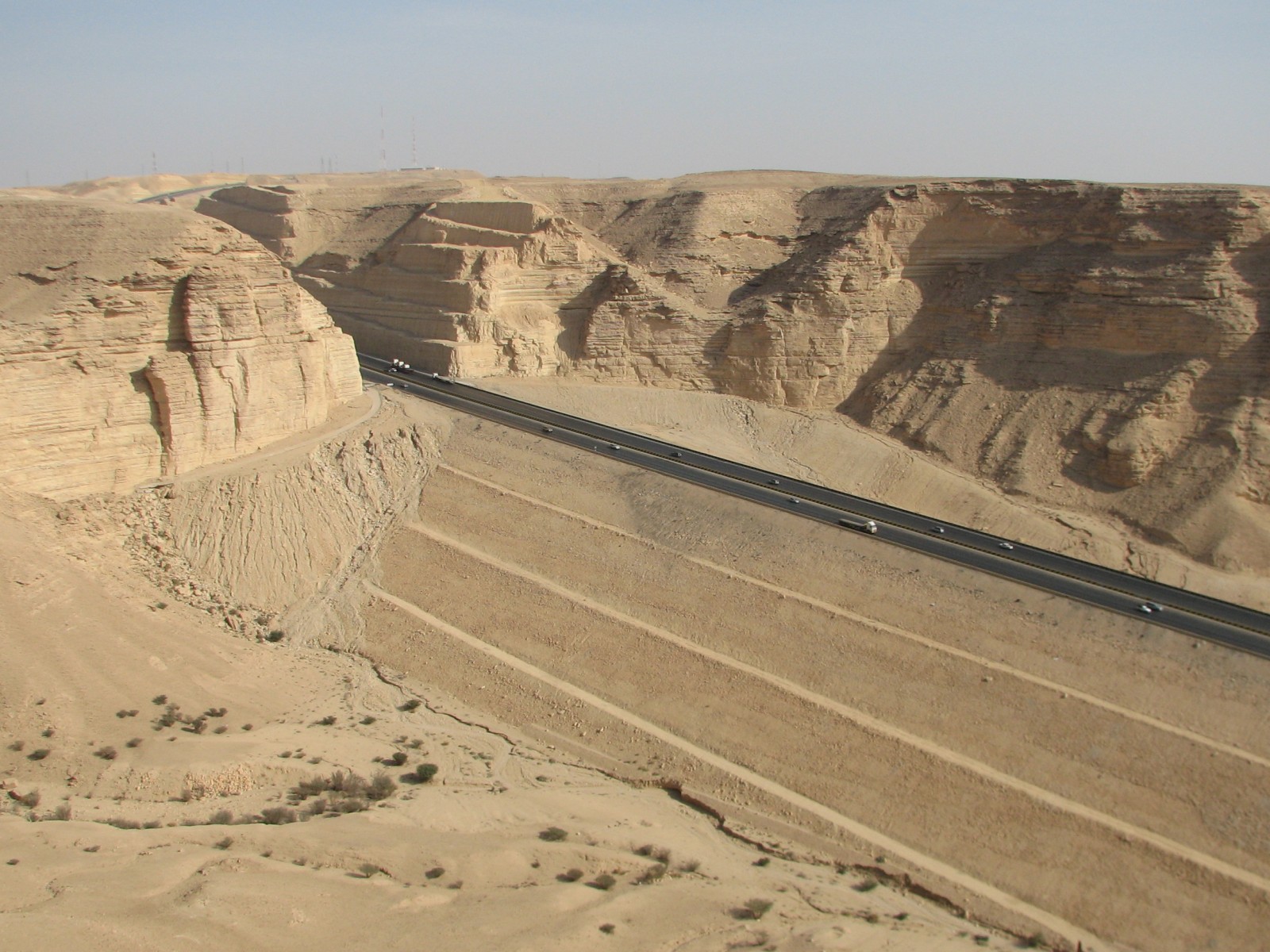
Saudi Arabia’s deserts are spectacular, but they are unforgiving for unprepared drivers. If you are heading off tarmac — whether to the Edge of the World near Riyadh or into the dunes for dune bashing — the rules change entirely.
Road Trip Routes Worth Knowing
Saudi Arabia’s modern highway network makes long-distance road trips practical and rewarding. Some of the most popular routes include:
For complete route planning, see our guides to day trips from Riyadh and the AlUla travel guide.