
Tabuk is the unlikely star of Saudi Arabia’s tourism revolution. Perched at 770 metres above sea level in the Kingdom’s far northwest, this city of more than 600,000 people serves as the gateway to some of the most dramatic landscapes on the Arabian Peninsula — from the towering sandstone canyons of Wadi Disah to the turquoise waters of the Red Sea coast, and from ancient Nabataean tombs to the futuristic construction site of NEOM just two hours down the road.
For decades, Tabuk was known primarily as a military garrison town and agricultural centre, its cool winters and fertile plains producing wheat, fruit, and roses. Today, under Vision 2030, it is being repositioned as northwest Saudi Arabia’s premier adventure and heritage destination. New highways, expanded flight routes, and a growing hotel stock are making this once-overlooked corner of the Kingdom more accessible than ever.
Whether you are a canyon hiker, a history enthusiast, a beach seeker, or a traveller who simply wants to see Saudi Arabia beyond the well-trodden Riyadh–Jeddah corridor, Tabuk delivers. This guide covers everything you need to plan a trip — from the headline sights and the best time to visit through to transport, accommodation, and practical tips on the ground.
Why Visit Tabuk?
Tabuk occupies a unique geographical and climatic niche within Saudi Arabia. The province stretches from the Jordanian border in the north to the Red Sea coast in the west and the Hisma desert in the south. Its elevation gives it markedly cooler temperatures than the rest of the Kingdom — winter lows can drop below freezing, and occasional snowfall dusts the surrounding mountains, a surreal sight in a country synonymous with scorching heat.
The region also sits at a crossroads of civilisation. Nabataean traders, Ottoman soldiers, Hejaz Railway engineers, and armies of the early Islamic period all left their mark here. The Expedition of Tabuk in 630 CE, one of the last military campaigns of the Prophet Muhammad, gave the city its enduring place in Islamic history.
Today Tabuk Province is home to two of Saudi Arabia’s most ambitious giga-projects — NEOM and The Red Sea destination — ensuring that billions of dollars in infrastructure investment are transforming access, accommodation, and attractions across the region. For independent travellers, this means better roads, new airports, and a wave of hotel openings in an area that still feels genuinely off the beaten track.
Top Attractions in Tabuk
Wadi Disah (Wadi Qaraqir)
If you see one thing in the Tabuk region, make it Wadi Disah. Also known as Wadi Qaraqir and locally nicknamed the Valley of Palm Trees, this 15-kilometre-long canyon slices through the Jebel Qaraqir sandstone massif roughly 200 kilometres south of Tabuk city. Towering cliffs rise up to 400 metres on either side, their russet walls catching the light in ways that invite comparison with the Grand Canyon or Jordan’s Wadi Rum.
The valley floor is a lush contrast to the arid heights — spring-fed streams nourish palm groves and wild grasses, and Nabataean tomb facades are carved into the lower rock faces. Hiking trails suit every ability, from gentle walks along the canyon floor to more demanding scrambles up side wadis. Birdwatchers, rock climbers, and photographers will find plenty to occupy a full day.
A standard car can reach the mouth of the canyon, where the asphalt gives way to a graded track. From there, you can hike in on foot or continue by 4×4. Organised tours from Tabuk typically run nine to twelve hours including travel time. The best months are November through March, when daytime temperatures sit comfortably between 12 and 31 degrees Celsius. For more on Saudi Arabia’s best hiking destinations, see our hiking guide.
Tabuk Castle
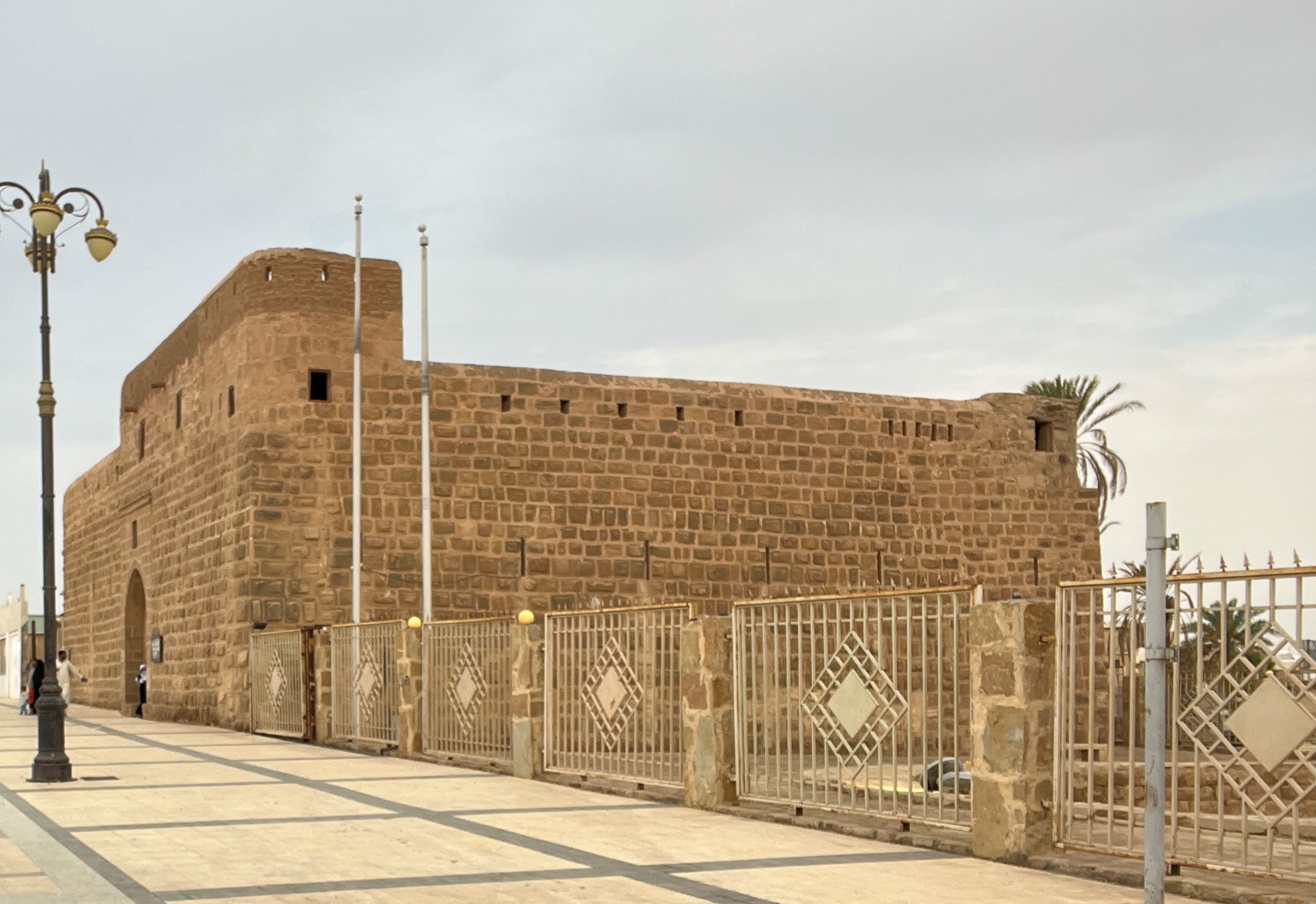
In the heart of the city, Tabuk Castle dates to 1559 and is the most significant Ottoman-era fortification in the province. The two-storey structure features a ground-floor mosque, an open courtyard, watchtowers, and a stairway leading to a second-floor prayer hall. It served as a waystation on the pilgrimage route to Mecca and as a military outpost during the Ottoman period.
Today the castle operates as a museum, with rooms displaying artefacts from the Ottoman period alongside signage about Tabuk’s connection to the Prophet Muhammad and famous travellers including Ibn Battuta and Evliya Celebi. Outside the walls, stone cisterns once captured water from a spring that, according to Islamic tradition, the Prophet himself drank from during the Expedition of Tabuk. Entry is free, and a visit takes roughly 45 minutes to an hour.
Hejaz Railway Station and Museum
Tabuk’s early twentieth-century Hejaz Railway station is one of the best-preserved along the entire route from Damascus to Medina. The complex spans 80,000 square metres and includes 13 recently refurbished buildings — among them a workshop, a handicrafts centre, and a hall housing an original locomotive, a freight car, and Ottoman-era relics.
Built in the early 1900s to transport pilgrims to Mecca, the narrow-gauge railway became a flashpoint during the Arab Revolt of 1916–1918, when T. E. Lawrence and allied forces sabotaged sections of the track. The Tabuk station is the third largest surviving station after Medina and AlUla, and it offers a vivid window into the logistical ambitions of the late Ottoman Empire. Allow one to two hours for a thorough visit.
Al-Bad’ Archaeological Site (Caves of Shuaib)
Approximately 225 kilometres west of Tabuk city, the oasis settlement of Al-Bad’ is one of the most historically resonant sites in the province. Scholars identify it with the ancient land of Midian, the place where, according to Islamic tradition, the Prophet Moses met the Prophet Shuaib (Jethro in the biblical texts) after departing Egypt.
Two kilometres south of the modern town, a cluster of rock-cut tombs known as Maghair Shuaib (the Caves of Jethro) are carved into sandstone outcrops. Modern archaeology dates these to the first century CE and attributes them to the Nabataeans, the same civilisation that built Petra and Hegra. The site also contains the Sauaidani Well, a Nabataean-era well engraved in stone and referred to in Islamic sources as the Well of Moses. A visit here pairs naturally with a drive along the coast to Haql or Sharma.
Hisma Desert
South of Tabuk, the Hisma Desert stretches across hundreds of kilometres of crimson sand and weathered sandstone pillars. Thousands of rocky formations — each with a unique shape and scale, some rising dramatically from flat plains — make this one of the most photogenic desert landscapes in the Middle East.
The Hisma was an important stop on ancient trade routes crossing the Arabian Peninsula, and its mountains are covered in Thamudic inscriptions dating back more than 2,600 years, alongside later Arab writings from before and after the emergence of Islam. Prehistoric circular stone structures, some nearly 140 metres in diameter, dot the landscape. Access is easiest by 4×4, and guided desert-camping trips can be arranged from Tabuk.
Haql Beach and the Georgios G Shipwreck
On the Gulf of Aqaba roughly 55 kilometres south of the coastal town of Haql, a rusting Greek cargo vessel sits beached on a coral reef — the Georgios G, sometimes dubbed the Titanic of Saudi Arabia. The ship ran aground decades ago and rescue efforts failed, leaving its hulking frame slowly surrendering to the sea. It has become one of the most photographed landmarks in the province.
The surrounding beach offers clear turquoise water, fine sand, and excellent snorkelling conditions, with coral formations visible from the surface. Haql itself sits at the northernmost tip of Saudi Arabia’s Red Sea coast, with views across to Egypt’s Sinai Peninsula and Jordan’s Aqaba. For a wider look at the Kingdom’s coastal destinations, see our beach guide.
Sharma Beach and the Duba Coast
Roughly 140 kilometres from Tabuk via the Duba highway, Sharma Beach is a serene stretch of white sand and crystal-clear turquoise water on the Red Sea. The shoreline is largely rock-free, making it ideal for swimming, snorkelling, and family outings. Camping on the beach is popular with Saudi visitors, and basic facilities are gradually improving as tourism investment flows into the area.
The Tabuk–Sharma Tourism Road has cut travel time to around one hour, transforming Sharma into one of the region’s most accessible coastal escapes. Beyond Sharma, the wider Duba coastline — including Al-Khuraybah, Al-Muwaileh, and Al-Sajdah — offers further beaches for diving, fishing, and picnicking. This stretch of coast also lies adjacent to the NEOM project zone, meaning significant infrastructure upgrades are underway.
NEOM: Tabuk’s Futuristic Neighbour
No guide to Tabuk is complete without acknowledging NEOM, the $500 billion giga-project taking shape on the province’s northwest coast. The planned city — encompassing The Line, Trojena (a mountain resort designed to host the 2029 Asian Winter Games), Sindalah (an island resort), and Oxagon (an industrial port) — is being built within Tabuk Province, roughly 230 kilometres or two and a half hours’ drive from Tabuk city.
While NEOM’s core zones are not yet open to general tourism, Tabuk is the logical base for exploring the surrounding region. As NEOM phases open from 2026 onwards, Tabuk’s role as a gateway city will only grow. New roads connecting Tabuk to NEOM are already complete, and a regional airport upgrade is expected to increase capacity for international arrivals. For a deep dive into what is coming, see our dedicated NEOM travel guide.
When to Visit Tabuk
Tabuk’s elevation gives it a more temperate climate than most of Saudi Arabia, but timing still matters. Here is a seasonal breakdown to help you plan.
October to March (Peak Season)
This is the ideal window. Daytime highs range from 15 to 25 degrees Celsius, nights can drop to 4 degrees Celsius or below, and the air is dry and clear — perfect for hiking, desert camping, and coastal exploration. January and February bring the coldest temperatures, and snow occasionally falls on the surrounding mountains. Pack layers and a warm jacket for evenings.
April to May and September (Shoulder Season)
Temperatures climb into the low 30s but remain manageable, particularly along the coast. Hotel prices tend to be lower and crowds thinner. This is a good compromise for travellers who want pleasant weather without peak-season demand.
June to August (Off Season)
Summers are hot — daytime highs regularly exceed 38 degrees Celsius and can top 42 degrees in July. Outdoor sightseeing becomes uncomfortable, though the coast offers some relief. Budget travellers will find the best hotel deals during this period. For a broader look at seasonal travel planning across the Kingdom, consult our best time to visit Saudi Arabia guide.
How to Get to Tabuk
By Air
Prince Sultan Bin Abdulaziz International Airport (IATA: TUU) handles domestic flights from Riyadh, Jeddah, Dammam, and Abha, plus seasonal international routes to Cairo. Saudia, flynas, and flyadeal all operate regular services. Flight time from Riyadh is approximately two hours; from Jeddah, around 90 minutes. The airport sits about three kilometres from the city centre, and taxis or ride-hailing apps (Uber and Careem both operate in Tabuk) will get you to most hotels in under ten minutes.
By Road
Tabuk is connected to the national highway network. Key driving distances include Medina (roughly 600 km, six to seven hours), Jeddah (roughly 1,100 km, ten to eleven hours), and Riyadh (roughly 1,200 km, eleven to twelve hours). The road from Tabuk to NEOM and the coast is excellent, recently widened and resurfaced. A rental car is strongly recommended for exploring the province’s spread-out attractions — Wadi Disah, Al-Bad’, Haql, and Sharma are all significant drives from the city.
By Rail
There is no passenger rail service to Tabuk at present, though future connections under Saudi Arabia’s national rail expansion plan have been discussed. For now, flying or driving remain the practical options.
Where to Stay in Tabuk
Tabuk’s hotel stock is growing rapidly, though it remains more limited than Riyadh or Jeddah. Most accommodation is concentrated in the city centre, within easy reach of the airport, the castle, and the railway museum. For broader guidance on accommodation across the Kingdom, see our Saudi Arabia hotels guide.
Luxury and Upper Midrange
Grand Millennium Tabuk — The city’s flagship five-star property, featuring indoor and outdoor pools, a full-service spa, a gym, meeting facilities, and children’s play areas. Rooms are spacious and well-appointed. Expect to pay from SAR 600 to SAR 1,000 per night depending on the season.
Hilton Garden Inn Tabuk — A reliable international chain option with modern rooms, an on-site restaurant, a fitness centre, and a pool. Rates typically fall between SAR 400 and SAR 700.
Midrange
Holiday Inn Tabuk — Centrally located with a pool, complimentary breakfast, free Wi-Fi, and 24-hour reception. A solid choice for business and leisure travellers at SAR 300 to SAR 500 per night.
Best Western Plus Tabuk City Center — Just three kilometres from the airport, this hotel offers good-value rooms with modern amenities. Rates from SAR 250.
Budget
Swiss Inn Tabuk and Ewaa Express Hotel Tabuk are popular budget options with clean rooms, basic facilities, and rates starting from around SAR 150 per night. Serviced apartments are also available across the city for longer stays, often at lower per-night rates than hotels.
Camping and Beach Stays
For a more adventurous experience, camping is permitted (and popular) at Sharma Beach, along the Duba coast, in the Hisma Desert, and in the vicinity of Wadi Disah. Basic camping supplies can be purchased in Tabuk city. Some tour operators offer fully outfitted glamping packages in the desert or on the coast — enquire locally for current offerings.
Getting Around Tabuk Province
A rental car is the single most important logistical decision you will make. Tabuk’s attractions are widely dispersed — Wadi Disah is 200 kilometres to the south, Al-Bad’ is 225 kilometres to the west, Haql is 200 kilometres to the northwest, and Sharma is 140 kilometres to the west. Public transport between these sites is essentially non-existent.
Major car-rental agencies operate at the airport and in the city centre. For Wadi Disah specifically, a 4×4 is advisable if you want to drive into the canyon rather than just hike from the trailhead. Roads to all other major attractions are paved and in good condition. Fuel stations are spaced at reasonable intervals along main highways.
Within Tabuk city itself, Uber and Careem are available and affordable. Taxis can also be flagged down or booked through hotels.
Food and Dining
Tabuk’s dining scene reflects both its Saudi heritage and its growing cosmopolitan character. Traditional restaurants serve generous portions of kabsa (fragrant spiced rice with slow-cooked lamb or chicken), mandi (tender meat prepared tandoor-style over basmati rice), saleeg (a creamy, milk-cooked rice dish often compared to risotto), and jareesh (cracked wheat simmered with meat and spices into a thick, savoury porridge).
Al-Qaryah Al-Turathiyah is a standout for authentic Saudi cuisine — the restaurant is designed to resemble a traditional village home and serves kabsa, mandi, jareesh, and margoog (a lamb and vegetable stew with thin bread). For international flavours, Western Road Steak and Grill is well-regarded, and Syed Al Biryani serves excellent Indian kebabs and biryani.
Do not leave Tabuk without trying local dates — the region produces several prized varieties — and kunafa, a sweet pastry of shredded dough layered with cheese or nuts and drenched in sugar syrup. Coffee culture is strong; look for speciality cafes serving Saudi Arabic coffee (qahwa) alongside lighter roasts.
Suggested Itineraries
Three Days: City and Canyon
Day 1: Arrive in Tabuk. Visit Tabuk Castle and the Hejaz Railway Museum in the morning. Explore the old souk in the afternoon. Dinner at Al-Qaryah Al-Turathiyah.
Day 2: Full-day trip to Wadi Disah. Depart early (allow two to three hours for the drive). Hike through the canyon, photograph the sandstone cliffs and palm groves, and picnic in the valley. Return to Tabuk in the evening.
Day 3: Drive to Sharma Beach (roughly 90 minutes via the tourism road). Swim, snorkel, and relax on the coast. Return via the scenic Duba highway. Depart Tabuk in the evening or stay for dinner.
Five Days: The Complete Northwest
Days 1–3: Follow the three-day itinerary above.
Day 4: Drive to Al-Bad’ to explore the Caves of Shuaib and the archaeological sites. Continue north to Haql to see the Georgios G shipwreck and swim on the Gulf of Aqaba coast. Overnight in Haql or return to Tabuk.
Day 5: Explore the Hisma Desert south of Tabuk — sandstone formations, ancient inscriptions, and wide-open landscapes. Alternatively, drive toward the NEOM border area for a glimpse of the construction activity transforming the coastline. Depart Tabuk in the afternoon.
One Week: Tabuk and Beyond
With a full week, combine the five-day Tabuk itinerary with a two-day extension south to AlUla (roughly four hours’ drive), home to the UNESCO-listed Hegra (Mada’in Saleh) and Saudi Arabia’s most developed heritage tourism infrastructure. The drive from Tabuk to AlUla via the Hisma Desert is spectacular in its own right.
Practical Tips
- Visa: Tourists from 49 countries can obtain a Saudi e-visa online before arrival. The visa costs approximately SAR 480 (around $128) and is valid for one year with multiple entries of up to 90 days each.
- Currency: The Saudi Riyal (SAR) is the local currency. One US dollar buys approximately 3.75 SAR. Credit cards are widely accepted in hotels, restaurants, and petrol stations, but carry cash for smaller shops, desert vendors, and camping-supply purchases.
- Dress code: Saudi Arabia has relaxed its dress requirements for tourists, but modest clothing remains expected — shoulders and knees should be covered in public, particularly at heritage and religious sites. Women are no longer required to wear an abaya but should dress conservatively.
- Language: Arabic is the official language. English is spoken at hotels, airports, and tourist-facing businesses but is less common in rural areas. Download offline Arabic translation on your phone before heading to remote sites.
- Connectivity: STC, Mobily, and Zain all offer prepaid SIM cards with data packages at the airport. 4G coverage is reliable in Tabuk city and along major highways but can be patchy in deep canyons and remote desert areas.
- Health and safety: Tabuk is very safe for tourists. Tap water is generally not recommended for drinking — bottled water is inexpensive and available everywhere. Sun protection is essential even in winter, and hikers should carry ample water. The nearest major hospital is King Fahad Specialist Hospital in Tabuk city.
- Driving tips: Saudi Arabia drives on the right. An international driving permit is recommended alongside your national licence. Speed limits are enforced by camera. Do not drive off-road without a 4×4 and, ideally, with at least one other vehicle in convoy.
- Respect for nature: Many of Tabuk’s attractions are unprotected natural sites. Carry out all rubbish, do not disturb archaeological features, and avoid driving off established tracks in the Hisma Desert and Wadi Disah.
- Wadi Disah: 200 km south (full day, 9–12 hours round trip including hiking time)
- Sharma Beach: 140 km west (half day or full day)
- Al-Bad’ and the Caves of Shuaib: 225 km west (full day, combine with coastal stop)
- Haql and the Georgios G shipwreck: 200 km northwest (full day)
- Hisma Desert: 50–150 km south (half day or full day depending on depth of exploration)
- NEOM border area: 230 km northwest (full day — note that NEOM’s core construction zones may have restricted access)
Day Trips From Tabuk
Tabuk’s central position in the northwest makes it an excellent base for day trips across the province.
For travellers with more time, the drive south to AlUla (approximately 400 km, four hours) opens up Saudi Arabia’s premier heritage destination, and a multi-day road trip linking Tabuk, AlUla, and Medina is one of the finest driving routes in the Kingdom.
The Future of Tabuk Tourism
Tabuk Province is at the centre of Saudi Arabia’s most ambitious tourism investments. NEOM alone is expected to generate tens of thousands of hotel rooms and attract millions of visitors annually once operational. The Red Sea destination, further south along the coast, will add another 3,000 rooms across eight resorts in its first phase.
For travellers visiting now, the appeal is the chance to experience the region in its raw, uncrowded state — before the mega-resorts and managed tourism experiences arrive in full force. The canyons, the coastline, the desert, and the archaeological sites are already world-class. The infrastructure to support comfortable travel is improving month by month. Tabuk is, quite simply, one of the most exciting emerging destinations in the Middle East.
Return to the Saudi Arabia Travel Hub for more destination guides across the Kingdom.
If you are heading south along the Red Sea coast, Yanbu offers world-class diving and a charming old town — a natural continuation of a northwest Saudi road trip.
Tabuk Province is one of the most photogenic regions in the Kingdom — see our photography guide for the best spots. If you are continuing south, AlUla is a four-hour drive and one of Saudi Arabia’s most spectacular destinations.